
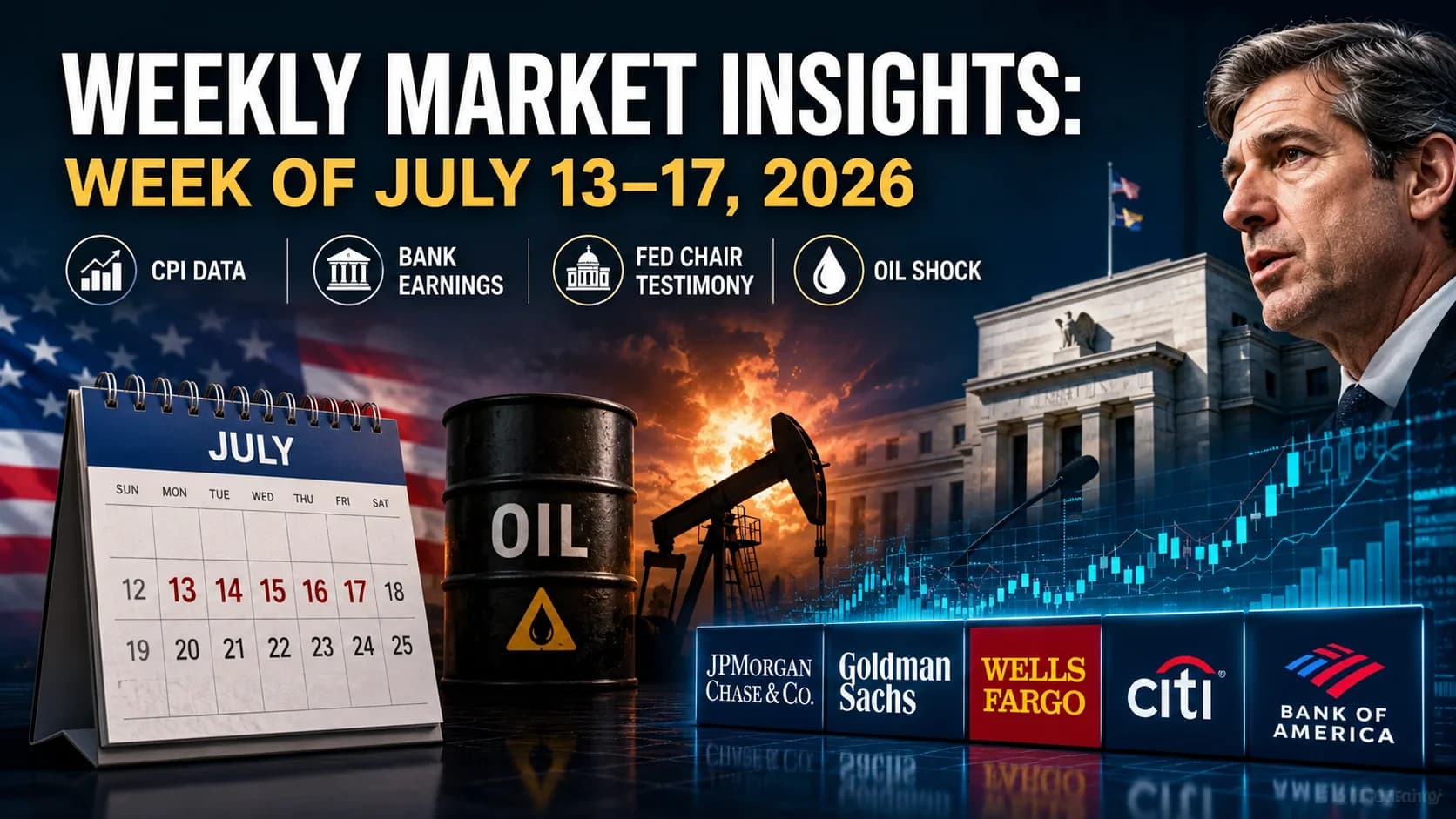
Iran and the US spent the weekend trading strikes over the Strait of Hormuz. Oil jumped roughly 4% by Monday's open. And the single most stacked trading session of the quarter lands the very next morning. Tuesday brings June CPIThe Consumer Price Index (CPI) is a monthly U.S. government report measuring the average change in prices paid by consumers for goods and services — it's the most closely watched inflation indicator in the market.Read definition →, five megabank EarningsAn earnings report is the quarterly financial disclosure a public company files with the SEC, revealing revenue, earnings per share (EPS), profit margins, and forward guidance — it's the most significant regular catalyst for individual stocRead definition → before the bell, and new Fed Chair Kevin Warsh's first-ever congressional testimony, all inside about ninety minutes of each other. That kind of pileup doesn't happen by accident, and it isn't going to resolve cleanly either. Economists expect Tuesday's CPI to show inflation cooling to somewhere in the high-3% RangeA range (or trading range) is a price zone where a stock oscillates between a defined support floor and resistance ceiling without making meaningful new highs or lows — price is consolidating rather than trending, and the dominant trade is Read definition →, down from May's 4.2%. Here's the part most coverage will skip: that number is built from June's prices, back when oil was still falling under the old ceasefire. By the time it prints, the oil market has already moved on to a different reality. This week is our map of that whole collision, plus everything else worth knowing before Monday's open.
The Week at a Glance
Times are Eastern. Bolded rows are the genuine market-movers.
- Day
- Monday, Jul 13
- Time (ET)
- 2:00 PM
- Event
- Federal Budget (June)
- Why It Matters
- Low-impact; expect the tape to spend the session positioning for Tuesday rather than reacting to anything on today's calendar
- Day
- Tuesday, Jul 14
- Time (ET)
- 8:30 AM
- Event
- June CPI (headline + core)
- Why It Matters
- Expected to cool from May's 4.2%, but built on pre-escalation oil prices. See The Big Question below
- Day
- Tuesday, Jul 14
- Time (ET)
- Before Open
- Event
- JPMorgan, Goldman Sachs, Wells Fargo, Citigroup, Bank of America earnings
- Why It Matters
- Kicks off Q2 bank earnings season; options market pricing 4.4%–6.0% one-day moves
- Day
- Tuesday, Jul 14
- Time (ET)
- 10:00 AM
- Event
- Fed Chair Warsh's first House Financial Services testimony
- Why It Matters
- His first on-record comments since June's hawkish minutes, delivered the same morning oil is repricing
- Day
- Wednesday, Jul 15
- Time (ET)
- 8:30 AM
- Event
- June PPI
- Why It Matters
- The producer-side follow-up to Tuesday's consumer print
- Day
- Wednesday, Jul 15
- Time (ET)
- 10:00 AM
- Event
- Warsh's Senate Banking testimony (day two)
- Why It Matters
- A second, differently-angled chance to parse his inflation posture
- Day
- Wednesday, Jul 15
- Time (ET)
- Before Open
- Event
- BlackRock, Morgan Stanley, Johnson & Johnson earnings
- Why It Matters
- Extends the bank-earnings read into asset management and healthcare
- Day
- Thursday, Jul 16
- Time (ET)
- 8:30 AM
- Event
- Jobless claims, June Retail Sales, Philly Fed Index
- Why It Matters
- The clearest read yet on consumer spending and labor health this month
- Day
- Thursday, Jul 16
- Time (ET)
- After Close
- Event
- Netflix earnings
- Why It Matters
- The first mega-cap tech print of the season, a preview of what's coming late July
- Day
- Friday, Jul 17
- Time (ET)
- 10:00 AM
- Event
- Michigan Consumer Sentiment (preliminary)
- Why It Matters
- Closes the week; housing starts, building permits, and industrial production also land Friday morning
| Day | Time (ET) | Event | Why It Matters |
|---|---|---|---|
| Monday, Jul 13 | 2:00 PM | Federal Budget (June) | Low-impact; expect the tape to spend the session positioning for Tuesday rather than reacting to anything on today's calendar |
| Tuesday, Jul 14 | 8:30 AM | June CPI (headline + core) | Expected to cool from May's 4.2%, but built on pre-escalation oil prices. See The Big Question below |
| Tuesday, Jul 14 | Before Open | JPMorgan, Goldman Sachs, Wells Fargo, Citigroup, Bank of America earnings | Kicks off Q2 bank earnings season; options market pricing 4.4%–6.0% one-day moves |
| Tuesday, Jul 14 | 10:00 AM | Fed Chair Warsh's first House Financial Services testimony | His first on-record comments since June's hawkish minutes, delivered the same morning oil is repricing |
| Wednesday, Jul 15 | 8:30 AM | June PPI | The producer-side follow-up to Tuesday's consumer print |
| Wednesday, Jul 15 | 10:00 AM | Warsh's Senate Banking testimony (day two) | A second, differently-angled chance to parse his inflation posture |
| Wednesday, Jul 15 | Before Open | BlackRock, Morgan Stanley, Johnson & Johnson earnings | Extends the bank-earnings read into asset management and healthcare |
| Thursday, Jul 16 | 8:30 AM | Jobless claims, June Retail Sales, Philly Fed Index | The clearest read yet on consumer spending and labor health this month |
| Thursday, Jul 16 | After Close | Netflix earnings | The first mega-cap tech print of the season, a preview of what's coming late July |
| Friday, Jul 17 | 10:00 AM | Michigan Consumer Sentiment (preliminary) | Closes the week; housing starts, building permits, and industrial production also land Friday morning |
The bottom line on the calendar: Tuesday is doing the work of three normal weeks in one morning. Everything else, PPI, retail sales, sentiment, matters in a typical week. This week, it's the undercard.
Earnings This Week
Only the names that move the broader tape, not a full list.
- Company
- JPMorgan Chase
- Ticker
- JPM
- Date
- Tue Jul 14
- When
- Before Open
- Est. EPS
- ~$5.62
- Est. Revenue
- ~$49.5B
- Implied Move
- ±4.4%
- Company
- Goldman Sachs
- Ticker
- GS
- Date
- Tue Jul 14
- When
- Before Open
- Est. EPS
- ~$14.47
- Est. Revenue
- ~$16.0B
- Implied Move
- ±6.0%
- Company
- Wells Fargo
- Ticker
- WFC
- Date
- Tue Jul 14
- When
- Before Open
- Est. EPS
- ~$1.72
- Est. Revenue
- ~$21.8B
- Implied Move
- ±5.5%
- Company
- Citigroup
- Ticker
- C
- Date
- Tue Jul 14
- When
- Before Open
- Est. EPS
- —
- Est. Revenue
- ~$30.5B
- Implied Move
- ±5.5%
- Company
- Bank of America
- Ticker
- BAC
- Date
- Tue Jul 14
- When
- Before Open
- Est. EPS
- ~$1.13
- Est. Revenue
- ~$30.7B
- Implied Move
- ±4.5%
- Company
- Morgan Stanley
- Ticker
- MS
- Date
- Wed Jul 15
- When
- Before Open
- Est. EPS
- —
- Est. Revenue
- —
- Implied Move
- —
- Company
- Netflix
- Ticker
- NFLX
- Date
- Thu Jul 16
- When
- After Close
- Est. EPS
- —
- Est. Revenue
- —
- Implied Move
- —
| Company | Ticker | Date | When | Est. EPS | Est. Revenue | Implied Move |
|---|---|---|---|---|---|---|
| JPMorgan Chase | JPM | Tue Jul 14 | Before Open | ~$5.62 | ~$49.5B | ±4.4% |
| Goldman Sachs | GS | Tue Jul 14 | Before Open | ~$14.47 | ~$16.0B | ±6.0% |
| Wells Fargo | WFC | Tue Jul 14 | Before Open | ~$1.72 | ~$21.8B | ±5.5% |
| Citigroup | C | Tue Jul 14 | Before Open | — | ~$30.5B | ±5.5% |
| Bank of America | BAC | Tue Jul 14 | Before Open | ~$1.13 | ~$30.7B | ±4.5% |
| Morgan Stanley | MS | Wed Jul 15 | Before Open | — | — | — |
| Netflix | NFLX | Thu Jul 16 | After Close | — | — | — |
A note on the blanks: where a reliable consensus figure wasn't confirmed across sources, we left the cell empty rather than guess. Implied moves are sourced from options pricing as of the weekend; verify before the session, since a fast-moving oil market can reprice them by Tuesday morning.
Stocks to Watch This Week
Eight names carrying a real CatalystA catalyst is the specific event or news item that triggers unusual price movement in a stock — earnings reports, FDA decisions, analyst upgrades, acquisition announcements, product launches, and short squeeze setups are all catalysts. WithRead definition → this week. This is what we're watching and why, never a recommendation, and there are no price levels here because this publishes Monday and Thursday's prices don't exist yet. In a week with this many moving pieces, a real-time scanner like Trade Ideas is genuinely useful for tracking which of these names is actually in play hour to hour, rather than relying on a static list written before Monday's open.
JPM, GS, WFC, C, BAC — The Bank Earnings Block
📅 Catalyst: All five report before Tuesday's open, the official kickoff of Q2 earnings season.
🔍 Why it's on the radar: Net interest MarginMargin is borrowed capital from your broker that lets you control a larger position than your cash balance would otherwise allow — a $25,000 account with 4:1 intraday margin can control up to $100,000 in positions, amplifying both profits aRead definition → and credit-quality commentary matter more than the headline beat-or-miss here. Consensus already expects EPS beats across the group; the real question is what management says about loan demand, deposit costs, and the economic outlook.
📊 What the options market is pricing: Implied one-day moves from 4.4% (JPMorgan) to 6.0% (Goldman Sachs), among the largest single-day moves this earnings season is expected to produce.
👁️ What to watch: Any commentary tying oil-driven cost pressure, Middle East exposure, or the CPI print to full-year guidance. That's the connective tissue between Tuesday's macro and micro stories.
🌐 Broader tape read: Banks reporting well and sounding confident on credit quality is historically a reassuring signal for the broader economy heading into a heavier earnings season.
META — Meta Platforms
📅 Catalyst: Continuing fallout from the AI cost-structure story that drove its best week since 2024.
🔍 Why it's on the radar: Last week's Bank of America note on Meta's capacity economics, plus the custom AI chip and Muse Spark model news, kept the stock at the center of the AI-infrastructure debate. It's still the name that moves the neocloud complex.
👁️ What to watch: Any further detail on the "Meta Compute" cloud-reselling plan, which is what triggered the whole re-pricing three weeks ago.
🌐 Broader tape read: As Meta's cost story goes, so goes sentiment on whether AI infrastructure spending is paying for itself.
NVDA — Nvidia
📅 Catalyst: A fresh, if capped, demand signal out of China: reports surfaced July 8 that Beijing may let Alibaba, ByteDance, and DeepSeek buy a limited allotment of Nvidia's H200 chips.
🔍 Why it's on the radar: The reported cap is well below what Chinese firms requested, and the chips would reportedly be restricted to AI training rather than day-to-day inference use. Modest as it is, it's a real data point in the ongoing China-access saga that's shadowed the stock all year.
👁️ What to watch: Whether Chinese regulators formally confirm anything, and how the broader semiconductor group trades around the bank-earnings and CPI catalysts.
🌐 Broader tape read: Nvidia remains the cleanest single read on whether the market is still willing to pay up for the AI buildout heading into a heavier earnings season.
MU, SNDK, SK Hynix (SKHYV) — The Memory Complex
📅 Catalyst: SK Hynix's blockbuster $26.5 billion Nasdaq debut Friday (a 13% pop) gave way to profit-taking Monday, with the ADR down sharply and the sell-off spilling into Micron and SanDisk.
🔍 Why it's on the radar: Micron officially entered a bear market last week before bouncing Thursday on news of an expanded $250 billion US investment commitment, then falling again pre-market Monday. This is a genuinely two-sided tape inside one of the year's strongest AI-adjacent trades.
👁️ What to watch: Whether dip buyers show up again this week or whether the SK Hynix debut turns out to have marked a near-term top for the memory trade.
🌐 Broader tape read: Memory has been the clearest expression of the AI-infrastructure story all year (Micron and SanDisk are both up well over 200% in 2026). How this group trades says a lot about risk appetite for the whole AI complex.
NBIS — Nebius Group (with CoreWeave as the read-across)
📅 Catalyst: Continuing fallout from Meta's cloud-reselling plans, which knocked both neocloud names down sharply three weeks ago.
🔍 Why it's on the radar: Nebius has stabilized well off its June peak rather than fully recovering, with retail sentiment split on whether that's a floor or a pause. No fresh clarification from Meta has arrived yet.
👁️ What to watch: Whether the stabilization holds through this week's macro-heavy calendar, or whether renewed AI-valuation jitters (from a hot CPI print, say) drag it back down.
🌐 Broader tape read: A secondary but useful gauge of whether investors are still willing to pay for AI-infrastructure growth stories with real customer-concentration risk attached.
TSLA — Tesla
📅 Catalyst: No earnings this week, but a plausible destination for capital rotating out of SpaceX.
🔍 Why it's on the radar: SpaceX's Nasdaq-100 inclusion mechanical bid did not hold. The stock is now down roughly 35% from its post-IPO peak, closing multiple sessions below its own IPO price, a pattern that echoes Palantir's post-inclusion stretch in late 2024. Some money that chased the SpaceX listing may look for a new, more liquid home.
👁️ What to watch: Relative volume and flow data on Tesla versus the broader "recent IPO" basket this week.
🌐 Broader tape read: A window into whether retail enthusiasm for 2026's mega-IPOs is fading or just rotating.
HOOD — Robinhood
📅 Catalyst: No single scheduled event, but continued relative strength tied to crypto stability and retail trading activity.
🔍 Why it's on the radar: Robinhood has been one of the more resilient names through a choppy few weeks, a useful proxy for whether retail risk appetite holds up against this week's macro noise.
👁️ What to watch: Whether retail flows stay engaged through Tuesday's data pileup or pull back defensively.
🌐 Broader tape read: A sentiment gauge for the more speculative, retail-driven corner of the market.
XLE — Energy Sector
📅 Catalyst: The direct read on the Hormuz escalation, with oil up roughly 4% as of Monday's open.
🔍 Why it's on the radar: This is the sector most mechanically tied to this week's central geopolitical story, and the one most likely to move on any headline out of the Strait of Hormuz, in either direction.
👁️ What to watch: Whether shipping traffic through Hormuz (reported at single digits per day versus a normal 30-40) continues to thin, or whether the diplomatic efforts reported over the weekend produce a de-escalation.
🌐 Broader tape read: Energy is the one sector where this week's geopolitical and inflation stories are literally the same story.
Sectors to Watch This Week
- Sector
- Financials
- ETF / Names
- XLF / JPM, GS, WFC, C, BAC
- Direction
- In play
- Catalyst This Week
- Bank earnings kick off Tuesday
- What to Watch
- NIM trajectory and credit commentary, not the EPS beat
- Sector
- Energy
- ETF / Names
- XLE
- Direction
- Two-sided
- Catalyst This Week
- Hormuz strikes, oil up ~4%
- What to Watch
- Whether the strait crisis de-escalates or the traffic slowdown deepens
- Sector
- Semiconductors / Memory
- ETF / Names
- SMH, SOXX, MU, SNDK
- Direction
- In play
- Catalyst This Week
- SK Hynix debut and profit-taking spillover
- What to Watch
- Whether dip buyers return or the memory trade cools further
- Sector
- AI Infrastructure
- ETF / Names
- META, NBIS, CRWV
- Direction
- Watching
- Catalyst This Week
- Continuing fallout from Meta's cloud plans
- What to Watch
- Whether neocloud stabilization holds through a volatile macro week
- Sector
- Small Caps
- ETF / Names
- IWM
- Direction
- Watching
- Catalyst This Week
- Most sensitive to the CPI and Warsh-testimony combination
- What to Watch
- A fast real-time read on how the market is digesting the inflation debate
- Sector
- Semiconductor Equipment & Secondary AI Chips
- ETF / Names
- TER, LRCX, KLAC, AVGO, MRVL, ARM
- Direction
- Watching
- Catalyst This Week
- No standalone catalyst, riding the broader semis tape
- What to Watch
- Whether the group confirms or lags the memory-driven moves above
| Sector | ETF / Names | Direction | Catalyst This Week | What to Watch |
|---|---|---|---|---|
| Financials | XLF / JPM, GS, WFC, C, BAC | In play | Bank earnings kick off Tuesday | NIM trajectory and credit commentary, not the EPS beat |
| Energy | XLE | Two-sided | Hormuz strikes, oil up ~4% | Whether the strait crisis de-escalates or the traffic slowdown deepens |
| Semiconductors / Memory | SMH, SOXX, MU, SNDK | In play | SK Hynix debut and profit-taking spillover | Whether dip buyers return or the memory trade cools further |
| AI Infrastructure | META, NBIS, CRWV | Watching | Continuing fallout from Meta's cloud plans | Whether neocloud stabilization holds through a volatile macro week |
| Small Caps | IWM | Watching | Most sensitive to the CPI and Warsh-testimony combination | A fast real-time read on how the market is digesting the inflation debate |
| Semiconductor Equipment & Secondary AI Chips | TER, LRCX, KLAC, AVGO, MRVL, ARM | Watching | No standalone catalyst, riding the broader semis tape | Whether the group confirms or lags the memory-driven moves above |
Market Snapshot
- Indicator
- S&P 500
- Level
- 7,575.39 (Fri close)
- Move
- +1%+ for the week
- Indicator
- Nasdaq Composite
- Level
- 26,281.61 (Fri close)
- Move
- +1%+ for the week
- Indicator
- Dow Jones
- Level
- 52,637.01 (Fri close)
- Move
- −0.5% for the week
- Indicator
- S&P 500 futures (Mon AM)
- Level
- —
- Move
- −0.3% to −0.5%
- Indicator
- Nasdaq 100 futures (Mon AM)
- Level
- —
- Move
- −0.8% to −1.2%
- Indicator
- VIX
- Level
- 15.03 (Fri close)
- Move
- Likely higher at Monday's open
- Indicator
- WTI Crude
- Level
- ~$73–74
- Move
- +4% on the Hormuz escalation
- Indicator
- Gold
- Level
- ~$4,065–4,070
- Move
- Falling despite the geopolitical shock
- Indicator
- 10-Year Yield
- Level
- ~4.59%
- Move
- Near seven-week highs
- Indicator
- Fear & Greed Index
- Level
- 49 (Neutral)
- Move
- Up from 32 (Fear) two weeks ago
| Indicator | Level | Move |
|---|---|---|
| S&P 500 | 7,575.39 (Fri close) | +1%+ for the week |
| Nasdaq Composite | 26,281.61 (Fri close) | +1%+ for the week |
| Dow Jones | 52,637.01 (Fri close) | −0.5% for the week |
| S&P 500 futures (Mon AM) | — | −0.3% to −0.5% |
| Nasdaq 100 futures (Mon AM) | — | −0.8% to −1.2% |
| VIX | 15.03 (Fri close) | Likely higher at Monday's open |
| WTI Crude | ~$73–74 | +4% on the Hormuz escalation |
| Gold | ~$4,065–4,070 | Falling despite the geopolitical shock |
| 10-Year Yield | ~4.59% | Near seven-week highs |
| Fear & Greed Index | 49 (Neutral) | Up from 32 (Fear) two weeks ago |
Regime: a market that spent last week rebuilding confidence, walking into a weekend that just tested it. Every major index finished last week higher (except the Dow, which lagged on the rotation out of mega-cap tech), and the Fear & Greed Index climbed all the way back to neutral. Then Iran and the US traded strikes over the weekend, and futures are pointing lower Monday morning. Our read: this isn't a market in crisis, it's a market that has to decide, in real time, how much weight to put on a geopolitical shock versus a genuinely heavy week of earnings and data. The fact that gold is falling even as oil spikes tells you something important: the market is currently treating this more as an inflation story (bad for gold, given hawkish Fed implications) than a pure fear story (which would normally lift gold too). That's a real and important divergence worth tracking through the week. For a framework on trading a market that's genuinely split on regime, our guide on identifying the market regime is a good place to start.
The Big Question: Why Tuesday's Cooling CPI Might Not Be the Real Story
Every economic calendar on the internet will tell you Tuesday's CPI is expected to show inflation cooling, from May's 4.2% down to somewhere in the high-3% range. Barclays put a specific number on it: 3.8% headline, with core actually accelerating slightly to around 0.26% month-over-month on stickier services costs. The Cleveland Fed's nowcast model, for what it's worth, is running a touch hotter at closer to 4.0%. Either way, the mainstream framing is simple: inflation is still cooling from its spring peak, largely because oil prices fell hard after the mid-June ceasefire.
Here's the problem with that framing. June's CPI measures June's prices. And for most of June, oil really was falling, on the back of the ceasefire signed June 17. But that world doesn't exist anymore. Over the weekend, the interim ceasefire collapsed entirely: Iran struck commercial vessels in the Strait of Hormuz, the US responded with strikes on roughly 140 targets Saturday and more Sunday, and Iran retaliated against US-allied bases in Kuwait, Jordan, Bahrain, and Qatar. Oil is up around 4% as of Monday morning, and actual shipping traffic through Hormuz has reportedly slowed to single digits per day, down from 30 to 40 tankers in a normal week. Whatever Tuesday's CPI print says about June, it's already a rearview mirror on an energy backdrop that changed dramatically after the data window closed.
This matters practically, not just academically, for one specific reason: energy costs feed into headline CPI with a lag. Retail gasoline prices take days to weeks to catch up to wholesale crude moves, which means this weekend's oil shock is a story for the July CPI report, due in mid-August, not the one printing Tuesday. If Tuesday's number comes in cool, as forecast, the market has a real decision to make. Does it trade the print at face value, as evidence the Fed's hawkish June tilt was overdone, and rally? Or does it look past the number to the fresher, less comfortable signal sitting in the oil market right now? We think the more interesting outcome isn't whether CPI beats or misses consensus. It's whether the market rallies on a technically accurate but already-outdated data point, only to have to unwind some of that reaction later in the week as the oil story keeps developing.
Layer in Fed Chair Warsh's testimony, scheduled for 10 AM, ninety minutes after the CPI release and on the same morning as five bank earnings. Warsh has been unusually tight-lipped since taking the chair, removing traditional forward guidance and letting June's hawkish minutes speak for themselves: nine of eighteen officials projecting at least one more 2026 rate hike, the dot plot median moving from two expected cuts in March to one hike now. His testimony is his first extended, on-record opportunity to react to developments since that meeting, including a weekend oil shock that hadn't happened when the minutes were drafted. If he acknowledges the new geopolitical inflation risk directly, that's a meaningfully more hawkish signal than the market may be pricing this morning. If he sticks to a purely data-dependent, wait-and-see posture (plausible, given his stated preference for saying less rather than more), markets may read that as an opening to keep betting on the cooling-CPI narrative regardless of what oil is doing.
Then there's the banks. Five megabanks reporting the same morning gives the market a real-economy check on top of the macro data: are commercial clients flagging Middle East-linked cost pressure, is loan demand holding up, is net interest margin still expanding. A hawkish Warsh plus a hot or ambiguous CPI plus cautious bank commentary on the economic outlook is a very different Tuesday than a cool CPI, a measured Warsh, and confident banks.
Our honest read: we lean toward this week producing more volatility than direction, precisely because there are four separate catalysts capable of pulling the tape in different ways within the same three-hour window, and because the most important number of the morning (CPI) may turn out to matter less than what it's already missing. What we're watching for the actual verdict: whether oil keeps climbing through the week (a sign the market believes this is a durable supply shock, not a weekend flare-up), and whether bank management teams mention the Hormuz situation unprompted on their calls. If they do, that's the market's real-time answer to a question the CPI print can't yet give.
The Teaching Moment: How an Options-Implied Move Actually Works
You'll see "implied move" attached to every one of Tuesday's bank earnings, and it's worth understanding exactly what that number is, because it isn't a forecast. Options prices already contain the market's collective bet on how much a stock will move by a certain date. An implied move is derived from the price of an at-the-money straddle, buying both a call and a put at the same strike, expiring right after the event. Add up what both options cost, divide by the stock price, and you get a percentage: that's the market's break-even estimate for how far the stock needs to move, in either direction, for someone buying that straddle to profit.
Take Goldman Sachs, priced Monday with roughly a 6.0% implied move ahead of Tuesday's report. That doesn't mean anyone expects Goldman to move exactly 6.0%. It means options buyers are collectively pricing in enough uncertainty that a 6.0% swing, up or down, would be the rough break-even point for a straddle bought today. If Goldman moves 3%, the straddle likely loses money even on a correct directional call, because the move wasn't large enough to cover what was paid for both sides of the bet. If it moves 9%, in either direction, the straddle profits significantly.
This is genuinely useful information for a week like this one, because it lets you compare relative uncertainty across five earnings reports happening at the same moment. JPMorgan's 4.4% implied move versus Goldman's 6.0% tells you the market sees meaningfully more binary risk in Goldman's quarter, likely tied to its heavier reliance on trading and investment-banking revenue, which swings harder than JPMorgan's more diversified retail-and-commercial mix. None of this tells you which direction any stock will move. It only tells you how much uncertainty is priced in, which is a very different and, frankly, more honest question than trying to guess a direction ahead of a report. Understanding this distinction is one of the more useful, durable skills a trader can build, and it applies just as well to reading uncertainty around CPI reactions or Fed testimony as it does to earnings.
Mindset for the Week
Four separate catalysts landing inside one three-hour window on Tuesday is a genuine test of discipline, not because any one of them is unusually dangerous on its own, but because the temptation to trade all of them at once is enormous. CPI reaction, bank earnings reaction, Warsh-testimony reaction, and an ongoing oil story all fighting for attention in the same ninety minutes is exactly the kind of setup that turns a disciplined trader into an overtrader by 11 AM.
The move that actually protects your account this week is deciding, before Tuesday's open, which single catalyst you're actually equipped to trade, and treating the other three as context rather than opportunities. If your edge is in bank earnings, trade the bank earnings and let the CPI print be background noise you're aware of, not something you're also trying to react to in real time. If you don't have a specific edge in any of Tuesday's four events, there's real value in simply watching this one play out and looking for cleaner setups once the dust settles Wednesday or Thursday. Sitting out an unusually crowded session isn't a lesser choice; it's frequently the correct one.
Your Week Ahead Checklist
- Mark Tuesday 8:30 AM to 10:00 AM ET as the highest-risk window of the week: CPI, five bank earnings, and Warsh's testimony all land inside it
- Decide now which single Tuesday catalyst you're actually equipped to trade, and treat the rest as context
- Keep oil and Hormuz shipping-traffic headlines on your radar all week; this story is still developing in real time
- Note that gold is falling even as oil spikes, a genuine divergence worth watching for a shift back toward safe-haven demand
- Watch the memory complex (Micron, SanDisk, SK Hynix) for whether dip buyers return after Monday's profit-taking
- Bookmark the earnings calendar: five banks Tuesday before the open, BlackRock and Morgan Stanley Wednesday, Netflix Thursday after the close
- Review your position exposure ahead of Tuesday's open if you're carrying anything in financials, energy, or AI-infrastructure names
- Run a clean pre-market routine Tuesday specifically; this is not a week to be improvising at 8:29 AM
Frequently Asked Questions
What is the June CPI report and why does it matter this week?
The report measures price changes across a broad basket of consumer goods and services in June, a month when oil prices were still falling under the earlier ceasefire. That's precisely what makes this release unusual: the data reflects an energy backdrop that changed dramatically over the weekend, after the reporting window had already closed. Our CPI-report playbook covers how releases like this tend to move markets more broadly.
Key Takeaway: Watch how the market reacts to the number itself versus how it reacts once traders start weighing it against the fresher oil-shock reality.
Why are five major banks reporting earnings on the same day?
This concentration creates outsized single-day volatility potential across the financial sector, and this year it happens to land on the same morning as the CPI report and Fed Chair Warsh's testimony. Our earnings-report playbook walks through how to approach a concentrated earnings morning without overreacting to the first headline.
Key Takeaway: The clustering is a scheduling convention, not a coordinated signal, but it does mean Tuesday carries unusually concentrated risk across the financial sector.
What happened with Iran and the Strait of Hormuz this weekend?
Shipping traffic through the strait, which normally sees 30 to 40 vessels a day, reportedly slowed to single digits over the weekend. Iran's state media claimed the strait was closed; US Central Command disputed that, saying traffic continues to flow. Diplomatic efforts involving Pakistan and Qatar were reported to be ongoing as of Monday morning. Our geopolitical-events playbook covers how to approach trading around a still-developing conflict like this one.
Key Takeaway: This is a live, unresolved situation, and oil prices are likely to stay sensitive to every headline out of the region this week.
Why is gold falling even though oil is spiking on geopolitical risk?
Higher oil raises the odds the Fed stays hawkish for longer, which lifts real yields and the dollar, both headwinds for a non-yielding asset like gold. That's a genuine divergence from the more typical playbook, where geopolitical shocks lift gold and oil together.
Key Takeaway: When gold and oil diverge like this, it's usually a sign the market is treating the shock as an inflation story more than a pure fear story.
Who is Fed Chair Kevin Warsh and what is he expected to say in his testimony?
Warsh has deliberately pulled back on forward guidance, preferring to let the committee's collective statements speak rather than offering his own personal rate-path commentary. That makes this week's testimony unusually significant: it's one of the only chances markets will get to hear him react, on the record, to both the CPI print and the weekend's oil-market developments before the July 28-29 FOMC meeting. Our FOMC and Fed-announcement playbook covers how markets tend to trade Fed communication more broadly.
Key Takeaway: Listen for whether he acknowledges the fresh oil shock directly or sticks to a purely data-dependent posture; the difference matters for how markets price the next several weeks.
What does an implied move in bank earnings actually mean?
It isn't a directional forecast. A 6.0% implied move for Goldman Sachs means the market has priced in enough uncertainty that a swing of roughly that size would be the break-even point for someone who bought a straddle ahead of earnings. Our Teaching Moment section above walks through the mechanics in more detail.
Key Takeaway: Implied move tells you how much uncertainty is priced in, not which direction the stock is likely to go.
Why did SK Hynix's stock fall after such a strong Nasdaq debut?
The pullback spread into other memory names, including Micron and SanDisk, both of which are up substantially in 2026 on the same AI-memory demand story. Analysts described the move as prudent profit-taking after a steep run rather than a loss of confidence in underlying AI-memory demand.
Key Takeaway: A strong debut followed by a sharp pullback is a common pattern for high-demand IPOs, and it doesn't necessarily signal a change in the underlying growth story.
Is the AI-trade rotation from last month still playing out?
The through-line stays the same: money continues to rotate within and around AI-infrastructure names based on which parts of the story (equipment, memory, cloud reselling) look most durable this week. Our sector rotation strategy guide covers the mechanics of tracking a rotation like this one as it moves between subsectors.
Key Takeaway: The AI trade hasn't ended; it's just kept finding new expressions, from neoclouds to memory chips to this week's China-access headlines.
What happened to SpaceX's stock after joining the Nasdaq-100?
Selling pressure from lockup and valuation concerns outweighed the forced buying from index funds, a pattern that echoed Palantir's stretch after its own Nasdaq-100 inclusion in late 2024. Some of that capital may be looking for a new home in other high-profile growth names this week.
Key Takeaway: Index inclusion creates real, mechanical demand, but it's a one-time event that can be easily overwhelmed by broader selling pressure.
Should traders expect more volatility than usual this week?
That doesn't necessarily mean bigger directional moves across the board, some of these catalysts could offset each other, but it does mean wider intraday ranges and a higher premium on picking your spots rather than trading everything that moves.
Key Takeaway: A crowded catalyst calendar rewards selectivity over activity; this is a week to trade fewer things more carefully, not more things quickly.
The Scorecard: How Last Week's Calls Played Out
The receipts from our July 6–10 edition, graded honestly, misses included.
Our call that the rotation and AI-trade re-pricing was the market's real engine → ✅ On target, though the story kept evolving. The specific expression shifted again this week, from Meta-versus-neocloud to SK Hynix's debut and the memory sector, but the underlying thesis (that AI-infrastructure repricing is driving more of the tape than the Fed or jobs data) continued to hold.
Watching the neocloud names for the reaction to whatever Meta clarified next → ⚠️ Partial. Meta resolved bullish on its own cost-structure story, best week since 2024, but no fresh clarification on the actual "Meta Compute" cloud-reselling plan arrived. Nebius and CoreWeave stabilized well off their peaks rather than either recovering fully or breaking down further.
Micron as a test of "buyable dip versus broken thesis" → ⚠️ Mixed, and still unresolved. Micron bounced hard Thursday on news of an expanded US investment plan, then fell again Monday on SK Hynix-linked profit-taking. Both dip buyers and profit takers showed up in the same week; the question isn't settled yet.
Watching whether SpaceX's index-inclusion buying bid held → ✅ On target. We flagged this as the key open question rather than a directional call, and it resolved clearly: the bid did not hold. SpaceX is down roughly 35% from its peak, a pattern that closely echoes Palantir's post-inclusion stretch.
Oil and Iran as "two-sided, with the bearish side winning" → ❌ Missed, and worth owning plainly. We framed oil as likely to keep drifting lower on the peace dividend. Instead, the interim ceasefire collapsed entirely over the following days, and oil is now up sharply on a real escalation, not a flare-up that faded. This was the most consequential miss of the past month, and it's exactly why this week's Big Question treats the oil story as unresolved rather than settled in either direction.
The lesson we're carrying forward: a ceasefire that depends on both sides agreeing what "open" means for a contested waterway is not a resolved situation, and it shouldn't have been framed as one leaning bearish. Genuinely two-sided geopolitical risk deserves genuinely two-sided framing, even when recent price action makes one side look more comfortable.
Disclaimer
Article Sources
- U.S. Bureau of Labor Statistics — CPI News Release Schedule - confirms the June CPI release date and time.bls.gov
- CNBC — Stock Market Today - Monday premarket levels, semiconductor sell-off detail, and futures data.cnbc.com
- Yahoo Finance — Markets - futures data, oil prices, and the week's setup.finance.yahoo.com
- Al Jazeera — Iran War Live Updates - the Strait of Hormuz escalation and oil-market reaction.aljazeera.com
- Kiplinger — This Week's Economic Calendar - the full week-ahead data and testimony schedule.kiplinger.com
- TradingEconomics — US Government Bond Yield - 10-year Treasury yield levels and context.tradingeconomics.com
- IG International — US Bank Earnings Preview - bank earnings estimates and sector context.ig.com
- CNN Business — Fear & Greed Index - current sentiment reading and methodology.cnn.com