
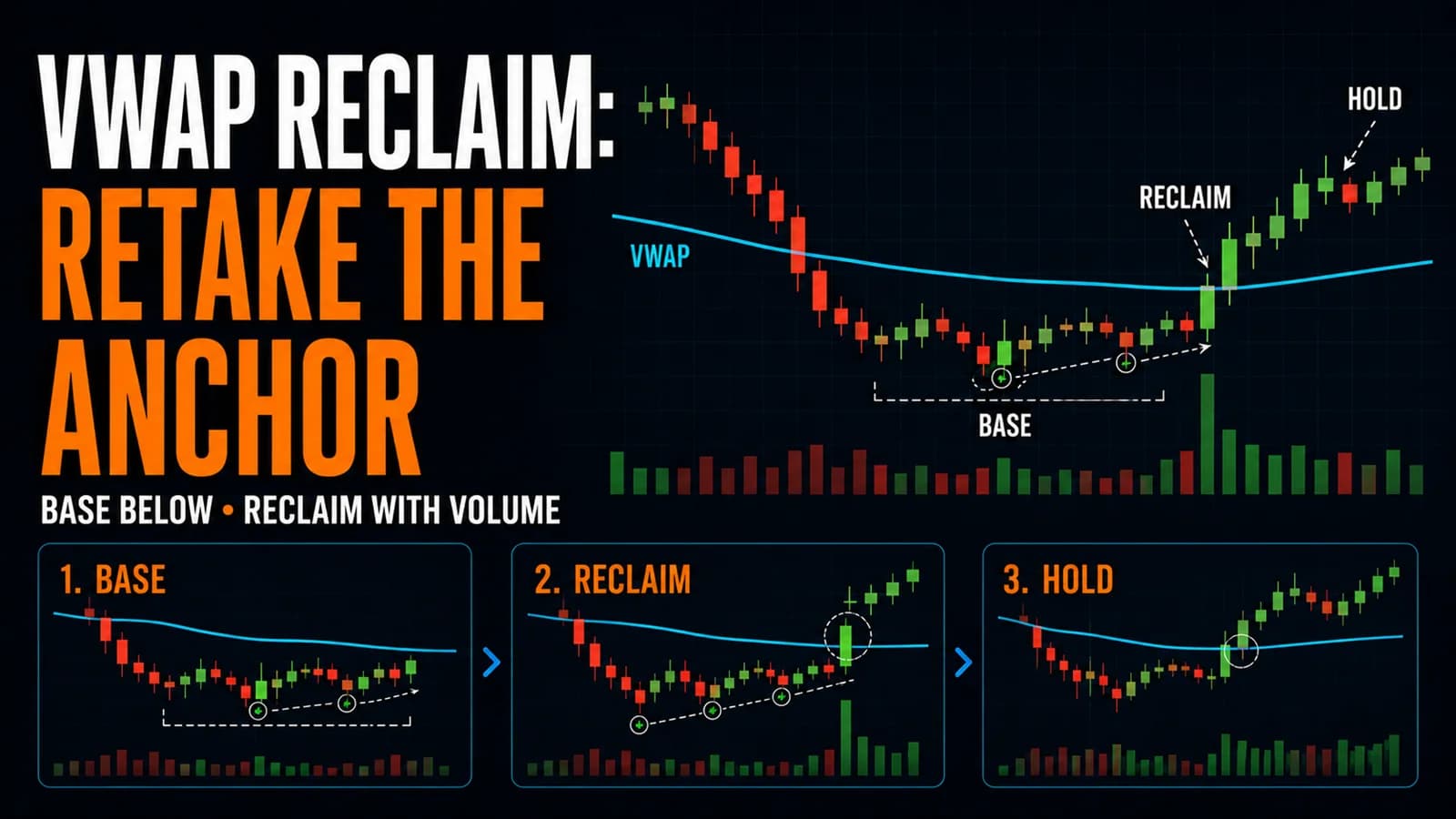
A stock that spends the morning below VWAPVWAP (Volume Weighted Average Price) is the average price a security has traded at throughout the session, weighted by volume — it's the most important intraday indicator for day traders, serving as a real-time measure of fair value and theRead definition → looks broken to most observers. Then, without warning, it grinds back above the level and holds. That single moment, the reclaim, tends to attract fresh buyers faster than almost any other intraday signal, because it forces two different groups to act at once: shorts who are suddenly underwater, and sideline buyers who were waiting for proof the selling had exhausted itself.
What is a VWAP reclaim? A VWAP reclaim occurs when a stock trading below its VolumeVolume is the total number of shares (or contracts) traded during a given time period — it's the primary confirmation tool for all price action, because a price move accompanied by high volume indicates genuine market participation, while tRead definition →-Weighted Average Price pushes back above that level and holds, signaling that buyers have absorbed the prior selling pressure and shifted the day's balance of power. It's treated as a bullish continuation or reversal trigger, distinct from a VWAP bounce, which assumes the stock never lost the level in the first place.
The Reclaim Is a Different Trade Than the Bounce, Not a Variation of It
It's worth separating this setup clearly from its closer cousin. A VWAP bounce assumes an established TrendA trend is a sustained directional movement in price over time — an uptrend is characterized by a sequence of higher highs and higher lows, a downtrend by lower highs and lower lows — and correctly identifying the current trend direction isRead definition → that briefly retests VWAP from above. A reclaim assumes the opposite starting condition: the stock has already lost VWAP, spent meaningful time below it, and is now attempting to take it back. The risk profile is different because a reclaim is fighting against a trend that was, at least temporarily, bearish. That's precisely what makes a clean reclaim more powerful when it works: it represents an actual shift in control rather than a continuation of existing momentum.
This matters practically because the two setups call for different confirmation. A bounce only needs the PullbackA pullback is a temporary counter-trend price movement within an established trend — in an uptrend, a pullback is a short-term decline that offers a lower-risk entry point before the trend resumes, as opposed to a reversal which signals theRead definition → to hold. A reclaim needs to see the stock actually absorb the overhead supply that pushed it below VWAP in the first place, which usually shows up as a period of basing or higher lows just beneath the level before the actual push through it.
Reading the Setup That Precedes a Genuine Reclaim
The strongest reclaims are rarely a single sharp move straight through VWAP. More often, a stock that lost VWAP early in the session spends 20 to 40 minutes building a base just below it, printing a series of higher lows as sellers get exhausted and buyers slowly step in. This basing period is diagnostic: a stock that's simply going to keep falling usually shows lower lows during this stretch, not higher ones.
Volume during the basing period tends to contract compared to the initial breakdown, another tell that the selling pressure is fading rather than intensifying. When the actual reclaim candle finally prints, look for it to trade on volume clearly above the basing period average, ideally 1.5x or more, since a reclaim on shrinking volume is much more likely to fail and roll back below the level within a few candles.
Setup Specification
- Component
- Market Conditions Required
- Rule
- Stock previously traded below VWAP for at least 15 to 20 minutes and has formed a visible base or series of higher lows beneath the level
- Component
- Time of Day
- Rule
- Most reliable between 10:00 AM and 1:00 PM ET, after the initial breakdown has had time to base; reclaims attempted in the first 10 minutes are less trustworthy since VWAP is still unstable
- Component
- Stock Selection Criteria
- Rule
- Average daily volume above 1 million shares, a defined catalyst or news reason for the morning weakness (so the reclaim has a story attached), RVOL at least 1.2x during the basing period
- Component
- Entry Trigger
- Rule
- A candle closes back above VWAP on volume exceeding the average of the prior three candles, ideally following a higher-low base rather than a straight-line push
- Component
- Stop Loss
- Rule
- Below the most recent higher low in the base, or below VWAP itself if price has cleared it by a meaningful margin
- Component
- Initial Profit Target
- Rule
- The pre-breakdown swing high, or the first resistance level visible on the higher timeframe chart
- Component
- Trade Management
- Rule
- Once price clears the pre-breakdown high, trail beneath each new higher low rather than beneath VWAP
- Component
- Invalidation Criteria
- Rule
- Price closes back below VWAP within one to two candles of the reclaim, especially on rising volume
| Component | Rule |
|---|---|
| Market Conditions Required | Stock previously traded below VWAP for at least 15 to 20 minutes and has formed a visible base or series of higher lows beneath the level |
| Time of Day | Most reliable between 10:00 AM and 1:00 PM ET, after the initial breakdown has had time to base; reclaims attempted in the first 10 minutes are less trustworthy since VWAP is still unstable |
| Stock Selection Criteria | Average daily volume above 1 million shares, a defined catalyst or news reason for the morning weakness (so the reclaim has a story attached), RVOL at least 1.2x during the basing period |
| Entry Trigger | A candle closes back above VWAP on volume exceeding the average of the prior three candles, ideally following a higher-low base rather than a straight-line push |
| Stop Loss | Below the most recent higher low in the base, or below VWAP itself if price has cleared it by a meaningful margin |
| Initial Profit Target | The pre-breakdown swing high, or the first resistance level visible on the higher timeframe chart |
| Trade Management | Once price clears the pre-breakdown high, trail beneath each new higher low rather than beneath VWAP |
| Invalidation Criteria | Price closes back below VWAP within one to two candles of the reclaim, especially on rising volume |
A Narrated Walk-Through
Consider a large-cap consumer stock, call it ABC, opening the session at $88.00 after a mixed GuidanceGuidance is forward-looking financial projections that a company's management provides for upcoming periods — typically covering expected revenue, earnings, or margins — and the market's reaction is often driven more by guidance than by theRead definition → update the night before. By 9:50 AM ET, ABC has dropped to $85.40, well below its forming VWAP of $86.70, as early sellers dump on the news.
Between 10:00 and 10:45 AM, ABC bases in a tight range between $85.30 and $86.10, printing three consecutive higher lows at $85.30, $85.55, and $85.80 while volume steadily declines from the initial breakdown's pace. At 10:52 AM, ABC prints a strong 5 minute candle that closes at $86.85, clearing VWAP (now sitting at $86.60) on volume 1.8x the average of the prior six candles.
A trader enters on this close at $86.85, placing a stop at $85.75, just below the most recent higher low in the base. The first target is set at $88.00, the pre-breakdown open, which represents roughly 1.4:1 reward to risk. If ABC clears $88.00 with continued buying, the position trails with a stop moved beneath each subsequent higher low, aiming for a secondary resistance level identified on the daily chart near $89.20. This scenario uses a hypothetical archetype rather than a real ticker at current prices, in keeping with how these setups should be studied rather than chased on any specific name.
Managing a Reclaim Once It's Confirmed
The first few minutes after a reclaim are the most fragile part of the trade. Many reclaims that ultimately fail do so within the first one or two candles, snapping back below VWAP almost as quickly as they cleared it. Because of this, waiting for one full candle to close and hold above VWAP before adding any size, rather than entering the instant price first crosses the level intraday, meaningfully reduces the number of false reclaims a trader gets caught in.
Once the reclaim holds for two or three candles, management shifts toward normal trend-following mechanics: trailing beneath higher lows, scaling at logical resistance, and giving the position room to work rather than exiting at the first sign of hesitation. A reclaim that's held for 30 minutes or more has usually demonstrated enough conviction that a shallow pullback toward VWAP from above should be treated as a bounce opportunity to add, not a reason to exit.
Where the Reclaim Setup Breaks Down
The most common failure is what traders sometimes call the fakeout reclaim: price pokes above VWAP for a single candle, often on unconvincing volume, then immediately rolls back below it. This tends to happen when the reclaim attempt comes too early, before the stock has actually built a real base, essentially a bounce attempt mislabeled as a reclaim. Waiting for the basing behavior described earlier is the direct defense against this failure mode.
A second failure mode shows up on stocks with no clear catalyst for the morning weakness. A reclaim on a stock that gapped down for an identifiable reason, an earnings miss, a downgrade, sector-wide weakness, tends to be more reliable than a reclaim on a stock that simply drifted lower for no obvious reason, since the latter often reflects genuine, unexplained distribution that a single volume candle isn't enough to overcome.
A third failure mode appears in broad market weakness. A reclaim attempt on an individual stock fighting against a falling overall market, with SPY or QQQ trending down at the same time, has a much lower success rate than the same setup occurring when the broader tape is flat or rising. Checking the index backdrop before trusting an individual reclaim is a simple filter that meaningfully improves the setup's odds.
Adapting the Reclaim for Different Situations
The mirror image, a breakdown reclaim short, occurs when a stock that gapped up and traded above VWAP loses the level, bases beneath a lower high, and then breaks down through VWAP on volume. All the same logic applies in reverse: wait for the base, confirm volume on the actual break, and place the stop above the most recent lower high.
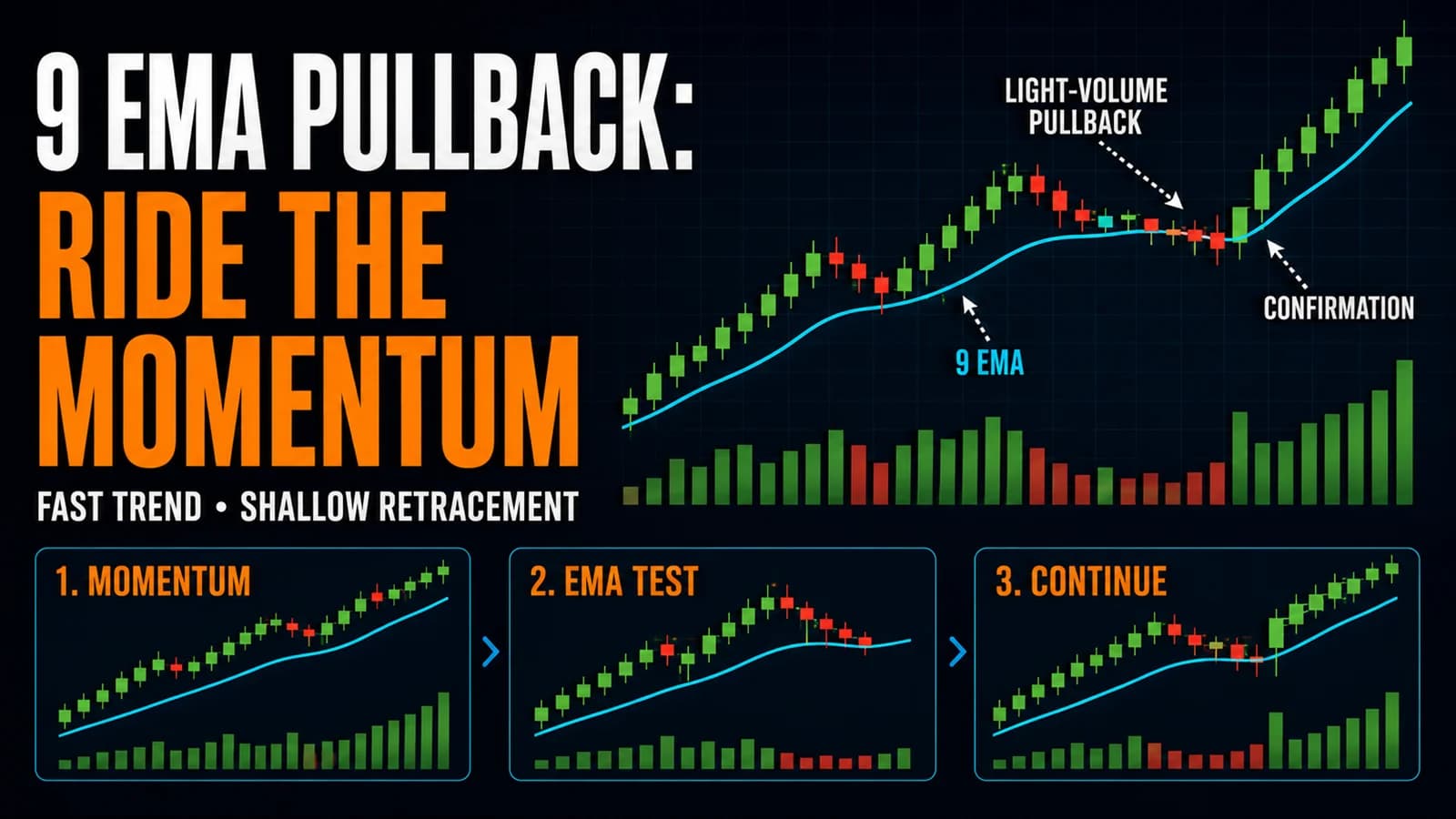
Some traders also watch for a reclaim that coincides with the stock reclaiming a nearby moving average at the same time, such as the 9 EMA on a shorter timeframe chart. When VWAP and a key moving average align at roughly the same price, a reclaim through both levels simultaneously tends to carry more weight than a reclaim of VWAP alone.
Finding Reclaim Candidates Without Watching Every Chart
Manually scanning for stocks that are below VWAP, basing, and showing rising volume across hundreds of names isn't realistic without a tool built for the job. A scanner that can filter for stocks currently below VWAP by a defined percentage with RVOL above a threshold narrows a full market watchlist down to a manageable shortlist worth actually charting. Trade Ideas offers real-time filters along these lines, and its Holly AI signals are trained to flag some of this exact reversal behavior, which traders can use as a starting point before applying the manual confirmation steps described above.
How the Reclaim Fits Into a Complete Trading Plan
This setup is best treated as a specific reversal tool rather than a default approach to every stock that dips below VWAP. It requires patience: the temptation to jump in the instant price crosses back above the line is exactly what produces the fakeout failures discussed earlier. Traders who build the discipline to wait for a real base, as covered in developing patience and staying objective, tend to catch a meaningfully higher percentage of genuine reclaims than those trading on the first cross.
FAQ
How long does a stock need to base below VWAP before a reclaim is considered valid?
A base that forms in under 10 minutes hasn't had time to demonstrate genuine exhaustion of selling pressure, and reclaims off very short bases fail more often. A longer base, particularly one showing declining volume as it develops, gives more confidence that the sellers who caused the initial breakdown have largely finished before buyers step back in.
Key Takeaway: A basing period of at least 15 to 20 minutes with rising lows is a stronger foundation for a reclaim than an immediate snapback.
What's the difference between a VWAP reclaim and a simple VWAP cross?
Price can cross VWAP dozens of times in a choppy session with none of those crosses meaning much. A reclaim is a subset of crosses that occurs after a real breakdown, following visible accumulation, and confirmed by volume and a subsequent hold above the level. Treating every cross as a reclaim signal leads to far more false entries than isolating the specific pattern described in this article.
Key Takeaway: Not every VWAP cross is a reclaim; the setup requires a prior breakdown, a base, and confirmation on the actual cross.
Does a VWAP reclaim work better on stocks with a known catalyst or on unexplained weakness?
A catalyst-driven dip, such as a guidance miss or a downgrade, gives the market a clear reason to have sold the stock, which also gives a clear reason for buyers to reassess and step back in once the initial reaction fades. Unexplained weakness can reflect quiet institutional distribution that a single strong volume candle isn't enough to reverse, which is part of why catalyst-driven reclaims are generally the higher-quality setups to trade.
Key Takeaway: Favor reclaim setups tied to a known catalyst over unexplained morning weakness.
How should position size change for a reclaim trade versus a bounce trade?
Because a reclaim requires the market to actually change its mind about a stock, the failure rate on the initial attempt tends to run higher than a bounce within an already-confirmed trend. Starting with a smaller initial position and adding once the reclaim has held for a candle or two is a common way traders manage this asymmetry without giving up the setup entirely.
Key Takeaway: Consider starting smaller on reclaim entries and scaling in as the reclaim proves itself over subsequent candles.
What volume level actually confirms a reclaim rather than a false break?
Comparing the reclaim candle only to the immediately preceding candle can be misleading if that candle happened to be unusually quiet. A more reliable comparison uses the average volume across the entire basing period, giving a cleaner read on whether the reclaim candle represents a genuine surge in participation or just ordinary variation.
Key Takeaway: Compare reclaim volume to the average of the whole basing period, not just the single candle before it.
Can the VWAP reclaim strategy be automated into a scanner alert?
A scanner can reliably flag the moment price recrosses VWAP with a volume spike, which narrows the universe of stocks worth watching. It's much harder for an automated filter to judge whether the prior 20 minutes actually formed a genuine higher-low base versus a disorganized chop, which is why most traders treat scanner alerts here as a shortlist to manually confirm rather than a fully automated signal.
Key Takeaway: Scanners can flag the mechanical reclaim event, but confirming genuine basing structure still requires visual chart review.
Why do reclaims fail more often in a falling broader market?
Most stocks carry some correlation to the broader market intraday, and a falling SPY or QQQ creates continuous background selling pressure that a single stock's reclaim attempt has to overcome. Checking the index trend before trusting an individual reclaim gives a useful additional filter, since the same setup performs meaningfully differently depending on what the broader market is doing at the same time.
Key Takeaway: Check the broader index trend before trusting a reclaim; a falling market lowers the setup's odds.
Is the VWAP reclaim a good strategy for a trader still learning to read volume?
A trader who hasn't yet built comfort distinguishing meaningful volume spikes from routine noise will struggle to tell a genuine reclaim from a fakeout, since the difference often comes down to exactly that judgment. This setup rewards traders who've already spent time watching volume patterns develop in real time rather than serving as a true first strategy.
Key Takeaway: Build volume-reading fundamentals first; the reclaim setup depends heavily on that skill.
Disclaimer
Article Sources
- StockCharts ChartSchool: Volume-Weighted Average Price (VWAP) - Explains the underlying VWAP calculation referenced throughout this setup.chartschool.stockcharts.com
- StockCharts ChartSchool: Introduction to Technical Indicators and Oscillators - Background on how traders interpret level crosses and confirmation signals generally.chartschool.stockcharts.com
- Charles Schwab: How to Use Volume-Weighted Indicators in Trading - Platform-level explanation of applying VWAP in live trading.schwab.com
- FINRA: Day Trading Risk Disclosure - Regulatory guidance on the risks inherent in short-term, intraday strategies.finra.org