
Most traders treat VWAPVWAP (Volume Weighted Average Price) is the average price a security has traded at throughout the session, weighted by volume — it's the most important intraday indicator for day traders, serving as a real-time measure of fair value and theRead definition → as a line on the chart that either gets respected or doesn't. That framing misses the point entirely. VWAP is the VolumeVolume is the total number of shares (or contracts) traded during a given time period — it's the primary confirmation tool for all price action, because a price move accompanied by high volume indicates genuine market participation, while tRead definition →-weighted average price every market participant paid for a stock that day, which makes it the one level on the chart that represents actual consensus value rather than a lagging calculation drawn from arbitrary periods. When price stretches away from it and then swings back, that's not a technical signal so much as a return to fair value, and that distinction is exactly why the VWAP bounce works as a repeatable intraday setup.
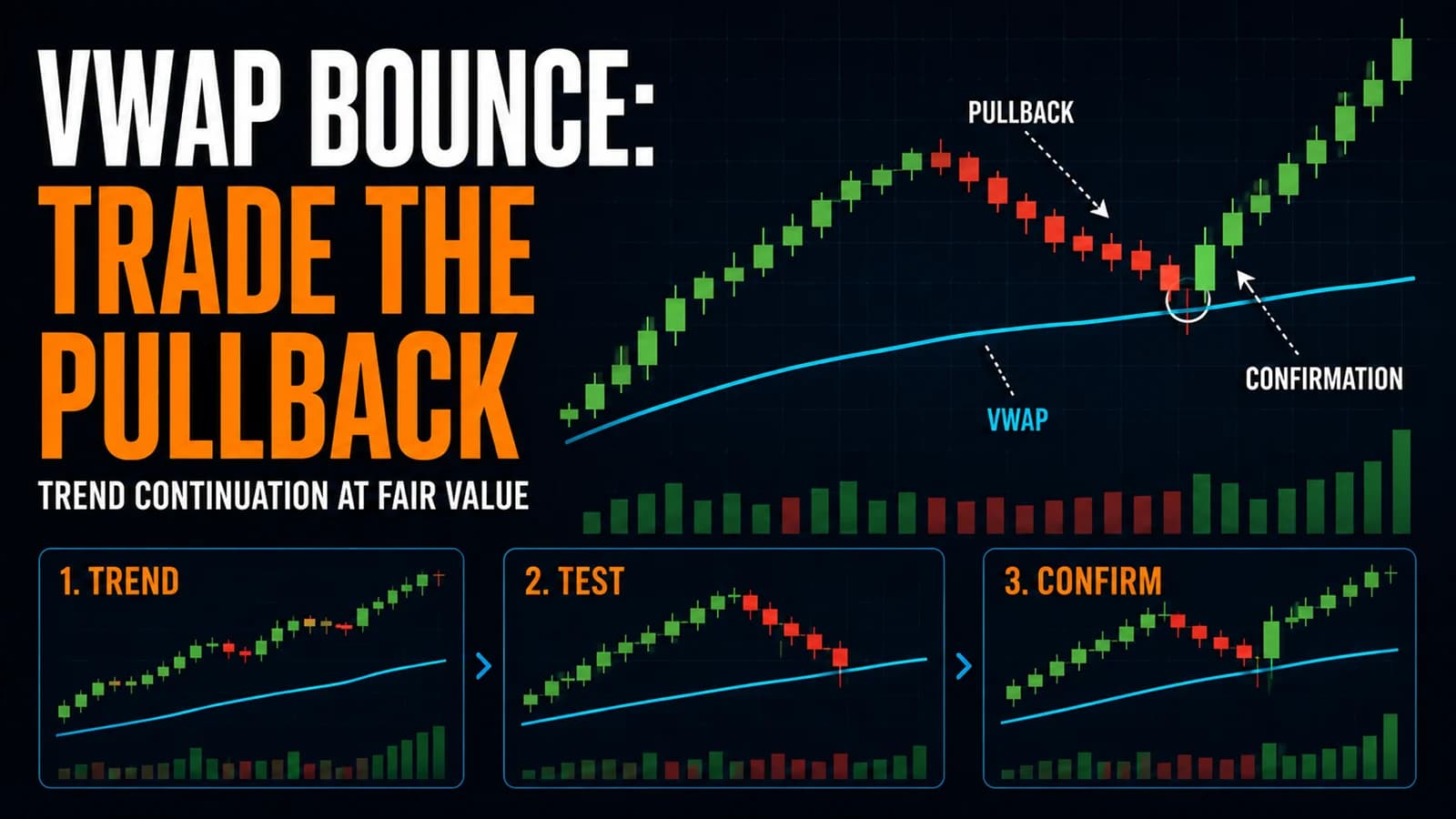
What is the VWAP bounce strategy? The VWAP bounce is a Mean ReversionMean reversion is the trading concept that after an extreme price move away from an average (VWAP, a moving average, a prior range), price has a statistical tendency to return toward that average — allowing traders to fade overextended moveRead definition → setup where a trader buys (or shorts) as price pulls back to touch the Volume-Weighted Average Price and shows signs of holding, treating VWAP as dynamic SupportSupport is a price level where buying pressure has historically overcome selling pressure, causing price to stop declining and reverse — it's the floor where demand enters the market, and when it holds, it's a potential long entry; when it Read definition → in an uptrend or dynamic ResistanceResistance is a price level where selling pressure has historically overcome buying pressure, causing price to stall, reverse, or consolidate — it's the ceiling where supply enters the market and where breakout traders watch for either a coRead definition → in a downtrend. It works because VWAP represents the day's true average transaction price, and institutional algorithms are frequently programmed to defend it.
Why VWAP Acts Like a Magnet and a Wall at the Same Time
VWAP does two contradictory-sounding jobs during a session, and understanding both is the key to trading the bounce correctly. Early in the day, before enough volume has accumulated, price tends to gravitate toward VWAP because there isn't yet a strong enough imbalance of buyers or sellers to hold it away. Later in a trending session, once a real directional move is underway, VWAP flips into acting as a floor or ceiling: the stock's average buyer is now sitting on a profit, and every dip back to that average price attracts a fresh wave of buyers who missed the first leg and don't want to miss the next one.
This is the mechanical reason large funds use VWAP as an execution benchmark. A portfolio manager buying a large position doesn't want to pay meaningfully more than the day's volume-weighted average, so institutional buy programs are frequently built to accumulate on dips toward VWAP and slow down above it. Retail traders don't need to know the specifics of any given algorithm to benefit from this. They just need to recognize that this behavioral pattern repeats often enough, across enough liquid names, to build a setup around it.
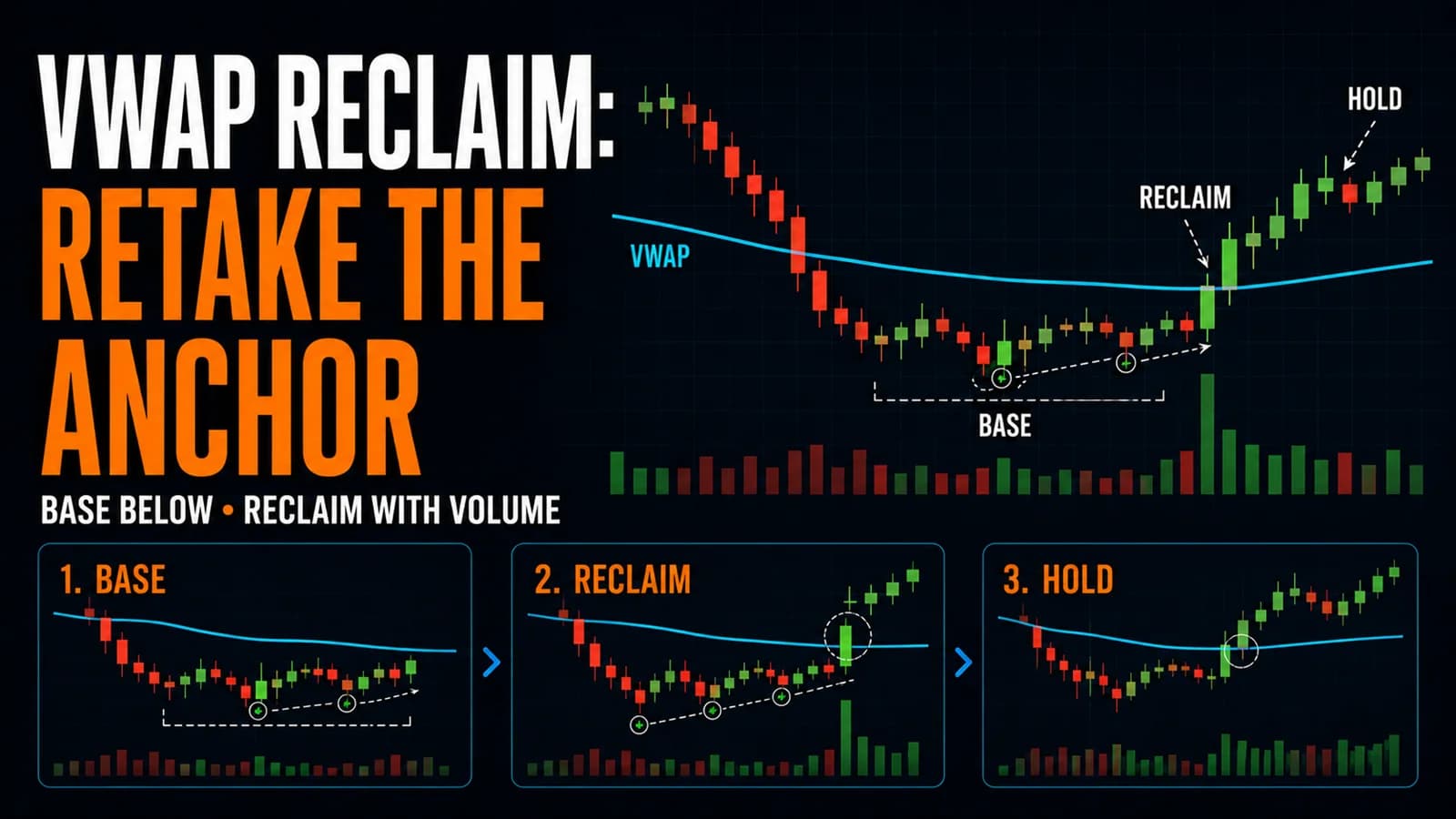
The VWAP bounce is not the same trade as a VWAP reclaim, which is about a stock recapturing VWAP from below after losing it. The bounce assumes the stock is already trending on the correct side of VWAP and is simply retesting it. Confusing the two setups is a common mistake: a bounce entry taken on a stock that's actually reclaiming VWAP for the first time carries a completely different risk profile, because the trend hasn't been established yet.
The Market Conditions a VWAP Bounce Actually Needs
This setup lives and dies on the presence of a real intraday trend. A stock chopping sideways around VWAP all day will generate touch after touch with no edge attached to any of them, because there's no directional order flow to defend the level. The bounce works best on trend days: a stock gapping up on a catalyst and grinding higher, or a stock breaking down on bad news and grinding lower, where VWAP is trailing behind price rather than sitting in the middle of a range.
Relative volume matters more here than on almost any other setup in this hub. A pullback to VWAP on rising RVOL, ideally 1.5x or higher relative to the same time of day historically, suggests real participants are stepping in to defend the level. A pullback on dying volume is often just drift, and drift-based touches fail more often because there's no active defense of the price.
Time of day shapes the setup's reliability as well. The first 5 to 10 minutes after the open should generally be skipped, since VWAP is still forming and swings wildly with each new print. The most reliable bounce windows tend to fall between roughly 10:00 AM and 2:30 PM ET, once the opening range has settled into a directional bias but before the closing imbalance dynamics of the final half hour start to dominate price action.
Setup Specification
- Component
- Market Conditions Required
- Rule
- Clear intraday trend already established (higher highs/higher lows for longs, the reverse for shorts); VIX doesn't need to be elevated, but chop days with VWAP near the middle of a tight range should be skipped
- Component
- Time of Day
- Rule
- 10:00 AM to 2:30 PM ET; avoid the first 10 minutes and the last 20 minutes
- Component
- Stock Selection Criteria
- Rule
- Price above $5, average daily volume above 1 million shares, RVOL at time of pullback at least 1.3x, spread no wider than a few cents on a sub-$50 stock
- Component
- Entry Trigger
- Rule
- First 1 or 5 minute candle to close back above VWAP (for longs) after touching or slightly piercing it, with volume on that candle exceeding the prior two candles
- Component
- Stop Loss
- Rule
- Below the low of the pullback candle, or a fixed amount (commonly 0.3 to 0.5x the stock's average true range) below VWAP itself
- Component
- Initial Profit Target
- Rule
- The prior swing high (for longs) as the first scale point, with a second target at a full measured move from the opening range
- Component
- Trade Management
- Rule
- Trail the stop below each new higher low, or below VWAP itself if price pushes decisively away from it
- Component
- Invalidation Criteria
- Rule
- A full-bodied candle closing meaningfully below VWAP on volume higher than the entry candle
| Component | Rule |
|---|---|
| Market Conditions Required | Clear intraday trend already established (higher highs/higher lows for longs, the reverse for shorts); VIX doesn't need to be elevated, but chop days with VWAP near the middle of a tight range should be skipped |
| Time of Day | 10:00 AM to 2:30 PM ET; avoid the first 10 minutes and the last 20 minutes |
| Stock Selection Criteria | Price above $5, average daily volume above 1 million shares, RVOL at time of pullback at least 1.3x, spread no wider than a few cents on a sub-$50 stock |
| Entry Trigger | First 1 or 5 minute candle to close back above VWAP (for longs) after touching or slightly piercing it, with volume on that candle exceeding the prior two candles |
| Stop Loss | Below the low of the pullback candle, or a fixed amount (commonly 0.3 to 0.5x the stock's average true range) below VWAP itself |
| Initial Profit Target | The prior swing high (for longs) as the first scale point, with a second target at a full measured move from the opening range |
| Trade Management | Trail the stop below each new higher low, or below VWAP itself if price pushes decisively away from it |
| Invalidation Criteria | A full-bodied candle closing meaningfully below VWAP on volume higher than the entry candle |
The stop placement deserves extra attention because it's the part traders get wrong most often. Placing a stop exactly at VWAP is a mistake: price frequently pierces VWAP by a few cents on the wick before reversing, since VWAP itself is a calculated value, not a real order sitting in the book. Give the trade a small amount of room below the actual level, sized to the stock's volatility, rather than treating VWAP as a hard line.
A Narrated Walk-Through
Picture a mid-cap industrial stock, call it XYZ, gapping up 4% on an earnings beat and opening at $52.00. By 9:45 AM ET it has run to $54.20 on strong volume, then starts to fade as early buyers take profit. VWAP, still forming, sits around $52.90.
By 10:20 AM, XYZ has pulled back to $53.05, just above VWAP, on noticeably lighter volume than the initial push. The 5 minute candle prints a small-bodied candle with a lower wick down to $52.85, touching VWAP and bouncing, closing at $53.10. Volume on that candle is 1.6x the average volume for that time slot, suggesting real buying interest showed up right at the level rather than the stock simply drifting.
A trader watching this setup enters on the close of that reversal candle at $53.10, placing a stop at $52.70, roughly 40 cents below VWAP and below the candle's low. The first target sits at $54.20, the prior swing high, representing a little better than 1:1 risk to reward on the first scale. If XYZ breaks through $54.20 with continued volume, the remaining position rides with a trailing stop moved up to $53.40, just below the most recent higher low, until either the trend clearly breaks or the stock reaches a second target near a full measured move of the opening range, roughly $55.30.
This walk-through uses a hypothetical archetype, not a real ticker at current prices, because the mechanics matter more than any single day's specific numbers.
Managing the Trade Once VWAP Has Held
The instinct after a successful bounce entry is to move the stop to breakeven immediately, but doing that too early on a VWAP bounce often results in getting stopped out on normal chop before the move actually develops. A better approach: leave the initial stop in place until the trade has moved at least half of the distance to the first target, then trail beneath the most recent short-term swing low rather than beneath VWAP itself, since price can dip back near VWAP more than once during a strong trend day without the trend actually breaking.
Scaling out at the first target and letting a runner ride toward the second is generally more forgiving than an all-or-nothing exit, because VWAP bounces frequently produce a second and even third touch later in the same session as the trend continues. A trader who takes partial profits at the first target retains the flexibility to re-enter on a subsequent touch without feeling like they're chasing.
Why This Setup Fails, and When to Skip It Entirely
The single most common failure mode is trading the bounce on a stock that's actually range-bound rather than trending. On a choppy day, VWAP sits near the center of the day's range, and price will cross it repeatedly with no directional bias attached to any single crossing. Traders who see "price touched VWAP and bounced" without first confirming an established trend end up trading noise.
A second failure mode shows up around scheduled news and economic releases. If a bounce setup forms 10 minutes before a Fed statement or an earnings call from a major sector peer, the setup should be skipped regardless of how clean it looks, because volatility around the release can blow through both VWAP and any reasonable stop level in seconds.
A third, more subtle failure mode involves late-day bounces. VWAP touches that occur in the final 20 to 30 minutes of the session are less reliable, because closing imbalances and index rebalancing flows can override the normal supply and demand dynamics that make VWAP meaningful earlier in the day. This setup also degrades in extremely low RVOL summer or holiday sessions, where there simply isn't enough volume to generate the kind of institutional defense the strategy depends on. Traders should treat a "textbook" VWAP touch on a dead-volume day with real skepticism rather than assuming the setup applies uniformly regardless of participation.
Variations Worth Knowing
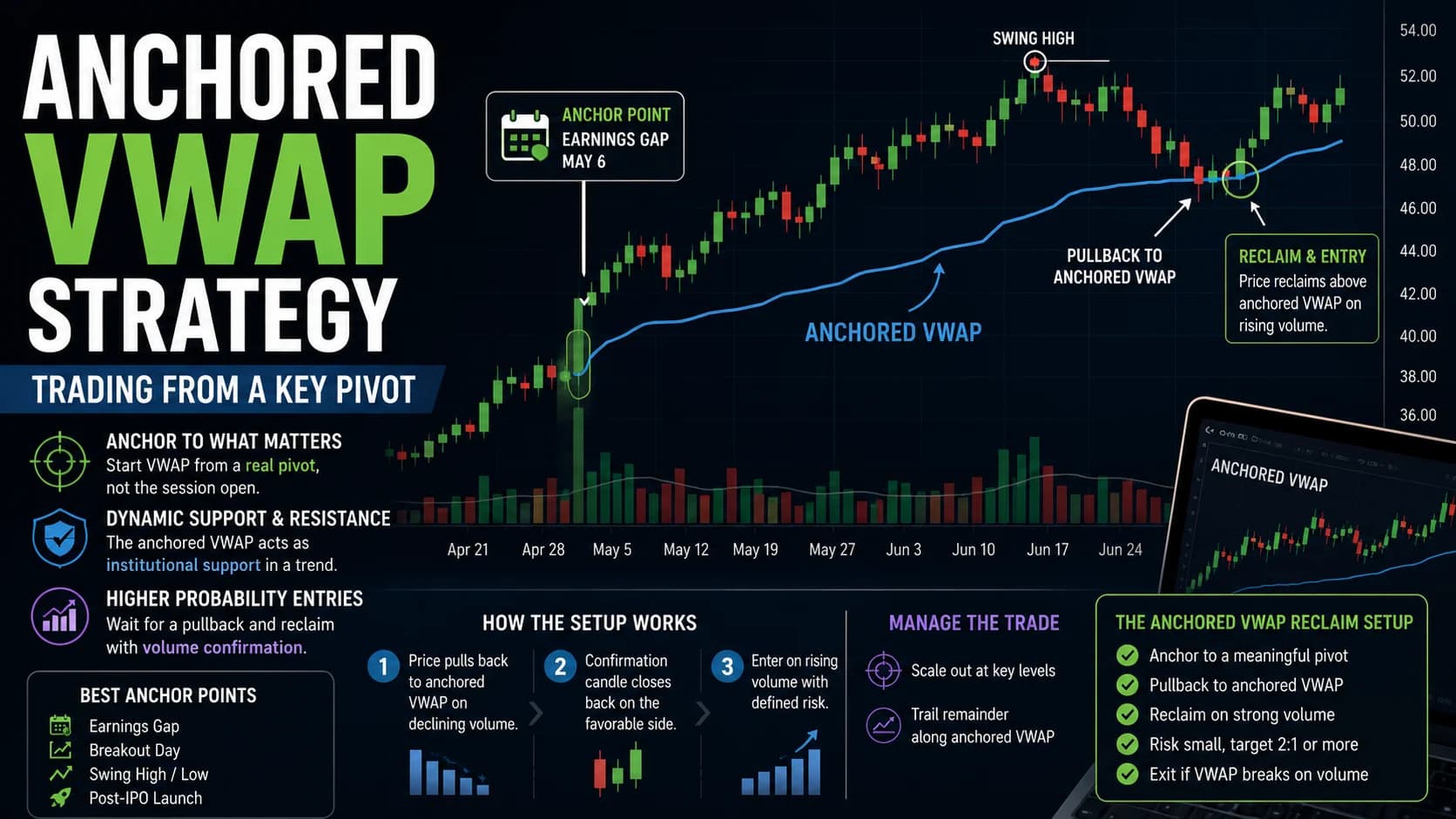
The short side of this trade works as a mirror image: a stock breaking down on bad news that rallies back to VWAP on light volume and stalls is a short entry, with the stop placed above the pullback high. Traders sometimes combine the VWAP bounce with an anchored VWAP drawn from a specific catalyst candle rather than the session open, which can offer an earlier or more precise read on where institutional accumulation actually began, particularly on stocks that gapped from a pre-market news event.
Some traders also use a small buffer band around VWAP, treating a zone rather than an exact price as the support or resistance area, since VWAP is a moving calculation and rarely gets tagged to the exact penny in real time.
Tools That Make This Setup Practical to Trade
VWAP is a built-in overlay on most modern charting platforms, but finding the setup in real time across a broad watchlist is a different problem than plotting it on one chart you're already watching. A scanner capable of flagging stocks trending with elevated RVOL and currently within a defined percentage of VWAP removes the manual work of monitoring dozens of charts simultaneously. Trade Ideas includes real-time scanning with filters built around VWAP proximity and relative volume, alongside its Holly AI signals, which some traders use to surface candidates for this exact kind of mean reversion setup before manually confirming the trend and volume conditions described above.
Where This Setup Fits a Broader Trading Plan
The VWAP bounce works best as a continuation tool within an existing trend-following approach rather than as a standalone system. It answers a specific, narrow question: given that a stock is already trending, where's a lower-risk place to join it? Traders who pair this setup with a broader top-down stock selection process tend to get cleaner results than those who scan for VWAP touches in isolation, because the setup's entire edge depends on the trend already being real before the pullback happens.
FAQ
How is the VWAP bounce different from trading a moving average bounce?
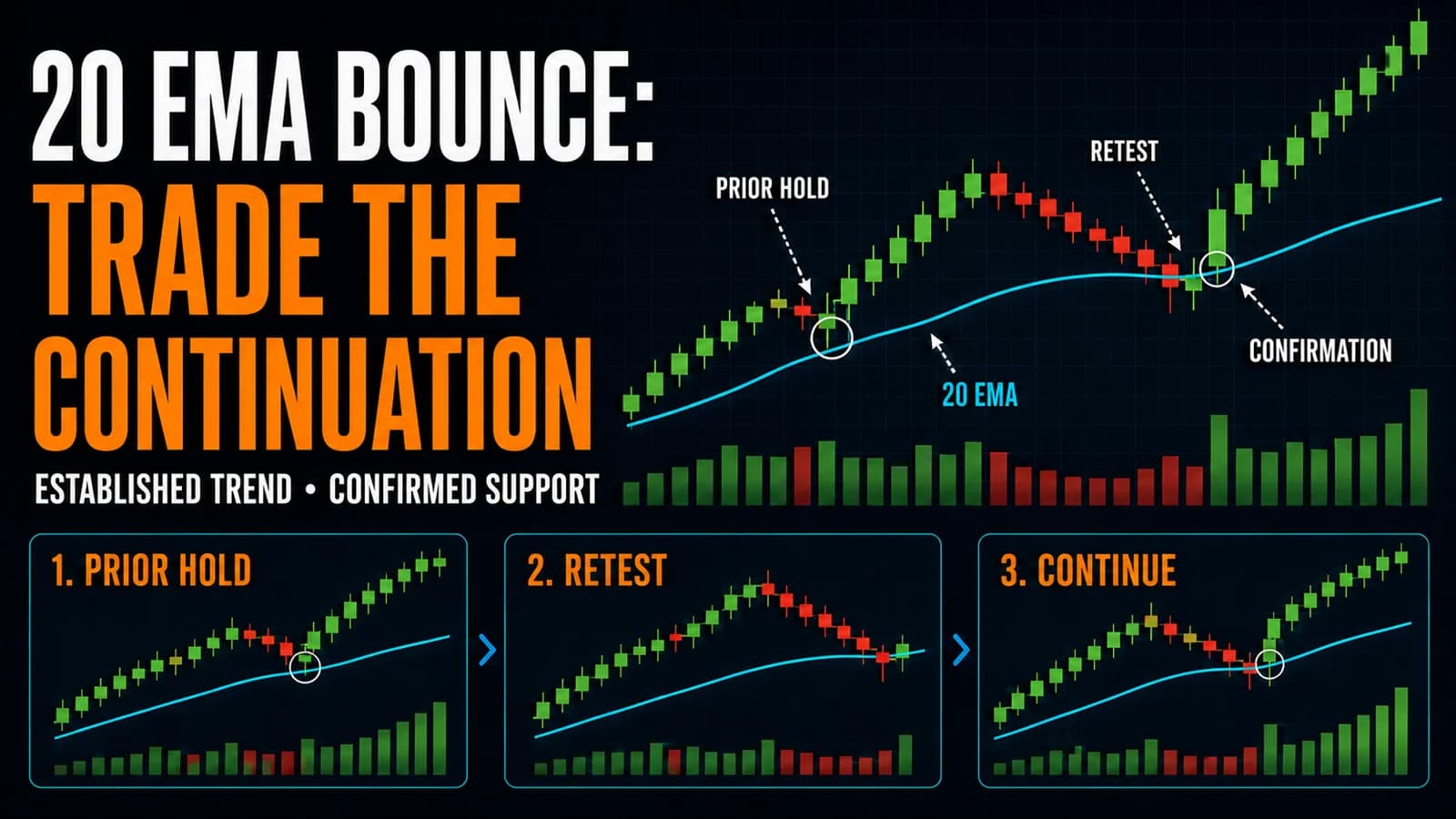
VWAP only reflects the current day's trading activity, which makes it uniquely relevant to intraday participants and less useful for multi-day swing positioning. A moving average incorporates data from previous sessions regardless of how much volume traded at each price, so it can sit in a very different location than VWAP on any given day, especially after a gap. Traders sometimes watch both together, treating a stock that holds above VWAP and its 20 EMA simultaneously as showing unusually strong intraday and short-term alignment.
Key Takeaway: VWAP is a same-day, volume-weighted level, while a moving average blends multiple sessions regardless of volume, and the two won't always agree.
What RVOL threshold actually matters for a VWAP bounce entry?
A stock can show high RVOL for the session as a whole purely because of a strong opening burst, while the actual pullback candle at VWAP trades on thin, declining volume. That mismatch is a warning sign, since it suggests the level isn't being actively defended in real time. Checking volume on the specific bounce candle, not the day's cumulative RVOL, gives a more accurate read on whether real buyers or sellers showed up exactly where it matters.
Key Takeaway: Confirm RVOL on the bounce candle itself, not just the session average, before trusting the signal.
Does the VWAP bounce work on low-float stocks the same way it works on large caps?
Low-float stocks can move several percent on a single block trade, which distorts VWAP itself and makes "bounces" look more like random noise than a genuine institutional defense of value. This setup performs most consistently on stocks with enough float and average volume that VWAP reflects a broad base of participants rather than a handful of large orders. Traders working with genuinely thin, low-float names are usually better served by setups built specifically for that volatility profile.
Key Takeaway: Reserve the VWAP bounce for stocks with real float and volume; use different tools for illiquid runners.
What happens if price wicks through VWAP but closes back above it?
A long lower wick with a strong close suggests sellers pushed price below VWAP briefly and were immediately overwhelmed by buyers, which is a more decisive rejection than a candle that simply approaches VWAP and turns without ever piercing it. Some traders specifically prefer this wick-and-reclaim pattern over a shallow touch, since it demonstrates real two-sided battle at the level rather than a passive approach.
Key Takeaway: A wick-and-close-above pattern at VWAP often carries more conviction than a shallow, untested touch.
How many times can a stock bounce off VWAP in a single session before the setup stops working?
Early bounces in a fresh trend often carry the highest odds, since the move is new and un-crowded. By the third or fourth touch in the same direction, more traders have noticed the pattern and are trading it, which can compress the reward available and increase the odds of a failed break on any given attempt. This doesn't mean later bounces should be ignored outright, but position sizing or profit targets are often adjusted smaller on repeat touches within the same session.
Key Takeaway: Treat later same-day bounces as lower-probability, and consider reducing size or targets accordingly.
Can the VWAP bounce be traded on futures and forex, or is it stock-specific?
Futures markets report real traded volume, so VWAP calculates the same way it does for equities and the bounce concept transfers directly. Spot forex doesn't have a single centralized volume figure, which means platforms typically substitute tick volume, an approximation that makes VWAP a less precise reflection of true participation. Traders applying this setup to forex should treat the VWAP line there as a rough guide rather than the same precision tool it represents in equities or futures.
Key Takeaway: VWAP bounces translate well to futures with real volume data, but forex VWAP is only an approximation.
Why does the VWAP bounce sometimes fail right after a strong opening range breakout?
This first pullback can look identical to a genuine trend-ending reversal, and the two are only distinguishable by what happens on the actual touch. A shallow pullback on light, orderly volume that holds VWAP is a healthy first test. A sharp, high-volume break through VWAP on the first pullback suggests the initial breakout may have been driven by short-term momentum chasers rather than durable demand, and the setup should be treated with more caution on that specific stock for the rest of the session.
Key Takeaway: The first VWAP test after an opening range breakout deserves extra scrutiny before trusting it as a standard bounce.
Is the VWAP bounce a beginner-friendly strategy?
The core concept, buying a pullback to a well-defined level, is intuitive, but distinguishing a genuine trend-day bounce from directionless chop around VWAP takes screen time and pattern recognition that usually comes after a trader has already practiced simpler setups. Traders newer to VWAP itself should build a solid grasp of what the indicator represents before attempting to trade reversals off it in real time.
Key Takeaway: This setup rewards traders who already understand VWAP's basic mechanics rather than serving as a true first strategy.
Disclaimer
Article Sources
- StockCharts ChartSchool: Volume-Weighted Average Price (VWAP) - Explains the VWAP calculation and its intended use as an intraday reference point.chartschool.stockcharts.com
- StockCharts ChartSchool: Anchored VWAP - Details how anchoring VWAP to a specific event changes its interpretation versus the standard session VWAP.chartschool.stockcharts.com
- Charles Schwab: How to Use Volume-Weighted Indicators in Trading - A brokerage-published explanation of VWAP mechanics and platform-level application.schwab.com
- CME Group: Understanding VWAP in Futures Markets - Background on how volume-weighted benchmarks are used across futures execution.cmegroup.com