
Session VWAPVWAP (Volume Weighted Average Price) is the average price a security has traded at throughout the session, weighted by volume — it's the most important intraday indicator for day traders, serving as a real-time measure of fair value and theRead definition → resets to zero every morning, which means it forgets everything that happened yesterday. A stock that gapped up hard on EarningsAn earnings report is the quarterly financial disclosure a public company files with the SEC, revealing revenue, earnings per share (EPS), profit margins, and forward guidance — it's the most significant regular catalyst for individual stocRead definition → three weeks ago and has been consolidating ever since gets no benefit from that institutional memory — unless the VWAP calculation is anchored to the actual moment that mattered, instead of to midnight.
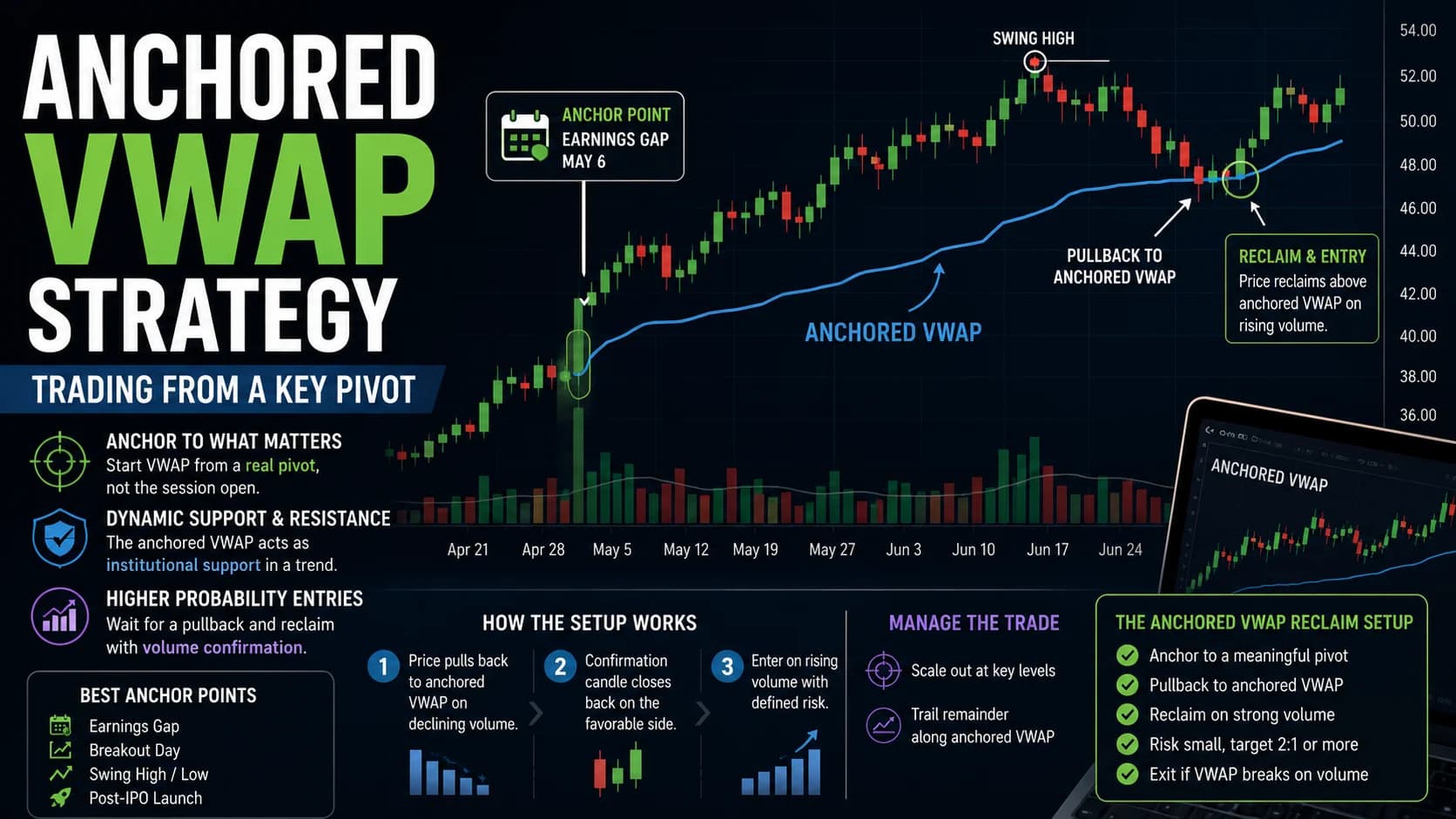
What is the anchored VWAP strategy? The anchored VWAP strategy calculates a VolumeVolume is the total number of shares (or contracts) traded during a given time period — it's the primary confirmation tool for all price action, because a price move accompanied by high volume indicates genuine market participation, while tRead definition →-weighted average price starting from a specific, meaningful price event — an earnings GapA gap is a price discontinuity on a chart where a stock opens significantly higher or lower than the previous session's close, leaving a visible empty space — gap-ups are driven by overnight buying pressure or positive news; gap-downs by seRead definition →, a major swing high or low, a BreakoutA breakout is when price moves decisively beyond a defined level — a resistance zone, a consolidation boundary, a chart pattern boundary, or a prior high — suggesting that the previous supply at that level has been overcome.Read definition → day — rather than resetting at the open of every session. That anchored line then behaves as dynamic support or resistance across multiple days or weeks, and this guide's entry rules trigger on a pullback to that line with the same volume confirmation this guide's session-VWAP checklist requires.
Anchored VWAP vs. the Session VWAP Reset
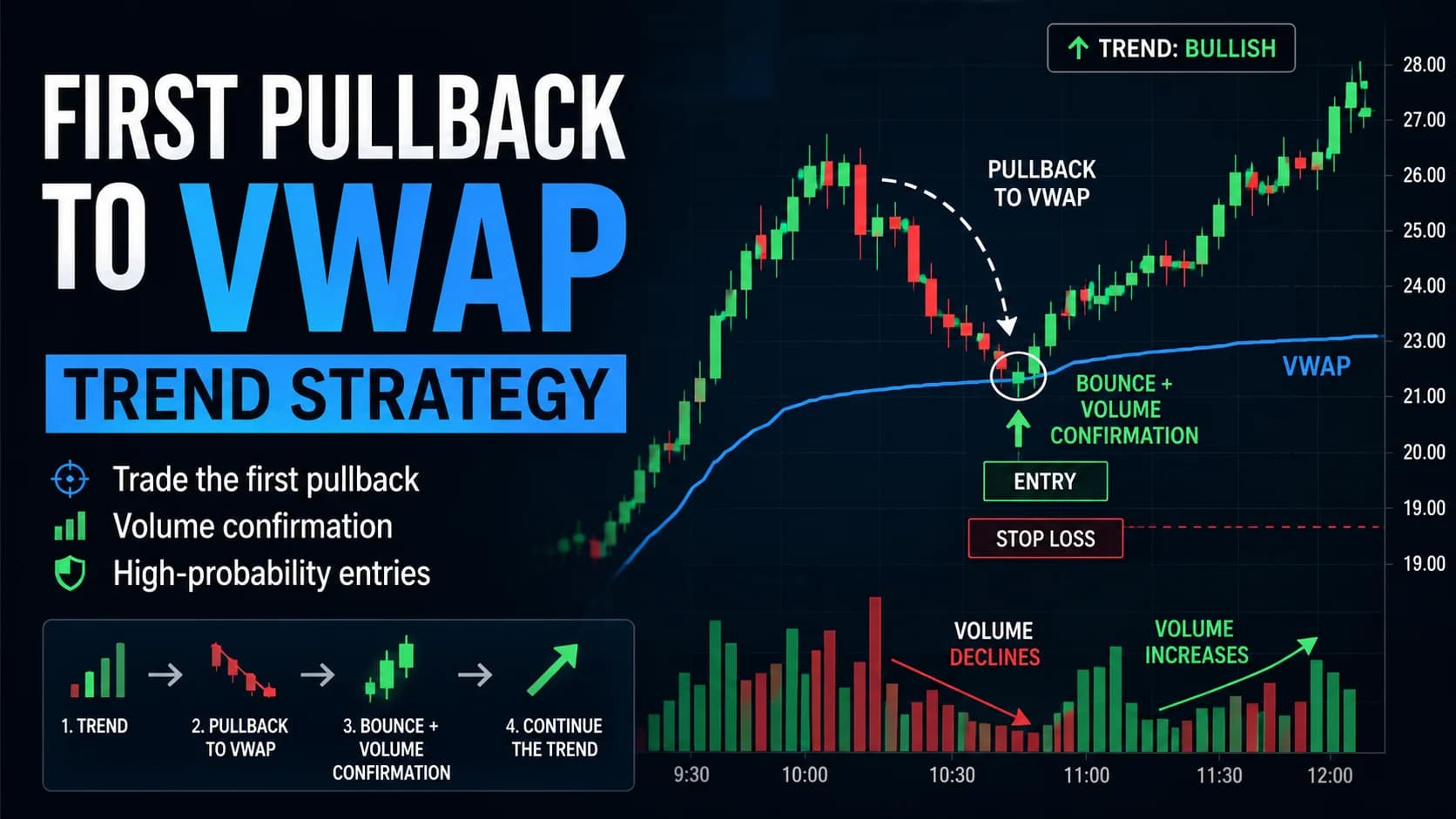
This guide's first pullback to VWAP strategy uses the standard session VWAP, which recalculates from zero at the open of every trading day — useful for intraday moves, but blind to anything that happened in prior sessions. This guide's VWAP basics explainer covers the standard calculation in more depth. Anchored VWAP solves a specific problem that tool can't: tracking the volume-weighted average price of everyone who has bought or sold since one specific, chosen event, regardless of how many sessions have passed since.
The technique is closely associated with Brian Shannon, CMT, who popularized anchoring VWAP to meaningful pivots as a way of identifying the average price paid by participants who entered at a genuinely significant moment — an earnings gap, a 52-week breakout, the start of a new trend — rather than an arbitrary calendar reset. That anchored average carries real weight precisely because it represents a cohort of traders and institutions who made a specific decision at a specific, identifiable moment.
This is not a replacement for session VWAP — the two answer different questions. Session VWAP asks "what's the average price today's participants have paid." Anchored VWAP asks "what's the average price everyone who's been in this move since it started has paid." A stock can be respecting its anchored VWAP from three weeks ago while bouncing around erratically relative to today's session VWAP, and both readings are simultaneously valid for what they're each measuring.
Choosing the Right Anchor Point for a Trend
The entire strategy depends on picking an anchor point that actually means something to a meaningful number of market participants — not an arbitrary date chosen because the chart looked interesting there. The most defensible anchors are moments with genuine, identifiable significance: the candle that started an earnings gap, the exact swing low or high that marked a clear trend change, the first candle of a confirmed breakout above a multi-month range, or the first day of trading after an IPO.
A stock needs to have shown sustained directional behavior since the chosen anchor for the resulting line to carry any predictive value — anchoring to a random midpoint in a choppy, directionless stretch produces a line with no real participants defending it. This strategy tends to work best on stocks with a clear, identifiable catalyst in their recent history and enough time elapsed since that catalyst for a meaningful anchored average to develop.
The Anchored VWAP Reclaim Setup (Setup Specification)
Every component below is a hard rule, built around the same volume-confirmation logic this guide's session-VWAP checklist uses, applied to a multi-day anchored line instead of an intraday one.
- Component
- Market Conditions Required
- Rule
- A genuinely significant anchor point (earnings gap, confirmed breakout, clear swing high/low) with sustained directional behavior since that point
- Component
- Time of Day
- Rule
- Less time-bound than session VWAP since the anchor spans multiple sessions; standard 10:00 AM–3:00 PM ET window still applies to the actual entry trigger
- Component
- Stock Selection Criteria
- Rule
- Liquid stock with average daily volume above roughly 1 million shares and a clearly identifiable anchor event in its recent history
- Component
- Entry Trigger
- Rule
- Price returns to touch the anchored VWAP line on declining volume, followed by a confirmation candle closing back on the anchor's favorable side on rising volume
- Component
- Stop Loss
- Rule
- 1–2 cents beyond the anchored VWAP line itself, or beyond the confirmation candle's low (or high), whichever is further
- Component
- Initial Profit Target
- Rule
- Prior swing high/low since the anchor, or a measured move from the anchor point, for a minimum 2:1 reward-to-risk
- Component
- Trade Management
- Rule
- Scale a portion at the first target; trail the remainder along the anchored VWAP line as it develops across sessions
- Component
- Invalidation Criteria
- Rule
- A full session closes decisively through the anchored VWAP line on elevated volume, or the original anchor point is invalidated by a new, more significant pivot forming since
| Component | Rule |
|---|---|
| Market Conditions Required | A genuinely significant anchor point (earnings gap, confirmed breakout, clear swing high/low) with sustained directional behavior since that point |
| Time of Day | Less time-bound than session VWAP since the anchor spans multiple sessions; standard 10:00 AM–3:00 PM ET window still applies to the actual entry trigger |
| Stock Selection Criteria | Liquid stock with average daily volume above roughly 1 million shares and a clearly identifiable anchor event in its recent history |
| Entry Trigger | Price returns to touch the anchored VWAP line on declining volume, followed by a confirmation candle closing back on the anchor's favorable side on rising volume |
| Stop Loss | 1–2 cents beyond the anchored VWAP line itself, or beyond the confirmation candle's low (or high), whichever is further |
| Initial Profit Target | Prior swing high/low since the anchor, or a measured move from the anchor point, for a minimum 2:1 reward-to-risk |
| Trade Management | Scale a portion at the first target; trail the remainder along the anchored VWAP line as it develops across sessions |
| Invalidation Criteria | A full session closes decisively through the anchored VWAP line on elevated volume, or the original anchor point is invalidated by a new, more significant pivot forming since |
The anchor point choice is the single biggest source of disagreement in this strategy. Two traders anchoring the same stock from slightly different candles — the exact gap candle versus the session after it, the precise swing low versus a candle nearby — can produce meaningfully different lines. This is the same kind of subjectivity this guide's trendline strategy runs into with wick-versus-body construction, and the same solution applies: pick a specific, defensible rule for what counts as an anchor, and apply it consistently.
The volume signature at the touch still does the real work. Exactly as with session VWAP, a touch by itself proves nothing — the entry still requires volume drying up into the touch and picking back up on the confirmation candle. An anchored line without that volume signature is just as capable of failing as a session VWAP line without it.
Walk-Through Example: Anchoring VWAP to an Earnings Gap
Consider a hypothetical industrial technology stock — call it PQR, which gapped up sharply three weeks ago on a strong earnings beat.
Setting the anchor: PQR gapped from $60 to $68 on the earnings reaction day on heavy volume. That gap day's opening candle becomes the anchor point, and the anchored VWAP line begins calculating from that exact session forward.
The trend since the anchor: Over the following three weeks, PQR has climbed to $78, with the anchored VWAP line rising steadily beneath price the entire time — currently sitting near $71.
The pullback and touch: PQR pulls back from $78 toward the anchored VWAP line, touching $71.20 on a session with clearly lighter volume than the run-up that preceded it.
The confirmation: The next session, PQR prints a bullish engulfing candle off the touch, closing at $73.10 on a pickup in volume. The candle's high is $73.40.
Execution: The entry is a buy-stop at $73.50, ten cents above the confirmation candle's high. The stop-loss goes at $70.90, thirty cents below the anchored VWAP line — a risk of $2.60 per share. The prior high of $78 becomes the initial target, offering $4.50 of reward against $2.60 of risk, comfortably above this guide's 2:1 minimum.
What happens next: PQR triggers the entry, works back through $78, and continues climbing over the following sessions, with the anchored VWAP line rising along beneath it. A trader following the management plan would scale a portion near $78, then trail the remainder along the still-rising anchored VWAP line as new sessions develop.
Managing a Multi-Day Anchored VWAP Position
Because this strategy typically plays out over days or weeks rather than within a single session, trade management looks more like swing-position management than intraday scalping. The anchored VWAP line itself updates every session as new volume and price data arrive, which means the trailing reference is a genuinely evolving level rather than a fixed number.
A position can reasonably be held as long as the anchored line keeps rising beneath price (or falling above it, for a short) without a session closing decisively through it. This gives a trend more room to breathe across a multi-day holding period than an intraday session-VWAP trade would typically get, since the anchored line is measuring participation since a specific event rather than resetting daily.
Why Anchor Point Choice Can Make or Break This Setup
The most significant honest limitation of this strategy is that the anchor point itself is a judgment call, and a poorly chosen anchor produces a line with no real meaning behind it. Anchoring to a candle that looked significant in hindsight but wasn't actually a genuine turning point creates a line that happens to have worked on one particular stock without any real reason to expect it to work reliably elsewhere.
There's a related risk worth naming directly: once an anchor is chosen and a trader has a position built around it, there's a real temptation to keep defending that anchor's validity even as price action suggests a better, more recent anchor point has since formed. Sticking with an outdated anchor out of attachment to the original thesis is a specific version of the same rationalization risk this guide's trendline strategy warns against with redrawing lines to fit a losing trade.
This approach also depends on genuine sustained participation since the anchor — a stock that gapped on earnings and then immediately went quiet and range-bound for weeks doesn't have the ongoing volume behind it that makes an anchored line meaningful. The strategy works best on stocks that have kept moving with real conviction since the anchor, not ones that spiked once and went dormant.
Different Anchor Points: Gaps, Swings, and Session Starts
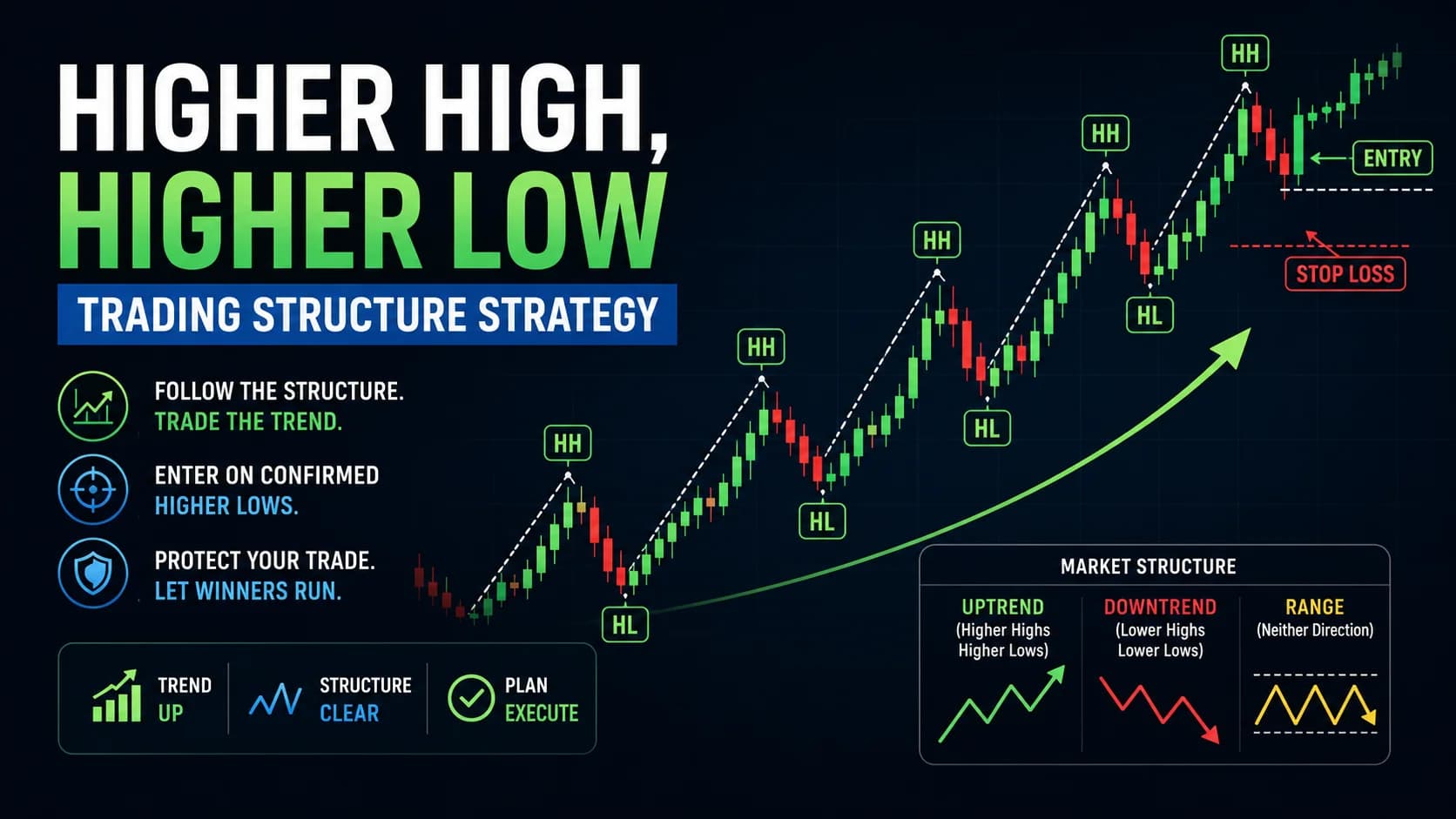
Anchoring to a swing low or high instead of a gap: The same logic applies to anchoring from a clean, confirmed swing point under this guide's market structure framework rather than an earnings gap — the anchor simply needs to represent a genuine, identifiable turning point.
Anchoring to the start of a new listing or major corporate event: IPOs, spinoffs, and major restructuring announcements all create natural anchor candidates, since they mark a clear moment where the stock's ownership and participant base meaningfully reset.
Using multiple anchors simultaneously: Advanced use of this strategy involves plotting more than one anchored VWAP line at once — from an older, more significant pivot and a more recent one — and watching for confluence where both lines converge near the same price.
Applying the mirror logic to downtrends: Everything reverses cleanly for a stock that gapped down or broke down from a significant pivot, with the anchored line acting as resistance and the entry, stop, and target all mirrored for a short position.
Automating Anchor Points With Trade Ideas' AVWAP Add-On
Manually plotting and updating anchored VWAP lines across a watchlist is time-consuming, and this is an area where dedicated software genuinely earns its cost. Trade Ideas sells an AVWAP add-on specifically built around anchored VWAP methodology — automating anchor point selection, plotting bands around the anchored line, and surfacing setups for traders whose process is built around this technique. As this guide's Trade Ideas pricing breakdown covers, this is an optional add-on best suited to traders who already use anchored VWAP as a core part of their process, rather than something worth adding out of curiosity.
For manual charting, TradingView includes a native anchored VWAP drawing tool that lets a trader click directly on the chosen anchor candle and plot the line forward, which is the most direct way to test different anchor points on the same chart before committing to one.
Where Anchored VWAP Fits a Multi-Day Trading Plan
This strategy sits closer to swing trading than to pure intraday scalping, and a trading plan built around it should specify the anchor-selection rule in writing — which kinds of events qualify as valid anchors, and how far back a stock's recent history gets searched for one — so the choice doesn't drift toward whatever anchor happens to make a favored stock look best in hindsight.
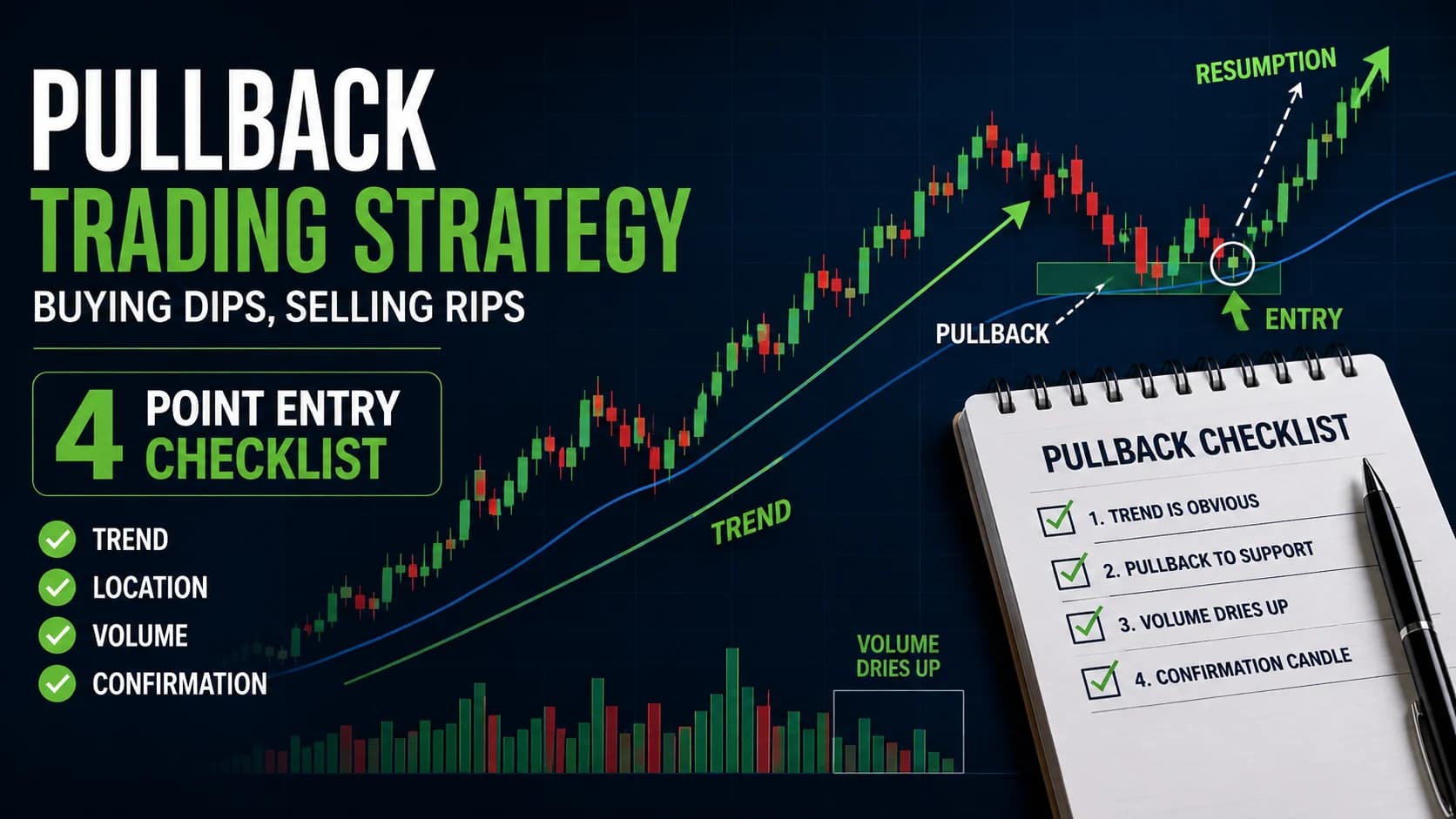
This guide's pullback trading strategy and this guide's market structure framework both pair naturally with anchored VWAP as confirmation layers, since a pullback that holds an anchored VWAP line while also confirming a higher low is a considerably stronger signal than any single method alone. For the complete library of related setups, this guide's Strategies hub covers everything else this framework builds on.
Frequently Asked Questions
How is anchored VWAP different from regular session VWAP?
Session VWAP is useful for intraday decisions since it reflects only the current day's participants. Anchored VWAP answers a different question entirely — what has the average participant paid since a specific, meaningful moment — which makes it more useful for multi-day and swing-oriented decisions than for pure intraday scalping.
Key Takeaway: Session VWAP measures today; anchored VWAP measures everything since a chosen turning point.
What makes a good anchor point for this strategy?
The anchor needs to represent a moment where a meaningful cohort of traders and institutions actually made a decision, which is what gives the resulting average price real weight as a level other participants are likely to respect. An anchor chosen purely because it produces a flattering-looking line in hindsight has no such backing.
Key Takeaway: A valid anchor represents a real decision point for market participants, not just a convenient-looking spot on the chart.
Who popularized anchored VWAP as a trading technique?
Shannon's contribution was reframing VWAP from a single-session institutional benchmark into a flexible tool that could be anchored to any meaningful point in a stock's history, extending its usefulness well beyond the original single-day execution-quality purpose.
Key Takeaway: Anchored VWAP is a well-established, credentialed extension of VWAP's original institutional-benchmark role, not a fringe technique.
Can two traders anchor the same stock differently and both be right?
This is the same kind of subjectivity this guide's trendline strategy faces with wick-versus-body construction. The practical answer isn't finding the single "correct" anchor — it's picking a specific, defensible rule for what counts as a valid anchor and applying it consistently rather than shopping for whichever anchor flatters a preferred conclusion.
Key Takeaway: Reasonable anchor disagreement is normal; consistency in the selection rule matters more than finding one "true" anchor.
Does this strategy work as an intraday trade or only as a swing trade?
An anchor set earlier the same trading day can technically work intraday, but the strategy's real advantage — tracking participation since a meaningful event regardless of how many sessions have passed — is most useful when the anchor point is genuinely older than the current session.
Key Takeaway: This is primarily a multi-day framework; intraday use is possible but underuses its main advantage.
What happens if the original anchor point stops being relevant?
Continuing to trade an outdated anchor because a position was already built around it is a rationalization risk similar to redrawing a trendline to justify a losing trade. The anchor should reflect the most currently relevant significant pivot, not whichever one was chosen first.
Key Takeaway: Re-anchor to a genuinely more significant pivot when one forms — don't defend an outdated anchor out of attachment.
Can anchored VWAP be combined with market structure or trendlines?
Each method measures something slightly different: anchored VWAP tracks volume-weighted participation since an event, market structure tracks the raw sequence of swing points, and trendlines track a drawn diagonal reference. Agreement across two or more of these independently calculated methods reduces the odds that any single one is giving a false signal.
Key Takeaway: Use anchored VWAP as one layer of confirmation alongside structure or trendlines, not as a standalone signal in isolation.
Does this strategy require special software, or can it be done manually?
Manually plotting an anchored VWAP line simply requires clicking on the chosen anchor candle in most modern charting platforms. Automation becomes more valuable when scanning many stocks for genuine anchored-VWAP setups, since manually testing anchor points across dozens of charts is considerably more time-consuming than doing so on one or two names.
Key Takeaway: Manual anchoring works fine for a focused watchlist; automation earns its cost at scale.
What's the minimum reward-to-risk this strategy should require?
Because anchored VWAP trades often play out over a longer holding period than intraday setups, the absolute dollar risk and reward figures tend to be larger, but the same proportional minimum applies before a setup is considered worth taking.
Key Takeaway: The 2:1 reward-to-risk floor applies here exactly as it does across this guide's other continuation strategies.
Disclaimer
Article Sources
- Alphatrends: Anchored VWAP - Brian Shannon, CMT, is widely credited with popularizing anchored VWAP methodology in modern technical analysis; referenced here for the core anchor-point framing this guide's strategy is built around.alphatrends.net
- Investopedia: Volume-Weighted Average Price (VWAP) - reference for the standard VWAP calculation underlying the anchored variant.investopedia.com
- CME Group: Benchmark Administration - reference for VWAP's original role as a formal institutional execution benchmark.cmegroup.com
- StockCharts ChartSchool - reference for standard VWAP and trend-continuation charting conventions used throughout this guide.chartschool.stockcharts.com