
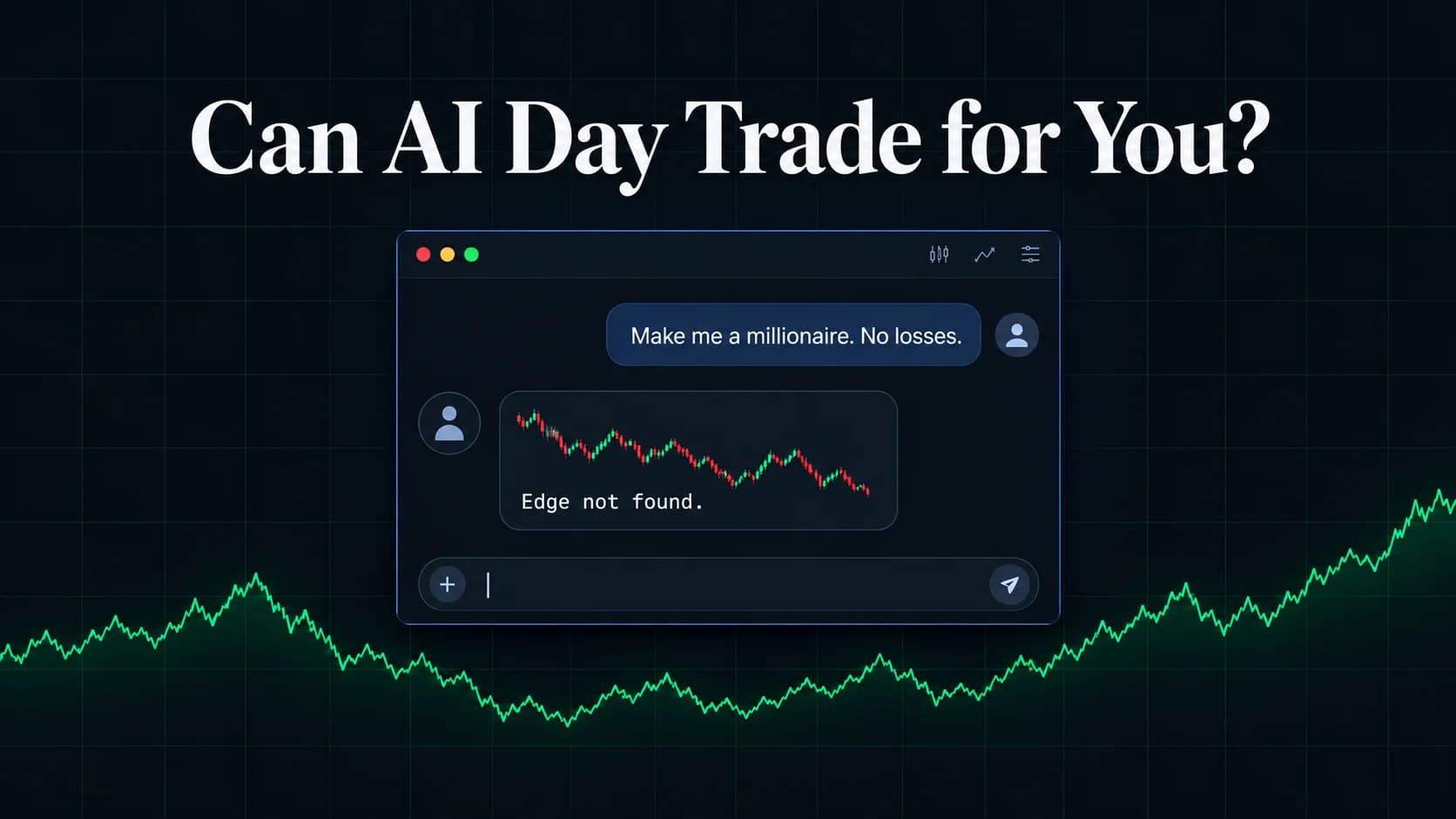
Somewhere right now, a trader is typing this into a chatbot: "Find me a stock that will double this week. Manage the trade. Don't lose."
It's a reasonable thing to want. Claude and ChatGPT can write code, summarize an EarningsAn earnings report is the quarterly financial disclosure a public company files with the SEC, revealing revenue, earnings per share (EPS), profit margins, and forward guidance — it's the most significant regular catalyst for individual stocRead definition → call in seconds, and explain options Greeks better than most textbooks. Several US brokers now let an AI agent place real orders. Social media is full of screenshots of bots turning a few hundred dollars into six figures.
So can AI actually day trade for you?
The short answer: A general AI chatbot like ChatGPT or Claude can't reliably day trade for you, and nothing in the public record shows one doing it profitably over a meaningful stretch of time. What AI does well is the work around trading: preparing for the session, explaining concepts, writing and testing code, and holding you to your own rules. The traders who get real value from AI use it as a research assistant and a DisciplineTrading discipline is the consistent application of your predefined rules — entries, stops, targets, position sizing, maximum daily loss — regardless of what you're feeling in the moment.Read definition → partner, not as the trader.
In 30 seconds
- General chatbots have no built-in trading edge. Everyone has access to the same model, and it doesn't see live market data unless you connect it to some.
- The best-documented public "let AI trade" experiments look impressive early and much less impressive later.
- AI is genuinely useful for session prep, research summaries, coding and BacktestingThe process of running a defined trading strategy against historical price data to evaluate how it would have performed before risking real capital. A well-constructed backtest gives you a statistical baseline — win rate, profit factor, maxRead definition → help, rule checklists, and journal review.
- Agentic broker connections can place real trades, which means a mistake becomes a real loss. Read the permissions before you connect anything.
- Regulators warn that "AI trading systems that can't lose" are a classic fraud pattern.
What "let AI trade for me" actually means in 2026
When people say "AI trading," they usually mean one of three very different things. Mixing them up is where most of the confusion, and a lot of the losses, come from.
1. A general chatbot giving you trade ideas. You AskThe ask is the lowest price a seller is currently willing to accept. When you buy with a market order, you pay the ask.Read definition → ChatGPT, Claude, Gemini, or Grok what to buy, and it answers. The model is a language model. It predicts useful text based on patterns it learned and anything you or a connected tool feed it. It isn't watching the tape.
2. An AI agent connected to your brokerage account. This is newer. Robinhood, Public, and eToro now let an AI agent place real trades through integrations built on MCP, the same protocol behind Claude's and ChatGPT's tool connections. The agent can read your positions and send orders. We break down how those connections work and what you're granting access to in our guide to connecting Claude or ChatGPT to your brokerage account, and we compare the permission models in Robinhood vs. Public vs. eToro.
3. A purpose-built trading AI. These are systems designed for one job: scanning markets and generating trade signals from strategies tested against historical data. Trade Ideas' Holly engine is an example. It's a different category from a chatbot, and we cover how it works below.
The question "can AI trade for me" has a different honest answer for each one.
What the public experiments actually show
The good news is that several people have run "let the AI trade" experiments in public, with logs. Here's what the best-documented ones show when you read past the headline.
The $100 ChatGPT micro-cap experiment
In mid-2025, Nathan Smith gave ChatGPT control of a $100 portfolio limited to US micro-cap stocks and planned to run it for six months. Four weeks in, the portfolio was up 23.8% while the Russell 2000 and the XBI biotech ETF rose about 3.9% and 3.5%. That's the version that went viral.
The less-shared part is what happened next. By week 21 of his public log, the ChatGPT portfolio was worth $69.98, against $108.53 for the same $100 in the S&P 500. It had hit a maximum DrawdownA drawdown is the peak-to-trough decline in account equity — it measures how far you've fallen from your high-water mark, either from a single losing trade or a series of losing trades.Read definition → of -50.33% in early November 2025. To his credit, Smith published all of it, including the bad weeks, and he was clear from the start that he executed the trades himself and adjusted when the model contradicted itself.
The $100,000 Claude Code experiment
In late 2025, developer Jake Nesler let Claude Code trade a $100,000 account for about a month. The important detail is in his first line: it was a paper trading account through Alpaca, not real money.
The account peaked at +20.4%, then fell 22.4% from that peak after a Broadcom earnings miss hit concentrated tech positions, and finished around +7.6% against roughly 4.5% for the market. Nesler's own conclusion was blunt. He called it "vibe trading," said the result wasn't a number you can trust without a longer test, and urged readers not to use his code with real money.
The Polymarket bot screenshots
The loudest 2026 stories came from prediction markets. One widely shared report said a "Claude-powered" bot turned $1 into $3.3 million on Polymarket. Read the article itself and you'll find it describes a high-speed sports arbitrage strategy placing bets multiple times a minute. It doesn't show any evidence of how Claude was involved.
Meanwhile, researchers at the IMDEA Networks Institute analyzed 86 million Polymarket bets and found arbitrage traders extracted almost $40 million over a year, with the biggest accounts behaving like bots. That money came from other participants. When a bot wins at that scale, someone on the other side is usually a person clicking buttons.
Why a chatbot can't just "make you rich"
None of this means the models are bad. It means trading is a strange problem for a language model, for reasons that have nothing to do with intelligence.
There's no built-in edge. An edge is something that works for you and not for everyone else. Millions of people can ask the same model the same question. If "ask ChatGPT what will go up" were an edge, it would be competed away almost instantly.
It doesn't see the market unless you show it. A chatbot without live data tools is working from its training data and whatever you paste in. Day trading decisions depend on price, volume, spread, and liquidity right now. Even with a search or data tool connected, the model sees a snapshot, not the order flow.
It sounds right even when it's wrong. Language models can state wrong numbers, outdated facts, or invented details with complete confidence. In most tasks that's an annoyance. In trading, a confident wrong number is a position size, a stop level, or a ticker.
It doesn't own your risk. The model doesn't lose sleep, doesn't get margin calls, and doesn't pay for slippage. You do. Nesler's experiment showed this clearly: the agent took a 22% drawdown in about a week without any of the emotional cost that would have stopped a human.
Speed games are already taken. The bot wins that make headlines are mostly speed and arbitrage strategies. Those depend on infrastructure, latency, and fees, not on how clever a prompt is. A retail trader typing into a chat window isn't competing in that race.
The scams know the hype. In a joint investor alert, the SEC, FINRA, and NASAA warned about unregistered platforms promoting "AI trading systems" with claims like "can't lose" or guaranteed winners. Their advice is simple: guaranteed high returns with little or no risk are classic warning signs of fraud, and you shouldn't rely solely on AI-generated information to make investment decisions.
What AI is genuinely good at for day traders
Here's the part the "AI will trade for you" crowd skips. Used as an assistant, these tools can save real time and make you a more disciplined trader. Some of the most useful jobs:
Pre-market prep. Paste in a company's earnings release, an 8-K, or a news summary and ask for the three things most likely to move the stock today, plus what would invalidate each one. You still check the source. The model just gets you to the right paragraph faster.
Explaining things you half-understand. Ask it to explain VWAP, short interest, a halt code, or options gamma at your level, then ask follow-up questions until it clicks. This is where language models are strongest.
Writing and checking code. If you build scanners, alerts, or backtests, AI coding tools can write the first draft and catch bugs. The model can write a backtest. It can't tell you whether the backtest is honest, so watch for look-ahead bias and missing costs.
Turning your plan into a checklist. Give it your strategy rules and ask it to turn them into a pre-trade checklist. Before each trade, paste in the setup and ask it to check it against your rules. It's useful precisely because it doesn't care about FOMO.
Reviewing your journal. Export a month of trades and ask what your losing trades have in common: time of day, hold time, setup type, position size. Dedicated journaling tools do this too. Our breakdown of TraderSync's Cypher AI coach shows what that kind of AI review can and can't tell you.
Stress-testing a trade idea. Ask: "Argue against this trade. What would make it fail?" A model is good at producing the counterargument you didn't want to hear.
Chatbot vs. agent vs. purpose-built trading AI
- What it is
- General chatbot
- A language model answering questions
- AI agent connected to a broker
- A language model that can place orders
- Purpose-built trading AI
- A system built to scan markets and generate signals
- Sees live market data
- General chatbot
- Only if you connect a data tool
- AI agent connected to a broker
- Your account and whatever data the integration provides
- Purpose-built trading AI
- Yes, by design
- Strategies tested on history
- General chatbot
- No
- AI agent connected to a broker
- Only if you build that yourself
- Purpose-built trading AI
- Yes, that's its core job
- Can place real trades
- General chatbot
- No
- AI agent connected to a broker
- Yes
- Purpose-built trading AI
- Depends on the platform and your settings
- Biggest risk
- General chatbot
- Confident wrong answers
- AI agent connected to a broker
- A wrong answer becomes a real order
- Purpose-built trading AI
- Trusting signals without testing them on your own terms
- Best use
- General chatbot
- Research, learning, coding, checklists
- AI agent connected to a broker
- Narrow, rule-based tasks with tight permissions
- Purpose-built trading AI
- Finding and structuring setups you still choose to take
| General chatbot | AI agent connected to a broker | Purpose-built trading AI | |
|---|---|---|---|
| What it is | A language model answering questions | A language model that can place orders | A system built to scan markets and generate signals |
| Sees live market data | Only if you connect a data tool | Your account and whatever data the integration provides | Yes, by design |
| Strategies tested on history | No | Only if you build that yourself | Yes, that's its core job |
| Can place real trades | No | Yes | Depends on the platform and your settings |
| Biggest risk | Confident wrong answers | A wrong answer becomes a real order | Trusting signals without testing them on your own terms |
| Best use | Research, learning, coding, checklists | Narrow, rule-based tasks with tight permissions | Finding and structuring setups you still choose to take |
The third column is worth understanding if you want AI involved in finding trades. A purpose-built engine like Trade Ideas' Holly runs dozens of strategies and, according to Trade Ideas, re-tests and adjusts its strategy set every night against historical data. Each signal arrives with an entry, a target, a stop type, and a suggested hold time. That's a structured trade idea, which is very different from a chatbot's opinion.
It still isn't a money machine, and it doesn't make the decision for you. You choose which signals fit your account, your schedule, and your risk. The sensible way to start is in paper trading, which is included on every Trade Ideas plan. Our full guide to Trade Ideas AI Signals covers which plan includes them and how to test them.
affiliate disclosure
If you're comparing prices, our Trade Ideas deals page always has the current discount.
A safer way to use AI in your trading
Bringing AI into your trading without handing it the keys
5 stepsWrite your rules first
Entry criteria, maximum loss per trade, maximum loss per day, and when you stop trading. AI can only enforce rules that exist.
Use AI for research and prep, not decisions
Let it summarize news and filings, explain concepts, and draft your watchlist notes. Check every number against the original source.
Test anything systematic in simulation
Whether it's an AI-written strategy or AI-generated signals, run it on paper long enough to see a bad week, not just a good one.
If you connect an agent, give it the smallest permissions possible
Prefer setups that require your approval before each order. Never give an agent withdrawal access or access to money you can't afford to lose.
Review weekly
Look at what the AI-assisted trades actually did versus your plan. Keep what helps. Cut what doesn't.
Red flags: when "AI trading" is really a sales pitch
- Guaranteed returns, "can't lose," or win rates near 100%.
- Results shown only as screenshots, with no account history, no drawdowns, and no time period.
- Pressure to deposit quickly or move money to a platform you can't verify.
- Claims that a famous AI model is "behind" a product, with no explanation of what it actually does.
- Anyone asking for your broker password or withdrawal permissions so "the AI" can trade.
You can check whether a firm or person is registered on FINRA BrokerCheck before sending money anywhere.
Can ChatGPT day trade for me?
Can Claude trade stocks for me?
Are AI trading bots profitable?
What's the difference between ChatGPT and a trading AI like Trade Ideas' Holly?
Is it safe to connect an AI agent to my brokerage account?
What's the best way to use AI as a day trader?
How can I tell if an "AI trading" offer is a scam?
Article Sources
- Nathan Smith, ChatGPT Micro-Cap Portfolio weekly log (Week 21) - portfolio value, drawdown, and S&P 500 comparisonnathanbsmith729.substack.com
- Benzinga: Redditor's $100 ChatGPT experiment - first-month results and setupbenzinga.com
- Jake Nesler: I gave Claude Code $100k to trade with for a month - paper trading results and author's warningsmedium.com
- Finbold: Claude-powered bot on Polymarket - the viral $1 to $3.3 million reportfinbold.com
- DL News: Polymarket users lost millions to bot-like bettors - summary of the IMDEA Networks studydlnews.com
- NASAA: Artificial Intelligence and Investment Fraud investor alert - joint SEC, FINRA, and NASAA alertnasaa.org