
AskThe ask is the lowest price a seller is currently willing to accept. When you buy with a market order, you pay the ask.Read definition → Cypher AI why your Win RateWin rate is the percentage of your trades that result in a profit — calculated as (number of winning trades ÷ total trades) × 100 — and while commonly cited as a measure of trading success, it means very little without also knowing the averRead definition → dropped last week, and it can tell you, with real precision, that your losing trades averaged a 40-minute hold while your winners averaged 12. Ask it why you kept holding those losers past your stop, and it has nothing to offer, because that question lives in the trade note you wrote, not in the numbers Cypher was built to analyze. Understanding that line, clearly, before you subscribe expecting more, is the single most useful thing this article can tell you.
What Cypher AI Actually Is
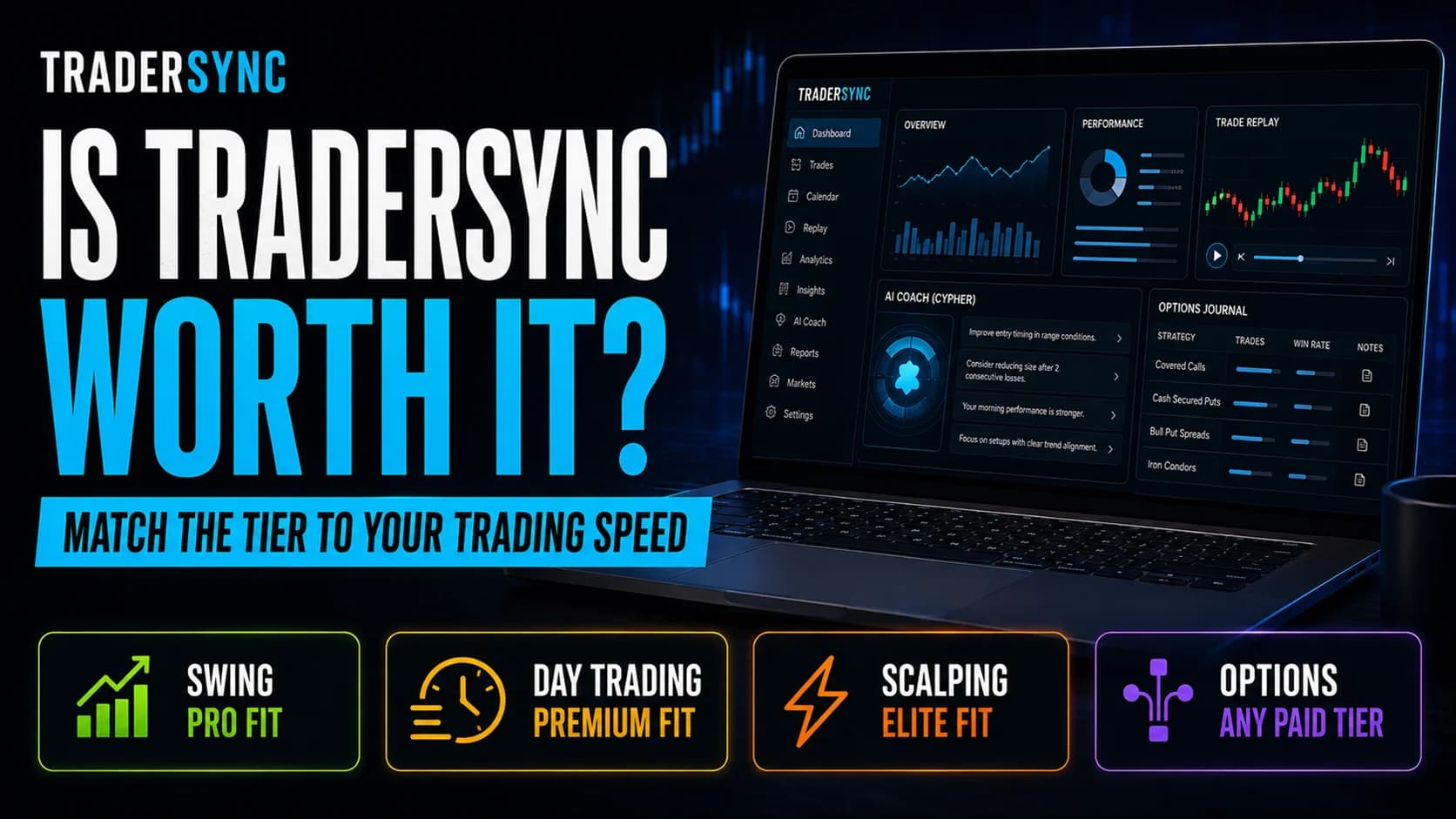
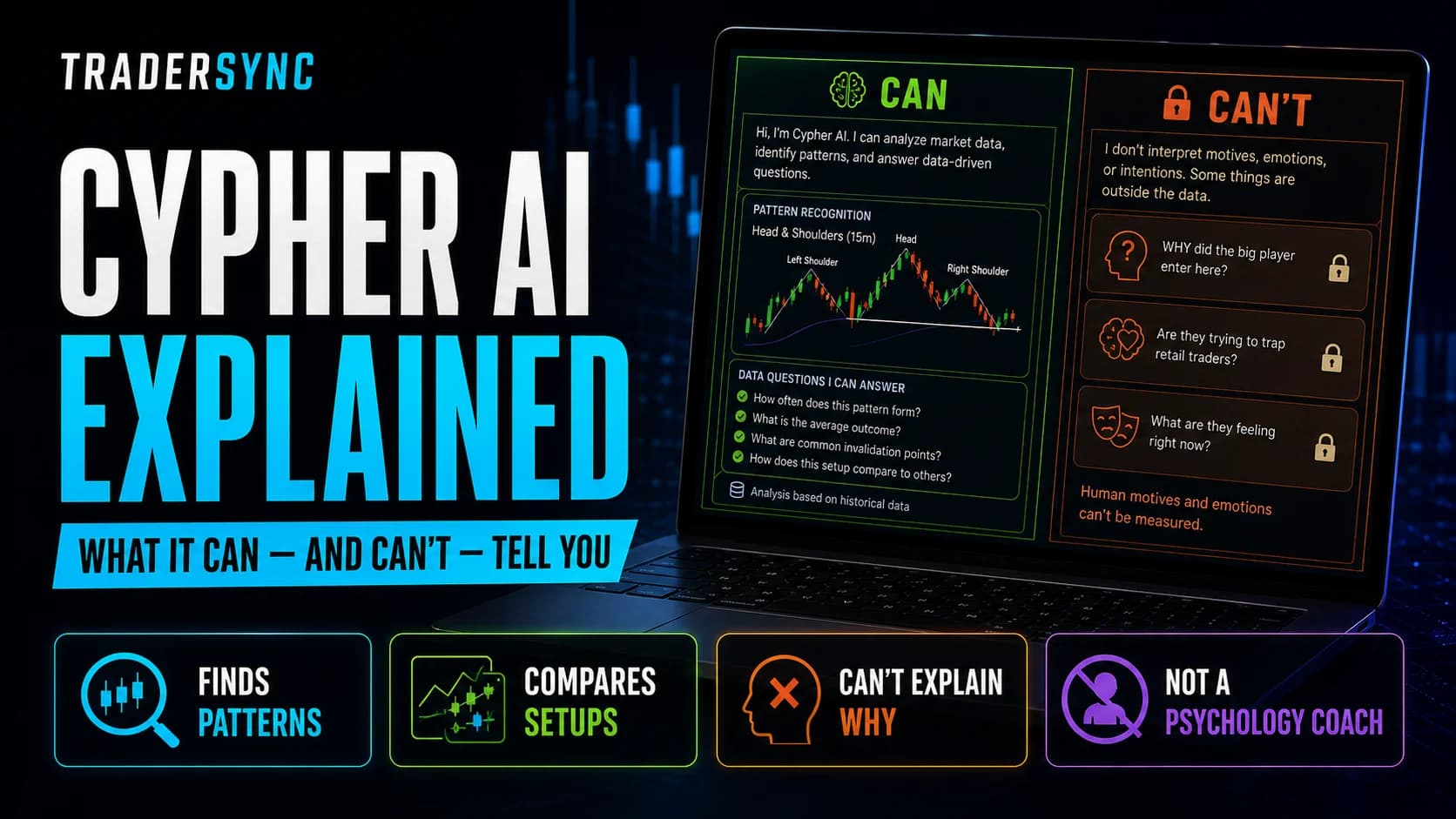
Cypher is TraderSync's conversational AI coach, available on Premium and Elite (capped at 5 messages a day on Pro). You ask it natural-language questions about your own trading data, "what's my win rate on VWAPVWAP (Volume Weighted Average Price) is the average price a security has traded at throughout the session, weighted by volume — it's the most important intraday indicator for day traders, serving as a real-time measure of fair value and theRead definition → bounce setups in the first hour?", and it responds with a specific, data-driven answer pulled from your logged trades. It also proactively surfaces patterns: flagging that you consistently overhold losing trades on Fridays, or that your largest losses cluster in a specific time window.
This is genuinely useful, and it's worth being specific about why: most traders never actually run this kind of cross-tabulated analysis on their own data, even when the raw numbers exist in their journal. Cypher does the querying you'd otherwise need spreadsheet skills and spare time to do yourself.
What Cypher Can Actually Tell You
Statistical patterns across your logged data. Win rate by setup, by time of day, by day of week, by holding period. If a pattern exists in the numbers you've entered, Cypher can surface it and quantify it.
Correlations you wouldn't think to check. The proactive coaching layer is where Cypher earns its keep. It can flag that your Friday performance is meaningfully worse than the rest of the week, or that trades held longer than 30 minutes lose money disproportionately more often than shorter ones, without you having to think to ask that specific question first.
Direct answers to specific data questions. "How many trades did I take on breakouts in the last 90 days, and what was my average R?" is exactly the kind of question Cypher is built to answer instantly, where manually filtering a spreadsheet would take real time.
What Cypher Can't Tell You
Why you actually made a decision. Cypher's analysis is statistical, not interpretive. It can show you that your losses cluster around a specific time window; it can't read your trade note explaining you were distracted by something outside trading that day and connect that to the pattern.
The emotional texture in your own notes. If you wrote "held because I couldn't accept the loss" on a losing trade, that's a direct, honest description of Loss AversionLoss aversion is the psychological tendency to feel the pain of a loss approximately twice as intensely as the pleasure of an equivalent gain — making traders hold losers too long and cut winners too early, which is one of the most well-docRead definition → in the moment, exactly the kind of insight a human trading coach would seize on. Cypher doesn't synthesize free-text emotional content into behavioral observations; it works from structured, quantifiable data.
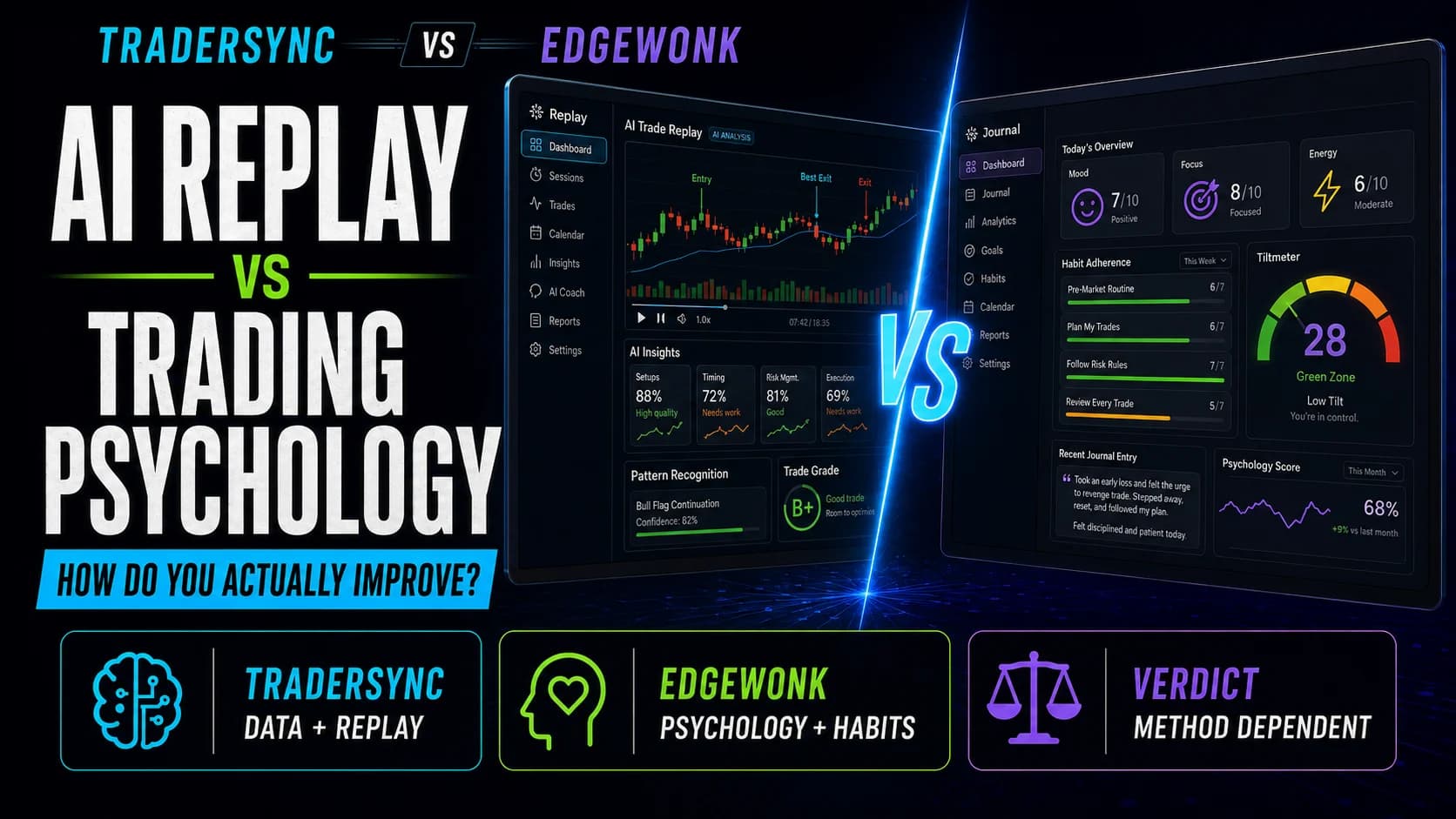
A genuine psychology-tracking layer. This is a structural GapA gap is a price discontinuity on a chart where a stock opens significantly higher or lower than the previous session's close, leaving a visible empty space — gap-ups are driven by overnight buying pressure or positive news; gap-downs by seRead definition →, not a bug that gets fixed in a future update. TraderSync's own honest limitation, stated plainly, is that Cypher is a performance assistant, not a psychology tool. Platforms built specifically around emotional and behavioral tracking (Edgewonk's Tiltmeter is the clearest example in this category) go somewhere Cypher structurally doesn't.
Why This Distinction Actually Matters for Your Decision
If you're evaluating TraderSync partly because you want an AI that understands why you keep making the same mistake, not just that you're making it, Cypher will genuinely disappoint you, through no fault of its engineering. It's built to be excellent at one thing (statistical pattern detection across structured data) and it doesn't pretend to be something else. The disappointment only happens when the expectation is mismatched to what the tool actually does.
Compare that to what Cypher is legitimately excellent at: a trader who wants fast, specific answers to "show me the numbers" questions, rather than a coach interpreting the story behind them, gets real, daily value from this feature, especially once you're past Pro's 5-message cap.
A Realistic Example of the Boundary in Action
Say your journal shows a losing streak on Wednesday afternoons. Cypher can tell you: your win rate on Wednesdays after 1 PM is 31%, versus 58% across the rest of the week, and your average loss size in that window is 40% larger than your typical loss. That's a genuinely actionable, quantified pattern you might never have noticed manually.
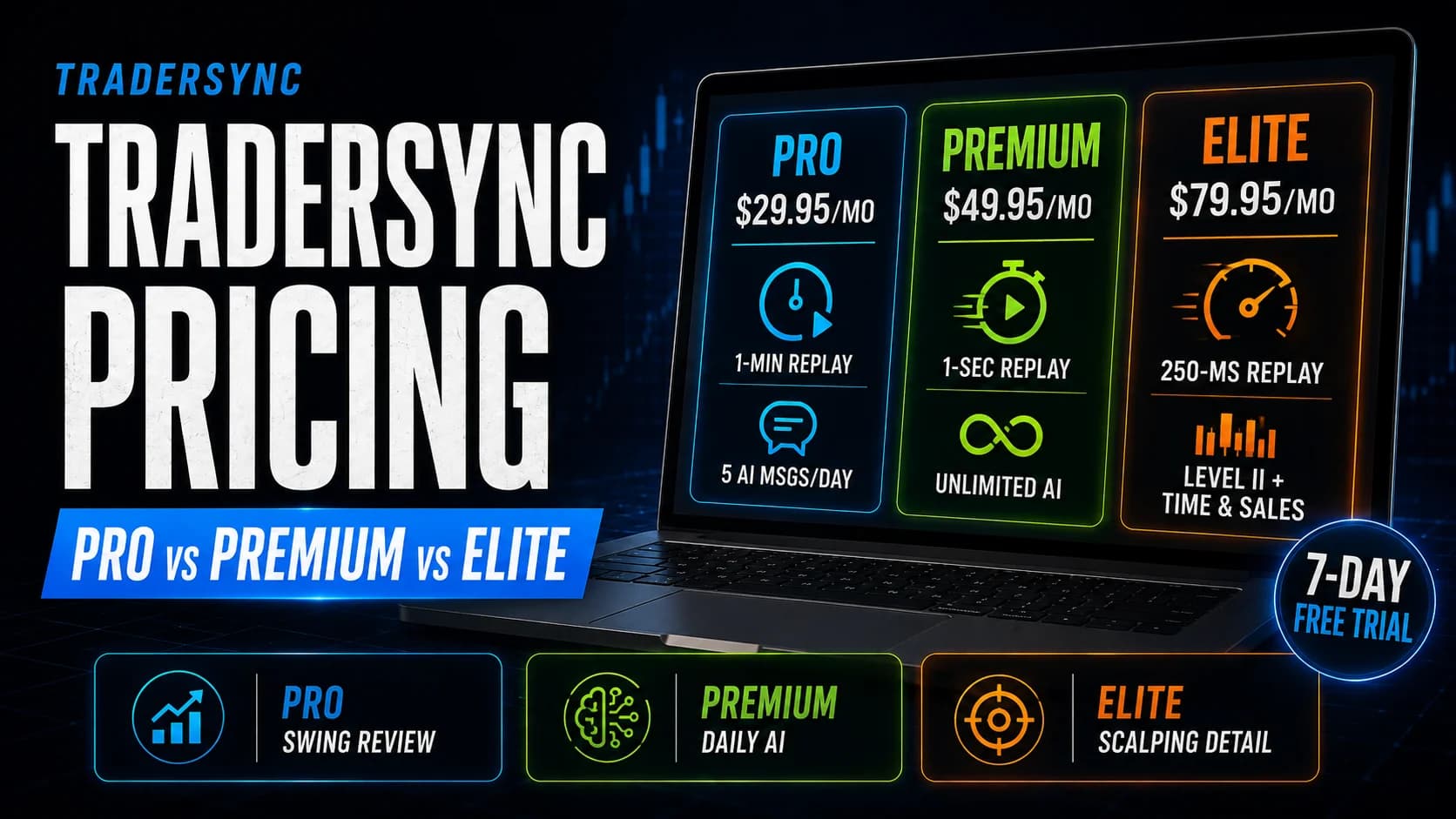
What Cypher won't tell you is why. Maybe you're trading Wednesday afternoons after a recurring standing meeting that leaves you distracted. Maybe it's a specific setup type you only take on Wednesdays that has a structural flaw. Cypher hands you the pattern; connecting it to a cause requires you to do the interpretive work yourself, ideally by rereading your own trade notes from that window with the pattern in mind. If Cypher's uncapped access is the reason you're considering an upgrade, see our pricing breakdown and cost-value breakdown for whether Premium is worth it, or start the 7-day trial to test Cypher on your own data first.
Is Cypher AI worth paying for the Premium tier specifically to unlock?
Price the Premium upgrade against how often you'd actually query Cypher in a normal week before assuming the uncapped access is worth the jump from Pro.
Key Takeaway: Only pay for uncapped Cypher access if you have a concrete, repeated use case for it.
Can I train Cypher to understand my specific trading style better over time?
The more consistently and accurately you tag and note your trades, the more useful Cypher's pattern detection becomes, since it's only as good as the underlying data you've logged.
Key Takeaway: Cypher's usefulness scales with how thoroughly you journal, not with any separate training process.
Does Cypher AI replace the need for a human trading coach or mentor?
Traders working through genuine behavioral or emotional trading issues typically need that human or specialized-psychology layer in addition to, not instead of, statistical journaling tools.
Key Takeaway: Treat Cypher as a data assistant, not a substitute for coaching or therapy-adjacent support.
How is Cypher different from a general-purpose AI chatbot asked about trading?
This makes Cypher's answers grounded in your real numbers rather than general trading advice, which is both its strength and the reason its scope stays limited to what's in your journal.
Key Takeaway: Cypher's value comes specifically from having your real data, not from broader trading knowledge.
Is Cypher's proactive coaching feature reliable, or does it miss things?
Treat proactive flags as a starting point for your own review, not a complete or infallible list of everything worth noticing in your trading.
Key Takeaway: Use Cypher's proactive suggestions as prompts for deeper personal review, not final verdicts.
Does using Cypher AI require a specific amount of trading history first?
A trader with only a handful of logged trades should treat early Cypher insights as preliminary rather than definitive.
Key Takeaway: Give Cypher enough logged trade history before trusting its pattern flags as solid conclusions.
Is there a competing journal with AI that does understand the emotional side of trading better?
See our TraderSync vs. Edgewonk comparison for the full breakdown of that difference.
Key Takeaway: If psychology tracking is your priority, evaluate Edgewonk specifically rather than expecting Cypher to close that gap.
Article Sources
- TraderSync Official Site - Cypher AI feature documentationtradersync.com
- Investopedia: Trading Psychology - background on behavioral factors in tradinginvestopedia.com
- Journal of Behavioral Finance research overview via NBER - academic context on trading behavior researchnber.org