
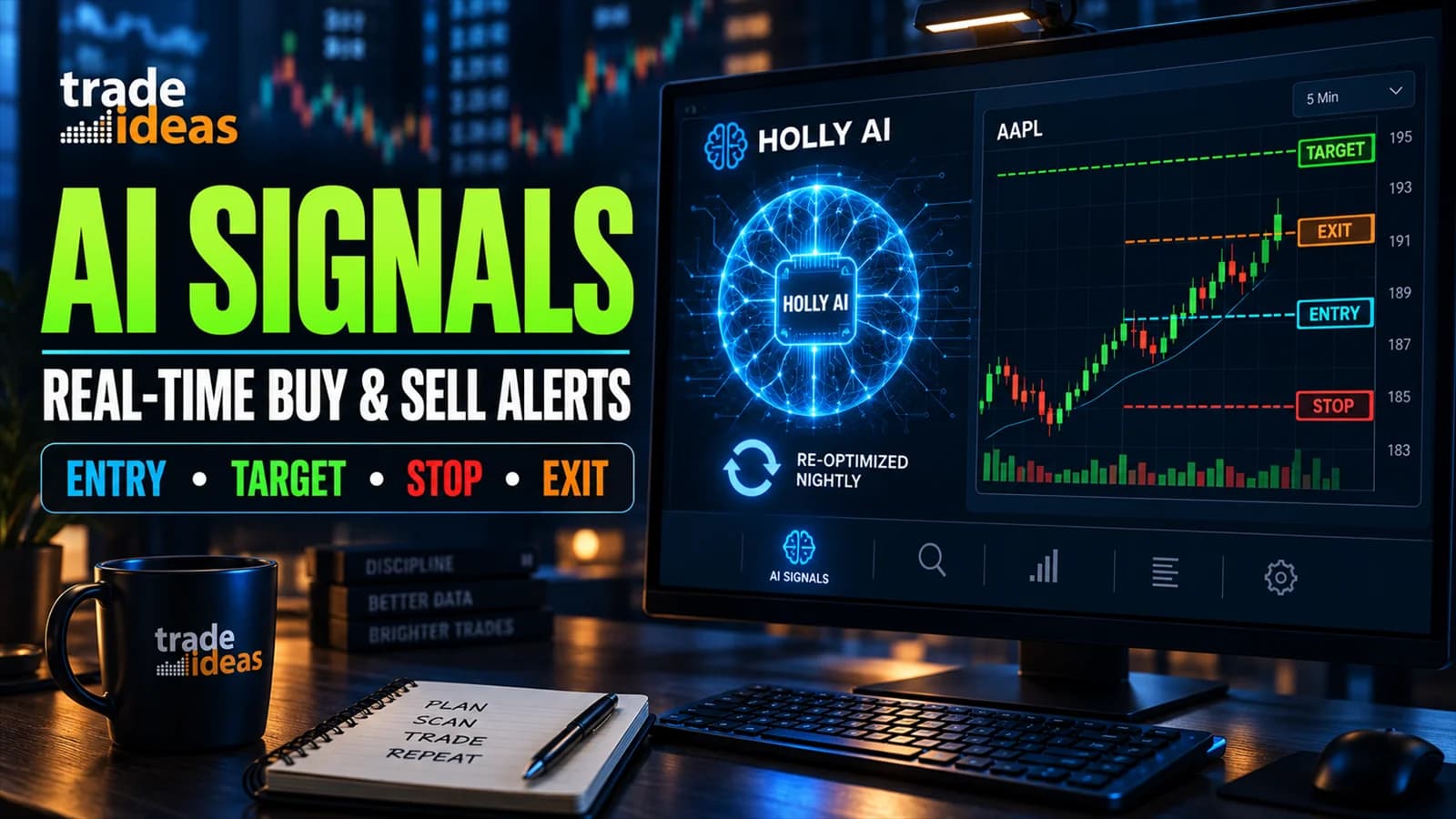
Most traders looking for AI trading signals end up in the same place: a Telegram group, a Discord room, or a subscription that sends a ticker and nothing else. No entry price. No stop. No exit. Just a symbol and the hope you figure out the rest before the move is gone.
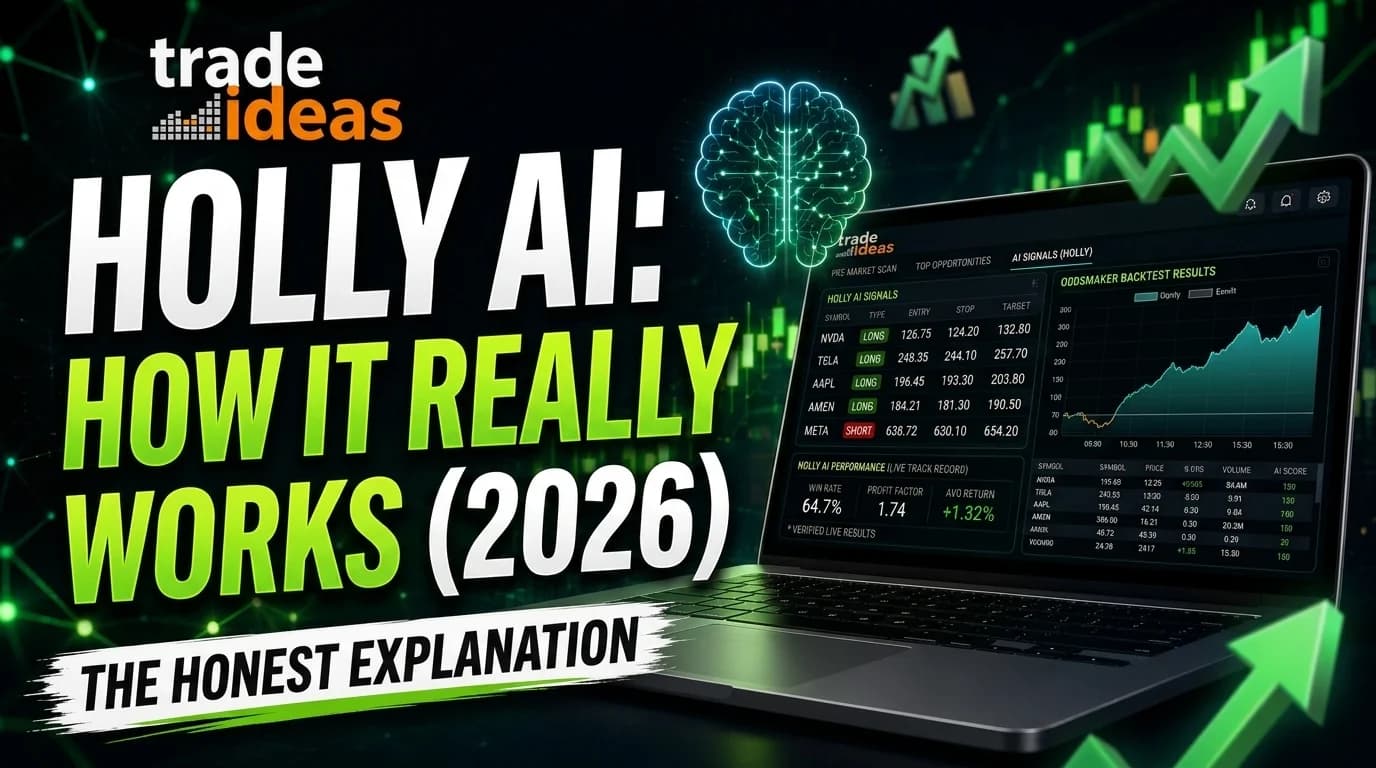
Trade Ideas AI Signals work differently, and the difference is the part that actually matters when real money is on the line: every signal arrives with an entry point, an exit point, and the levels to manage the trade around, generated in real time by an AI engine that rebuilds itself every single night.
What are Trade Ideas AI Signals? Trade Ideas AI Signals are real-time buy and sell alerts generated by Holly, the platform's AI trading engine. Each signal includes entry and exit points with corresponding target prices and stop types, delivered live during market hours with no scan-building or setup required from you.
If that's the kind of signal you've been looking for, you can see Trade Ideas AI Signals here.
What You Get With Every AI Signal
This is the part that separates a real AI signal service from a ticker feed. Trade Ideas describes Holly's output as "precision buy/sell signals with entry and exit points in real-time," and in practice each signal carries the full trade structure:
- An entry signal on a specific symbol, fired live as the setup triggers rather than in a nightly email you read after the move
- A target price attached to that entry, so you know what the AI is actually playing for
- A stop type, meaning the exit side is defined before you're in the position rather than improvised while it moves against you
- A hold time recommendation, which tells you whether this is a quick intraday rotation or something with room to develop
- No setup required, in Trade Ideas' own words. You don't build the scan, tune the filters, or maintain anything. The signals arrive already formed.
That last point is the one most people underestimate. Every other route to signals of this quality means building and maintaining your own screening system, then validating it across enough history to trust it. Holly's output is the finished product of that work, running whether or not you're at your desk.
How the AI Actually Generates Them
You don't need to understand the machinery to trade the signals, but knowing it isn't a black box helps.
Holly runs dozens of separate trading strategies, each built on algorithms designed to recognize patterns, anomalies, and specific market conditions that have historically preceded trading opportunities. The critical piece is what happens overnight: according to Trade Ideas, the scan modifies itself every night based on simulated BacktestingThe process of running a defined trading strategy against historical price data to evaluate how it would have performed before risking real capital. A well-constructed backtest gives you a statistical baseline — win rate, profit factor, maxRead definition → against past data. The strategies that held up get weighted forward. The ones that stopped working get dropped.
The practical consequence is that the signal engine you're trading on Monday isn't the same one you traded in March. It's continuously re-fit to what the market is currently rewarding, which is precisely the failure point of static indicator-based alert services that were tuned once and never revisited.
Trade Ideas markets Holly as "the most powerful artificial intelligence trading engine in fintech." That's their claim, not a measured benchmark, but the underlying architecture (nightly re-optimization across a rotating strategy set) is genuinely uncommon in the retail AI signal category. If you want the full mechanical breakdown of how that nightly simulation works, our Holly AI deep dive covers it in detail.
Why AI Signals Beat Building Your Own Scans
If you're already running your own screens, the honest question is what an AI signal engine adds. Three things:
Coverage you physically can't match. Holly evaluates the market continuously across dozens of concurrent strategies. A human running three or four scans is watching a fraction of that surface area, and only during the hours they're actually at the screen.
Adaptation you'd have to do manually. Your scan criteria decay. The BreakoutA breakout is when price moves decisively beyond a defined level — a resistance zone, a consolidation boundary, a chart pattern boundary, or a prior high — suggesting that the previous supply at that level has been overcome.Read definition → filter that printed winners in a trending market produces nothing but ChopChop is a market condition where price oscillates back and forth in a tight, directionless range with no follow-through in either direction — breakouts fail, pullbacks reverse, and every trade feels like a coin flip.Read definition → in a RangeA range (or trading range) is a price zone where a stock oscillates between a defined support floor and resistance ceiling without making meaningful new highs or lows — price is consolidating rather than trending, and the dominant trade is Read definition →. Re-fitting that yourself means backtesting work most traders never get around to. Holly does it nightly by design.
A complete trade, not just an idea. A scan hit tells you something is happening. An AI signal tells you where to get in, what it's targeting, what kind of stop to use, and roughly how long to hold. That's the difference between a lead and a plan.
None of that removes your judgment from the process. You still decide which signals fit your risk tolerance, your account size, and your schedule. What changes is that you're choosing from a stream of fully-formed setups instead of manufacturing them from scratch.
Which Plan Includes AI Signals
Trade Ideas splits its platform into two annual plans, and AI Signals live on the upper one.
- The Core (TI Standard)
- Annual price
- The Apex (TI Premium)
- $1,068
- The Core (TI Standard)
- Published monthly equivalent
- The Apex (TI Premium)
- $89/mo
- The Core (TI Standard)
- Annual saving vs. monthly
- The Apex (TI Premium)
- $456
- The Core (TI Standard)
- 1st Gen AI Signals
- The Apex (TI Premium)
- Not included
- The Core (TI Standard)
- Backtesting
- The Apex (TI Premium)
- Not included
- The Core (TI Standard)
- Smart Risk Levels
- The Apex (TI Premium)
- Not included
- The Core (TI Standard)
- Auto Trading
- The Apex (TI Premium)
- Not included
- The Core (TI Standard)
- Real-time data, charting, paper trading
- The Apex (TI Premium)
- Included
- The Core (TI Standard)
- TI Wave
- The Apex (TI Premium)
- Included
- The Core (TI Standard)
- Customizable scans, screeners, 500+ data points
- The Apex (TI Premium)
- Included
| The Core (TI Standard) | The Apex (TI Premium) |
|---|---|
| Annual price | $1,068 |
| Published monthly equivalent | $89/mo |
| Annual saving vs. monthly | $456 |
| 1st Gen AI Signals | Not included |
| Backtesting | Not included |
| Smart Risk Levels | Not included |
| Auto Trading | Not included |
| Real-time data, charting, paper trading | Included |
| TI Wave | Included |
| Customizable scans, screeners, 500+ data points | Included |
The short version: The Core gives you the real-time scanning platform to find setups yourself. The Apex is the plan that includes AI Signals, which Trade Ideas labels "1st Gen AI Signals" on its pricing page, alongside backtesting, Smart Risk Levels, and auto trading. Trade Ideas flags The Apex as its most popular plan, and its own positioning is direct about why: "Our Signals Make Us the #1 Service for Active Investors."
If AI signals are the reason you're here, The Apex is the plan. There's no way to add them to the cheaper tier.
One thing worth doing before you subscribe: Trade Ideas discounts both plans periodically, and the savings on an annual Apex subscription are substantial enough to be worth thirty seconds of checking. Our deals page is kept current with whatever offer is live, including the code.
How to Start Getting AI Signals
The fastest path from here to live signals on your screen:
- Create your account through the Trade Ideas AI Signals page and choose The Apex plan, since that's the tier carrying the AI signal engine.
- Let Holly populate. The signals stream in real time during market hours, already formed with entry, target, and stop GuidanceGuidance is forward-looking financial projections that a company's management provides for upcoming periods — typically covering expected revenue, earnings, or margins — and the market's reaction is often driven more by guidance than by theRead definition →. There's no scan to build first.
- Paper trade the signals before sizing up. Real-time paper trading is included on every plan. Trading the AI's calls in simulation for a few sessions tells you which of Holly's strategies actually suit your temperament and schedule before you commit capital.
- Validate with backtesting. The Apex includes backtesting, so you can score a given strategy against historical data yourself instead of taking any signal on faith.
- Connect execution when you're ready. Trade Ideas' brokerage integrations support acting on signals directly, and the platform reported 108 million shares traded in August through those partnership integrations.
That sequence matters. The traders who get the most out of an AI signal engine are the ones who spend the first couple of weeks learning which signals they can actually execute well, rather than trying to trade all of them on day one.
When you're ready, start with Trade Ideas AI Signals here and Holly's signals begin streaming as soon as your account is active. If there's a discount running, it'll be on our deals page.
What are AI trading signals?
The quality difference between services comes down to what arrives with the alert. A bare ticker symbol leaves you to do the actual trading work. Trade Ideas' AI Signals include entry and exit points, target prices, stop types, and hold-time guidance, which is the difference between receiving an idea and receiving a trade plan.
Key Takeaway: Judge any AI signal service by whether the signal tells you how to manage the trade, not just what to look at.
How do Trade Ideas AI Signals work?
The distinguishing feature is nightly re-optimization: Trade Ideas states the scan modifies itself every night based on simulated backtesting against past data, so the strategy mix continuously re-fits to current market behavior rather than running on criteria set months ago.
Key Takeaway: The engine adapts nightly, which is what separates it from static indicator alerts.
Do I need to set up scans to receive AI signals?
This is a meaningful practical difference from the rest of the platform, where customizable scans and screeners reward traders who enjoy building their own criteria. AI Signals are the opposite experience: you open the platform and the setups are already there, ranked and structured.
Key Takeaway: Start with AI Signals if you want the output without building the system.
Which Trade Ideas plan do I need for AI Signals?
The Core (TI Standard) plan at $1,068 annually includes real-time data, charting, paper trading, TI Wave, customizable scans and screeners, and 500+ data points, but not the AI signal engine. Trade Ideas lists "1st Gen AI Signals" as an Apex-tier feature, alongside backtesting, Smart Risk Levels, and auto trading.
Key Takeaway: AI Signals require The Apex; they can't be added to The Core.
How much do Trade Ideas AI Signals cost?
Trade Ideas runs promotional discounts on both plans through the year, so the effective price is often below list. Current pricing and any active discount code are always kept up to date on our deals page.
Key Takeaway: Check the deals page for the current discount before subscribing, then get started here.
Can I test AI Signals before trading them with real money?
This is the sensible first move rather than an optional extra. Trading signals in simulation for a few sessions shows you which of Holly's strategies fit your schedule and risk tolerance before any capital is at stake, and The Apex additionally includes backtesting to score a strategy against historical data.
Key Takeaway: Paper trade the signals first, then scale into live execution.
What kind of stocks do the AI signals cover?
Individual strategies carry their own filters for price, volume, and timeframe, which is why the signals aren't confined to one type of stock or one style of trade. Trade Ideas also notes that the exact set of strategies varies over time as the nightly optimization drops underperformers.
Key Takeaway: Expect a mixed stream of setups rather than a single repeating pattern.
Are AI trading signals better than doing my own analysis?
The strongest use case is a trader who already understands what they're looking at but doesn't have the time, or the backtesting infrastructure, to keep their own scans current. The weakest is a trader hoping to skip learning entirely, since every signal still requires a sizing and risk decision that no engine makes for you.
Key Takeaway: Use AI signals to widen your opportunity set, not to outsource risk management.
Can I automate trades from the AI signals?
Trade Ideas reported 108 million shares traded in August through those brokerage partnership integrations. Automating execution is worth approaching gradually, in simulation first, since automation multiplies both good decisions and bad ones without pausing to ask.
Key Takeaway: Automation is available immediately, but simulate the strategy before letting it trade live.
How quickly do the AI signals arrive?
That timing is the entire point of an intraday signal engine: the entry level attached to a signal is only actionable while price is near it. This is also why AI Signals suit active traders rather than someone checking in once a day, since the signals assume you're in a position to act on them.
Key Takeaway: See the signals live if you're trading during market hours.