The Yen Carry Trade Unwind: What It Means for US Day Traders

In this article9 sections
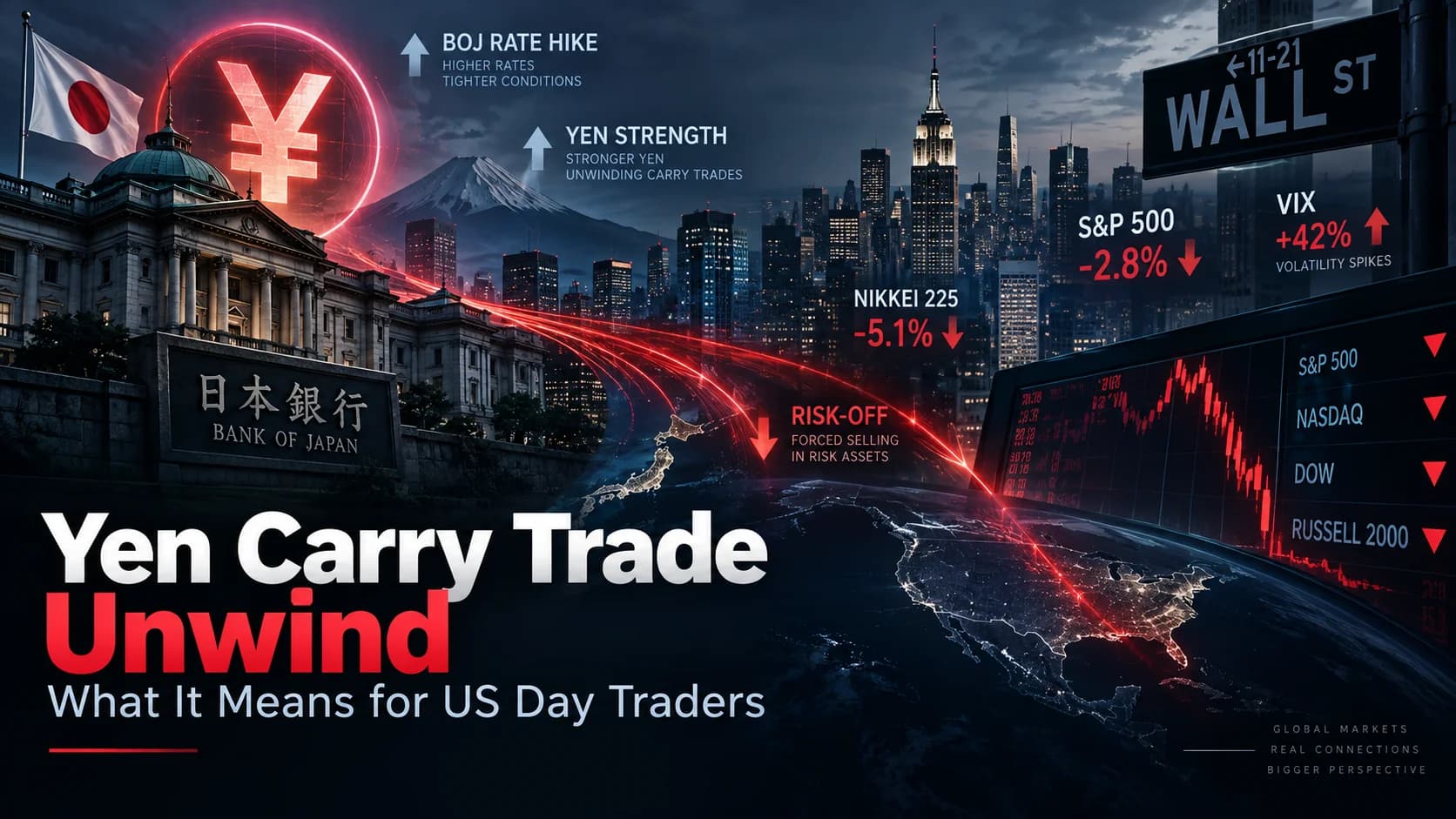
On August 5, 2024, the Nikkei 225 fell 12.4 percent in a single session, its worst one-day decline since the 1987 crash. The S&P 500 dropped 3 percent the same day. The VIX spiked to 65, a level last seen during COVID and the 2008 financial crisis. None of it started with a US company, a US data release, or a US headline. It started four days earlier, when the Bank of Japan raised its overnight rate from around 0.1 percent to 0.25 percent, a hike smaller in absolute terms than a single Fed meeting typically moves the US federal funds rate by half.
If that sounds like an outsized reaction to a small rate change, that's because the rate hike itself was never the real story. The real story was everything quietly built on top of cheap Japanese borrowing costs for the better part of a decade, and what happens when that foundation shifts even slightly. With the Bank of Japan meeting again this week and a further hike widely expected, this is a mechanism worth understanding before it shows up on your screen again, not after.
What is a yen carry trade unwind? A yen carry trade unwind happens when investors who borrowed cheap Japanese yen to fund purchases of higher-yielding assets elsewhere, US stocks, bonds, emerging-market currencies, are forced to reverse those positions, usually because the yen has strengthened enough to erode or eliminate the trade's profitability. Because the same investors often used that borrowed yen to fund some of the market's most popular momentum trades, the unwind shows up as forced selling in assets that have nothing to do with Japan.
Why Yen Became the World's Cheapest Funding Currency
For a currency to become a popular funding source for a trade this size, borrowing it has to be reliably, almost boringly cheap for long enough that a huge amount of leverage can quietly accumulate on top of it.
Japan spent years with interest rates at zero or below it, a policy stance that persisted long after most major central banks had moved on. That gap between near-zero yen borrowing costs and meaningfully higher yields available almost anywhere else, US Treasuries, US equities, emerging-market bonds, made the arithmetic of a carry trade almost irresistible: borrow yen for next to nothing, convert it into dollars, buy an asset yielding several percentage points more, and pocket the difference as long as the yen doesn't move against you.
The trade works exactly as intended for as long as two conditions hold: the interest rate gap stays wide, and the yen stays flat or keeps weakening. Both conditions held for most of the 2010s and into the mid-2020s. Neither holds indefinitely, and the trade has no mechanism for a gentle exit once they stop.
The Mechanism: How a Small Rate Change Becomes a Global Margin Call
A carry trade unwind is a feedback loop, and understanding the loop matters more than memorizing any single data point about it.
When the Bank of Japan raises rates, or even signals it's about to, two things happen almost simultaneously. First, the interest rate gap that made the trade profitable narrows, making the position less attractive on its own economic merits. Second, and more urgently, the yen tends to strengthen on the news, since higher rates generally attract capital into a currency. For anyone who borrowed yen and is now sitting on a position that requires converting back into a currency that's gotten more expensive, the trade starts losing money on the currency leg even before considering what happens to the underlying asset.
That's where the loop becomes self-reinforcing. Leveraged investors facing losses on both the funding currency and, often, margin calls start selling their highest-conviction, most liquid holdings first, which in the 2024 episode meant US momentum stocks and mega-cap tech names. Selling those assets to raise cash to buy back yen pushes the yen higher still, which makes the remaining carry positions even less profitable, which forces the next round of selling. None of this requires a single catastrophic trigger. It requires a rate move landing on top of enough accumulated leverage, and the leverage does the rest.
August 5, 2024: The Clearest Case Study on Record
The 2024 episode is worth walking through in detail because every piece of it, the trigger, the amplifier, and the resolution, shows up again in some form every time this setup rebuilds.
The trigger landed in two parts, four days apart. On July 31, 2024, the Bank of Japan unexpectedly raised its benchmark rate from around 0 to 0.1 percent to around 0.25 percent, a hawkish surprise relative to what markets had priced. On August 2, the US released a jobs report showing only 114,000 jobs added in July, well below the roughly 175,000 expected, which simultaneously raised fears of a US economic slowdown and expectations that the Federal Reserve would need to cut rates sooner than planned. Both halves of the same interest rate gap were moving in the same direction at once: Japan's rate rising, and the market pricing a falling US rate.
The yen appreciated roughly 6 percent against the dollar between July 29 and August 5. Over the same stretch, the US 10-year Treasury yield fell 55 basis points, from 4.28 percent to 3.73 percent, as recession fears mounted alongside the currency move. From its July 31 level, the Nikkei fell roughly 20 percent over four trading sessions into August 5, and on August 5 alone it dropped 12.4 percent in a single day, a record that stood as the index's worst one-day decline since Black Monday in 1987. The S&P 500 fell 3 percent that same day. The VIX spiked to 65.
The resolution came almost as fast as the drop. The Bank of Japan, facing a genuinely disorderly market reaction, walked back its hawkish signaling within days, and Deputy Governor Shinichi Uchida explicitly said the central bank wouldn't raise rates during unstable markets. That statement alone did much of the work of calming the unwind. Within about two weeks, US and Japanese equities had recovered most of the drawdown. The speculative, most-leveraged portion of the trade was cleaned out in that single week. What remained, and has since rebuilt, is a smaller, somewhat more disciplined version of the same underlying position.
It Doesn't Take Another 2024 to Feel It
The August 2024 episode is the extreme version of this mechanism, but smaller aftershocks have shown up every time the Bank of Japan has moved since, and they're worth recognizing precisely because they're easy to miss if you're only watching for something that dramatic.
When the Bank of Japan raised its rate to 0.75 percent in December 2025, the reaction was a fraction of 2024's scale but ran through the identical channel. The VIX, which had been sitting around 14, ticked up to 17 the same afternoon, a clear if modest signal that traders were buying downside protection. Bitcoin, which had been trading near $91,000 heading into the decision, dropped to about $88,500 within two hours, exactly the kind of asset that had absorbed cheap yen liquidity during the trade's buildup. CFTC data later showed net short yen positioning had already declined about 40 percent in the weeks before that hike, evidence that some of the more exposed positioning had been reduced ahead of time rather than forced out in a panic.
That's the pattern worth internalizing: the mechanism doesn't require a repeat of 2024's exact severity to matter. It requires a rate move that narrows the funding advantage, and the market's reaction scales with how much leverage has rebuilt since the last time it was cleared out, not with how large the headline rate change itself is.
- Episode
- August 2024
- BOJ Move
- Surprise hike from about 0.1 percent to 0.25 percent
- Yen Reaction
- Up roughly 6 percent in a week
- Equity Market Reaction
- Nikkei down 12.4 percent in one day, S&P 500 down 3 percent, VIX to 65
- Episode
- December 2025
- BOJ Move
- Hike to 0.75 percent
- Yen Reaction
- Yen strengthened, no extreme single-day spike
- Equity Market Reaction
- VIX ticked from 14 to 17, Bitcoin fell roughly 3 percent within hours
- Episode
- September 2026 setup
- BOJ Move
- Hike to 1.25 percent widely expected
- Yen Reaction
- Yen already up more than 2 percent in the days before the meeting
- Equity Market Reaction
- Outcome not yet known as of this writing
| Episode | BOJ Move | Yen Reaction | Equity Market Reaction |
|---|---|---|---|
| August 2024 | Surprise hike from about 0.1 percent to 0.25 percent | Up roughly 6 percent in a week | Nikkei down 12.4 percent in one day, S&P 500 down 3 percent, VIX to 65 |
| December 2025 | Hike to 0.75 percent | Yen strengthened, no extreme single-day spike | VIX ticked from 14 to 17, Bitcoin fell roughly 3 percent within hours |
| September 2026 setup | Hike to 1.25 percent widely expected | Yen already up more than 2 percent in the days before the meeting | Outcome not yet known as of this writing |
Where the Setup Stands Heading Into This Week
The Bank of Japan has been on a slow, telegraphed normalization path through 2026: a hike to 1.00 percent in June, a hold in July with one board member dissenting in favor of an even larger increase, and a steady drumbeat of hawkish commentary from Governor Kazuo Ueda since. In the first days of September 2026, the yen already jumped more than 2 percent against the dollar in a single session on hawkish remarks from Ueda and board member Hajime Takata, who both raised the possibility of a larger-than-usual increase at this week's meeting, pushing the currency to its strongest level in about a month before the decision has even happened.
That's the detail worth sitting with. Some of this unwind is already showing up on the tape ahead of the actual announcement, which is exactly how the mechanism is supposed to work when it's functioning in an orderly way rather than a panicked one: positioning adjusts gradually into a well-telegraphed event instead of all at once after a surprise. Hedge fund short-yen positioning had rebuilt to levels last seen approaching 2007 in the months leading into this decision, giving the trade real size to unwind if this week's decision, or its forward guidance, lands more hawkish than the market has already priced.
None of that guarantees a repeat of August 2024's severity. It does mean the ingredients, a rate hike, a narrowing rate differential, and a rebuilt speculative position, are present again in some form, which is precisely why this mechanism deserves a place in your framework rather than a one-time history lesson about a single week in 2024.
For how this week's decision fits alongside everything else moving markets right now, DayTradingToolkit's Weekly Market Insights tracks it alongside the Fed's own meeting the same week. The same instinct to split a spending or policy signal into what it means for different parts of the market applies just as directly to how AI capex disclosures move chip and memory stocks, a different mechanism built on the same underlying discipline of reading a catalyst by who it actually exposes, not just its headline size.
How to Actually Trade This
The useful version of this framework starts with knowing what to watch and roughly when, rather than trying to predict whether this specific meeting produces a violent reaction.
Know the calendar. The Bank of Japan meets eight times a year, and its decisions are typically announced overnight or in the early morning hours Eastern time, meaning the first reaction often happens while US markets are closed. Checking USD/JPY and Nikkei futures before the US open on a BOJ decision day tells you more about what to expect at the opening bell than waiting for the headline to hit US financial media.
Watch the yen, not just the headline rate decision. The August 2024 episode showed the yen itself moving before equities fully caught up. A sharp yen appreciation in the days or hours around a BOJ meeting is an earlier signal than waiting for the equity reaction to confirm something is happening.
Check whether the VIX is actually moving. Not every BOJ hike produces a 2024-style spike, and the December 2025 example shows a much smaller, still-real reaction is more the norm. A VIX move from the mid-teens into the high teens or twenties is a proportionate signal worth respecting on its own terms, without needing to see a repeat of 65 to take it seriously.
Watch correlation to mega-cap tech and momentum names specifically. The 2024 unwind hit US momentum stocks disproportionately, since that's where a large share of yen-funded leverage had been deployed. If a yen move coincides with underperformance concentrated in the same handful of high-beta names rather than a broad, even decline, that's a signature worth recognizing rather than treating as an unrelated coincidence.
Size positions for a gap, not just a drift. Because the initial reaction to a BOJ surprise often happens overnight in a currency market with thin liquidity, the opening print on a US index the following morning can gap meaningfully before intraday price action has a chance to develop normally. Identifying the market regime you're actually in, a contained currency-driven move versus a broadening risk-off event, is the same judgment call this site's geopolitical oil shock framework asks of a war-driven shock, just triggered by a central bank instead. A Trade Ideas scan for unusual volume across Nikkei-correlated ETFs and yen-sensitive momentum names can flag which corners of the market are actually reacting before the move is obvious on a major index chart.
Where This Framework Breaks Down
The biggest risk in this framework is assuming every Bank of Japan hike produces an equity reaction proportional to 2024's. The overwhelming majority of BOJ decisions since, including several hikes and holds through 2025 and 2026, have passed with far milder market reactions, precisely because the most extreme, over-leveraged positioning from the original trade was cleared out in that first violent week and rebuilds more gradually than it did the first time.
The second risk is treating the yen carry trade as a single, uniform position that unwinds all at once. In practice it's a patchwork of institutional, hedge fund, and retail positioning of varying size, leverage, and sensitivity to yen moves, and a well-telegraphed hike that the market has had weeks to prepare for tends to produce a more orderly unwind than a genuine surprise landing on an already-jittery market, the way July 31, 2024's hike did.
The third risk is forgetting that central bank behavior itself is part of the mechanism. The Bank of Japan explicitly softened its own hawkish signaling within days of the 2024 crash specifically because policymakers didn't want to be the cause of continued financial instability. A central bank that has already shown it will step back from tightening if markets turn disorderly is a genuine dampener on how far any single episode can run, and assuming otherwise overstates the risk of a repeat.
Where This Fits a Complete Trading Plan
This isn't a framework for predicting Bank of Japan policy, and it's not a reason to treat every BOJ meeting as a guaranteed volatility event. It's a way of recognizing a specific transmission mechanism, cheap yen funding built up over years, a rate move that narrows the gap, and a feedback loop between currency and equity selling, that will keep showing up in some form for as long as Japan remains a major source of globally cheap leverage. The scale of the reaction will vary every time. The channel it travels through, yen strength forcing the unwind of positions that were never really about Japan in the first place, has stayed consistent across every episode so far.
Frequently Asked Questions
What exactly is a yen carry trade?
Japan's interest rates stayed near or below zero for years, making yen one of the cheapest currencies in the world to borrow. Investors used that cheap funding to buy everything from US Treasuries to momentum stocks to other higher-yielding currencies, a trade that Morgan Stanley has estimated reached roughly $500 billion in outstanding size even after the 2024 unwind cleared out its most extreme positioning.
Key Takeaway: The trade itself is simple. The risk comes from how much leverage quietly builds on top of it over years of it working.
Why did a small Bank of Japan rate hike cause such a large stock market reaction in August 2024?
The July 31, 2024 hike from about 0.1 percent to 0.25 percent was small in absolute terms, but it landed on top of years of accumulated carry trade positioning and coincided with a weak US jobs report that simultaneously raised expectations of Fed rate cuts, narrowing the interest rate gap from both directions at once.
Key Takeaway: Watch the size of the positioning behind a rate move, not just the size of the rate move itself.
Does every Bank of Japan rate hike trigger a carry trade unwind this severe?
The December 2025 hike moved the VIX from about 14 to 17 and briefly pressured Bitcoin, a real but proportionate reaction rather than a repeat of 2024's severity.
Key Takeaway: Expect the scale of any future reaction to track how much speculative positioning has rebuilt since the last unwind, not the size of the new rate hike alone.
What should a day trader actually watch during a live Bank of Japan decision?
Bank of Japan decisions are usually announced overnight or in the early morning Eastern time, so checking how yen crosses and Nikkei futures have moved before the US cash open gives an earlier read than waiting for the US market's own reaction.
Key Takeaway: The yen itself is the earliest signal in this chain, often moving hours before US equities get a chance to react.
How is this different from a normal risk-off selloff?
A standard risk-off move is usually driven by deteriorating fundamentals or a specific negative catalyst tied to the assets themselves. During the 2024 unwind, US momentum stocks fell hard with no company-specific bad news at all, purely because they were the most liquid, most appreciated holdings available to sell for yen.
Key Takeaway: A selloff with no clear fundamental catalyst, concentrated in high-beta and momentum names, alongside a sharply strengthening yen, is a signature worth recognizing on its own.
Why did the Bank of Japan back off its hawkish stance so quickly after the 2024 crash?
That statement did much of the work of ending the acute phase of the unwind within about two weeks, and it established a pattern the market has watched for in every subsequent Bank of Japan decision since.
Key Takeaway: A central bank that has already shown it will step back from tightening during market instability is itself a real dampener on how far a future episode can run.
Which US assets are most exposed to a yen carry trade unwind?
Emerging-market currencies and bonds funded by the same cheap yen borrowing are also exposed, along with risk assets more broadly like Bitcoin, which showed a real if smaller reaction during the December 2025 aftershock.
Key Takeaway: Concentrated weakness in high-beta, high-momentum names alongside yen strength is the pattern to watch for, more than a broad, even decline across the index.
Is the yen carry trade unwind over, or does it keep happening?
Positioning data has shown short-yen bets rebuilding toward levels approaching those seen before the 2024 unwind, which is part of why each subsequent Bank of Japan meeting carries some version of this same risk.
Key Takeaway: Treat this as a recurring setup tied to the ongoing rate differential between Japan and the rest of the world, not a one-time historical event.
How does this connect to what's happening with the Bank of Japan this week?
That pre-positioning is itself informative: an unwind that happens gradually as the market prepares for a well-telegraphed decision tends to be more orderly than one triggered by a genuine surprise landing on an unprepared market, which was a key feature of the 2024 shock.
Key Takeaway: Watch whether the reaction around this week's decision looks like an orderly continuation of the move already underway, or a sharper break that suggests the market was still under-positioned for the outcome.
Can a trader actually profit from trading a carry trade unwind directly?
The more reliable use of this framework is defensive and interpretive: recognizing when a US equity selloff is being driven by this specific currency mechanism rather than a fundamental, company-specific, or broader macro cause, which changes how durable you should expect the move to be.
Key Takeaway: Understanding this mechanism is more valuable for correctly reading a fast-moving session than as a standalone entry signal on the currency itself.
Disclaimer
Article Sources
- Bank of Japan: Statement on Monetary Policy, July 31, 2024 - primary source on the rate hike that triggered the August 2024 unwind
- Financial Study Association Groningen: The Collapse of the Yen Carry Trade - detailed timeline and data on the August 5, 2024 market reaction
- Wellington Management: The yen carry trade unwind - institutional analysis of the mechanism and which US assets were most exposed
- Bloomberg: Carry Trade Exodus Fuels Yen Gain Ahead of BOJ Rate Decision - reporting on the September 2026 pre-positioning ahead of this week's decision
- FocusEconomics: Bank of Japan holds rates in July - primary data on the 2026 Bank of Japan rate path
- CNBC: Bank of Japan hikes rates to 1%, highest since 1995 - reporting on the June 2026 hike and yen intervention context
Was this helpful?
Be the first to weigh in

Written by
Kazi Mezanur RahmanFounder, independent researcher, and editor of DayTradingToolkit. A one-person publication focused on risk-first trading education and documented tool research. He trades his own capital as a retail trader and combines personal market experience with systematic primary-source research.
Keep Reading
Market Analysis & Insights
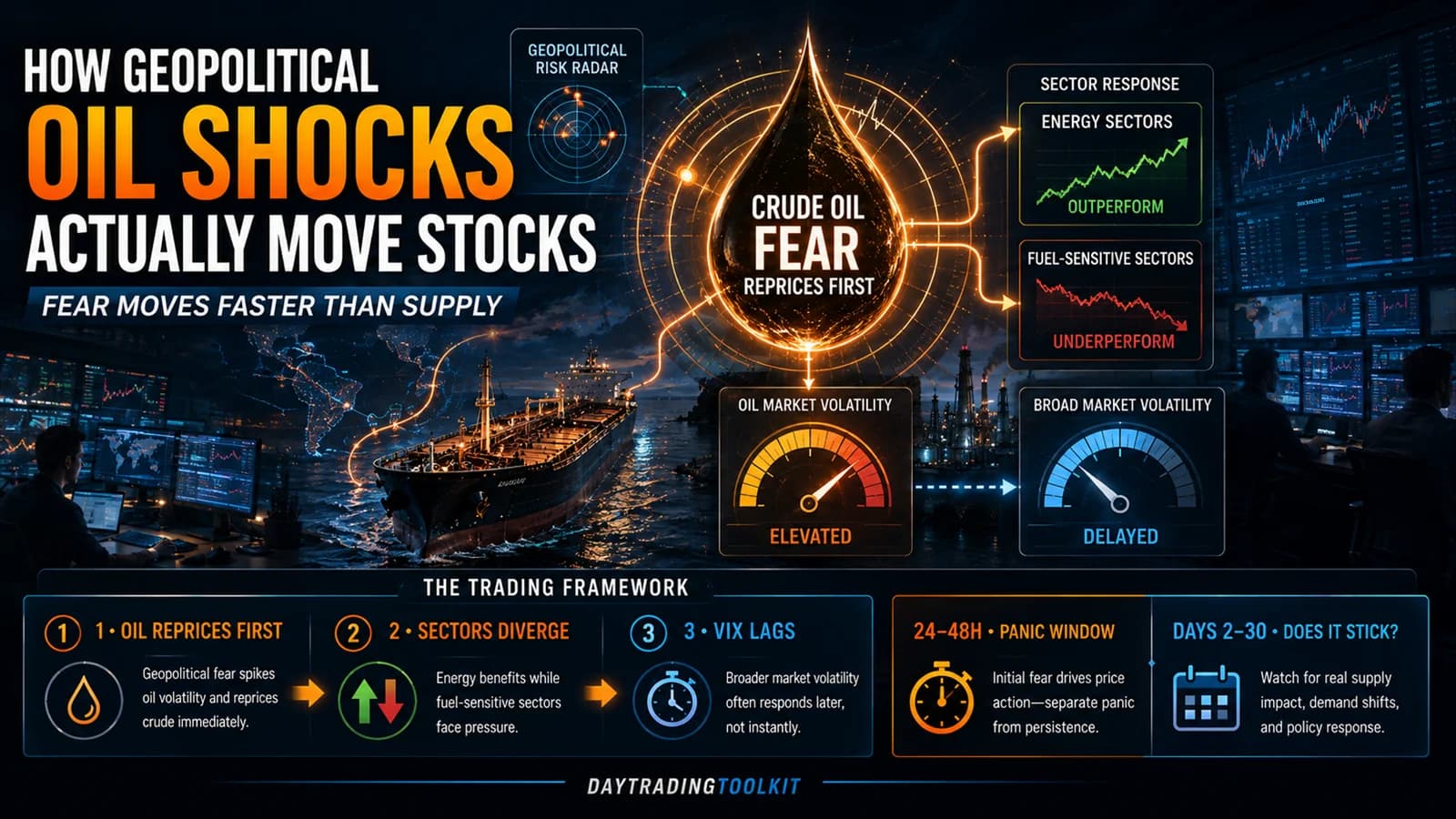
How Geopolitical Oil Shocks Actually Move Stocks
Oil spikes on fear, not fundamentals, and equities take their cues later on a different clock. Here's the actual mechanism behind a geopolitical oil shock, four historical case studies, and how to trade the pattern without guessing what happens next.
Strategies
How to Identify the Market Regime: A Strategy for Choosing Your System
Learn to identify the market regime with our simple 2-question framework. Choose the right trading strategy for any market condition (bull, bear, volatile, or quiet).

Market Analysis & Insights
Why Index Rebalancing Days Break Volume Records—and Why Chasing the Addition Still Fails
Index rebalancing forces price-insensitive buying and selling into the closing auction, sometimes 40%+ of a stock's daily volume. The mechanics, the September 2026 dates, and why forced buying doesn't guarantee a price pop.

Market Analysis & Insights
Jackson Hole Aftermath: What Warsh Changed for Traders
Warsh did not promise a September rate hike at Jackson Hole. He made inflation the Fed's dominant concern, and the bond market repriced the next meeting immediately.
Comments
No comments yet. Be the first to share your thoughts.