
Prop Firm Regulation: What's Real, What's Hype, and What It Means for Your Account

In this article8 sections
A federal judge sanctioned the CFTC more than $3 million for mishandling its biggest case against a prop trading firm. Some traders read that as a sign the funded account industry is in the clear. It isn't. The court punished the regulator's conduct, not the business model, and three other regulators on three continents are still circling.
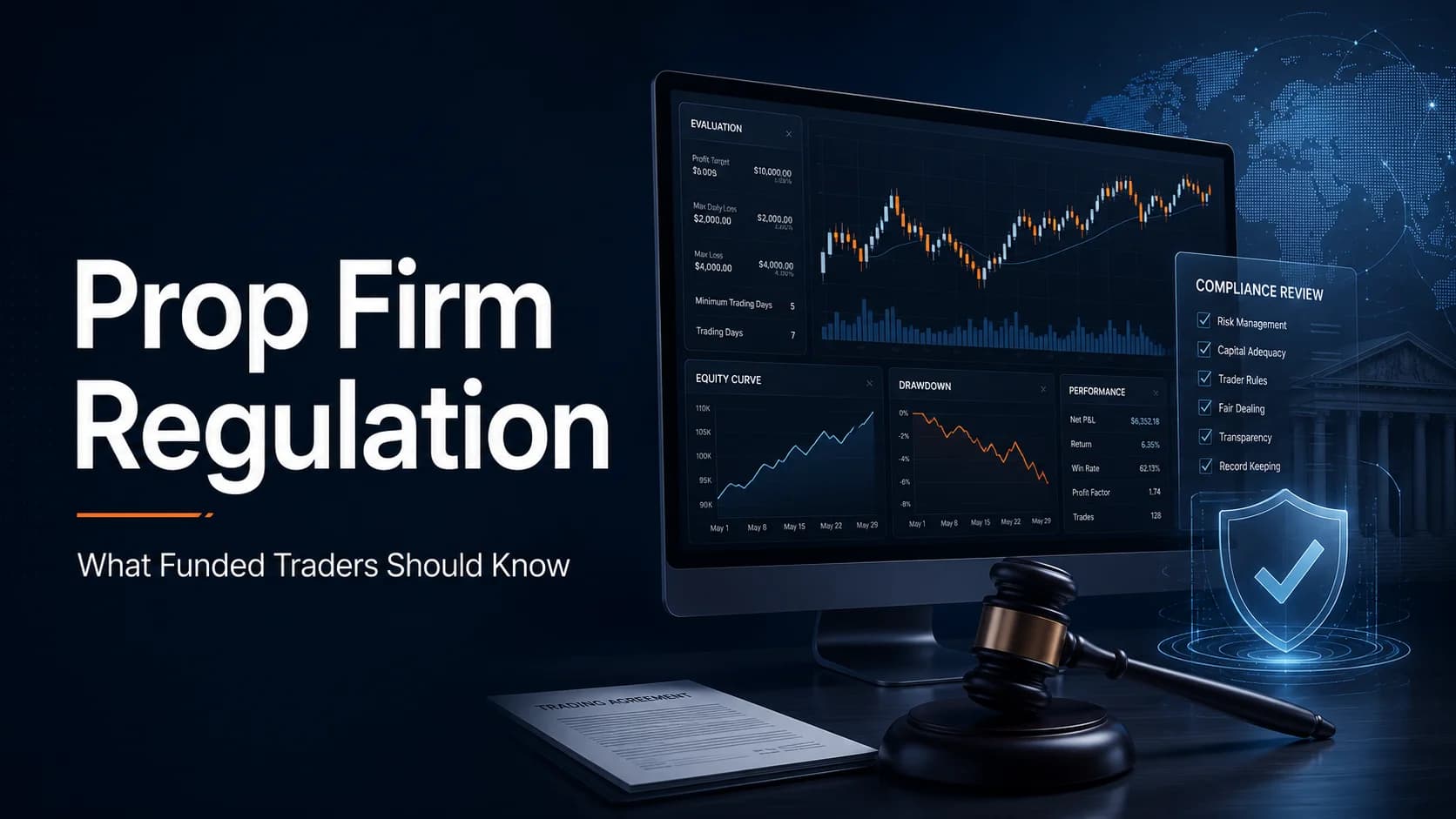
What is a prop trading firm? A proprietary (prop) trading firm charges traders an upfront fee to attempt an "evaluation" or "challenge," which requires hitting a profit target without breaching a drawdown limit. Traders who pass are granted a "funded" account and keep a share of any profit, typically 80% to 90%. In most cases the funded account is simulated, meaning the trader is competing against the firm's own risk engine rather than trading real capital in live markets.
The case regulators built and then lost
In August 2023, the CFTC charged Traders Global Group, the parent company behind My Forex Funds, with fraud exceeding $300 million. The agency froze the firm's assets and told the court that a CAD $31.55 million transfer looked like the founder dissipating customer funds before they could be recovered.
That transfer turned out to be a routine corporate tax payment to the Canada Revenue Agency. The CFTC knew, or should have known, before it sought the freeze. A court-appointed Special Master reviewed the agency's conduct and recommended dismissal with sanctions. On May 13, 2025, Judge Edward S. Kiel of the U.S. District Court for the District of New Jersey dismissed the case with prejudice and ordered the CFTC to pay more than $3 million in attorneys' fees and costs under Rule 11, the sanction reserved for filings made without a reasonable factual basis.
That's an unusual outcome for a financial regulator. It's the kind of defeat that changes how aggressively an agency moves on its next case, and it matters because My Forex Funds was supposed to be the test case. It was meant to answer the question every prop firm in the country has been operating around for years: does charging an evaluation fee and splitting profits on a simulated account count as a regulated activity?
The dismissal didn't answer that question. It just meant the CFTC picked the wrong evidence to answer it with.
Why prop firms still matter now that the PDT rule is gone
It's worth pausing on a question that doesn't get asked enough in prop firm coverage. The $25,000 pattern day trader minimum ended in June 2026, replaced by a risk-based intraday margin system with roughly a $2,000 floor. That was supposed to be the barrier prop firms existed to route around. If it's gone, why do funded account challenges still sell?
Because capital access was never the only thing prop firms were selling. A trader with $2,000 can technically day trade now, but a $2,000 account has almost no room for a normal stop-loss on a volatile stock without risking an outsized share of the account on a single trade. Prop firms are still selling buying power at a scale most individual traders can't fund themselves, along with a structure that caps downside to the evaluation fee rather than a trader's own capital. That's a real value proposition even in a world without the old PDT wall. It's also exactly why the business model draws regulatory attention: the firm is taking on the traders' market risk and charging for the privilege of a shot at its capital, which starts to look less like a brokerage relationship and more like the kind of pooled arrangement securities and commodities regulators are built to oversee.
What the dismissal actually decided, and what it didn't
Read the ruling narrowly and the picture gets clearer fast. The court found that the CFTC's enforcement conduct was reckless, not that the funded account business model is legal. Judge Kiel's opinion described the agency's yearlong pattern of conduct as willful and undertaken in bad faith, a finding aimed squarely at how the case was built, not at whether prop firms belong inside the CFTC's jurisdiction.
That distinction matters for anyone trading a funded account right now. The underlying legal question, whether an evaluation fee paid for a shot at a profit-share arrangement constitutes a commodity pool interest requiring registration, is still completely open. The CFTC lost the fight over one company's conduct. It didn't lose the argument.
If anything, the sanctions changed the regulator's approach rather than its intent. Reporting in industry press indicates the CFTC opened a public consultation in August 2026 specifically asking whether firms running challenge-based evaluation programs fall under its authority, with the comment period set to close on November 30, 2026. That's the same question My Forex Funds was supposed to settle. This time, the agency appears to be building its record through public comment rather than an emergency asset freeze, which is exactly what a regulator does after a court tells it its evidence wasn't good enough.
Europe, the UK, and Australia never needed a My Forex Funds case
The U.S. approach to prop firm oversight has always been indirect. It relies on registration requirements written for off-exchange retail forex and commodity contracts, then argues those requirements should stretch to cover the funded account model. That's a harder legal argument to win, and it's part of why the CFTC's case collapsed the way it did.
Regulators outside the U.S. didn't need a novel legal theory. The European Union, the UK, and Australia already cap retail forex and CFD leverage at 30:1 under existing product intervention rules, well below the 50:1 ceiling U.S. retail forex traders can access under NFA rules. Prop firms marketing high leverage on simulated accounts to traders in those jurisdictions run directly into rules that were written years before the funded account model existed. Germany's BaFin and Italy's Consob have both issued investor warnings specifically naming the high-leverage products behind prop firm challenges, and the UK's FCA leans on its financial promotions regime, which exposes any firm soliciting UK retail clients without authorization regardless of how the product is labeled.
That's the real asymmetry heading into the back half of 2026. The U.S. has the broadest theoretical jurisdiction but the weakest recent track record of using it. The UK, the EU, and Australia have narrower legal hooks but don't need to prove fraud to act, since a product intervention or an unauthorized promotions case carries a much lower evidentiary bar than the wire fraud theory the CFTC tried and failed to make stick.
- Jurisdiction
- United States (CFTC/NFA)
- Primary tool
- Registration law, potential CTA reclassification
- What it takes to act
- Proving a commodity pool interest or fraud
- Retail leverage ceiling
- 50:1 on retail forex
- Jurisdiction
- European Union (ESMA + national regulators)
- Primary tool
- Product intervention measures
- What it takes to act
- Applying existing leverage and marketing rules
- Retail leverage ceiling
- 30:1 on retail forex and CFDs
- Jurisdiction
- United Kingdom (FCA)
- Primary tool
- Financial promotions and authorization regime
- What it takes to act
- Showing unauthorized solicitation of retail clients
- Retail leverage ceiling
- 30:1 on retail forex and CFDs
- Jurisdiction
- Australia (ASIC)
- Primary tool
- CFD product intervention order
- What it takes to act
- Applying design and distribution obligations
- Retail leverage ceiling
- 30:1 on retail forex and CFDs
| Jurisdiction | Primary tool | What it takes to act | Retail leverage ceiling |
|---|---|---|---|
| United States (CFTC/NFA) | Registration law, potential CTA reclassification | Proving a commodity pool interest or fraud | 50:1 on retail forex |
| European Union (ESMA + national regulators) | Product intervention measures | Applying existing leverage and marketing rules | 30:1 on retail forex and CFDs |
| United Kingdom (FCA) | Financial promotions and authorization regime | Showing unauthorized solicitation of retail clients | 30:1 on retail forex and CFDs |
| Australia (ASIC) | CFD product intervention order | Applying design and distribution obligations | 30:1 on retail forex and CFDs |
The table makes the pattern obvious. Three of the four jurisdictions already had the legal tools in place before the funded account model existed at scale. Only the U.S. needed a new legal theory to reach it, and that's precisely the theory that just lost in court.
The firms that didn't survive the shakeout
Regulatory pressure is only half the story. The other half is business model stress, and it's already claimed real firms.
FundingTicks shut down in January 2026 after introducing a set of rule changes the previous December, including a one-minute minimum holding requirement for scalping trades, higher profit targets, and a reduced profit split. Those changes were applied retroactively, which meant traders who had already completed an evaluation under the old rules found their qualifying results canceled under the new ones. The firm closed within weeks of rolling the changes out.
That pattern, tightening the rules on paper right before a firm runs out of money to pay winning traders, is one of the clearest early warning signs in this industry. A firm's challenge fees fund its operations and its payouts to successful traders in the same pool of money. When challenge sales slow down or payout obligations grow faster than new signups can cover, a firm has three options: raise fees, tighten pass rates, or close. Industry estimates put the number of prop firms that have shut down between 2024 and early 2026 somewhere between 80 and 100, a wave large enough that "did my firm just change its rules to avoid paying me" has become a routine question in prop trading forums rather than an edge case.
The firms that made it through that period tend to share a few traits: transparent payout statistics, profit splits that don't require constant tightening to stay solvent, and terms of service that don't get rewritten retroactively. FTMO, Topstep, The5%ers, FundedNext, and Apex Trader Funding are generally cited as the survivors of the 2024 shakeout, not because they're immune to the regulatory questions above, but because their business models weren't already running on borrowed time when the questions started getting asked.
What actually changes for a trader with a funded account right now
None of this means your funded account disappears tomorrow. It means the ground under the entire industry is less stable than the marketing suggests, and a few practical things are worth doing regardless of which firm you're with.
Read the fine print on rule changes the moment they're announced, not after your next payout request. Retroactive rule changes are the single biggest red flag in this industry, and the firms that apply them tend to announce them quietly, buried in a terms-of-service update rather than a headline email.
Watch how a firm talks about its own product. Regulators in every jurisdiction examined here are converging on the same complaint: firms that blur the line between a simulated evaluation account and live trading in their marketing are the ones drawing enforcement attention. If a firm's advertising implies your evaluation account is trading real capital in the market, that's not just a compliance problem for the firm. It's a signal about how honestly the rest of its terms were written.
Keep your own record of every trade, every rule you were held to, and every communication about payouts, independent of whatever dashboard the firm gives you. A trading journal that logs your actual performance against your account's stated drawdown and daily loss rules gives you documentation the firm can't quietly revise after the fact. TraderSync's review on this site covers how its rule-tracking features hold up specifically for funded accounts, which is worth a look if you're trading under a firm's evaluation rules right now.
And treat payout percentage claims with the same skepticism you'd apply to a win rate claim from a trading educator. A firm advertising a 90% profit split isn't meaningful on its own. What matters is whether the firm has a documented history of actually paying that split on schedule, and whether its evaluation pass rate and payout statistics are published anywhere you can verify them.
The daily loss limits and drawdown caps built into most evaluation accounts aren't arbitrary either. They mirror the same layered risk management that professional trading desks build into their own accounts, per-trade, daily, and account-level limits stacked on top of each other. Treating a prop firm's drawdown rule as a hurdle to route around, rather than a version of the risk discipline you should already be practicing, is a mistake that shows up in both failed evaluations and failed live trading careers. It's also worth calibrating expectations around what a funded account actually pays out in practice. Realistic income figures for active day traders tend to run well below what prop firm marketing implies, and a firm advertising outsized payout potential without publishing its actual pass rate is telling you more about its marketing budget than its trader outcomes.
Where this goes from here
Three things are worth watching through the rest of 2026 and into 2027.
The CFTC's reported consultation closes November 30, 2026. If the agency concludes that challenge fees constitute commodity pool interests, expect a formal rulemaking proposal to follow in early 2027, which would eventually require futures-focused prop firms to register with the CFTC and the National Futures Association. That's a multi-year process even if it moves forward, but the direction of travel matters more than the timeline for anyone deciding which firm to trust with an evaluation fee today.
The FCA and ASIC are better positioned to move first, precisely because their existing tools don't require proving fraud. A product intervention or an unauthorized marketing case clears a much lower bar than the wire fraud theory that just cost the CFTC three million dollars, and regulators tend to follow the path of least resistance after a public defeat like that one.
And the firm-closure wave isn't finished. The firms most exposed are the ones that grew fastest on aggressive marketing and thin profit splits, which is the same combination that's now drawing the most direct regulatory scrutiny. Watching which firms survive the next twelve months will tell you more about which business models were sound than any leverage cap or court filing will.
Common Questions About Prop Firm Regulation
Are prop trading firms regulated in the United States?
That framing is exactly what regulators are now testing. The core question is whether an evaluation fee paid for a shot at a profit-share arrangement functions as a commodity pool interest, which would require registration. No U.S. court has ruled on that question directly. The CFTC's one major attempt to build a case around it, against My Forex Funds, was dismissed on unrelated evidentiary grounds before the underlying legal theory was ever tested.
Key Takeaway: The regulatory question is open, not settled, and that uncertainty is exactly why documentation and firm selection matter more right now than they did two years ago.
What happened in the CFTC's case against My Forex Funds?
The CFTC pointed to a CAD $31.55 million transfer as evidence the founder was hiding customer funds. That transfer was a legitimate corporate tax payment to the Canada Revenue Agency. A Special Master reviewed how the agency built its case and recommended sanctions, and Judge Edward S. Kiel ordered the CFTC to pay more than $3 million in fees and costs under Rule 11.
Key Takeaway: This was the CFTC's flagship attempt to define how prop firms should be regulated, and it collapsed on the agency's own conduct rather than on the merits of the underlying business model question.
Does the My Forex Funds dismissal mean prop firms are legal?
Judge Kiel's ruling addressed how the agency handled evidence during its investigation, not whether charging an evaluation fee for a profit-share arrangement on a simulated account is a regulated activity. That question remains open in the United States, the European Union, the UK, and Australia. Firms in this space should treat the dismissal as a procedural reprieve, not legal validation.
Key Takeaway: Nothing about this ruling changes the underlying regulatory exposure a prop firm or its traders carry going forward.
Why do prop firms keep closing?
FundingTicks is a clean example. It introduced retroactive rule changes in December 2025, including a one-minute scalping hold requirement and a reduced profit split, then closed the following month. Industry estimates put the number of prop firms that shut down between 2024 and early 2026 somewhere between 80 and 100.
Key Takeaway: A firm tightening its rules suddenly, especially retroactively, is one of the clearest signals that its payout obligations are outpacing its revenue.
How can I tell if my prop firm might be at risk of closing?
None of these signs guarantees a firm is about to shut down, but they're the same pattern that preceded FundingTicks' closure and the broader wave of roughly 80 to 100 firm closures since 2024. A firm that publishes its actual payout history and keeps its rules stable is behaving very differently from one that quietly rewrites its terms of service every few months.
Key Takeaway: Firm stability shows up in its payout history and rule consistency long before it shows up in a closure announcement.
What's the difference between a prop firm's evaluation account and a live account?
This distinction is at the center of the regulatory scrutiny described throughout this guide. The SEC and other regulators have specifically flagged marketing language that implies evaluation accounts carry live market exposure when they don't. Before paying an evaluation fee, confirm directly with the firm which phases of your account, if any, involve real capital.
Key Takeaway: If a firm's marketing doesn't clearly state whether you're trading simulated or live capital at every stage, treat that ambiguity as a warning sign, not a marketing choice.
Are prop firm payouts taxed differently than regular trading income?
This differs from how a trader's own brokerage account gains are typically taxed, and it catches new funded traders off guard more often than it should. The specific treatment can vary by state and by how a given firm structures its payout agreements, so this is worth confirming with a tax professional rather than assuming it works like a normal trading account.
Key Takeaway: Don't assume your prop firm payout gets the same tax treatment as gains in your personal brokerage account. Confirm it in writing before you're surprised at filing time.
Which prop firms are considered the most established?
Surviving isn't the same as being immune to the regulatory questions covered in this guide. It does suggest these firms weren't already running on the kind of thin, retroactively-adjusted terms that preceded closures like FundingTicks. This site's Strategies Hub (/strategies) covers firm-specific approaches to some of these platforms' evaluation rules in more depth.
Key Takeaway: A firm's longevity through the recent shakeout is a reasonable starting filter, but it's not a substitute for reading that firm's current rules and payout history yourself.
Could my prop firm's rules change after I've already been funded?
This is exactly what happened at FundingTicks before it closed, and it's the mechanism regulators are increasingly focused on when they talk about consumer protection gaps in this space. Reading the specific language in your firm's terms of service about whether rule changes apply retroactively or only to future evaluations is worth doing before you need the answer.
Key Takeaway: A firm's terms of service, not its marketing page, is where you'll find out whether your funded account is actually protected from retroactive changes.
What should I do to protect myself as a funded trader?
A trading journal that tracks your performance against your account's specific drawdown and loss limits gives you a record the firm can't quietly revise later, which matters more in this industry than in ordinary retail trading given the pattern of retroactive rule changes described above. Choosing a firm with a documented, verifiable payout history matters more than chasing the highest advertised profit split.
Key Takeaway: In an industry where the rules can change after you've already qualified, your own documentation is the only record you fully control.
Disclaimer
Article Sources
- CFTC Press Release 8771-23 - the CFTC's original charging release against Traders Global Group and My Forex Funds
- Quinn Emanuel: Historic Rule 11 Dismissal and Fee Victory - legal analysis of the case dismissal and sanctions
- Finance Magnates: My Forex Funds Parent Defeats CFTC in Court - trade press coverage of the May 2025 ruling
- ESMA Product Intervention Measures - official EU leverage cap and CFD marketing rules
- FCA: Financial Promotions and Adverts - UK regulatory framework for firms marketing to retail traders
- National Futures Association News - ongoing NFA regulatory notices affecting futures-focused firms
Was this helpful?
Be the first to weigh in

Written by
Kazi Mezanur RahmanFounder, independent researcher, and editor of DayTradingToolkit. A one-person publication focused on risk-first trading education and documented tool research. He trades his own capital as a retail trader and combines personal market experience with systematic primary-source research.
Keep Reading
Market Analysis & Insights
The PDT Rule Is Dead: Everything That Changed, When It Takes Effect, and What Every Trader Needs to Do Now
The SEC eliminated the $25K Pattern Day Trader rule on April 14, 2026. Effective June 4. Here's exactly what changed, the new margin rules, and what every broker is doing.

Market Analysis & Insights
Cboe Premarket Options Trading Is Delayed: What Changed and What to Watch For
Cboe's C1 exchange postponed its planned 7:30-9:25 a.m. ET premarket options session past its August 17, 2026 target, with the new date still TBD. Here's what changed, why it matters, and what the eventual launch will look like.

Market Analysis & Insights
How Stocks Actually Qualify for the S&P 500
The S&P 500 isn't a list of the 500 biggest US companies. It's a curated index with a two-part GAAP earnings test, a moving market-cap threshold, and a discretionary committee. Here's the real eligibility bar, using Reddit's own numbers as the case study.
Market Analysis & Insights
Warsh Wants Fewer Fed Meetings: What Changes for Traders
Fed Chair Kevin Warsh is exploring cutting FOMC meetings from eight a year to as few as five or six. Here's what's actually been proposed, the history behind the eight-meeting standard, and what wider gaps between Fed decisions would mean for your trading calendar.
Comments
No comments yet. Be the first to share your thoughts.