
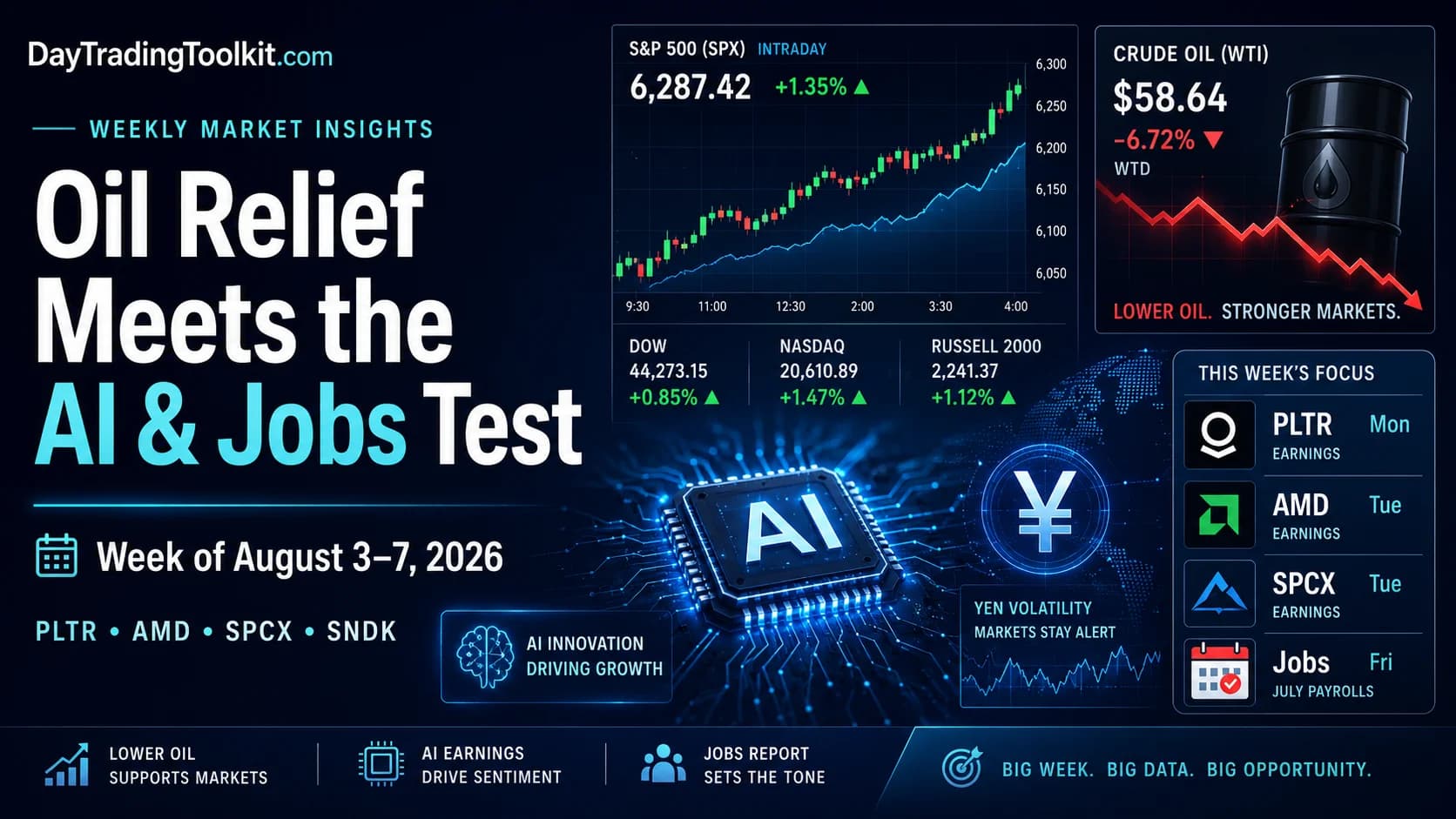
Weekly Market Insights August 3–7, 2026: Oil Relief Meets the AI and Jobs Test

In this article8 sections
Research cutoff: Monday, August 3, 2026, 1:32 p.m. ET. Market prices in this article were recorded at approximately 1:21 p.m. ET and are not closing prices.
By early Monday afternoon, the market had already delivered the easy part of this week’s story.
Oil was down sharply. Treasury yields were lower. SPY, QQQ, and IWM were all higher, which meant the rebound was reaching beyond one narrow corner of the market. That is a healthier start than another rally carried by two megacap names and little else.
The complication arrived at 10:00 a.m. ET.
The July ISM Manufacturing PMI rose to 55.6, its strongest reading since May 2022. New orders, production, and employment all expanded, while the prices index remained high at 71.1. In plain English, the economy looked stronger, but cost pressure had not disappeared.
That leaves the market with an awkward combination. Lower oil can calm inflation fears and help rate-sensitive stocks. Strong economic data can keep the Federal Reserve cautious and make Friday’s employment report more dangerous for the same stocks.
The week now has three moving parts. Oil headlines can change at any time. Earnings arrive almost every evening. Labor data builds toward Friday morning.
A Monday rally is useful information. It is not the final answer.
Week at a Glance: August 3–7, 2026
All times are Eastern. Monday’s cash session was already underway at this article’s research cutoff.
- Day
- Monday
- Date
- August 3
- Time ET
- During market hours
- Event
- Oil selloff, yen intervention, and post-ISM price discovery
- Relevance
- Very high
- Why It Matters
- Tests whether lower inflation pressure can outweigh stronger economic data.
- Day
- Monday
- Date
- August 3
- Time ET
- After close; 5:00 p.m.
- Event
- Palantir earnings webcast
- Relevance
- Very high
- Why It Matters
- The first major software and AI-demand test of the week.
- Day
- Tuesday
- Date
- August 4
- Time ET
- 10:00 a.m.
- Event
- June JOLTS report
- Relevance
- High
- Why It Matters
- Job openings and quits can move the market’s labor and rate expectations before payrolls.
- Day
- Tuesday
- Date
- August 4
- Time ET
- After close; 4:30 p.m.
- Event
- SpaceX earnings webcast
- Relevance
- Very high
- Why It Matters
- First public-company earnings report, followed by a major share-unlock event later in the week.
- Day
- Tuesday
- Date
- August 4
- Time ET
- After close; 5:00 p.m.
- Event
- AMD earnings conference call
- Relevance
- Very high
- Why It Matters
- A direct read on data-center demand, accelerator growth, margins, and the wider semiconductor trade.
- Day
- Wednesday
- Date
- August 5
- Time ET
- 7:00 a.m.
- Event
- Novo Nordisk earnings conference call
- Relevance
- High
- Why It Matters
- An early read on obesity-drug demand, pricing, supply, and competitive pressure.
- Day
- Wednesday
- Date
- August 5
- Time ET
- 8:00 a.m.
- Event
- Uber earnings conference call
- Relevance
- High
- Why It Matters
- Provides a consumer-demand and profitability signal before Friday’s jobs report.
- Day
- Wednesday
- Date
- August 5
- Time ET
- 8:30 a.m.
- Event
- Treasury quarterly refunding documents
- Relevance
- High
- Why It Matters
- Auction sizes and financing plans can move Treasury yields even without new inflation data.
- Day
- Wednesday
- Date
- August 5
- Time ET
- 10:00 a.m.
- Event
- ISM Services PMI and Eli Lilly earnings call
- Relevance
- Very high
- Why It Matters
- Services activity matters for rates; Lilly adds a second major obesity-drug read.
- Day
- Wednesday
- Date
- August 5
- Time ET
- After close; 4:30 p.m.
- Event
- Sandisk earnings conference call
- Relevance
- Very high
- Why It Matters
- Tests whether the memory and storage boom can support current margins and expectations.
- Day
- Thursday
- Date
- August 6
- Time ET
- 8:30 a.m.
- Event
- Q2 productivity and unit labor costs
- Relevance
- High
- Why It Matters
- Productivity can soften the inflation impact of wage growth; labor costs can do the opposite.
- Day
- Thursday
- Date
- August 6
- Time ET
- During market hours
- Event
- First major SpaceX post-IPO share-unlock window
- Relevance
- Very high
- Why It Matters
- More shares become eligible for sale, creating a supply test after earnings.
- Day
- Friday
- Date
- August 7
- Time ET
- 8:30 a.m.
- Event
- July employment report
- Relevance
- Very high
- Why It Matters
- The week’s final test for yields, the dollar, small caps, and expensive growth stocks.
| Day | Date | Time ET | Event | Relevance | Why It Matters |
|---|---|---|---|---|---|
| Monday | August 3 | During market hours | Oil selloff, yen intervention, and post-ISM price discovery | Very high | Tests whether lower inflation pressure can outweigh stronger economic data. |
| Monday | August 3 | After close; 5:00 p.m. | Palantir earnings webcast | Very high | The first major software and AI-demand test of the week. |
| Tuesday | August 4 | 10:00 a.m. | June JOLTS report | High | Job openings and quits can move the market’s labor and rate expectations before payrolls. |
| Tuesday | August 4 | After close; 4:30 p.m. | SpaceX earnings webcast | Very high | First public-company earnings report, followed by a major share-unlock event later in the week. |
| Tuesday | August 4 | After close; 5:00 p.m. | AMD earnings conference call | Very high | A direct read on data-center demand, accelerator growth, margins, and the wider semiconductor trade. |
| Wednesday | August 5 | 7:00 a.m. | Novo Nordisk earnings conference call | High | An early read on obesity-drug demand, pricing, supply, and competitive pressure. |
| Wednesday | August 5 | 8:00 a.m. | Uber earnings conference call | High | Provides a consumer-demand and profitability signal before Friday’s jobs report. |
| Wednesday | August 5 | 8:30 a.m. | Treasury quarterly refunding documents | High | Auction sizes and financing plans can move Treasury yields even without new inflation data. |
| Wednesday | August 5 | 10:00 a.m. | ISM Services PMI and Eli Lilly earnings call | Very high | Services activity matters for rates; Lilly adds a second major obesity-drug read. |
| Wednesday | August 5 | After close; 4:30 p.m. | Sandisk earnings conference call | Very high | Tests whether the memory and storage boom can support current margins and expectations. |
| Thursday | August 6 | 8:30 a.m. | Q2 productivity and unit labor costs | High | Productivity can soften the inflation impact of wage growth; labor costs can do the opposite. |
| Thursday | August 6 | During market hours | First major SpaceX post-IPO share-unlock window | Very high | More shares become eligible for sale, creating a supply test after earnings. |
| Friday | August 7 | 8:30 a.m. | July employment report | Very high | The week’s final test for yields, the dollar, small caps, and expensive growth stocks. |
The order matters more than the number of events.
Palantir can set the first tone for software Monday evening. SpaceX and AMD can strengthen or weaken the AI trade Tuesday. Wednesday then combines Treasury supply, services data, healthcare earnings, Uber, and Sandisk. Friday gets the last word through payrolls.
A strong company report can still be rewritten by the next macro release. A weak report can be partly rescued by falling yields. Treat each reaction as one step in the week’s argument rather than a complete verdict.
DayTradingToolkit’s step-by-step pre-market routine can help you separate the event windows that deserve preparation from the ones that only add noise.
Monday’s Rally Is Broad Enough to Matter—But Not Strong Enough to End the Debate
At approximately 1:21 p.m. ET, the market looked considerably better than it did at the open.
- Instrument
- SPY
- Approximate Monday Move
- +1.3%
- What It Suggests
- Broad large-cap participation, not only a technology rebound.
- Instrument
- QQQ
- Approximate Monday Move
- +1.6%
- What It Suggests
- Technology was leading, but not operating alone.
- Instrument
- IWM
- Approximate Monday Move
- +1.4%
- What It Suggests
- Small caps were participating, which improves the quality of the rally.
- Instrument
- USO
- Approximate Monday Move
- -5.6%
- What It Suggests
- The oil shock was reversing sharply, easing some inflation pressure.
- Instrument
- SMH
- Approximate Monday Move
- +0.6%
- What It Suggests
- Semiconductors were positive, but lagged QQQ after a volatile morning.
- Instrument
- EWJ
- Approximate Monday Move
- +0.3%
- What It Suggests
- U.S.-listed Japan exposure was firm despite weakness in Japanese local-market indexes.
- Instrument
- 10-year Treasury yield
- Approximate Monday Move
- About 4.68%
- What It Suggests
- Lower than Friday, but still high enough to pressure expensive valuations.
| Instrument | Approximate Monday Move | What It Suggests |
|---|---|---|
| SPY | +1.3% | Broad large-cap participation, not only a technology rebound. |
| QQQ | +1.6% | Technology was leading, but not operating alone. |
| IWM | +1.4% | Small caps were participating, which improves the quality of the rally. |
| USO | -5.6% | The oil shock was reversing sharply, easing some inflation pressure. |
| SMH | +0.6% | Semiconductors were positive, but lagged QQQ after a volatile morning. |
| EWJ | +0.3% | U.S.-listed Japan exposure was firm despite weakness in Japanese local-market indexes. |
| 10-year Treasury yield | About 4.68% | Lower than Friday, but still high enough to pressure expensive valuations. |
The broad participation is the encouraging part. SPY, QQQ, and IWM were all higher. A rally that reaches small caps usually carries more information than one supported only by the largest technology companies.
The semiconductor response was less clean. AMD recovered from a weak opening and moved higher, but Micron had already traveled from a sharp intraday loss to roughly flat. Sandisk swung from approximately 7% below Friday’s close to almost 6% above it. That is not orderly leadership. It is aggressive price discovery.
The ISM report explains part of the uncertainty. Manufacturing activity accelerated, new orders strengthened, and the employment index moved into expansion for the first time in 33 months. At the same time, input prices remained elevated.
Lower oil says inflation pressure may cool. Strong manufacturing says the economy may not need much policy help. Both can be true, and that is why Friday’s jobs report matters more after Monday—not less.
DayTradingToolkit’s guide to sector and market context explains why a stock move becomes more useful when the wider index and its sector confirm the same story.

Stocks to Watch: Six Catalyst Groups With a Real Reason to Move
These names are not included simply because their charts are active. Each one can answer a wider question about AI spending, software demand, memory pricing, the consumer, healthcare competition, or post-IPO supply.
They can also move sharply in either direction. That makes them worth preparing for, not automatically worth trading.
PLTR: Monday’s first test comes with expectations already high
Palantir reports after Monday’s close and hosts its earnings webcast at 5:00 p.m. ET. The stock was up about 2.1% near the market-data cutoff, so the report is arriving after buyers have already shown some confidence.
The previous quarter set a demanding comparison. Palantir reported $1.63 billion in revenue, up 85% from a year earlier, while U.S. revenue grew 104%. The company also raised its full-year revenue-growth outlook and its U.S. commercial forecast.
Those numbers explain why the stock remains central to the AI-software trade. They also make another ordinary beat less meaningful.
The reaction to watch is the one that survives management’s discussion of new contracts, customer concentration, U.S. commercial growth, government demand, margins, and full-year guidance. If the initial after-hours move weakens during the webcast, the market may be saying the headline was already priced in. If strength holds and other software names improve Tuesday, the result carries more weight beyond Palantir.
AMD: the semiconductor report needs to travel beyond one stock
AMD reports Tuesday after the close, with its earnings conference call beginning at 5:00 p.m. ET.
The company entered the quarter with clear momentum. First-quarter revenue rose 38% year over year to $10.3 billion. Management guided second-quarter revenue to approximately $11.2 billion, plus or minus $300 million, with non-GAAP gross margin near 56%.
The market will look past the total revenue figure quickly. Data-center revenue, accelerator deployment, server demand, gross margin, supply, and the next-quarter outlook will decide whether the report supports the larger AI infrastructure argument.
SMH is the first confirmation check. Micron and Sandisk show whether the reaction reaches memory. Intel offers a broader server and compute comparison. A strong AMD move that leaves all three behind may still be company-specific. A move that lifts the group would say more about the sector.
The Monday tape already showed why patience matters. AMD traded down early, then recovered to a gain of roughly 1.2% near the cutoff. The stock can travel a long way before the company says anything new.
SPCX: earnings meet a supply event two sessions later
SpaceX posts results Tuesday after the close, and management’s webcast begins at 4:30 p.m. ET. This is the company’s first quarterly report as a public company.
The report alone would make SPCX a major watch. The lockup schedule makes it more important.
Reuters reported that 911.5 million employee and early-investor shares become eligible for sale on the second trading day after the earnings report. With the report scheduled Tuesday, that puts the first major release on Thursday.
“Eligible for sale” does not mean every share will be sold. That distinction is essential. The market is testing how much supply actually appears and whether existing demand can absorb it.
Tuesday’s report should clarify Starlink growth, launch economics, operating costs, capital spending, and management’s priorities across the company’s major projects. Thursday then tests the stock’s structure. A positive earnings reaction that fails once more shares become available would tell a different story from a reaction that remains stable despite the added supply.
This is one of the few names this week where earnings and market structure are equally important.
SNDK: Monday’s reversal has already raised the bar
Sandisk reports Wednesday, and its earnings conference call begins at 4:30 p.m. ET.
The stock had one of Monday’s most violent reversals. It traded near $1,125 at its low, then recovered above $1,280 by the research cutoff. That moved it from roughly 7% below Friday’s close to almost 6% above it in the same session.
The previous quarter was unusually strong. Revenue reached $5.95 billion, up 97% sequentially, and reported gross margin reached 78.4%. Those figures reflect an exceptional memory and storage environment. They also create a difficult comparison.
Wednesday’s report needs to explain whether NAND pricing, enterprise SSD demand, hyperscaler orders, product mix, and inventory conditions can support those economics. Guidance may matter more than the quarter that has already ended.
Keep MU nearby, but do not assume the two stocks must move together. Micron covers a different product mix and can react differently to memory pricing. The useful question is whether Sandisk’s report improves the entire storage and memory group or only its own shares.
UBER: a consumer read without waiting for payrolls
Uber’s earnings conference call begins Wednesday at 8:00 a.m. ET.
The previous quarter showed a large platform still growing quickly. Gross bookings reached $53.7 billion, up 25% year over year, while trips grew 20%. Adjusted EBITDA increased 33% to $2.5 billion. For the second quarter, Uber guided to gross bookings of $56.25 billion to $57.75 billion and adjusted EBITDA of $2.70 billion to $2.80 billion.
This week’s report can show whether mobility and delivery demand remain firm while the labor market becomes harder to read. Bookings, trips, active users, driver supply, insurance costs, and profitability all matter.
The stock also gives the market a useful contrast. If Uber responds well while Friday’s labor data are mixed, investors may be treating platform demand as resilient. If good operating results cannot hold because yields rise, the macro backdrop is still in control.
NVO and LLY: the obesity-drug trade gets two answers on one morning
Novo Nordisk reports Wednesday morning and begins its earnings call at 7:00 a.m. ET. Eli Lilly’s conference call begins at 10:00 a.m. ET.
Treating these as a pair is more useful than reading either company in isolation. Investors will compare obesity-drug demand, supply capacity, pricing, access, prescription trends, market share, and pipeline commentary.
Lilly entered the quarter with enormous momentum. First-quarter Mounjaro revenue rose 125% to $8.7 billion, and Mounjaro plus Zepbound accounted for a large share of company revenue. Novo Nordisk’s reported first-quarter sales rose 32% at constant exchange rates, although its adjusted figures were less straightforward because of acquisition and restructuring effects.
The comparison is therefore about more than total growth. It is about which company is converting demand into durable market share without creating a new problem in pricing, manufacturing, or margins.
Monday added an extra wrinkle: LLY was down about 2.8% and NVO about 0.8% at the market cutoff. The sector was already repricing before either company had reported.
If six catalyst groups still feel like too much, narrow them. A useful watchlist removes decisions. It does not reward you for tracking every moving ticker. DayTradingToolkit’s guide to building a day-trading watchlist offers a practical framework using catalysts, liquidity, relative volume, and clear reference levels.
Oil, the Yen, and the Confirmation Board
The main watchlist explains what companies can reveal. The confirmation board helps determine whether a move is broad, company-specific, or driven by macro conditions.
- Theme
- Oil and inflation relief
- Instrument or Comparison
- Brent crude, USO, 10-year yield
- Observable Confirmation
- Oil remains lower and yields do not reverse sharply higher.
- Theme
- Technology leadership
- Instrument or Comparison
- QQQ versus SPY
- Observable Confirmation
- QQQ keeps leading without SPY and IWM losing participation.
- Theme
- Semiconductors
- Instrument or Comparison
- SMH, AMD, MU, INTC
- Observable Confirmation
- AMD’s reaction spreads across compute and memory rather than stopping at one stock.
- Theme
- Memory and storage
- Instrument or Comparison
- SNDK, MU, EWY
- Observable Confirmation
- Similar reactions support an industry signal; divergence points to company-specific repricing.
- Theme
- Yen and carry-trade stress
- Instrument or Comparison
- USD/JPY, Nikkei, EWJ
- Observable Confirmation
- A stronger yen is accompanied by pressure in export-heavy Japanese shares and wider risk assets.
- Theme
- Megacap rotation
- Instrument or Comparison
- META, AAPL, QQQ
- Observable Confirmation
- Strength in one name holds without masking broader weakness.
- Theme
- Post-IPO supply
- Instrument or Comparison
- SPCX volume and price after Thursday’s unlock
- Observable Confirmation
- The market absorbs additional eligible shares without a disorderly loss of support.
| Theme | Instrument or Comparison | Observable Confirmation |
|---|---|---|
| Oil and inflation relief | Brent crude, USO, 10-year yield | Oil remains lower and yields do not reverse sharply higher. |
| Technology leadership | QQQ versus SPY | QQQ keeps leading without SPY and IWM losing participation. |
| Semiconductors | SMH, AMD, MU, INTC | AMD’s reaction spreads across compute and memory rather than stopping at one stock. |
| Memory and storage | SNDK, MU, EWY | Similar reactions support an industry signal; divergence points to company-specific repricing. |
| Yen and carry-trade stress | USD/JPY, Nikkei, EWJ | A stronger yen is accompanied by pressure in export-heavy Japanese shares and wider risk assets. |
| Megacap rotation | META, AAPL, QQQ | Strength in one name holds without masking broader weakness. |
| Post-IPO supply | SPCX volume and price after Thursday’s unlock | The market absorbs additional eligible shares without a disorderly loss of support. |
Oil is the clearest macro signal. U.S. crude and Brent fell sharply Monday after the United States held off on further strikes against Iran and markets began pricing a better chance of diplomacy. Iran disputed that formal talks were underway, which is why crude remains headline-sensitive.
USO was down about 5.6% at the market cutoff. The first confirmation is simple: does that decline hold? The second is more important: do Treasury yields remain lower with it?
The yen requires more care.
The United States and Japan confirmed coordinated yen-buying intervention, and the yen strengthened. Japan’s Nikkei fell as exporters faced a less favorable currency translation. EWJ, however, was slightly positive in U.S. trading.
That is not necessarily a contradiction. EWJ owns Japanese equities but is priced in dollars and carries currency exposure. A stronger yen can improve the dollar value of its holdings even while exporter shares weaken in Tokyo. That makes EWJ useful, but not identical to the Nikkei.
For traders, the better question is whether yen strength stays contained to Japan or begins forcing wider carry-trade deleveraging. If QQQ, Korean memory stocks, and high-volatility growth names weaken at the same time the yen rises sharply, the currency move is becoming a wider risk event.
This is also a week to respect correlation risk. AMD, MU, SNDK, SMH, and several AI names may look like separate trades while responding to the same underlying factor.
Can Lower Oil Keep Yields Down if the Economy Stays Strong?
Monday’s rally rests on a reasonable chain of logic.
Lower oil reduces immediate inflation pressure. Lower inflation pressure can pull Treasury yields down. Lower yields make future earnings more valuable in today’s dollars, which tends to help expensive growth stocks.
The market followed that chain Monday. Brent crude fell roughly 5%, the 10-year Treasury yield dropped to around 4.68% from 4.75% late Friday, and technology shares rallied.
Then manufacturing data complicated the picture.
The July ISM Manufacturing PMI reached 55.6. New orders rose to 56.7, production reached 58.5, and employment moved to 52.8. Those figures describe an economy with real momentum. The prices index eased from June but remained high at 71.1.
This is where “good news is good news” becomes less reliable.
Strong growth supports revenue and earnings. It can also keep inflation sticky and reduce the need for lower interest rates. Expensive stocks benefit from growth, but they also depend heavily on the discount rate investors apply to future profits.
The remaining calendar helps break the tie.
Tuesday’s JOLTS report shows whether job openings and quits are cooling. Wednesday’s ISM Services report matters because services dominate the U.S. economy and often carry more wage pressure than manufacturing. Thursday’s productivity and unit labor-cost data show whether workers are producing enough additional output to offset rising compensation. Friday’s employment report brings the pieces together.
Three broad outcomes make sense.
The most supportive outcome for equities would be lower oil, stable or lower yields, and labor data that show cooling without a collapse. In that case, companies with strong earnings have room to keep their gains, and participation should remain visible in SPY and IWM rather than only QQQ.
A more difficult outcome would be strong earnings alongside stronger labor and services data. Revenue growth could look healthy, but the 10-year yield might reverse higher. That would make valuation more important and could split the market between companies producing immediate cash flow and those asking investors to wait.
The third outcome comes from the headlines. Oil reverses higher, diplomacy breaks down, or the yen intervention triggers wider deleveraging. In that case, even respectable earnings may struggle because the market’s required return has changed again.
The practical lesson is not to predict which branch wins. It is to identify the evidence each branch would leave behind.
If QQQ rises while yields climb, check whether only a few earnings winners are carrying the index. If yields fall and IWM strengthens, the move is probably broadening. If oil rises and both groups weaken, the macro story has taken control.
What Can Safely Be De-Prioritized
A crowded week becomes easier once the lower-priority ideas are removed.
Chart-only rebound setups without a fresh catalyst can stay off the main list. BE, ORCL, CRWD, PANW, BABA, BIDU, and GRMN may remain active, but their price patterns do not carry the same preparation value as a verified current-week event.
Leveraged single-stock ETFs also belong outside the primary analysis. AMDL, NBIL, SKUU, and SKDD add daily leverage, compounding effects, and product-specific liquidity risk. They do not add a separate company catalyst. The underlying stock should explain the business story first.
Every secondary economic release does not need equal attention. JOLTS, ISM Services, productivity, labor costs, and payrolls deserve calendar alerts. Smaller reports should move up the list only if they create an unusual rates reaction.
Monday’s closing percentage should not become the week’s conclusion. The market still has Palantir, AMD, SpaceX, Sandisk, Treasury supply, services data, and payrolls ahead.
There is nothing wrong with deciding that one event window is too crowded. DayTradingToolkit’s guide to when not trading is the better decision is particularly relevant when several correlated catalysts arrive within minutes of one another.
A Shorter Plan for the Rest of the Week
The goal is not to follow every headline. It is to know what would change the market’s current explanation.
- Before Monday’s close: Save Palantir’s official release and webcast page. Record QQQ, software-sector, and PLTR reference levels before the numbers arrive.
- Before Tuesday morning: Add JOLTS at 10:00 a.m. ET. Watch whether yields move more than equities after the release.
- Before Tuesday’s close: Prepare separate notes for SpaceX and AMD. Do not mix the SpaceX earnings reaction with Thursday’s share-supply test.
- Before Wednesday: Reduce the calendar to five windows—NVO, UBER, Treasury refunding, ISM Services and LLY, then SNDK after the close.
- Before Thursday: Compare SpaceX trading volume with Tuesday and Wednesday. Eligibility to sell is not proof of selling; volume and price behavior provide the evidence.
- Before Friday at 8:30 a.m.: Record the 10-year yield, dollar, oil, QQQ, and IWM. The cross-asset response may explain more than the payroll headline alone.
Keep company earnings and macro reactions in separate notes. A stock can report well and still fall because yields rose. It can report poorly and still bounce because the entire market rallied. Mixing those explanations makes the next decision harder.
For a broader explanation of how scheduled reports can change intraday conditions, see DayTradingToolkit’s earnings-season survival guide.
Frequently Asked Questions
What is the most important market event this week?
Payrolls arrive at 8:30 a.m. ET Friday and can move Treasury yields, the dollar, small caps, and expensive technology shares at the same time. The earlier earnings reports will show whether company fundamentals are strong enough to withstand that macro test.
Key Takeaway: Treat Friday as the final rates test, not the only event that matters.
Why did stocks rally while manufacturing data were strong?
The ISM report supported the economic outlook, which helps corporate revenue. It also showed elevated input prices and stronger employment, which can make the Federal Reserve less willing to ease policy. The market liked the growth side Monday, but the balance can change after JOLTS, services data, or payrolls.
Key Takeaway: Strong growth helps earnings, but its effect on yields decides how much expensive stocks benefit.
Why is lower oil important for technology stocks?
The relationship is not automatic. Oil can fall because supply risk improves, which is usually supportive, or because demand is weakening, which can signal economic trouble. This week’s decline was tied mainly to reduced geopolitical escalation risk.
Key Takeaway: Watch oil together with yields and economic data rather than treating a crude decline as an isolated bullish signal.
What should traders watch in AMD’s earnings report?
AMD’s report becomes more useful when compared with SMH, Micron, Intel, and Sandisk. If those instruments respond in the same direction, the result is more likely to reflect a sector change. A move limited to AMD may be company-specific.
Key Takeaway: The strongest AMD signal is one that broadens through the semiconductor group.
Why is SpaceX’s share unlock important?
Eligibility does not guarantee selling. The market needs evidence through volume, order flow, and the stock’s ability to hold levels after Thursday’s unlock. The earnings report arrives first, so the company story and the supply story should be analyzed separately.
Key Takeaway: More eligible shares create a test; actual selling and market absorption determine the result.
Why can EWJ rise when Japanese stocks fall?
The Nikkei and EWJ are related but not interchangeable. A currency move can create different returns for a U.S. investor than for a local-currency index.
Key Takeaway: Compare EWJ with both Japanese equities and USD/JPY before drawing a conclusion.
Is Sandisk’s Monday rebound a bullish signal before earnings?
The stock moved through a very wide range before the report. That increases the importance of guidance, memory pricing, margins, and whether the post-earnings move holds into the following regular session.
Key Takeaway: Monday’s reversal is evidence of volatility and active price discovery—not proof that earnings will be rewarded.
Should leveraged ETFs such as AMDL or NBIL be on the main watchlist?
Daily leveraged products can magnify both gains and losses and may diverge from a simple multiple of the underlying stock over longer holding periods. They also introduce their own spread and liquidity considerations.
Key Takeaway: Understand the company catalyst first; leverage does not improve the quality of the analysis.
What would weaken Monday’s relief-rally thesis?
The rally becomes more credible if SPY and IWM continue participating and if earnings reactions spread to related sectors. It becomes easier to reverse if only a handful of technology names remain strong.
Key Takeaway: Follow-through and breadth matter more than Monday’s closing percentage.
What can traders safely ignore this week?
The week already has enough verified events. Adding more names does not create better preparation; it often hides the few signals that matter.
Key Takeaway: A shorter evidence-based watchlist is more useful than a long list of possible movers.
Disclaimer
Article Sources
- Institute for Supply Management — July 2026 Manufacturing PMI
- U.S. Bureau of Labor Statistics — August 2026 Release Calendar
- U.S. Treasury — Most Recent Quarterly Refunding Documents
- Reuters — Oil Falls, Stocks Gain and Yen Firms After Intervention
- Associated Press — Falling Oil Prices Calm Inflation Worries
- Palantir — Q2 2026 Earnings Release and Webcast Date
- Palantir — Q1 2026 Financial Results
- AMD — Q2 2026 Earnings Date
- AMD — Q1 2026 Financial Results and Q2 Guidance
- SpaceX — Q2 2026 Earnings Webcast
- Reuters — SpaceX Lockup Expiration and Eligible Shares
- Sandisk — Q4 and Full-Year 2026 Earnings Schedule
- Sandisk — Fiscal Q3 2026 Financial Results
- Uber — Q2 2026 Earnings Conference Call Schedule
- Uber — Q1 2026 Financial Results
- Novo Nordisk — Financial Results and August 5 Earnings Call
Was this helpful?
Be the first to weigh in

Written by
Kazi Mezanur RahmanFounder, independent researcher, and editor of DayTradingToolkit. A one-person publication focused on risk-first trading education and documented tool research. He trades his own capital as a retail trader and combines personal market experience with systematic primary-source research.
Keep Reading

Market Analysis & Insights
Calm Markets, Cracking Consumer: Weekly Market Insights, August 17-21
Records sit atop a divided Fed (9-3, most split since 2016), rising oil, and cracking consumer data. This week's five retail earnings, FOMC minutes, and an active Hormuz standoff will test whether the calm is justified.
Market Analysis & Insights
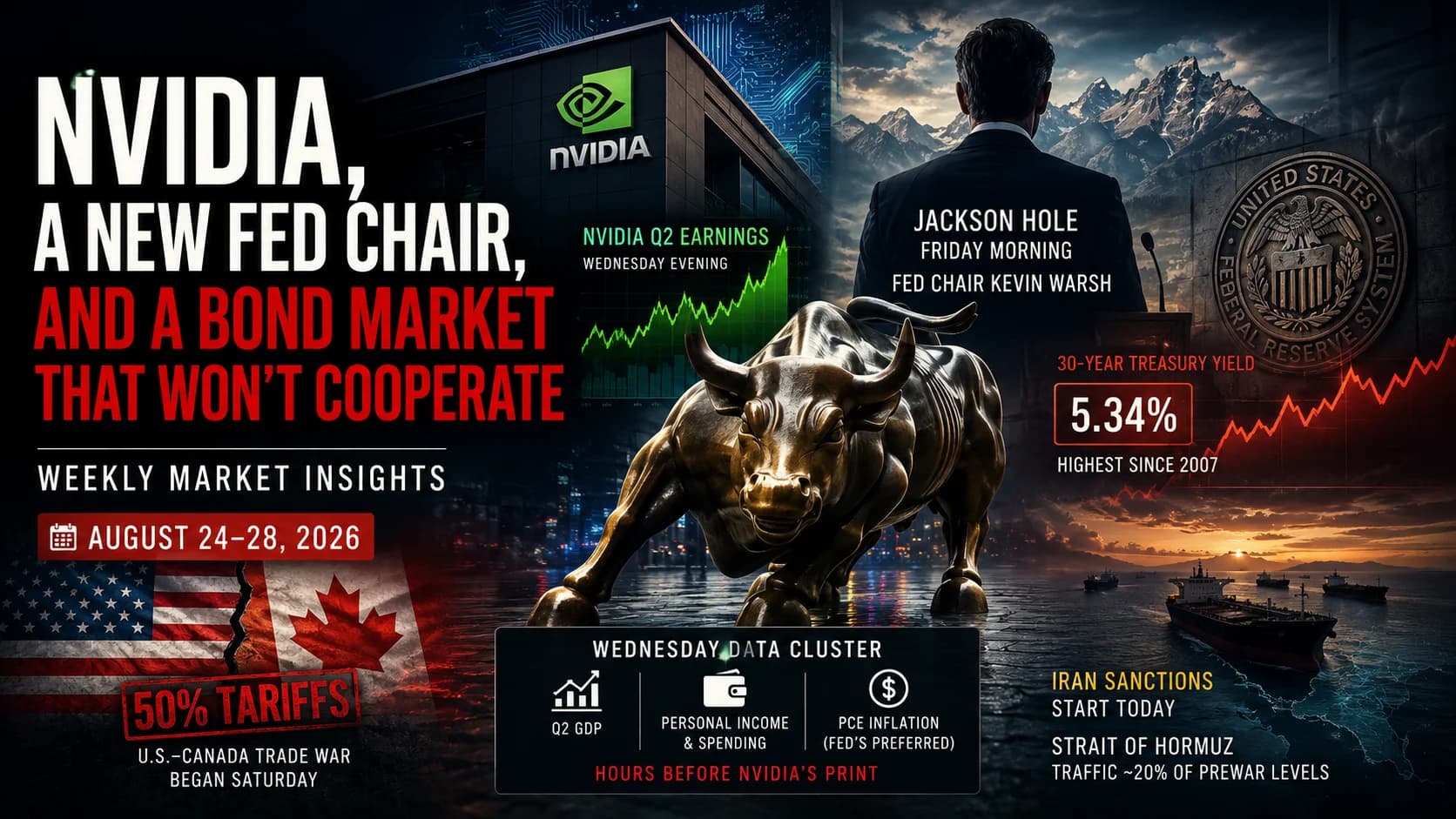
Nvidia, a New Fed Chair, and a Bond Market That Won't Cooperate: Weekly Market Insights, August 24-28
Warsh's first Jackson Hole speech, Nvidia's earnings, and fresh Iran and Canada shocks collide this week. The full Aug 24-28 catalyst map, stock watchlist, and scenario tree for traders.

Market Analysis & Insights
Two Wars, a Trade Fight, and CPI Still Has to Land Clean: Weekly Market Insights, September 7-11
A blowout jobs report already pushed rate-hike odds above 58%. Now a widening Middle East war and a new US-Canada trade fight collide with the last inflation data before the Fed's September 15-16 decision, while Nokia, Compass Pathways, Qualcomm, and Amgen all move on stories the calendar never saw coming.
Market Analysis & Insights
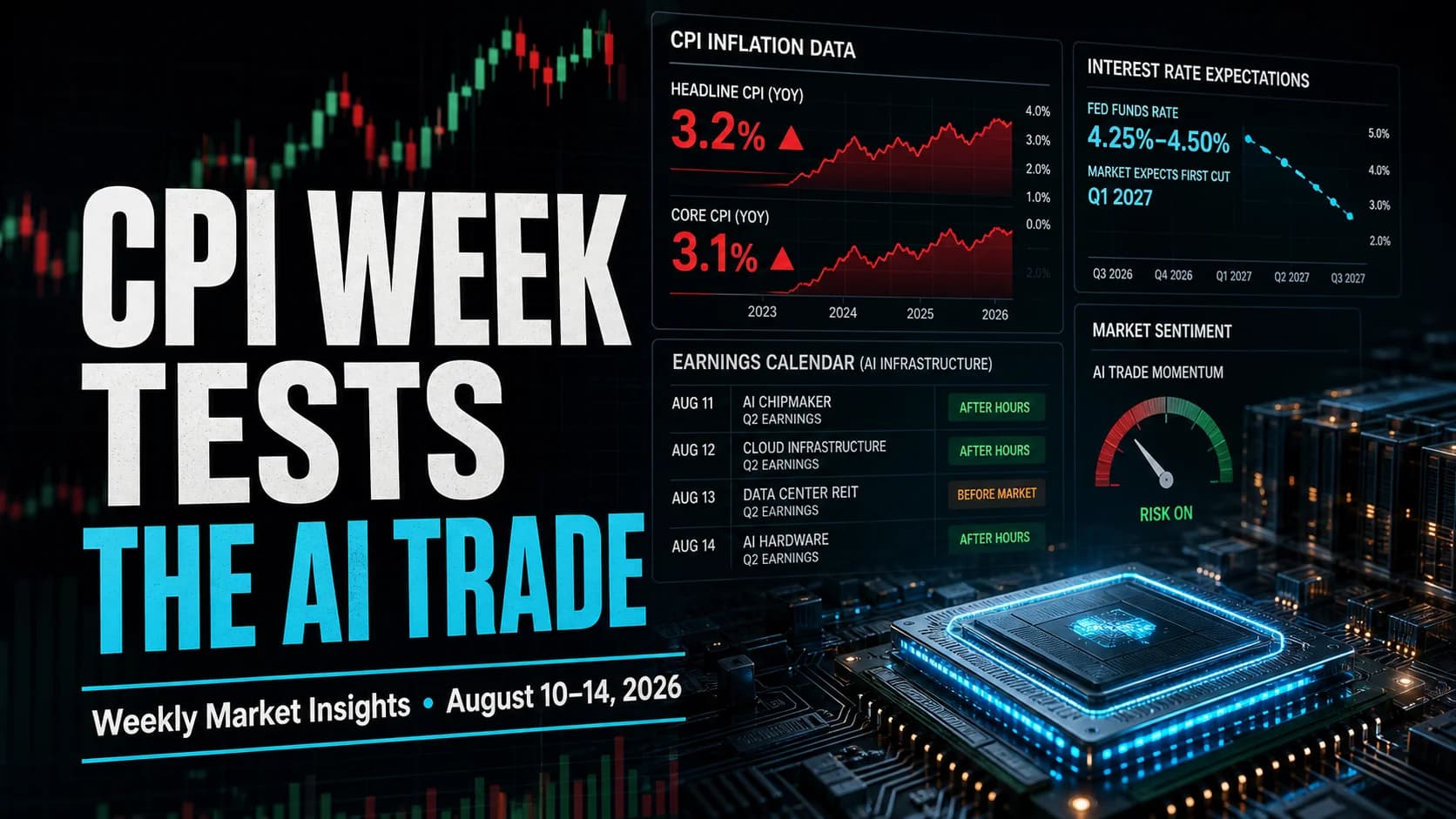
Weekly Market Insights August 10-14, 2026: A Weak Jobs Report Bought the Fed Room to Wait. CPI and a Wall of AI Earnings Decide If It Holds.
A weak jobs report eased rate fears, but CPI, PPI, and earnings from CoreWeave, Nebius, Cisco, and Applied Materials test whether the AI trade holds this week.
Comments
No comments yet. Be the first to share your thoughts.