
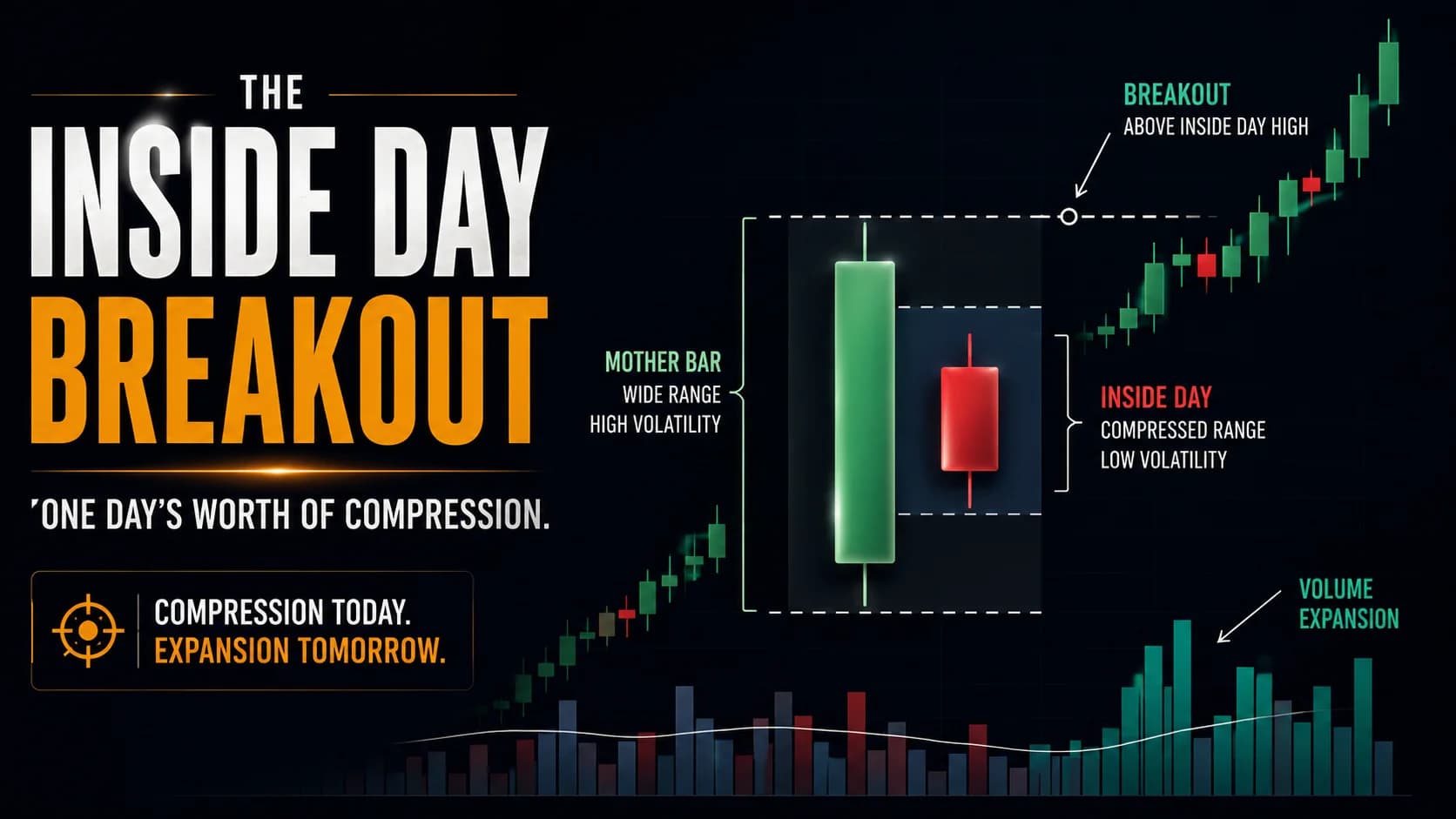
A stock trades in a wide, decisive RangeA range (or trading range) is a price zone where a stock oscillates between a defined support floor and resistance ceiling without making meaningful new highs or lows — price is consolidating rather than trending, and the dominant trade is Read definition → on Monday — a $3 high-to-low spread. On Tuesday, it barely moves, trading entirely within Monday's range from open to close. That single quiet session, sitting completely inside the prior day's range, is the entire signal behind one of the oldest short-term compression patterns in day trading.
Unlike a multi-week base or a statistical indicator reading, an inside day is defined by nothing more than two days of price data — a comparison anyone can make by eye. That simplicity is exactly why it's remained a staple of short-term trading since Toby Crabel first documented it systematically in 1990.
What is an inside day? An inside day is a trading session whose entire high-to-low range falls within the previous session's range — the current day makes neither a Higher HighA higher high occurs when price makes a swing peak that is above the previous swing peak — it's one of the two defining features of an uptrend and indicates buyers are consistently willing to pay more than before.Read definition → nor a Lower LowA lower low is when price makes a swing low that is below the previous swing low, confirming a downtrend in market structure — the mirror image of a higher low, and one of the two components (with lower highs) that defines a bearish trend.Read definition → than the day before it. The prior, wider-ranging session is often called the "mother bar." An inside day represents a session of relative indecision or ConsolidationConsolidation is a period where price moves sideways within a relatively tight range after a directional move — it reflects a temporary equilibrium between buyers and sellers before the next move.Read definition →, and the strategy trades the eventual BreakoutA breakout is when price moves decisively beyond a defined level — a resistance zone, a consolidation boundary, a chart pattern boundary, or a prior high — suggesting that the previous supply at that level has been overcome.Read definition → of that compressed range.
A Single-Session Pattern, Not a Multi-Week Base or an Indicator Reading
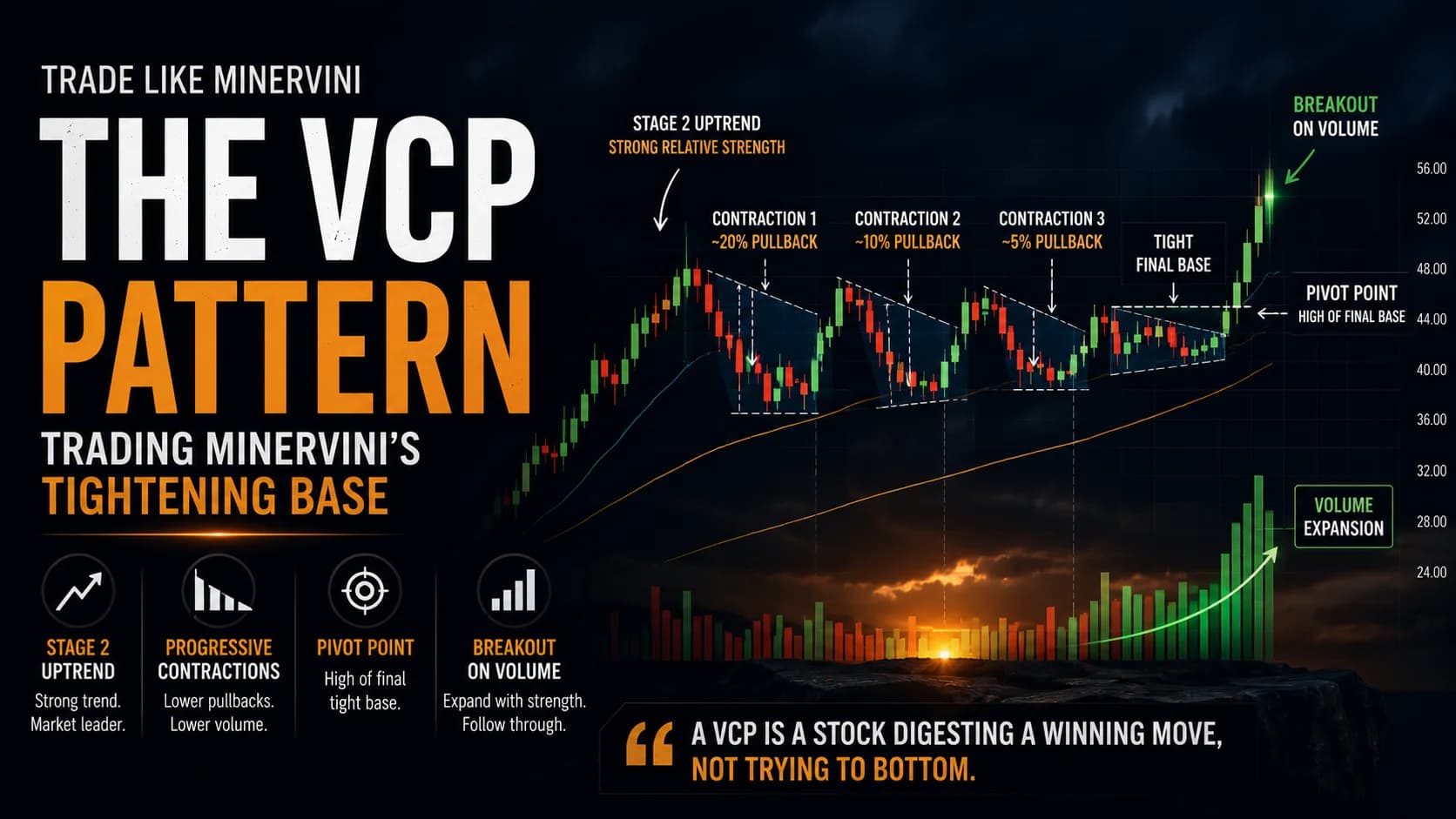
It's worth placing this alongside the other volatility-contraction concepts in this hub, since all three share the same underlying logic — contraction precedes expansion — while differing considerably in scale and mechanics. The VCP is a multi-week, multi-stage base requiring a prior uptrend. The Bollinger Band Squeeze is a statistical indicator reading measured against an instrument's own historical BandWidth. An inside day is neither — it's a two-day price comparison, readable directly off a bar chart with no indicator or multi-week base required, which is part of why it remains one of the most widely used short-term patterns in day trading specifically.
Where This Comes From: Crabel's Research on Narrow Range Days
Toby Crabel's 1990 book Day Trading with Short Term Price Patterns and Opening Range Breakout is the foundational text behind this pattern and several related ones. Alongside inside days, Crabel documented Narrow Range 4 (NR4) and Narrow Range 7 (NR7) days — a day whose range is narrower than each of the previous four or seven sessions, respectively — built on the same core premise that a period of contracted volatility tends to precede a period of expansion.
Crabel's research went a step further by identifying what happens when an inside day and an NR7 day coincide on the same session — sometimes labeled IDnr7 or NR7ID. This "double compression" is rarer than either pattern occurring alone, and is generally treated as a higher-conviction version of the same underlying signal, since two independent measures of contraction are agreeing on the same session simultaneously.
Crabel built his research directly on liquid futures data — index futures, bonds, currencies, and commodities — rather than equities specifically, and his broader thesis extended beyond inside days alone: markets cycle between periods of contraction (reduced volatility, narrower ranges) and expansion (larger ranges, stronger directional moves), and identifying which phase a market is currently in provides a genuine edge for timing entries. The inside day is one specific, easily identified marker of the contraction phase within that broader cycle.
Inside Days Don't Predict Direction — Only That a Move Is Coming
This is a point worth stating clearly, since it's easy to assume a compressed session implies which way the eventual breakout will go. It doesn't. An inside day, like a Bollinger squeeze, is directionally neutral on its own — it signals that volatility is likely to expand soon, not which direction that expansion will favor.
Other tools have to supply the directional bias: the broader trend, a supporting catalyst, or simply waiting for price to actually break one side of the range before committing to a direction. Assuming an inside day following an uptrend must resolve higher, without waiting for the actual breakout to confirm, turns a rules-based setup into a guess wearing the setup's name.
The Inside Day Breakout: A Setup Specification
- Component
- Market Conditions Required
- Rule
- Current session's entire high-low range falls within the prior session's ("mother bar") range; optionally combined with an NR7 reading (narrowest range of the last seven sessions) for a higher-conviction double-compression setup
- Component
- Time of Day
- Rule
- The breakout can be traded intraday as price clears either boundary of the inside day's own range, generally in the 9:45 AM–3:30 PM ET window on the session following the inside day
- Component
- Stock Selection Criteria
- Rule
- Liquid stocks, ETFs, or futures with consistent average daily volume — Crabel's original research was built on liquid futures markets, and the pattern's reliability depends on genuine two-sided participation rather than a thinly traded range
- Component
- Entry Trigger
- Rule
- A stop order placed just beyond the inside day's high (for a long) or low (for a short), triggering only once price actually clears the compressed range rather than assuming a direction in advance
- Component
- Stop Loss
- Rule
- Placed at the opposite side of the inside day's own range — since the inside day is, by definition, narrower than the mother bar, this produces a naturally tight, well-defined stop
- Component
- Initial Profit Target
- Rule
- The width of the mother bar (the prior day's full range), projected from the breakout point, is a commonly used starting reference for a first target
- Component
- Trade Management
- Rule
- This is a short-term setup that needs to show follow-through quickly — if the breakout doesn't continue promptly in the triggered direction, that lack of immediate follow-through is itself a warning sign worth acting on
- Component
- Invalidation Criteria
- Rule
- Price breaks one side of the inside day's range, then reverses and closes back through the opposite side — a whipsaw that suggests the compression resolved into noise rather than a genuine expansion
| Component | Rule |
|---|---|
| Market Conditions Required | Current session's entire high-low range falls within the prior session's ("mother bar") range; optionally combined with an NR7 reading (narrowest range of the last seven sessions) for a higher-conviction double-compression setup |
| Time of Day | The breakout can be traded intraday as price clears either boundary of the inside day's own range, generally in the 9:45 AM–3:30 PM ET window on the session following the inside day |
| Stock Selection Criteria | Liquid stocks, ETFs, or futures with consistent average daily volume — Crabel's original research was built on liquid futures markets, and the pattern's reliability depends on genuine two-sided participation rather than a thinly traded range |
| Entry Trigger | A stop order placed just beyond the inside day's high (for a long) or low (for a short), triggering only once price actually clears the compressed range rather than assuming a direction in advance |
| Stop Loss | Placed at the opposite side of the inside day's own range — since the inside day is, by definition, narrower than the mother bar, this produces a naturally tight, well-defined stop |
| Initial Profit Target | The width of the mother bar (the prior day's full range), projected from the breakout point, is a commonly used starting reference for a first target |
| Trade Management | This is a short-term setup that needs to show follow-through quickly — if the breakout doesn't continue promptly in the triggered direction, that lack of immediate follow-through is itself a warning sign worth acting on |
| Invalidation Criteria | Price breaks one side of the inside day's range, then reverses and closes back through the opposite side — a whipsaw that suggests the compression resolved into noise rather than a genuine expansion |
The Trade Management row reflects something specific to short-term setups like this one: unlike a multi-week base that can be given time to develop, an inside day breakout is expected to work close to immediately. A slow, hesitant move after the trigger is a different, weaker signal than the same trigger followed by decisive continuation.
A Walk-Through: Trading a Double-Compression Setup
Picture a large-cap stock — call it ABC — trading in a wide $4 range on Monday, from $96 to $100, closing near $98. On Tuesday, the stock trades entirely within that range, making a high of $98.80 and a low of $97.20 — a clear inside day. Checking the prior six sessions confirms Tuesday's $1.60 range is also the narrowest of the past seven days, qualifying it as an NR7 day as well — the double-compression setup.
A buy-stop is placed at $98.85, just above Tuesday's high, and a sell-stop at $97.15, just below Tuesday's low — Crabel's opening-range-breakout approach of letting the market pick the direction rather than guessing it. On Wednesday, price gaps slightly higher and clears $98.85 by mid-morning on solid volume, triggering the long entry and canceling the unfilled sell-stop. The stop-loss sits at $97.15, the opposite side of Tuesday's narrow range — a tight risk relative to Monday's full $4 range. The initial target, projected using Monday's $4 mother-bar width from the $98.85 breakout point, sits near $102.85.
Now picture an alternate Wednesday: price clears $98.85 briefly, trades up to $99.20, then reverses and closes back below $97.15 by the end of the session. That reversal through the opposite boundary is the invalidation signal — the compression resolved into a whipsaw rather than a clean expansion, and the position should already be closed rather than held on the assumption the original breakout will reassert itself.
Where the Inside Day Breakout Fails
The most common failure is treating the pattern as directional on its own, entering in the direction of a recent trend before the actual breakout confirms rather than waiting for price to clear the range. Since the inside day carries no inherent directional bias, this shortcut turns a rules-based entry into a guess with worse timing than simply waiting for the trigger.
It also fails on illiquid or thinly traded instruments, where a narrow daily range can reflect a simple lack of participation rather than genuine coiled-spring compression. Crabel's original research applied to liquid futures markets specifically, and the same logic depends on real two-sided interest being present, not merely an absence of trading activity.
And it fails when the follow-through requirement gets ignored. Because this is a short-term setup built around a single day's compression, a breakout that stalls immediately rather than continuing decisively is providing real information — treating that hesitation as a temporary pause rather than a warning sign is a common way this setup produces a string of small losses rather than the occasional large winner it's designed to catch.
A subtler failure is entering on both the buy-stop and sell-stop without canceling the unfilled one once the first triggers. The opening-range-breakout style entry described in the setup specification is designed to let the market pick a direction, but that only works if the opposite-side order is genuinely canceled the moment one side fills — otherwise a whipsaw session can trigger both orders in sequence, turning a single directional bet into two separate losing trades.
Combining Inside Days With Narrow Range for Higher Conviction
The double-compression variant — an inside day that's also an NR7 day — deserves particular attention because it stacks two independent measures of contraction on the same session. An inside day alone confirms the range didn't exceed the prior day's boundaries; an NR7 reading alone confirms the range is the tightest of the past week. When both conditions are true simultaneously, the case for a coiled, compressed session is considerably stronger than either measure would suggest on its own.
This combination is rarer than an ordinary inside day, which means fewer qualifying setups overall — a reasonable tradeoff for the added conviction, rather than a reason to loosen the criteria back down to plain inside days when the stricter combination isn't available.
Where This Fits a Complete Trading Plan
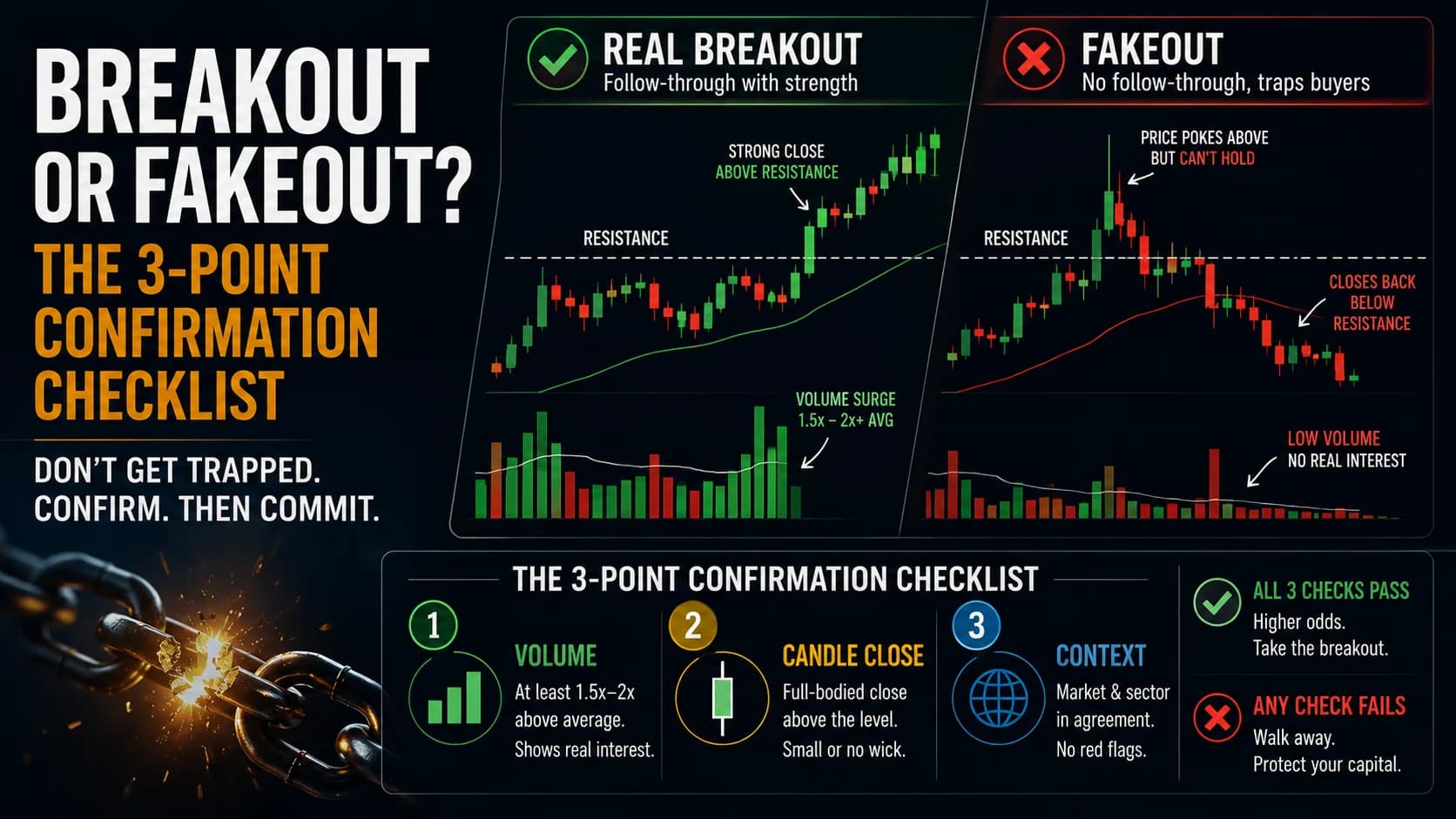
The inside day breakout still needs to clear the same basic confirmation logic covered in the breakout vs. fakeout checklist — volume and candle-close confirmation matter here just as they do for any other breakout, even though the setup condition itself is defined purely by price range rather than an indicator. For the deeper volume-reading techniques that can add confidence to a compressed-range breakout specifically, the volume breakout guide covers pace, OBV, and volume profile structure that apply directly here.
For the rest of the breakout and breakdown setups this guide complements, the Strategies Hub organizes the full library by market condition.
Frequently Asked Questions About the Inside Day Breakout
How is an inside day different from the VCP or a Bollinger Band Squeeze?
All three share the underlying logic that contraction precedes expansion, but they operate at very different scales — an inside day can be identified from two bars on a chart, while the other two require either weeks of price history or an indicator calculation.
Key Takeaway: Use an inside day when a fast, purely price-based read is needed; reserve the VCP and Bollinger squeeze for their respective longer-term or indicator-based contexts.
Does an inside day predict which direction the breakout will go?
Other factors — the broader trend, a supporting catalyst, or simply the direction of the actual breakout once it occurs — have to supply the directional bias. Assuming a direction in advance based on the pattern alone turns a rules-based entry into an unconfirmed guess.
Key Takeaway: Wait for price to actually clear one side of the range before committing to a direction, rather than assuming the pattern implies one.
What is a "mother bar," and why does it matter?
Referring to the containing session by this specific term makes it easier to discuss the pattern precisely, since the target and the general scale of the setup are both defined relative to the mother bar's range rather than the (narrower) inside day itself.
Key Takeaway: Use the mother bar's range, not the inside day's own narrower range, as the basis for the profit target projection.
What is NR7, and how does it relate to the inside day pattern?
Both patterns measure contraction, but from different angles: an inside day compares the current range only to the prior single session, while NR7 compares it to the past week. Agreement between the two adds confidence beyond what either measure provides alone.
Key Takeaway: Treat a session that qualifies as both an inside day and an NR7 day as a stronger signal than either pattern occurring by itself.
Why does this setup need to show follow-through quickly after the breakout triggers?
A breakout that stalls right after triggering is providing real information about the setup's quality, not simply taking time to develop the way a longer-term pattern might reasonably be given room to do.
Key Takeaway: Treat a lack of immediate follow-through after the trigger as an early warning sign, not something to wait out patiently.
Why does the inside day pattern work less reliably on illiquid stocks?
Crabel's original research was built on liquid futures markets specifically, where a narrow range genuinely reflected reduced volatility among active participants rather than an absence of trading activity altogether.
Key Takeaway: Reserve this setup for liquid instruments where a narrow range reflects genuine volatility compression, not simple inactivity.
How should the stop-loss be set on an inside day breakout?
This tight, structurally defined stop is one of the practical advantages of trading off the inside day's own narrow range rather than a wider reference point, since the pattern's own compression does the work of defining a close risk level.
Key Takeaway: Use the inside day's own opposite boundary for the stop — its narrowness is a structural advantage of the pattern, not an arbitrary choice.
Can this setup be traded using an opening-range-breakout approach instead of an intraday range break?
Both approaches share the same underlying contraction-then-expansion logic; the intraday range-break version described in this guide is a straightforward, widely used variation that applies directly to the inside day's own defined boundaries.
Key Takeaway: The inside day range-break and the classic opening-range-breakout stretch method are two valid variations on the same core Crabel-derived logic.
Does an inside day need to be a perfect, textbook range containment to qualify?
Being strict about the definition matters because the pattern's logic depends specifically on the current session failing to extend the prior day's range at all. A day that extends even slightly beyond the mother bar's boundary is a different pattern, not a minor variation of an inside day.
Key Takeaway: Apply the strict definition — both the high and low must be contained — rather than counting close approximations as qualifying inside days.
Is the inside day pattern only useful as a standalone setup?
Treating the inside day purely as an isolated, standalone signal ignores how much stronger the setup becomes when other independent measures — narrow range status, broader trend, or volume confirmation — happen to agree with it on the same session.
Key Takeaway: Layer the inside day with other confirming tools, particularly NR7, rather than trading it in isolation by default.
Disclaimer
Article Sources
- Crabel, T. (1990). Day Trading with Short Term Price Patterns and Opening Range Breakout. Traders Press. — the foundational published source for inside days, NR4, NR7, and the opening-range-breakout methodology referenced throughout this guide.
- Narrow Range Day NR7 — StockCharts ChartSchool - explains the NR4 and NR7 concepts, their origin with Crabel, and their relationship to the same contraction-precedes-expansion logic behind the Bollinger Band Squeeze.chartschool.stockcharts.com