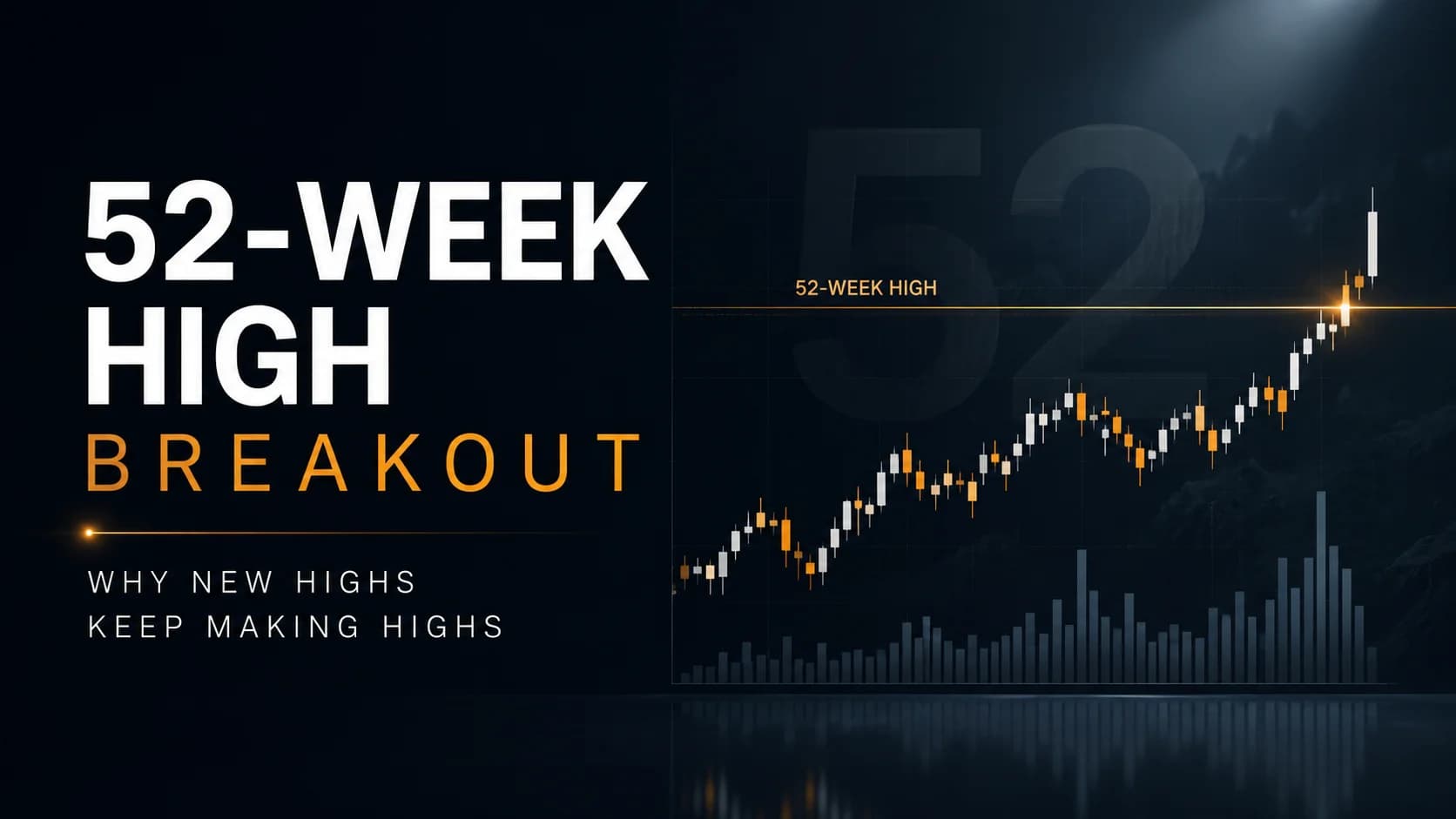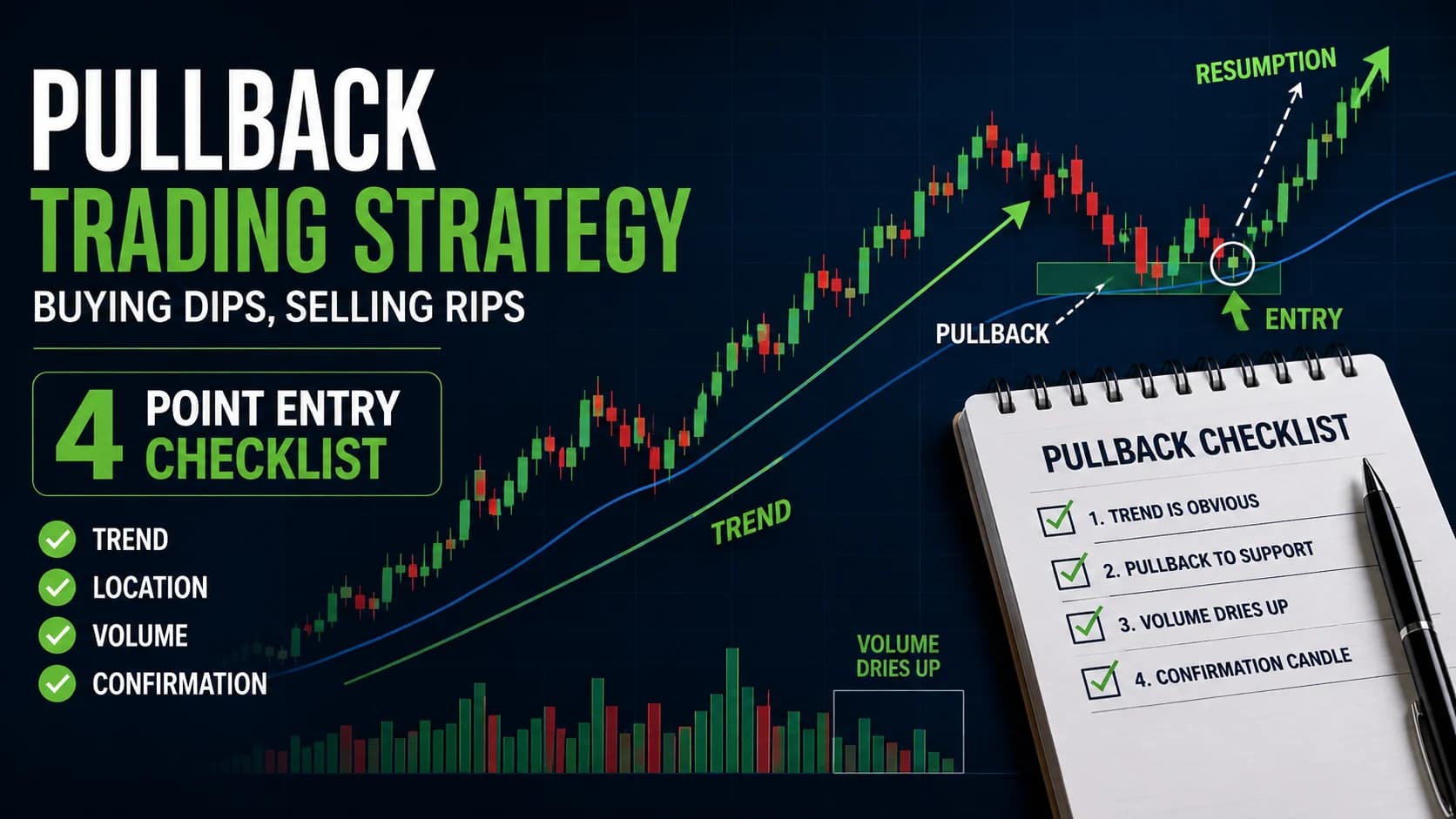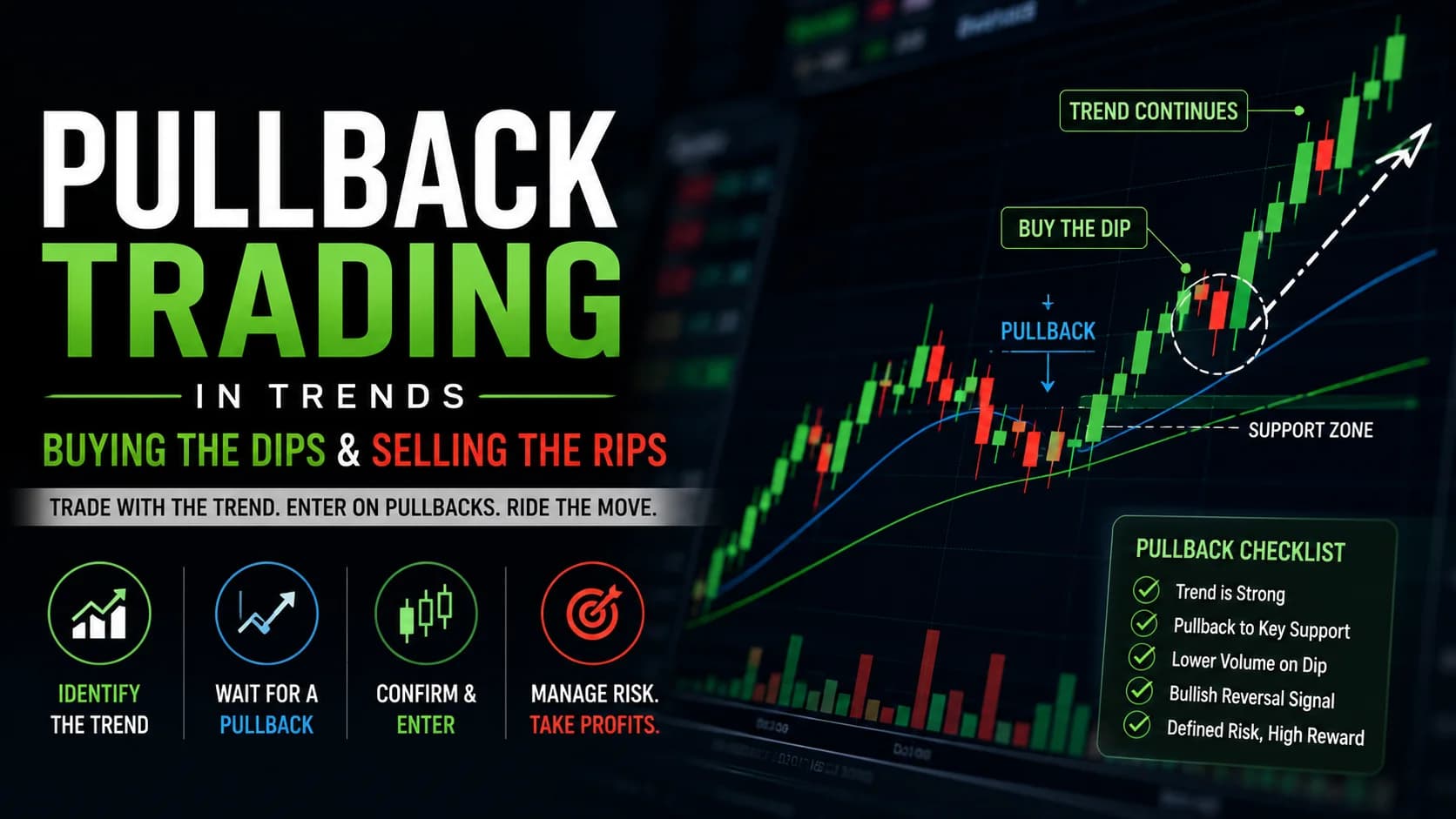

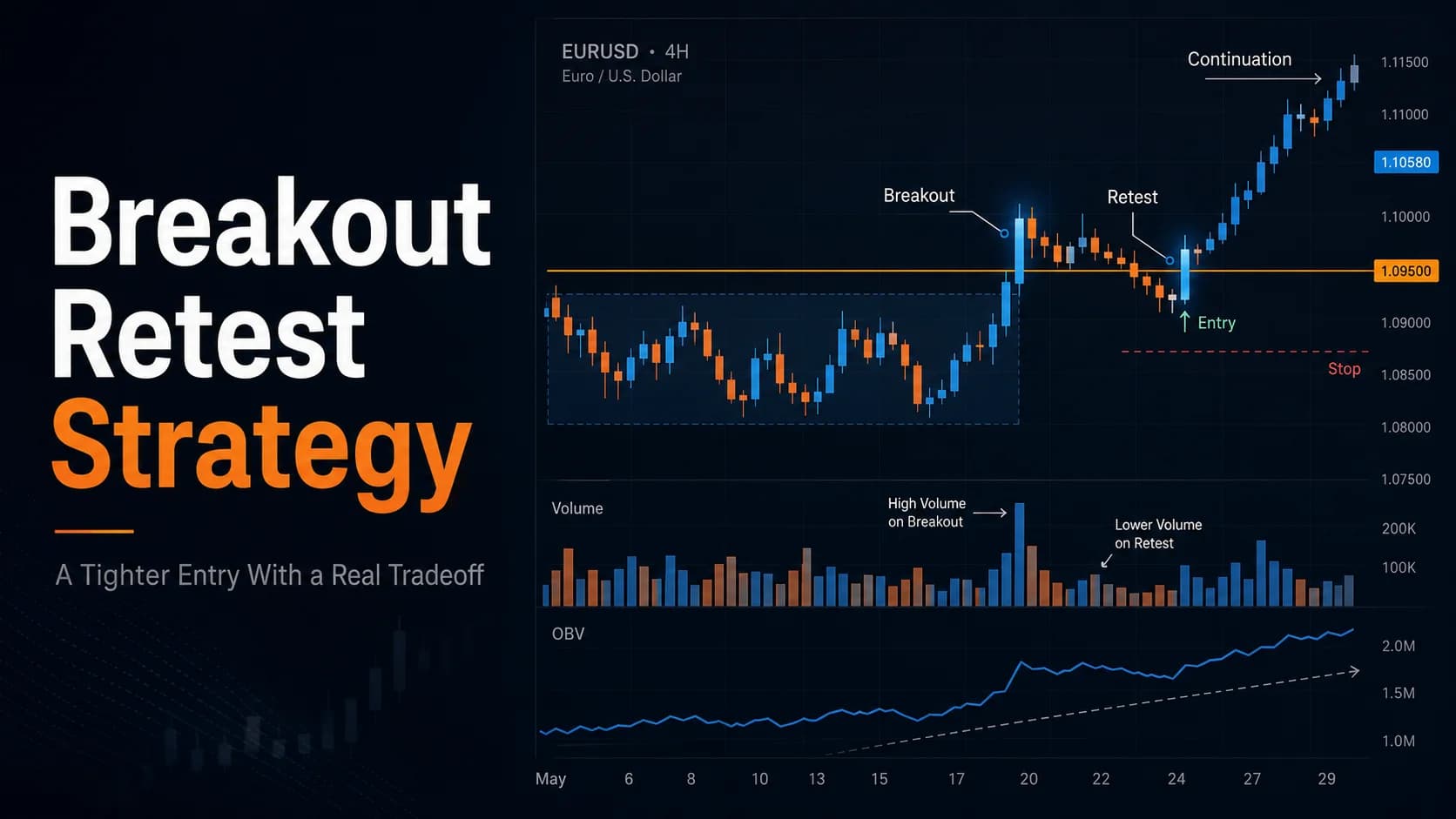
Waiting for a stock to retest a broken level before entering feels like the more careful, disciplined choice — a better entry price, a tighter stop, one more piece of confirmation before committing. That instinct is reasonable. It's also worth knowing that the actual historical data on this exact behavior tells a more complicated story than "waiting is always safer."
Long-running empirical research on chart-pattern performance has found that stocks which never look back after breaking out tend to outperform, on average, the ones that do retest the level. This guide covers how to trade a retest properly when one does occur, while being honest about what the data actually says about the tradeoff involved in waiting for one.
What is a BreakoutA breakout is when price moves decisively beyond a defined level — a resistance zone, a consolidation boundary, a chart pattern boundary, or a prior high — suggesting that the previous supply at that level has been overcome.Read definition → retest? A retest — called a throwback after an upward breakout and a PullbackA pullback is a temporary counter-trend price movement within an established trend — in an uptrend, a pullback is a short-term decline that offers a lower-risk entry point before the trend resumes, as opposed to a reversal which signals theRead definition → after a downward one, in the precise terminology used in chart-pattern research — is when price returns to the level it just broke before continuing in the original breakout direction. Trading the retest means entering on that return visit rather than on the initial break, in exchange for a tighter stop and a more favorable entry price.
Throwback and Pullback: The Precise Terms, and Why They're Often Reversed Colloquially
In casual trading conversation, "pullback" often gets used for any retracement in either direction. The terminology used in serious chart-pattern research is more specific: a throwback occurs after an upward breakout, when price returns down to the breakout level. A pullback occurs after a downward breakout, when price returns up to the breakout level. The two words aren't interchangeable once precision matters, and mixing them up when reading research or discussing a setup with other traders is a common source of confusion.
Both are the same underlying phenomenon — a return visit to a level just broken — just named according to which direction the original breakout occurred.
What the Data Actually Says About Retests
This is the part most retest guides skip, and it matters. Long-running research tracking tens of thousands of chart patterns found that a majority of chart pattern types with upward breakouts performed better, on average, when no throwback occurred at all — and a similarly large majority of downward-breakout pattern types performed better without a pullback. In other words, a clean breakout that never looks back tends to be the stronger statistical outcome, not the retest.
This doesn't mean retests are a bad thing to trade — it means the decision to wait for one involves a real tradeoff, not a free upgrade in safety. Waiting for a retest that never comes means missing the (statistically stronger) clean breakouts entirely. Waiting for a retest that does come means entering a subset of setups that, as a group, has historically underperformed the setups that never needed a retest to begin with.
The same research found throwbacks occur after roughly 58% of upward breakouts (measured since 2000 across a large sample of chart patterns), with the return trip typically taking about 6 days to begin and roughly 10 days total to complete. A retest, in other words, is a common event, not a rare one — which makes understanding how to trade it properly, or knowing when to skip waiting for it, a genuinely practical question rather than an edge case.
The typical throwback's height — how far price climbs before turning back toward the breakout level — averages around 8% in the same research, with most falling somewhere between 4% and 10%. And not every throwback resolves cleanly: after price returns to the breakout level, a meaningful share (documented at roughly 35% in the same dataset) continue dropping below the original chart pattern entirely rather than recovering to resume the breakout direction. The other 65% do recover — but that failure rate is a real number worth weighing against the appeal of a tighter stop, not a footnote to skip past.
Clean vs. Deep: The Distinction That Actually Predicts Performance
Not all retests behave the same way, and the difference matters more than whether a retest happens at all. A "clean" retest is one where price returns to test the broken level but doesn't close back below it (for an upward breakout) or above it (for a downward one) — it holds right at the old boundary before resuming the original direction. A "deep" retest crosses back through that level into the old pattern before eventually recovering.
Research on this exact distinction found a meaningful performance GapA gap is a price discontinuity on a chart where a stock opens significantly higher or lower than the previous session's close, leaving a visible empty space — gap-ups are driven by overnight buying pressure or positive news; gap-downs by seRead definition →: when price remained at or above the original breakout level during a throwback, the subsequent rise averaged considerably more than when price dropped below that level before recovering. A retest that stays clean is a meaningfully stronger signal than one that dips back into the old RangeA range (or trading range) is a price zone where a stock oscillates between a defined support floor and resistance ceiling without making meaningful new highs or lows — price is consolidating rather than trending, and the dominant trade is Read definition → first, even when both eventually resume the original direction.
The Confirmed Retest Entry: A Setup Specification
- Component
- Market Conditions Required
- Rule
- A breakout already confirmed under the standard volume-and-close checklist; price now returning toward the broken level within roughly 6–10 sessions of the original break, consistent with typical retest timing
- Component
- Time of Day
- Rule
- 9:45 AM–3:30 PM ET for the retest entry candle itself, consistent with the general breakout confirmation framework
- Component
- Entry Trigger
- Rule
- Price touches or approaches the broken level and prints a rejection candle while remaining at or above the breakout price (for an upward breakout) or at or below it (for a downward one) — a clean retest, not a deep one
- Component
- Stop Loss
- Rule
- Placed just beyond the retest candle's extreme — meaningfully tighter than the stop used on the original breakout entry, which is the main structural advantage of waiting for this entry style
- Component
- Initial Profit Target
- Rule
- The same measured-move target used for the original breakout pattern, adjusted for the improved entry price achieved by waiting for the retest
- Component
- Trade Management
- Rule
- If the retest becomes deep — price closes back through the original breakout level into the old pattern — treat the setup with meaningfully more caution, since deep retests have historically preceded weaker subsequent moves than clean ones
- Component
- Invalidation Criteria
- Rule
- Price continues through the retest level and closes decisively back inside or beyond the original pattern boundary, rather than merely dipping below the breakout price temporarily — this is a failed retest, not a deeper buying opportunity
| Component | Rule |
|---|---|
| Market Conditions Required | A breakout already confirmed under the standard volume-and-close checklist; price now returning toward the broken level within roughly 6–10 sessions of the original break, consistent with typical retest timing |
| Time of Day | 9:45 AM–3:30 PM ET for the retest entry candle itself, consistent with the general breakout confirmation framework |
| Entry Trigger | Price touches or approaches the broken level and prints a rejection candle while remaining at or above the breakout price (for an upward breakout) or at or below it (for a downward one) — a clean retest, not a deep one |
| Stop Loss | Placed just beyond the retest candle's extreme — meaningfully tighter than the stop used on the original breakout entry, which is the main structural advantage of waiting for this entry style |
| Initial Profit Target | The same measured-move target used for the original breakout pattern, adjusted for the improved entry price achieved by waiting for the retest |
| Trade Management | If the retest becomes deep — price closes back through the original breakout level into the old pattern — treat the setup with meaningfully more caution, since deep retests have historically preceded weaker subsequent moves than clean ones |
| Invalidation Criteria | Price continues through the retest level and closes decisively back inside or beyond the original pattern boundary, rather than merely dipping below the breakout price temporarily — this is a failed retest, not a deeper buying opportunity |
The Trade Management row exists because of the clean-versus-deep distinction covered above. A retest isn't a single event to simply wait for — its character once it arrives carries real information about how strong the eventual continuation is likely to be.
A Walk-Through: Trading a Clean Throwback
Picture a mid-cap stock — call it ABC — breaking out above $55 ResistanceResistance is a price level where selling pressure has historically overcome buying pressure, causing price to stall, reverse, or consolidate — it's the ceiling where supply enters the market and where breakout traders watch for either a coRead definition → on strong volume, climbing to $58 over the following four sessions. On day six after the breakout, the stock begins drifting back down, and by day nine it's testing the $55 area again.
The retest holds at $55.20 — a rejection candle forms, and price never closes below $55. That's a clean retest: price approached the old resistance-turned-support level without crossing back through it. The entry triggers here, with a stop placed at $54.80, just below the retest low — considerably tighter than a stop placed at the original breakout candle's low would have been. The target remains the same measured-move projection calculated from the original pattern.
Now picture the same setup with one difference: instead of holding at $55.20, the stock dips to $54.10 — closing back below the $55 breakout level — before recovering over the next two sessions and climbing again. That's a deep retest. The setup can still be traded, but the historical data on this exact distinction suggests a meaningfully weaker average outcome than the clean version, which argues for a smaller position size or a higher bar for the rejection confirmation before entering.
Where the Retest Entry Breaks Down
The most common failure is treating "wait for the retest" as an unambiguous safety upgrade rather than the tradeoff it actually is. A trader who only ever waits for retests will, by definition, never catch the class of breakouts that never look back — which the data suggests are, on average, the stronger performers as a group.
It also fails when a deep retest gets treated identically to a clean one. The two have historically produced different average outcomes, and applying the same confidence and position size to both ignores real information the retest's own behavior is providing.
And it fails when a retest is awaited indefinitely. Most retests that are going to happen complete within roughly ten days of the original breakout; a level that hasn't been retested by then is less likely to be revisited at all, and waiting past that window on the assumption that a retest is still coming can mean missing a move that's already fully underway.
There's also a subtler failure worth naming: mistaking the documented 35% failure rate for something close to zero. A retest reaching the broken level and then continuing lower rather than recovering isn't a rare tail event — it happens often enough that a stop-loss on a retest entry needs to be treated as a real, expected possibility, not a formality included out of general caution.
Why High-Volume Breakouts Retest More Often, Not Less
One counterintuitive finding worth knowing: breakouts occurring on volume above the 30-day average have actually been found to throw back more often than lower-volume breakouts, not less. This runs against the intuitive assumption that a high-volume, high-conviction breakout should be the one least likely to need retesting.
The practical takeaway isn't that volume doesn't matter — it's that a strong initial breakout and the likelihood of a subsequent retest are two separate questions, and a trader shouldn't assume a clean, high-volume breakout is guaranteed to run without a look back. Both breakout styles (with or without an eventual retest) can be legitimate, high-conviction setups; the volume confirmation matters for judging the breakout itself, not for predicting whether a retest will follow.
Where This Fits a Complete Trading Plan
The retest entry is a specific style layered on top of an already-confirmed breakout — it isn't a substitute for the three-point breakout checklist covering volume, candle close, and context, which still has to pass before a retest is even worth waiting for in the first place. For anyone applying this to a breakdown rather than a breakout, the same clean-versus-deep logic applies with the direction reversed, alongside the short-selling-specific mechanics covered elsewhere in this hub.
For the rest of the breakout and breakdown setups this guide complements, the Strategies Hub organizes the full library by market condition.
Frequently Asked Questions About Trading Breakout Retests
Is waiting for a retest actually safer than trading the initial breakout?
Waiting for a retest offers a tighter stop and better entry price on the setups that do retest, but it also means missing the (statistically stronger, on average) breakouts that run without ever looking back. Neither approach is universally correct; they represent different points on the same risk-reward tradeoff.
Key Takeaway: Treat "wait for the retest" as a deliberate tradeoff between entry quality and missed opportunity, not an unambiguous safety upgrade.
What's the actual difference between a throwback and a pullback?
The two terms describe the same underlying behavior — a return visit to a just-broken level — distinguished only by which direction the original breakout occurred. Casual trading conversation often uses "pullback" loosely for both, but the precise terminology matters when discussing research or specific setups.
Key Takeaway: Use "throwback" for a return visit after an upward breakout and "pullback" for one after a downward breakout, not interchangeably.
How long does it typically take for a retest to develop, if one is going to happen?
A retest that hasn't developed within roughly this window is less likely to occur at all, which is useful for deciding when to stop waiting for one and treat the breakout as having run without a look back.
Key Takeaway: Give a retest roughly a week to ten days to develop before assuming it isn't coming.
What's the difference between a "clean" and a "deep" retest, and why does it matter?
This distinction carries more predictive information than simply noting that a retest occurred at all. Treating a deep retest with the same confidence as a clean one overlooks a real, measurable difference in historical outcomes between the two.
Key Takeaway: Note whether a retest stays clean or goes deep — the two have historically produced meaningfully different average outcomes.
Why do high-volume breakouts throw back more often than low-volume ones?
The practical implication is that breakout strength (measured by volume) and the likelihood of a subsequent retest are separate questions. A high-volume breakout shouldn't be assumed immune to a retest simply because the initial move looked convincing.
Key Takeaway: Don't assume a strong, high-volume breakout is less likely to retest — the data suggests the opposite tendency.
Should the stop-loss on a retest entry really be tighter than on the original breakout entry?
This tighter stop is the practical benefit that offsets the risk of missing a breakout that never retests. It's the concrete reason the retest entry style remains worth knowing even given the overall performance data favoring breakouts that don't retest.
Key Takeaway: Use the retest candle's extreme for a tighter stop — this is the specific advantage that makes the tradeoff worthwhile when a retest does occur.
When does a retest turn into a failed breakout instead of a "deeper" buying opportunity?
The data shows a meaningful share of throwbacks and pullbacks do eventually fail this way rather than recovering, which is why the invalidation criteria in the setup specification distinguish a temporary deep dip from a genuine breakdown of the entire pattern.
Key Takeaway: A decisive close back inside the old pattern is a failure signal, not an invitation to buy a deeper discount.
Does the retest strategy apply the same way to breakdowns as to breakouts?
The same statistical tradeoffs apply: patterns without a pullback have, on average, outperformed those with one, and a clean pullback that doesn't reclaim the broken support carries more favorable historical odds than a deep one that does.
Key Takeaway: Apply the identical clean-versus-deep framework to breakdown pullbacks, just with the price direction reversed.
Is it ever correct to skip waiting for a retest entirely?
The retest entry style exists as an option for traders who specifically value the tighter stop and improved entry price enough to accept missing the (statistically stronger) breakouts that never look back. Neither choice is objectively wrong; they simply represent different priorities.
Key Takeaway: Entering directly on a confirmed breakout, without waiting for a retest, is a reasonable default given what the data shows about average outcomes.
How should position sizing differ between a clean retest and a deep one?
This isn't a rigid formula so much as a reflection of the real difference in historical performance between the two retest types. Treating every retest, clean or deep, with identical size ignores information the retest's own character is providing about the setup's likely strength.
Key Takeaway: Scale size down on a deep retest relative to a clean one, reflecting the documented difference in average outcomes between the two.
Disclaimer
Article Sources
- Bulkowski on Throwbacks — ThePatternSite.com - the primary empirical source for throwback occurrence rates, timing, volume relationships, and the clean-versus-deep performance distinction referenced throughout this guide.thepatternsite.com
- Bulkowski on Pullbacks — ThePatternSite.com - the equivalent empirical data for pullbacks following downward breakouts.thepatternsite.com
- Bulkowski's Study of Studies — ThePatternSite.com - summarizes the comparative finding that most chart pattern types perform better, on average, without a throwback or pullback occurring.thepatternsite.com