
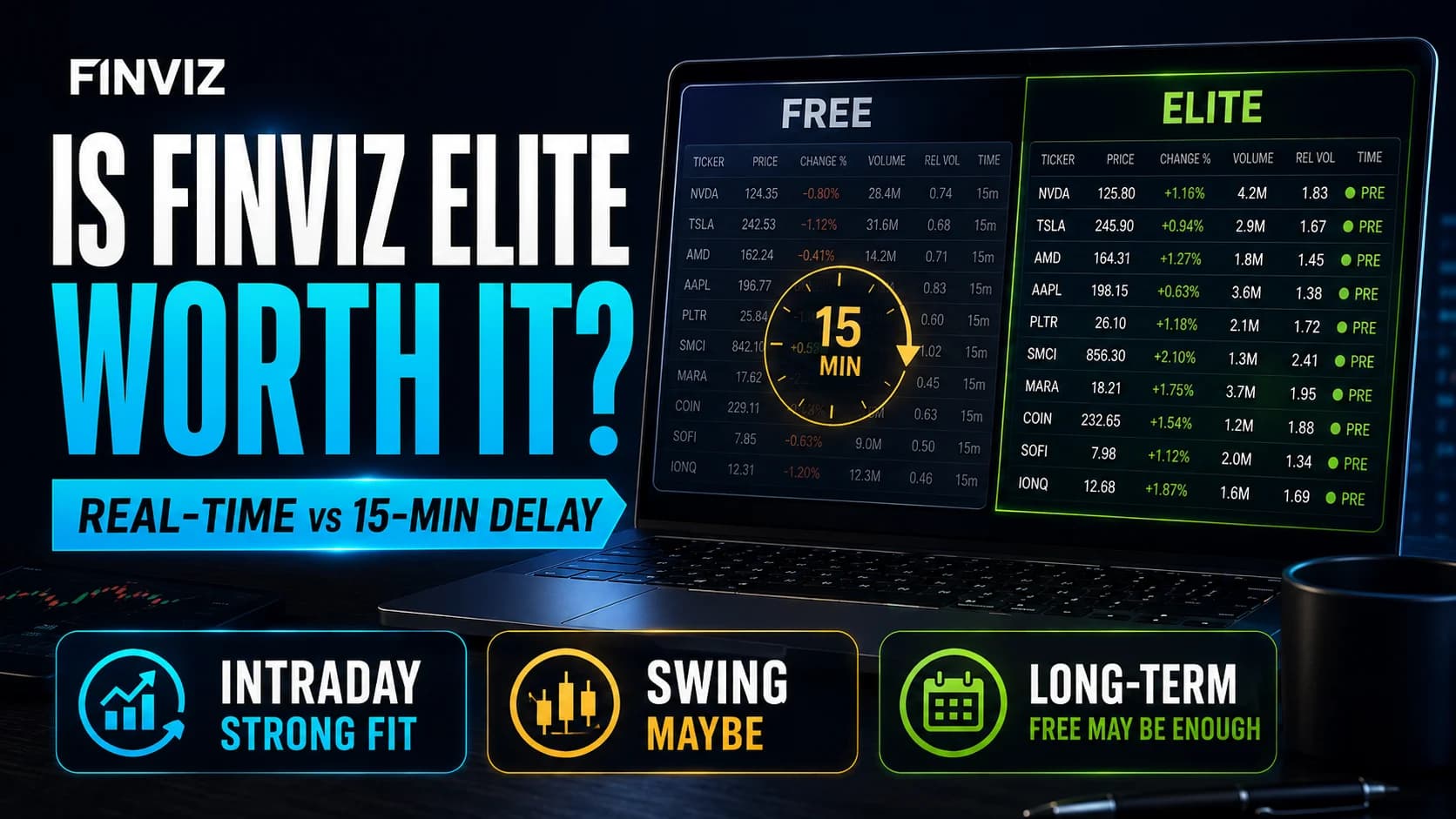
Finviz doesn't have five confusing tiers to untangle. It has one decision: stay free, or pay $24.96 to $39.50 a month for Elite. That should make "is it worth it" simple, and for a lot of traders it actually is, once you know whether live quotes and Elite's extra research tools matter for how you trade.
Is Finviz Elite worth it? It depends on whether you need real-time quotes, advanced filters, alerts, or intraday charts inside Finviz. The free tier can be enough for broader research, including many swing-trading workflows.
That's the short version. The honest version depends on which research and monitoring tools you will actually use, so let's break it down by trading style.
What Elite Actually Buys You
Finviz Free is a genuinely usable research tool, not a stripped demo designed to push an upgrade. A capable core screener, the SectorA broad grouping of companies that operate in the same segment of the economy — such as Technology, Healthcare, Energy, or Financials. Stocks within a sector tend to move together in response to shared economic, regulatory, and sentiment faRead definition → heat map, and basic daily charts are available at no cost. Elite adds advanced filters, customizable views, real-time quotes, and more active monitoring tools:
- Feature
- Stock Quotes
- Free
- 1-minute delayed
- Elite
- Real-time, plus pre-market (4:00-9:30 AM ET) and after-hours (4:00-8:00 PM ET)
- Feature
- Screener
- Free
- Core filters
- Elite
- Advanced filters and customizable views
- Feature
- Charts
- Free
- Daily/weekly/monthly, basic
- Elite
- Intraday timeframes down to 1 minute
- Feature
- Backtesting
- Free
- Not available
- Elite
- Screener-based backtesting on historical data
- Feature
- Alerts
- Free
- Not available
- Elite
- Email alerts for price, news, and portfolio events
- Feature
- Ads
- Free
- Present
- Elite
- Ad-free
| Feature | Free | Elite |
|---|---|---|
| Stock Quotes | 1-minute delayed | Real-time, plus pre-market (4:00-9:30 AM ET) and after-hours (4:00-8:00 PM ET) |
| Screener | Core filters | Advanced filters and customizable views |
| Charts | Daily/weekly/monthly, basic | Intraday timeframes down to 1 minute |
| Backtesting | Not available | Screener-based backtesting on historical data |
| Alerts | Not available | Email alerts for price, news, and portfolio events |
| Ads | Present | Ad-free |
Elite costs $39.50/month, or $24.96/month billed annually (roughly 37% off), with a genuine 7-day free trial. Full details are in our Finviz review, and the current Finviz deals page has whatever discount is active right now. You can start the free trial directly here once you've decided Elite fits.
Trader Type 1: The Same-Session Intraday Trader
You're making entry and exit decisions within the trading day, sometimes within minutes, based on what price and VolumeVolume is the total number of shares (or contracts) traded during a given time period — it's the primary confirmation tool for all price action, because a price move accompanied by high volume indicates genuine market participation, while tRead definition → are doing right now.
The trade-off: Finviz says regular stock quotes are delayed by one minute, while Elite quotes are real-time. For a fast same-session decision, check live prices in your execution platform before acting. Elite is more useful when you also want current quotes, alerts, advanced filters, and intraday charts in the same Finviz workflow.
Verdict: Potentially worth it if Finviz is your active monitoring workspace. If your broker already supplies live prices and you mainly use Finviz to build a watchlist, test the free tier first.
Trader Type 2: The Swing Trader Holding Days to Weeks
You're screening for setups you'll hold for several days or longer, and you're not trying to catch the exact minute of an intraday move.
The trade-off: A one-minute delay in stock quotes is usually less important when your holding period is measured in days. The free screener can cover broad research, but Elite adds advanced filters and customizable views, so it may still be useful if those criteria materially improve your shortlist. Real-time monitoring and intraday charts are less central to this profile.
Verdict: Usually not worth it. The exception is if you specifically want Elite's screener-based BacktestingThe process of running a defined trading strategy against historical price data to evaluate how it would have performed before risking real capital. A well-constructed backtest gives you a statistical baseline — win rate, profit factor, maxRead definition → to validate a strategy historically, in which case the low monthly cost is easy to justify for that one feature alone.
Trader Type 3: The Long-Term Investor Screening for Positions
You're building or adjusting a portfolio over weeks or months, using Finviz primarily to filter for fundamentally interesting names.
The math: This profile has the least use for Elite of anyone. Real-time data, intraday charts, and price alerts are all built around short holding periods and fast decisions, none of which describe long-term position building. The free screener's fundamental filters (P/E, EPS growth, insider ownership) already cover the criteria this profile actually screens on.
Verdict: Not worth it. A long-term investor is generally better served by a dedicated fundamental research platform if they outgrow Finviz's free tier at all, rather than by Finviz Elite specifically.
The Honest Gap: What Finviz Doesn't Do at Either Tier
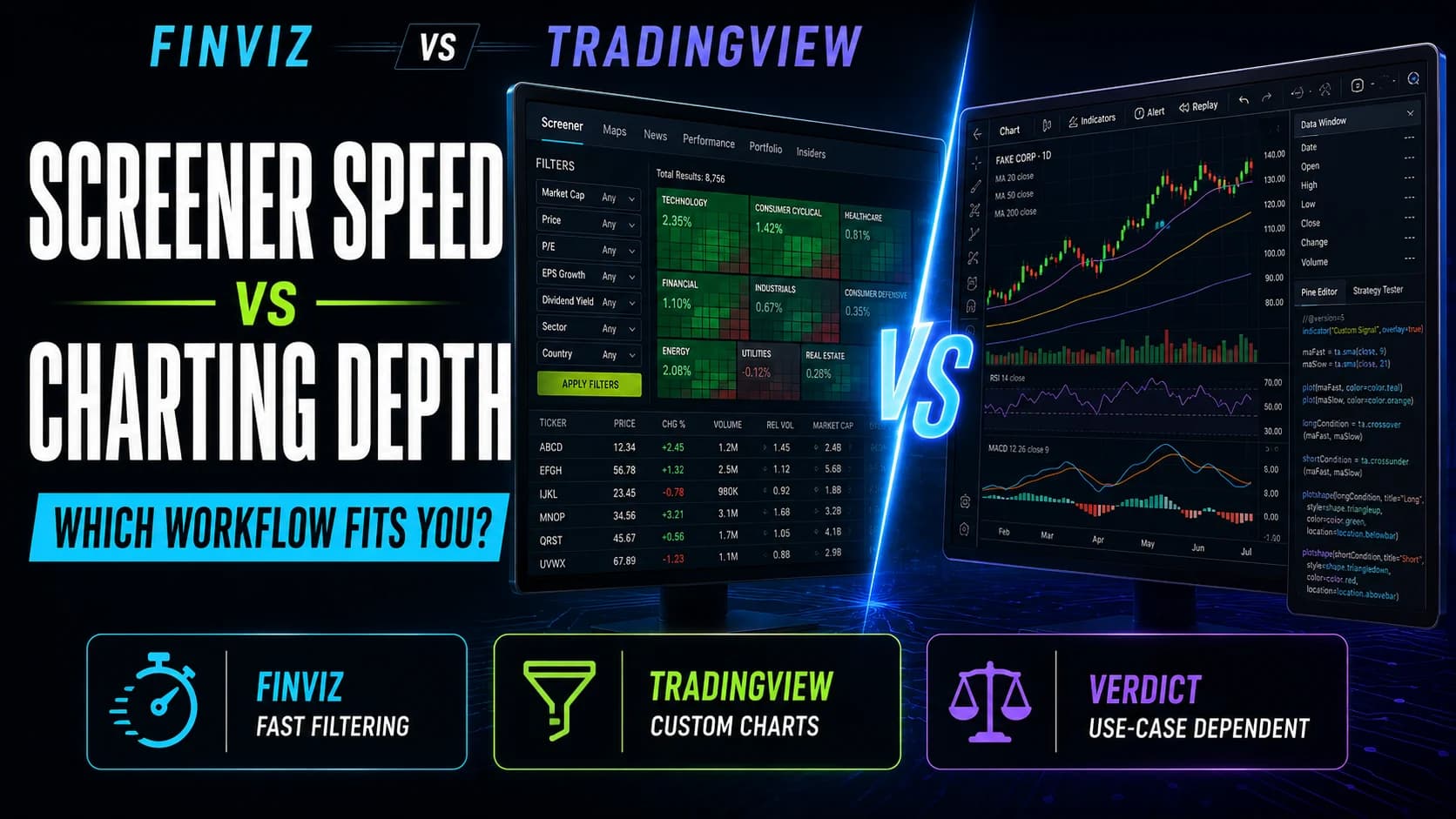
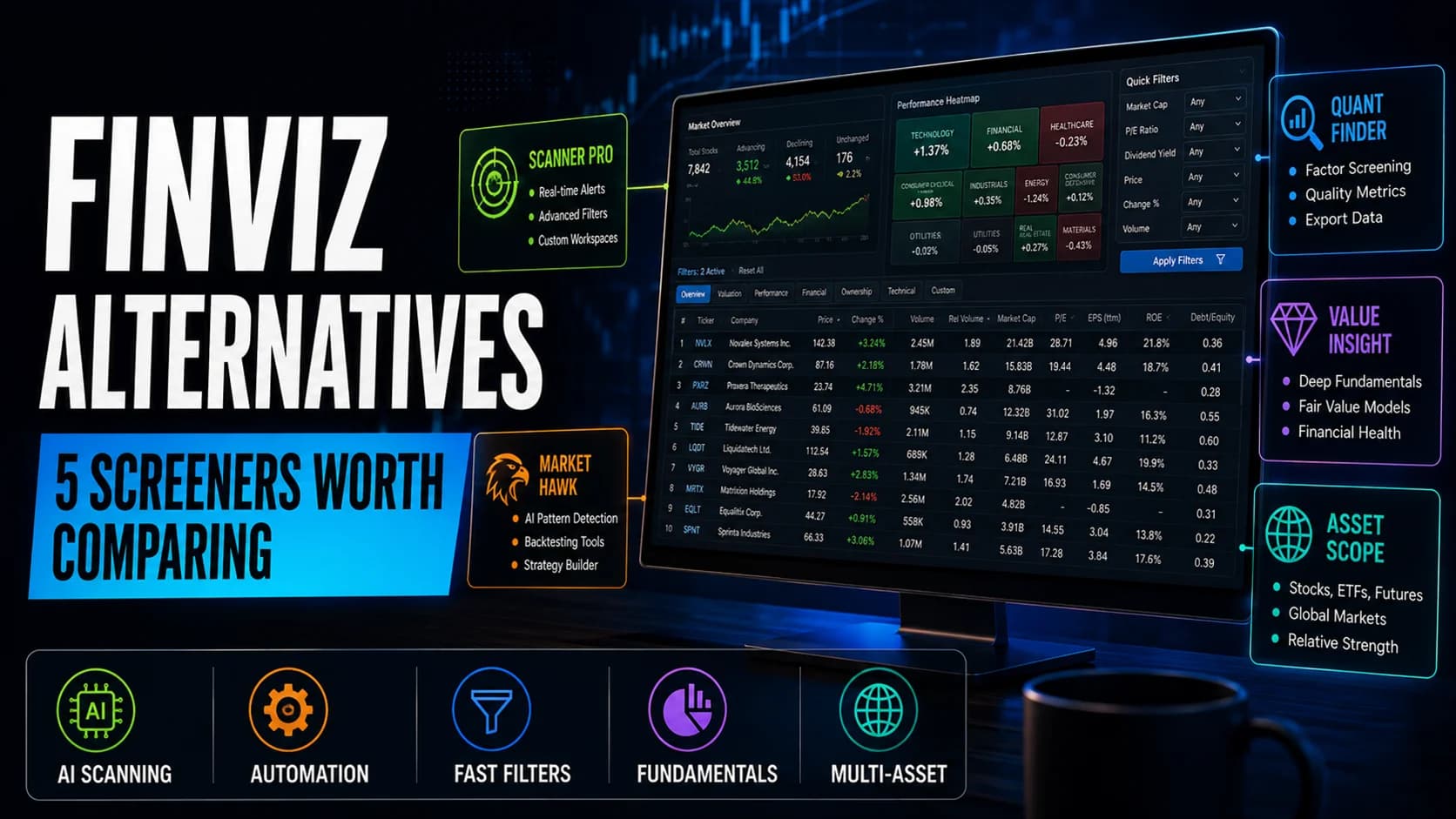
Regardless of which tier you're on, Finviz has real limits worth knowing before you treat it as your whole toolkit. There's no broker integration and no mobile app, so it's a research tool you pair with execution elsewhere, not a full trading workstation. Charting is functional for a quick look but lacks the drawing tools and custom indicators of a dedicated charting platform. And coverage is limited to US equities and ETFs, with little for traders working international markets. None of that changes with Elite; it's a property of the platform itself. For how Finviz stacks up against a deeper charting-first alternative, see Finviz vs. TradingView, or browse 5 other screeners worth comparing if you're not sure Finviz itself is the right fit.
Is the 7-day Finviz Elite trial actually free?
That makes testing Elite low-risk: use the week specifically during your normal trading hours to see whether real-time data changes your actual decisions, not just whether the interface looks nicer.
Key Takeaway: Use the full 7 days during real trading sessions, not just to browse the interface.
Can I cancel Finviz Elite easily if it's not worth it for me?
Mark your billing date if you're testing the annual plan specifically, since a longer commitment means a longer window before you can reassess without a partial-year cost.
Key Takeaway: Start with monthly billing if you're still unsure Elite is worth it long-term.
Does Finviz Elite include real-time data for all markets, or just US stocks?
If your trading includes non-US equities, forex, or crypto, Finviz Elite's real-time upgrade won't help with those instruments at all, since the platform doesn't cover them regardless of tier.
Key Takeaway: Confirm Finviz covers your actual traded markets before paying for Elite's real-time upgrade.
Is Finviz Elite worth it if I already have real-time data through my broker?
In that case, Finviz Free's delayed screener results can still guide which names to research, and you can verify current price action through your broker before acting, without paying twice for the same real-time data.
Key Takeaway: Check what real-time data you already have elsewhere before assuming you need Elite for it.
Does upgrading to Elite make Finviz a full day trading platform?
Elite makes Finviz a better real-time research and screening tool; it doesn't turn it into a trading workstation. Most Elite subscribers pair it with a separate charting platform or broker for execution.
Key Takeaway: Budget for a separate execution platform regardless of which Finviz tier you choose.
How does Finviz Elite's backtesting compare to a dedicated backtesting tool?
It's useful for validating "would this filter have caught good setups historically," but it's not a substitute for platforms built specifically around rules-based strategy backtesting.
Key Takeaway: Treat Finviz Elite's backtester as a filter-validation tool, not a full strategy tester.
Is there a middle-ground option between Finviz Free and Elite?
That simplicity cuts both ways: you don't have to research which of several tiers fits you, but you also can't pay a smaller amount for just one or two Elite features if that's all you actually want.
Key Takeaway: Decide based on the full Elite feature set, since there's no partial upgrade path.
Should I get Finviz Elite or a different tool entirely if I need more than screening?
Finviz Elite genuinely improves Finviz's core screening and data speed, but it doesn't add capabilities Finviz never had. See our Finviz Alternatives roundup for platforms that cover more ground in a single subscription.
Key Takeaway: Elite makes Finviz better at what it already does; it doesn't expand what Finviz does.
Article Sources
- Finviz Official Elite Page - current pricing and feature termsfinviz.com
- Investopedia: Stock Screener Definition - how stock screeners functioninvestopedia.com
- FINRA: Technology and Your Brokerage Account - general guidance on evaluating trading technology relative to needfinra.org