
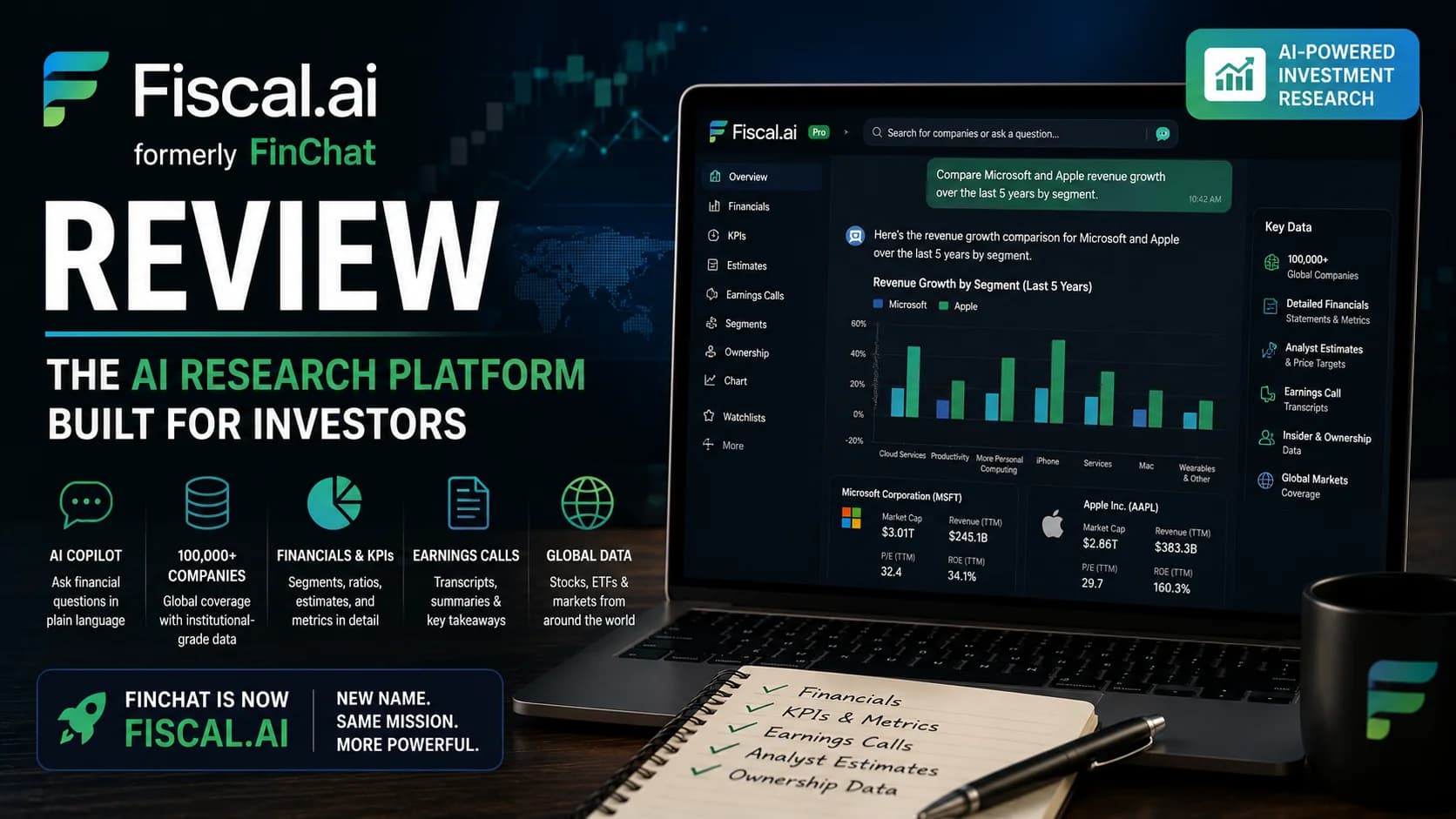
Anyone searching for a FinChat review in 2026 needs one fact before anything else: the product has rebranded. FinChat launched in 2023 as a conversational AI interface for financial data, then rebranded to Fiscal.ai in mid-2025 alongside a Series A funding round, expanding from a chat tool into a broader financial data terminal and API platform. Same team, same underlying data, new name and a reorganized set of plans — worth knowing upfront so the rest of this review makes sense.
What is FinChat (Fiscal.ai)? FinChat — now operating as Fiscal.ai — is an AI-powered investment research platform combining institutional-grade financial data on 100,000-plus global public companies with a conversational AI interface built specifically for financial questions. It's designed for fundamental research: company financials, segment and KPI breakdowns, analyst estimates, EarningsAn earnings report is the quarterly financial disclosure a public company files with the SEC, revealing revenue, earnings per share (EPS), profit margins, and forward guidance — it's the most significant regular catalyst for individual stocRead definition → call transcripts, and ownership data, accessible through natural-language queries rather than manually navigating filings.
This review evaluates FinChat/Fiscal.ai against the criteria that matter most for an AI research platform — data depth and accuracy, the quality of its financial AI specifically, pricing (including what changed with the rebrand), and how well any of it applies to day trading. It's based on documented research into the platform's official pricing and feature pages alongside independently published reviews, not a claimed personal subscription history.
What's good
- Genuinely specialized financial AI that outperforms general-purpose chatbots on financial questions specifically, letting you AskThe ask is the lowest price a seller is currently willing to accept. When you buy with a market order, you pay the ask.Read definition → detailed, multi-part fundamental questions in plain language instead of manually digging through filings.
- Institutional-grade data — coverage across 100,000+ global public companies, with detailed segment and KPI breakdowns for roughly 2,000 companies that would otherwise require manually aggregating figures from filings.
- A genuinely generous free tier, including a bundled trial period of the paid tier for new users, giving a real, low-risk way to test the full feature set before subscribing.
- Recently launched as an official app inside ChatGPT and OpenAI's Codex (June 2026), letting you pull the platform's verified financial data directly into a chat interface you may already use daily.
- Priced meaningfully below traditional institutional terminals while offering a genuinely comparable class of underlying data for individual investors and analysts.
Trade-offs
- FinChat rebranded to Fiscal.ai in mid-2025 alongside a Series A round, and pricing tier names shifted as part of that change — a reader researching "FinChat" today needs to verify current pricing and plan names directly rather than trusting older reviews.
- AI-generated summaries can occasionally misinterpret accounting nuances or one-time items, and independent sources consistently stress verifying important figures against primary filings rather than trusting the AI output alone.
- No real-time price quotes, Level 2 DataLevel 2 data shows the full order book — all the bids and asks queued at multiple price levels beyond the inside bid and ask — giving traders visibility into where supply and demand are stacking up before price gets there.Read definition →, or live news feeds — this is explicitly a fundamental research tool, not a trading terminal, and getting the most from a specific question requires learning to prompt it with real precision.
- Limited native charting and technical analysis tools, meaning traders who want deep technical charting alongside fundamental research will need a separate, dedicated platform.
What Is FinChat (Fiscal.ai)? A Closer Look
FinChat launched in 2023 with a specific mission: let investors query financial data conversationally instead of manually digging through 10-Ks, earnings call transcripts, and scattered analyst estimates. Rather than positioning itself as a general-purpose AI wrapper, the company built specialized financial AI trained specifically to handle financial questions — comparing segment revenue across companies, pulling multi-year KPI trends, or surfacing a specific line from an earnings call — more precisely than a general-purpose chatbot handles the same request.
In mid-2025, the company rebranded to Fiscal.ai alongside a $10 million Series A round, repositioning from a chat-first product into a broader financial data terminal and API platform. The rebrand reflects a real expansion in scope: alongside the original research terminal, Fiscal.ai now offers a separate API and MCP product for developers and teams who want to pipe the platform's verified financial data directly into their own tools, including Claude and ChatGPT.
For an individual investor evaluating the platform today, the practical takeaway is straightforward: the research experience that made FinChat notable is still there, now under the Fiscal.ai name, with an updated (and somewhat confusingly renamed) set of subscription tiers. Anyone comparing pricing across older and newer reviews should expect some inconsistency purely because of that transition.
Key Features
AI Copilot. The platform's core interface: a conversational AI built specifically for financial questions, letting you ask things like "compare Costco's membership revenue growth to its merchandise MarginMargin is borrowed capital from your broker that lets you control a larger position than your cash balance would otherwise allow — a $25,000 account with 4:1 intraday margin can control up to $100,000 in positions, amplifying both profits aRead definition → trends over the last 8 quarters" and get a direct, structured answer with supporting data rather than needing to locate and interpret the underlying filings yourself. Independent reviewers consistently note that specificity matters — vague questions get vague answers, while precise, well-scoped questions get genuinely useful results.
Financial Data Coverage. Data spanning more than 100,000 global public companies, with 10 years of annual financials and multiple years of quarterly data available depending on plan tier. Detailed segment and KPI-level data — the kind that normally requires manually parsing a filing's footnotes — is available for a smaller, more specific set of roughly 2,000 companies.
Analyst Estimates and Price Targets. Forward-looking consensus estimates, analyst revisions, and price targets are available directly inside company profiles, letting you see market expectations alongside historical financial performance without switching to a separate research platform.
Transcripts, Filings, and Ownership Data. Earnings call transcripts, SEC filings, dividend histories, and institutional and insider ownership data are all searchable and summarizable through the same conversational interface, reducing the multi-tab workflow most fundamental research otherwise requires.
Dashboards and Screening. Customizable dashboards let you track specific companies and metrics over time, and a stock screener (including AI-assisted filters on newer plans) helps narrow a universe of companies by financial criteria. This is fundamentals-first screening, not technical or chart-pattern-based filtering.
ChatGPT and Codex Integration. As of June 2026, Fiscal.ai is available as an official app inside ChatGPT and OpenAI's Codex, letting Plus, Pro, Business, and Enterprise ChatGPT users pull the platform's verified financials, KPIs, prices, and filings directly into a chat session without separately configuring an MCP connector.
The platform is explicit about what it isn't built for: no real-time price quotes, no Level 2 order-book data, and limited charting or technical-analysis tools. Investors who want fundamental AI research alongside serious charting typically pair a platform like this with a dedicated charting tool. DayTradingToolkit's TradingView review covers a charting-first platform commonly used alongside fundamentals-focused research tools for exactly that reason.
Who FinChat (Fiscal.ai) Is Best For
FinChat/Fiscal.ai earns its following for a specific kind of research process, and it's worth being direct that day trading isn't part of that picture.
It's a strong fit if you're an individual investor, analyst, or finance professional doing regular fundamental research on individual companies and want institutional-grade data accessible through natural language rather than manual filing navigation. It's also a strong fit if you specifically want detailed segment and KPI-level data that's genuinely hard to aggregate manually, or if you already work inside ChatGPT and want verified financial data available in the same interface.
It's a weaker fit if you need real-time quotes, Level 2 data, or a live news feed — none of which this platform provides — or if serious technical charting is central to your process. DayTradingToolkit's guide to day trading vs. swing trading vs. investing covers why fundamentals-first research tools like this one generally serve a different timeframe than day trading, if you're still working out which fits your goals.
FinChat (Fiscal.ai) Pricing
Pricing has shifted with the rebrand, and tier names from the old FinChat brand now map to renamed tiers under Fiscal.ai — worth confirming live before subscribing given how recently this changed:
- Plan
- Free
- Price (current, post-rebrand)
- $0 forever
- What's Included
- 10 years annual financials, 2 years of KPIs, 1 dashboard, basic AI Copilot; new users get a bundled trial of the paid tier
- Plan
- Pro (formerly "Plus")
- Price (current, post-rebrand)
- Around $39–49/month, cheaper billed annually
- What's Included
- Expanded AI prompts, deeper financial history, customizable dashboards, notifications
- Plan
- Max (formerly "Pro")
- Price (current, post-rebrand)
- Priced above Pro
- What's Included
- Unlimited AI prompts, full historical data, advanced features including modeling tools and full analyst ratings
- Plan
- API & MCP
- Price (current, post-rebrand)
- Custom pricing
- What's Included
- Verified financials, KPIs, prices, and filings piped into your own tools; free trial covering a limited number of companies and daily calls
| Plan | Price (current, post-rebrand) | What's Included |
|---|---|---|
| Free | $0 forever | 10 years annual financials, 2 years of KPIs, 1 dashboard, basic AI Copilot; new users get a bundled trial of the paid tier |
| Pro (formerly "Plus") | Around $39–49/month, cheaper billed annually | Expanded AI prompts, deeper financial history, customizable dashboards, notifications |
| Max (formerly "Pro") | Priced above Pro | Unlimited AI prompts, full historical data, advanced features including modeling tools and full analyst ratings |
| API & MCP | Custom pricing | Verified financials, KPIs, prices, and filings piped into your own tools; free trial covering a limited number of companies and daily calls |
Given the tier renaming happened as part of the 2025 rebrand, treat any pricing figure from an older FinChat-branded review with caution and check Fiscal.ai's current live pricing page directly before subscribing — several independent sources published before or during the transition cite meaningfully different numbers for what appear to be the same tiers under their old names.
What Works Well
The specialized financial AI is a genuine strength, not just a marketing claim. Multiple independent reviewers specifically note that it outperforms general-purpose AI models on financial questions, which makes sense given it's trained and tuned for exactly this use case rather than being a general assistant with financial data bolted on.
The segment and KPI-level data depth deserves real credit too. Getting a clean, multi-year breakdown of a specific business segment's revenue or margin TrendA trend is a sustained directional movement in price over time — an uptrend is characterized by a sequence of higher highs and higher lows, a downtrend by lower highs and lower lows — and correctly identifying the current trend direction isRead definition → — the kind of data usually buried in filing footnotes — accessible through a plain-language question is a genuine time-saver for anyone doing serious fundamental research on individual companies.
The recent ChatGPT and Codex integration is a smart, well-timed move. Meeting users inside an assistant they may already use daily, rather than requiring a separate destination site for every question, lowers the friction of actually using verified financial data instead of whatever a general AI model happened to pick up in training.
Limitations
Two limitations are worth taking seriously.
The rebrand itself is a real source of confusion for anyone researching this platform right now. Pricing tier names have shifted, older reviews reference plans that no longer exist under those names, and the practical effect is that a good amount of published information about "FinChat" needs to be re-verified against the current Fiscal.ai product rather than trusted at face value.
The platform's scope, while genuinely strong for fundamentals, has real, acknowledged limits. No real-time data, limited technical charting, and AI outputs that can occasionally misinterpret accounting nuances mean this is a research accelerant to pair with your own verification and other tools — not a standalone terminal that replaces a broker, a charting platform, and a filing review all at once.
Verdict
FinChat (Fiscal.ai) Is Worth It for Fundamentals-Focused Researchers, Not Day Traders
FinChat's specialized financial AI and deep segment-level data coverage — now under the Fiscal.ai name — make it a genuinely useful research accelerant for investors and analysts doing fundamental company research. The recent rebrand means pricing and plan names require direct verification rather than trusting older third-party reviews, and the platform explicitly doesn't cover real-time data or serious technical charting. For this site's audience specifically, the clearest finding is that this is a fundamentals research tool, not a trading terminal, and it has essentially no application to day trading.
Individual investors, analysts, and finance professionals doing fundamental research on public companies who want AI-assisted access to institutional-grade data — not day traders.
Frequently Asked Questions
Is FinChat good for day trading?
The platform's entire design — segment KPIs, analyst estimates, multi-year financial trends — is oriented around understanding a business over years, not making an intraday trading decision. A day trader evaluating this platform is evaluating a tool built for a fundamentally different job.
Key Takeaway: FinChat/Fiscal.ai is a fundamentals research tool; it has no meaningful application to day trading specifically.
Why does FinChat now redirect to Fiscal.ai?
Same underlying team, product, and data — the name change reflects a genuine expansion in scope (adding a separate API/MCP product for developers) rather than a shutdown or unrelated new company. If you searched for "FinChat," Fiscal.ai is the current, correct product to evaluate.
Key Takeaway: FinChat didn't disappear — it's the same platform now operating under the Fiscal.ai name with an expanded product lineup.
How much does Fiscal.ai (FinChat) actually cost?
Because tier names changed during the 2025 rebrand, older reviews citing "FinChat Plus" or "FinChat Pro" pricing may not reflect current tier names or costs. Confirm live pricing directly on Fiscal.ai's official site before subscribing.
Key Takeaway: Treat any specific price you see in an older FinChat-branded review as potentially outdated, and verify current Fiscal.ai pricing directly.
Is Fiscal.ai's AI actually reliable for financial research?
The platform's financial AI is purpose-built and reportedly outperforms general-purpose chatbots on financial queries, but that doesn't eliminate the need to verify important figures against primary filings, especially for decisions where the details genuinely matter.
Key Takeaway: Use the AI to accelerate research and surface data quickly, but verify anything decision-critical against the underlying filing yourself.
Does FinChat/Fiscal.ai include charting or technical analysis tools?
This is a deliberate scope choice rather than an oversight; the platform's strength is fundamentals and segment-level data, and it doesn't try to compete with charting-first platforms on that specific ground.
Key Takeaway: Pair FinChat/Fiscal.ai with a dedicated charting platform if technical analysis is part of your process.
Can I use Fiscal.ai inside ChatGPT?
This removes the need to separately configure an MCP connector to access the same underlying data inside ChatGPT, making it more convenient for users who already work inside that assistant regularly.
Key Takeaway: If you're already a ChatGPT subscriber, you can access Fiscal.ai's data without leaving that interface.
Does FinChat/Fiscal.ai pair well with TradingView?
This is a common structural pairing: one tool for deep fundamental data, another for charting and technical setups. DayTradingToolkit's TradingView review covers what that pairing looks like in more detail.
Key Takeaway: Fiscal.ai handles fundamentals well; pair it with a dedicated charting tool if technical analysis matters to your process.
Is the free plan actually usable?
Independent reviewers describe the free tier as more of a genuine demo than a complete solution, but it's enough to evaluate whether the AI Copilot and data depth fit your research style before paying.
Key Takeaway: Use the free tier and bundled trial to test the platform's AI Copilot and data depth before committing to a paid plan.
What kind of financial data does Fiscal.ai actually cover?
Detailed segment-level breakdowns are available for a smaller subset of roughly 2,000 companies, since that level of granularity requires more intensive data processing than headline financial statements.
Key Takeaway: Coverage is broad at the headline level and genuinely deep for a smaller set of companies with full segment and KPI data.
Is FinChat/Fiscal.ai good for casual investors, or only professionals?
The platform's design intent is specifically to make institutional-quality data accessible to individual investors through natural language, rather than requiring the kind of terminal training a professional-only platform assumes.
Key Takeaway: The AI-conversational interface lowers the barrier to entry, but the underlying data depth scales up to serious professional use as well.