
A trader named Mayer reported $20.7 million, then $18.4 million, then $14.4 million in gross receipts on his Schedule C across three consecutive years, claiming Trader Tax Status the entire time. The IRS challenged it anyway, and the Tax Court agreed with the IRS. Not because his VolumeVolume is the total number of shares (or contracts) traded during a given time period — it's the primary confirmation tool for all price action, because a price move accompanied by high volume indicates genuine market participation, while tRead definition → was too low. Because a letter Mayer had written to his own money manager years earlier, describing his goal as "wealth maximization through capital appreciation" rather than profit from daily price swings, ended up in the case record and directly contradicted the profit-seeking intent his TTS claim depended on.
Twenty million dollars a year in trading volume, and it was his own words, written for an entirely different purpose, that sank the case. That's the real lesson behind recordkeeping for Trader Tax Status: it isn't only about logging your trades. It's about controlling every piece of paper that describes what you're actually doing, because the IRS and the Tax Court will read all of it, not just the parts you meant as evidence.
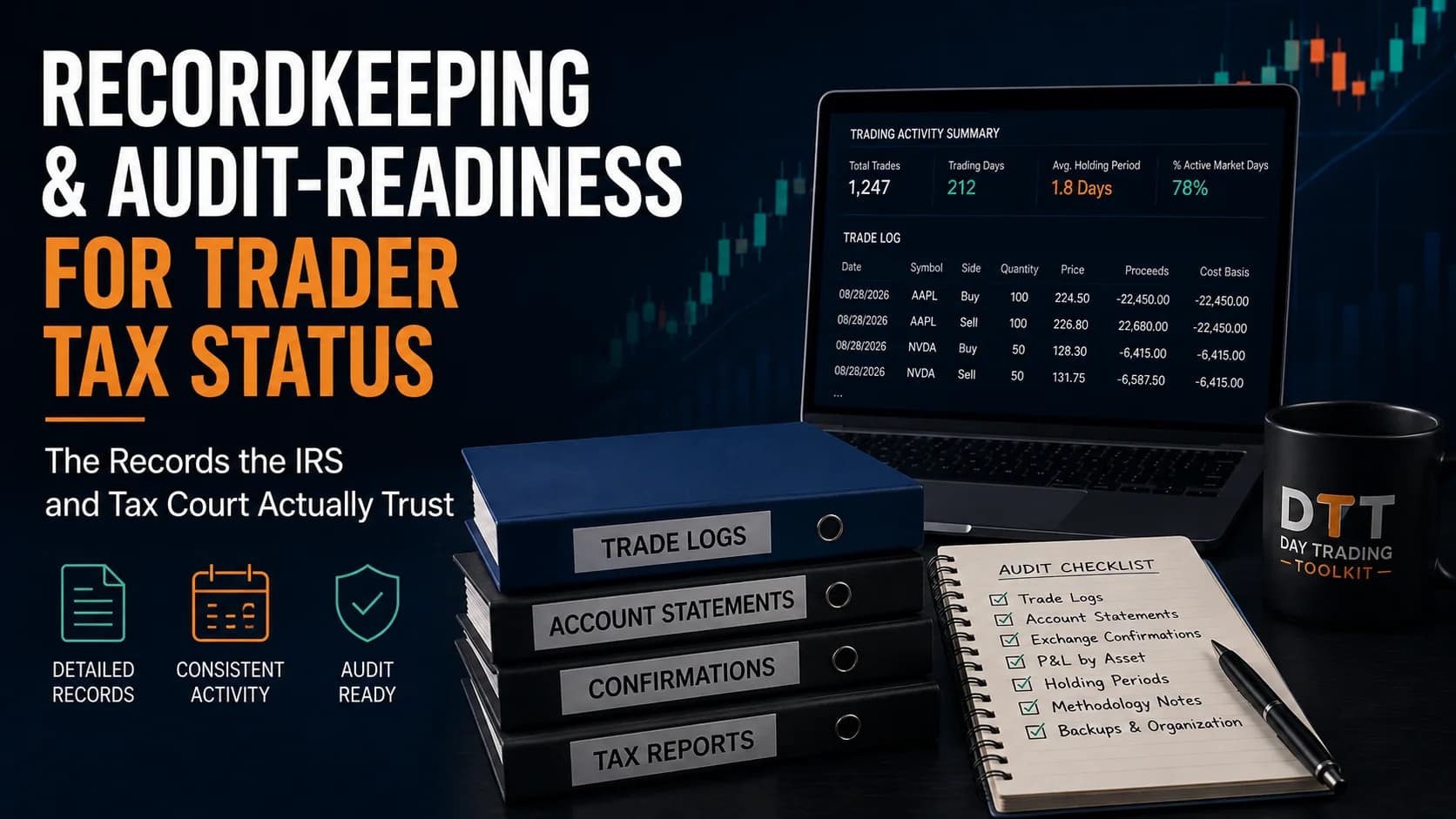
What records does the IRS actually look for in a Trader Tax Status audit? Examiners and the Tax Court focus on three things above all else: your trade volume and frequency, the percentage of available market days you were active, and your average holding period, all of which need contemporaneous SupportSupport is a price level where buying pressure has historically overcome selling pressure, causing price to stop declining and reverse — it's the floor where demand enters the market, and when it holds, it's a potential long entry; when it Read definition →, records created at or near the time of the activity, not reconstructed afterward once an audit notice has already arrived.
Contemporaneous Beats Reconstructed, Every Time
This principle isn't unique to trader taxation. It shows up across nearly every area of tax law where a taxpayer has to substantiate their own activity: vehicle mileage under IRC Section 274(d), real estate professional status hours, and Trader Tax Status all get evaluated by the same underlying standard. A log created in one sitting, months after the year ended, is a reconstruction, and the Tax Court has rejected these repeatedly even when the total activity claimed was entirely plausible. A log built as you go, timestamped, dated, created by the actual activity happening in real time, carries meaningfully more weight, because it can't have been shaped by hindsight about which facts would help your case.
For a trader, this means the trade log, time log, and expense records covered in the TTS guide need to exist now, this week, not get assembled next April when you're preparing your return. If you're relying on a broker's year-end statement alone to prove your case later, you have volume data and nothing else, no time commitment evidence, no proof of the daily pattern the courts actually weigh most heavily.
Your Own Words Can Undermine You, Even When You Didn't Mean Them As Evidence
Mayer's case is the clearest illustration of a risk most trader tax content never mentions: documents you create for reasons that have nothing to do with your taxes can still end up deciding your tax case. An investment policy statement, a letter to a financial advisor, an email describing your goals to a spouse or business partner, any of it can surface in an audit or a court proceeding and get read against the profit-seeking intent your TTS claim depends on.
The practical takeaway isn't to hide documents. It's to be consistent. If your actual trading pattern is short-term and volume-driven, make sure nothing else you've put in writing, anywhere, describes your goals in long-term, buy-and-hold language. Inconsistency between your trading pattern and your own stated intent is exactly the GapA gap is a price discontinuity on a chart where a stock opens significantly higher or lower than the previous session's close, leaving a visible empty space — gap-ups are driven by overnight buying pressure or positive news; gap-downs by seRead definition → an examiner is trained to look for.
What a Real Trader Tax Status Exam Actually Looks At
An IRS examination of a claimed TTS position typically starts with an Information Document Request asking for exactly the three data points courts weigh most heavily: total trade count for the year, a breakdown of which days you were actually active in the market, and your average holding period across positions. A broker-generated trade confirmation export can usually answer the first two if you've kept nothing else, but it can't speak to the third factor courts weigh independently, your time commitment, since a brokerage statement has no way of showing how many hours you spent on research, monitoring positions, or managing the business between trades.
This is exactly why a trade log alone is an incomplete defense. Pair it with a time log, and you can answer all three questions from your own contemporaneous records rather than needing the broker to FillA fill is the execution of an order — when your buy or sell order is matched with a counterparty and the transaction is completed, you've received a fill.Read definition → gaps their data was never designed to cover.
Building a File That Actually Holds Up
A trade log needs the date, security, share or contract count, and holding period for every position, exportable directly from your broker or platform where possible, since a system-generated export carries more weight than a manually recreated spreadesheet. A time log, ideally kept daily rather than weekly or monthly, should note the date and roughly how much time went into research, trade execution, and position management, since this is the factor courts weigh heavily and the one a trader is most likely to have nothing to show for if they didn't track it as they went. Expense receipts need to tie directly to whatever's claimed on Schedule C, not exist as a vague recollection of "about $5,000 in software." And given how often mixed accounts undermined traders in the cases covered in the TTS guide, keep documentation showing your active trading account is genuinely separate from any long-term investment holdings, a brokerage statement or account-opening document is often enough on its own.
Digital tools that timestamp entries automatically, a dedicated trading journal app, a spreadsheet with version history, or broker-native trade tracking, provide a form of built-in corroboration that a plain document can't: metadata showing exactly when an entry was created, which is difficult to fake and directly answers the contemporaneous-versus-reconstructed question an examiner will AskThe ask is the lowest price a seller is currently willing to accept. When you buy with a market order, you pay the ask.Read definition →.
How Long to Keep Everything
The standard IRS audit window reaches back three years from filing, but extends to six years if the IRS asserts a substantial understatement of income, and there's no time limit at all in cases involving fraud. Given that TTS claims specifically invite scrutiny and get challenged more often than an average return, keeping records for seven years rather than the statutory minimum of three is the more defensible practice. Anything tied to establishing cost basis on assets you still hold, equipment purchases you're depreciating, or your entity formation documents, should be kept indefinitely rather than discarded on any fixed schedule.
If You're Actually Selected for Examination
Respond to any document request completely and on time; a partial or late response reads as evasiveness even when the underlying facts are fine. Provide the records you actually have rather than attempting to reconstruct anything you're missing, since a reconstruction created after the audit notice arrives is transparently what it is and generally carries little weight, while an honest gap paired with the records you do have is a more credible position than a suspiciously complete-looking file assembled after the fact. If your case reaches the point of a formal notice of deficiency and you're considering Tax Court, the burden of proof sits with you as the taxpayer, not the IRS, which is precisely why the quality of your contemporaneous records, not the strength of your argument alone, tends to decide these cases.
Working with a CPA who specializes in trader taxation before an exam ever starts, not after, is the highest-leverage move available. Every case discussed throughout this tax series that a trader lost involved gaps a specialist would likely have caught and fixed years before an examiner ever asked a question.
Frequently Asked Questions
What is the difference between a contemporaneous record and a reconstructed one?
Courts have repeatedly rejected reconstructed logs even when the total activity claimed was plausible, specifically because a record built after the fact can be shaped by knowledge of which facts would help the case.
Key Takeaway: Keep records as you go. A log built in one sitting months later is a liability, not a defense.
Can documents I wrote for reasons that had nothing to do with taxes affect my Trader Tax Status claim?
Any document describing your goals, an investment policy statement, correspondence with an advisor, even casual communication, can surface in an audit and be read against your stated trading intent.
Key Takeaway: Consistency matters everywhere, not just in your trade log. Make sure nothing you've put in writing contradicts the profit-seeking, short-term intent your TTS claim depends on.
What does the IRS actually ask for in a Trader Tax Status audit?
A broker-generated trade export can usually answer the volume and frequency questions, but it can't demonstrate your time commitment, which is why a separate time log matters even when your trade data is complete.
Key Takeaway: Broker records alone leave a real gap in your defense. A time log fills the one factor brokerage data was never designed to capture.
How long should I keep my trading and tax records?
Records tied to cost basis on assets you still hold, or to your entity formation, should be kept indefinitely rather than on any fixed retention schedule.
Key Takeaway: Treat seven years as your practical minimum for anything related to a TTS claim specifically.
What should I do if I don't have complete contemporaneous records for a year already under audit?
A credible partial record paired with an honest explanation typically holds up better than a suspiciously thorough file that doesn't match the timeline of when it was actually created.
Key Takeaway: An honest gap is more defensible than a reconstruction that doesn't survive basic scrutiny about when it was actually made.
Does keeping good records guarantee my Trader Tax Status claim will survive a challenge?
Good records won't manufacture a qualifying trading pattern that doesn't exist, but they're consistently the deciding factor between traders with similar activity levels who won and lost their cases.
Key Takeaway: Records don't replace substance, but insufficient records turn a genuinely qualifying trading pattern into a losing case anyway.
Who has the burden of proof if my Trader Tax Status claim is challenged in Tax Court?
This burden-of-proof structure is precisely why contemporaneous documentation is the central theme of surviving a TTS challenge rather than a secondary concern.
Key Takeaway: Build your case file assuming you'll need to prove your position affirmatively, not just respond to an accusation.
Should I use a digital trading journal instead of a spreadsheet?
That metadata directly answers the contemporaneous-versus-reconstructed question an examiner is specifically trained to ask, which is why it's worth the switch for anyone serious about defending a TTS claim.
Key Takeaway: The format matters less than the content, but automatic timestamping gives you a form of proof that's difficult to fake and easy to produce if challenged.
Disclaimer
Article Sources
- Mayer v. Commissioner, T.C. Memo. 1994-209 - a large-volume trader whose own written investment goals undermined his TTS claimtaxnotes.com
- IRS Topic 429, Traders in Securities - the official facts-and-circumstances framework this documentation supportsirs.gov
- IRS: Publication 583, Starting a Business and Keeping Records - general recordkeeping standards and retention periodsirs.gov
- Cornell Law School, 26 U.S. Code Section 274 - the contemporaneous substantiation standard applied across multiple areas of tax lawlaw.cornell.edu