
A trader has a rough first nine months, then catches an incredible run in the final six weeks of the year, up $150,000 in a stretch that makes the whole year profitable. He pays his full tax bill by April 15 and assumes he's done. A penalty notice shows up anyway.
The reason is almost nobody explains clearly: the IRS doesn't just check whether you paid enough by the annual deadline. It checks, quarter by quarter, whether you paid enough as the year went along, and by default it assumes your income arrived in four equal chunks. A trader who genuinely made most of their money in six weeks still gets measured against that flat assumption unless they specifically tell the IRS otherwise, on a form built exactly for this situation.
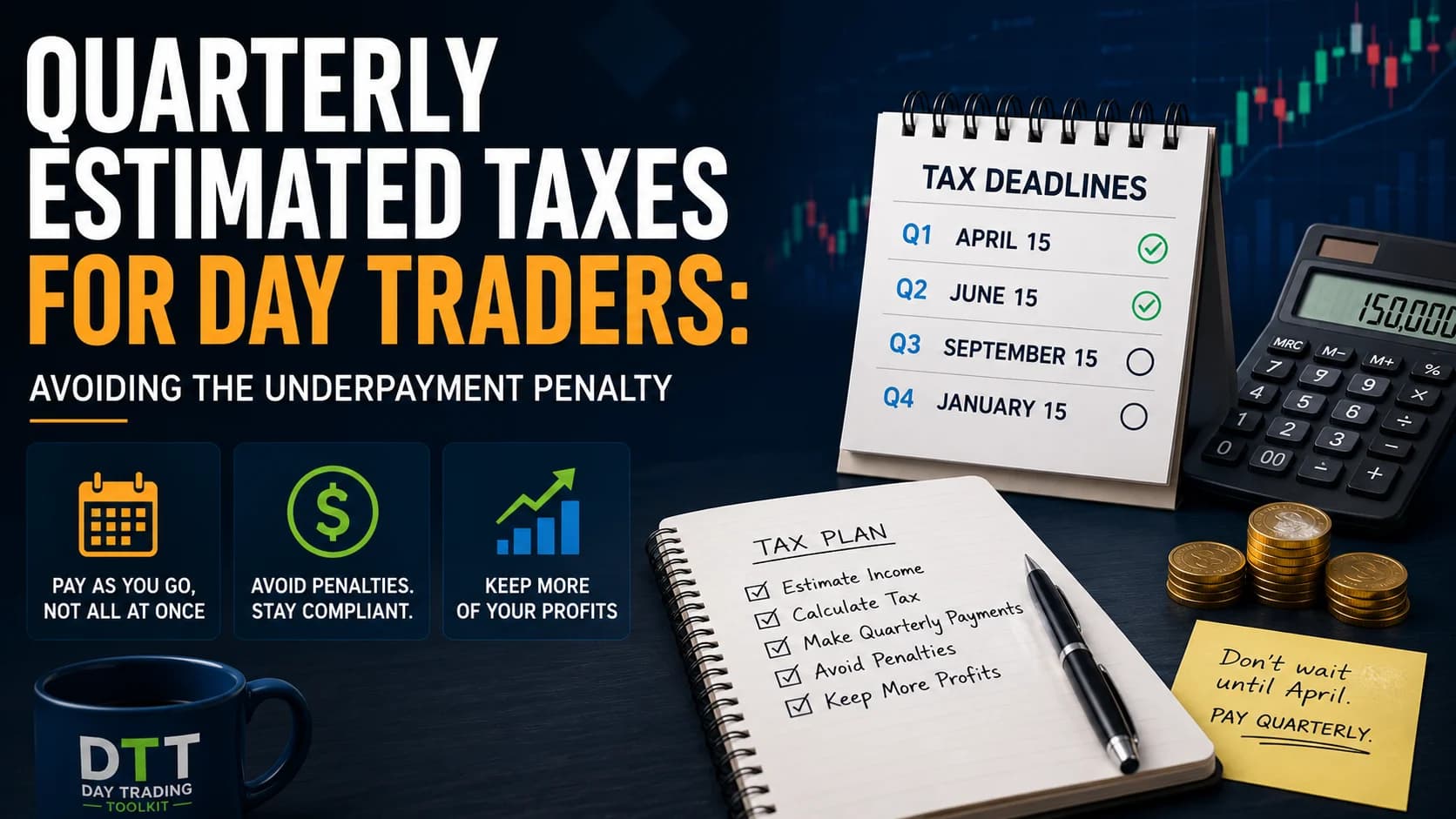
What are quarterly estimated taxes? Quarterly estimated taxes are payments the IRS requires from anyone who expects to owe $1,000 or more in tax that isn't covered by withholding, due four times a year rather than once. For day traders, who have no employer withholding anything from a paycheck, this isn't optional bookkeeping. It's the primary way trading income tax actually gets paid throughout the year.
Why This Hits Traders Harder Than Almost Anyone Else
The federal tax system runs on a pay-as-you-go assumption. A W-2 employee satisfies it automatically, since their employer withholds tax from every paycheck. A day trader has no employer and no withholding at all, which means the entire burden of paying tax throughout the year, not just filing correctly the following April, falls on the trader directly.
This isn't a minor administrative detail. A profitable trader who treats their trading account as their entire net worth and only thinks about taxes in March can genuinely not have the cash available when the bill comes due, on top of whatever penalty accrued for not paying along the way.
The Two Safe Harbors That Make This Simple
Before getting into the more complicated cases, know that most traders can sidestep the entire calculation with one of two safe harbor rules. Pay, across your four quarterly payments combined, at least 100% of last year's total tax liability, or 110% if your prior year adjusted gross income was over $150,000, and you owe no underpayment penalty regardless of how this year's income actually turns out, even if you have a dramatically better year than last year. Alternatively, pay at least 90% of your actual current-year tax liability across the four payments, and the same protection applies.
The prior-year safe harbor is particularly useful for a trader who had a big year last year and expects a normal one this year, since it locks in a known, calculable number early rather than requiring you to forecast an uncertain year in progress. It backfires in the opposite direction: a trader with a modest prior year who has an explosive current year still only needs to pay based on last year's smaller number to stay penalty-free, even though the actual tax owed this year will be much larger and due in full by the filing deadline.
The Default Method Assumes Your Income Arrived Evenly. It Almost Never Does for a Trader.
Here's where the opening story comes from. If you don't specifically elect otherwise, the IRS calculates your required payment for each quarter by dividing your total estimated annual liability into four equal pieces, one due each quarter, regardless of when you actually earned the money. A trader who made most of their profit in the final quarter still gets evaluated as if a quarter of that profit had already existed back in April, and if the April, June, and September payments don't reflect that assumed even distribution, a penalty starts accruing for those earlier quarters specifically, even though the income genuinely didn't exist yet.
Underpayment penalties are calculated using Form 2210, and they function as an interest charge rather than a flat fine, currently in the neighborhood of the federal short-term rate plus 3 percentage points, reset every quarter and compounding daily on whatever balance was underpaid. It's real money, but it's also avoidable with the right form.
The Fix: The Annualized Income Installment Method
Form 2210's Schedule AI lets you calculate your required payment for each quarter based on what you'd actually earned by that point in the year, rather than a flat quarter of your annual total. A trader who had minimal income through September and a massive Q4 can use this method to show the IRS that little or no payment was actually required for the earlier quarters, because little or no income had actually been earned yet, potentially eliminating penalties that the default method would have calculated as owed.
This is genuinely one of the most underused tools available to traders with lumpy income, which describes most active traders more than the smooth, predictable income the default method implicitly assumes. It requires more calculation than simply dividing by four, and it's a place where a CPA who works with traders regularly earns their fee, but for anyone whose trading income is concentrated rather than steady, it's worth the extra form.
When Payments Are Actually Due
Estimated payments follow a fixed quarterly schedule regardless of your specific income pattern: April 15, June 15, September 15, and January 15 of the following year. Note that the GapA gap is a price discontinuity on a chart where a stock opens significantly higher or lower than the previous session's close, leaving a visible empty space — gap-ups are driven by overnight buying pressure or positive news; gap-downs by seRead definition → between the second and third payments is only two months while the others run roughly three, an easy date to miss if you're going by feel rather than a calendar. Withholding from any other source, like a spouse's job, is treated by Form 2210 as if it were paid evenly across all four dates regardless of when it actually happened, which can help smooth out an otherwise uneven quarter, while your own estimated payments only count for the quarter you actually made them in.
Payments can be made through IRS Direct Pay, the Electronic Federal Tax Payment System, or by mailed check with a payment voucher. Whichever method you use, keep the confirmation, since payment date and quarter matter directly to any later penalty calculation.
A Practical Approach for an Active Trader
Since trading income is inherently unpredictable, most trader tax specialists recommend setting aside a percentage of every profitable trade or month into a separate account the moment the gain is realized, rather than waiting to calculate anything at quarter-end. The exact percentage depends on your bracket and whether you've elected mark-to-market, but treating tax as a running expense taken off the top, the way a business owner sets aside money for a known future bill, avoids the far more stressful version of this problem: discovering in December that a profitable year created a tax bill larger than the cash currently sitting in the account.
Reviewing your year-to-date trading results each quarter, not just at filing time, lets you catch an unusually strong or weak quarter early enough to adjust your next estimated payment accordingly, which is exactly the DisciplineTrading discipline is the consistent application of your predefined rules — entries, stops, targets, position sizing, maximum daily loss — regardless of what you're feeling in the moment.Read definition → the annualized income method above is built to reward.
Frequently Asked Questions
Do day traders have to pay quarterly estimated taxes?
Waiting until the annual filing deadline to pay the full amount, even if you pay everything owed, can still trigger an underpayment penalty for the quarters where payment should have happened earlier.
Key Takeaway: For an active trader, quarterly payments aren't optional paperwork. They're the primary mechanism for actually paying tax on trading income throughout the year.
How much do I need to pay each quarter to avoid a penalty?
The prior-year safe harbor is often the simpler and more predictable choice, since it's based on a number you already know rather than a forecast of an uncertain year in progress.
Key Takeaway: Pick whichever safe harbor gives you a lower, more certain required payment, and use that as your baseline.
Why did I get a penalty even though I paid my full tax bill by April 15?
This is exactly the scenario the annualized income installment method exists to fix, by calculating what you'd actually earned by each quarter rather than assuming an even split.
Key Takeaway: Paying the full amount owed by the filing deadline doesn't protect you from a penalty tied to earlier quarters if you didn't pay along the way.
What is the annualized income installment method and when should I use it?
It's specifically useful for traders whose income is concentrated in certain months or quarters rather than arriving evenly, which describes the majority of active traders far more accurately than the default method's assumption.
Key Takeaway: If your trading profit is lumpy rather than steady, this method can eliminate penalties the default calculation would otherwise assess.
How is the underpayment penalty actually calculated?
Because the rate resets each quarter, the exact cost of an underpayment depends on which quarter it occurred in and how long the balance remained unpaid.
Key Takeaway: This is genuinely interest, not a punitive penalty in the traditional sense, but it accrues daily and is entirely avoidable with correct planning.
When exactly are quarterly estimated tax payments due?
Note that the second and third payments are only two months apart while the others span roughly three, a scheduling quirk that catches people who assume evenly spaced quarters.
Key Takeaway: Mark all four dates on a calendar at the start of the year rather than relying on memory of a "quarterly" rhythm that isn't actually evenly spaced.
Does withholding from a spouse's job or another source help with my estimated tax requirement?
This can meaningfully offset an underpayment in an earlier quarter, unlike your own estimated payments, which only count for the specific quarter you actually made them.
Key Takeaway: A household with any W-2 withholding has a built-in smoothing tool that a trader with zero withholding doesn't have access to.
What happens if my trading income swings between a big profit and a loss during the year?
A trader who was profitable in Q1 and Q2 but had losses in Q3 can potentially reduce or eliminate the Q3 and Q4 required payments using this method, reflecting the year's actual shape rather than an assumed even distribution.
Key Takeaway: Volatile trading income is exactly the situation this method exists for. Don't default to the flat quarterly calculation if your year genuinely wasn't flat.
Is there a minimum amount below which I don't need to make estimated payments?
For most profitable active traders, this threshold is cleared quickly, but it's worth knowing for a smaller or newer trading operation.
Key Takeaway: The $1,000 threshold is a floor, not a target. Most traders who AskThe ask is the lowest price a seller is currently willing to accept. When you buy with a market order, you pay the ask.Read definition → this question have already cleared it.
Disclaimer
Article Sources
- IRS: Estimated Taxes - the general requirement to pay tax throughout the year and payment methodsirs.gov
- IRS Instructions for Form 2210 - the underpayment penalty calculation, safe harbor rules, and the annualized income installment methodirs.gov
- IRS Publication 505, Tax Withholding and Estimated Tax - the full framework connecting withholding and estimated paymentsirs.gov
- IRS Topic 429, Traders in Securities - how trading income is classified for tax planning purposesirs.gov