
A trader transfers a position from one broker to another partway through the year, the ordinary kind of account move people make when they switch platforms. The new broker never receives the original purchase records. The following year, she sells the position, and her 1099-B arrives showing the full sale proceeds with the cost basis box blank, Box 5 checked, noncovered. Her tax software imports the form automatically. She assumes it's handled.
Fourteen months later, a CP2000 notice shows up proposing she owes tax on the entire sale amount, treated as if she'd paid nothing to acquire the position at all. The IRS's automated matching system saw proceeds with no offsetting basis anywhere on her return and did exactly what it's built to do: assume the whole thing was pure profit.
That GapA gap is a price discontinuity on a chart where a stock opens significantly higher or lower than the previous session's close, leaving a visible empty space — gap-ups are driven by overnight buying pressure or positive news; gap-downs by seRead definition →, between what a broker actually reports and what a trader assumes gets reported automatically, is where this kind of notice comes from. It's entirely preventable, and it starts with understanding what's actually on the form.
What is Form 1099-B? Form 1099-B is the information return a broker sends you and the IRS reporting the proceeds from securities you sold during the year. It's the source data behind Form 8949 and Schedule D, but it doesn't always include your full cost basis, and the gaps in what it reports are entirely your responsibility to FillA fill is the execution of an order — when your buy or sell order is matched with a counterparty and the transaction is completed, you've received a fill.Read definition → in before you file.
What's Actually on the Form
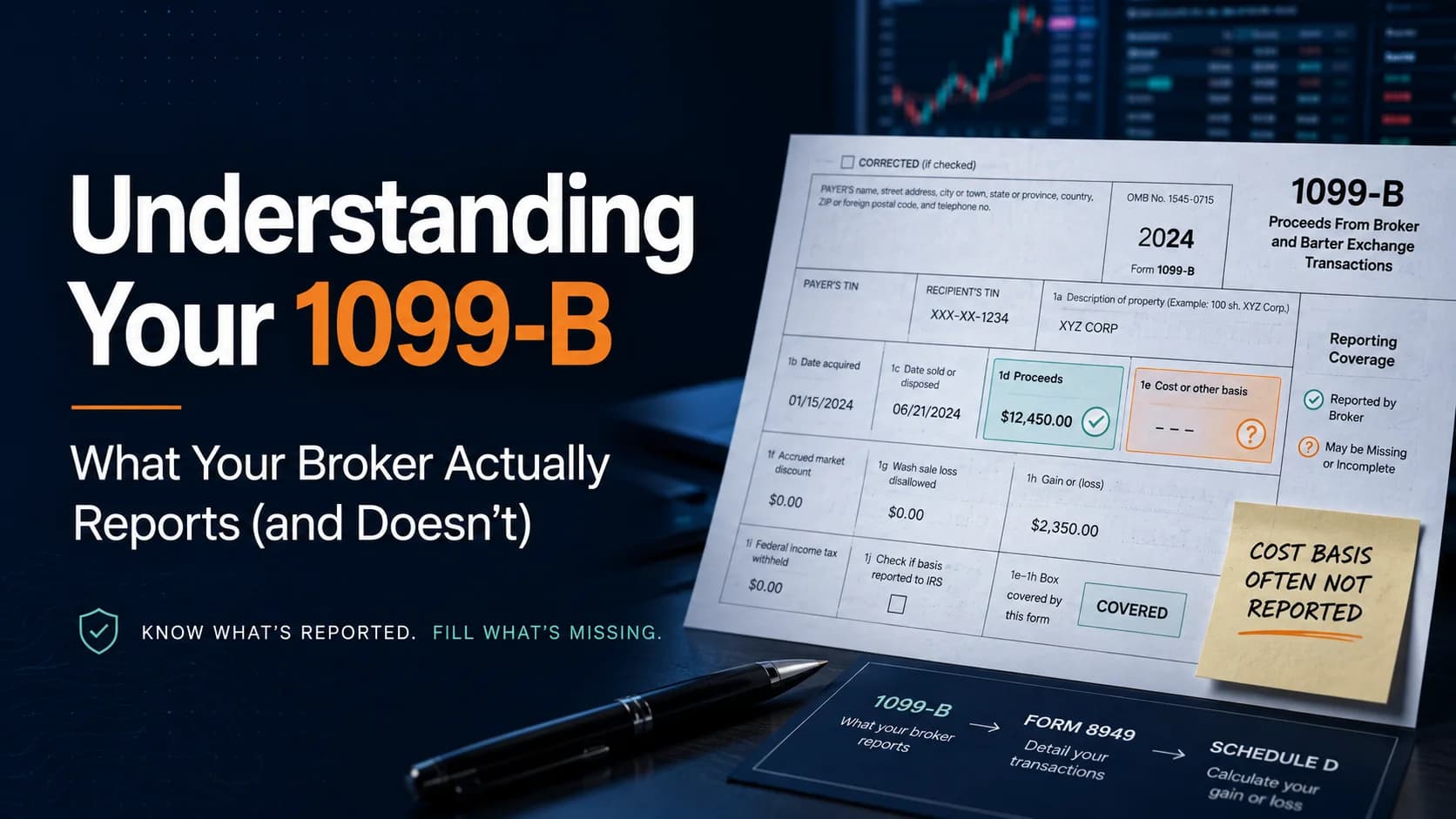
A 1099-B breaks each sale, or each summarized group of sales, into a handful of boxes that matter far more than most traders realize. Box 1a identifies the security. Box 1b is the date you acquired it. Box 1d is your proceeds from the sale. Box 1e, when your broker has it, is your cost basis. Box 1g shows any wash sale loss the broker disallowed on that specific transaction. Box 6 tells you whether proceeds are reported gross or net of commissions, almost always gross. Box 11, covered separately in the Section 1256 contracts guide, aggregates your net gain or loss on futures and qualifying index options.
The box that actually causes problems is Box 5. When it's checked, the security is "noncovered," and your broker is explicitly telling you, and the IRS, that Box 1e might be blank or unreliable, and that determining the correct basis is on you.
Covered vs. Noncovered: The Distinction That Actually Matters
Brokers weren't always required to report cost basis to the IRS. Congress phased that requirement in gradually: stocks acquired starting in 2011, mutual fund and dividend reinvestment plan shares starting in 2012, and most other specified securities, bonds, options, starting in 2014. A security acquired after its applicable date is "covered," and your broker must report its basis to the IRS, not just to you. A security acquired before that date is "noncovered," and the broker reports the sale proceeds without any obligation to report basis at all.
This matters enormously for active traders in a few specific situations. Transferring an account between brokers frequently breaks basis reporting, since the receiving broker doesn't always get complete transfer statements from the sending one, especially for older accounts or less common security types. Inherited or gifted positions often arrive with murky basis history. And any position you've held long enough to straddle the 2011 to 2014 phase-in dates might genuinely be noncovered no matter how careful your recordkeeping has been.
When you see Box 5 checked, that's not the broker being lazy. It's the broker following the exact reporting rule that applies to that specific security, and it's your signal to go find the real basis yourself rather than trust whatever number, if any, shows up on the form.
Why a Blank Basis Box Can Turn Into a Six-Figure Notice
Here's the mechanism behind the opening story, and it's worth understanding precisely because it's completely avoidable. The IRS runs an automated system, the Automated Underreporter program, that matches every 1099 filed under your Social Security number against what you actually reported on your return. When your broker reports $340,000 in sale proceeds and your Schedule D shows nothing offsetting it, either because you didn't report the sale at all or because your basis genuinely wasn't available, the system doesn't know you actually paid $335,000 for that position eight years ago. It sees $340,000 of unexplained proceeds and proposes tax on the full amount as if your cost basis were zero.
A CP2000 notice generated this way isn't a bill and isn't an audit. It's a proposed adjustment, and it's very often wrong in exactly this way, dramatically overstated because the matching system has no visibility into a basis that exists but wasn't reported. The fix is straightforward once you understand what happened: respond within the notice's deadline, generally 30 days, with documentation of your actual cost basis, purchase confirmations, old account statements, a transfer summary from your prior broker. The IRS routinely adjusts these notices down substantially once real basis is supplied. The problem is entirely preventable if you catch the missing basis before you file rather than after a notice arrives.
How This Flows Into Form 8949 and Schedule D
Your 1099-B doesn't get typed directly into your return. It feeds Form 8949, where every sale gets sorted into one of several boxes depending on whether it's short-term or long-term and whether basis was reported to the IRS. Covered securities with basis reported use one set of codes; noncovered securities where you're supplying your own basis use another. Getting this categorization right matters, since mixing a noncovered sale into the wrong Form 8949 section can make it look like you're reporting a number that contradicts what the IRS already has on file, inviting exactly the kind of mismatch notice described above. Form 8949 totals then flow to Schedule D, where your short-term and long-term gains and losses net against each other before any tax rate applies.
Wash Sales on Your 1099-B Aren't the Whole Picture
Box 1g shows wash sale losses your broker disallowed, but this number is frequently incomplete for an active trader, and it's worth understanding exactly why before you assume your 1099-B already captured every disallowed loss you had. Brokers calculate wash sales using an exact-symbol match within a single account. The actual rule, covered in full in the wash sale rule guide, reaches substantially identical positions, not just identical tickers, and applies across every account you or your spouse own, including IRAs, not just the one account the broker can see.
That gap means a trader working the same underlying position across a stock and its options, or across two different brokers, can have real wash sale exposure that never shows up anywhere on any single 1099-B. The form is a starting point for your wash sale accounting, not the finished product.
What's Changing for Crypto: Form 1099-DA
If you trade cryptocurrency through a broker or exchange, sales are increasingly reported on a separate form, Form 1099-DA, rather than the traditional 1099-B. Mandatory basis reporting for covered digital asset sales phases in starting with 2026 transactions, following a similar covered versus noncovered structure to what's described above, and a lot of crypto sales still arrive with basis marked "unknown" because of how routinely people move assets between exchanges and wallets. That gap creates the exact same CP2000 risk described earlier, at potentially larger scale, since crypto transfers between platforms are even more common than security transfers between brokers. The complete picture of how crypto trading gets taxed, including this reporting shift, is covered in the crypto day trading taxes guide.
A Short Checklist Before You File
Pull your 1099-B, or your consolidated 1099 if your broker bundles it with dividend and interest reporting, and actually look at Box 5 on every line before your tax software auto-imports everything. For any noncovered sale, track down the real basis from old confirmations or statements rather than leaving it blank or accepting a zero. Cross-check Box 1g against your own trade records if you're an active trader working the same names repeatedly, since the broker's wash sale figure is frequently a floor, not a ceiling. And if you transferred accounts during the year, specifically confirm the receiving broker actually got your original cost basis, since this is the single most common way a clean, fully-basis-reported position turns into a noncovered, blank-basis nightmare a year or two later.
Frequently Asked Questions
What is Form 1099-B and when do I get it?
That deadline is later than the January 31 deadline most other 1099 forms carry, specifically because investment transaction reporting is more complex to compile accurately.
Key Takeaway: Don't expect this form as early as your other tax documents. Mid-February is normal, not late.
What does it mean if Box 5 is checked on my 1099-B?
This commonly happens with positions acquired before the cost basis reporting phase-in dates (2011 for stocks, 2012 for funds, 2014 for most other securities), or with positions that were transferred between brokers without complete basis information following them.
Key Takeaway: A blank or unreliable Box 1e isn't a broker error. It's a signal that you need to supply the real basis yourself.
Why did I get an IRS notice proposing I owe tax on money I never actually made as profit?
This is a proposed adjustment, not a final bill, and it's frequently wrong in exactly this way. Responding with documentation of your actual purchase cost typically resolves it.
Key Takeaway: A scary CP2000 notice about a huge proposed gain is often really a missing-paperwork problem, not a real tax bill.
Does my 1099-B capture every wash sale I need to report?
An active trader working the same underlying stock through both shares and options, or across two brokers, can have wash sale exposure that never appears on any single 1099-B.
Key Takeaway: Treat your 1099-B's wash sale box as a starting point, not the complete picture, especially if you trade the same names across multiple accounts.
How does my 1099-B connect to Form 8949 and Schedule D?
Getting the categorization right matters, since placing a sale in the wrong Form 8949 section can create a mismatch with what the IRS already has, inviting exactly the kind of notice described above.
Key Takeaway: Form 8949 is the reconciliation step between what your broker reported and what you're actually claiming, not a formality.
What happens if I transfer my account to a new broker mid-year?
This is one of the most common, entirely avoidable ways a trader ends up with a blank Box 1e on a position they actually have complete purchase records for.
Key Takeaway: After any account transfer, specifically verify your cost basis followed the position rather than assuming it did.
Are crypto sales reported on Form 1099-B?
Crypto basis is frequently marked "unknown" due to how often assets move between exchanges and wallets, creating the same CP2000 risk described above, often at a larger scale.
Key Takeaway: Don't assume your crypto exchange's tax form works exactly like a stock broker's 1099-B. Check which form you actually received.
Can I trust the short-term versus long-term classification on my 1099-B?
An incorrect acquisition date can misclassify a genuinely long-term holding as short-term, or the reverse, changing which tax rate applies to the gain.
Key Takeaway: Trust but verify, especially on any position that didn't originate as a simple buy at your current broker.
What should I do if I can't find the cost basis for a noncovered security?
If genuinely no records exist, a CPA can sometimes help reconstruct a reasonable basis from historical price data and account activity, which is still far better than reporting a zero basis or omitting the sale entirely.
Key Takeaway: Missing basis is a solvable problem before filing and a much harder one after an IRS notice arrives.
Do I need to report a sale on my tax return if my 1099-B already shows it?
The IRS's matching system is specifically built to flag returns where a 1099-B exists but the corresponding sale never shows up on Form 8949 or Schedule D.
Key Takeaway: Every sale on your 1099-B needs a corresponding entry on your return, even ones you're confident your broker "already handled."
Disclaimer
Article Sources
- IRS Instructions for Form 1099-B - the box-by-box reporting requirements and covered versus noncovered rulesirs.gov
- IRS Instructions for Form 8949 - how 1099-B data gets categorized and reconciled on your returnirs.gov
- IRS Instructions for Form 1099-DA - the new digital asset reporting form and its 2026 basis reporting phase-inirs.gov
- IRS Topic 409, Capital Gains and Losses - how reported proceeds and basis flow into your final capital gains calculationirs.gov
- IRS Topic 652: Notice of Underreported Income (CP2000) - how the underreporter matching program works and how to respondirs.gov