

A trader holds Bitcoin, likes what she's seeing in Ethereum, and swaps half her BTC directly for ETH on an exchange. No bank account touched, no dollars ever appeared anywhere in the transaction. She assumes that without a cash-out, there's nothing to report. Tax season arrives, and she learns the IRS sees that swap exactly the way it would see selling the Bitcoin for cash and immediately using the proceeds to buy Ethereum: a fully taxable disposal of the BTC, gain or loss recognized right then, whether or not a single dollar ever touched a bank account.
This single misunderstanding, that only cashing out to fiat counts as a taxable event, is responsible for more surprise crypto tax bills than almost anything else in this topic. Crypto is property under U.S. tax law, and property triggers a taxable event every time it changes hands for something else of value, a currency swap included.
How is cryptocurrency taxed for active traders? The IRS treats cryptocurrency as property, not currency or a security, which means every trade, crypto-to-dollars or crypto-to-crypto, is a taxable disposal governed by the same short-term and long-term capital gains framework that applies to stocks, with a few genuinely different rules layered on top for cost basis, the wash sale rule, and reporting.
Every Trade Is a Taxable Event, Not Just Cash-Outs
Because crypto is property under Notice 2014-21, the same general tax principles that apply to selling a stock or a piece of real estate apply to selling crypto, and "selling" here includes trading one crypto asset for another. Swap BTC for ETH, and you've disposed of the BTC at its current fair market value, recognizing whatever gain or loss exists between that value and what you originally paid for it. Using crypto to buy something, a product, a service, an NFT, works the same way. The absence of a dollar conversion doesn't exempt the transaction from anything.
For an active crypto trader making dozens or hundreds of trades between different coins, this means nearly every single trade is its own taxable event requiring its own gain or loss calculation, not just the handful of moments you actually converted something back to dollars.
The Same Holding Period Rules as Everything Else
Once a crypto trade is recognized as a disposal, it follows the short-term versus long-term capital gains framework exactly the way a stock trade does. Held one year or less, the gain is short-term, taxed at your ordinary income rate up to 37% in 2026. Held more than a year, it's long-term, taxed at 0%, 15%, or 20% depending on income. For an active day trader moving between coins frequently, this means the same reality that applies to stock day trading: almost every gain ends up short-term and taxed at the higher rate, since positions rarely survive a full year.
The 3.8% Net Investment Income Tax applies to crypto gains the same way it applies to any other capital gain once modified adjusted gross income crosses $200,000 single or $250,000 married filing jointly.
Cost Basis: Where a Real Choice Actually Exists
This is one of the few places crypto taxation genuinely differs from stock trading in a way that can meaningfully change your tax bill, and it comes down to which cost basis method you use when you've bought the same coin at different prices over time.
FIFO, first in first out, is the IRS default if you don't specify otherwise, and it assumes you're selling your oldest, often cheapest, coins first, which tends to produce the largest taxable gain in a rising market. HIFO, highest in first out, sells your most expensive lots first, minimizing the recognized gain on any given sale, and specific identification lets you choose exactly which lot you're selling at the moment of the transaction. Both HIFO and specific identification are legal and can meaningfully reduce your tax bill, but they require real documentation: for dispositions occurring in 2025 and later, the specific lot has to be identified before the trade executes, not selected afterward once you know which choice would have produced the better number. That's the same no-hindsight principle that governs several elections elsewhere in this tax series, and it's enforced the same way here: contemporaneous records or the IRS defaults you to FIFO.
Cost basis methods are applied per wallet or exchange account, not per type of coin across your entire portfolio, and whichever method you use needs to stay consistent within the year.
No Wash Sale Rule, For Now
Crypto's property classification means the wash sale rule doesn't reach it. You can sell a losing position and buy it straight back immediately with no disallowance, a real advantage over stock trading that Congress has repeatedly proposed closing and hasn't yet. Treat this as the current state of the law rather than a permanent feature, and don't build a multi-year strategy assuming it never changes.
What's Different for Mining, Staking, and Similar Income
Buying and trading crypto is one thing; earning it through mining or staking is a different tax category entirely, and it's worth not conflating the two. Newly mined or staked coins are ordinary income at their fair market value the moment you receive them, not capital gains, and if that activity rises to the level of an actual trade or business rather than a passive hobby, it can be subject to self-employment tax in a way that pure trading gains, covered in the capital gains guide, specifically are not. Once you later sell coins you received through mining or staking, that sale is a separate, second taxable event, measured against the fair market value basis you established when you originally received them.
Crypto Futures Are a Different Regime Entirely
If you trade Bitcoin or Ether futures on the CME rather than holding the coins directly, you're in Section 1256 territory, not property rules. Regulated crypto futures on a CFTC-regulated exchange get the mandatory 60/40 split and automatic year-end mark-to-market that apply to any other Section 1256 contract, a materially different, generally more favorable regime than spot crypto trading. Perpetual swaps and futures on offshore or unregulated platforms don't qualify for this treatment and fall back to standard property rules instead.
What's Changing in Reporting: Form 1099-DA
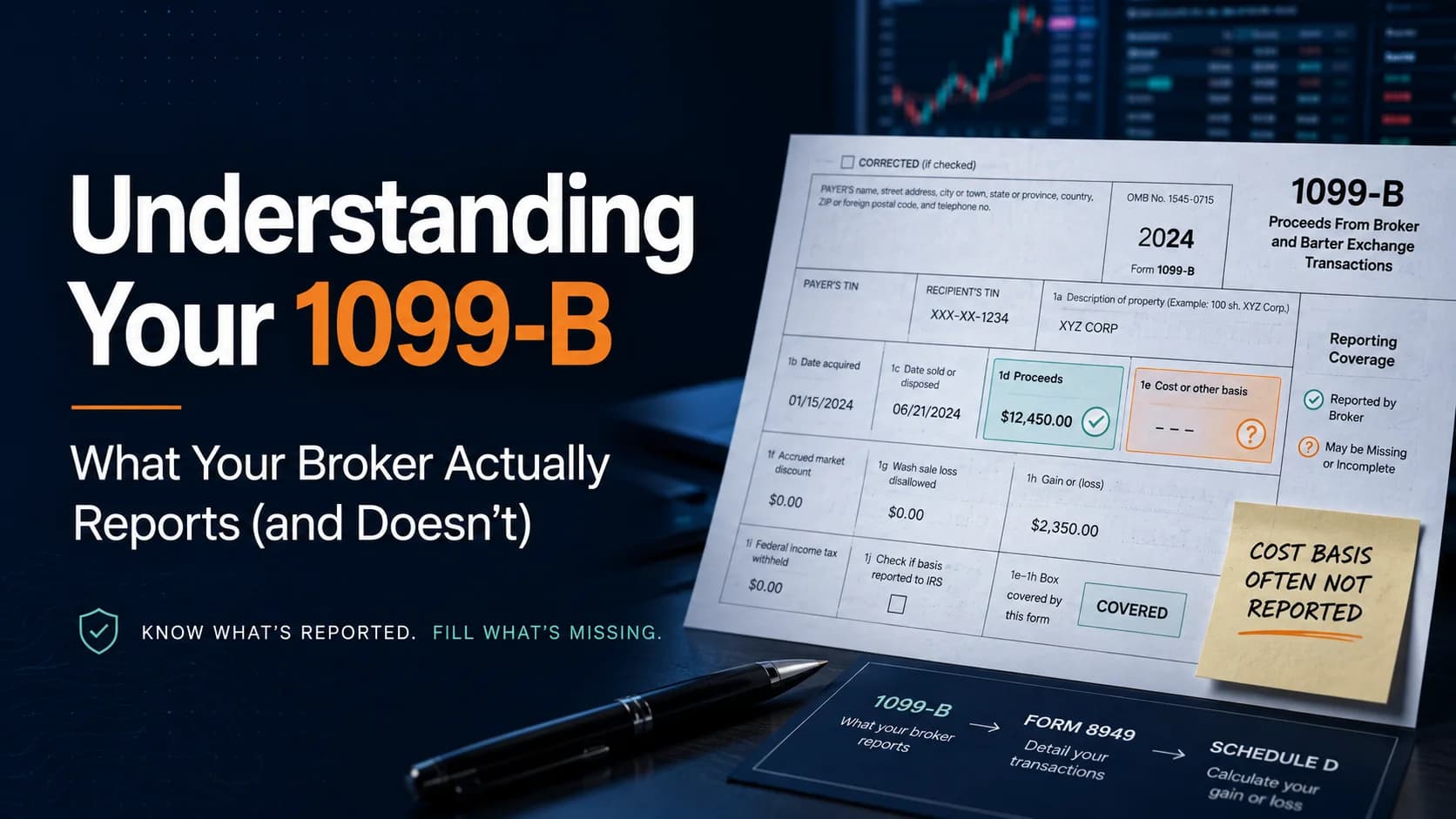
Crypto brokers are increasingly issuing a dedicated reporting form, Form 1099-DA, rather than the traditional 1099-B, with mandatory cost basis reporting for covered digital asset sales phasing in starting with 2026 transactions. Basis is still frequently reported as "unknown" for coins that moved between exchanges or wallets before landing at their current broker, which creates the same missing-basis, inflated-notice risk covered in detail in the 1099-B guide, arguably at larger scale given how routinely crypto moves across platforms compared to traditional securities.
Frequently Asked Questions
Is trading one cryptocurrency for another a taxable event?
This applies even though no dollars are ever involved in the transaction. The absence of a cash conversion doesn't exempt a crypto swap from being a taxable disposal.
Key Takeaway: Track every crypto-to-crypto trade as its own taxable event, not just the moments you converted back to dollars.
How is cryptocurrency taxed compared to stocks?
The mechanics of the holding period test, the tax brackets involved, and the netting of gains and losses all work identically to how they work for stock trading, covered in the capital gains guide.
Key Takeaway: An active crypto trader faces the same "almost everything is short-term" reality that an active stock day trader does.
Which cost basis method should I use for crypto: FIFO, HIFO, or specific identification?
HIFO tends to minimize gains in a rising market by selling your highest-cost coins first, while FIFO, by selling your oldest and often cheapest coins first, tends to produce larger gains in the same conditions.
Key Takeaway: The tax savings from choosing HIFO or specific identification over FIFO can be substantial, but only if your records SupportSupport is a price level where buying pressure has historically overcome selling pressure, causing price to stop declining and reverse — it's the floor where demand enters the market, and when it holds, it's a potential long entry; when it Read definition → the choice at the time of each trade.
Does the wash sale rule apply to cryptocurrency?
This is the current state of the law, not a guaranteed permanent feature. Proposed legislation to extend wash sale treatment to digital assets has been introduced repeatedly without passing.
Key Takeaway: Don't assume this exemption is permanent when planning multi-year tax strategies.
Are mining and staking rewards taxed the same way as trading gains?
Once you later sell coins received this way, that sale is a separate taxable event measured against the basis established when the coins were originally received.
Key Takeaway: Don't conflate earning crypto through mining or staking with trading it. They're taxed under different rules entirely.
How are Bitcoin and Ether futures taxed compared to spot crypto trading?
This is a materially different, generally more favorable tax regime, and it applies specifically to regulated exchange-traded futures, not to perpetual swaps or futures on offshore platforms.
Key Takeaway: The instrument you use to get crypto exposure, spot versus regulated futures, can meaningfully change your tax outcome on the same underlying view.
Do I need to report crypto transactions if I never converted anything to dollars?
Brokers are increasingly reporting these transactions directly to the IRS via Form 1099-DA, so an unreported crypto-to-crypto trade is now more likely than ever to generate a mismatch notice.
Key Takeaway: Treat every crypto disposal as reportable, not just the transactions that touched a bank account.
What is Form 1099-DA and how is it different from Form 1099-B?
Basis is still frequently marked "unknown" for coins transferred between platforms, creating the same risk of an inflated IRS notice covered in the 1099-B guide.
Key Takeaway: Check which form your crypto broker actually issued rather than assuming it works exactly like a traditional 1099-B.
Disclaimer
Article Sources
- IRS: Frequently Asked Questions on Virtual Currency Transactions - the property classification and general transaction principlesirs.gov
- IRS Instructions for Form 1099-DA - the new digital asset reporting form and its basis reporting phase-inirs.gov
- IRS Topic 409, Capital Gains and Losses - the holding period and netting rules that apply equally to cryptoirs.gov
- Cornell Law School, 26 U.S. Code Section 1091 - confirms the wash sale rule's limitation to stock and securities, excluding cryptolaw.cornell.edu
- IRS: Net Investment Income Tax - how the 3.8% NIIT applies to crypto gains at higher income levelsirs.gov