
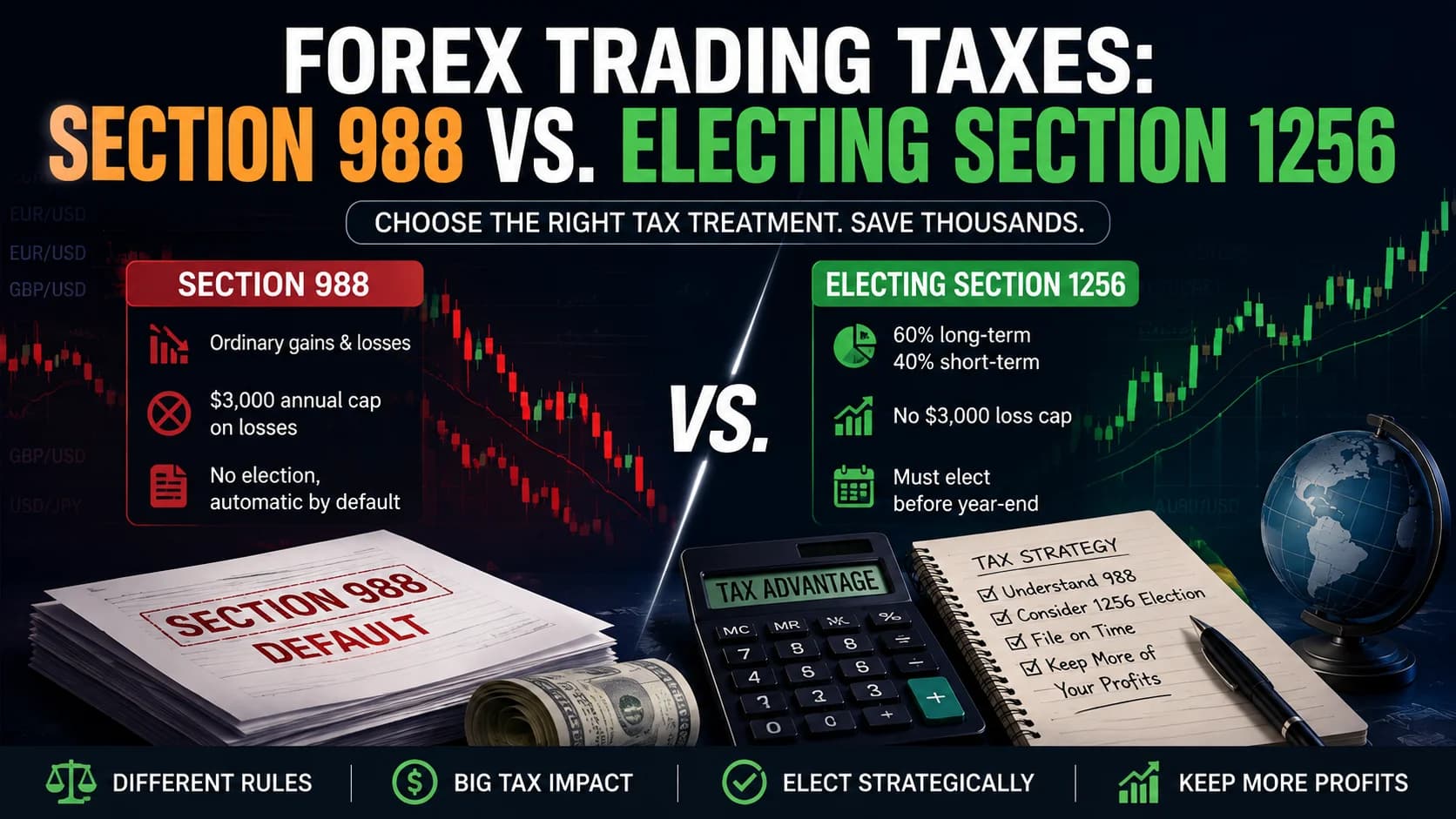
A forex trader has a rough year, down $40,000. Because forex defaults to Section 988 tax treatment, every dollar of that loss is fully deductible against her other income immediately, no $3,000 cap, no carryforward, unlike the wall a stock trader hits under the default capital gains rules. The next year, she has an outstanding run, up $60,000. That same Section 988 default now taxes the entire gain at her full ordinary rate, up to 37%, with no discount at all, because she never filed the internal election to opt out before the year began. The exact rule that saved her in the losing year cost her in the winning one, and by the time she wanted a different answer, the window to choose it had already closed.
That's the central tension in forex tax treatment, and it's the reason this asset class needs its own explanation rather than borrowing the rules built for stocks. Forex doesn't follow the capital gains framework that governs equities by default, and the election that changes that has a hard deadline most traders don't find out about until it's already passed.
How is forex trading taxed? Retail forex trading defaults to Section 988 ordinary gain or loss treatment: gains are taxed at your regular income tax rate, but losses are fully deductible against other income with no capital loss limitation. Traders can elect out of this default into capital gains treatment, and in narrower circumstances into the more favorable Section 1256 60/40 split, but the election has to be made before the trades happen, not after you see how the year turned out.
The Default: Section 988
Spot and forward foreign currency transactions start out under Section 988 automatically, no election, no paperwork required. Gains are ordinary income, taxed at your regular marginal rate, the same brackets covered in the capital gains guide. That sounds like a pure downside compared to a discounted capital gains rate, and for a profitable trader, it is.
The upside shows up on the loss side. Section 988 losses are ordinary losses, not capital losses, which means they aren't subject to the $3,000 annual cap on deducting capital losses against other income that stock and equity traders run into constantly. A rough year in forex can offset a full salary or other ordinary income immediately, with no carryforward required, a genuine advantage over how a losing year in stocks gets treated by default.
One more quiet benefit: the wash sale rule applies only to stock and securities under IRC Section 1091. Currency isn't a security, so wash sale disallowance simply doesn't reach Section 988 forex transactions at all, regardless of how quickly you re-enter a position after a loss.
The Opt-Out Election: Trading Ordinary Loss Relief for a Shot at Capital Gains Rates
A forex trader can elect out of Section 988 into capital gains treatment under Section 988(a)(1)(B). This is an internal election, not a form filed with the IRS. You document it contemporaneously in your own records, and it has to be made before the tax year begins or before you start the relevant trading, not retroactively once you've seen whether the year was a winner or a loser.
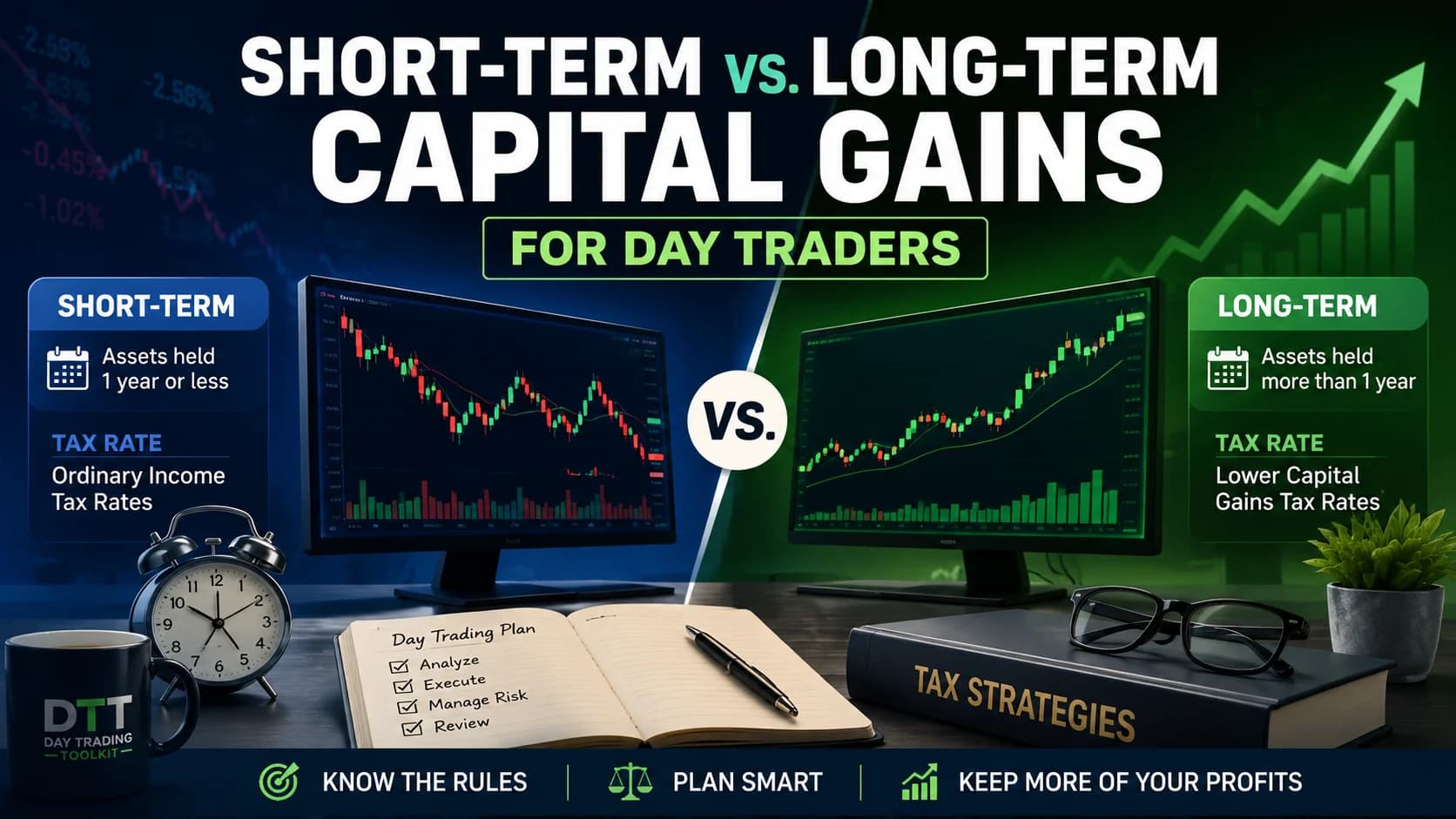
Making this election converts your forex gains and losses into capital gains and losses, subject to the same short-term versus long-term holding period rules as stocks, and subject to the same $3,000 loss limitation you'd otherwise have avoided under 988. For a trader confident in a profitable year, and specifically one holding positions long enough to have any real shot at long-term treatment, this trade can make sense. For a trader who ends up with a losing year instead, it's a genuinely worse outcome than simply staying under the 988 default would have been.
The More Aggressive Path: Section 1256(g) Treatment for Major Pairs
There's a further step some traders take, electing not just out of 988 but into Section 1256 treatment for major currency pairs, capturing the 60/40 split regardless of holding period. This requires that the currency trade in the interbank market, involve a major currency for which regulated futures exist on a qualified exchange, and that the trader not take or make physical delivery of the currency.
This is genuinely less settled ground than the equivalent question for stocks and standard futures. A federal appellate case, Wright v. Commissioner, found in 2016 that certain over-the-counter foreign currency options could qualify for Section 1256 treatment, but the IRS responded in 2022 with proposed regulations specifically written to narrow the definition and override that outcome, and those regulations remain proposed rather than final as of this writing. Beyond that, there's a real, still-debated question about whether retail spot forex traded through a standard regulated forex dealer or futures commission merchant, the way almost all retail traders actually access this market, qualifies for 1256(g) treatment the same way genuine interbank forward contracts do. Even specialists who advocate for retail traders using this treatment acknowledge the tax treatment here is uncertain rather than settled.
Given that uncertainty, treat Section 1256(g) treatment for spot forex as a position to take with a CPA who specializes in this exact area and is prepared to defend it, not as a default assumption to build a Trading PlanA trading plan is a written document that defines your strategy, the specific setups you trade, entry and exit rules, risk management parameters, daily loss limits, market conditions required to trade, and psychological rules — it's the difRead definition → around.
Making the Election Correctly, and the Trap of Doing It Too Late
The single most important operational detail in this entire topic is timing. Both the 988 opt-out and any further 1256(g) position have to be decided before the trading year starts, or before you begin the specific trading activity, and documented at that time. There's no valid version of looking at your December results and retroactively deciding which treatment would have worked out better. The IRS is specifically alert to elections that appear to have been made with the benefit of hindsight, and a contemporaneous, dated internal record of your election is your only real defense that it was actually made when it needed to be.
Practically, this means the decision has to happen at the start of your trading year, based on your expectations and strategy going forward, not your results looking backward. A trader who trades both stocks and forex, or forex alongside currency futures, needs to track which positions fall under which regime carefully, since a single account can genuinely contain both.
How Each Treatment Actually Gets Reported
Section 988 gains and losses are reported as ordinary income or loss, generally on Schedule 1 of Form 1040, or flowing through Schedule C if you've qualified for Trader Tax Status and are treating forex trading as part of a broader trading business. Section 1256-elected forex gains and losses go on Form 6781 alongside any other Section 1256 contracts you hold, with the same 60/40 split and the same three-year loss carryback option covered in the Section 1256 guide.
Which Election Fits Which Trader
A trader expecting losses, especially a newer trader still finding their footing or one running a strategy with real DrawdownA drawdown is the peak-to-trough decline in account equity — it measures how far you've fallen from your high-water mark, either from a single losing trade or a series of losing trades.Read definition → risk, generally benefits from staying under the Section 988 default, since the unlimited ordinary loss deduction is worth more than a shot at capital gains rates that assume a winning year. A consistently profitable trader with real conviction in that pattern continuing may find the 988 opt-out into capital gains treatment worthwhile, accepting the $3,000 loss cap in exchange for a shot at long-term rates on positions held past a year. The further step into 1256(g) treatment for major pairs is a specialist decision that depends on exactly how your forex exposure is structured and should be made with professional GuidanceGuidance is forward-looking financial projections that a company's management provides for upcoming periods — typically covering expected revenue, earnings, or margins — and the market's reaction is often driven more by guidance than by theRead definition → given the genuine uncertainty involved.
Frequently Asked Questions
How is forex trading taxed by default?
This is the automatic treatment for spot and forward currency transactions with no election or paperwork required. It applies whether you're profitable or not, until you specifically elect otherwise.
Key Takeaway: Section 988's biggest advantage is unlimited loss deductibility, not favorable treatment of gains.
Can I choose a better tax treatment for my forex trading?
Electing out trades away the unlimited ordinary loss deduction for a shot at capital gains rates, a worthwhile trade for a confident, consistently profitable trader and a poor one for anyone who ends up with a loss instead.
Key Takeaway: This decision has to be made looking forward, based on your strategy and expectations, never backward based on how the year actually went.
What happens if I don't make any election for my forex trading?
Doing nothing isn't a mistake by default. For a trader with real loss risk or an uncertain track record, staying under Section 988 is often the reasonable default choice.
Key Takeaway: The default treatment is a legitimate choice, not just an absence of planning.
Does the wash sale rule apply to forex trading?
This holds regardless of how quickly you re-enter a currency position after taking a loss on it.
Key Takeaway: Forex traders don't need to track wash sale timing the way stock and options traders do.
Can retail spot forex qualify for the Section 1256 60/40 tax treatment?
This is one of the least settled areas in trader taxation, and it should be approached with a CPA prepared to defend the position, not assumed as a default.
Key Takeaway: Don't build a trading plan around an assumption of 1256 treatment for spot forex without specialist guidance specific to your exact setup.
Is there a limit on how much forex trading loss I can deduct?
This changes if you've elected out of 988 into capital gains treatment, where the standard $3,000 annual capital loss limitation applies just as it does for stock traders.
Key Takeaway: The unlimited loss deduction is the single biggest reason to stay under the Section 988 default for anyone uncertain about a strategy's long-term profitability.
How do I actually report forex gains and losses on my tax return?
Keeping clean records of which trades fall under which treatment matters especially if you trade both spot forex and currency futures in the same year.
Key Takeaway: The reporting form follows directly from which tax treatment applies, so know your election status before you start filling out forms.
Can I switch between Section 988 and capital gains treatment year to year?
A trader can reasonably elect out of 988 for a year they expect to be strongly profitable and stay under the 988 default for a year with more uncertainty, as long as the decision is made and documented at the start of each period.
Key Takeaway: Flexibility exists year to year, but never within a year after the fact.
Does Trader Tax Status affect how forex is taxed?
A forex trader can qualify for TTS the same way a stock or futures trader does, based on the same substantial, regular, and continuous activity test covered in the Trader Tax Status guide.
Key Takeaway: TTS and the 988 election are separate decisions that both apply to a serious forex trader, not substitutes for each other.
Disclaimer
Article Sources
- Cornell Law School, 26 U.S. Code Section 988 - the statutory default ordinary gain or loss treatment for foreign currency transactionslaw.cornell.edu
- Cornell Law School, 26 U.S. Code Section 1256 - the foreign currency contract provisions within Section 1256law.cornell.edu
- Federal Register: Definition of Foreign Currency Contract Under Section 1256 (REG-130675-17) - the proposed regulations narrowing Section 1256(g) eligibilityfederalregister.gov
- Cornell Law School, 26 U.S. Code Section 1091 - confirms the wash sale rule's limitation to stock and securitieslaw.cornell.edu
- IRS Topic 429, Traders in Securities - how Trader Tax Status applies across instrument types including forexirs.gov