
Buying at the BidThe bid is the highest price a buyer is currently willing to pay. When you sell with a market order, you receive the bid price.Read definition → and selling at the AskThe ask is the lowest price a seller is currently willing to accept. When you buy with a market order, you pay the ask.Read definition → sounds like the simplest trade in the market — capture the spread, repeat all day. It's also a trade professional market makers compete over at speeds measured in millionths of a second, using infrastructure no individual account can match. This guide covers the concept honestly: what it actually requires, why the pure version isn't realistically available to retail traders, and what a genuinely useful adapted version looks like instead.
What is Bid-Ask SpreadThe bid-ask spread is the difference between the highest price buyers will pay and the lowest price sellers will accept — it's an immediate, invisible transaction cost on every trade you make.Read definition → ScalpingScalping is a trading style that targets very small price moves — often just cents or a few ticks — entering and exiting positions within seconds to minutes, with the goal of accumulating many small wins throughout the day while keeping losRead definition →? Bid-ask spread scalping means attempting to buy at the bid price and sell at the ask price on the same stock, repeatedly, capturing the spread between them the way a market maker does. This guide covers this hub's scalping introduction, which flagged this specific approach as one of the hardest to execute well, in the depth that flag deserves. Readers who need the basics on spreads as a trading cost should start there before this deeper treatment.
What Market Makers Actually Do (And Why It's Structurally Different From Retail)
A market maker posts both a bid and an ask simultaneously, profiting from the spread between them across a large VolumeVolume is the total number of shares (or contracts) traded during a given time period — it's the primary confirmation tool for all price action, because a price move accompanied by high volume indicates genuine market participation, while tRead definition → of trades, while managing the risk that either side gets filled by someone who knows something they don't. That's the entire business model, and it depends on two things an individual retail account doesn't have: the speed to update quotes faster than the market moves against them, and enough trading volume across enough names that the spread captured on winning trades reliably exceeds the losses taken on the ones where they were adversely selected.
Retail traders attempting this strategy are trying to do the same job — post both sides, capture the spread — without either of those structural advantages. That mismatch is worth understanding precisely rather than just accepting as received wisdom, because the research behind it is specific and well worth knowing before attempting this approach with real capital.
The Research Behind Why This Doesn't Work at Retail Speed
This hub's scalping introduction already flagged the foundational explanation: Glosten and Milgrom's 1985 model established that bid-ask spreads exist specifically as compensation for adverse selection — a market maker sets a spread wide enough to cover the losses taken from trading against better-informed counterparties. That's true for every market maker, professional or otherwise, and it's the baseline cost of doing this job at all.
What makes it specifically unworkable for retail is the speed dimension. Budish, Cramton, and Shim's 2015 study documented that modern markets have settled into a continuous arms race for microsecond-level speed, driven by "mechanical arbitrage" opportunities that appear whenever a stale quote can be picked off before it updates — and found that competition hasn't reduced the profits available from winning these races, it has only raised the bar for how fast a firm needs to be to keep capturing them.
A 2022 follow-up by Aquilina, Budish, and O'Neill quantified exactly how extreme that speed requirement has become, using exchange message data that captures both the winners and losers of these races rather than just the visible outcome. They found latency-arbitrage races occur roughly once per minute per symbol, last on the order of five to ten millionths of a second, and account for a substantial share of overall trading volume — with the top six firms capturing more than 80% of all race outcomes between them. A retail trader's order, routed through a standard broker's infrastructure, isn't a participant in races decided at that timescale. It's the liquidity those races are being fought over.
The Realistic Version: Spread-Aware Execution, Not Standalone Market Making
The honest, workable adaptation of this idea isn't posting two-sided quotes and hoping to profit from the spread in isolation — it's using limit orders instead of market orders on trades already justified by another strategy, specifically to avoid paying the spread as a cost on every entry and exit. This isn't a new source of profit; it's a reduction in the cost of executing trades that already have their own reason for existing.
The distinction matters. A trader entering a momentum trade covered elsewhere on this hub who places a market order pays the ask price going in and receives the bid price coming out, absorbing the full spread as a transaction cost on top of commissions. The same trader placing a limit order at the bid on entry, and at the ask on exit, captures that spread back — not as a standalone strategy, but as an execution discipline layered onto a trade that already had a real thesis behind it.
The Setup Specification: Eight Rules for Spread-Aware Execution
Every component below describes the realistic, adapted version of this concept — using limit orders to reduce execution cost on trades justified elsewhere, not standalone market making.
- Component
- Market Conditions Required
- Rule
- A liquid, actively-traded stock with a consistently tight spread; this technique adds real value in a $0.01-wide spread and adds real risk in a wide, illiquid one.
- Component
- Time of Day
- Rule
- Most reliable during active, liquid trading hours; avoid relying on limit-order fills during the most chaotic minutes at the open or close.
- Component
- Stock Selection Criteria
- Rule
- High average volume and a tight, stable spread — the same liquidity profile this hub's scalping introduction identifies as necessary for any of this style's approaches.
- Component
- Entry Trigger
- Rule
- When a trade is already justified by another strategy's criteria, place a limit order at the bid (for a long) or ask (for a short) rather than crossing the spread with a market order.
- Component
- Stop Loss
- Rule
- Identical to whatever the underlying strategy specifies — this technique doesn't change the risk framework of the trade it's applied to.
- Component
- Initial Profit Target + Scaling
- Rule
- Identical to the underlying strategy; the spread-capture benefit applies to the entry and exit fills, not to the trade's actual target logic.
- Component
- Trade Management
- Rule
- If the limit order hasn't filled within a reasonable window and the setup is time-sensitive, default to a market order rather than missing an otherwise-valid trade over a few cents of spread.
- Component
- Invalidation Criteria
- Rule
- The same invalidation rules as the underlying strategy; this technique is an execution layer, not an independent trade with its own exit logic.
| Component | Rule |
|---|---|
| Market Conditions Required | A liquid, actively-traded stock with a consistently tight spread; this technique adds real value in a $0.01-wide spread and adds real risk in a wide, illiquid one. |
| Time of Day | Most reliable during active, liquid trading hours; avoid relying on limit-order fills during the most chaotic minutes at the open or close. |
| Stock Selection Criteria | High average volume and a tight, stable spread — the same liquidity profile this hub's scalping introduction identifies as necessary for any of this style's approaches. |
| Entry Trigger | When a trade is already justified by another strategy's criteria, place a limit order at the bid (for a long) or ask (for a short) rather than crossing the spread with a market order. |
| Stop Loss | Identical to whatever the underlying strategy specifies — this technique doesn't change the risk framework of the trade it's applied to. |
| Initial Profit Target + Scaling | Identical to the underlying strategy; the spread-capture benefit applies to the entry and exit fills, not to the trade's actual target logic. |
| Trade Management | If the limit order hasn't filled within a reasonable window and the setup is time-sensitive, default to a market order rather than missing an otherwise-valid trade over a few cents of spread. |
| Invalidation Criteria | The same invalidation rules as the underlying strategy; this technique is an execution layer, not an independent trade with its own exit logic. |
The trade-off built into the entry and management rules is the honest core of this whole approach. A limit order at the bid might not fill at all if the stock never trades back down to that price, which means a real risk of missing a valid setup entirely in exchange for a small execution-cost saving. That trade-off is worth making on setups with some room to wait for a fill and not worth making on genuinely time-sensitive entries, like a fast-breaking momentum trade where a few seconds of delay defeats the entire purpose of the setup.
A Walk-Through: Spread-Aware Execution on an Otherwise Ordinary Trade
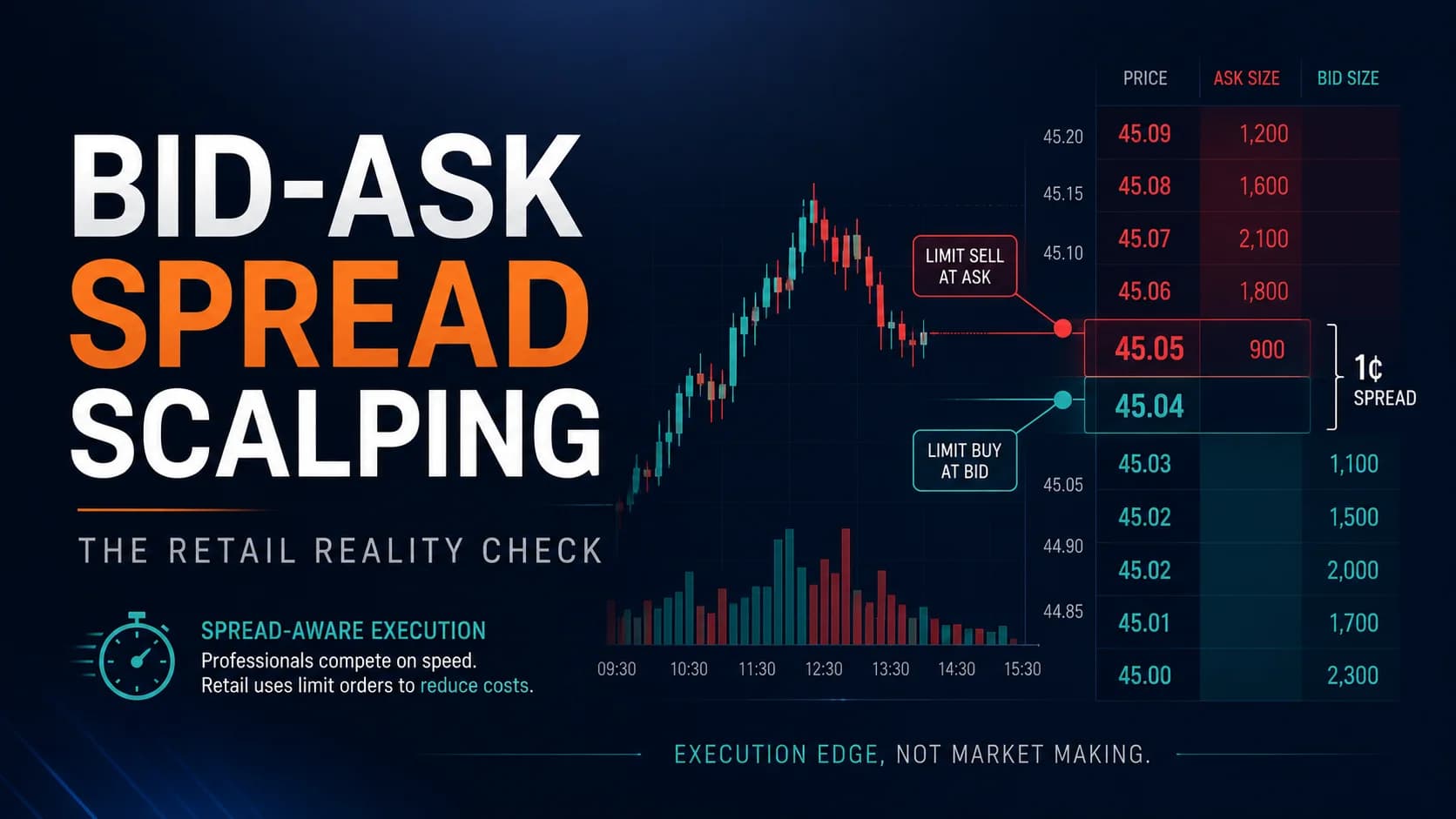
Consider a hypothetical, liquid mid-cap stock, ticker EFG, trading at $45.04 bid / $45.05 ask, where a separate momentum strategy covered elsewhere on this hub has already generated a valid long entry signal. None of the prices below are real; they're constructed to show the mechanics in action.
A market order to buy fills at the $45.05 ask immediately. A limit order placed at the $45.04 bid instead waits for a seller to come to that price — which may happen within seconds in a genuinely liquid, active name, or may not happen at all if the stock is moving up steadily without any pullback to the bid.
In this instance, EFG ticks down briefly to $45.04 within the next 8 seconds as a routine, small intraday fluctuation, filling the limit order at that price — one cent better than the market order would have achieved. On the exit side, assuming the trade reaches its target and the stock is trading $46.20 bid / $46.21 ask, a limit order at $46.21 captures the ask rather than accepting $46.20 on a market sell, another cent recovered.
Across a single trade, two cents per share isn't dramatic. Across dozens of trades over a trading career, consistently avoiding the spread on both sides of every liquid, non-time-sensitive entry adds up to a real, if modest, improvement in net results — achieved by execution discipline, not by running a standalone spread-capture strategy.
Managing the Trade Once the Execution Layer Is Applied
Once filled, the position is managed exactly as the underlying strategy specifies — this technique's entire contribution happens at the entry and exit fills, not during the life of the trade itself. There's no separate management logic to layer on top.
The one discipline worth maintaining deliberately: don't let waiting for a better fill become an excuse to second-guess a valid setup. If a limit order sits unfilled while the underlying thesis (the reason for the trade in the first place) is time-sensitive, defaulting to a market order and accepting the spread cost is the correct choice far more often than holding out for a marginally better price and missing the trade entirely.
Where This Strategy Fails: Attempting the Pure Version
The dominant failure mode isn't really a failure of the adapted, execution-focused version described above — it's attempting the pure, standalone version this article opened by explaining. Posting two-sided quotes and expecting to profit purely from the spread, without the speed infrastructure professional market makers and high-frequency firms operate, means competing directly in the exact races the research above documents as decided in millionths of a second by a small handful of dominant firms. That's not a difficult version of this strategy for a retail trader to execute well — it's a version that isn't realistically available at retail speed and infrastructure at all.
A second, more specific risk applies even to the adapted version: chasing a marginally better fill on a genuinely time-sensitive setup. A fast-moving momentum entry that requires immediate execution loses far more from a delayed or missed fill than it gains from capturing a cent or two of spread, and treating every trade as an opportunity to save on execution cost regardless of urgency is how a sound cost-reduction habit turns into a source of missed opportunities.
Adapting the Approach Across Instruments and Liquidity Levels
This execution technique scales with liquidity in a straightforward way: the tighter and more consistent a stock's spread, the more reliably a limit order captures a meaningful saving without much risk of non-execution. In a genuinely wide-spread, thinly-traded name, the same technique carries real risk of never filling at all, which usually argues for simply accepting the spread as a cost of trading that particular stock rather than forcing an execution technique built for liquid names onto an illiquid one.
Options markets, particularly on lower-volume contracts, often show far wider spreads than the underlying stock, which makes spread-aware limit-order execution considerably more valuable there in percentage terms — though the same non-execution risk applies, often more acutely given lower overall liquidity.
Tools for Managing Execution
Hotkeys and a direct-access broker, covered in this hub's scalping introduction, matter here too: placing and adjusting limit orders quickly, rather than fumbling through a slower order-entry process, is what makes this execution discipline practical to apply consistently across many trades rather than only occasionally when there's time to think about it.
Trade Ideas can help identify which candidates on a watchlist are liquid and tight-spread enough for this technique to make sense in the first place, as part of a comprehensive scanning and research platform used for finding and evaluating trade candidates generally — the execution technique itself, though, lives in the order entry, not in the scanner.
Sizing and Applying This Approach Inside a Broader Plan
This technique doesn't have its own position-sizing framework, because it isn't a standalone strategy — it inherits the sizing and risk rules of whatever underlying setup it's applied to, and its only real contribution is a modest reduction in execution cost across many trades over time.
The psychological trap worth naming honestly: the appeal of "getting paid to provide liquidity" is real, and it's tempting to want the pure version to work simply because the concept sounds elegant. This hub's guide to cognitive biases in trading covers this same pull toward an appealing idea over rigorous evidence in more depth. Accepting that this is an execution refinement rather than an independent edge, and sizing expectations accordingly, keeps this technique in its proper, genuinely useful place rather than becoming a source of disappointment when the standalone version doesn't deliver what professional market makers achieve with entirely different infrastructure. This strategy belongs on the Strategies Hub specifically as an honest treatment of a widely-discussed idea — useful in its adapted form, not viable in the form its name most naturally suggests.
Common Questions About Bid-Ask Spread Scalping
Can retail traders actually make money as market makers?
Research specifically quantifying this competition found that the fastest, most concentrated firms capture the large majority of the profits available from these speed-based opportunities, leaving essentially none of that specific edge accessible to a retail order routed through standard broker infrastructure.
Key Takeaway: The pure liquidity-provider version of this strategy isn't a hard version of a viable idea — it's a version that isn't realistically available at retail speed.
If pure spread scalping doesn't work, what's actually useful about this idea?
Applied consistently across many liquid, non-time-sensitive trades over time, this adds up to a real, if incremental, improvement in net results, achieved through disciplined execution rather than through running a standalone market-making operation.
Key Takeaway: Treat this as a cost-reduction habit layered onto other strategies, not as its own trading strategy with independent profit potential.
Why can't a fast retail trading platform compete with the speed described in the research?
The gap isn't about a retail trader's reflexes or attentiveness; it's a structural difference in the physical and technological infrastructure between a retail brokerage connection and a firm with dedicated, co-located exchange access.
Key Takeaway: This is an infrastructure gap, not a skill gap, and no amount of practice closes an infrastructure gap measured in millionths of a second.
Does this mean bid-ask spreads don't matter for ordinary retail trading?
Every trade pays the spread as a cost unless a limit order avoids it, which is exactly why the adapted, execution-focused version of this idea covered in this guide is worth applying even though the standalone version isn't.
Key Takeaway: Spreads remain a real cost worth managing carefully — the shift is from trying to profit from them directly to simply avoiding paying them unnecessarily.
When should a trader use a market order instead of trying to capture the spread?
The entire value of spread-aware execution depends on having some room to wait for a fill; forcing it onto a setup that requires immediate execution defeats the purpose of the underlying trade to save a marginal amount on entry price.
Key Takeaway: Match the execution method to how time-sensitive the actual trade is, rather than applying the same approach to every trade regardless of urgency.
Does this approach work the same way on illiquid stocks?
This technique is built for liquid, tight-spread names specifically; forcing it onto an illiquid stock with a wide, unstable spread often means accepting a real chance of missing the trade entirely to chase a saving that isn't reliably available in the first place.
Key Takeaway: Reserve this technique for genuinely liquid names, and simply accept the spread as a cost on illiquid ones.
Do options benefit from this technique more than stocks?
The same non-execution risk applies, and in some cases more acutely, since options markets can be considerably less liquid than the underlying stock even on actively-traded names.
Key Takeaway: The percentage benefit can be larger on options, but so can the risk of a limit order simply not filling.
Why does this hub cover a strategy it says doesn't really work?
Giving this idea the same rigorous, evidence-based treatment as every other strategy on this hub — including being direct when the evidence argues against the most literal version of it — is more useful than either omitting it or presenting it uncritically.
Key Takeaway: An honest "this doesn't work as commonly imagined, but here's what does" is more valuable than silence or false encouragement.
Is there any realistic path for a retail trader to compete on speed at all?
There are other ways retail traders compete effectively in markets — reading price action, managing risk disciplined, choosing setups with a genuine statistical edge — but out-racing dedicated high-frequency infrastructure by microseconds isn't realistically one of them, regardless of platform or hotkey setup.
Key Takeaway: Compete on the dimensions actually available to a retail account — setup selection, discipline, and risk management — rather than on raw execution speed.
How does this honest limitation compare to other strategies covered on this hub?
That distinction is worth sitting with rather than glossing over — not every widely-discussed trading idea survives contact with the underlying market structure research, and this hub aims to say so plainly when that's the case.
Key Takeaway: This guide exists specifically to be honest about a popular idea's real limitations, not to force a workable-sounding strategy out of a concept the evidence doesn't support in its literal form.
Disclaimer
Article Sources
- Glosten & Milgrom (1985), "Bid, Ask and Transaction Prices in a Specialist Market with Heterogeneously Informed Traders", Journal of Financial Economics - the foundational model explaining why bid-ask spreads exist as compensation for adverse selection risksciencedirect.com
- Budish, Cramton & Shim (2015), "The High-Frequency Trading Arms Race: Frequent Batch Auctions as a Market Design Response", Quarterly Journal of Economics - documents the continuous speed-based arms race underlying modern liquidity provisionacademic.oup.com
- Aquilina, Budish & O'Neill (2022), "Quantifying the High-Frequency Trading 'Arms Race'", Quarterly Journal of Economics - quantifies the speed and concentration of this competition using exchange message data, finding races decided in millionths of a second dominated by a small handful of firmsideas.repec.org