
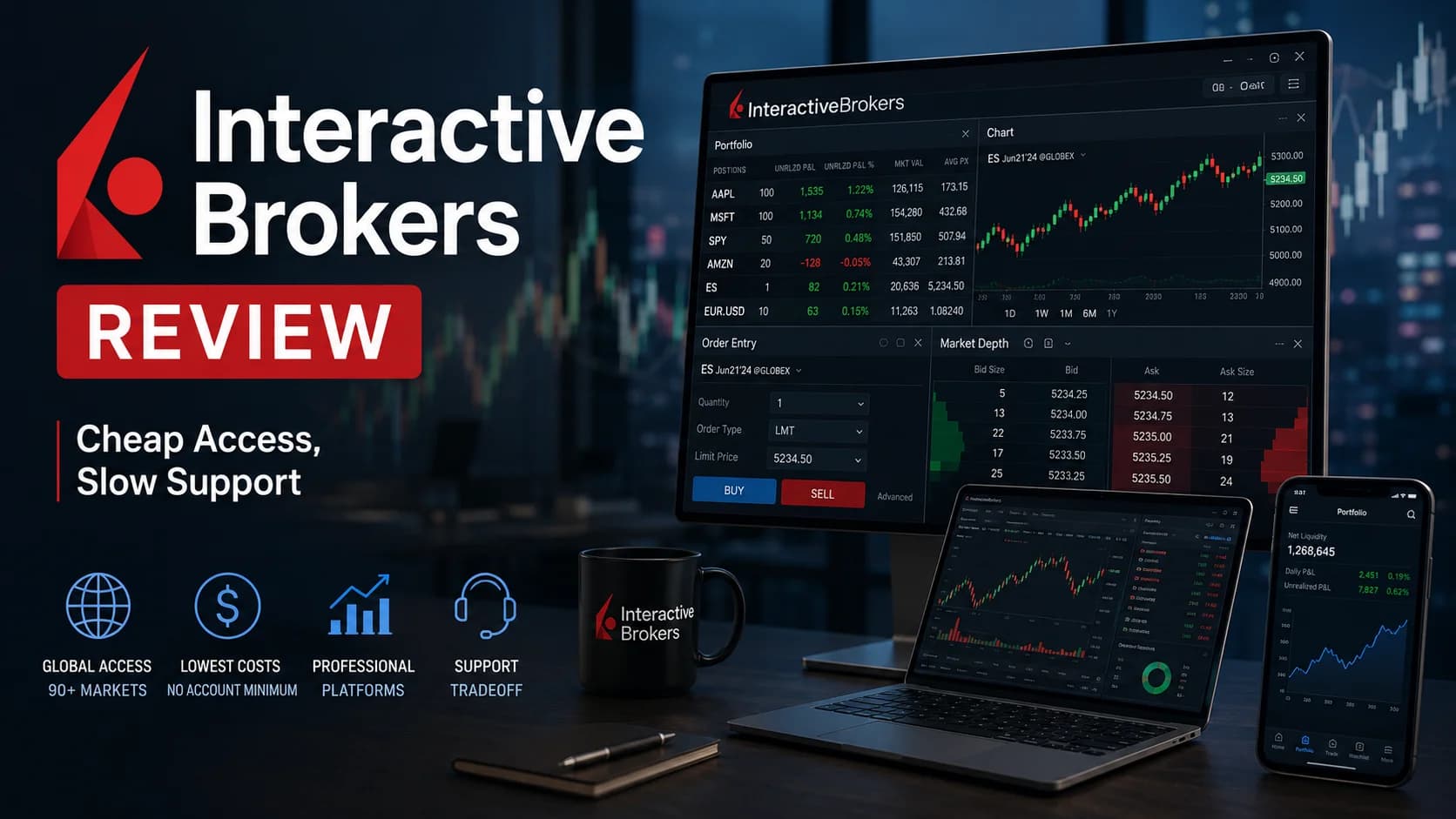
Interactive Brokers built its reputation on being the broker professional traders graduate into — the one with the lowest MarginMargin is borrowed capital from your broker that lets you control a larger position than your cash balance would otherwise allow — a $25,000 account with 4:1 intraday margin can control up to $100,000 in positions, amplifying both profits aRead definition → rates, the deepest order book access, and a platform complex enough to make a hedge fund trader feel at home. That reputation is largely earned. It's also only half the story: the same independent reviews that praise IBKR's pricing and market access consistently flag slow customer SupportSupport is a price level where buying pressure has historically overcome selling pressure, causing price to stop declining and reverse — it's the floor where demand enters the market, and when it holds, it's a potential long entry; when it Read definition → and a genuinely steep learning curve. A useful review has to hold both facts at once.
What is Interactive Brokers? Interactive Brokers (IBKR) is a global brokerage offering stock, options, futures, forex, bond, and cryptocurrency trading across roughly 90 markets worldwide. It splits its service into two account types — IBKR Lite, a commission-free tier for casual US investors, and IBKR Pro, a tiered-commission tier built for active traders who want SmartRouting execution and lower margin rates.
This review evaluates Interactive Brokers against the criteria that matter most for a day trading broker — commission structure, platform depth, market access, and customer support quality — using IBKR's official pricing pages and independently published reviews and testing data, not a claimed personal account history.
What's good
- Genuinely rock-bottom costs — no account minimum, no monthly or inactivity fee, and margin rates that are consistently among the lowest in the industry, especially on IBKR Pro.
- Unmatched market access — stocks, options, futures, forex, bonds, and direct cryptocurrency trading across roughly 90 global markets, covering nearly any asset class a day trader might want from a single account.
- Trader Workstation (TWS) remains one of the deepest professional-grade platforms available to retail traders, with advanced order types, algorithmic trading support, and institutional-grade APIs.
- The newer IBKR Desktop platform meaningfully closes the usability GapA gap is a price discontinuity on a chart where a stock opens significantly higher or lower than the previous session's close, leaving a visible empty space — gap-ups are driven by overnight buying pressure or positive news; gap-downs by seRead definition → that has historically kept IBKR out of reach for less experienced traders.
- Free paper trading with simulated funds lets new users learn the platform's complexity before committing real capital.
Trade-offs
- Customer support is a documented weak point — independent reviews and testing describe support tickets taking days or weeks to resolve, worth factoring in if you might need fast help during a trading issue.
- Account opening and setup is more tedious and error-prone than at simpler competitors, per independent broker testing.
- Trader Workstation's depth comes with a real learning curve that can overwhelm a trader who isn't ready to invest time in learning the platform before going live.
- IBKR Lite's zero-commission model relies on payment for order flow, which can mean slightly worse execution prices than Pro's SmartRouting — worth understanding before assuming "free" has no tradeoff at all.
What Is Interactive Brokers? A Closer Look
Interactive Brokers has built its business around serving traders who outgrow simpler platforms — active day traders, professional and prop traders, financial advisors, and even hedge funds all use the same underlying infrastructure, just with different account configurations layered on top. That institutional DNA shows up everywhere: in the depth of Trader Workstation, in margin rates that consistently undercut mainstream competitors, and in market access that spans roughly 90 exchanges across dozens of countries.
The account structure reflects two different audiences. IBKR Lite is built for US retail investors who want commission-free trading on US-listed stocks and ETFs without thinking too hard about routing or execution quality. IBKR Pro is built for traders who care about execution quality enough to pay a small per-share commission in exchange for SmartRouting — an order-routing system that searches multiple exchanges and dark pools for the best available price rather than relying on payment for order flow.
For a day trader specifically, the practical decision usually comes down to VolumeVolume is the total number of shares (or contracts) traded during a given time period — it's the primary confirmation tool for all price action, because a price move accompanied by high volume indicates genuine market participation, while tRead definition → and how much execution quality matters at the margins. A trader placing a handful of trades a week may never notice IBKR Lite's routing tradeoffs. A trader placing dozens of trades a day, especially in size, tends to find that Pro's SmartRouting and lower margin rates pay for themselves well beyond the commission cost.
Key Features
IBKR Lite vs. IBKR Pro. Lite offers $0 commissions on US-listed stocks and ETFs, available only to US (and Singapore) residents, using payment-for-order-flow arrangements that can result in marginally worse execution prices. Pro charges tiered commissions from roughly $0.0005 to $0.0035 per share (or a flat $0.005/share, $1 minimum) in exchange for SmartRouting execution, lower margin rates, and availability to traders globally. You can switch between Lite and Pro at any time with no fee and no impact on existing positions.
Trader Workstation (TWS) and IBKR Desktop. TWS remains one of the most powerful retail-accessible trading platforms available — 90+ order types, algorithmic trading tools, multi-leg options construction, and institutional-grade APIs for traders who want to build their own tools on top. That depth is also TWS's biggest barrier to entry for newer traders. IBKR Desktop, a newer platform, wraps much of that same execution power in a more modern, visually organized interface — including a MultiSort screener that lets you rank stocks by multiple criteria simultaneously rather than a single metric at a time — and is quickly becoming a meaningfully more approachable entry point into IBKR's ecosystem.
Margin Rates. This is one of IBKR's clearest competitive advantages. Pro's margin rates are consistently cited as among the lowest in the industry, which matters disproportionately for active day traders who use margin regularly — a one-percentage-point difference in rate on a $50,000 margin balance works out to real annual cost. Lite's margin rates carry a higher markup than Pro's, which is worth factoring into the Lite-vs-Pro decision if you plan to trade on margin.
Global Market Access. Stocks and ETFs across roughly 90 markets, options and futures with global reach, forex trading across two dozen-plus currencies, access to a large universe of bonds, and direct cryptocurrency trading (including Bitcoin, Ethereum, and a growing list of additional coins via regulated partners) alongside crypto futures. Few brokers in this category offer this breadth from a single account.
Fee Structure Beyond Commissions. No account minimum, no monthly fee, and no inactivity fee — a previous inactivity fee was eliminated years ago. Real-time Level I and Level II market data is typically a paid add-on, commonly in the $5–$30/month RangeA range (or trading range) is a price zone where a stock oscillates between a defined support floor and resistance ceiling without making meaningful new highs or lows — price is consolidating rather than trending, and the dominant trade is Read definition → per exchange package. There's also a modest per-withdrawal fee if you exceed one withdrawal per month, worth knowing if you move cash frequently.
Paper Trading. IBKR offers free paper trading with simulated funds, letting new users learn the platform's genuinely complex order types and interface before risking real capital — a meaningful safety net given how much of a learning curve TWS specifically carries.
Who Interactive Brokers Is Best For
Interactive Brokers earns its reputation for a specific kind of trader, and it's worth being clear about who that is rather than treating it as a universal fit.
It's a strong fit if you're an active day trader who places enough volume that low commissions and tight margin rates meaningfully affect your bottom line, or if you need access to international markets, futures, forex, or crypto that many US-focused brokers simply don't offer. It's also a strong fit for a trader willing to invest real time learning Trader Workstation's depth in exchange for tools that most competing platforms don't have at all.
It's a weaker fit if you're a complete beginner who values a guided, simple experience and responsive customer support more than raw platform power — several simpler platforms are built specifically around that experience. It's also worth pausing if you expect to need customer support quickly and often, since independent testing consistently flags response times as a genuine weak point.
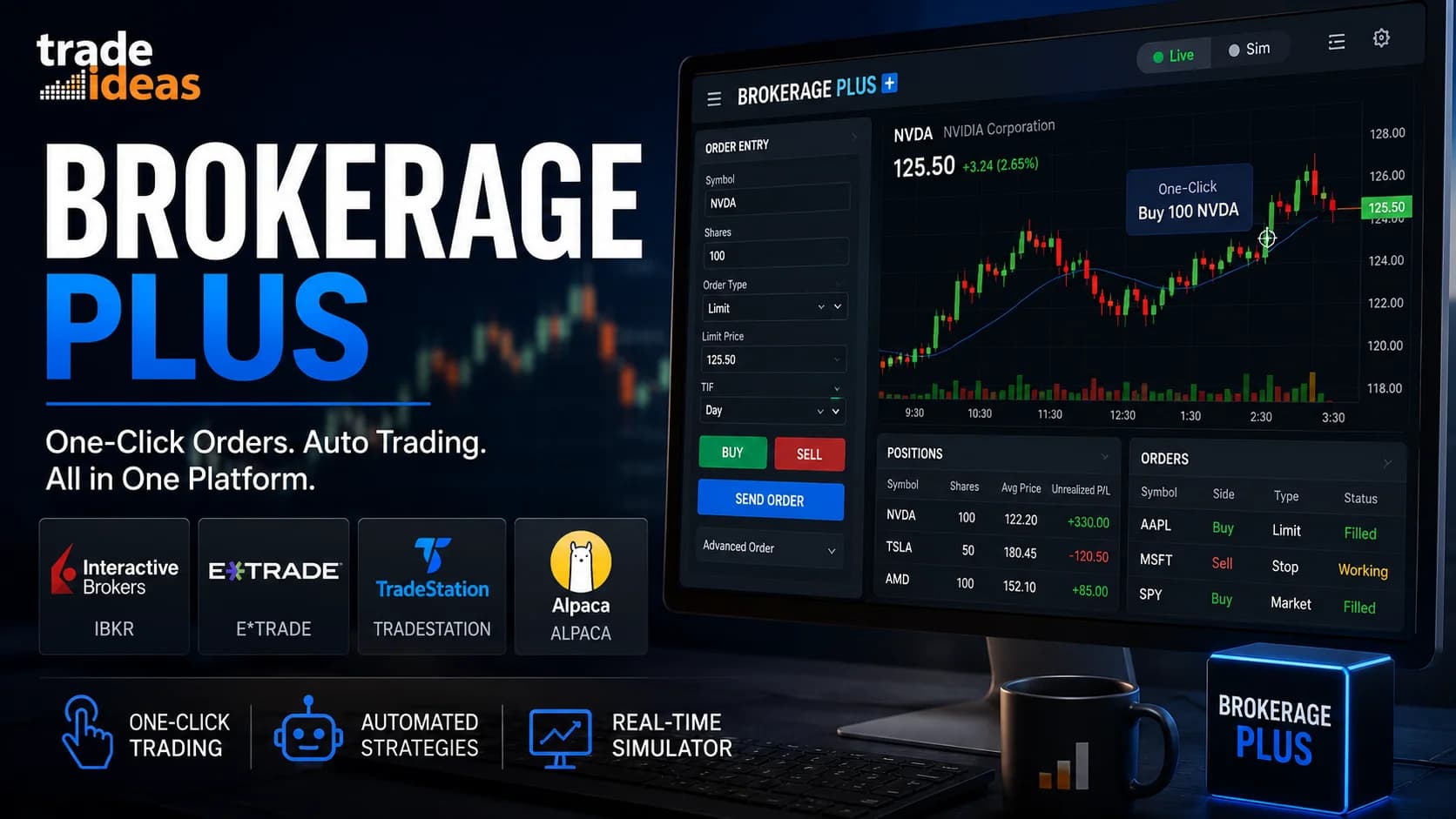
Many active day traders pair a broker like Interactive Brokers with a separate scanning and execution layer rather than relying on the broker's native tools alone for stock discovery. Trade Ideas' Brokerage Plus feature, for example, connects directly to Interactive Brokers accounts for one-click order routing straight from a scan result — letting a trader use IBKR for execution quality and cost while using a dedicated scanner for the discovery side of the workflow. You can read more about how that combination works in DayTradingToolkit's Trade Ideas Brokerage Plus review, and explore Trade Ideas directly if pairing a scanner with your IBKR account is something you're considering.
Interactive Brokers Pricing
Interactive Brokers splits pricing across two account types, with no account minimum on either:
- Account Type
- IBKR Lite
- Stock/ETF Commissions
- $0 (US-listed)
- Options
- $0.65/contract flat
- Margin Rates
- Higher markup
- Availability
- US and Singapore residents only
- Account Type
- IBKR Pro (Tiered)
- Stock/ETF Commissions
- $0.0005–$0.0035/share
- Options
- $0.15–$0.65/contract (volume-based)
- Margin Rates
- Among the lowest in the industry
- Availability
- Available globally
- Account Type
- IBKR Pro (Fixed)
- Stock/ETF Commissions
- $0.005/share ($1 min)
- Options
- Fixed schedule available
- Margin Rates
- Among the lowest in the industry
- Availability
- Available globally
| Account Type | Stock/ETF Commissions | Options | Margin Rates | Availability |
|---|---|---|---|---|
| IBKR Lite | $0 (US-listed) | $0.65/contract flat | Higher markup | US and Singapore residents only |
| IBKR Pro (Tiered) | $0.0005–$0.0035/share | $0.15–$0.65/contract (volume-based) | Among the lowest in the industry | Available globally |
| IBKR Pro (Fixed) | $0.005/share ($1 min) | Fixed schedule available | Among the lowest in the industry | Available globally |
Beyond commissions, expect no monthly or inactivity fee, a $2,000 minimum to enable margin trading on either account type, and optional paid add-ons for real-time market data by exchange. For most active day traders trading meaningful volume, Pro's combination of SmartRouting execution and lower margin rates tends to outweigh the small per-share commission compared to Lite.
What Works Well
The cost structure is Interactive Brokers' clearest strength, and it's not close. Between no account minimum, no recurring fees, and margin rates that consistently undercut the industry average — especially on Pro — active traders who use margin regularly stand to save real money over a full year of trading, not just on a per-trade basis.
Market access is the other standout. Very few brokers let you trade US and international stocks, options, futures, forex, bonds, and cryptocurrency from the same account with the same margin infrastructure behind all of it. For a day trader whose strategy might expand into a new asset class later, that flexibility avoids the need to open and fund an entirely separate account elsewhere.
Trader Workstation's depth, once learned, is a genuine long-term asset rather than a one-time hurdle. Advanced order types, multi-leg options construction, and API access for traders who want to build custom tools on top of the platform are capabilities most competing brokers simply don't offer at any price.
Limitations
Two limitations are worth weighing seriously before opening an account.
Customer support quality is the most consistently cited weakness across independent reviews. Support tickets taking days or weeks to resolve is a real issue for any trader who might need timely help with an account or execution problem — this is less of an issue for a self-sufficient trader who rarely needs support, and more of a real risk factor for someone newer to the platform who's likely to run into questions early on.
The learning curve on Trader Workstation specifically is steep enough that independent testing has scored account opening and initial onboarding notably lower than at simpler competitors. IBKR Desktop meaningfully narrows this gap for newer users, but TWS itself remains a platform that rewards time investment rather than one you can pick up in an afternoon. A trader who wants to be trading confidently within days rather than weeks should budget real time for the learning curve, or start with IBKR Desktop rather than TWS directly.
Verdict
Interactive Brokers Is Worth It for Active Traders Who Value Cost and Access Over Hand-Holding
Interactive Brokers delivers genuinely rock-bottom costs and market access that few competitors can match, and IBKR Pro's margin rates and SmartRouting execution reward traders who use margin and trade meaningful volume. Customer support response times and Trader Workstation's learning curve are real, well-documented tradeoffs that shouldn't be dismissed. Traders who value cost efficiency and global market access, and who are willing to invest time learning the platform, get the most from Interactive Brokers; traders who prioritize hand-holding and fast support may be better served starting elsewhere.
Active, cost-conscious day traders who want global market access and are willing to invest time learning Trader Workstation or IBKR Desktop.
Frequently Asked Questions
Is Interactive Brokers good for day traders?
IBKR Pro's combination of tiered commissions, SmartRouting execution, and industry-leading margin rates tends to reward traders who place meaningful volume or use margin regularly. Traders who place only a handful of trades a week may not notice enough of a difference to justify the platform's learning curve over a simpler broker.
Key Takeaway: The more actively and heavily you trade, the more Interactive Brokers' cost structure works in your favor.
What's the difference between IBKR Lite and IBKR Pro?
Lite is only available to US and Singapore residents and is built for casual, lower-volume trading. Pro is available globally and tends to be the better choice for active day traders, especially anyone trading on margin, since Pro's margin rates carry a meaningfully lower markup than Lite's.
Key Takeaway: Most active day traders end up better served by Pro despite the small commission, once margin rates and execution quality are factored in.
Does Interactive Brokers have account minimums or inactivity fees?
You do need at least $2,000 in the account to enable margin trading specifically, but that's a margin-trading threshold rather than a general account minimum. A previous inactivity fee was eliminated years ago and no longer applies.
Key Takeaway: You can open and hold an Interactive Brokers account indefinitely at no cost, and only pay for the trading activity and margin use you actually generate.
Is Interactive Brokers good for beginners?
IBKR Desktop narrows this gap considerably with a more modern, approachable interface, and free paper trading lets a beginner practice before using real capital. That said, independent reviews consistently note that customer support — something a beginner is more likely to need — is slower and less consistent than at competitors built specifically around a beginner-friendly experience.
Key Takeaway: A beginner willing to learn can grow into IBKR's depth over time; a beginner who wants maximum hand-holding from day one may be better served starting elsewhere and moving to IBKR later.
What platform does Interactive Brokers use for day trading?
TWS offers the deepest feature set — 90+ order types, algorithmic trading, multi-leg options tools, and API access — but carries the steepest learning curve. IBKR Desktop retains much of that execution power while wrapping it in a more modern, visually organized interface, including a MultiSort screener for ranking stocks by multiple criteria at once.
Key Takeaway: New users may find IBKR Desktop a more approachable starting point than diving straight into Trader Workstation.
Can I day trade cryptocurrency on Interactive Brokers?
This is a genuine differentiator versus brokers that don't offer crypto access at all, letting active traders manage crypto and traditional asset classes from a single account rather than splitting activity across multiple platforms.
Key Takeaway: Traders who want crypto and traditional stock, options, or futures trading under one roof get real value from IBKR's combined asset-class access.
Does Interactive Brokers pair well with a stock scanner like Trade Ideas?
This kind of pairing is common among active day traders who want a dedicated scanning and alerting layer on top of a broker chosen primarily for execution cost and quality. DayTradingToolkit's Trade Ideas Brokerage Plus review covers how that specific integration works in more detail.
Key Takeaway: IBKR's execution quality and Trade Ideas' scanning and alerting tools are commonly used together rather than as competing choices.
What are Interactive Brokers' margin rates?
Margin rates also scale with balance size — larger margin balances typically receive better rates than smaller ones. For a trader who uses margin regularly, even a one-percentage-point difference in rate can add up to real annual cost on a moderate margin balance.
Key Takeaway: If margin trading is part of your strategy, IBKR Pro's rate advantage over Lite is worth factoring into which account type you choose.
Is Interactive Brokers' customer support reliable?
This matters more for traders who anticipate needing frequent help, particularly newer users still learning the platform's complexity. Traders who are largely self-sufficient and rarely need support may find this less of a practical concern day to day.
Key Takeaway: Factor slower support response times into your decision if you expect to need frequent help, especially in your first months on the platform.
How much does it cost to trade options on Interactive Brokers?
Higher-volume options traders benefit disproportionately from Pro's tiered structure, since per-contract costs decline as monthly volume increases. There's no fee for exercise or assignment, which is a detail worth knowing if your options strategy involves being assigned or exercising positions.
Key Takeaway: Frequent options traders should model their expected monthly contract volume against Pro's tiered schedule to estimate real costs accurately.