Weekly Market Insights: Week of June 22–26, 2026

In this article11 sections
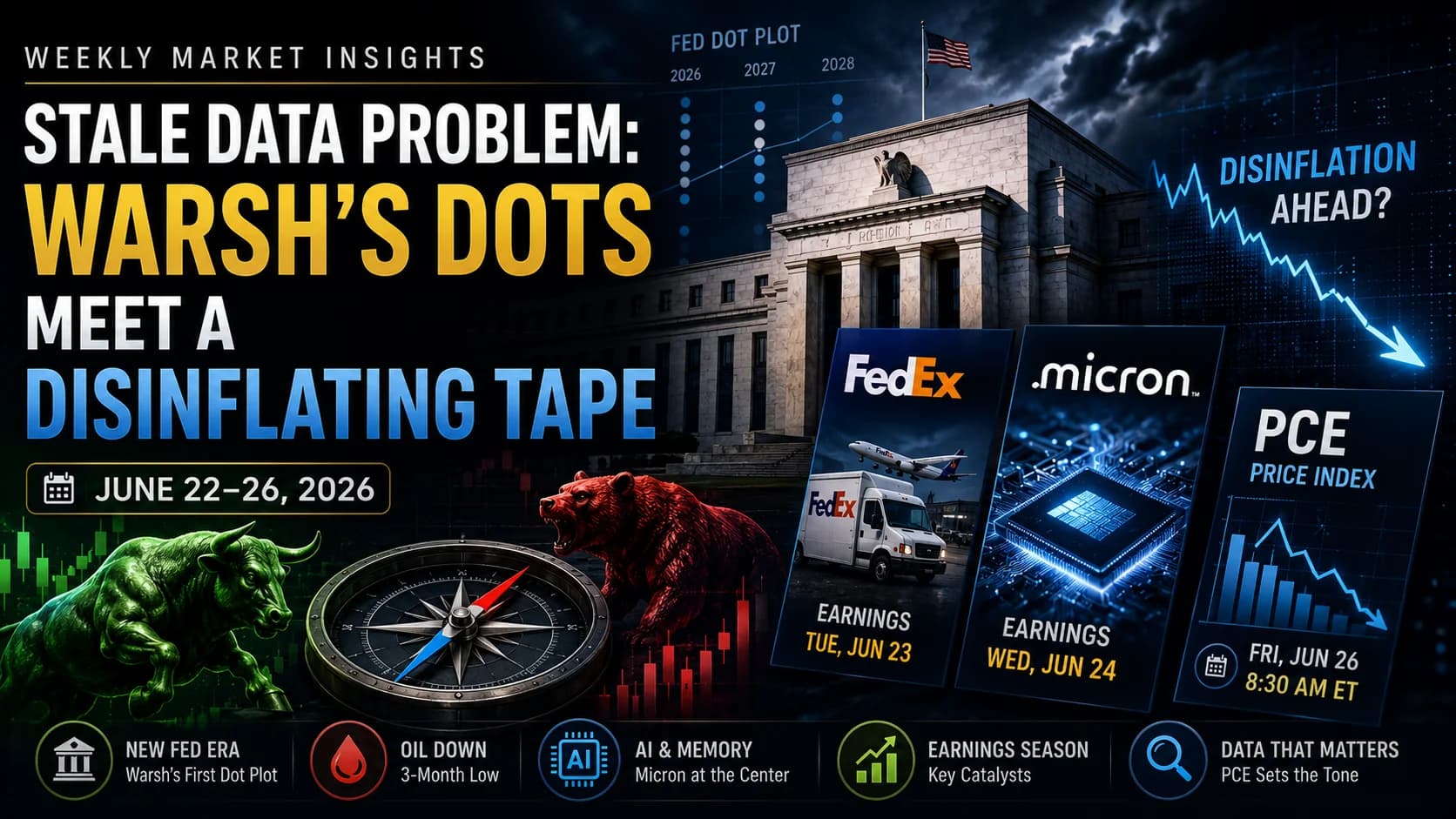
Last week the market took its worst Fed-day beating under a new chair since 1994, then spent two sessions clawing most of it back. That whipsaw is the lens for this week. Kevin Warsh's debut delivered a hawkish dot plot built on May's hot, energy-driven inflation, even as oil quietly slid to a three-month low and the disinflation that should follow has barely shown up in the official data yet. The Fed is steering off numbers that are already going stale, and it just took away the map. This is a normal five-day week after a holiday-shortened one, light on scheduled data until Friday, but heavy on single-stock firepower: Micron reports Wednesday with a 17% move priced in, FedEx reports Tuesday, and Friday brings the PCE inflation print that will be the first real test of whether Warsh's hawkish signal survives contact with reality. Here's the full map.
The Week at a Glance
Times are Eastern. Bolded rows are the genuine market-movers. Everything else is context — we'll tell you what to skip.
- Day
- Monday, Jun 22
- Time (ET)
- —
- Event
- Greenspan tributes; ECB's Lagarde speaks; Japan PMI
- Why It Matters
- No U.S. data. Light, news-driven session as the Iran roadmap digests
- Day
- Tuesday, Jun 23
- Time (ET)
- 9:45 AM
- Event
- Flash S&P Global PMIs (Mfg + Services)
- Why It Matters
- First June activity read; a soft services number would feed the slowdown debate
- Day
- Tuesday, Jun 23
- Time (ET)
- AMC
- Event
- FedEx (FDX) earnings
- Why It Matters
- First report post-Freight spinoff; a global shipping read on the consumer and trade
- Day
- Wednesday, Jun 24
- Time (ET)
- 10:00 AM
- Event
- New Home Sales (May)
- Why It Matters
- Housing/rates read; secondary this week
- Day
- Wednesday, Jun 24
- Time (ET)
- —
- Event
- Bank stress test results (expected)
- Why It Matters
- Watch financials/regional banks for capital-return reactions
- Day
- Wednesday, Jun 24
- Time (ET)
- AMC
- Event
- Micron (MU) earnings
- Why It Matters
- The defining catalyst of the week. ~17% implied move; reads across the entire AI-memory complex
- Day
- Thursday, Jun 25
- Time (ET)
- 8:30 AM
- Event
- Q1 GDP (final), Durable Goods (May), Jobless Claims
- Why It Matters
- Growth and labor checkpoints; claims has been creeping up
- Day
- Friday, Jun 26
- Time (ET)
- 8:30 AM
- Event
- PCE Price Index (May)
- Why It Matters
- The Fed's preferred inflation gauge and the first post-Warsh reading. The number that confirms or undercuts the hawkish dots
- Day
- Friday, Jun 26
- Time (ET)
- 10:00 AM
- Event
- UMich Sentiment (final), Personal Income & Spending
- Why It Matters
- Consumer-health context alongside PCE
| Day | Time (ET) | Event | Why It Matters |
|---|---|---|---|
| Monday, Jun 22 | — | Greenspan tributes; ECB's Lagarde speaks; Japan PMI | No U.S. data. Light, news-driven session as the Iran roadmap digests |
| Tuesday, Jun 23 | 9:45 AM | Flash S&P Global PMIs (Mfg + Services) | First June activity read; a soft services number would feed the slowdown debate |
| Tuesday, Jun 23 | AMC | FedEx (FDX) earnings | First report post-Freight spinoff; a global shipping read on the consumer and trade |
| Wednesday, Jun 24 | 10:00 AM | New Home Sales (May) | Housing/rates read; secondary this week |
| Wednesday, Jun 24 | — | Bank stress test results (expected) | Watch financials/regional banks for capital-return reactions |
| Wednesday, Jun 24 | AMC | Micron (MU) earnings | The defining catalyst of the week. ~17% implied move; reads across the entire AI-memory complex |
| Thursday, Jun 25 | 8:30 AM | Q1 GDP (final), Durable Goods (May), Jobless Claims | Growth and labor checkpoints; claims has been creeping up |
| Friday, Jun 26 | 8:30 AM | PCE Price Index (May) | The Fed's preferred inflation gauge and the first post-Warsh reading. The number that confirms or undercuts the hawkish dots |
| Friday, Jun 26 | 10:00 AM | UMich Sentiment (final), Personal Income & Spending | Consumer-health context alongside PCE |
Bottom line on the calendar: Monday through Thursday the data is secondary — the action is in earnings (FDX Tuesday night, MU Wednesday night). Then Friday morning, PCE becomes the whole week's macro hinge. If you only circle one data point, circle Friday at 8:30.
Earnings This Week
Two reports genuinely move the tape. One of them could move a whole sector.
- Company
- FedEx
- Ticker
- FDX
- Date
- Tue, Jun 23
- When
- After Close
- Est. EPS
- $5.91
- Est. Revenue
- $24.18B
- Implied Move
- ±6.7%
- Company
- Micron
- Ticker
- MU
- Date
- Wed, Jun 24
- When
- After Close
- Est. EPS
- $19.95
- Est. Revenue
- $34.66B
- Implied Move
- ±17%
- Company
- Carnival
- Ticker
- CCL
- Date
- Tue, Jun 23
- When
- Before Open
- Est. EPS
- —
- Est. Revenue
- —
- Implied Move
- —
| Company | Ticker | Date | When | Est. EPS | Est. Revenue | Implied Move |
|---|---|---|---|---|---|---|
| FedEx | FDX | Tue, Jun 23 | After Close | $5.91 | $24.18B | ±6.7% |
| Micron | MU | Wed, Jun 24 | After Close | $19.95 | $34.66B | ±17% |
| Carnival | CCL | Tue, Jun 23 | Before Open | — | — | — |
Consensus from Earnings Whispers and broker estimates; implied moves from options pricing via Unusual Whales as of last week's close. Implied moves drift daily — re-check before each print. Carnival estimates left blank pending verification rather than guessed.
Stocks to Watch This Week
Six names with a real catalyst this week. Framing is observation only — what's on our radar and why, never a recommendation. No price targets, because this publishes Monday and we don't know Thursday's prices.
MU — Micron Technology
📅 Catalyst: Earnings Wednesday after the close. Options pricing a ~17% move — one of the widest implied earnings moves in the entire market this quarter.
🔍 Why it's on the radar: Micron sits at the center of the AI-memory story, and the stock is at a record high (it closed last week near $1,134). The bull case: high-bandwidth memory (HBM) reportedly sold out through 2026 as hyperscalers lock in long-term supply. The tension: a stock at all-time highs with a 17% move priced in leaves no room for a merely-good quarter, and filings show insiders sold roughly $92.5 million in shares over the past three months, including the CEO. That's a fact worth knowing, not a verdict.
📊 What the options market is pricing: ±17% on the reaction. Consensus is around $19.95 EPS on ~$34.66B revenue, with attention on gross margin and the HBM commentary more than the headline.
👁️ What to watch: The HBM4 roadmap and FY27 demand commentary. Memory has historically been a brutally cyclical commodity business — the entire bull thesis rests on the AI era making it structural instead. Management's framing of that question is the real signal.
🌐 Broader tape read: MU is the read-through for the whole memory and AI-hardware complex. A blowout lifts the group; a "sold-the-news" reaction on a good-but-not-perfect print would hit the most extended names first (see WDC below).
WDC — Western Digital
📅 Catalyst: No earnings this week — it trades as the highest-beta proxy for the MU reaction.
🔍 Why it's on the radar: WDC is one of the most extended charts in the memory group after a steep run. It gapped up alongside MU in Monday's pre-market on memory-sector strength. When a leader like MU reports, the most overextended name in the group tends to move the most in both directions.
👁️ What to watch: Whether WDC confirms or diverges from MU's reaction. A strong MU print that WDC fails to hold would be an early "this move is tired" tell for the complex.
🌐 Broader tape read: WDC is the canary. Memory traders watch it for the first sign the sector's momentum is exhausting.
SNDK — SanDisk
📅 Catalyst: Memory-complex sympathy to MU, plus its own steady uptrend.
🔍 Why it's on the radar: SNDK has been holding a more controlled uptrend than the rest of the group — relative strength without the same overextension. It's the name that could continue if the sector stays bid after earnings.
👁️ What to watch: Whether it keeps its trend structure through the MU print or gets dragged into any sector-wide unwind.
🌐 Broader tape read: A relative-strength gauge for the group — if SNDK holds up while extended names sell off, the rotation is orderly, not a rout.
FDX — FedEx
📅 Catalyst: Earnings Tuesday after the close. Options pricing a ±6.7% move. First report since the Freight business spinoff.
🔍 Why it's on the radar: FedEx is a classic global-economy bellwether — package volumes are a read on the consumer and on trade flows. This is also the first clean look at the company post-spinoff, so the structure of the numbers will be new.
📊 What the options market is pricing: ±6.7% on the reaction. Consensus around $5.91 EPS on $24.18B revenue.
👁️ What to watch: Volume trends, any color on the Amazon relationship, and cost-savings progress. Forward guidance matters more than the backward-looking quarter.
🌐 Broader tape read: Transports and the broader "is the consumer holding up" question. FedEx commentary often sets the tone for how the market reads consumer-facing names into a print-heavy stretch.
NVDA — Nvidia
📅 Catalyst: No earnings — it's the largest read-through to the MU/memory print and AI-demand narrative.
🔍 Why it's on the radar: Nvidia led the chip-fueled comeback that pulled the Nasdaq off its post-Fed lows last week. As the anchor of the AI trade, it both influences and reacts to how the market digests Micron's HBM commentary.
👁️ What to watch: Whether NVDA confirms the memory-complex move after MU reports, and how the broader semiconductor group trades around it.
🌐 Broader tape read: NVDA is the tell for whether the AI trade as a whole is still being bought on dips or starting to wobble.
INTC — Intel
📅 Catalyst: Fresh news — Intel rose around 4% in Monday's pre-market on a reported foundry partnership with UMC.
🔍 Why it's on the radar: A specific, datable company catalyst landing into a semiconductor-heavy week. Intel has been a turnaround-story battleground, so a credible foundry partnership is the kind of news that can change its near-term narrative.
👁️ What to watch: Whether the move holds and builds or fades by the cash open — and whether the foundry story draws follow-through buying.
🌐 Broader tape read: A second, independent semiconductor catalyst beyond memory, useful for gauging whether chip-sector enthusiasm is broad or concentrated.
Sectors to Watch This Week
- Sector
- Semiconductors / Memory
- ETF
- SOXX / SMH
- This Week's Direction
- In play
- Catalyst
- Micron earnings Wednesday AMC
- What to Watch
- The whole complex moves on MU; WDC and SNDK are the high-beta reads
- Sector
- Energy
- ETF
- XLE / USO
- This Week's Direction
- Two-sided
- Catalyst
- Oil at 3-month low; SPR at lowest since 1983; Iran roadmap
- What to Watch
- Crowded shorts plus a depleted reserve mean a supply headline could squeeze hard
- Sector
- Small Caps
- ETF
- IWM
- This Week's Direction
- Watching
- Catalyst
- Post-Fed; PCE Friday
- What to Watch
- Most rate-sensitive group; reaction to PCE is a vote on the hike narrative
- Sector
- Gold
- ETF
- GLD
- This Week's Direction
- Watching
- Catalyst
- Lost its 200-day MA; safe-haven bid Monday
- What to Watch
- Whether it reclaims the 200-day or stays below it as the dollar and Fed pull against each other
- Sector
- Consumer
- ETF
- XLY / XLP
- This Week's Direction
- Watching
- Catalyst
- FedEx + Carnival earnings; PCE personal spending Friday
- What to Watch
- A three-part read on whether the consumer is still spending
- Sector
- Crypto-adjacent
- ETF
- MSTR / COIN
- This Week's Direction
- Watching
- Catalyst
- Bitcoin testing a key long-term support zone
- What to Watch
- MicroStrategy's financing structure is a stress point if crypto weakens
| Sector | ETF | This Week's Direction | Catalyst | What to Watch |
|---|---|---|---|---|
| Semiconductors / Memory | SOXX / SMH | In play | Micron earnings Wednesday AMC | The whole complex moves on MU; WDC and SNDK are the high-beta reads |
| Energy | XLE / USO | Two-sided | Oil at 3-month low; SPR at lowest since 1983; Iran roadmap | Crowded shorts plus a depleted reserve mean a supply headline could squeeze hard |
| Small Caps | IWM | Watching | Post-Fed; PCE Friday | Most rate-sensitive group; reaction to PCE is a vote on the hike narrative |
| Gold | GLD | Watching | Lost its 200-day MA; safe-haven bid Monday | Whether it reclaims the 200-day or stays below it as the dollar and Fed pull against each other |
| Consumer | XLY / XLP | Watching | FedEx + Carnival earnings; PCE personal spending Friday | A three-part read on whether the consumer is still spending |
| Crypto-adjacent | MSTR / COIN | Watching | Bitcoin testing a key long-term support zone | MicroStrategy's financing structure is a stress point if crypto weakens |
Market Snapshot
Last full session was Thursday, June 18 — markets were closed Friday, June 19 for Juneteenth.
- Indicator
- S&P 500
- Level (Thu Jun 18 close)
- 7,500.58 (+1.08%)
- Context
- Clawed back most of the Wednesday Fed-day drop
- Indicator
- Nasdaq Composite
- Level (Thu Jun 18 close)
- 26,517.93 (+1.91%)
- Context
- Chip-led comeback
- Indicator
- Dow
- Level (Thu Jun 18 close)
- 51,564.70 (+0.14%)
- Context
- Hit a record high earlier in the week
- Indicator
- Russell 2000
- Level (Thu Jun 18 close)
- 2,979.77 (+2.12%)
- Context
- Led the bounce — rate-sensitive names rebounding
- Indicator
- VIX
- Level (Thu Jun 18 close)
- 16.78
- Context
- Calm restored, but a thin cushion into a PCE week
- Indicator
- 2-Year Treasury
- Level (Thu Jun 18 close)
- 4.19%
- Context
- Spiked to a one-year high on the hawkish dots, then eased slightly
- Indicator
- 10-Year Treasury
- Level (Thu Jun 18 close)
- 4.46%
- Context
- Long end relatively contained
- Indicator
- WTI Crude
- Level (Thu Jun 18 close)
- ~$75
- Context
- Three-month low; near $75 again Monday on Iran progress
- Indicator
- CNN Fear & Greed
- Level (Thu Jun 18 close)
- 37 (Fear)
- Context
- Slipped from 34 after the hawkish Fed
| Indicator | Level (Thu Jun 18 close) | Context |
|---|---|---|
| S&P 500 | 7,500.58 (+1.08%) | Clawed back most of the Wednesday Fed-day drop |
| Nasdaq Composite | 26,517.93 (+1.91%) | Chip-led comeback |
| Dow | 51,564.70 (+0.14%) | Hit a record high earlier in the week |
| Russell 2000 | 2,979.77 (+2.12%) | Led the bounce — rate-sensitive names rebounding |
| VIX | 16.78 | Calm restored, but a thin cushion into a PCE week |
| 2-Year Treasury | 4.19% | Spiked to a one-year high on the hawkish dots, then eased slightly |
| 10-Year Treasury | 4.46% | Long end relatively contained |
| WTI Crude | ~$75 | Three-month low; near $75 again Monday on Iran progress |
| CNN Fear & Greed | 37 (Fear) | Slipped from 34 after the hawkish Fed |
Regime: range-bound near the highs, fearful sentiment, with the macro story now hinging on the bond market. The headline indices are within range of records, but Fear & Greed sits at 37 — the market is climbing a wall of worry, not celebrating. The most important number in that table isn't the S&P level; it's the 2-year yield. Warsh's debut shifted the entire decision framework, and we'll spend the deep dive explaining why the 2-year is now the chart that matters most. Monday is opening cautious-but-quiet: futures are near flat, oil is easing on reports that U.S. and Iranian negotiators agreed on a 60-day roadmap to a final deal, and Micron is indicating up around 4% ahead of Wednesday. Our read: the tape wants to drift until Wednesday night's Micron print and Friday's PCE give it a real reason to move.
The Big Question: What Happens When the Fed Takes Away the Map
Kevin Warsh's first meeting as Fed chair did two things at once, and the combination is what makes this week genuinely hard to read.
First, the substance was hawkish. The new dot plot showed roughly half the committee — nine of eighteen officials — projecting at least one rate hike this year, a sharp reversal from a market that began 2026 expecting cuts. The 2-year Treasury yield, the maturity most sensitive to the near-term rate path, rocketed to a one-year high on the news before settling around 4.19%. That was the worst Fed-day reaction under a new chair since 1994, the year the Greenspan Fed blindsided the bond market with a tightening cycle nobody was prepared for.
Second — and this is the part most coverage is underplaying — Warsh changed how the Fed communicates. The post-meeting statement reportedly ran about 130 words, among the shortest in modern memory. He declined to attach his own dot to the projection. And he signaled a clear philosophical break from the Powell era's emphasis on forward guidance: less telegraphing, more optionality, a Fed that intends to be harder to predict on purpose.
There is an almost unsettling timing to that shift. This is the same Monday the market learned that Alan Greenspan died at 100. Greenspan was the original master of deliberate Fed opacity — "Fedspeak," the gnomic phrasing that left markets parsing every clause — even as he also nudged the institution toward more transparency than it had before him. The week a new chair pulls the Fed back toward opacity is the week the man who defined that art passed away. We note it with respect, and because it sharpens the question every trader now faces: when the Fed won't tell you where it's going, where do you look?
The answer is the bond market. With forward guidance gone, the 2-year yield becomes the cleanest available proxy for what the Fed is likely to do, because it prices the expected path of short-term rates directly. (If you want the mechanics of trading around a Fed decision itself, our FOMC playbook breaks down how these sessions tend to unfold.) That's why the 2-year is now the single most important chart on your screen — more than the dot plot, which Warsh has signaled he wants to de-emphasize anyway.
Which brings us to Friday. May PCE — the Fed's preferred inflation gauge — is the first major inflation reading since the hawkish debut, and economists broadly expect it to come in firm, around +0.5% month-over-month and roughly 4.1% year-over-year, still carrying the energy shock from the Iran war. Here's the stale-data problem in one sentence: that hot reading reflects a world where oil was high, but oil has since fallen to a three-month low and the disinflation that follows simply hasn't hit the data yet. So the week sets up two scenarios.
If PCE comes in hot, in line or above expectations, it validates the hawkish dots, the 2-year likely pushes back toward its highs, and rate-sensitive groups — small caps, gold, long-duration tech — feel the pressure. The "hike is real" narrative strengthens.
If PCE comes in soft, or if the market chooses to look through it toward the disinflation already visible in oil, traders may start treating the hawkish dots as a negotiating posture rather than a plan — a new chair establishing credibility rather than pre-committing to hikes. In that case the 2-year eases, and the relief rally that started Thursday gets a second leg.
We don't know which way it breaks, and anyone who tells you they do is guessing. What we'd watch is the 2-year yield's reaction Friday morning, because in a no-forward-guidance world, that's where the market's real verdict shows up first.
The Teaching Moment: What an Implied Move Actually Tells You
This week hands us two perfect examples to explain one of the most useful — and most misunderstood — numbers in trading: the implied move.
When you see that Micron has a "±17% implied move" into earnings, or FedEx "±6.7%," that number isn't a prediction. It's extracted from options prices — specifically, from how expensive the at-the-money options expiring just after the report are. Because option prices embed the market's expectation of volatility, you can back out the size of the move the options market is collectively bracing for. A 17% implied move on Micron means options are priced as if a roughly 17% move in either direction is a coin-flip outcome by expiration.
Think of it as the betting line, not the result. A 17% implied move tells you the crowd expects a big swing; it says nothing about direction, and the actual move can land anywhere — inside the range, or well outside it. Micron in particular has a history of moving more than its implied number on some reports.
Why does this matter even if you never trade options? Two reasons. First, it calibrates expectations: a stock that moves 8% on earnings sounds dramatic, but if the implied move was 17%, that's actually a muted reaction — and a muted reaction to a big-implied-move event often signals the news was already priced in. Second, it's a risk gauge. The implied move is the market telling you, in advance, how much uncertainty surrounds a name. A 17% implied move is a flashing sign that says "this is binary — size accordingly." For a fuller walkthrough of how earnings season reshapes the tape, our guide on how earnings season affects day trading covers the mechanics.
The skill is learning to read a reaction against the implied move rather than in isolation. The number is the market's pre-game bet. Your job is to watch how reality scores against it.
Mindset for the Week
The trap this week is the Micron lottery ticket.
A ±17% implied move on a marquee AI name is magnetic. It's easy to talk yourself into a position the night before the print — "it's sold out of HBM through 2026, how can it miss?" — and size it up because the potential payoff is huge. That's not trading. That's buying a lottery ticket and calling it analysis. The entire point of a 17% implied move is that the outcome is genuinely uncertain; if it were obvious, the options wouldn't be priced that way.
Holding a large position into a binary earnings event means handing your week's outcome to a single number you can't control and won't see until after the close. The traders who last don't do that. They either stand aside and trade the reaction the next morning with information in hand, or they size so small that being wrong doesn't matter.
The action item: decide your earnings-night exposure before Wednesday, and write down the number. If the honest answer is "I just want to gamble on MU," that's useful self-knowledge — keep that position small enough that it's entertainment, not a threat to your month. More on why this pattern quietly drains accounts is in our piece on overtrading, the silent account killer.
Your Week Ahead Checklist
- [ ] Mark the two earnings nights — FedEx Tuesday after close, Micron Wednesday after close — and decide your exposure into each before the bell
- [ ] Circle Friday 8:30 AM ET for PCE; it's the week's macro hinge
- [ ] Add the 2-year Treasury yield to your screen — it's the Fed-decoder now that forward guidance is gone
- [ ] Watch WDC and SNDK as the high-beta reads on Micron's reaction
- [ ] Decide now whether you're trading the MU reaction Thursday morning or sitting it out — don't decide at 3:59 PM Wednesday
- [ ] Keep energy on the radar both ways: oil is at a three-month low, but the SPR is at a 1983 low and shorts are crowded
- [ ] Set your weekly max-loss number before Monday's open and a separate, smaller one for earnings nights
- [ ] Run a clean pre-market routine Tuesday through Friday — this week rewards preparation over prediction
- [ ] If MU's reaction is muted relative to its 17% implied move, treat that as information, not boredom
Frequently Asked Questions
What is the most important event for traders this week?
PCE is the Fed's preferred inflation gauge and the first major reading since Warsh's hawkish debut, so it directly tests whether the rate-hike signal holds. Micron is the largest single-stock catalyst, with a 17% move priced in and read-through to the entire AI-memory sector.
Key Takeaway: The week is quiet until Wednesday night, then intensifies into Friday morning — plan your risk around those two windows.
Why is Micron's earnings such a big deal this week?
The stock is at a record high on the thesis that high-bandwidth memory is sold out through 2026 as AI demand turns a historically cyclical business structural. A strong report would lift names like Western Digital and SanDisk; a disappointing one would hit the most extended names first.
Key Takeaway: Micron's print Wednesday night sets the tone for AI-hardware sentiment heading into the back half of the week.
What did Warsh's first Fed meeting actually change?
Nine of eighteen officials projected at least one 2026 hike, the 2-year yield jumped to a one-year high, and the post-meeting statement was unusually short. Warsh signaled the Fed will be deliberately less predictable than it was under Powell.
Key Takeaway: With forward guidance fading, the bond market — especially the 2-year yield — becomes the best available read on the Fed's path.
How does the U.S.-Iran situation affect markets this week?
Reports Monday of a 60-day roadmap to a final deal eased crude toward a three-month low. But the Strategic Petroleum Reserve is at its lowest level since 1983, and with bearish oil bets crowded, any breakdown in talks or supply headline could spark a sharp reversal.
Key Takeaway: Falling oil is disinflationary and market-friendly now, but the thin reserve cushion makes the energy setup more fragile than the calm price action suggests.
Is this a good week to trade earnings aggressively?
A 17% implied move on Micron means the options market itself is signaling genuine uncertainty. Many experienced traders prefer to trade the reaction the next morning, with the result in hand, rather than gamble on the print. The right approach depends on your strategy and risk tolerance.
Key Takeaway: Decide your earnings-night exposure before the close, size honestly, and don't let a tempting setup override your rules. Our weekly coverage in the Market Insights hub tracks how these events resolve.
The Scorecard: How Last Week's Calls Played Out
The receipts from our June 15-19 edition.
What we flagged: Wednesday's FOMC decision was "the entire week compressed into one day." What happened: The S&P had its worst Fed-day reaction under a new chair since 1994 on the hawkish dot plot. The week genuinely turned on that single afternoon. Grade: ✅ On target
What we flagged: Watch small caps (IWM) and gold (GLD) as the fastest reads on the Fed reaction. What happened: IWM led both the post-Fed selloff and Thursday's bounce (+2.12%), and gold weakened, losing its 200-day moving average. Both behaved exactly as the fast-reaction reads we said they'd be. Grade: ✅ On target
What we flagged: Jabil (JBL) as the marquee earnings event at a ±8.9% implied move. What happened: JBL reported as scheduled, but the bigger earnings story was Accenture's roughly 19% single-day collapse — its worst day on record — which we did not size highly enough. Grade: ⚠️ Partial
What we flagged: Energy pressured as the Iran premium drains out of oil. What happened: Crude fell further to a three-month low near $75. The direction was right; what we underweighted was how depleted the SPR has become, which adds a squeeze risk on the other side — a nuance we've built into this week's energy read. Grade: ✅ On target, with a lesson carried forward
Disclaimer
Article Sources
- CNBC — Markets and Fed coverage - Warsh's first meeting takeaways, the 2-year yield's move, Monday pre-market futures, and the Iran negotiation roadmap.
- TheStreet — Stock Market Today - Thursday June 18 closing levels, Monday June 22 pre-market movers, and oil prices.
- U.S. Treasury / FRED - the 2-year Treasury yield close of 4.19% on June 18.
- CNN Business — SPR and Fear & Greed Index - Strategic Petroleum Reserve at its lowest level since 1983, and the sentiment reading of 37.
- Fortune — Strategic Petroleum Reserve coverage - context on the scale and pace of SPR drawdowns since the Iran war began.
- Earnings Whispers - FedEx and Micron earnings dates, timing, and consensus estimates.
- Unusual Whales - options-implied move percentages for Micron (±17%) and FedEx (±6.7%).
- Kiplinger — Economic Calendar - the week's data schedule and the May PCE release timing and expectations.
- TradingKey — pre-market sector coverage - Monday memory-complex strength, Intel's UMC foundry news, and SpaceX's decline.
- CBS News / NPR — Alan Greenspan obituary - confirmation of the former Fed chair's passing on June 22 at age 100.
Was this helpful?
Be the first to weigh in

Written by
Kazi Mezanur RahmanFounder, independent researcher, and editor of DayTradingToolkit. A one-person publication focused on risk-first trading education and documented tool research. He trades his own capital as a retail trader and combines personal market experience with systematic primary-source research.
Keep Reading
Market Analysis & Insights
Calm Markets, Cracking Consumer: Weekly Market Insights, August 17-21
Records sit atop a divided Fed (9-3, most split since 2016), rising oil, and cracking consumer data. This week's five retail earnings, FOMC minutes, and an active Hormuz standoff will test whether the calm is justified.
Market Analysis & Insights
Nvidia, a New Fed Chair, and a Bond Market That Won't Cooperate: Weekly Market Insights, August 24-28
Warsh's first Jackson Hole speech, Nvidia's earnings, and fresh Iran and Canada shocks collide this week. The full Aug 24-28 catalyst map, stock watchlist, and scenario tree for traders.

Market Analysis & Insights
Two Wars, a Trade Fight, and CPI Still Has to Land Clean: Weekly Market Insights, September 7-11
A blowout jobs report already pushed rate-hike odds above 58%. Now a widening Middle East war and a new US-Canada trade fight collide with the last inflation data before the Fed's September 15-16 decision, while Nokia, Compass Pathways, Qualcomm, and Amgen all move on stories the calendar never saw coming.
Market Analysis & Insights
An AI Slowdown Call, a Live Fed Hike, and $108 Oil Collide in One Week: Weekly Market Insights, September 14-18
CME FedWatch has Wednesday's hike odds near 90 percent after a weekend AI slowdown call from Anthropic's CEO hit chip stocks, oil spiked past $107 on a Saudi pipeline shutdown, and Friday's quad witching sets up next Monday's S&P rebalance.
Comments
No comments yet. Be the first to share your thoughts.