
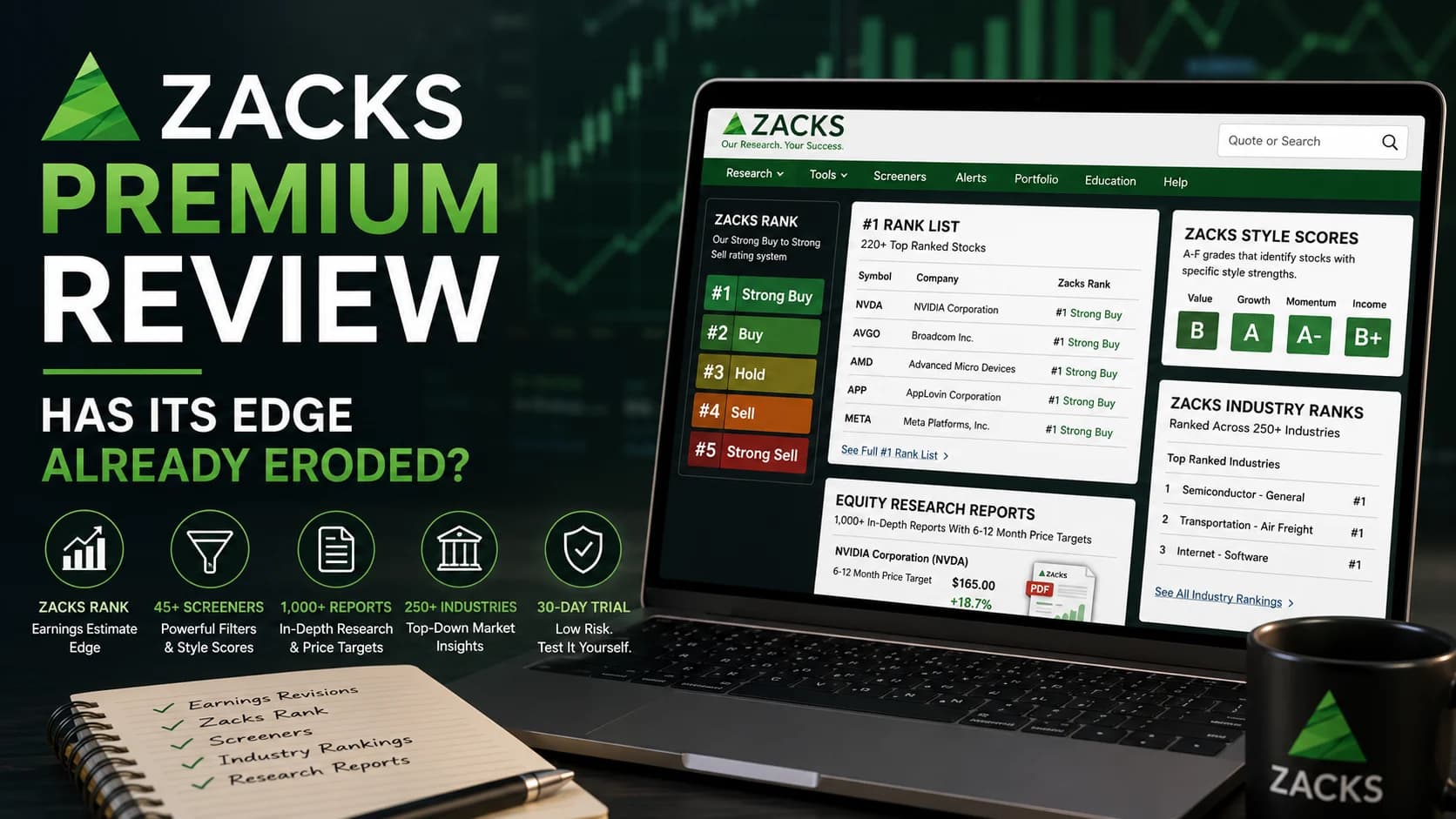
Len Zacks built an entire research firm around one specific insight: when Wall Street analysts revise their EarningsAn earnings report is the quarterly financial disclosure a public company files with the SEC, revealing revenue, earnings per share (EPS), profit margins, and forward guidance — it's the most significant regular catalyst for individual stocRead definition → estimates, stock prices tend to follow. That was a genuinely useful, hard-to-access signal in the late 1970s. Whether it still is in 2026 — when earnings estimate revisions are tracked and published instantly across dozens of free and paid platforms — is the real question underneath every other feature Zacks Premium offers, and independent reviewers are genuinely split on the answer.
What is Zacks Premium? Zacks Premium is the paid research tier of Zacks Investment Research, built around the Zacks Rank — a proprietary stock-rating system based on earnings estimate revisions — alongside stock screeners, equity research reports, and industry rankings. It's aimed at self-directed investors doing fundamental research on individual stocks, priced at $249/year with a free trial.
This review evaluates Zacks Premium against the criteria that matter most for a research platform — the credibility of its core rating methodology, tool depth, pricing, and how well any of it applies to day trading specifically. It's based on documented research into Zacks' official pricing and feature pages alongside independently published reviews, not a claimed personal subscription history.
What's good
- The Zacks Rank system offers a genuinely long, continuously-run track record dating to 1988 as a quantitative screening framework, with a company-published backtest showing Strong Buy-ranked stocks meaningfully outperforming the S&P 500.
- 45+ pre-built screeners and Style Scores (Value, Growth, and Momentum, graded A through F, plus a combined VGM score) let you combine Zacks' proprietary rank with more conventional fundamental filters in a single screen.
- Over 1,000 equity research reports with 6-12 month price targets go well beyond the free two-paragraph summaries available elsewhere on the site.
- Zacks Industry Rank across 250+ industries adds a useful top-down layer for narrowing which sectors to research before drilling into individual stocks.
- A 30-day free trial and, per most independent sources, a money-back guarantee give a real, low-risk way to test whether the platform's approach fits your research style.
Trade-offs
- The platform's core edge — trading on earnings estimate revisions — is a genuinely contested claim in 2026; several independent reviewers argue that data is now so widely and instantly available elsewhere that whatever advantage it offered decades ago has been substantially priced away.
- Zacks' headline performance figures for its #1 Rank list are company-published backtests on a hypothetical basis, not independently audited results from real subscriber portfolios — a meaningfully different kind of evidence.
- Zacks' aggregate Trustpilot rating is notably poor, worth weighing alongside the more favorable editorial reviews cited elsewhere.
- Built for long-term and swing investors — research reports carry 6-12 month price targets and the core methodology isn't intraday — meaning it offers essentially nothing for a day trader's actual workflow.
Zacks Investment Research was founded in 1978 by Len Zacks, an MIT-trained PhD whose research identified a specific pattern: when analysts raise or lower their earnings estimates for a company, the stock price tends to move in the same direction, often before the broader market has fully caught up. That observation became the foundation of the Zacks Rank, a proprietary system that's been in continuous use since 1988 and still drives the platform's core product today.
The Zacks Rank works by aggregating estimate revisions across roughly 3,000 analysts and 200,000-plus individual earnings estimates, recalculating nightly, and sorting stocks into five tiers from #1 (Strong Buy) to #5 (Strong Sell) based on the direction, magnitude, and consistency of recent revisions. Premium subscribers get the full, sortable #1 Rank list (typically around 220 stocks at any given time), Style Scores layering value/growth/momentum grades on top, and a stock screener that lets you combine Zacks' proprietary rank with conventional fundamental filters.
The genuinely contested question, raised by multiple independent reviewers rather than just one skeptical voice, is whether this specific edge still exists in a meaningful way. Earnings estimate revisions were a comparatively obscure, hard-to-track signal in the late 1970s. In 2026, that same data is aggregated and published, often for free, across a wide RangeA range (or trading range) is a price zone where a stock oscillates between a defined support floor and resistance ceiling without making meaningful new highs or lows — price is consolidating rather than trending, and the dominant trade is Read definition → of financial platforms — which raises a fair question about how much of the Zacks Rank's historical outperformance is still available to a subscriber today versus already priced into the market the moment a revision happens.
Key Features
Zacks Rank. The core proprietary rating, recalculated nightly across five tiers based on the direction and magnitude of analyst earnings estimate revisions. The #1 Strong Buy list is the platform's flagship feature; its #5 Strong Sell list, aimed at short-selling ideas, has a considerably more mixed historical record per independent testing, which is worth knowing if you're specifically drawn to Zacks for short ideas.
Style Scores. Every stock gets A-through-F grades across value, growth, and momentum, plus a combined VGM score, which can be combined with Zacks Rank inside the screener. Independent reviewers describe these as a genuinely useful additional filter layer, though several also note the grades are based on Zacks' in-house methodology and should be treated as one input rather than a definitive verdict.
Equity Research Reports. More than 1,000 in-depth reports covering individual stocks, including 6-12 month price targets and the reasoning behind a stock's current rank, downloadable as PDF or viewable in-browser. This is a meaningfully deeper research artifact than the short free summaries available without a subscription.
Zacks Industry Rank. A ranking of 250-plus industries by the same estimate-revision methodology applied at the SectorA broad grouping of companies that operate in the same segment of the economy — such as Technology, Healthcare, Energy, or Financials. Stocks within a sector tend to move together in response to shared economic, regulatory, and sentiment faRead definition → level, intended to help you identify which industries are attracting positive analyst sentiment before narrowing down to individual stocks within them.
Focus List and Model Portfolios. A curated list of roughly 50 stocks the service expects to outperform over the next 12 months, plus model portfolios organized by investing style that you can track over time. Both are explicitly long-horizon tools — nothing here is built around a shorter holding period.
Earnings ESP Filter. A proprietary metric attempting to predict earnings surprises before they're reported, based on the GapA gap is a price discontinuity on a chart where a stock opens significantly higher or lower than the previous session's close, leaving a visible empty space — gap-ups are driven by overnight buying pressure or positive news; gap-downs by seRead definition → between Zacks' most accurate estimate and the broader consensus. Company-published backtests cite meaningful historical accuracy for this specific signal, though — consistent with the rest of Zacks' performance claims — that data comes from Zacks itself rather than an independent auditor.
Additional Paid Services. Beyond Premium, Zacks sells a range of separately-priced, actively-managed newsletter-style services — Zacks Confidential, Surprise Trader, Home Run Investor, Stocks Under $10, and others — each built around a specific niche strategy. These sit outside the core Premium subscription and represent a real additional cost if you want them.
Zacks Premium earns its following for a specific kind of investor, and it's worth being direct that day traders aren't really that audience.
It's a reasonable fit if you're a long-term or swing investor who specifically wants a structured, quantitative framework built around earnings estimate revisions, and you're comfortable treating Zacks Rank as one research input to combine with your own due diligence rather than a mechanical buy signal. It's also a reasonable starting point if the free Zacks Rank data (available without a subscription) has already caught your interest and you want deeper screening and research report access on top of it.
It's a weaker fit if you're specifically evaluating whether the EPS-revision edge is still meaningful in 2026 — several independent reviewers make a genuinely credible case that it's largely priced away given how widely available that same data now is. And it's essentially the wrong tool if you're a day trader: everything here, from 6-12 month price targets to the Focus List's 12-month horizon, is built around a holding period that has nothing to do with intraday decision-making. DayTradingToolkit's guide to day trading vs. swing trading vs. investing covers that distinction in more depth if you're still working out which timeframe fits your goals.
Zacks runs a free tier alongside a single core paid Premium subscription, with additional specialized services priced separately:
- Plan
- Free
- Price
- $0
- What's Included
- Basic Zacks Rank lookup, quotes, charts, news, portfolio tracker
- Plan
- Premium
- Price
- $249/year
- What's Included
- Full #1 Rank list, Style Scores, 45+ screeners, 1,000+ research reports, Industry Rank, Focus List
- Plan
- Additional Newsletter Services
- Price
- Priced separately
- What's Included
- Zacks Confidential, Surprise Trader, Home Run Investor, and other niche stock-picking services
| Plan | Price | What's Included |
|---|---|---|
| Free | $0 | Basic Zacks Rank lookup, quotes, charts, news, portfolio tracker |
| Premium | $249/year | Full #1 Rank list, Style Scores, 45+ screeners, 1,000+ research reports, Industry Rank, Focus List |
| Additional Newsletter Services | Priced separately | Zacks Confidential, Surprise Trader, Home Run Investor, and other niche stock-picking services |
Most sources cite a 30-day free trial and a money-back guarantee window, though it's worth confirming current trial and refund terms directly on Zacks' site before subscribing, since these details can change. The core Premium price has stayed relatively stable at $249/year across the sources reviewed for this piece.
What Works Well
The research report depth is a genuine strength. Over 1,000 in-depth reports with explicit 6-12 month price targets and reasoning go well beyond a simple letter grade, and for an investor who wants to understand why a stock ranks where it does, that's meaningfully more useful than the rank alone.
The screener and Style Score combination also holds up as a practical research tool. Being able to filter by Zacks Rank alongside conventional value, growth, and momentum grades in one interface saves real time versus manually cross-referencing several separate data sources, and independent reviewers consistently describe the screener interface itself as well-designed.
Zacks Industry Rank is a smaller but genuinely useful feature — a top-down starting point for narrowing research focus to sectors already showing positive revision momentum before drilling into individual names is a reasonable way to structure a research process.
Limitations
Two limitations are worth taking seriously, and the first one is more fundamental than a typical feature gap.
The core methodology's edge is a real, actively debated question, not a settled positive. Multiple independent reviewers — not just one outlier — make the specific argument that earnings estimate revisions, novel and hard to access in the 1970s, are now tracked and published so widely and instantly that whatever historical advantage the Zacks Rank captured has been substantially priced away by the time a subscriber can act on it. That's a real critique of the platform's central value proposition, not a minor complaint about a secondary feature.
The performance evidence behind that value proposition is also worth scrutinizing carefully. Zacks' cited outperformance figures for its #1 Rank list are backtested and company-published rather than independently audited, and — as with any research platform's self-reported numbers — deserve the same skepticism you'd apply to any company grading its own performance. The aggregate Trustpilot rating for Zacks, notably poor relative to some competitors, is worth weighing alongside more favorable individual editorial reviews rather than in isolation.
Verdict
Zacks Premium Is Worth It for Long-Term Investors Who Want a Structured Screening Framework, Not Day Traders
Zacks Premium offers a genuinely long-running, structured quantitative framework and real research report depth for investors specifically interested in earnings-estimate-revision-based screening. Whether that framework still provides a meaningful edge in 2026 is a legitimately contested question among independent reviewers, and the platform's own performance claims are company-published rather than independently audited. For this site's audience specifically, the more important finding is that nothing here — 6-12 month price targets, a 12-month Focus List — has any real application to day trading.
Long-term or swing investors specifically interested in an earnings-estimate-revision-based screening framework, combined with their own due diligence — not day traders.
Frequently Asked Questions
Is Zacks Premium good for day traders?
Everything in the platform, from equity research report price targets to the Industry Rank's sector-level framing, assumes a much longer timeframe than a day trader operates on. A day trader evaluating Zacks Premium is evaluating a tool built for a fundamentally different job.
Key Takeaway: Zacks Premium is a long-term and swing-investing research tool; it has essentially no application to day trading specifically.
How much does Zacks Premium actually cost?
Beyond Premium, Zacks sells a range of separately-priced, niche stock-picking newsletter services that aren't included in the base subscription. Confirm current trial length and refund terms directly on Zacks' site before subscribing, since these details are subject to change.
Key Takeaway: Budget for $249/year for the core Premium tier alone; any additional Zacks newsletter service is a separate cost on top.
What is the Zacks Rank system, and does it still work in 2026?
The underlying logic — that positive earnings revisions tend to precede stock price gains — is a reasonable framework. The debate is whether that signal, discovered and comparatively obscure in the 1970s, still offers real advantage now that the same revision data is tracked and published instantly and widely across many platforms, some for free.
Key Takeaway: Treat Zacks Rank as one input to weigh against the genuine, well-argued critique that its edge has substantially eroded, not as a settled, guaranteed advantage.
Are Zacks' historical performance claims independently verified?
This is an important distinction rather than an accusation of dishonesty. Company-published backtests are a different, weaker kind of evidence than an independently audited real-money track record, and it's reasonable to apply the same scrutiny to these figures that you would to any company evaluating its own historical performance.
Key Takeaway: Weigh Zacks' published performance figures as a company backtest, not an independently verified result.
Is the free version of Zacks worth using?
Several independent reviewers specifically point out that you can look up any individual stock's Zacks Rank for free without subscribing, which is worth doing before paying for Premium if your main interest is simply checking the rank on names you already follow.
Key Takeaway: Check whether the free rank lookup alone covers your actual use case before paying for the full Premium subscription.
Is Zacks Premium better than Seeking Alpha?
Both platforms combine quantitative ratings with fundamental research, but Seeking Alpha layers in a large body of independent contributor articles and analyst consensus that Zacks' more narrowly-scoped, in-house research model doesn't replicate. Neither platform, regardless of which you prefer, is built around day trading.
Key Takeaway: If you're choosing between the two for long-term research depth, multiple independent sources lean toward Seeking Alpha; either way, day traders should look elsewhere.
What's included in Zacks Premium besides the Zacks Rank?
The screeners and Style Scores in particular let you combine Zacks' proprietary rank with more conventional value, growth, and momentum filters in a single search, rather than relying on the rank alone.
Key Takeaway: Premium's value beyond the free Zacks Rank lookup comes mainly from the screener depth and full research report access.
Does Zacks Premium offer a free trial or refund policy?
Given that promotional terms and trial lengths can change, treat any specific number cited in a third-party review as a starting point to verify rather than a guaranteed current offer.
Key Takeaway: Confirm the current trial length and refund window directly with Zacks before subscribing, since third-party figures may be out of date.
Is Zacks Premium good for short-selling ideas?
If short-selling research is your main interest, it's worth weighing this specific limitation carefully rather than assuming Zacks' overall reputation applies equally to both ends of its ranking system.
Key Takeaway: The #1 Strong Buy list is Zacks' strongest, most-cited feature; the #5 short list has a meaningfully weaker documented track record.
Does Zacks Premium include charting tools?
If charting depth is a priority, a dedicated charting platform will go considerably further than what's built into Zacks Premium, which is better understood as a fundamental research and screening tool that happens to include basic charts.
Key Takeaway: Don't subscribe to Zacks Premium for its charting tools specifically — the screeners and research reports are the platform's real value.