
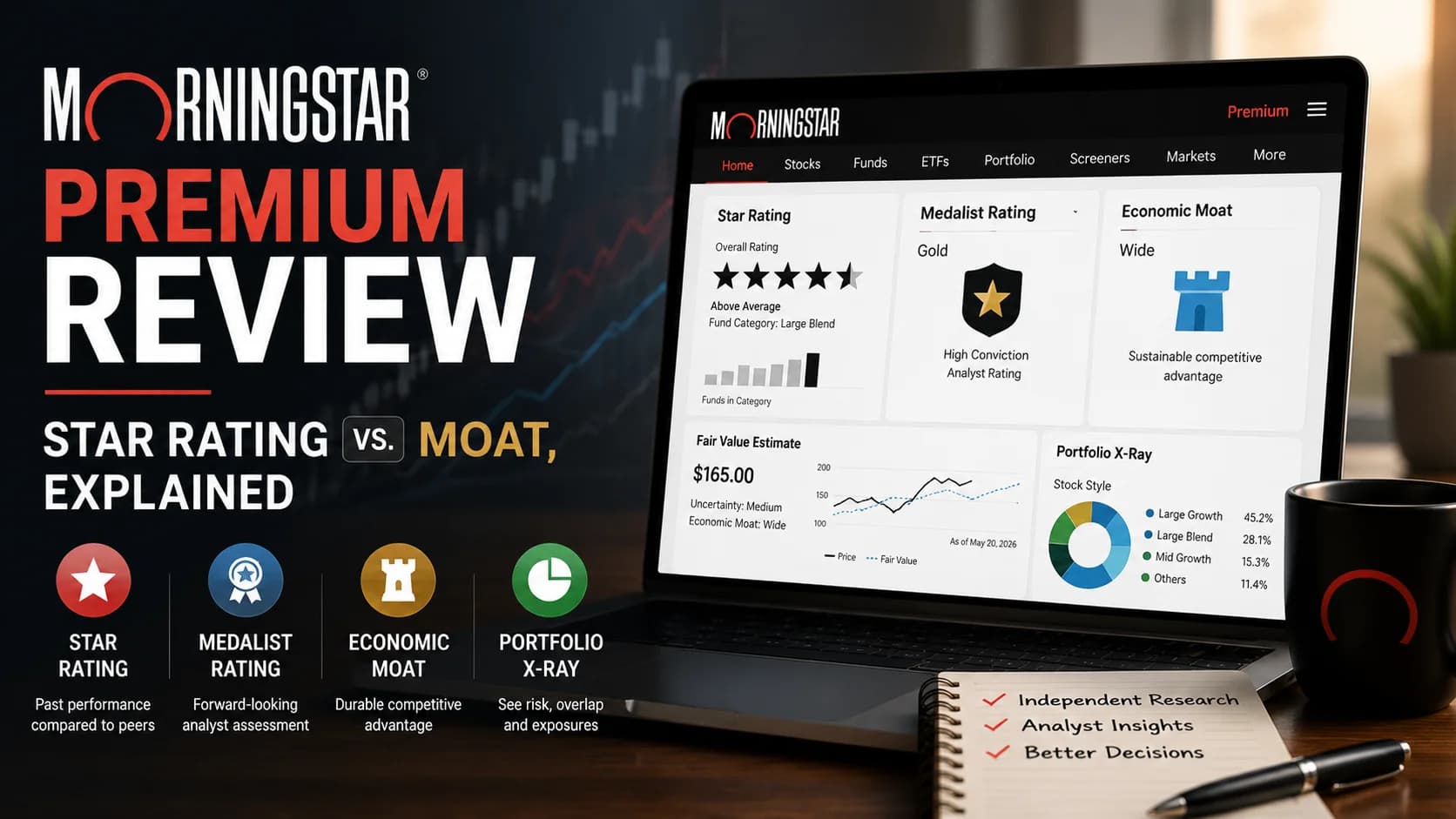
Morningstar's star rating shows up everywhere — brokerage fund pages, retirement plan menus, FINRA's own mutual fund analyzer. Fewer people realize the platform actually runs three separate rating systems that measure genuinely different things, or that the one everyone recognizes means something different for a stock than it does for a fund. That confusion matters more than it sounds, and it's worth untangling before deciding whether a Morningstar Premium subscription is worth $249 a year.
What is Morningstar Premium? Morningstar Premium — recently rebranded Morningstar Investor — is the paid research tier of Morningstar, a publicly traded independent investment research firm founded in 1984. It combines analyst-driven Star Ratings, Medalist Ratings, and Economic Moat analysis with stock and fund screeners, Portfolio X-Ray diagnostics, and full analyst reports, built for fundamentals-driven, long-term investors.
This review evaluates Morningstar Premium against the criteria that matter most for a research platform — the clarity and credibility of its rating systems, tool depth, pricing, and how well any of it applies to day trading specifically. It's based on documented research into Morningstar's official pricing and feature pages alongside independently published reviews, not a claimed personal subscription history.
What's good
- Genuinely independent research — Morningstar doesn't take investment banking fees or payments from fund companies to rate their products, a real and increasingly rare differentiator in this category.
- Analyst-driven coverage on roughly 1,800 US equities and 1,500 global stocks, backed by over 1,000 researchers across stocks, funds, and credit — with a quantitative rating filling the GapA gap is a price discontinuity on a chart where a stock opens significantly higher or lower than the previous session's close, leaving a visible empty space — gap-ups are driven by overnight buying pressure or positive news; gap-downs by seRead definition → for smaller companies outside direct analyst coverage.
- The combination of Star Rating, Medalist Rating, and Economic Moat gives fund and stock investors three distinct, complementary lenses rather than a single flattened score.
- Portfolio X-Ray diagnostics surface real concentration risk — SectorA broad grouping of companies that operate in the same segment of the economy — such as Technology, Healthcare, Energy, or Financials. Stocks within a sector tend to move together in response to shared economic, regulatory, and sentiment faRead definition →, geography, overlap across holdings — that a simple list of tickers won't show you on its own.
- A 7-day free trial and frequently available first-year discounts give a genuine low-cost way to test the full platform before committing to the full annual price.
Trade-offs
- Morningstar's aggregate Trustpilot rating is notably poor, worth weighing alongside the more favorable individual editorial reviews cited elsewhere.
- Fair value estimates and ratings are updated periodically by human analysts, not in real time, which means they can lag meaningfully during fast-moving situations.
- The three-rating-system structure (Star, Medalist, Moat) is genuinely useful once understood, but multiple independent reviewers note it's easy for a new subscriber to misread what a given star rating actually means, especially the difference between the stock version and the fund version.
- Built for long-term, fundamentals-driven investing — the screener has little to offer for finding technical entry and exit points, and nothing in the platform is oriented toward day trading.
Morningstar has been publishing investment research since 1984, and the 1-to-5 star rating it introduced for mutual funds shortly after founding has become one of the most recognized symbols in retail investing — showing up on brokerage fund pages, retirement plan menus, and even FINRA's own mutual fund analyzer. The company itself is publicly traded (NASDAQ: MORN), runs a separate asset management arm with roughly $250 billion in assets under management, and is a component of the Russell 1000.
What sets Morningstar apart structurally from research competitors is its independence. It doesn't collect investment banking fees, and fund companies don't pay to have their products rated — a genuine differentiator that's increasingly rare in an industry where sponsored content sometimes blurs into research. That independence is a real reason multiple institutions and advisors have relied on Morningstar's ratings for decades.
The part that trips up new subscribers is that Morningstar actually runs three separate, complementary rating systems, not one. The Star Rating means something different depending on whether you're looking at a fund or a stock: for funds, it's a backward-looking measure of risk-adjusted historical performance against category peers; for stocks, it's a forward-looking valuation opinion — how far the current price sits below (or above) an analyst's fair value estimate. The Medalist Rating (Gold, Silver, Bronze, Neutral, Negative) is a separate, genuinely forward-looking judgment for funds specifically, based on five pillars: process, people, parent company, performance, and price. The Economic Moat rating (Wide, Narrow, None) is a qualitative analyst assessment of how durable a company's competitive advantage is, popularized as a concept by Warren Buffett and formalized into Morningstar's own ratings framework.
Key Features
Star Rating. For funds, a 1-to-5 rating reflecting historical risk-adjusted performance versus category peers over 3-, 5-, and 10-year periods — a backward-looking descriptor, not a prediction. For stocks, the same 1-to-5 scale instead reflects how the current price compares to Morningstar's analyst-estimated fair value, meaning a 5-star stock is one an analyst believes is trading at a meaningful discount to what it's actually worth. Morningstar itself is explicit that neither version should be treated as a standalone buy or sell signal.
Medalist Rating. A separate, forward-looking rating for funds (Gold, Silver, Bronze, Neutral, or Negative), assessing whether analysts and quantitative models expect a fund to outperform its benchmark over a full market cycle, based on process, people, parent, performance, and price. For a fund investor, this is generally more useful than the backward-looking star rating for actually deciding whether to hold or buy.
Economic Moat Rating. A qualitative judgment — Wide, Narrow, or No Moat — on how long a company's competitive advantage is likely to persist, independent of current price or recent financial performance. Combining a Wide Moat rating with a high star rating (undervalued and durable) is the combination long-term-oriented reviewers consistently point to as Morningstar's highest-conviction signal.
Analyst Reports and Fair Value Estimates. Full analyst reports covering individual stocks, bond funds, and equity funds, including the reasoning behind a given fair value estimate, moat assessment, and uncertainty rating. Free users see partial snapshots; full reports and forward-looking commentary are Premium-only. For companies outside Morningstar's roughly 1,800-plus US and 1,500-plus global direct analyst coverage, a quantitative rating (marked with a "Q") fills the gap using a modeled proxy rather than a human analyst's judgment.
Screeners. Separate stock and fund screeners let you filter using Morningstar's proprietary ratings (Star, Medalist, Moat) alongside hundreds of conventional financial and performance parameters. Independent reviewers describe the screener as genuinely strong for fundamentals-driven filtering, though it offers little for finding technical entry or exit points — that's simply not what it's built for.
Portfolio X-Ray. A diagnostic tool that analyzes your actual portfolio for concentration risk — sector exposure, geographic weighting, style-box distribution, and overlap between holdings that might look diversified individually but aren't collectively. This is one of the more genuinely useful tools for an investor managing several funds or stocks who wants to see the whole picture rather than each position in isolation.
Cost Analyzer and Similar Funds Tools. The Cost Analyzer projects how a given mutual fund's fees will compound over time against a starting investment, useful for comparing funds with different expense ratios over a long holding period. A Similar Funds tool surfaces comparable mutual funds by performance, allocation, and load — though there's currently no equivalent tool for comparing similar ETFs specifically.
Morningstar Premium earns its reputation for a specific kind of investor, and it's worth being direct that day traders aren't part of that audience.
It's a strong fit if you're a long-term, fundamentals-driven investor building a portfolio of individual stocks, mutual funds, or ETFs, and you specifically value independent research uncomplicated by fund-company payments or investment-banking conflicts. It's also a strong fit if you hold several funds or stocks across accounts and want a genuine diagnostic view of overall portfolio concentration rather than checking each position separately.
It's a weaker fit if you're a trader who relies on charts, technical entry and exit points, or short-term price action — several independent reviewers make this point directly, and it's an accurate one. Nothing in Morningstar's toolset is oriented toward that kind of decision-making; the fair value estimates and ratings update periodically by human analysts, not in real time, and the entire framework assumes a holding period measured in years, not minutes or hours. DayTradingToolkit's guide to day trading vs. swing trading vs. investing covers that distinction if you're still working out which timeframe actually fits your goals.
Morningstar runs a free tier alongside a single core paid subscription:
- Plan
- Free
- Price
- $0
- What's Included
- Partial analyst report snapshots, basic star ratings, limited screener access
- Plan
- Premium (Investor)
- Price
- $249/year (~$20.75/month equivalent)
- What's Included
- Full analyst reports, Medalist Ratings, Moat ratings, fair value estimates, full screeners, Portfolio X-Ray
| Plan | Price | What's Included |
|---|---|---|
| Free | $0 | Partial analyst report snapshots, basic star ratings, limited screener access |
| Premium (Investor) | $249/year (~$20.75/month equivalent) | Full analyst reports, Medalist Ratings, Moat ratings, fair value estimates, full screeners, Portfolio X-Ray |
A 7-day free trial is commonly available, and first-year promotional discounts (frequently bringing the effective price down toward $199) show up regularly across independent reviews — worth checking Morningstar's current offers page before paying full price. There's no meaningfully cheaper mid-tier; it's a single Premium subscription covering the full toolset.
What Works Well
Independence is Morningstar's clearest, most durable strength. Not taking fund-company payments or investment-banking fees is a structural choice that shapes the credibility of everything else the platform produces, and it's a genuinely rarer position in this category than it should be.
The three-part rating framework, once understood, is a real analytical asset rather than just a marketing gimmick. Having a backward-looking performance measure, a forward-looking quality-of-process assessment, and a separate durability judgment on competitive advantage gives a fund or stock investor three distinct angles most single-score systems collapse into one number.
Portfolio X-Ray deserves specific credit as a genuinely underused tool category. Most research platforms focus entirely on individual securities; being able to see your entire portfolio's real sector and geographic concentration in one diagnostic view catches risk that looking at each holding separately simply won't reveal.
Limitations
Two limitations are worth taking seriously before subscribing.
The rating system's genuine usefulness comes with a real risk of misunderstanding it. Multiple independent reviewers specifically flag that new subscribers can conflate the fund-version star rating (backward-looking performance) with the stock-version star rating (forward-looking valuation), or treat any of the three systems as a mechanical buy signal rather than one input among several — a mistake Morningstar's own materials explicitly warn against.
The pacing of the underlying research is the more structural limitation. Fair value estimates and ratings are set and updated periodically by human analysts, not algorithmically in real time, which means they can lag during a fast-moving situation — a genuine tradeoff for the depth and independence the manual process buys you, but a real one nonetheless. Combined with Morningstar's notably poor aggregate Trustpilot score, it's worth weighing the platform's strong editorial reputation against a more mixed picture from everyday subscribers.
Verdict
Morningstar Premium Is Worth It for Long-Term Fund and Stock Investors, Not Day Traders
Morningstar Premium's independence, three-part rating framework, and Portfolio X-Ray diagnostics make it a genuinely strong research tool for a fundamentals-driven, long-term investor managing stocks and funds. The rating system takes real effort to understand correctly, analyst updates lag real-time market moves, and the platform's aggregate customer rating is notably poor. For this site's audience specifically, the clearest finding is that nothing here is built for day trading — the entire framework assumes a multi-year holding period.
Long-term, fundamentals-driven investors managing individual stocks and mutual funds or ETFs who want independent research and portfolio diagnostics — not day traders.
Frequently Asked Questions
Is Morningstar Premium good for day traders?
Analyst ratings and fair value estimates update periodically, not in real time, which is fine for long-term investing but has no relevance to a day trader's actual decision-making process. Traders looking for intraday research tools will find dedicated charting and scanning platforms a far closer fit.
Key Takeaway: Morningstar Premium is a long-term investing research tool; it has essentially no application to day trading specifically.
How much does Morningstar Premium actually cost?
A 7-day free trial is typically offered before the annual charge applies. It's worth checking Morningstar's current promotional offers page, since first-year discounts bringing the effective price closer to $199 show up regularly.
Key Takeaway: Budget for $249/year as the standard rate, but check for a current first-year discount before paying full price.
What's the difference between Morningstar's Star Rating, Medalist Rating, and Moat Rating?
These are three genuinely different lenses rather than three versions of the same score. A fund's star rating tells you how it has performed; its Medalist Rating tells you what analysts expect going forward; a stock's Moat Rating tells you nothing about price at all, only about the durability of its competitive position.
Key Takeaway: Don't treat any single Morningstar rating as the whole picture — each of the three measures something genuinely different.
Does a 5-star stock rating mean the same thing as a 5-star fund rating?
This is one of the most commonly confused aspects of Morningstar's system according to multiple independent reviewers. Treating a 5-star stock as if it has a proven performance track record, or a 5-star fund as if it's necessarily undervalued, both misread what the rating actually measures.
Key Takeaway: Always check whether you're looking at a fund or a stock star rating before drawing a conclusion from it — the two measure different things entirely.
Are Morningstar's ratings independent, or is it paid by fund companies?
This independence is one of the most consistently cited reasons institutions, advisors, and individual investors have relied on Morningstar's research for decades, and it's a genuinely less common position than it should be among research and ratings providers.
Key Takeaway: Morningstar's independence from the products it rates is a real credibility signal, not just a marketing claim.
Is Morningstar Premium better than Seeking Alpha or Zacks?
Investors who hold a mix of individual stocks and mutual funds or ETFs, and who value independence from fund-company influence, tend to find Morningstar's combination distinctive. None of the three platforms — Morningstar, Seeking Alpha, or Zacks — is built around day trading.
Key Takeaway: Compare the specific research style and asset-class coverage each platform emphasizes against your actual portfolio composition, rather than assuming one is categorically better.
How often does Morningstar update its ratings and fair value estimates?
This is a reasonable tradeoff for the depth and independence a manual analyst process provides, but it's a real limitation worth knowing rather than assuming Morningstar's numbers reflect the very latest market conditions at all times.
Key Takeaway: Treat Morningstar's fair value estimates as a periodically-updated analyst opinion, not a live, continuously recalculated price target.
Does Morningstar Premium include a portfolio analysis tool?
This is one of Morningstar's more distinctive tools relative to platforms that only analyze securities individually. For an investor holding multiple funds or stocks across several accounts, it's a genuinely useful way to catch concentration risk that wouldn't be obvious position by position.
Key Takeaway: Use Portfolio X-Ray specifically if you hold multiple funds or accounts and want to see your true aggregate exposure, not just each position separately.
Is Morningstar good for evaluating individual stocks, or just mutual funds?
For stocks outside direct analyst coverage, Morningstar substitutes a quantitative rating (marked with a "Q") as a modeled proxy rather than a human analyst's full report — worth knowing if you're specifically researching smaller or less-covered companies.
Key Takeaway: Confirm whether a specific stock you're researching has full analyst coverage or only a quantitative rating before expecting a complete report.
Does Morningstar Premium offer a free trial?
Given that trial terms and promotional discounts can change, it's worth confirming the current trial length and any first-year discount directly on Morningstar's official signup page before subscribing.
Key Takeaway: Use the 7-day trial to test the screener and Portfolio X-Ray specifically, since those are the tools most likely to determine whether the subscription fits your workflow.