
Lightspeed doesn't try to be everyone's broker, and that's the whole point of the platform. It was built by traders who came out of a professional trading desk, for traders who care more about execution speed and direct market access than about mutual funds, retirement planning, or a friendly onboarding flow. That focus produces one of the fastest, deepest execution platforms available to retail-adjacent traders — and a real account minimum that makes it a poor fit for anyone outside its intended audience.
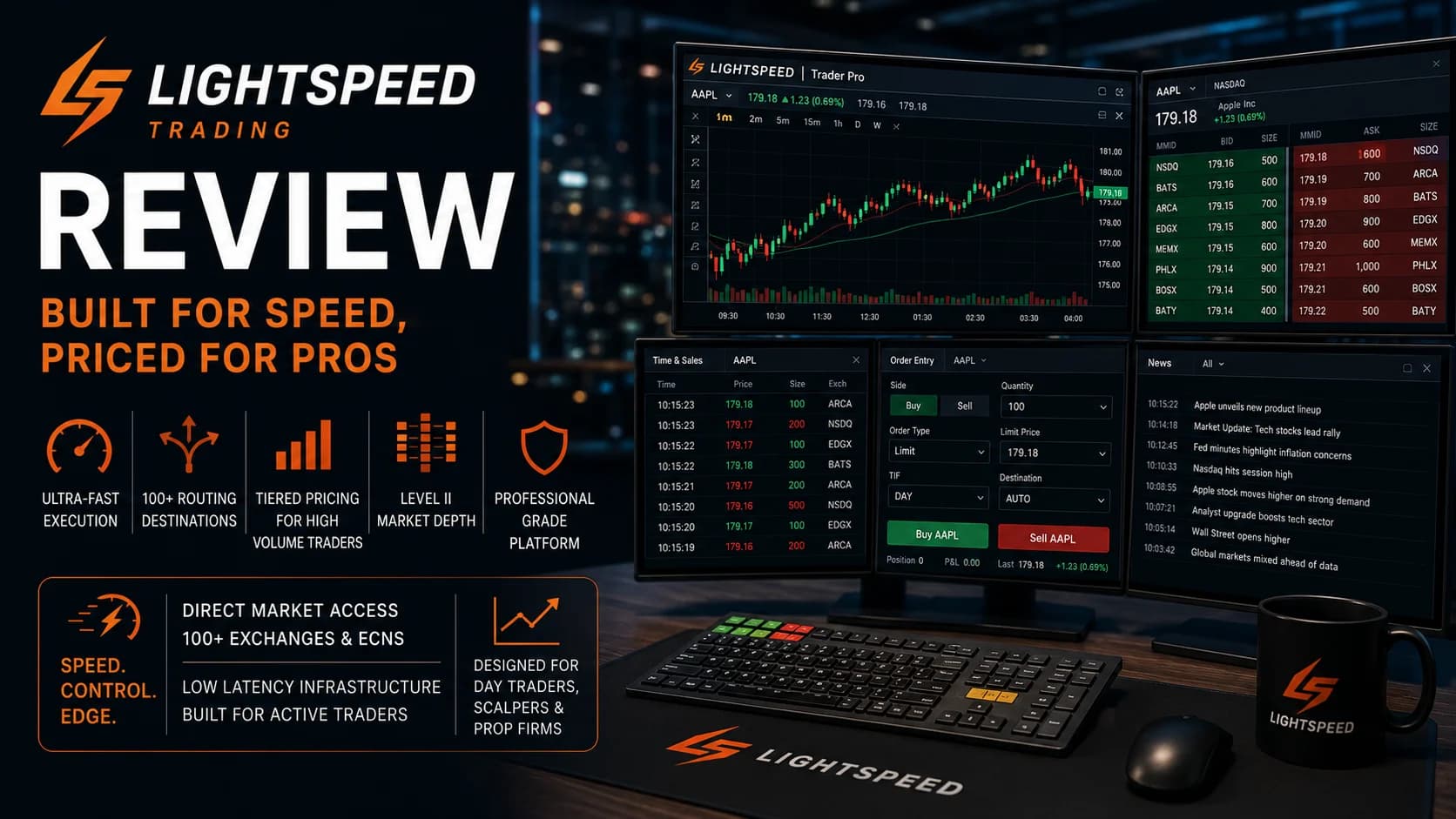
What is Lightspeed? Lightspeed (Lightspeed Financial Services Group) is a direct-access brokerage founded in 2006, built specifically for active day traders, scalpers, and proprietary trading groups. Its flagship Lightspeed Trader platform offers direct market access routing to 100+ destinations, Level II depth-of-book data, and hotkey-driven execution, with tiered per-share commissions that reward high trading VolumeVolume is the total number of shares (or contracts) traded during a given time period — it's the primary confirmation tool for all price action, because a price move accompanied by high volume indicates genuine market participation, while tRead definition →.
This review evaluates Lightspeed against the criteria that matter most for a direct-access day trading platform — execution speed and routing depth, commission structure, account minimums, and platform usability — using Lightspeed's official pricing pages and independently published reviews and testing data, not a claimed personal account history.
What's good
- Direct market access execution with 100+ routing destinations and genuinely ultra-low latency — built specifically for traders who prioritize speed above nearly everything else.
- Tiered per-share commissions get meaningfully cheaper at volume, with rates among the lowest available to serious high-frequency traders.
- Lightspeed Trader Pro's 2025 rebuild adds a modernized interface, a natural-language AI chat tool for scanning and fundamental queries, and real-time news, without sacrificing the platform's execution speed.
- Genuinely deep charting and Level II tools built into the core platform, with quality independent reviews compare favorably to thinkorswim.
- A lower-cost path exists on the web and mobile platform, including commission-free trading for accounts above $15,000, for traders who don't need the full per-share desktop experience.
Trade-offs
- Account minimums are steep and platform-dependent — $25,000 for the full Lightspeed Trader desktop experience, and even the web/mobile tier requires $10,000 — a business policy set by the firm itself, not a regulatory requirement, and substantially higher than commission-free retail brokers.
- The interface is explicitly built for professional-style workstation trading rather than simplicity, and independent reviews consistently describe a real learning curve unsuited to a casual or brand-new trader.
- Data and platform fees can stack up for traders who don't qualify for waivers, and smaller accounts face a minimum monthly commission plus fees like a transfer-out charge.
- Public review volume is thinner than at larger retail brokers, making broad reputation claims harder to independently verify at scale compared to brokers with thousands of aggregated reviews.
What Is Lightspeed? A Closer Look
Lightspeed's origin story explains most of what the platform is today. It was formed in 2006 when a management team purchased E*TRADE's professional trading unit and spun it off as an independent firm, and in 2018 it was acquired by Wedbush Securities and merged with Lime Brokerage, an agency broker known for serving high-frequency options traders. That professional-trading-desk lineage is still the platform's defining feature: Lightspeed exists to route orders to the exchange as fast as possible with maximum control over how they're routed, not to be a general-purpose brokerage.
That focus shows up in what Lightspeed deliberately doesn't offer. There's no robo-advisor, no retirement-planning push, and no attempt to compete on beginner-friendliness. The account minimums reflect the same philosophy — $10,000 for the web and mobile platform, $25,000 for the full Lightspeed Trader desktop experience — which the company sets as its own business policy for the audience it's built around, independent of any regulatory requirement.
In September 2025, Lightspeed launched Lightspeed Trader Pro, a ground-up rebuild of its flagship desktop platform. The original was already respected for raw speed; the Pro version adds a modernized interface alongside genuinely new capabilities, including an AI chat tool for natural-language scanning and fundamental data queries and a real-time news feed called Fly News, while preserving the execution speed the platform built its reputation on.
Key Features
Direct Market Access and Routing. Lightspeed routes orders to more than 100 destinations — exchanges, ECNs, dark pools, and market makers — giving active traders meaningful control over exactly how and where an order gets filled. Execution speed is a genuine differentiator here, with the platform's infrastructure hosted in data centers near major exchanges specifically to minimize latency.
Lightspeed Trader and Lightspeed Trader Pro. The flagship desktop platform offers customizable layouts, hotkey-driven order entry, Level II depth-of-book data for both stocks and options, a short-locate feature for borrowing hard-to-locate shares, and charting with roughly two decades of historical price data. Lightspeed Trader Pro, the 2025 rebuild, layers in a modernized interface, an AI chat tool for scanning and fundamental queries, and Fly News for real-time market-moving headlines, alongside multi-threaded processing across core, Pre-MarketPre-market trading is the session that occurs between 4:00 AM and 9:30 AM Eastern, before the regular market opens — it allows traders to react to overnight news and earnings reports, establishes where stocks will likely open (the gap), andRead definition →, post-market, and overnight sessions.
Per-Share and Commission-Free Pricing. Lightspeed offers two pricing structures. Active traders on the desktop platform get tiered per-share commissions that decrease with monthly volume — rates can fall into the low tenths-of-a-cent RangeA range (or trading range) is a price zone where a stock oscillates between a defined support floor and resistance ceiling without making meaningful new highs or lows — price is consolidating rather than trending, and the dominant trade is Read definition → at very high volume — with a modest per-trade minimum. Traders who don't need full per-share pricing can use the web or mobile platform, where commission-free stock and ETF trading is available for accounts with at least $15,000.
Sterling Trader Pro and Specialty Platforms. Beyond its own namesake platform, Lightspeed offers access to Sterling Trader Pro (popular with prop trading firms), RealTick Pro (built for hedge funds and RIAs), and Eze EMS Pro (institutional order management) — giving traders and small firms with more specialized execution needs additional platform options under the same account.
Multi-Asset and Algorithmic Trading. Beyond core stock and options trading, Lightspeed supports futures trading and has added cryptocurrency access through Lightspeed Crypto. A Connect API supports algorithmic and automated strategy execution for traders who want to build and deploy their own systems rather than trading manually.
Paper Trading. A 10-day demo of Lightspeed Trader is available for traders who want to test the platform's workflow and hotkey setup before committing to the account minimums required for live trading.
Lightspeed's built-in tools cover execution, routing, and Level II data extremely well, but the platform's stock discovery and scanning tools are comparatively basic next to a dedicated scanner — the Risers and Fallers window and the newer AI chat tool help, but they're not built to replace a purpose-built scanning platform. Many active traders pair Lightspeed's execution speed with a dedicated scanner like Trade Ideas for pre-market and intraday stock discovery, using Lightspeed purely for the fill. DayTradingToolkit's Trade Ideas review covers what that pairing looks like in more detail.
Who Lightspeed Is Best For
Lightspeed earns its reputation for a specific, narrow kind of trader, and it's genuinely not trying to be a fit for anyone else.
It's a strong fit if you're an active or professional-level day trader executing dozens to hundreds of trades and specifically need direct market access, deep order routing control, and hotkey-driven execution speed — the kind of trader for whom milliseconds and routing choices genuinely matter to the bottom line. It's also a strong fit if you have the capital to meet the account minimums comfortably and don't need the platform to double as a retirement or long-term investing account.
It's a weaker fit, by the company's own positioning, if you trade fewer than roughly 10 times a month, are new to day trading and want a gentler learning curve, or don't have $10,000–$25,000 available to meet the relevant platform's minimum. Independent reviews are consistent on this point: Lightspeed is not built or priced for casual or beginning traders.
Lightspeed Pricing
Lightspeed's pricing depends heavily on which platform tier you use:
- Platform
- Web/Mobile (Commission-Free)
- Account Minimum
- $15,000+
- Pricing Structure
- $0 commission on stocks/ETFs
- Platform
- Web/Mobile (Standard)
- Account Minimum
- $10,000 ($2,000 for IRA)
- Pricing Structure
- Standard per-trade/per-share rates
- Platform
- Lightspeed Trader (Desktop)
- Account Minimum
- $25,000 (or $10,000 for retirement accounts)
- Pricing Structure
- Tiered per-share pricing, from roughly $0.0045/share down to near $0.001/share at high volume
| Platform | Account Minimum | Pricing Structure |
|---|---|---|
| Web/Mobile (Commission-Free) | $15,000+ | $0 commission on stocks/ETFs |
| Web/Mobile (Standard) | $10,000 ($2,000 for IRA) | Standard per-trade/per-share rates |
| Lightspeed Trader (Desktop) | $25,000 (or $10,000 for retirement accounts) | Tiered per-share pricing, from roughly $0.0045/share down to near $0.001/share at high volume |
Options are priced per contract with volume-based discounts and a modest per-trade minimum. Additional costs to budget for include market data fees for professional-status traders (waived for qualifying non-professional accounts on several platform tiers), a minimum monthly commission for smaller accounts, and fees for services like IRA closure or transferring your account to another broker. Given the meaningful gap between platform tiers, it's worth being precise about which minimum and pricing structure applies to the specific platform you plan to actually use day to day.
What Works Well
Execution quality is Lightspeed's clearest strength, and it's the reason the platform exists in the first place. Direct market access across 100+ routing destinations, genuinely low latency, and hotkey-driven order entry give active traders a level of execution control that most commission-free retail brokers simply don't offer, because they're not built around that use case.
Lightspeed Trader Pro's 2025 rebuild deserves real credit for modernizing the interface without diluting what made the original platform valuable. Adding an AI chat tool for natural-language queries and real-time news alongside the platform's existing speed is a meaningful upgrade rather than a cosmetic refresh.
The charting and Level II depth built into the core platform are also genuinely strong — independent comparisons put Lightspeed's charting quality on par with thinkorswim, and meaningfully ahead of more dated professional platforms like DAS Trader.
Limitations
Two limitations are worth weighing seriously, and they're really two sides of the same underlying tradeoff.
The account minimums are a real barrier, and they're a deliberate business choice rather than a regulatory requirement. $25,000 for the full desktop platform experience, or $10,000 for the web/mobile tier, rules Lightspeed out for a trader who isn't ready to commit that much capital specifically to a trading account — a very different starting point than a $0-minimum commission-free broker.
The learning curve and workstation-style interface are the flip side of the platform's power. Traders coming from a simpler, mobile-first broker should expect a genuine adjustment period, and independent reviews are consistent that this isn't a platform built to ease a beginner in gently. For the intended audience — traders who need the routing control and speed — that tradeoff is usually worth it; for anyone outside that audience, it's a real mismatch.
Verdict
Lightspeed Is Worth It for High-Volume Traders Who Need Direct Market Access
Lightspeed delivers genuinely elite execution speed, routing control, and Level II depth for traders who need those specific things, backed by tiered per-share pricing that rewards real volume. The account minimums and workstation-style interface are real, deliberate tradeoffs that make the platform a poor fit outside its intended audience of active and professional traders. Traders executing dozens to hundreds of trades who specifically value execution control get real value from Lightspeed; casual or newer traders, or anyone without the required capital, will be better served by a more accessible broker.
Active and professional-level day traders who execute high volume and specifically need direct market access, deep order routing, and hotkey-driven execution speed.
Frequently Asked Questions
Is Lightspeed good for day trading?
Lightspeed's entire platform design, pricing structure, and account minimums are oriented around traders executing meaningful volume who care about routing control and latency. A trader placing only a handful of trades a month is unlikely to get proportional value from the platform's specialized tools.
How much does Lightspeed actually cost?
Options carry per-contract pricing with volume discounts, and additional fees apply for data packages (waived for qualifying accounts), smaller-account minimum monthly commissions, and services like IRA closure or account transfers.
What's the minimum account balance for Lightspeed?
These minimums are Lightspeed's own business policy for its target audience of active traders, not a regulatory requirement. They're substantially higher than commission-free retail brokers with no account minimum.
Does the old $25,000 day trading rule still apply at Lightspeed?
It's an important distinction: the old regulatory PDT threshold no longer legally requires $25,000 to day trade at any broker, but Lightspeed independently sets its own account minimums based on its target audience, and those minimums haven't changed as a result of the regulatory shift. DayTradingToolkit's complete guide to the PDT rule elimination covers exactly what changed regulatorily and what didn't.
What platforms does Lightspeed offer?
Lightspeed Trader Pro, launched in September 2025, is a ground-up rebuild adding a modernized interface, an AI chat tool for natural-language scanning and fundamental queries, and real-time news, while preserving the original platform's execution speed.
Is Lightspeed good for beginners?
A newer trader is generally better served starting with a lower-minimum, more guided broker and building consistent trading volume and comfort with the mechanics before considering a direct-access platform like Lightspeed.
Does Lightspeed pair well with a scanner like Trade Ideas?
Lightspeed's built-in Risers and Fallers window and newer AI chat tool provide some discovery functionality, but they're not built to replace a purpose-built scanning platform. DayTradingToolkit's Trade Ideas review covers how that kind of scanner-plus-execution pairing typically works.
What is Lightspeed Trader Pro?
It represents Lightspeed's answer to newer, more modern-feeling competitor platforms without sacrificing the raw speed and routing control that its core user base specifically values.
Does Lightspeed offer options and futures trading?
Level II data for options is included on the core platforms, and the options pricing structure follows the same volume-based discount logic as Lightspeed's stock commissions.
Is Lightspeed's customer support reliable?
Multiple independent sources describe Lightspeed's support as responsive and knowledgeable, with multilingual support options in some accounts. The relatively small sample size of aggregated public reviews is worth keeping in mind when weighing this against broker complaints with thousands of data points.