
"Trade our $100,000. Keep up to 90% of the profits."
It's one of the best pitches in trading. You pay a few hundred dollars, prove you can trade, and a firm hands you a large account. No need to risk your savings. No need for $25,000, or $100,000, of your own money.
For a small number of traders, it works exactly like that. For most, it works like a subscription they keep renewing. The difference comes down to numbers the ads don't put in the headline.
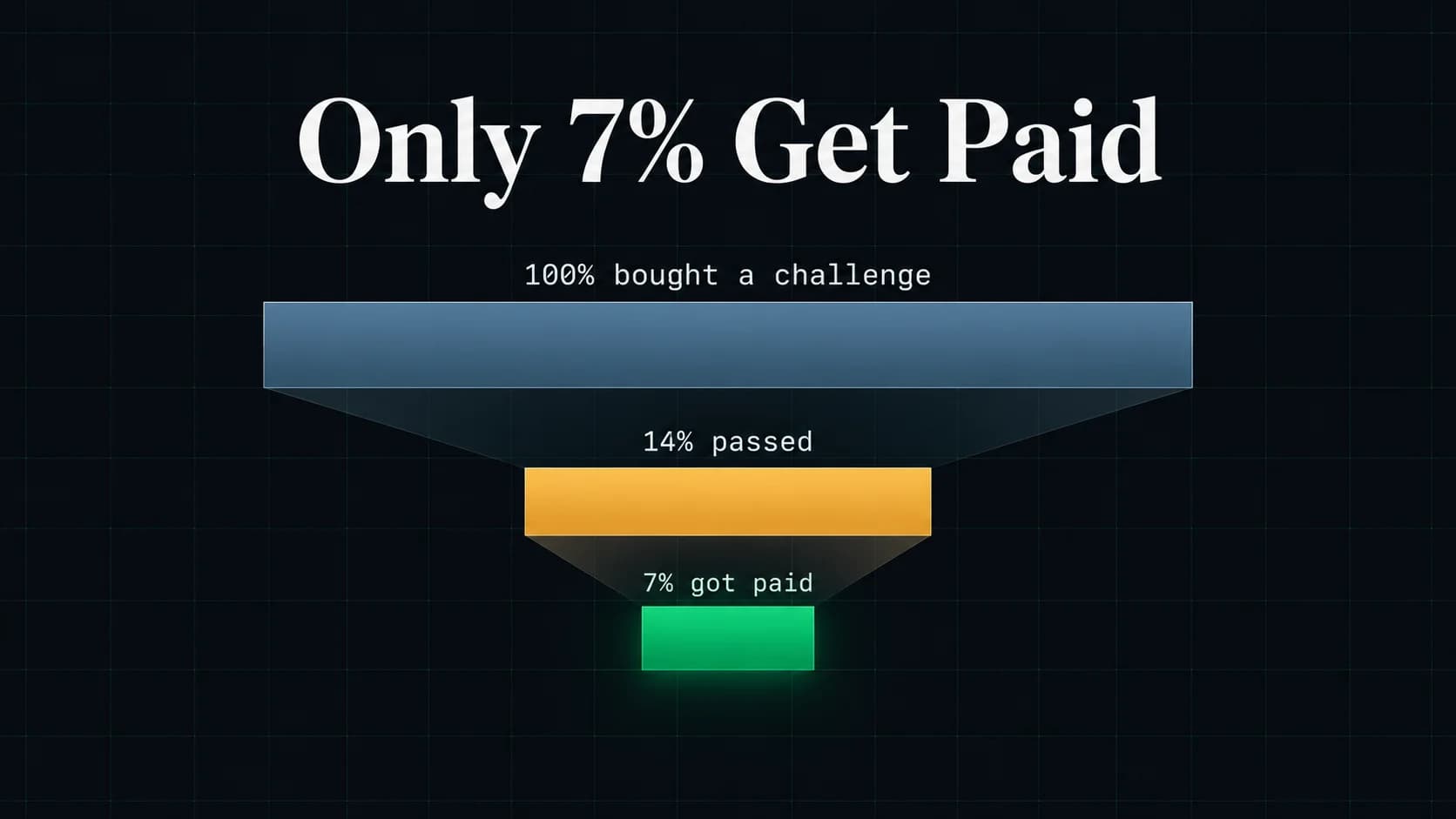
The short answer: The largest public dataset on prop firm challenges, covering more than 300,000 accounts across 10 firms, found that about 14% of traders passed an evaluation and only about 7% ever received a payout. The average payout was around 4% of the account size. Prop challenges can be a reasonable, limited-risk way to trade bigger size, but only for traders who are already consistent and who treat each fee as a real cost.
In 30 seconds
- Across 300,000+ accounts, about 14% of traders passed a challenge and about 7% ever got paid.
- The average payout among those who got paid was about 4% of the funded account size.
- Most challenges are failed by breaking a rule, especially daily loss limits and trailing drawdowns, not by being wrong about the market.
- On those averages, the typical challenger pays more in fees than they receive in payouts.
- Prop firms themselves fail too. Finance Magnates estimated as many as 100 shut down in 2024 alone.
How a prop firm challenge works
Retail prop firms, sometimes called funded trader programs, mostly follow the same model.
- You buy an evaluation. You pay a fee, often a few hundred dollars, for a challenge on a set account size such as $50,000 or $100,000.
- You hit a Profit TargetA profit target is a predetermined exit price where you plan to close a winning trade and lock in gains — defined before you enter the position based on the risk-reward ratio you require and the next significant resistance or support level,Read definition → without breaking the rules. Typical rules include a daily loss limit, a maximum DrawdownA drawdown is the peak-to-trough decline in account equity — it measures how far you've fallen from your high-water mark, either from a single losing trade or a series of losing trades.Read definition →, minimum trading days, and sometimes a consistency rule or restrictions around news.
- Some programs have two phases. You pass one stage, then do a second, usually with a lower target.
- You get a "funded" account. You trade the firm's account and split profits, often keeping the majority.
- You request payouts. If you're profitable and still within the rules when payout time comes, you get paid.
One detail many traders miss: at many retail prop firms, both the challenge and the funded account run in a simulated trading environment. The firm pays your share of profits from its own revenue, which comes largely from evaluation fees. That isn't automatically a scam. It's a business model. But it means the firm's revenue depends on how many people buy challenges, and payouts are a cost the firm needs to manage. Read each firm's terms to see exactly how its accounts work.
The numbers: 14% pass, 7% get paid
The most useful public data comes from FPFX Tech, a company that provides the technology many prop firms run on. In data reported by Finance Magnates, FPFX looked at more than 300,000 accounts belonging to about 100,000 traders across 10 prop firms.
- Stage
- Bought a challenge
- Share of traders
- 100%
- Stage
- Passed and received a funded account
- Share of traders
- About 14%
- Stage
- Received at least one payout
- Share of traders
- About 7%
- Stage
- Average payout (for those paid)
- Share of traders
- About 4% of account size
| Stage | Share of traders |
|---|---|
| Bought a challenge | 100% |
| Passed and received a funded account | About 14% |
| Received at least one payout | About 7% |
| Average payout (for those paid) | About 4% of account size |
FPFX's CEO explained the drop between passing and getting paid: of the traders who passed, about 45% went on to receive a payout. The rest lost the funded account before reaching one.
Other firms' own disclosures tell a similar story:
- The Funded Trader said only about 1 in 20 traders passes its challenge.
- ATFunded published June data showing 22.6% of traders moved from Phase 1 to Phase 2, and 26.9% of those reached a funded account. That works out to roughly 6% of starters.
- E8 Markets reported a 17.7% pass rate from January 2023 through March 2024, and Fintokei reported 23% for 2024.
Pass rates vary by firm and rules, but the pattern is consistent. Most people who buy a challenge never get funded, and of those who do, many never get paid.
Why most traders fail (it's usually not the market)
Here's the part that surprises people: the most common way to fail a challenge isn't picking the wrong direction. It's breaking a rule.
The daily loss limit
Most challenges cap how much you can lose in a single day, often around 4% to 5% of the starting balance. On a $100,000 account, a 5% limit is $5,000. That sounds like a lot until you have three losing trades in a row at a Position SizePosition size is the number of shares, contracts, or dollar value you deploy in a single trade — determined by the relationship between your account risk percentage, your dollar risk per share (distance to stop), and your account size ratheRead definition → that felt normal on a demo account. One bad morning ends the challenge, even if the rest of your month would have been great.
The trailing drawdown trap
Many firms use a trailing drawdown, meaning your failure level moves up as your account makes new highs. Here's how that catches traders:
- Event
- Start
- Account balance
- $100,000
- Failure level (10% trailing)
- $90,000
- Room before failing
- $10,000
- Event
- Good week, new high
- Account balance
- $106,000
- Failure level (10% trailing)
- $96,000
- Room before failing
- $10,000
- Event
- Give back profits
- Account balance
- $100,000
- Failure level (10% trailing)
- $96,000
- Room before failing
- $4,000
| Event | Account balance | Failure level (10% trailing) | Room before failing |
|---|---|---|---|
| Start | $100,000 | $90,000 | $10,000 |
| Good week, new high | $106,000 | $96,000 | $10,000 |
| Give back profits | $100,000 | $96,000 | $4,000 |
At the end of that sequence, the account is back to where it started, but the trader has only $4,000 of room left instead of $10,000. Trailing drawdowns punish the most natural trading behavior there is: making money, then giving some back. Rules differ by firm, so check whether a firm's drawdown trails, locks at a certain point, or is static.
Consistency and conduct rules
Some firms require that no single day makes up too large a share of your total profit. Others ban specific strategies, restrict trading around major news, or flag accounts for using the same device or IP as another account. A trader can hit the profit target and still fail, or be denied a payout, for breaking a rule they didn't read closely.
The "I'll just buy another one" loop
Failing a challenge costs a fee, not your savings, which makes it easy to buy another. And another. In an August 2026 post, The Forex Trading Coach described a reader who had failed five $100,000 challenges at about $550 each, roughly $2,750 in fees, with nothing to show for it. The fee is small enough to feel like a reset button and large enough to add up fast.
FPFX's data hints at this too: traders in its sample used an average of 2.2 prop firms.
The math the ads skip
Let's put the averages together with a simple illustration. Imagine a $100,000 challenge that costs $550, and a trader with exactly average results from the FPFX data.
- Chance of ever getting a payout: about 7%
- Average payout for those who do: about 4% of $100,000, or $4,000
- Expected payout per challenge: 7% × $4,000 = about $280
- Cost per challenge: $550
On those averages, the typical challenger loses about $270 per attempt. Buy five challenges, and the expected loss is around $1,350.
This is an illustration, not a law of nature. Individual traders aren't average, some firms refund the challenge fee with the first payout, and many traders receive more than one payout. But it shows why prop firms can stay in business: across the whole population, fees collected exceed payouts made. The challenge is only a good deal for traders whose personal pass and payout odds are far better than average.
When a prop challenge actually makes sense
None of this means prop firms are a bad idea for everyone. For the right trader, a challenge has real advantages. Your maximum loss is the fee, not your account. You can trade larger size than your own capital would allow. And the rules force the kind of risk DisciplineTrading discipline is the consistent application of your predefined rules — entries, stops, targets, position sizing, maximum daily loss — regardless of what you're feeling in the moment.Read definition → many traders never develop on their own.
A challenge is more likely to make sense if:
- You're already consistent. You have months of journaled trading, in simulation or with real money, showing a positive result after costs.
- Your normal risk fits inside the rules. If your typical losing day would breach a 5% daily limit at the challenge's account size, you'll fail eventually even if you're good.
- You've read the rules, not the summary. Daily limits, drawdown type, consistency rules, news restrictions, and payout conditions.
- You can afford the fee as a loss. If losing it would push you to buy another one immediately to "win it back," you're not ready.
How to prepare before paying for a challenge
Getting challenge-ready before you spend a dollar
5 stepsSimulate under the exact rules
Set up a paper account at the same size, and trade it with the firm's daily loss limit, drawdown type, and profit target written down. Most platforms offer free or included paper trading.
Journal every trade for at least a month
Track entry, exit, size, setup, and whether you broke a rule. A trading journal shows whether you'd have passed, not just whether you made money.
Size for the daily limit, not the target
Work out how many losing trades in a row you could take before hitting the daily limit. If it's fewer than four or five, your size is too large.
Check the firm itself
Look at how long it has operated, who owns it, how payouts work, and whether its rules have changed suddenly in the past.
Set a fee budget
Decide in advance how many challenges you'll buy in total. When you hit that number, stop and go back to simulation.
If journaling is the GapA gap is a price discontinuity on a chart where a stock opens significantly higher or lower than the previous session's close, leaving a visible empty space — gap-ups are driven by overnight buying pressure or positive news; gap-downs by seRead definition →, a dedicated journal makes rule-tracking much easier. Our comparison of TraderSync vs. TradeZella looks specifically at which one fits traders running prop firm accounts.
If the gap is skill rather than tracking, learning alongside experienced traders tends to be cheaper than buying challenges until something clicks. Investors Underground combines structured courses with a live trading community, which is the kind of environment where you can watch how experienced traders manage risk in real time.
This article contains affiliate links, and DayTradingToolkit may earn a commission if you sign up through them, at no extra cost to you.
The other risk: the firm itself
Even if you trade well, the firm has to stay in business to pay you. Finance Magnates Intelligence estimated that as many as 100 prop firms shut down in 2024, and FPFX's CEO said he expected the shakeout to continue.
Regulation is also unsettled. The best-known US case shows how messy it can get. In August 2023, the CFTC froze the assets of My Forex Funds, one of the largest prop firms at the time, alleging fraud. In May 2025, a federal judge dismissed the case with prejudice and sanctioned the CFTC for misconduct in how it pursued the case. Traders' accounts stayed frozen for nearly two years along the way. We covered where regulation stands now in our guide to prop firm regulation.
Practical red flags:
- Anonymous ownership or no verifiable company registration.
- Rules or payout terms that change after traders have already passed.
- Payout requests stuck in long "review" periods.
- Marketing built mainly on influencer payout screenshots.
- Pricing that seems too generous to be sustainable, like very cheap challenges with very large payouts.
What percentage of traders pass prop firm challenges?
What percentage of prop firm traders actually get paid?
Why do most traders fail prop firm challenges?
Are prop firm challenges worth it?
Are prop firm funded accounts real money?
How do I know if a prop firm is legitimate?
How should I prepare for a prop firm challenge?
Article Sources
- Finance Magnates: Only 7% of 300,000 prop trading accounts achieved payouts - FPFX Tech data on pass rates, payout rates, and average payoutfinancemagnates.com
- Finance Magnates via TradingView: ATFunded reports 6% of traders reached funded status - ATFunded data, The Funded Trader pass rate, and the estimate of 100 firm closures in 2024vn.tradingview.com
- TradeInformer: What FTMO tells us about prop firm finances - E8 Markets and Fintokei pass ratestradeinformer.com
- The Forex Trading Coach: The trading mistake that cost him 5 prop firm accounts - five $100,000 challenges at about $550 eachtheforextradingcoach.com
- Finance Magnates: My Forex Funds parent defeats CFTC in court as judge imposes sanctions - dismissal and sanctions, May 2025financemagnates.com