
Kalshi moved more than $31 billion in notional VolumeVolume is the total number of shares (or contracts) traded during a given time period — it's the primary confirmation tool for all price action, because a price move accompanied by high volume indicates genuine market participation, while tRead definition → in June 2026 alone. Polymarket did another $10.8 billion. A brand-new venue backed by Robinhood and Susquehanna did $2 billion in its first month of existence. None of that is stock, options, or futures volume — it's trading activity on prediction markets, and most day traders have barely looked at it.
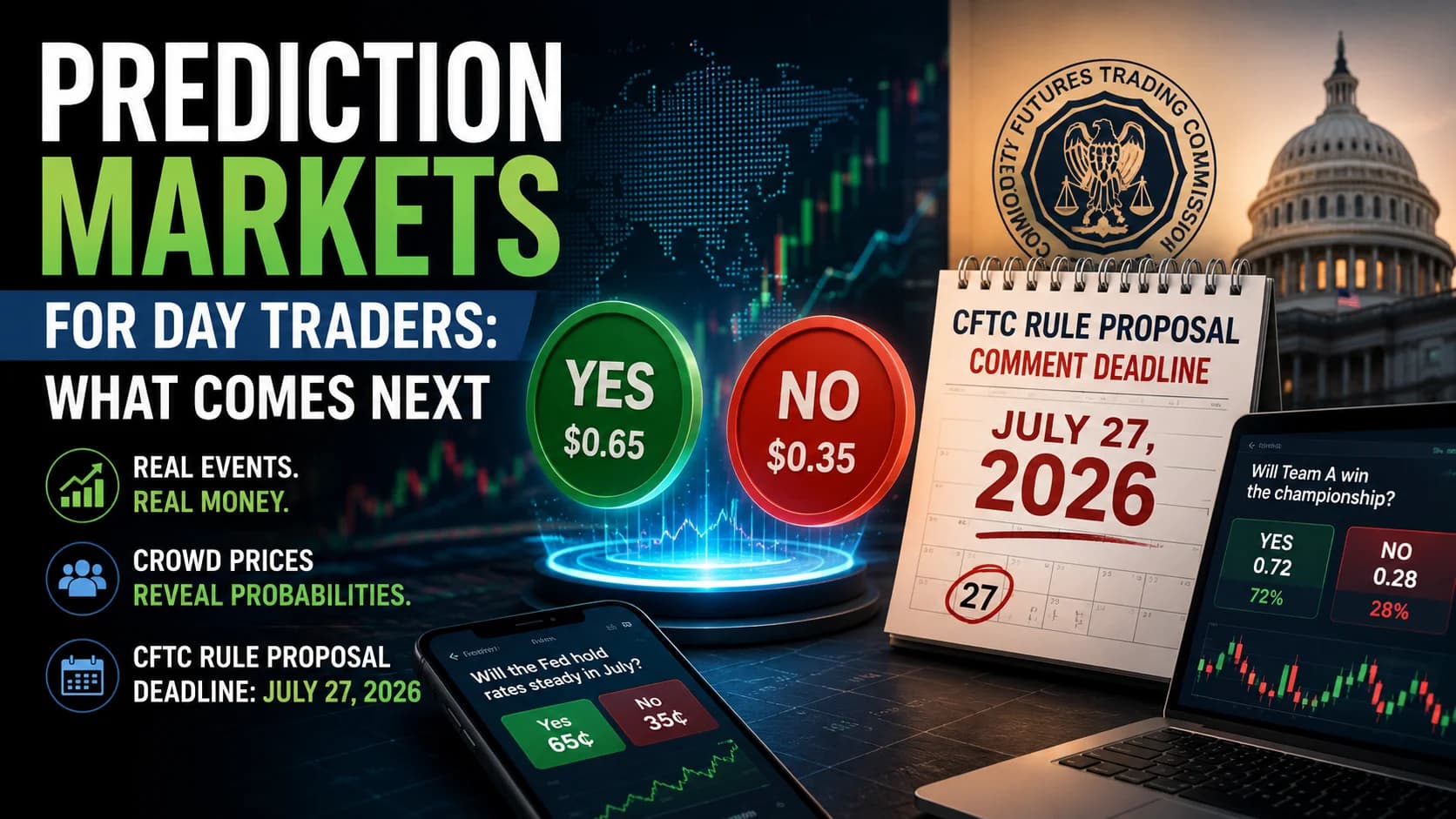
That's about to become harder to ignore. On June 10, 2026, the Commodity Futures Trading Commission published a formal rule proposal that will decide which of these contracts stay listed and which get pulled. Public comments close Monday, July 27, 2026. Whatever the CFTC does next will shape which event contracts you can actually trade — and which ones quietly disappear.
What is a prediction market? A prediction market is a regulated exchange where traders buy and sell "event contracts" — instruments that pay out $1 if a specific future event happens and $0 if it doesn't. The contract's price, somewhere between one cent and ninety-nine cents, reflects the market's real-time estimate of the probability that the event occurs.
What's Actually Happening: The CFTC's Rule and the July 27 Deadline
Here's the short version. Event contracts — sometimes called prediction markets — have existed under CFTC oversight for years, but they were a rounding error in market structure terms. Total volume across all CFTC-designated venues was still under $25 billion for the whole of 2025. Then two things happened at once: Kalshi and Polymarket both scaled aggressively, and the 2026 FIFA World Cup, hosted across North America, gave every casual sports fan a reason to open an account. Combined monthly volume on Kalshi and Polymarket alone went from under $5 billion in September 2025 to roughly $24 billion by April 2026, according to a Pew Research Center analysis of data from The Block. By June, Kalshi's World Cup contracts had generated $7.4 billion on their own before the group stage even finished.
Regulators noticed. On March 16, 2026, the CFTC issued an advance notice seeking public comment on how prediction markets should be treated — a first step, not a rule. That escalated on June 10, 2026, when the Commission issued an actual Notice of Proposed Rulemaking amending CFTC Regulation 40.11 and adding a new Appendix F specifically covering event contracts. This is the real thing: a proposed rule that, once finalized, determines what a designated contract market can and can't list.
The comment period on that proposal closes July 27, 2026. That date matters less for what happens on it — nothing dramatic occurs the moment comments close — and more for what it kicks off. Once the window shuts, the CFTC reviews everything submitted and moves toward a final rule. There's no published date for that. Rulemakings of this size typically take months, sometimes longer, and the Commission can always reopen comment or issue amendments along the way.
If this feels like a familiar pattern, it should. Day traders just went through something structurally similar with FINRA's elimination of the PDT rule — a multi-month process from proposal to comment period to final effective date, with the actual mechanics only becoming clear once the rule was finalized. Regulatory change in this business rarely moves on the timeline anyone would prefer.
How Event Contracts Actually Work
Strip away the branding and an event contract is a simple binary bet dressed up as a regulated derivative. You buy a "Yes" or "No" position on a specific proposition — will the Fed hold rates steady at the July meeting, will a named stock close above some level by a set date, will a particular team win. If you're right, your contract settles at $1. If you're wrong, it settles at $0. There's no partial credit and no dividend stream sitting underneath it — the whole return comes from being correct about the outcome.
Pricing is where it gets interesting for anyone who already reads an order book. A contract trading at $0.65 implies the market thinks there's roughly a 65% chance the event happens. Buy it there, and the event happens, you collect $0.35 in profit per contract. Buy it there and you're wrong, you lose the full $0.65. That price moves continuously as new information hits the market — an economic release, a news headline, a shift in the underlying odds — the same way an option's premium moves with the stock, except there's no strike, no Greeks, and no expiration decay curve. There's just a probability, priced by the crowd, converging toward $0 or $1 as the event gets closer to resolving.
Why Retail Money Is Suddenly Pouring In
Three forces are stacking on top of each other right now, and it's worth separating them because they won't all persist.
The World Cup is the obvious one. Kalshi has been running north of $1 billion in daily notional volume since the tournament began June 11, and sports contracts account for roughly 85% of its trading, per Dune Analytics data cited by CoinDesk. That's a seasonal spike — it'll fade once the tournament ends, the way NFL and March Madness volume always does on these platforms.
The distribution push is more durable. Robinhood's prediction markets hub, built on a March 2025 Kalshi partnership, put event contracts in front of roughly 27 million funded brokerage accounts for the first time. In June, Robinhood went further and launched Rothera, a joint venture with market maker Susquehanna that routes certain contracts through its own venue rather than Kalshi's. Rothera did $2 billion in notional volume in its debut month and already accounts for about 7% of U.S. prediction market volume, according to Bank of America. This is the part that should get a day trader's attention: a mainstream brokerage app just made event contracts a native product sitting next to your equities and options tabs, not a separate destination you have to seek out.
The regulatory clarity is the third piece, and it cuts both ways. Kalshi's win in federal court over election contracts back in 2024 gave the whole category legal footing it never had before. That footing is exactly what's now up for a more formal, comprehensive rule — which is either the thing that cements this as a legitimate asset class or the thing that carves out a chunk of it. Nobody honestly knows yet.
Event Contracts vs. the Instruments You Already Trade
If you already trade 0DTE options, the comparison is unavoidable, so it's worth doing directly.
A 0DTE contract and an event contract both resolve fast and both can go to zero. That's where the similarity ends. Our 0 DTE options trading guide walks through GammaGamma is the options Greek that measures the rate of change in delta for every $1 move in the underlying stock — high gamma means delta shifts rapidly as price moves, making the option increasingly sensitive to further price movement, and iRead definition →, ThetaTheta is the options Greek that measures time decay — the rate at which an option's extrinsic (time) value decreases each day as expiration approaches, all else equal — it represents a constant headwind for option buyers and a constant tailRead definition → decay, and the mechanics that make same-day options behave the way they do — an option's value is a function of the underlying's price, time remaining, and Implied VolatilityImplied volatility (IV) is the market's forward-looking estimate of how much a stock will move, derived from current option prices — high IV means options are expensive because the market expects big moves, low IV means options are cheap beRead definition →, all moving simultaneously. An event contract has none of that. There's no underlying security, no Strike PriceThe strike price (or exercise price) is the fixed price at which an options contract can be exercised — for a call option, it's the price at which you can buy 100 shares; for a put, it's the price at which you can sell 100 shares — and its Read definition →, no Greeks, and no volatility surface to read. There's a single probability, and the price is that probability, full stop. You're not trading a derivative of something — you're trading a direct bet on something.
That difference matters for how transferable your existing skills are. A trader who's built an edge reading options flow, gamma exposure, or implied volatility skew has genuinely useful pattern recognition for equities and index options. Almost none of it carries over to event contracts. What carries over instead is closer to what a sharp sports bettor or a probability-focused analyst does: sourcing better information than the crowd, and pricing it faster. That's a different skill set, and it's worth being honest with yourself about whether you actually have it before committing size.
There's an odd regulatory overlap worth flagging too. The CFTC is the same regulator that oversees futures contracts like /ES and /NQ — instruments most active day traders already understand. But a futures contract on the S&P 500 gives you leveraged exposure to a continuously priced index; an event contract gives you a fixed, binary claim on a single yes-or-no outcome. Same regulator, genuinely different risk profile.
What the CFTC Is Actually Deciding
The June 10 proposal isn't a blanket yes-or-no on prediction markets — it's a three-step filter that every event contract has to clear. First, is it an event contract in an "excluded commodity" under the Commodity Exchange Act? Second, does it "involve" one of a specific list of enumerated activities: unlawful activity, terrorism, assassination, war, gaming, or something similar? Third — and this is the one with the most discretion built in — is the contract "contrary to the public interest"?
Under the current proposal, sports-outcome contracts — final scores, point differentials, season-long stats, tournament advancement — are broadly expected to clear that test and remain listed, according to a summary from law firm Greenberg Traurig. That's a meaningful signal given that sports contracts are the overwhelming majority of current volume.
Political and some "gaming-adjacent" contracts are the murkier territory. Worth knowing the recent history here: back in 2024, under a prior CFTC leadership, the Commission had proposed a much broader rule that would have effectively barred political and sports contracts outright as contrary to the public interest. That rule was never finalized, and in February 2026 the Commission formally withdrew it — along with a related staff advisory — citing ongoing state-level regulatory actions and litigation over the CFTC's jurisdiction. The current proposal is a different, more targeted approach, but it's proof that this rulemaking area has already reversed course once. It can again.
What Happens After July 27
Nothing changes for existing contracts the day the comment window closes. What changes is that the CFTC stops accepting new input and starts working toward a final rule using what it's already received. Expect industry groups, individual platforms, state regulators, and probably a few members of Congress to weigh in before the deadline — comment volume on rules like this can run into the thousands of submissions.
From there, the honest answer is that nobody outside the Commission has a reliable timeline. Some rulemakings clear in a few months; others sit for a year or more, especially when the underlying legal questions — like the CFTC's exclusive jurisdiction claim over these products, which is currently being tested in litigation — remain unsettled elsewhere. If you're trading event contracts now, the practical takeaway isn't "wait for clarity." It's "assume the rules of this specific game can change on a timeline you don't control, and size accordingly."
The Real Risks Every Trader Should Understand
Start with the one that gets glossed over the most: an event contract is a zero-sum bet against other traders, not a claim on an economic asset. There's no earnings growth, no yield, no long-term thesis to be right about eventually if your timing is off. You're either right about the specific event by the specific date, or your capital is gone. That structure is genuinely closer to sports betting than to anything in the equity or options markets, and it's worth being clear-eyed about that rather than letting the "regulated derivatives exchange" framing soften it.
Market integrity is a live concern, not a hypothetical one. On March 23, 2026, both Kalshi and Polymarket announced new measures specifically aimed at curbing insider trading — participants with early or non-public knowledge of an outcome trading ahead of the crowd. The CFTC's own Division of Enforcement has already brought insider-trading cases tied to event contracts on a designated contract market. If a contract resolves based on information a small number of people had access to before you did, you're on the wrong side of that information gap by design, and there's no SEC-style Reg FD requiring the underlying event to disclose anything to the market at large.
Platform and jurisdictional risk is also real and easy to overlook. Kalshi and Polymarket US operate as CFTC-regulated designated contract markets, which brings real oversight. Polymarket's much larger international platform does not operate under that same U.S. regulatory umbrella for non-U.S. users, and the volume split matters — Polymarket US did roughly $1.3 billion in April 2026 against $9 billion on Polymarket International. Know which version of a platform you're actually using before you fund an account.
And then there's the ordinary behavioral risk that applies to any fast, binary, constantly-priced product: it's built to be checked compulsively, and the dopamine loop of watching a probability tick toward 100% is not meaningfully different from watching a stock price during a momentum trade. If you already recognize overtrading tendencies in your equity trading, a new venue with faster resolution cycles and sports-adjacent framing is not the place to test your discipline.
Should Day Traders Actually Add Event Contracts to Their Toolkit?
For most active day traders, the honest answer right now is: not yet, and not with real size. The instrument category is legitimate and growing fast, but the rulebook governing it is still being written in real time, with a hard deadline three weeks out and no clear picture of what comes after. That's a different kind of uncertainty than not knowing which way a stock breaks — it's uncertainty about whether the game itself keeps its current shape.
This guide's take is straightforward: treat prediction markets the way you'd treat any new instrument with an unresolved regulatory question mark — worth understanding, worth watching, not worth committing meaningful capital to until the picture clears. If you're drawn to the mechanics because you already trade short-dated options, the better use of your time this month is probably tightening what you already do well rather than starting from zero in a market structure that's still being decided by regulators you have no visibility into.
Frequently Asked Questions
What is a prediction market or event contract, in plain terms?
Unlike a stock or option, an event contract has no underlying security, no dividend, and no time-decay curve driven by volatility. Its entire value comes down to whether one defined proposition — a game result, an economic data print, a policy outcome — turns out to be true by a set date. Platforms like Kalshi and Polymarket US operate as CFTC-regulated designated contract markets, meaning the exchange itself doesn't take a side of your trade; it just matches buyers and sellers and collects a fee.
Key Takeaway: Think of it as a binary bet with exchange-grade infrastructure around it, not a security with a business or an asset behind it.
Is trading prediction markets actually legal in the US right now?
The legality question that's actually unsettled isn't "can these platforms operate" — they already do, under current CFTC rules — it's "which specific categories of contracts will remain listed once the new rule is final." Kalshi's 2024 court win over election-related contracts established that political event contracts fall under the CFTC's jurisdiction rather than being an illegal gaming product, and that precedent underpins the current framework.
Key Takeaway: Trading is legal today on regulated platforms; what's in question is which contract types survive the rule the CFTC finalizes after July 27, 2026.
What exactly is the CFTC deciding by the July 27 deadline, and what happens next?
The three-step test asks whether a contract involves an excluded commodity, whether it touches an enumerated activity like gaming or unlawful conduct, and whether it's ultimately contrary to the public interest. Sports contracts look likely to clear under the current draft. Political and some other categories remain less certain, partly because a broader, more restrictive version of this rule was proposed in 2024 and then withdrawn in February 2026 — a reminder that this area has already changed direction once.
Key Takeaway: The deadline starts the countdown to a final rule; it isn't the rule itself, and there's no confirmed date for when a final version lands.
How is an event contract different from the 0DTE options I already trade?
If you've built pattern recognition around gamma exposure, implied volatility, or options flow — the kind of thing covered in our 0 DTE options trading strategy guide — very little of that transfers directly. What transfers instead is sourcing and pricing information faster than the crowd on a specific proposition, which is a closer skill to sports or forecasting analysis than to options trading.
Key Takeaway: Fast resolution and binary payoff make these feel similar to 0DTE options on the surface, but the underlying mechanics — and the edge required — are genuinely different.
Will political event contracts get banned by the new CFTC rule?
Sports contracts appear to have the clearest path to staying listed under the current draft. Political contracts are subject to more case-by-case judgment, and the regulatory history here includes a full reversal: a broader restrictive proposal from 2024 was formally withdrawn in February 2026. That withdrawal doesn't guarantee political contracts survive the current rulemaking either — it just shows the CFTC's position on this specific question has already moved once.
Key Takeaway: Treat any specific contract category — political or otherwise — as provisional until the final rule is published, not guaranteed to remain listed.
What's the difference between Kalshi, Polymarket, and Robinhood's Rothera?
Kalshi is currently the largest U.S.-regulated venue by volume. Polymarket runs two separate products — a much larger international platform and a smaller, CFTC-regulated Polymarket US arm for domestic users, and the volume gap between them is significant. Rothera, which launched in June 2026, is Robinhood's attempt to build its own venue rather than simply routing volume to an existing partner, and it's already capturing a meaningful share of total U.S. prediction market activity just months after launch.
Key Takeaway: All three sit inside the same regulatory conversation, but they're not interchangeable — check which specific entity you're actually trading on before assuming a blanket set of protections applies.
Can insider information actually move event contract prices?
Because an event contract settles entirely on a single real-world outcome, someone with early or non-public knowledge of that outcome has a structural edge that's arguably sharper than most insider-trading scenarios in equities, where a company's fundamentals still take time to fully play out in price. There's no Reg FD-style disclosure requirement forcing the underlying event to inform the market broadly and simultaneously.
Key Takeaway: Treat any fast-moving, unexplained price shift in an event contract as a signal that someone may know something you don't — not as a setup to chase.
How are prediction market winnings taxed?
This is genuinely evolving terrain, and getting it wrong has real consequences. Our day trading tax strategies guide covers how the IRS treats more established instruments like equities, Section 1256 futures contracts, and standard options — event contracts don't fit cleanly into any of those existing buckets, and guidance specific to this instrument type is still developing alongside the CFTC's own rulemaking.
Key Takeaway: Don't assume your event contract activity gets the same tax treatment as your options trades — confirm with a tax professional before you're surprised at filing time.
Should I add event contracts to my day trading routine right now?
The category is real, it's growing fast, and mainstream distribution through Robinhood means it isn't a niche curiosity anymore. But you'd be sizing a position in an instrument whose basic tradability — for certain contract categories, at least — is subject to a regulatory decision with no confirmed timeline. That's a different, harder-to-price risk than anything in your existing playbook, and it compounds on top of the ordinary risk of the bet itself.
Key Takeaway: There's a difference between staying informed on a fast-moving market structure story and funding an account in the middle of it — right now, this guide favors the former.
Disclaimer
Article Sources
- Understanding Prediction Markets and Event Contracts - U.S. Commodity Futures Trading Commission. The regulator's own plain-language explainer of how event contracts work and how they're overseen.cftc.gov
- The Odds Are In: CFTC Proposes Framework for Event Contracts and Prediction Markets - Mayer Brown, June 2026. Confirms the June 10, 2026 NPRM and the July 27, 2026 comment deadline.mayerbrown.com
- CFTC Proposes New Rules for Event Contracts on Prediction Markets - Greenberg Traurig, June 2026. Breaks down the three-step public interest test and sports contracts' likely treatment.gtlaw.com
- CFTC Advances Regulatory Framework for Prediction Markets - Norton Rose Fulbright, May 2026. Details the February 2026 withdrawal of the prior, broader 2024 proposed rule.nortonrosefulbright.com
- The World Cup Sends Prediction Market Volumes Soaring to Record Highs - CNBC, July 2026. June 2026 volume data for Kalshi, Polymarket, and Rothera.cnbc.com
- Trading Volume on Prediction Markets Has Soared in Recent Months - Pew Research Center, May 2026. Combined monthly volume growth trend, based on The Block's data.pewresearch.org
- How Prediction Markets Scaled to USD 21B in Monthly Volume in 2026 - TRM Labs, March 2026. Covers the Robinhood-Kalshi partnership and March 2026 anti-insider-trading measures.trmlabs.com