DayTradingToolkit
  • Home
  • Beginner’s Guide
  • Psychology & Risk
  • Strategies
  • Reviews & Comparisons
  • Blog
  • Free ToolsMust Check
    • Day Trading Dictionary
    • Reward/Risk Calculator
    • Position Size Calculator
    • Trade Growth Calculator
    • Trade Fee Calculator
    • Stop Loss & Take Profit Calculator
    • Trade Profit Loss Calculator
  • Home
  • Beginner’s Guide
  • Psychology & Risk
  • Strategies
  • Reviews & Comparisons
  • Blog
  • Free ToolsMust Check
    • Day Trading Dictionary
    • Reward/Risk Calculator
    • Position Size Calculator
    • Trade Growth Calculator
    • Trade Fee Calculator
    • Stop Loss & Take Profit Calculator
    • Trade Profit Loss Calculator
No Result
View All Result
Day Trading Toolkit | Proven Strategies, Tools & Beginner’s Guide
No Result
View All Result

Home » Day Trading Basics » The Ultimate Guide to Day Trading Taxes for 2026

The Ultimate Guide to Day Trading Taxes for 2026

Kazi Mezanur Rahman by Kazi Mezanur Rahman
October 29, 2025
in Day Trading Basics
Reading Time: 25 mins read
A A
Featured Image for The Ultimate Guide to Day Trading Taxes (5-Star Tips)
10
VIEWS
Share on FacebookShare on Twitter

Let’s be clear: nothing is more frustrating than a monster trading year followed by a soul-crushing tax bill. For active traders, day trading taxes are one of the most complex, confusing, and costly parts of the business.

Here’s the deal. The IRS has a default set of rules for casual investors. But as an active day trader, you are not a casual investor, and you shouldn’t be taxed like one.

Our team of traders and researchers has spent countless hours navigating this system. The good news? The tax code provides a specific path for serious traders to be treated as a business, unlocking powerful benefits that casual investors simply don’t get. But—and this is a big “but”—you have to be proactive.

This is your complete trading taxes guide. We’re going to break down the exact strategies professional traders use, from the “game-changer” of Trader Tax Status to the advanced tools of Mark-to-Market accounting and Section 1256 contracts. This is how you stop leaving money on the table and start keeping more of what you earn.

a day trader analyzing a complex tax code maze, representing the challenges and strategies of day trading taxes.
Understanding day trading taxes is like navigating a maze, but the right path leads to significant savings.

Why Day Trading Taxes Are Different (And Why You Can’t Ignore Them)

When you’re just starting, it’s easy to ignore the tax implications of your trades. You buy, you sell, your broker sends you a 1099-B in February, and you plug the numbers into a tax program. Simple, right?

Wrong. This “simple” method traps you in a system designed for buy-and-hold investors, and it’s devastating for active traders.

The Default: “Investor” vs. “Trader” Status

By default, the IRS views you as an “investor.” An investor is someone who buys and sells securities with the intent to profit from dividends, interest, or long-term capital appreciation.

As an investor, your tax world is very restrictive:

  • The Wash Sale Rule: This rule is a nightmare for active traders. We’ll cover it in detail later, but it essentially disallows you from claiming a loss on a stock if you buy it back too soon.
  • Capital Loss Limitation: If you have a bad year, you can only deduct $3,000 of net capital losses against your ordinary income (like your W-2 job).
  • No Business Deductions: That expensive charting software? Your multiple monitors? Your high-speed internet? None of it is deductible.

A “trader,” in the eyes of the IRS, is completely different. A trader is someone in the business of buying and selling securities, aiming to profit from short-term daily market movements. This business designation is the key that unlocks everything else.

The Default Tax Treatment: Short-Term Capital Gains

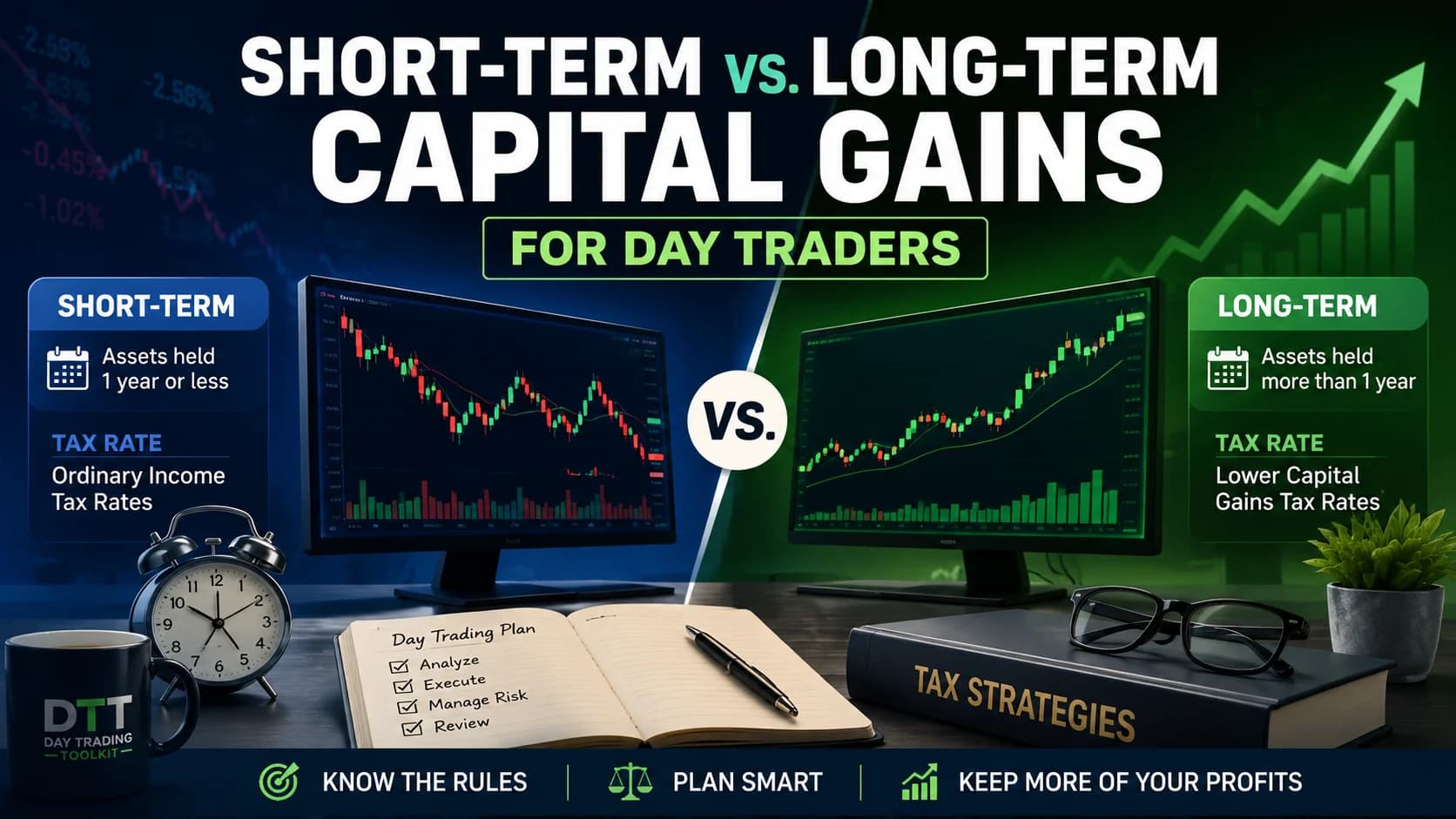
As a day trader, virtually 100% of your winning trades are held for less than one year. This means they are all short-term capital gains.

How are those taxed? They’re added directly to your regular income and taxed at your highest marginal income tax rate. That’s the same (and highest) rate as your salary. There’s no discount, no special treatment.

So, if you’re in the 32% tax bracket, you’re handing over nearly a third of your net trading profits to the government. This is why understanding the strategies in this guide is so critical.

Trader Tax Status (TTS): The Game-Changer for Active Traders

This is the first and most important hurdle you need to clear. Trader Tax Status (TTS) is an IRS classification that formally recognizes you as being in the “trade or business of trading securities.”

It is not an election. You don’t just fill out a form to get it. You must qualify for it based on your activity.

2D illustration showing a key labeled "TTS" unlocking a vault door labeled "BUSINESS DEDUCTIONS," symbolizing the benefits of trader tax status.
Qualifying for Trader Tax Status (TTS) is the key to unlocking valuable business expense deductions.

What is Trader Tax Status (TTS)?

TTS is the bridge that takes you from being a hobbyist “investor” to a professional “trader” in the eyes of the IRS. It’s the prerequisite for the most powerful tax-saving tools.

Think of it this way: Without TTS, you’re just a person with a costly hobby. With TTS, you’re a business owner.

The IRS’s “Vague” Three-Part Test for Qualification

The IRS is famously vague about what it takes to qualify for TTS. They don’t give you a hard number of trades or hours. Instead, they provide a “facts and circumstances” test based on three main criteria:

  1. Substantial Activity: You must be trading a lot. While not a hard rule, court cases have given us clues. We’re talking hundreds of trades per year, not a handful per month.
  2. Regular and Continuous Activity: Your trading can’t be sporadic. You must be trading frequently and consistently throughout the year. Taking off a few weeks is fine, but trading hard in January and then stopping until July won’t cut it.
  3. Profit Intent: You must be trading to profit from short-term, daily price movements, not from long-term appreciation or dividends. This one is the easiest for day traders to prove.

The Real-World Benefits of Qualifying for TTS

Just qualifying for TTS—even before you do anything else—unlocks one major benefit: business expense deductions.

With TTS, you can file a Schedule C (Form 1040), Profit or Loss from Business. This allows you to deduct all your “ordinary and necessary” trading expenses, just like any other business. This includes:

  • Charting software (TradingView, TrendSpider)
  • Scanners and data feeds (Trade-Ideas, Benzinga Pro)
  • Computers, monitors, and equipment
  • A home office deduction
  • Education, coaching, and subscription fees
  • Margin interest

These deductions are subtracted from your gross income, which can save you thousands of dollars, regardless of whether your trading was profitable.

Learn the full details in our complete Trader Tax Status (TTS) Guide

The “Mark-to-Market” (MTM) Election: Your Most Powerful Tool

Here’s the kicker. TTS is the gateway, but Mark-to-Market (MTM) accounting is the main event. This is an election you must formally make under Section 475(f) of the tax code, and you can only make it if you qualify for TTS.

Split 2D illustration contrasting a trader restricted by wash sale rule limits versus a trader using the MTM election to overcome them.
The Mark-to-Market election cuts through the limitations of the wash sale rule and the $3,000 capital loss cap

What is Mark-to-Market (Section 475(f)) Accounting?

In simple terms, MTM changes your accounting method.

Instead of tracking capital gains and losses, MTM treats all your gains and losses as ordinary gains and losses. At the end of the year (December 31), all your open positions are “marked to market,” meaning they are treated as if you sold them for their fair market value. You pay tax on the gain or deduct the loss, and your cost basis resets to that price for the new year.

The Pros of MTM: No Wash Sales, Ordinary Loss Deductions

This is why you do it. The benefits of an MTM election are massive:

  1. The Wash Sale Rule is GONE: Because your trades are no longer “capital assets,” the wash sale rule does not apply to you. You can take a loss on a stock, buy it back 10 seconds later, and still claim the full loss. For an active trader, this is a total game-changer.
  2. No More $3,000 Capital Loss Limit: Remember that $3,000 limit? It’s gone, too. Because your losses are now “ordinary losses,” they can be used to offset all your other ordinary income (like a W-2 salary) with no limit. If you have a $50,000 W-2 salary and a $50,000 trading loss, your adjusted gross income becomes $0.

The Cons of MTM: All Gains are Ordinary Income, Hard to Revoke

There are two major trade-offs:

  1. No More Capital Gains Rates: This is the big one. Under MTM, all your gains are also ordinary income. You lose the ability to pay lower long-term capital gains rates on any position, ever. For a pure day trader, this rarely matters. But if you’re a swing trader who sometimes holds for a year, this is a huge drawback.
  2. It’s (Very) Hard to Revoke: Once you make the MTM election, you can’t just switch back. You must file a formal request with the IRS to revoke it, and they don’t have to say yes. This is a serious, long-term commitment.

How to Make the MTM Election (And a Critical Deadline You Can’t Miss)

This is the part that trips up most traders. You must make the election by the original due date of the prior year’s tax return (not including extensions).

  • For Individuals: To elect MTM for the 2025 tax year, you must have made the election by April 15, 2025.
  • For New Entities: If you form a new business, you have a special window to make the election internally.

You can’t just decide to use MTM when you’re filing your taxes in March for the year that just ended. By then, it’s too late.

See if MTM is right for you in our Mark-to-Market Election Guide

The Wash Sale Rule: The Silent Profit Killer You Must Understand

We’ve mentioned this a few times, but it deserves its own section. It’s that dangerous.

What is the Wash Sale Rule and How Does it Trap Traders?

The Wash Sale Rule (IRS Publication 550) states that you cannot claim a loss on the sale of a security if you buy a “substantially identical” security within 30 days before or after the sale. This creates a 61-day window.

Here’s an example of how it traps you:

  1. You buy 100 shares of $AAPL at $150.
  2. It drops. You sell it at $140 for a $1,000 loss.
  3. You see it bouncing and buy back 100 shares at $142 just five minutes later.

Because you bought it back within 30 days, your $1,000 loss is disallowed. The loss is instead added to the cost basis of your new shares. Your new basis is $14,200 + $1,000 = $15,200, or $152 per share.

You don’t get to claim that $1,000 loss until you sell the new position and don’t trigger the rule again. For an active trader, this creates a rolling, ever-growing tax liability that can result in you owing a massive tax bill even in a year you lost money.

Why MTM (Section 475(f)) is the Ultimate Solution

As we covered, electing MTM under Section 475(f) completely eliminates this problem. Since your securities are treated as ordinary assets, the wash sale rule (which only applies to capital assets) no longer applies.

Read more on avoiding this trap in our Wash Sale Rule Explained Guide

The “Other” Tax Advantage: Section 1256 Contracts (The 60/40 Rule)

Now, let’s talk about one of the biggest “secrets” in the tax strategies for active day traders. If you trade futures, you are already playing by a different, better set of rules.

2D illustration comparing tax rates on screens: Stocks show high tax, while Futures (Section 1256) show the favorable 60/40 tax rule benefit.
Section 1256 contracts like futures offer a significant tax advantage thanks to the 60/40 rule, resulting in lower effective tax rates.

What Are Section 1256 Contracts?

The IRS has a special classification for certain financial instruments called Section 1256 contracts. These include:

  • Regulated Futures Contracts (e.g., E-mini S&P 500, Gold, Oil, Corn)
  • Broad-Based Index Options (e.g., $SPX, $NDX, $VIX)
  • Options on Futures

Note: This does not include single-stock options or ETFs like $SPY.

The 60/40 Advantage: How Futures Traders Get a Better Tax Rate

Here is the magic. All gains and losses on Section 1256 contracts—regardless of your holding period—are given a blended tax rate:

  • 60% are treated as long-term capital gains (taxed at the lower 0%, 15%, or 20% rate).
  • 40% are treated as short-term capital gains (taxed at your higher, ordinary income rate).

Think about that. You can day trade /ES futures, hold a position for 30 seconds, and 60% of your profit is still taxed at the favorable long-term rate. This is a massive, built-in advantage that stock traders simply do not get without holding for over a year.

Automatic Mark-to-Market and How It’s Reported (Form 6781)

Section 1256 contracts are automatically marked-to-market by law. You don’t need to make an election. Your broker will send you a Form 1099-B showing your total net gain or loss, which you then report on IRS Form 6781 (Gains and Losses From Section 1256 Contracts and Straddles).

This simplicity and tax advantage are why many of our team members focus heavily on the futures market.

Learn more about this powerful strategy in our Section 1256 Contracts Guide

Choosing Your Business Entity: Sole Prop, LLC, or S-Corp?

If you’ve qualified for TTS, the next logical step is to consider forming a business entity. This can provide liability protection and, in some cases, significant tax savings.

Option 1: Sole Proprietorship (The Default)

If you qualify for TTS and don’t form an entity, you are a sole proprietor by default. You file your trading expenses on a Schedule C. It’s simple, but it has two flaws:

  1. No Liability Protection: Your personal assets (house, car, savings) are not separate from your business.
  2. Self-Employment Tax: This is a big one. While your trading gains are (usually) exempt from self-employment tax, some CPAs argue that your net income as a full-time trader (if you’re a single-member LLC) could be subject to it. This is a gray area, and an S-Corp solves it.

Option 2: LLC (Liability Protection)

A Limited Liability Company (LLC) is the easiest way to get liability protection. It legally separates your personal assets from your business debts.

For tax purposes, a single-member LLC is a “disregarded entity”. This means the IRS taxes you exactly like a sole proprietor by default. You get the protection, but the tax situation is the same.

Option 3: S-Corporation (The Self-Employment Tax Strategy)

This is the advanced play. You can form an LLC and then elect for it to be taxed as an S-Corporation. This is where the real savings can happen.

Here’s how it works:

  1. As an S-Corp, you must pay yourself a “reasonable salary” as an employee (e.g., $60,000). This salary is subject to self-employment taxes (Social Security & Medicare).
  2. Any trading profits above that salary can be taken as a “distribution”.
  3. Here is the key: Distributions are NOT subject to self-employment tax.

This strategy can save you 15.3% on every dollar of profit you take as a distribution instead of a salary.

When Does Forming an Entity Make Sense?

Real talk: If you’re new or not yet consistently profitable, don’t bother. The costs and complexity aren’t worth it.

Our team generally agrees that you should only consider an S-Corp after you have qualified for TTS, are consistently profitable, and your net trading income is high enough that the self-employment tax savings will outweigh the costs of payroll and corporate compliance.

We break down the pros and cons in our LLC for Day Trading Guide

Day Trader Tax Deductions: What You Can Write Off (With TTS)

Once you’ve qualified for TTS, a whole new world of day trader tax deductions opens up. You are now a business, and your expenses are deductible on Schedule C.

Home Office Deduction

You can deduct the portion of your home used “exclusively and regularly” for your trading business. This can be calculated two ways:

  • Simplified Method: A simple $5 per square foot (up to 300 sq. ft.).
  • Regular Method: You calculate the percentage of your home’s square footage and deduct that percentage of your actual expenses (rent, utilities, insurance, etc.).

Software, Data Feeds, and Subscriptions

This is one of the biggest categories.

  • Platforms & Scanners: Trade Ideas, TrendSpider, TradingView.
  • News Feeds: Benzinga Pro, Reuters.
  • Data Feeds: Level 2, premium market data.

Computers, Monitors, and Equipment

Your trading rig—computers, monitors, desk, chair—are all deductible business expenses. You can often deduct the full cost in the first year using depreciation rules (like Section 179).

Education and Professional Fees

  • Education: Trading courses, coaching, seminars, and books related to your business.
  • Professional Fees: The cost of a CPA or tax professional to prepare your (much more complicated) tax return.

See the full list in our Day Trading Tax Deductions Guide These costs add up. See how they fit your budget in our Understanding Brokerage Costs guide.

Year-Round Tax Planning: How to Avoid a Massive April Surprise

Professional traders treat their taxes as a year-round business function, not an April emergency.

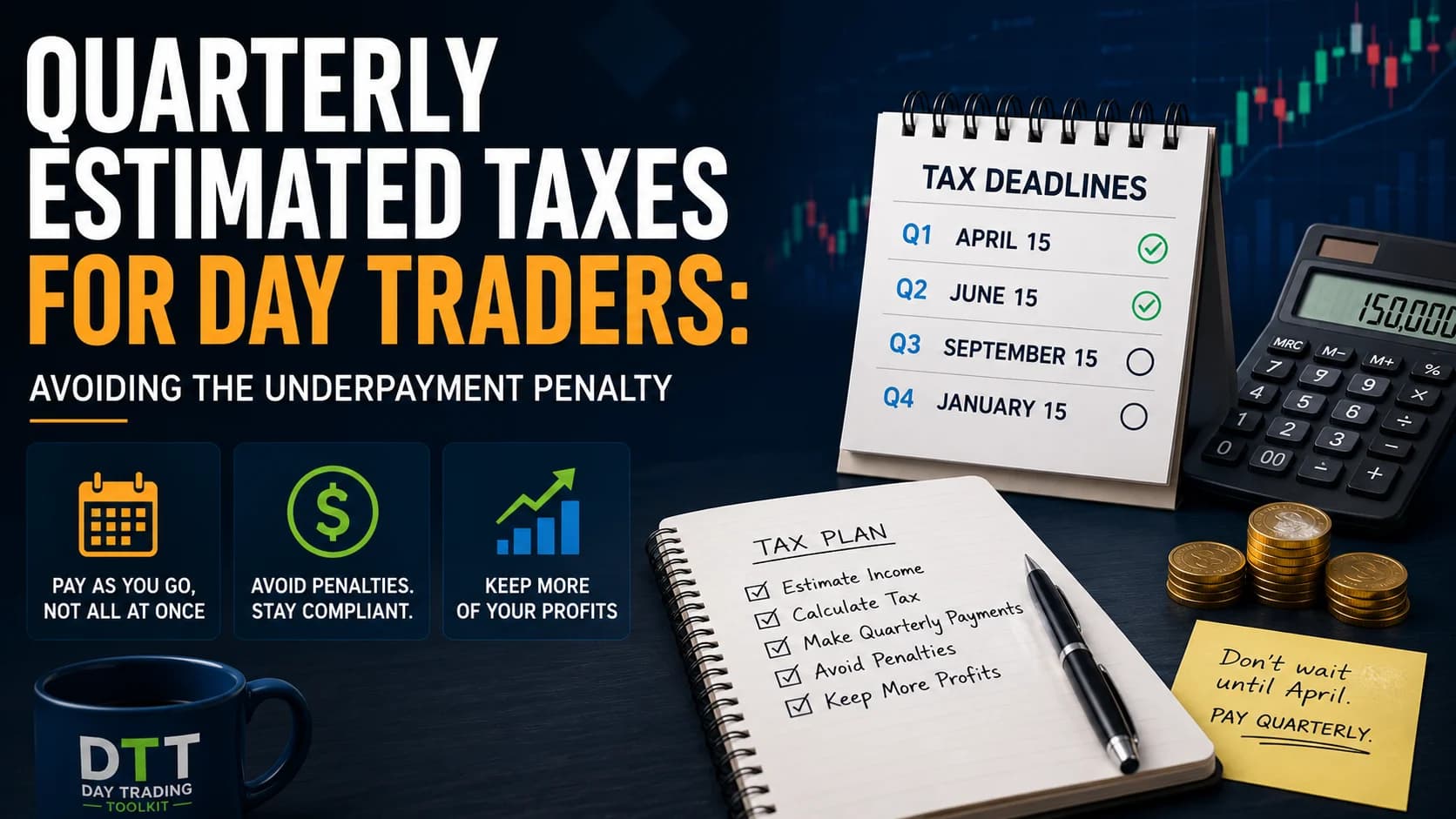
The Reality of Quarterly Estimated Tax Payments

If you are a profitable trader (and especially if you have an S-Corp), you can’t wait until April 15 to pay your taxes. The IRS requires you to pay as you go.

This means you must calculate and pay quarterly estimated taxes (due April 15, June 15, Sept 15, and Jan 15). If you don’t, and you owe more than $1,000 at the end of the year, you’ll be hit with an underpayment penalty.

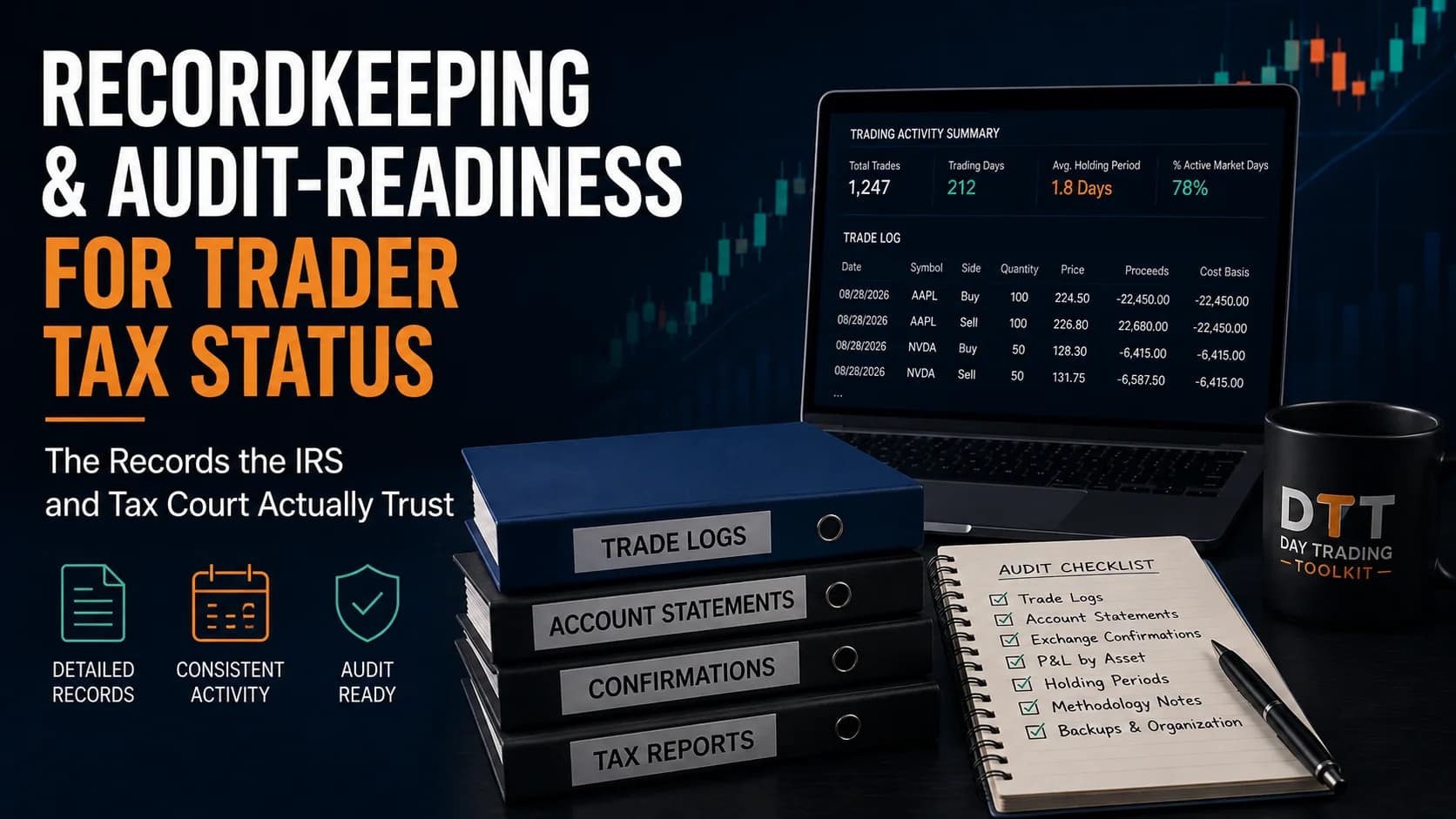
Record-Keeping: Your Best Defense in an Audit

If you claim TTS and MTM, your audit risk is higher. Period. The IRS knows these are powerful benefits and they want to make sure you’ve truly earned them.

Your best defense is meticulous records.

  • Trade Logs: Keep detailed logs of all your trades.
  • Time Logs: Keep a calendar or log of the time you spend trading, researching, and managing your business. This is your proof for the “regular and continuous” test.
  • Receipts: Keep every receipt for every business expense you plan to deduct.

When to Hire a Tax Professional (And What to Ask)

We are professional traders, not tax accountants. This guide is for educational purposes. Once you decide to pursue TTS, you must hire a professional.

Do not go to a standard retail tax preparer. You need a CPA who specializes in active traders and TTS. When you interview them, ask these questions:

  1. “How many clients with Trader Tax Status do you have?”
  2. “Can you explain the pros and cons of a Section 475(f) election for me?”
  3. “At what point would you recommend I form an S-Corp?”

If they can’t answer these confidently, find someone else.

Our Team’s Verdict: A Simple Tax Strategy for Day Traders

Navigating day trading taxes is a journey. Here’s the path our team recommends.

2D illustration of a trader choosing between the 'Investor' tax path with limits and the 'Trader' tax path (TTS/MTM) with deductions and benefits.
Choosing the right tax path is crucial. Qualifying as a trader unlocks strategies unavailable to investors.
  1. For Beginners: Don’t even think about taxes yet. Focus on learning to trade. You are an “investor” by default. Just be aware of the wash sale rule and the $3,000 loss limit.
  2. For Developing Traders: Once you are trading full-time (or near full-time) and have a consistent record of high-volume (hundreds of trades/year) activity for at least 6-12 months, it’s time to talk to a CPA about Trader Tax Status (TTS).
  3. For Profitable Traders: Once you have TTS and are consistently profitable, the next conversation is the Mark-to-Market (MTM) election. This is what shields you from the wash sale rule and fully unlocks your losses.
  4. For Futures Traders: You’re already in great shape. The Section 1256 (60/40) rule gives you a significant tax advantage from day one.
  5. For Business Owners: The S-Corporation is the final step, designed to optimize your tax bill after you are already a proven, profitable trading business.

Don’t try to do it all at once. Master your trading, then master your taxes.

For a primer, see our Day Trading and Taxes: Beginner Awareness post. The size of your account also matters, as we cover in How Much Money to Start Day Trading.

Frequently Asked Questions (FAQ) About Day Trading Taxes

How do day traders pay taxes?

Quick Answer: By default, day traders pay taxes on short-term capital gains at their ordinary income tax rate.

Most day traders are initially classified as “investors.” This means every profitable trade held for less than a year is a short-term capital gain, which is added to your total income and taxed at your normal federal and state rates. You’re also subject to the wash sale rule and a $3,000 limit on net capital loss deductions.

Key Takeaway: To change this, you must qualify for Trader Tax Status (TTS) and potentially elect Mark-to-Market (MTM) accounting.

How much does a day trader pay in taxes?

Quick Answer: This depends entirely on your tax bracket, but profits are taxed at the same high rates as a salary (10% to 37% federally, plus state tax).

If you’re an “investor,” your net trading profits are added to your other income (like a W-2 salary) to determine your total taxable income. If your job and trading profits put you in the 24% federal bracket, you’ll pay 24% on your last dollar of profit (plus state taxes). If you trade Section 1256 contracts (futures), you get a blended 60/40 rate which is more favorable.

Key Takeaway: Expect to pay your highest marginal tax rate on all stock trading profits unless you trade futures or can hold for over a year.

Do day traders have to pay taxes if they lose money?

Quick Answer: Yes, it is dangerously possible to lose money overall and still owe taxes, primarily due to the wash sale rule.

If you are an “investor,” the wash sale rule disallows losses if you re-buy the same stock within 30 days. Active traders can easily have thousands in disallowed losses at year-end. This means your 1099-B from your broker could show a taxable gain even if your account value went down.

Key Takeaway: This is the #1 reason serious stock traders seek TTS and a Mark-to-Market election, which eliminates the wash sale rule.

Can day traders write off losses?

Quick Answer: Yes, but the rules are different. “Investors” can only deduct $3,000 of net capital losses per year. Traders with a Mark-to-Market election can deduct 100% of their losses.

Investors: You offset capital gains with capital losses. If you have more losses than gains, you can only deduct a net $3,000 against your other income. The rest is carried forward.
Traders (with TTS + MTM): Your losses are “ordinary losses.” They are not subject to the $3,000 limit. You can use them to offset all your other income (W-2, business, etc.) in the same year.

Key Takeaway: This “tax loss insurance” is a primary benefit of electing Mark-to-Market (MTM) accounting.

Do day traders file taxes quarterly?

Quick Answer: If you are consistently profitable and expect to owe more than $1,000 in tax for the year, the IRS requires you to make quarterly estimated tax payments.

The US tax system is “pay-as-you-go.” When you have a W-2 job, this is handled via withholding. As a profitable trader, you are your own employer and are responsible for sending these payments to the IRS four times a year. If you fail to do so, you will likely face an underpayment penalty.

Key Takeaway: Profitable trading is a business, and businesses must pay their taxes quarterly, not just once in April.

What tax forms do day traders receive?

Quick Answer: You will primarily receive a Form 1099-B from your broker.

The Form 1099-B (Proceeds from Broker and Barter Exchange Transactions) shows all your gross proceeds, cost basis, and whether your gains/losses were short-term or long-term. Your broker will also report any wash sale losses. If you trade Section 1256 contracts, this information may be on your 1099-B or a separate statement showing your net 1256 gain/loss.

Key Takeaway: You use the 1099-B to fill out Form 8949 and Schedule D (for investors), or Form 4797 (for MTM traders), and Form 6781 (for futures).

Is day trading considered a business by the IRS?

Quick Answer: Only if you meet the specific criteria for Trader Tax Status (TTS). By default, it is not considered a business.

The IRS defaults to classifying you as an “investor.” To be considered a “business,” you must demonstrate substantial, regular, and continuous trading activity with the intent to profit from short-term moves. You can’t just declare yourself a business; your actions must prove it.

Key Takeaway: Qualifying for TTS is the only way to have your trading treated as a business and unlock business-level tax deductions.

What is the difference between an investor and a trader for tax purposes?

Quick Answer: An “investor” holds for capital appreciation, while a “trader” profits from short-term price moves. The tax treatment is completely different.

Investor (Default): Subject to wash sale rule. $3,000 capital loss limit. Cannot deduct business expenses (software, home office).
Trader (with TTS): Can deduct business expenses. If they also elect MTM, the wash sale rule does not apply and the $3,000 loss limit is removed.

Key Takeaway: Your tax liability and strategic options are defined by which of these two categories you fall into.

Article Sources

  • IRS.gov – Topic No. 429, Traders in Securities
  • IRS.gov – Publication 550, Investment Income and Expenses
  • IRS.gov – About Form 6781, Gains and Losses From Section 1256 Contracts
  • Investopedia – Benefits for Active Traders Who Incorporate
  • Investopedia – Section 1256 Contract: Definition and Tax Rules
  • IRS.gov – How small business owners can deduct their home office
  • Collective.com – LLC vs S Corp: The Difference and Tax Benefits

The DayTradingToolkit.com team, comprised of professional traders and fintech researchers, is committed to providing content built on a foundation of verifiable, high-authority sources. We rely on primary data from government agencies (like the SEC and BLS), academic research, financial white papers, and data from reputable financial institutions. All content is created to be objective, educational, and is fact-checked against these sources to ensure accuracy.

Tags: Day Trading Taxes
Previous Post

The Hidden Costs of Automated Trading: Why Your Backtest Lies

Next Post

What Is Trader Tax Status (TTS)? A Complete Guide to Qualifying

Kazi Mezanur Rahman

Kazi Mezanur Rahman

Kazi Mezanur Rahman is the founder of DayTradingToolkit.com and an active day trader since 2018. With over 6 years of hands-on trading experience combined with a background in fintech research and web development, Kazi brings real-world perspective to every platform review and trading tool analysis. He leads a team of traders, data analysts, and researchers who test platforms the same way traders actually use them—with real accounts, real money, and real market conditions. His mission: replace confusion with clarity by sharing what actually works in day trading, backed by independent research, live testing, and plain-English explanations. Every article on DayTradingToolkit.com is verified through hands-on experience to ensure practical value for developing traders.

Next Post
Featured Image for What Is Trader Tax Status (TTS)? A Complete Guide to Qualifying

What Is Trader Tax Status (TTS)? A Complete Guide to Qualifying

Featured Image for Mark-to-Market Trading (475(f)): Day Trader Tax Guide

Mark-to-Market Trading (Section 475(f)): The Ultimate Day Trader Tax Tool

Featured Image for Section 1256 Contracts: The 60/40 Tax Advantage for Traders

Section 1256 Contracts: The 60/40 Tax Advantage for Futures Traders

Leave a Reply Cancel reply

Your email address will not be published. Required fields are marked *

I agree to the Terms & Conditions and Privacy Policy.

Disclaimer & Affiliate Disclosure
Transparency & risk details — please read
Read the disclaimer & affiliate disclosure ▸

Disclaimer: All content on DayTradingToolkit.com is for educational purposes only and does not constitute financial advice. Day trading is a high-risk activity, and you should not trade with money you cannot afford to lose. Please consult with a qualified financial advisor before making any investment decisions.

Affiliate Disclosure: DayTradingToolkit.com may receive a commission if you sign up for a product or service through one of our affiliate links. This comes at no extra cost to you and helps us to continue creating high-quality content. We only recommend products our team has personally used and vetted.

Read Full Disclaimer
🔥 Christmas Sale - Up to 25% OFF

Trade Ideas Christmas Sale

Get up to 25% off Trade Ideas Subscriptions.

Holly AI Trading Assistant
Real-time Market Scanners
60+ Backtested Strategies
TI Money Machine (Sim)
Get Coupon Code

Limited-time Black Friday exclusive – don't miss out!

Popular Tags

Algorithmic Trading (9) Beginners Guide Stage 1 (8) Beginners Guide Stage 2 (9) Beginners Guide Stage 3 (8) Beginners Guide Stage 4 (5) breakouts-momentum (14) Day Trading Taxes (7) Economic Reports (7) Market-Specific Strategies (15) Pre-Market Game Plan (1) sideways-choppy (13) Special Events (10) Strategy-Building (3) Strategy by Market Condition (15) The Trader's Playbook (21) time-and-events (22) Time-of-Day (5) trending-markets (12)
Day Trading Toolkit | Proven Strategies, Tools & Beginner’s Guide

© 2025 DayTrading Toolkit

Navigate Site

  • Home
  • Privacy Policy
  • Disclaimer
  • Contact Us
  • About
  • Free Trading Calculators

Follow Us

Day Trading Toolkit | Proven Strategies, Tools & Beginner’s Guide
Manage Consent
To provide the best experiences, we use technologies like cookies to store and/or access device information. Consenting to these technologies will allow us to process data such as browsing behavior or unique IDs on this site. Not consenting or withdrawing consent, may adversely affect certain features and functions.
Functional Always active
The technical storage or access is strictly necessary for the legitimate purpose of enabling the use of a specific service explicitly requested by the subscriber or user, or for the sole purpose of carrying out the transmission of a communication over an electronic communications network.
Preferences
The technical storage or access is necessary for the legitimate purpose of storing preferences that are not requested by the subscriber or user.
Statistics
The technical storage or access that is used exclusively for statistical purposes. The technical storage or access that is used exclusively for anonymous statistical purposes. Without a subpoena, voluntary compliance on the part of your Internet Service Provider, or additional records from a third party, information stored or retrieved for this purpose alone cannot usually be used to identify you.
Marketing
The technical storage or access is required to create user profiles to send advertising, or to track the user on a website or across several websites for similar marketing purposes.
  • Manage options
  • Manage services
  • Manage {vendor_count} vendors
  • Read more about these purposes
View preferences
  • {title}
  • {title}
  • {title}
No Result
View All Result
  • Home
  • Beginner’s Guide
  • Psychology & Risk
  • Strategies
  • Reviews & Comparisons
  • Blog
  • Free Tools
    • Day Trading Dictionary
    • Reward/Risk Calculator
    • Position Size Calculator
    • Trade Growth Calculator
    • Trade Fee Calculator
    • Stop Loss & Take Profit Calculator
    • Trade Profit Loss Calculator

© 2025 DayTrading Toolkit