Trade Ideas vs Finviz: Is the AI Worth 6× the Price?

In this article7 sections
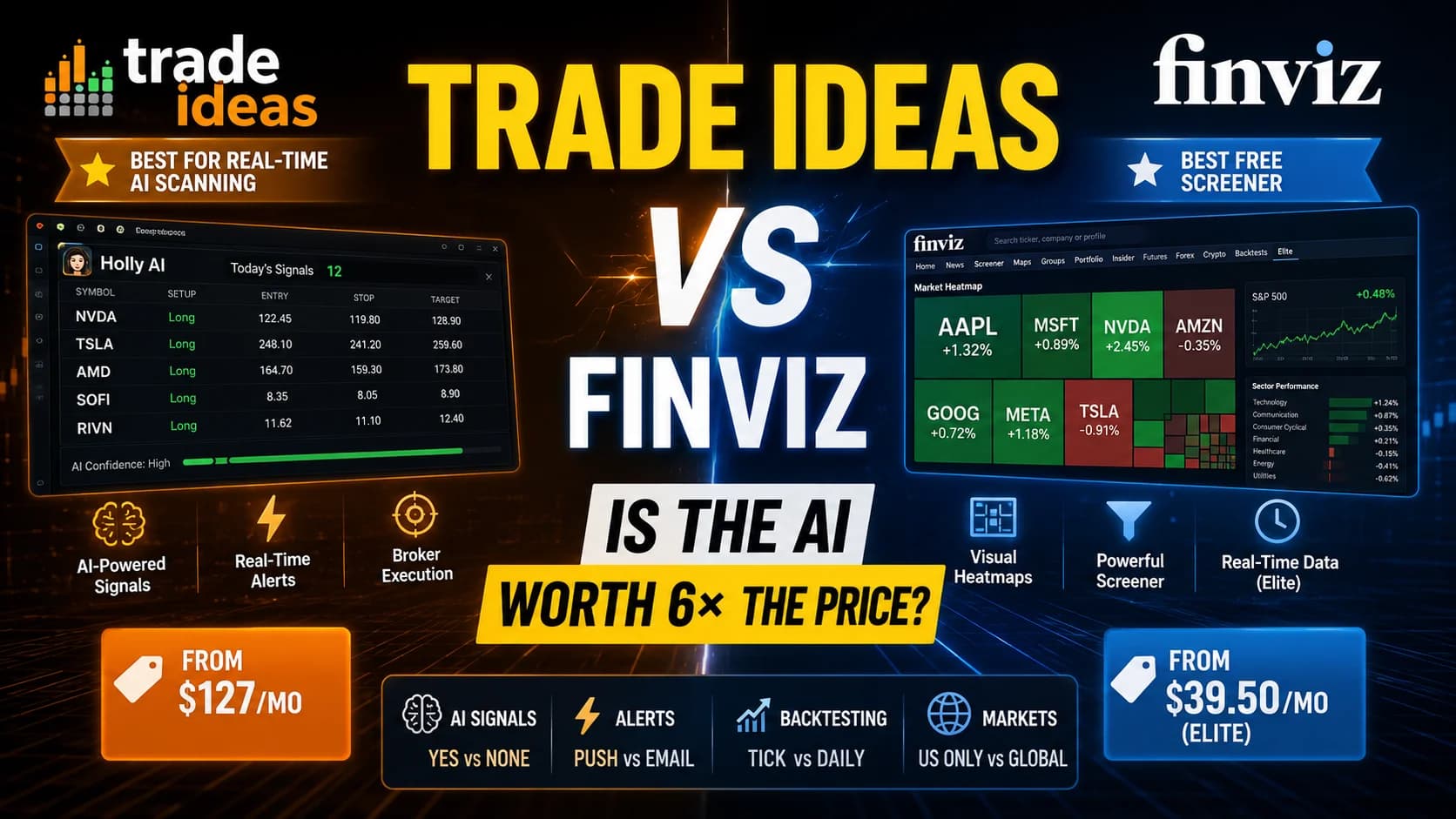
Finviz Elite costs $39.50 a month. Trade Ideas Basic ("The Core") starts at $127. Trade Ideas Premium ("The Apex") — the plan with Holly AI — costs $254 a month. That's a price gap of 3× to 6×, and whether that gap is justified depends entirely on one question: do you need AI-driven real-time signals pushed to you, or do you need a fast screener you operate yourself?
That's the whole comparison. Everything else — the heatmaps, the backtesting differences, the execution capabilities — flows from that core distinction.
Trade Ideas vs Finviz
Best for Real-Time AI ScanningTrade Ideas 8.6/10 | Best Free ScreenerFinviz 8.3/10 | |
|---|---|---|
| Real-time data | Always included | Elite only ($39.50/mo); free tier = 15-min delay |
| AI signals | Holly AI, 5–25/day | None — no AI at any tier |
| Alert type | Server-side push, instant | Email alerts (manual setup) |
| Visual heatmaps | None | Yes — Finviz's signature feature |
| Broker execution | Yes — IBKR, E*TRADE, TradeStation, Alpaca | None |
| Backtesting | OddsMaker — tick-level, intraday | Basic — daily timeframe only |
| Asset coverage | US stocks/ETFs only | Stocks, ETFs, forex, futures, crypto |
| Entry price | $127/mo (The Core) | Free / $39.50/mo (Elite) |
| Get started | Read Trade Ideas Review | Read Finviz Review |
What is the difference between Trade Ideas and Finviz? Trade Ideas is a real-time AI scanning platform: Holly AI surfaces intraday trade setups from nightly backtesting, and server-side scanning pushes alerts to you the moment a stock triggers your criteria. Finviz is a browser-based stock screener and financial visualization tool: it gives traders a fast, manual way to filter markets, analyze sectors via heatmaps, and build watchlists — with no AI signals and no broker execution at any price tier.
The Core Difference: Proactive Discovery vs Active Screening
The real distinction between these two platforms is not price. It's direction of information flow.
Finviz is a tool you operate. You define filters, you run the screener, you read what comes back. It's fast and capable, and for traders who know what they're looking for before they sit down, that workflow works very well. The free tier is genuinely useful — millions of traders use Finviz daily without ever paying a cent, and the heatmaps alone make it worth bookmarking.
Trade Ideas flips the model. You set your scan parameters once and the platform watches the entire market for you, pushing an alert the moment a stock triggers your criteria. Server-side processing means the alert fires in real time on the exchange data feed — not on a 15-minute delay, and not waiting for you to click "run scan" again. Holly AI adds another layer: every night it re-evaluates dozens of strategies and issues 5–25 ready-to-trade intraday signals the next session, complete with entry, stop, and target, before you've even opened your morning coffee.
The question isn't which one is "better." It's which information flow matches how you trade.
What Finviz Does Well (And What It Doesn't)
Finviz earned its reputation for two things: speed and heatmaps. On the screener speed, the platform is genuinely fast — filtering 8,000+ stocks across 60+ criteria and getting results is nearly instantaneous. The heatmaps — color-coded visual blocks showing which sectors and stocks are gaining or losing — have become one of the most recognized market visualizations in retail trading, and Trade Ideas has nothing comparable.
The free tier holds up well for research, watchlist building, and pre-market preparation on end-of-day data. Finviz wins for investors and swing traders who want a fast, mostly free way to filter markets, visualize leadership, and analyze sectors. Finviz Elite ($39.50/mo monthly, or $24.96/mo on annual billing) adds real-time data, email alerts, backtesting against 20 years of daily data, and API access.
Where Finviz genuinely falls short for active day traders:
No AI at any tier. This is the most concrete differentiator. Finviz has no Holly equivalent, no signal engine, no nightly optimization. You supply all the intelligence. The screener surfaces what meets your filters; it doesn't suggest what you should be looking for today.
Email alerts, not push alerts. Finviz Elite's alert system fires email notifications when criteria are met. For active intraday trading, that's inadequate — you need to be at your screen reading email in real time. Trade Ideas' alerts fire in the platform the moment a condition triggers.
Backtesting is basic. Finviz Elite's backtest covers daily timeframes only — no intraday, no tick-level, no complex multi-condition strategies. Trade Ideas' OddsMaker backtests against tick-level historical data at any intraday resolution.
No broker execution. Finviz is a research tool, full stop. There's no brokerage integration, no one-click execution, no automation layer. Everything stops at the watchlist.
What Trade Ideas Does That Justifies the Price Gap
The price difference is real and significant. Here's exactly what the additional cost buys.
Real-time server-side scanning. This is the foundational difference for active intraday trading. Trade Ideas' scanners run on the company's servers and push alerts to you the moment conditions fire on live exchange data. Most traders comparing these two eventually cite a specific experience: finding an alert in Finviz after a stock has already moved, versus catching the same alert in Trade Ideas while the setup was still fresh. Over enough occurrences, the speed difference is measurable in execution quality.
Holly AI signal generation. Holly runs nightly simulations, re-evaluates which strategies are working in current market conditions, and issues real-time intraday trade signals the next session. Each signal carries a specific entry, stop, and target — not a vague directional call. Finviz has zero equivalent to this at any price point. For traders who want AI to identify opportunities rather than just confirm ones they've already found, this is the entire justification for The Apex tier.
OddsMaker backtesting. Trade Ideas' no-code backtester runs against tick-level historical data. You build a scan, you backtest it, you see the historical win rate, average gain, maximum drawdown. That's substantially more useful than Finviz Elite's basic daily-timeframe backtest for anything resembling active intraday trading.
Brokerage Plus execution. Trade Ideas connects directly to Interactive Brokers, E*TRADE, TradeStation, and Alpaca. When Holly fires a signal, you can execute with one click without leaving the platform. Finviz has no brokerage integration.
The Money Machine. Trade Ideas' second-generation AI layer manages momentum positions autonomously — monitoring, entering, and rotating among the market's strongest names in real time. There is no Finviz equivalent, and there's nothing in Finviz's feature roadmap that suggests one is coming.
The Pricing Math, Honestly
The gap looks large until you add up what Trade Ideas replaces.
Trade Ideas Premium ("The Apex") at $178/month effective (annual billing) bundles all U.S. market data with no separate exchange fees. Most competing platforms charge $40–60/month for the same data separately. Subtract that from the headline price and you're comparing against a net cost closer to $120–140/month for the AI and execution layer.
Finviz Elite at $24.96/month (annual) or $39.50/month (monthly) is one of the best value buys in trading software. But most active day traders using Finviz find they need to add a separate charting platform for technical analysis — which means TradingView or similar adds another $30–60/month. The combined cost of Finviz Elite plus a charting platform lands around $55–100/month, which starts closing the gap with Trade Ideas' Core plan considerably.
For current Trade Ideas codes and the full savings math, the deals page and the maximum discount guide cover both.
Who Should Use Finviz (And Who Should Use Trade Ideas)
Finviz is the stronger choice if:
- You're a swing trader or investor who makes decisions on daily/weekly data
- Your pre-market routine is building a watchlist, not live-scanning for signals
- Budget is a real constraint — the free tier may genuinely cover your needs
- You trade multiple asset classes beyond U.S. stocks (Finviz covers forex, futures, crypto too)
- You want a fast visual market overview without complexity
Trade Ideas is the stronger choice if:
- You trade actively — multiple setups per day, in front of screens during market hours
- You want AI signals surfacing opportunities you haven't thought to search for
- You need real-time alerts that fire the instant a condition triggers
- You plan to use integrated broker execution rather than switching platforms to trade
- The cost is justifiable against how often you actually use the platform
You might benefit from both if:
- You use Finviz for pre-market watchlist building (it's faster for visual screening) and Trade Ideas for intraday live scanning and signals
- This "layered scanning" approach — Finviz to build the universe, Trade Ideas to monitor it — is exactly what many active traders do. Finviz for initial screening, Trade Ideas for intraday execution is a documented workflow across trading communities.
The honest word for newer traders: if you're still learning to read setups and build a process, start with Finviz's free tier. The cost of Trade Ideas during the learning phase is hard to justify before you have a defined edge. Come back to Trade Ideas when "finding setups fast enough" is the genuine bottleneck — not before.
The Honest Verdict
For swing traders, researchers, and anyone building a watchlist rather than live-scanning: Finviz, probably starting with the free tier.
For active equities day traders who need AI signals, server-side real-time scanning, and broker execution: Trade Ideas, with The Apex plan if Holly is the reason you're there.
The price gap is justified when you trade often enough, and it isn't when you don't. That's a simpler calculation than it first appears.
Frequently Asked Questions
Is Finviz good enough for day trading, or do I need Trade Ideas?
Finviz Elite with real-time data is adequate for pre-market preparation — running overnight gap scans, building a watchlist, checking sector heat maps. Where it fails active intraday traders is the alert model: email notifications on manual trigger versus Trade Ideas' server-side push alerts that fire in real time. If your trading happens during market hours and speed to alert matters, Trade Ideas is the right tool.
Key Takeaway: Finviz for pre-market watchlist building; Trade Ideas when live intraday scanning is your actual bottleneck.
Does Finviz have AI like Trade Ideas?
Trade Ideas' Holly AI is the clearest functional gap between these two platforms. Holly runs nightly backtesting across dozens of strategies and issues real-time signals with entry, stop, and target during the session. Finviz applies no machine learning to signal generation; you supply all the intelligence through your filter choices. If AI-driven setup discovery is the goal, Finviz is the wrong tool entirely.
Key Takeaway: AI signals are Trade Ideas-exclusive — the Holly AI explainer covers exactly how they work.
Is Finviz Elite worth it compared to Trade Ideas?
Comparing Finviz Elite to Trade Ideas is less a head-to-head than a workflow question. If you need real-time data plus a fast screener for pre-market prep, Finviz Elite is hard to beat on value. If you need AI signals pushing setups to you in real time during market hours plus broker integration, you need Trade Ideas. The two solve different problems.
Key Takeaway: Finviz Elite wins on value for what it does; Trade Ideas wins on capability for active intraday trading.
Can I use Finviz and Trade Ideas together?
The workflow is complementary: Finviz heatmaps and screener to build the morning watchlist and understand sector rotation; Trade Ideas scanners and Holly alerts to monitor those stocks and find new setups during market hours. The two don't overlap functionally enough to create redundancy.
Key Takeaway: Using both is a legitimate and common workflow — Finviz for preparation, Trade Ideas for live trading.
How does Finviz's screener compare to Trade Ideas' scanners?
Finviz's screener is faster to set up for basic filtering and covers more asset classes including forex, futures, and crypto. Trade Ideas' scanning engine is more sophisticated for U.S. equities intraday work — 500+ filter types, simultaneous active scans, and real-time push alerts that fire the moment a condition triggers on the exchange feed. For swing trading and research, Finviz is more than enough. For momentum day trading, Trade Ideas' scanning architecture is in a different category.
Key Takeaway: Finviz is better for broad market research; Trade Ideas is better for active real-time intraday scanning.
Is the Finviz free plan good enough?
Finviz free runs on 15-minute delayed data, which makes it unsuitable for intraday execution decisions. But for pre-market research, sector analysis via heatmaps, fundamental screening, and building a daily watchlist on end-of-day data, the free plan is genuinely capable. Millions of professional traders use it as part of their morning routine without paying for Elite.
Key Takeaway: The free plan is excellent for research; upgrade to Elite when real-time data becomes a trading requirement.
What does Trade Ideas have that Finviz doesn't?
These are not incremental upgrades — they're different categories of tool. Holly generates trade ideas from nightly strategy optimization; Finviz has nothing comparable. Trade Ideas' server-side alerts fire in real time versus Finviz's manual screener. OddsMaker backtests at tick resolution versus Finviz's daily-timeframe-only backtest. And Trade Ideas executes directly through four brokers; Finviz stops at the watchlist.
Key Takeaway: Trade Ideas adds AI, real-time automation, and execution — Finviz is a research and visualization tool.
Does Finviz have real-time data?
Finviz Elite at $39.50/month (or $24.96/month annually) adds real-time data across the platform, including pre-market and after-hours quotes from 4:00 AM to 8:00 PM. The free plan's 15-minute delay means any setup you find in the screener may have already moved significantly before you can act on it.
Key Takeaway: Real-time data requires Elite; for intraday trading, delayed data is not usable for live decisions.
Which is better for beginners — Finviz or Trade Ideas?
Trade Ideas assumes you already have a strategy and need to find setups faster. A beginner who doesn't yet know what they're looking for will get more from Finviz's visual market overview than from 500+ filter options in Trade Ideas. Start with Finviz, build a process, and add Trade Ideas when screening speed is the genuine bottleneck — not before.
Key Takeaway: Start with Finviz free; add Trade Ideas when you're actively trading and real-time scanning is the constraint — the beginner's guide covers what to build first.
Was this helpful?
Be the first to weigh in

Written by
Kazi Mezanur RahmanFounder, independent researcher, and editor of DayTradingToolkit. A one-person publication focused on risk-first trading education and documented tool research. He trades his own capital as a retail trader and combines personal market experience with systematic primary-source research.
Keep Reading
Tools & Tutorials
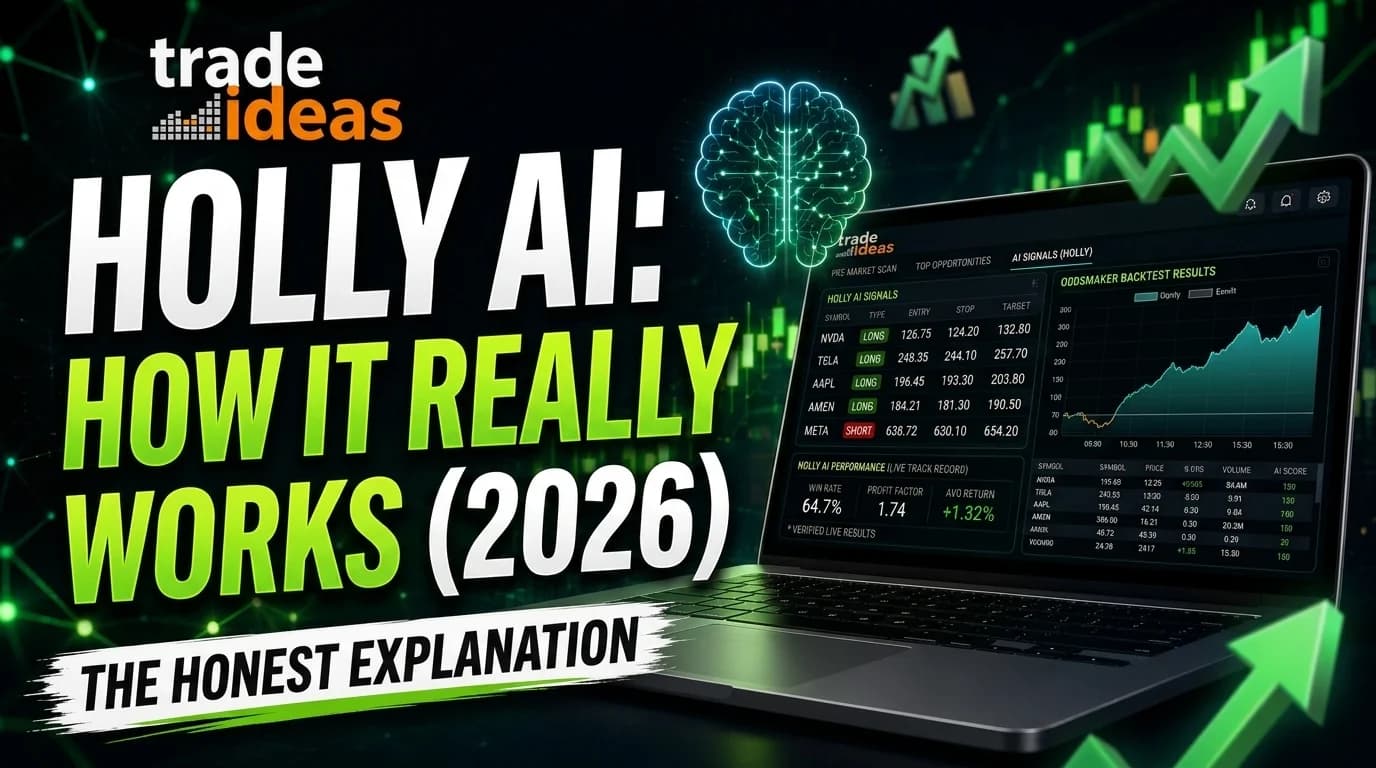
Trade Ideas Holly AI: How It Really Works (And What Nobody Tells You)
How does Trade Ideas' Holly AI work? An honest breakdown of the nightly simulation, the three Holly systems, signal mechanics, limits, and who it's for.
Tools & Tutorials
Trade Ideas Promo Code & Discount: How to Save Up to 51%
Learn how to cut Trade Ideas costs by up to 51% with smart billing, promo codes, and timing — save hundreds while keeping full AI trading power.
Comparisons
Finviz vs. TradingView: Screener Speed vs. Charting Depth
Finviz gets you to a watchlist fast and cheap. TradingView gives you the charting depth and execution to actually trade what you find. Here's which one your workflow actually needs.
Comparisons
TrendSpider vs. Finviz: Full Platform or Screener?
Finviz gets you from idea to watchlist in seconds for the price of a coffee subscription. TrendSpider tries to be your whole research and automation stack. Here's which one actually fits your workflow.
Comments
No comments yet. Be the first to share your thoughts.