
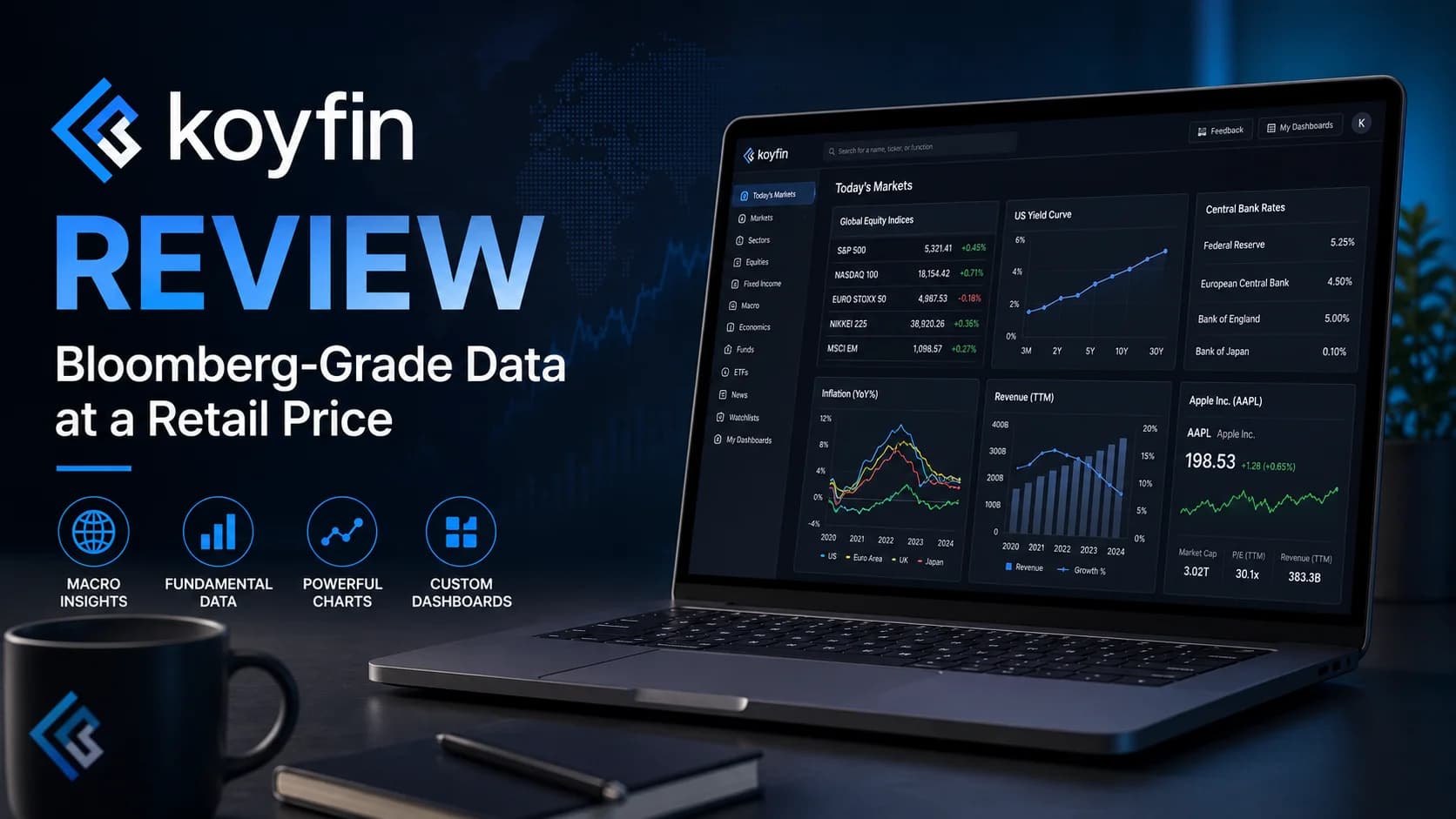
A Bloomberg Terminal costs somewhere around $25,000 to $30,000 a year per seat, which puts it out of reach for almost every individual investor no matter how serious their research process is. Koyfin's entire reason for existing is closing that GapA gap is a price discontinuity on a chart where a stock opens significantly higher or lower than the previous session's close, leaving a visible empty space — gap-ups are driven by overnight buying pressure or positive news; gap-downs by seRead definition → — institutional-grade data, delivered through a modern web interface, at a price an independent investor can actually justify. It mostly succeeds, with real, specific limits worth understanding before you subscribe.
What is Koyfin? Koyfin is a web-based financial data and analytics platform, founded in 2016 by former Goldman Sachs and Bloomberg LP employee Rob Koyfman, built around macroeconomic dashboards, fundamental company data, and customizable charting. It sources institutional-grade data through S&P Capital IQ and is used by more than 500,000 investors, positioned as an affordable alternative to expensive professional terminals like Bloomberg and FactSet.
This review evaluates Koyfin against the criteria that matter most for a research and data platform — macro and fundamental data depth, charting quality, pricing (including a 2026 plan restructuring worth knowing about), and how well any of it applies to day trading. It's based on documented research into Koyfin's official pricing and feature pages alongside independently published reviews, not a claimed personal subscription history.
What's good
- Genuinely exceptional macro data depth — yield curves, central bank rates, and inflation, employment, and GDP data across 40-plus countries, a level of top-down coverage most retail-accessible platforms simply don't offer.
- Institutional-grade underlying data via S&P Capital IQ, the same data infrastructure used by professional research desks, at a small fraction of what a Bloomberg or FactSet terminal costs.
- A genuinely functional free tier, not a stripped demo, plus a 7-day Pro trial with no credit card required, giving a real way to evaluate the platform before paying.
- Consistently praised setup and interface speed across independent reviews, with most users reporting a working dashboard within minutes rather than a steep onboarding process.
- A third-party Kitces Report specifically scored Koyfin highly for value relative to cost, outperforming several considerably more expensive platforms in that comparison.
Trade-offs
- Koyfin reworked its pricing tiers in 2026, retiring the old "Pro" plan name and introducing dedicated advisor tiers — a number of older reviews still cite pricing and tier names that no longer apply, worth verifying directly before subscribing.
- Charting and technical analysis tools are functional but consistently described as more basic than dedicated charting platforms, and slower in some cases than free alternatives like Yahoo Finance.
- No mobile app — Koyfin is web-based only, a real limitation for anyone who wants to check dashboards or watchlists away from a desktop.
- Explicitly not built for day trading or execution — free-tier data is delayed, there's no real-time order routing, and the entire platform is oriented around research rather than trade execution.
What Is Koyfin? A Closer Look
Koyfin was founded in 2016 by Rob Koyfman, whose background at Goldman Sachs and Bloomberg LP shaped the platform's core thesis directly: the institutional research infrastructure he'd used professionally shouldn't require an institutional budget to access. The platform sources its underlying data through S&P Capital IQ — the same data provider professional analysts rely on — and has grown to more than 500,000 users, spanning individual investors, financial advisors, and portfolio managers.
The platform's identity centers on two things it does genuinely well: macro dashboards and fundamental company analysis. Rather than trying to replicate Bloomberg's trading infrastructure or real-time execution capabilities, Koyfin focuses on the research side — global yield curves, central bank policy tracking, inflation and employment data, and detailed company financials, all viewable through customizable, drag-and-drop dashboards that most reviewers describe as considerably faster to learn than Bloomberg's function-code-driven interface.
Worth knowing upfront: Koyfin reworked its pricing structure in 2026, retiring the tier previously called "Pro" and introducing dedicated advisor-focused plans alongside its individual tiers. Multiple older reviews still reference pricing and tier names from before that change, so anything you read about "Koyfin Pro" pricing from earlier sources may not reflect the current structure.
Key Features
Macro Dashboards. This is Koyfin's clearest differentiator. Global yield curves across dozens of countries, central bank rate tracking for the Fed, ECB, Bank of England, Bank of Japan and others, and inflation, employment, and GDP data with historical charting and cross-country comparison — a depth of top-down macro coverage that's genuinely rare outside a professional terminal.
Fundamental Company Data. Detailed financial statements, analyst estimates, and valuation metrics across global equities, ETFs, and mutual funds, with the ability to overlay fundamentals directly on price charts. Multiple reviewers specifically highlight this fundamentals-on-price charting as a real time-saver compared to manually building the same view in a spreadsheet.
Customizable Dashboards. Drag-and-drop dashboard building lets you combine macro indicators, equity data, and fund performance into a personalized workspace, whether your focus is SectorA broad grouping of companies that operate in the same segment of the economy — such as Technology, Healthcare, Energy, or Financials. Stocks within a sector tend to move together in response to shared economic, regulatory, and sentiment faRead definition → rotation, a specific watchlist, or broad macro monitoring. Independent reviews consistently describe initial setup as fast — often five minutes or less to a working dashboard.
Charting. Koyfin's charting supports standard technical elements — candlesticks, moving averages, annotations — and a stock screener with several hundred metrics. That said, independent reviewers are consistent that the charting experience is more basic than a dedicated charting platform, and in some cases slower than free tools like Yahoo Finance or Google Finance.
Screener. A stock screener covering several hundred metrics lets you filter across fundamental and some technical criteria. It's a genuinely useful research tool, though — consistent with Koyfin's overall positioning — it's built more for fundamentals-first screening than for the kind of fast, CatalystA catalyst is the specific event or news item that triggers unusual price movement in a stock — earnings reports, FDA decisions, analyst upgrades, acquisition announcements, product launches, and short squeeze setups are all catalysts. WithRead definition →-driven Pre-MarketPre-market trading is the session that occurs between 4:00 AM and 9:30 AM Eastern, before the regular market opens — it allows traders to react to overnight news and earnings reports, establishes where stocks will likely open (the gap), andRead definition → screening a day trader typically wants.
Portfolio and Advisor Tools. Portfolio modeling and tracking across multiple accounts, plus dedicated Advisor Core and Advisor Pro tiers with client-portfolio reporting and custodian integrations — features aimed specifically at financial advisors and RIAs managing client assets rather than an individual self-directed investor.
For pure charting and technical analysis depth, several independent reviewers explicitly point toward TradingView as the stronger choice, and for fast pre-market screening specifically, a dedicated screener tends to go further than Koyfin's fundamentals-oriented tool. DayTradingToolkit's TradingView review and Finviz review cover both alternatives in detail if either gap matters more to your workflow than Koyfin's macro and fundamental depth.
Who Koyfin Is Best For
Koyfin earns its reputation for a specific kind of investor, and it's worth being direct that day trading isn't part of that picture.
It's a strong fit if you're a fundamental or macro-oriented investor who wants institutional-grade data — yield curves, central bank tracking, detailed company financials — without an institutional budget, and you're comfortable doing research on desktop rather than needing a mobile app. It's also a strong fit for financial advisors and portfolio managers who want client-ready dashboards and reporting at a fraction of what a full professional terminal costs.
It's a weaker fit if day trading or short-term technical analysis is your main use case — Koyfin is explicit that it's a research platform, not a trading terminal, with no real-time execution and charting that's genuinely more basic than dedicated platforms. DayTradingToolkit's guide to day trading vs. swing trading vs. investing covers why fundamentals- and macro-first tools like this one generally serve a longer research timeframe than day trading, if you're still working out which fits your goals.
Koyfin Pricing
Koyfin's pricing was restructured in 2026, so current tiers differ from what some older reviews still describe:
- Plan
- Free
- Price
- $0
- What's Included
- 2 dashboards, 2 watchlists, basic (delayed) financial data
- Plan
- Plus
- Price
- ~$39/month (cheaper billed annually)
- What's Included
- Expanded dashboards and watchlists, deeper historical data, additional formulas and templates
- Plan
- Premium (formerly "Pro")
- Price
- ~$79/month (cheaper billed annually)
- What's Included
- Real-time data, transcript search, full macro dashboard suite, advanced screener access
- Plan
- Advisor Core
- Price
- ~$209/month
- What's Included
- Client-portfolio tools, reporting, custodian integrations
- Plan
- Advisor Pro
- Price
- ~$299/month
- What's Included
- Full advisor feature set with expanded reporting and integrations
| Plan | Price | What's Included |
|---|---|---|
| Free | $0 | 2 dashboards, 2 watchlists, basic (delayed) financial data |
| Plus | ~$39/month (cheaper billed annually) | Expanded dashboards and watchlists, deeper historical data, additional formulas and templates |
| Premium (formerly "Pro") | ~$79/month (cheaper billed annually) | Real-time data, transcript search, full macro dashboard suite, advanced screener access |
| Advisor Core | ~$209/month | Client-portfolio tools, reporting, custodian integrations |
| Advisor Pro | ~$299/month | Full advisor feature set with expanded reporting and integrations |
A 7-day free trial of the paid tier is commonly available without requiring a credit card. Given the 2026 tier restructuring, treat any pricing figure from an older review with some caution and confirm current numbers directly on Koyfin's official pricing page before subscribing.
What Works Well
The macro dashboard depth is Koyfin's standout strength, and it's not a close comparison against most retail-accessible alternatives. Global yield curves, central bank policy tracking, and cross-country inflation and employment data, all in customizable dashboards, is the kind of top-down research infrastructure that historically required a professional terminal subscription.
The value proposition holds up under real scrutiny, not just marketing framing. A third-party Kitces Report — an independent financial-advisor-focused research firm, not Koyfin itself — specifically scored the platform highly for value relative to cost, ahead of considerably more expensive alternatives in that same comparison. That's a meaningfully more credible signal than a company's own value claims.
The interface and onboarding speed deserve real credit too. Multiple independent reviews across different platforms (G2, Capterra, and others) consistently describe initial setup as fast and the dashboard-building experience as genuinely intuitive — a real contrast to the learning curve traditionally associated with professional terminals like Bloomberg.
Limitations
Two limitations are worth taking seriously before subscribing.
Charting depth is a real, consistently-cited gap. While Koyfin's charts are functional and SupportSupport is a price level where buying pressure has historically overcome selling pressure, causing price to stop declining and reverse — it's the floor where demand enters the market, and when it holds, it's a potential long entry; when it Read definition → standard technical elements, independent reviewers are consistent that the experience is more basic than dedicated charting platforms, and in some cases slower than free alternatives. If deep technical analysis is central to your process, Koyfin alone likely won't be sufficient.
The 2026 pricing restructuring adds a real layer of confusion for anyone researching the platform right now. With the old "Pro" tier retired and renamed, plus new dedicated advisor tiers introduced, a meaningful amount of previously published pricing information no longer reflects the current structure — worth verifying directly rather than trusting any specific older figure.
Verdict
Koyfin Is Worth It for Fundamental and Macro-Focused Investors, Not Day Traders
Koyfin delivers genuinely institutional-grade macro and fundamental data at a small fraction of what a Bloomberg or FactSet subscription costs, backed by a third-party value assessment and consistently praised ease of use. Charting depth is a real, acknowledged gap relative to dedicated platforms, there's no mobile app, and the 2026 pricing restructuring means older reviews need re-verification. For this site's audience specifically, the clearest finding is that Koyfin is explicitly a research platform, not a trading terminal, with essentially no application to day trading.
Fundamental and macro-oriented investors, plus financial advisors, who want institutional-grade data at an accessible price — not day traders.
Frequently Asked Questions
Is Koyfin good for day trading?
Free-tier data is delayed rather than real-time, and the entire platform is built around macro and fundamental research rather than the intraday price action a day trader actually needs. A day trader evaluating Koyfin is evaluating a tool built for a fundamentally different research timeframe.
Key Takeaway: Koyfin is a fundamental and macro research tool; it has essentially no application to day trading specifically.
How much does Koyfin actually cost?
Koyfin restructured its pricing in 2026, retiring the old "Pro" tier name, so older reviews may cite different numbers or tier names than what's currently offered. Confirm current pricing directly on Koyfin's official site before subscribing.
Key Takeaway: Budget roughly $39–79/month for individual use depending on tier, and verify current pricing given the 2026 restructuring.
What changed with Koyfin's 2026 pricing update?
The practical effect is that a meaningful amount of previously published Koyfin pricing information — including specific tier names — no longer matches the current lineup. Treat any older third-party review's specific pricing figures as a starting point to verify rather than a guaranteed current rate.
Key Takeaway: If you're comparing pricing across multiple reviews, prioritize the most recent sources and verify directly with Koyfin given the 2026 changes.
Is Koyfin really comparable to Bloomberg Terminal?
Independent comparisons consistently describe Koyfin as covering a large share of what a self-directed investor or advisor actually needs from Bloomberg, at a small fraction of the cost, while being explicit that professional trading desks requiring execution infrastructure still need Bloomberg or a similar institutional terminal.
Key Takeaway: Koyfin is a strong Bloomberg alternative for research specifically; it's not a replacement for Bloomberg's trading and execution infrastructure.
Is Koyfin's free plan actually usable?
The free tier includes a limited number of dashboards and watchlists with basic financial data, enough to evaluate whether Koyfin's dashboard-building approach fits your research style before committing to a paid tier.
Key Takeaway: Use the free tier to test the dashboard-building workflow, but expect delayed rather than real-time data until you upgrade.
Does Koyfin have a mobile app?
This is a consistent limitation across independent reviews rather than a recent change, so it's worth factoring in if mobile access to your research dashboards matters to your workflow.
Key Takeaway: Plan on desktop-based use only; Koyfin doesn't currently offer a mobile app for on-the-go access.
Does Koyfin pair well with TradingView or Finviz?
Koyfin's own charting and screening tools are genuinely useful but consistently described as secondary to its macro and fundamental data strengths. DayTradingToolkit's TradingView review and Finviz review cover both alternatives for the specific gaps Koyfin doesn't fully close.
Key Takeaway: Koyfin's core strength is macro and fundamental data; pair it with a dedicated charting or screening tool for those specific needs.
What makes Koyfin's macro data special?
This depth of top-down macro coverage is rare among retail-accessible platforms specifically, and it's the feature most independent reviewers point to as Koyfin's clearest differentiator from cheaper or free alternatives.
Key Takeaway: If top-down macro research is part of your process, Koyfin's dashboard depth here is a genuine, hard-to-replicate strength at this price point.
Is Koyfin good for crypto research?
If crypto is a small part of a broader portfolio you're tracking alongside equities and macro data, Koyfin's basic price tracking is a reasonable convenience. For serious, dedicated crypto analysis, a crypto-native platform will serve you considerably better.
Key Takeaway: Use Koyfin for equity and macro research primarily; pair it with a dedicated crypto tool if that's a serious focus area.
Who founded Koyfin, and is the data trustworthy?
This lineage is a genuine credibility signal: both the founder's professional background and the underlying data source are independently verifiable facts, not just marketing claims specific to Koyfin itself.
Key Takeaway: Koyfin's data credibility rests on a verifiable, professional-grade data source (S&P Capital IQ), not an unverified proprietary claim.