
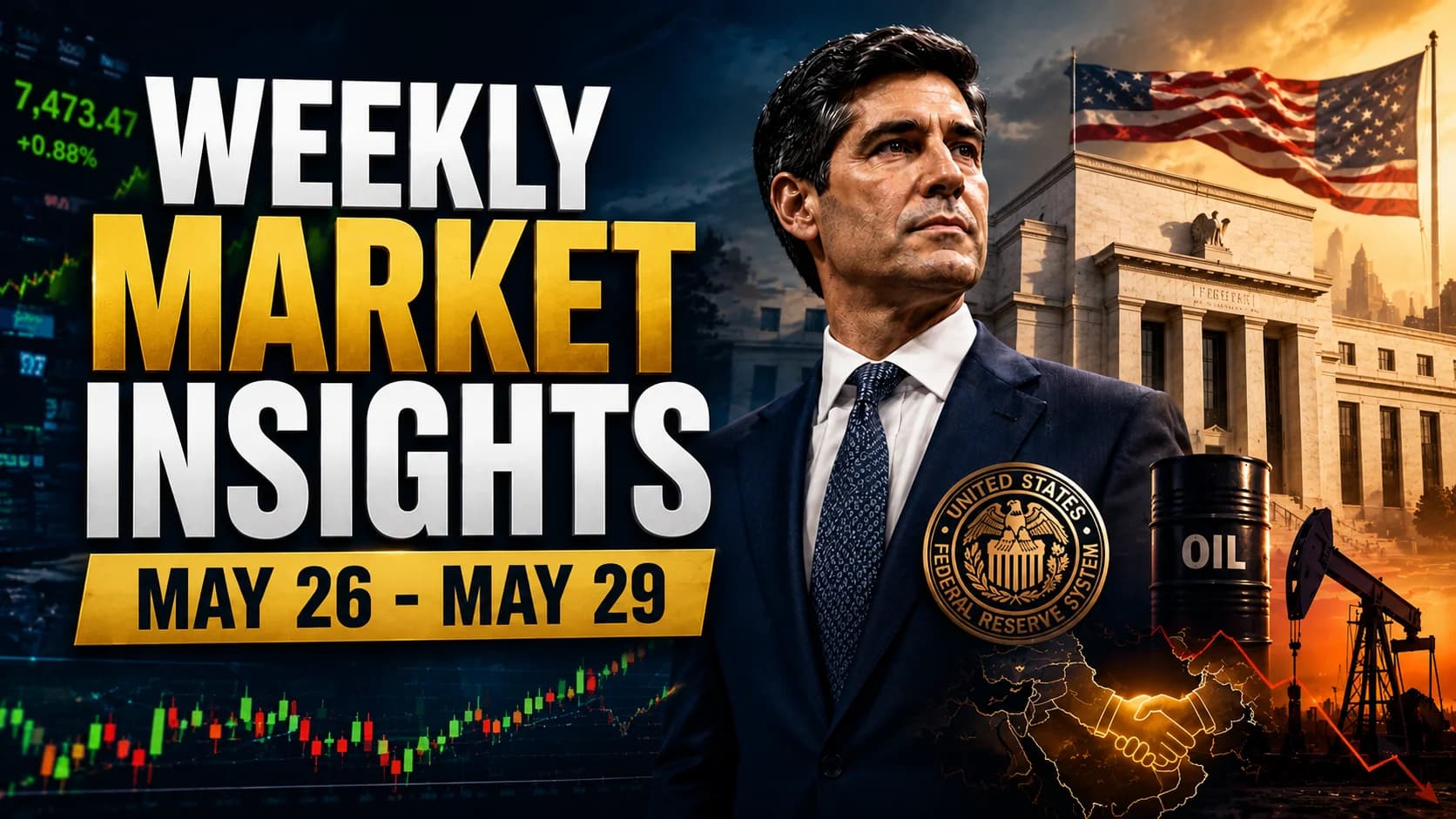
The S&P 500 closed Friday at 7,473.47. That's the eighth weekly gain in a row, the longest winning streak since 2023, and a tape that just refuses to break. The Dow set another all-time high. The VIXThe CBOE Volatility Index — a real-time measure of the market's expectation for 30-day volatility in the S&P 500, derived from the prices of S&P 500 options. Widely called the "fear gauge," a rising VIX indicates increasing uncertainty and Read definition → drifted back to 16.70. The calendar going into Memorial Day looked almost peaceful.
Then Friday happened.
Kevin Warsh was sworn in as the 11th chair of the Federal Reserve in the East Room of the White House. The first Fed chair sworn in at the White House since Greenspan in 1987. Powell, who held the job for eight years, stays on as a governor. And on the same day, Trump told reporters he had "largely negotiated" a peace deal with Iran, with an announcement expected as soon as Sunday afternoon.
So here we are. A 4-day trading week. A brand-new Fed chair whose first big macro data point will be PCE inflation on Thursday. A pending Iran deal that could either crush oil overnight or send it ripping if talks collapse. And in the middle of all that, the biggest software EarningsAn earnings report is the quarterly financial disclosure a public company files with the SEC, revealing revenue, earnings per share (EPS), profit margins, and forward guidance — it's the most significant regular catalyst for individual stocRead definition → dump of the quarter, headlined by Salesforce, Costco, Dell, Marvell, and Snowflake.
We think this is the most stacked week of the year so far. Not because anything is broken, but because so many different things are converging into one shortened window. The eight-week win streak gets tested. The new Fed chair gets his first real trading day. And every retail trader who looked at the calendar and thought "holiday week, slow tape" is about to find out the hard way that this is the wrong week to lower the guard.
Here's what we're watching, and why the "easy part" of this rally is officially behind us.
What Happened Last Week, the Short Version
The story last week was a tug-of-war between three forces, and stocks somehow ended up winning anyway.
Force one: rising yields. The 30-year Treasury touched 5.19% on Tuesday, the highest level in nearly 19 years. The 10-year hit a one-year high earlier in the week before settling at 4.56% by Friday. Bond markets were not buying any narrative about imminent rate cuts. If anything, traders quietly added to rate-hike bets. Markets are now pricing roughly a 40% probability of a 25 basis-point hike by December, according to Trading Economics. That's the opposite of what equity bulls have been positioning for.
Force two: AI infrastructure euphoria. Nvidia reported on Wednesday after the close. Revenue of $81.62 billion crushed the $78.86 billion consensus, EPS of $1.87 beat the $1.76 estimate, the company announced an $80 billion buyback authorization and raised its dividend 25x. CEO Jensen Huang said on the call that demand "has gone parabolic." And then the stock fell on Thursday, the fourth straight quarter where Nvidia beat and the stock dropped post-earnings. Dell, meanwhile, ripped 16.77% on Friday alone, pushing it up roughly 40% in a month going into its own earnings on May 28. Hewlett Packard Enterprise added 9% the same day. Super Micro tacked on 5%. The AI infrastructure trade is no longer subtle.
Force three: Iran. Oil cooled off as peace talks progressed. WTI ended the week around $96, Brent around $100. Down from the panic highs of two months ago when Israel and the US began coordinated strikes on Iran in late February. Friday's session was driven by optimism that a framework deal was close.
Net of all three: S&P up 0.88% on the week, Dow up 2.31% to new highs, Nasdaq up 0.45%, Russell 2000 up roughly the same. Eight straight green weeks.
That's the setup we're trading into.
The Current Market Regime
Regime read: late-stage TrendA trend is a sustained directional movement in price over time — an uptrend is characterized by a sequence of higher highs and higher lows, a downtrend by lower highs and lower lows — and correctly identifying the current trend direction isRead definition →-up, internally split, sentiment quietly cooling.
Let's start with the indices. SPY closed at $745.64 on Friday, up 0.39% on the day. QQQ closed at $717.54, up 0.42%. IWM closed at $285.25 per BlackRock's official NAV, up 0.91% in what was a small-cap-led session. The Dow added 294 points to 50,579.70, hitting another record. VIX printed 16.70, down a hair on the day, well off the 35.30 it touched on March 9 when the Iran situation looked apocalyptic.
So far, so bullish. But look one layer down and the picture gets more interesting.
SectorA broad grouping of companies that operate in the same segment of the economy — such as Technology, Healthcare, Energy, or Financials. Stocks within a sector tend to move together in response to shared economic, regulatory, and sentiment faRead definition → leadership last week was defensive. Energy held up, defensives held up, while economically sensitive areas like materials and industrials lagged. That's not the rotation you'd expect during a normal rally to all-time highs. In a healthy Bull MarketA bull market is a sustained period of rising prices in the broader market — traditionally defined as a 20% or greater rise from a recent significant low — characterized by strong economic growth, rising corporate earnings, investor confideRead definition →, materials and industrials lead because investors are pricing in stronger growth. When defensives lead while indices set highs, it usually means the rally is being driven by the biggest names, not the broader market. Per Bloomberg's Friday recap, the S&P 500 was up almost a half-percent while breadth was narrowing in real time.
The breadth narrative gets stranger when you remember what's happening in the bond market. The 30-year yield touched 5.19% Tuesday. That's a number you'd associate with the late 1990s, not 2026. Textbook reaction to 30-year yields at 19-year highs is for high-multiple growth stocks to get hammered. Instead, the Nasdaq closed the week up 0.45% and Dell ran 40% in a month. Our read is that the AI capex story has become so dominant that it's overriding the duration math that should otherwise be punishing tech. That's a fragile situation. It works until it doesn't, and we have no idea when it stops working. But we are watching the spread between rising long-duration yields and tech multiples very carefully.
On sentiment: the CNN Fear & Greed Index closed the week at 61 on Friday, in the "Greed" zone. Not extreme greed, but Greed. Meanwhile the AAII Sentiment Survey, released Wednesday evening for the week ending May 21, told a very different story. Bullish sentiment dropped 7.6 percentage points to 31.7%, falling below its historical average of 37.5% for the first time in five weeks. Bearish sentiment jumped 7.0 points to 43.6%. The bull-bear spread collapsed 14.6 points to -11.9%, which AAII flagged as "unusually low."
Translate that: institutional sentiment indicators are still bullish. But individual investors, the ones running their own accounts, just pulled their bullish bets dramatically even as the index made new highs. That divergence usually shows up at one of two points. Either it's a healthy "wall of worry" where stocks keep grinding because nobody's positioned long enough, or it's an early warning that retail noticed something institutions haven't priced in yet. We're not making a call on which one this is. But we're noting that the divergence exists.
Macro indicators worth pinning down: 10-year Treasury at 4.56%, 2-year at 4.13%, dollar index quietly firm, WTI crude at $96.36, Brent at $100.21, gold around $4,508 per ounce (down 0.75% Friday), Bitcoin at $75,880 (down 2.26% on the day, weakest of the major risk assets). The crypto weakness through Friday is one of those tells. Bitcoin usually tracks Nasdaq when risk appetite is healthy. When it diverges lower, it's often the canary.
The takeaway from the full regime read: we're in a tape grinding higher because the AI infrastructure narrative is overpowering everything else. But the internals (defensive leadership, retail bullishness collapsing, crypto fading, 30-year yields at 19-year highs) are flashing the early-stage warnings that usually precede a meaningful pause. The trend is up. The conviction is thinning.
The Week Ahead and What Actually Matters
This is a 4-day week. Markets are closed Monday for Memorial Day. That changes how everything trades. Tuesday opens with traders trying to digest a long weekend's worth of news (likely Iran-related), Wednesday is when earnings start landing in earnest, and Thursday is the macro and earnings double-shock day.
Let's go event by event.
Tuesday, May 26
The cash session opens for the first time under the Warsh-led Fed. Nothing changes mechanically on day one (the FOMC's policy framework doesn't shift overnight), but every algorithm that parses Fed speech is now calibrating against a new chair. Three economic releases hit Tuesday morning. The Philadelphia Fed Non-Manufacturing Survey at 8:30 AM ET, Consumer Confidence at 10:00 AM ET, and the Dallas Fed Manufacturing Survey at 10:30 AM ET. Of these, Consumer Confidence is the one to watch. The University of Michigan's May survey released Friday hit a new low, with consumers anxious about gas prices and inflation. If the Conference Board's measure confirms that read on Tuesday, the "consumer is fine" narrative cracks.
Earnings Tuesday are light. AutoZone (AZO) reports before the open with a $36.18 EPS estimate per Kiplinger. After the close, Zscaler (ZS) reports with a $1.01 estimate. Box (BOX), Modine (MOD), and Semtech (SMTC) round out the night. Cybersecurity has been quietly outperforming, and ZS earnings often set the tone for SentinelOne on Thursday.
Wednesday, May 27
New residential home sales at 10:00 AM ET. Richmond Fed manufacturing also at 10:00 AM. Nothing market-moving in the morning.
The story Wednesday is after the close. Salesforce (CRM) reports with a $3.13 EPS estimate on $11.1 billion of revenue (+13.3% YoY) per Kiplinger and Refinitiv consensus. Options markets are pricing a 7.9% implied move per Bloomberg. CRM has been brutal this year, down 31% YTD through May 21, making it the worst-performing Dow stock. The whole conversation is about whether Agentforce and Data 360 are finally accelerating. Our view: if CRM disappoints on Agentforce metrics specifically, software broadly takes a hit Thursday morning. It's not just a single-stock story.
Also after the close Wednesday: Marvell Technology (MRVL) with a $0.79 EPS estimate, Snowflake (SNOW) at $0.32, HP Inc. (HPQ) at $0.71, Synopsys (SNPS) at $3.15, HEICO (HEI) at $1.33, Agilent (A) at $1.41, and a handful of mid-cap software names including Nutanix (NTNX), Braze (BRZE), and nCino (NCNO). It's a software-and-semis Wednesday.
Thursday, May 28
This is the biggest day of the week, and it's not even close.
At 8:30 AM ET, four reports land simultaneously. Initial Jobless Claims, Advance Durable Goods Orders, the second release of Q1 GDP, and Personal Income and the PCE Deflator. That last one is the Fed's preferred inflation gauge. It's also Warsh's first major inflation print as chair. We will not have to wait long for the market's verdict on whether bond traders' fear of a hike (the 40% probability priced in for December) was right or wrong.
A hotter-than-expected core PCE print sends the long end of the curve back up, the dollar firms, growth names sell, and the eight-week S&P streak is at serious risk. A cooler print does the opposite, and the AI-led rally extends. There is genuinely no scenario where PCE is a non-event for traders this week.
After Thursday's close, the calendar gets absurd. Costco (COST) reports with a $4.98 estimate. Dell (DELL) reports with a $2.89 estimate, going in up roughly 40% in a month. Autodesk (ADSK) at $2.84. MongoDB (MDB) at $1.19. Okta (OKTA) at $0.85. NetApp (NTAP) at $2.27. American Eagle (AEO), Gap (GAP), Asana (ASAN), Elastic (ESTC), SentinelOne (S), Ambarella (AMBA), UiPath (PATH), and PagerDuty (PD) also land. Before the open Thursday, Dollar Tree (DLTR) reports at a $1.56 estimate, plus Burlington (BURL), Kohl's (KSS), Royal Bank of Canada (RY), and TD Bank (TD).
We think Costco and Dell are the two prints that matter most beyond the company-specific tape. Costco is a consumer-economy read. Dell is the cleanest pure-play AI infrastructure name not named Nvidia. If Dell guides cautiously after running 40% into the print, the entire AI infrastructure complex (SMCI, HPE, ANET, VRT) reprices on Friday.
Friday, May 29
The FOMC blackout period begins, meaning Fed speakers go silent through the June 10 meeting. Buckle (BKE) reports before the open. Otherwise, it's a settlement day. Multivariate Core Trend Inflation from the NY Fed releases at 10:00 AM, but that's a research read, not a market mover.
What's absent from this calendar is just as important as what's on it. There's no FOMC meeting this week (next one is June 9-10), no nonfarm payrolls (those come the following Friday), and no major retail earnings beyond the ones we've mentioned. The week is dense, but the density is concentrated in two windows: Wednesday after the close, and Thursday from 8:30 AM through 4:30 PM.
The third thing on the calendar that doesn't fit on any economic release page: the Iran peace deal announcement. Per the Washington Times, a draft was finalized Saturday morning, with top negotiators (VP Vance, special envoy Witkoff, Jared Kushner, and Iranian parliament speaker Mohammad Bagher Ghalibaf) approving the document, which was sent to leaders of both nations for final approval. As of this writing on Sunday morning, Trump told CBS the two sides were "getting closer" and pegged the odds at 50/50. CBS also reported the administration was preparing for possible new strikes, with some US military personnel canceling Memorial Day leave. If a framework is announced before Tuesday's open, oil gaps lower, stocks gap higher, defensive names sell, and small caps likely outperform. If talks collapse, the inverse. Tuesday's pre-market is going to be one of the more interesting opens of the year.
Warsh Week One: What the Algorithms Will Actually Listen For
This is the section where we want to get into the weeds, because we think this is the angle most coverage will miss.
Kevin Warsh took the oath of office Friday, May 22, from Supreme Court Justice Clarence Thomas in the East Room of the White House. The Senate confirmation vote was 54-45 on May 13, almost entirely along party lines. Warsh, 56, served on the Fed Board of Governors from 2006 to 2011 and most recently worked at Stanford's Hoover Institution.
He inherits an economy with these tensions: inflation still running above target, consumer sentiment at fresh lows, mortgage rates near multi-decade highs, the long end of the Treasury curve flirting with levels not seen since the 1990s, and an executive branch publicly demanding faster rate cuts. In his swearing-in remarks, Warsh said he would lead "a reform-oriented Federal Reserve" and would never "predetermine" interest rates. Trump, speaking at a campaign-style rally in Suffern, NY later Friday, said rates would be coming down "very quickly."
Markets don't believe Trump. Fed futures are pricing in a Fed on hold through 2026 with growing odds of a hike by early 2027. That's the bond market essentially betting Warsh is going to disappoint the White House.
Here's why this matters mechanically for traders this week.
When a new Fed chair takes office, algos and institutional desks have to re-calibrate two things. The first is the chair's "reaction function" (how they respond to data). Powell's reaction function was reasonably well understood after eight years. Warsh's is not. Old speeches from his 2006-2011 tenure are about a different economy, with different inflation dynamics. So every Fed speaker who talks before the May 29 blackout becomes a positioning signal, because every speech becomes a data point about which way Warsh is likely to lean.
The second thing institutions have to calibrate is "narrative drift." Powell had a vocabulary. Words like "patient," "data-dependent," "transitory," and "well-anchored" all had specific weights. Warsh, based on his confirmation testimony and post-swearing-in remarks, is using different language. "Reform-oriented." "Static frameworks." "Clear standards of integrity and performance." Those are not Powell phrases. Algos parsing Fed minutes and speeches in real time have to re-weight these terms, and that process takes weeks.
This is why we think the first real Warsh trading day (Tuesday) is mechanically more important than the calendar makes it look. There's no Fed meeting and no scheduled Warsh appearance. But every Fed speaker who does talk this week, before the May 29 blackout, gets scrutinized for how they're positioning relative to the new chair. Anything Fed officials say this week is the first "Warsh-era" speech, even if Warsh himself stays quiet.
Here's the historical analog worth flagging. Powell took office February 5, 2018. Within two weeks, the S&P fell roughly 10% in what became known as "Volmageddon" (the XIV short-vol blowup). Was that Powell's fault? Not directly. But the regime change coincided with rising yields, which combined with crowded positioning to create a violent unwind. We're not predicting Volmageddon 2.0. We're noting that Fed chair transitions historically coincide with elevated volatility, and that Warsh's first PCE print landing on a day when half the cloud software complex also reports is the kind of setup that could surprise people positioned for a sleepy holiday week.
Our view: don't fight the trend, don't anticipate the breakdown, but recognize that this is the kind of week where post-event moves can extend further than the implied move suggested they would, in both directions. PCE Thursday is the single event we'd build the week's positioning around. Bitcoin's behavior is also worth watching, given Warsh's reportedly more crypto-friendly rhetoric during confirmation. BTC closed Friday down 2.26% at $75,880, weakest of the major risk assets. If that diverges from Nasdaq Tuesday, it's a tell.
Key Levels on the Indices
We're going to keep this section observational, not directive. These are levels we're watching for our own framing, not levels we're telling anyone to trade.
SPY at $745.64. Resistance: The 52-week high is around $749.53, only about half a percent away. A clean break and hold above $750 keeps the trend intact. Support: $735, which roughly corresponds to the May 14 swing low and is also the level that held during the mid-week pullback driven by spiking yields. Below that, $725 is the next visible level, which was the late-April breakout zone. The 50-day moving average sits around $725 as well. If SPY traded below $725, the 8-week win streak narrative is unambiguously broken.
QQQ at $717.54. Resistance: The 52-week high at $722.12 set Friday intraday. A close above that confirms the AI infrastructure trade is still leading. Support: $700 round number, then the May low around $675. The 50-day moving average is rising steeply and currently sits around $685. QQQ has been the strongest of the index ETFs and any meaningful weakness here would be the first real warning about the AI complex.
IWM at $285.25. Resistance: $287, which is the 52-week high zone (per iShares the 52-week high is $286.79, almost exactly current price). Small caps have been ripping in May. Support: $278, which roughly corresponds to the early-May breakout level. Russell 2000 has been the surprise of the month, partly because falling oil and stabilizing yields are exactly what small caps need. If Iran headlines push oil lower Tuesday, IWM could be the cleanest beneficiary. If oil spikes, IWM underperforms first.
VIX at 16.70. This is more of a regime check. With SPY at all-time highs, VIX below 17 is "complacency tape." It's not extreme. The 4-year low for VIX is around 12.50, well below where we are. But when VIX is below 17 and the broader sentiment indicators are split (F&G at Greed but AAII bulls collapsing), it usually means options markets are underestimating the actual realized risk. If VIX spikes to 20+ on any single day this week, we'd take that seriously as a regime shift signal.
The synthesis: holding these levels this week means the 8-week streak likely extends to nine. Losing them means the streak ends, and the question becomes how violently. We are not making predictions about which way these levels resolve. We are noting them so traders watching the tape have anchors to react against, rather than being whipsawed by every headline. Every level above is an observation, not a trade idea. Day traders should set their own levels based on their own systems, their own risk parameters, and their own time horizons.
The Teaching Moment: How Holiday-Shortened Weeks Actually Trade
Here's the uncomfortable truth about 4-day weeks: most retail traders mentally treat them like normal weeks minus one day. They aren't. The mechanics are genuinely different, and understanding the difference is one of the highest-leverage skills a newer trader can learn.
Three things shift in a 4-day holiday-shortened week.
Liquidity is uneven, not just lower. The naive view is that volume is lower across the board. The reality is that volume is dramatically lower in the first hour Tuesday (as institutional desks return from the long weekend), then concentrates around specific events. If PCE drops Thursday at 8:30 AM, the pre-market volume into that print is going to be massive. If you took a trade at the Tuesday open expecting normal liquidity, you got bad fills, weak follow-through, and probably gave back any edge. Lesson: in shortened weeks, the first 30 minutes of the first day are the most dangerous, not the easiest.
Holders position differently than traders. Long-term holders going into a long weekend often hedge or de-risk slightly, especially when there are macro catalysts pending (like Iran this week). That creates a small but real "Friday discount" effect. When Tuesday opens, those hedges unwind. The result: Tuesday gaps and early-session moves often have less to do with what happened over the weekend and more to do with hedges being lifted. This pattern plays out for years. Tuesday's first move after a long weekend is often "wrong" in the sense that it reverses by Wednesday.
The "Tuesday trap" is real. This is the pattern research and trader accounts show destroy more accounts than almost any other shortened-week behavior. Tuesday opens, there's a clear directional move (often gap-and-go), retail piles in chasing, and by 11 AM the move is fully exhausted. Why? Because institutional flow that normally takes 2-3 days to play out compresses into the first session. By Wednesday the tape is choppy, by Thursday the macro catalysts hit, and Tuesday's momentum traders sit on losses they didn't expect. Our view: Tuesday is for observation, Wednesday-Thursday is for action.
The other shift to keep in mind: the FOMC blackout window starts Friday May 29. That means Tuesday through Thursday are the last days for Fed speakers to position publicly before June 10. Any Fed speaker who does talk this week is signaling something. Headlines that would be ignored in a normal week will move tape this week, because they're the last public Fed signals before silence.
If you're newer to trading and want to think systematically about how different market environments require different approaches, we cover the foundational concepts in our Day Trading for Beginners guide and walk through some of the strategy variations in our Best Trading Strategies hub. The short version: knowing what kind of week you're in is one of the most underrated skills in this business.
The lesson for this specific week: respect the calendar. Tuesday isn't a normal Monday. Thursday is the macro day. Friday is the let-it-settle day. Trying to force every day to look like a "normal" Wednesday is how you get chopped up.
The Mindset Note
The trap in this kind of week is FOMO disguised as confidence.
The S&P just put in its eighth weekly gain in a row. Dell ripped 40% in a month. Nvidia just reported the biggest quarter in semiconductor history. AI infrastructure stocks are setting all-time highs almost daily. And the new Fed chair was sworn in at the White House with Trump signaling rate cuts are imminent. Every piece of news flow looks like a reason to be bigger, more aggressive, less defensive.
This is exactly the kind of psychological setup that wrecks accounts.
We've been through this enough times to recognize the pattern. The "obvious" moves at moments like this are the ones that punish traders the hardest. Eight-week win streaks don't usually become nine-week streaks for free. They become nine-week streaks after a scare. The scare is what shakes out the people who pushed size too aggressively at the wrong moment.
The question we'd ask ourselves this week, and we'd encourage every trader reading this to ask themselves: am I trading the same way I was three weeks ago, or have I quietly let position sizes creep up because everything has been working?
Honest answers usually look something like "yeah, I'm trading bigger and I told myself I'd reset on Monday." If that's your answer, this is the week to actually reset. Not after the next winning trade. Now, before the 4-day gauntlet starts.
We talk about this kind of discipline more broadly in our Trading Psychology hub. Take the smaller size. Take the cleaner setups. Skip the headline trades.
Your Week Ahead Checklist
A few preparation items before Tuesday's open. None of these are trade directives. They're behavioral and process-focused.
- Confirm what your max daily loss number is for this week, in writing, before Tuesday's open. Holiday-shortened weeks are not the time to discover you forgot your own rules.
- If you have overnight positions in any name reporting earnings Wednesday or Thursday (CRM, COST, DELL, MRVL, SNOW, ADSK, MDB, OKTA, DLTR are the headline names), know your earnings gap exposure before Tuesday.
- Pre-commit to not trading the first 15 minutes Tuesday. Whatever happens at the open is mostly hedge-unwind, not signal.
- Review whether you're trading larger size than you were three weeks ago. If yes, this is the week to dial it back.
- Know exactly when PCE drops (Thursday 8:30 AM ET) and decide before Wednesday whether you'll hold positions through it.
- Have an honest plan for what you'll do if oil gaps significantly Tuesday morning either way on Iran news.
- Bookmark the AAII sentiment update for Thursday afternoon, which will give the first read on whether retail sentiment continues to deteriorate even as indices grind higher.
- If you find yourself watching the screen for the sake of watching, log off. Boredom trades in a 4-day week are how accounts die.
Frequently Asked Questions
Is the 8-week win streak in the S&P 500 a sell signal?
How does Kevin Warsh's appointment as Fed chair change Fed policy?
Why did Nvidia stock drop after beating earnings again?
What is the implied move for Salesforce earnings this week?
What happens to markets if the Iran peace deal is announced?
Should day traders trade the first hour of Tuesday's open?
Disclaimer
Article Sources
Our research for this week's Weekly Market Insights drew from the following authoritative sources. We cross-reference all specific data points against at least two independent sources before publication.
- FRED, Federal Reserve Bank of St. Louis — primary source for S&P 500 daily close, 10-year Treasury yield, and VIX historical data
- Federal Reserve Board, News and Events — primary source for Warsh swearing-in, FOMC calendar, and recent Fed speeches
- iShares Russell 2000 ETF (IWM) Fund Page — primary source for IWM NAV and daily change
- New York Fed Economic Indicators Calendar — primary source for the May 26-29 economic calendar
- Kiplinger Earnings Calendar for May 25-29 — earnings dates, EPS estimates, and key reports
- AAII Investor Sentiment Survey — bullish/bearish/neutral sentiment for week ending May 21
- CNN Fear and Greed Index — composite sentiment reading
- Reuters and CNBC market coverage — corporate news, market reactions, and confirmed Friday closing prices
- The Washington Times — exclusive reporting on US-Iran draft peace deal as of May 23-24, 2026
- CBS News — Warsh swearing-in coverage and ongoing Iran negotiations status