
The "A+ Setup" Mindset: How Pro Traders Filter for Their Best Trades

In this article12 sections
Every trader has had this moment. You're watching a stock and it's doing something that looks familiar — the shape is right, the move is happening — and something in your brain says that's my setup. So you enter. And then it fails. Not in a dramatic, explainable way. It just drifts against you, stops you out, and an hour later you're reviewing the chart wondering what you missed.
What you usually missed wasn't a technical indicator. You missed the difference between a setup that resembles your pattern and a setup that is your pattern — at full strength, with all the confirming factors present, in the right conditions. The resemblance was there. The quality wasn't.
This distinction — A-grade versus B-grade versus C-grade setups — is one of the most consistently under-discussed ideas in trading education, and it accounts for a disproportionate share of why traders who've learned valid strategies still lose money. You can have genuine edge in a setup and still produce losses if you're taking every instance of it rather than only the best instances.
This article is about the mindset and mechanics of professional-level trade filtering — how to define what makes a setup A-grade for your specific strategy, how to score setups objectively before entering, and how to build a system that actually enforces the standard rather than letting you talk yourself into marginal trades.
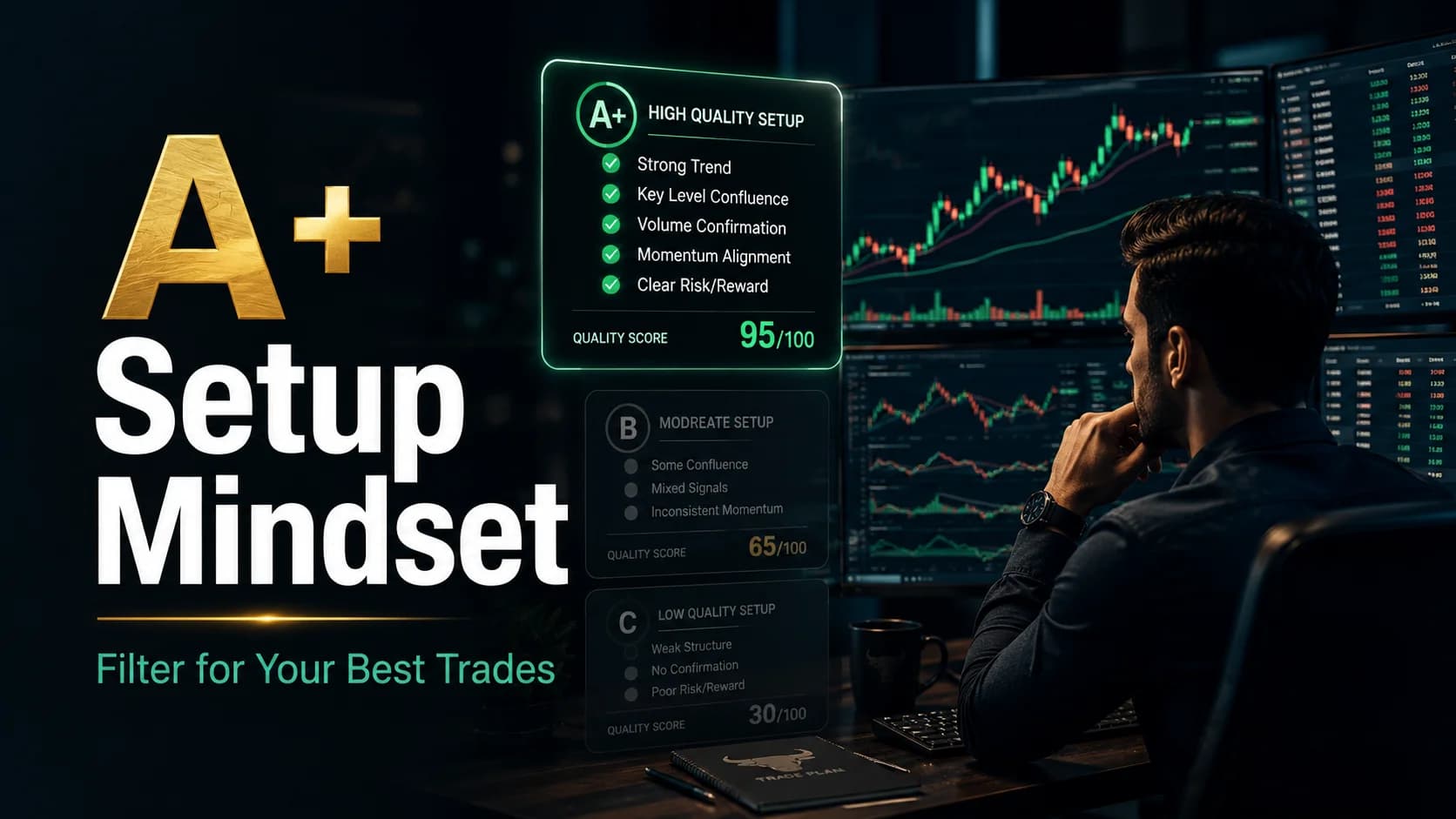
What is an A+ setup in day trading? An A+ setup is a trade that meets every pre-defined quality criterion for a given strategy — the full confluence of technical factors, market conditions, timing, and risk parameters that collectively indicate the setup is at its highest-probability form. The grading framework is strategy-specific: what constitutes A-grade for a gap-and-go momentum play differs from A-grade for a range-fade setup. The common thread is that an A+ setup leaves no major confirming factor absent, no significant conflicting signal unaddressed, and presents a clearly defined entry, stop, and initial target before the trade is taken.
The Quick Answer
An A+ setup isn't a feeling — it's a checklist with a minimum score. Define four to six specific confirming factors for your strategy, each of which must be present or absent to qualify a trade. Score every potential setup before entering. If it doesn't meet your threshold, you pass. The benefit isn't just higher win rates — it's that grading setups objectively removes the emotional negotiation that happens when you want to be in a trade and are looking for reasons to justify it. Most traders lose money not because their strategy has no edge, but because they take far too many setups that fall below the quality line their strategy actually requires.
Why Setup Quality Is the Lever Most Traders Ignore
Imagine you have a strategy with a genuine edge. In its cleanest form — all conditions present, proper timing, full confluence — that setup wins 60% of the time at a 1:2 risk-reward. That's a meaningfully profitable expectancy.
Now imagine you also take every approximate version of that setup: the ones where volume isn't quite right, where the overall market is working against the direction, where the stock's float is too high for the pattern to move decisively, where you're entering in the second hour when your strategy is really built for the first. Those approximate setups win 40% of the time at the same risk-reward — a losing expectancy.
If half your trades are A-grade and half are approximate, your blended expectancy might be roughly breakeven. You're not trading a bad strategy. You're trading a good strategy diluted by bad instances of it.
This is the hidden mechanism behind a huge proportion of new-to-intermediate trader failure. The strategy gets blamed when the real culprit is indiscriminate setup selection. We've seen traders dramatically improve their results not by finding a better strategy but by simply cutting their trade count by 40-50% and insisting on the full-quality version of what they were already doing.
Professional traders are ruthless about this. They describe the feeling of watching a market for hours, seeing three setups that almost qualify, passing on all of them, and then having the fourth one meet every criterion. They take that one. The restraint is the skill, not the entry.
What "A+" Actually Means — And What It Doesn't
Before building a grading system, it helps to be clear on what A-grade means and what it doesn't.
A+ does not mean perfect. No setup comes with certainty — the best setups still fail, sometimes repeatedly in a row. A+ means the setup is at its highest-probability form given your strategy's specific requirements. It means no major confirming factor is missing. It does not mean every minor variable is favorable.
A+ is not universal. This is the point most generic confluence guides miss entirely. The factors that define A-grade for a scalping setup on a 1-minute chart are different from the factors that define A-grade for a bull flag on a 5-minute chart, which are different again from what defines A-grade for a parabolic short at the top of a multi-day runner. Your A+ criteria are derived from your specific strategy's mechanics and requirements — not from a generic checklist of technical indicators.
A+ is not a synonym for "high confidence." Confidence is an emotional state. A+ is a pre-defined mechanical standard. This distinction matters because the most dangerous trades are often the ones where a trader feels extremely confident but the setup doesn't actually meet the quality criteria. Confidence often peaks when you want a trade to work, not necessarily when it's actually your best setup.
B-grade setups are not worthless. Some traders operate a system where B-grade setups are taken at reduced size — half position, not full. That's a reasonable approach. The critical discipline is never treating a B-grade setup as an A-grade one, because A-grade sizing applied to B-grade setups is where accounts quietly bleed.
The Confluence Framework for Day Trading
Confluence — the alignment of multiple independent confirming factors — is the mechanism behind setup quality. The more factors pointing the same direction simultaneously, the higher the probability of the setup working. Here's how to think about confluence practically, not abstractly.
For any given strategy, there are roughly five to seven independent factors that influence whether the setup will work on any specific instance. Your job is to identify which ones are essential (A-grade requirement), which ones are confirming (elevate from B to A), and which ones are nice-to-have (minor positive but not qualifying on their own).
Market context. The overall market environment either supports or fights your setup. A momentum long in a stock works better when the broader market is trending up than when it's in a sharp selloff. A reversal short works better when the broad market is struggling than when everything is ripping. This doesn't mean you can never trade against the tape — but it's a material factor. A+ setups in directional strategies usually have the market environment at least neutral, ideally favorable.
Relative volume. Volume tells you whether participants are engaged with the move. A breakout on twice the average volume has very different implications than the same price action on 70% of average volume. For momentum strategies, RVOL (relative volume — current volume as a multiple of the stock's average for that time of day) is one of the most reliable quality indicators available. A+ setups in momentum typically show RVOL above 2x at minimum; the best ones show 4x or higher. A breakout on below-average volume is almost always a B or C setup, regardless of how clean the chart looks.
Level quality. The price level at which a setup triggers matters. A breakout clearing a level that's been tested four times over three days is not the same as a breakout clearing a level that appeared once yesterday. Prior-day highs, prior-day lows, multi-week resistance levels, round numbers — these carry more weight than lines drawn on today's chart for the first time. A+ setups usually trigger at or from well-established, multi-touch price levels.
Stock-specific conditions. Is this the right kind of stock for this setup? A low-float runner with a news catalyst behind it moves very differently from a high-float mega-cap near an earnings report. Momentum strategies built around low-float runners need a low-float runner — applying them to a different stock type because the chart shape looks similar is a mismatch that masquerades as a legitimate trade.
Time of day. Most strategies perform significantly differently across the trading day. A gap-and-go setup at 9:35 AM, when volume is surging and participants are making reactive decisions, operates in a fundamentally different environment than the same price action at 11:45 AM, when volume has dried up and the move is grinding. Your A+ criteria should specify which time windows produce your best setups and treat entries outside those windows with a lower grade by default.
Entry mechanics. Even when everything else qualifies, the entry itself matters. Are you entering at the right point in the pattern — the candle close that confirms the breakout — or are you anticipating it? Is your stop placement clean and specific, or is it vague? Is your initial target realistic given the stock's average daily range and current level relative to prior resistance? A setup where you can't define a clean mechanical entry with a specific stop and specific target is not yet ready to grade.
How to Build Your Personal Setup Grading System
Generic frameworks are starting points, not endpoints. Here's how to build one specific to your strategy.
Step 1: List your strategy's essential conditions. Start with the entry criteria your strategy requires — the ones without which the trade doesn't qualify at all. These are your C-grade filters. If any of these are absent, you don't trade. For a bull flag strategy, this might be: a strong prior trend confirmed by RVOL above 1.5x, consolidation on declining volume forming a flag shape, and a clear trigger level above the flag's high.
Step 2: Add your quality elevators. These are the confirming factors that differentiate A-grade from B-grade within the setups that passed your C-grade filter. For the same bull flag: RVOL above 3x (better than 1.5x), market trending in the same direction, flag forming at or near a significant prior-day high, and the flag lasting more than 5 minutes but less than 20 (tight enough to show continuation, long enough to show genuine consolidation).
Step 3: Score every potential setup before entering. Assign one point for each quality elevator present. Set a threshold: two or more points is an A-grade trade at full size. One point is B-grade at half size. Zero points is a pass, even if the entry criteria are technically met.
Step 4: Keep score in your journal. After each session, record which grade you assigned to each trade and what the outcome was. Over 50-100 trades, patterns will emerge. Your A-grade win rate and your B-grade win rate will diverge — and the gap between them tells you how much your grading system is actually finding. If they're similar, your quality elevators aren't differentiating well. Adjust them. If A-grade wins significantly more, your system is working and the data will make passing on B-grade setups psychologically easier.
Step 5: Review and refine quarterly. What counts as A-grade isn't static. As you accumulate journal data, you'll discover some factors you thought were quality elevators don't actually correlate with better outcomes, and some factors you weren't formally tracking do. The grading system should evolve with your evidence, not with your mood.
The Walk-Through: Grading a Setup in Real Time
Here's how this works in practice. Imagine a stock — call it XYZ — that has gapped up 8% on earnings-related news. By 9:45 AM, it's run from $12.00 to $14.80 on RVOL at 6.2x. It then begins to consolidate between $14.60 and $14.80, with each successive 2-minute candle showing lighter volume than the last. The broader market is slightly green. The prior-day high on XYZ was $14.25, already cleared on this morning's open.
You're trading a bull flag strategy. Let's run the score.
Essential conditions: strong prior trend — yes. Consolidation on declining volume — yes. Clear trigger level — yes, the $14.80 flag high. This setup passes the C-grade filter.
Quality elevators: RVOL above 3x — yes (6.2x). Market aligned — yes (slightly green). Flag forming near a significant level — the $14.25 prior-day high has been cleared, but $14.80 is a new level with no prior history. Partial credit, maybe. Flag duration appropriate — it's been consolidating for about 8 minutes. Yes.
Score: three clear quality elevators, one partial. This is an A-grade setup. Full size, clean stop below the flag's low near $14.55, initial target at a 1:2 risk-reward puts first target around $15.30.
Now imagine the same situation but RVOL is 1.8x, the market is down 0.4%, and the flag has been forming for 28 minutes with the range getting wider rather than tighter. Score: zero quality elevators present. This is at best a B-grade, likely a pass.
The price action in both scenarios looks similar. The underlying quality is completely different.
Why Smart Traders Still Take B-Grade Setups
Here's the uncomfortable truth that most discussions of trade selectivity skip: knowing your grading system and following it are two different skills entirely, and the gap between them is where most of the money goes.
Experienced traders take B-grade setups for reasons that feel rational in the moment. The most common ones:
Boredom. Extended stretches with no qualifying setups are genuinely difficult. The market is moving, things are happening, and sitting in cash feels like falling behind. A B-grade setup that appears after 90 minutes of watching isn't just a trading opportunity — it's relief. The emotional need to participate masquerades as a trading judgment.
Recency bias after losses. After a losing trade, the recovery instinct kicks in. The next setup that appears gets evaluated through the lens of "I need to make this back" rather than "does this meet my criteria." The grading system gets quietly downgraded — the trader finds ways to score the setup higher than it deserves.
Overconfidence after winners. A strong A-grade winner creates a feeling of being in sync with the market. The next marginal setup benefits from that residual confidence. The thinking goes: "I'm reading this well today, so this B-grade is probably going to work." It usually doesn't.
Narrative override. The trader finds a compelling story about why this particular stock is going to move — a news catalyst, a sector rotation, something they read in the morning. The narrative makes the setup feel stronger than the criteria actually support. Strong narratives are dangerous precisely because they're convincing.
Understanding why you take B-grade setups helps you build defenses against it. The trading psychology hub covers these behavioral mechanisms in depth — particularly the emotional management required during slow markets when no A-grade setups appear for extended periods.
How to Enforce Selectivity Without Relying on Willpower
Willpower is unreliable. The research on self-regulation consistently shows it degrades under fatigue and stress — exactly the conditions that produce B-grade setups. The right approach is to build structural enforcement into your process so the system does the filtering rather than your moment-to-moment discipline.
Write down the score before entering. Not in your head — actually write it. Or type it. The act of recording forces deliberate engagement with the criteria rather than a fast, intuitive assessment. If you can't write "RVOL 4.2x, market green, flag 9 minutes, prior-day high cleared — Score: 3 out of 4 quality elevators" before clicking buy, you haven't finished evaluating the setup.
Set a minimum acceptable score as a rule, not a guideline. "I try to only take A-grade setups" is different from "I do not enter unless my score is 3 or above." The latter is a rule with a clear violation condition. The former is an aspiration you can rationalize around.
Use a session maximum trade count. Some traders find it helpful to impose a maximum of, say, five trades per session regardless of how many setups appear. This creates artificial scarcity — if you're limited to five, you get more selective about which ones make the cut. The constraint forces prioritization.
Review your B-grade trade history regularly. After 30-50 trades, pull your journal and filter for every trade you graded B or lower. Calculate the win rate and expectancy for that subset. The data is usually sobering in the best possible way — it converts a psychological argument ("I should be more selective") into an economic one ("my B-grade trades are costing me X per month"). Economic arguments stick better.
Where the A+ Mindset Goes Wrong
Even the best frameworks produce failure modes when applied incorrectly.
Grading inflation. The most common error. The trader defines rigorous criteria, then gradually finds reasons to score marginal factors as positive because they want to be in the trade. The criteria stay the same on paper while the scoring gets looser in practice. If your graded win rate isn't meaningfully higher than your ungraded win rate was before you started the system, grading inflation is probably the cause.
Paralysis by analysis. The opposite problem. A trader implements so many grading factors — eight, ten, twelve criteria — that no setup ever achieves a high enough score. They miss legitimate A-grade setups waiting for an impossible configuration of factors. Three to five core quality elevators is the right range for most strategies. More than that produces diminishing returns and practical paralysis.
Applying the wrong criteria. You build your grading system based on a different market environment than the one you're currently trading in. High-RVOL criteria built during a period of elevated market volatility may grade too harshly in a lower-volatility regime. Your criteria need to be periodically calibrated against current market behavior, not preserved as permanent rules.
Confusing setup quality with trade outcome. An A-grade setup that loses is still an A-grade setup. A C-grade setup that wins is still a C-grade setup. Outcome-based evaluation of your grading criteria over a single trade or even a single week is meaningless. The validity of your grading system shows up in the statistical difference between A-grade and B-grade outcomes over 50-100 trades minimum.
Tools That Support Setup Filtering
A scanner doesn't replace setup grading — but it does change what you're grading.
Without a scanner, you're manually scanning the market to find candidates and then grading them. The problem is that the scanning process itself introduces bias: you find a stock that interests you, and because you found it yourself, it feels like a promising setup before you've actually evaluated it. The emotional investment starts before the grading does.
A scanner configured to your strategy's essential criteria flips this dynamic. It presents you with candidates that have already passed the mechanical baseline. Your grading then focuses purely on the quality elevators — the subjective, context-dependent factors that determine whether a mechanically qualifying setup is actually A-grade.
Trade Ideas is particularly well-suited to this workflow. Its filtering system lets you define your essential conditions precisely — RVOL threshold, price range, float size, gap percentage, sector — so the candidates it surfaces have already cleared your C-grade filters before you ever look at the chart. What remains is the quality assessment: is this specific instance of the setup at its best form? That's a faster, cleaner evaluation than starting from a blank market.
For a full breakdown of the scanning and charting tools our team uses in live trading, see our day trading toolkit.
How A+ Thinking Fits a Complete Trading Plan
The A+ setup mindset isn't a separate skill you layer onto an existing strategy. It's integrated into every component of a well-built trading plan.
Your risk management rules should explicitly reference setup grade. Full position size for A-grade, reduced size for B-grade, no trade for C-grade. This is not a soft preference — it's a written rule in your plan with specific size definitions attached to each grade.
Your journaling should track setup grade as a primary field, not an afterthought. Every trade record should note the grade assigned before entry, the actual factors present, and the outcome. The longitudinal data this produces is what gives you genuine insight into whether your grading system is working — and where to refine it.
Your session review should ask two questions about selectivity: which setups did you pass on that were correctly passed, and which setups did you take that didn't meet your criteria. Both matter. Successful passes are a positive signal; criterion violations are the primary target for improvement.
This connects directly to the broader framework of strategy specialization covered in One Strategy or Many? — because you can't build a meaningful grading system until you've committed to one specific setup long enough to know what its quality factors actually are. And it relates to the failure mode of abandoning a system after losing trades, which is covered in The Strategy Hopping Trap. Both articles address the same underlying challenge from different angles: the discipline to stay with a systematic approach when instinct and impatience pull you toward shortcuts.
For the deeper work of identifying and quantifying your strategy's edge, our guide to developing and backtesting your trading strategy covers how to build the evidential foundation that makes grading criteria defensible rather than arbitrary.
Across the broader day trading strategies library, every strategy article includes a "Where This Strategy Fails" section — which is, in effect, a description of what B-grade and C-grade instances of that strategy look like. Reading those sections with the A+ mindset in mind will help you build quality criteria faster than trial and error alone.
FAQ
How many confirming factors should an A+ setup require?
What's the difference between an A-grade setup and a B-grade setup in practical terms?
Does my A+ checklist change in different market regimes?
How do I avoid justifying poor setups by telling myself they're A-grade?
Should I take fewer total trades if I adopt an A+ mindset?
Is the A+ setup concept relevant for all strategy types, or mainly for pattern-based strategies?
What should I do when I've been sitting in cash for two hours with no A-grade setup?
How long does it take to build a reliable A+ grading system?
Disclaimer
Article Sources
- **Douglas, Mark. Trading in the Zone. Prentice Hall Press, 2000.** The foundational practitioner text on probabilistic thinking in trading — directly relevant to the argument that A-grade setups are not certainties but expressions of highest-probability conditions, and that consistent execution of a graded system over many trades produces edge that no single trade can demonstrate.
- **Kahneman, Daniel. Thinking, Fast and Slow. Farrar, Straus and Giroux, 2011.** The authoritative source on System 1 (intuitive, fast) versus System 2 (deliberate, analytical) cognition — foundational for understanding why real-time setup grading must be made explicit and written rather than fast and intuitive, and why the narrative override failure mode is so common.
- **Steenbarger, Brett N. The Daily Trading Coach. Wiley, 2009.** Practitioner-focused analysis of how selective, high-conviction trading differs from reactive, high-frequency trading in its psychological demands and performance outcomes — directly applicable to the enforcement framework discussed in this article.
- **Barber, B. M., & Odean, T. (2000). "Trading Is Hazardous to Your Wealth: The Common Stock Investment Performance of Individual Investors." The Journal of Finance, 55(2), 773–806.** Academic research demonstrating the negative correlation between trading frequency and individual investor returns — the academic foundation for the argument that fewer, higher-quality trades outperform more, lower-quality ones.
- **Lo, Andrew W., & Repin, Dmitry V. (2002). "The Psychophysiology of Real-Time Financial Risk Processing." Journal of Cognitive Neuroscience, 14(3), 323–339.** Research documenting the role of emotional responses in real-time financial decision-making — supports the argument that structural enforcement of grading criteria is more reliable than moment-to-moment willpower under market stress.
- Read at SEC.gov - SEC Office of Investor Education and Advocacy. "Day Trading: Your Dollars at Risk." The regulatory baseline for understanding the risk context in which any active trading framework operates.
Was this helpful?
Be the first to weigh in

Written by
Kazi Mezanur RahmanFounder, independent researcher, and editor of DayTradingToolkit. A one-person publication focused on risk-first trading education and documented tool research. He trades his own capital as a retail trader and combines personal market experience with systematic primary-source research.
Keep Reading

Strategies
One Strategy or Many? The Specialization vs. Diversification Debate
Should you master one trading strategy or trade multiple setups? We break down the real debate, a phased model, and a self-assessment framework to decide.
Strategies
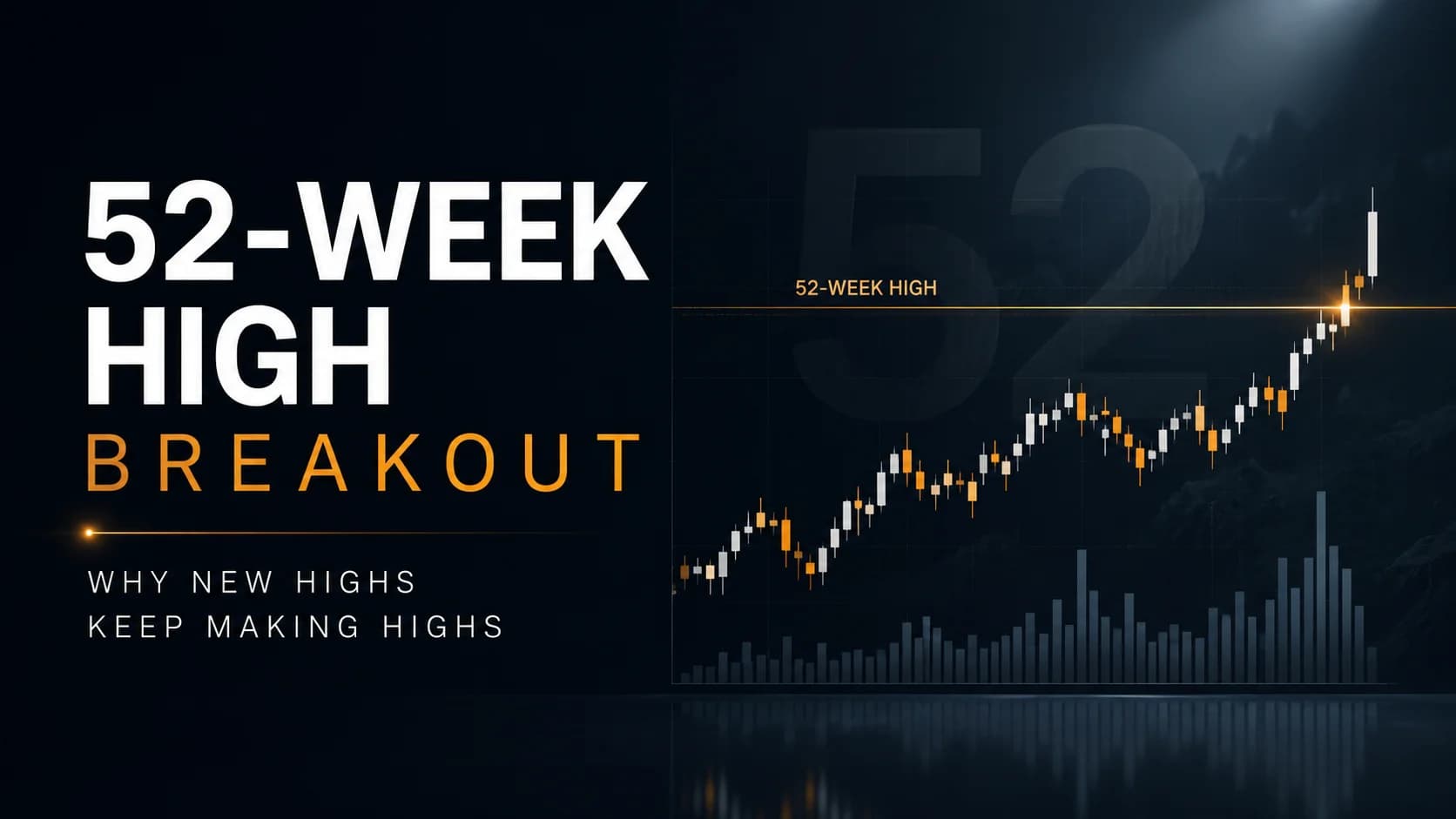
The 52-Week High Breakout Strategy: Trading Stocks at New Highs
Investors anchor on the 52-week high, and that bias is exactly why breaking it carries real weight. This guide covers the research and trading the breakout.
Strategies
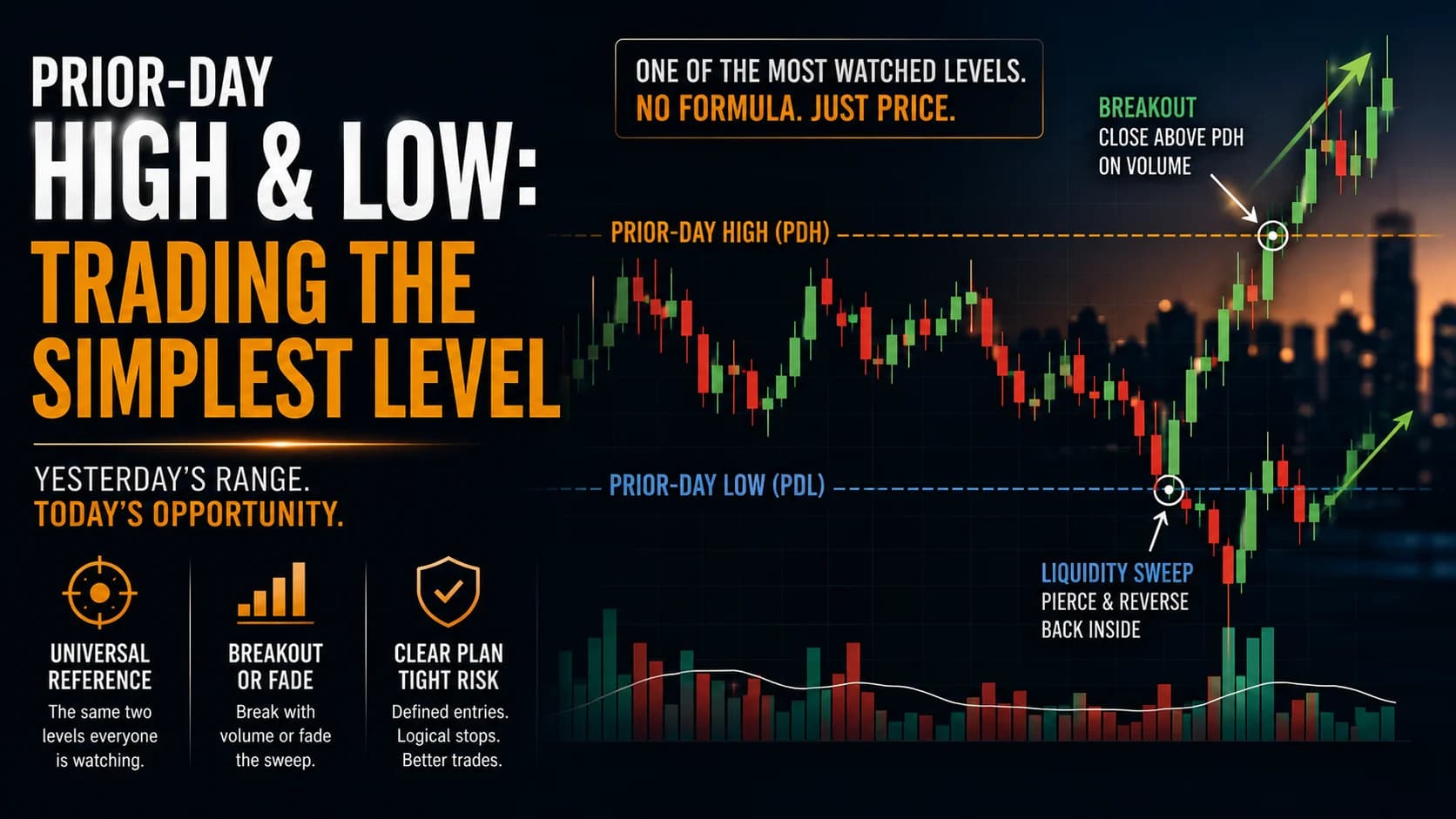
Trading the Breakout of Prior-Day High/Low Levels
PDH and PDL need no formula, just yesterday's range. This guide covers the breakout, the liquidity-sweep fade, and why stops cluster right at these levels.
Strategies
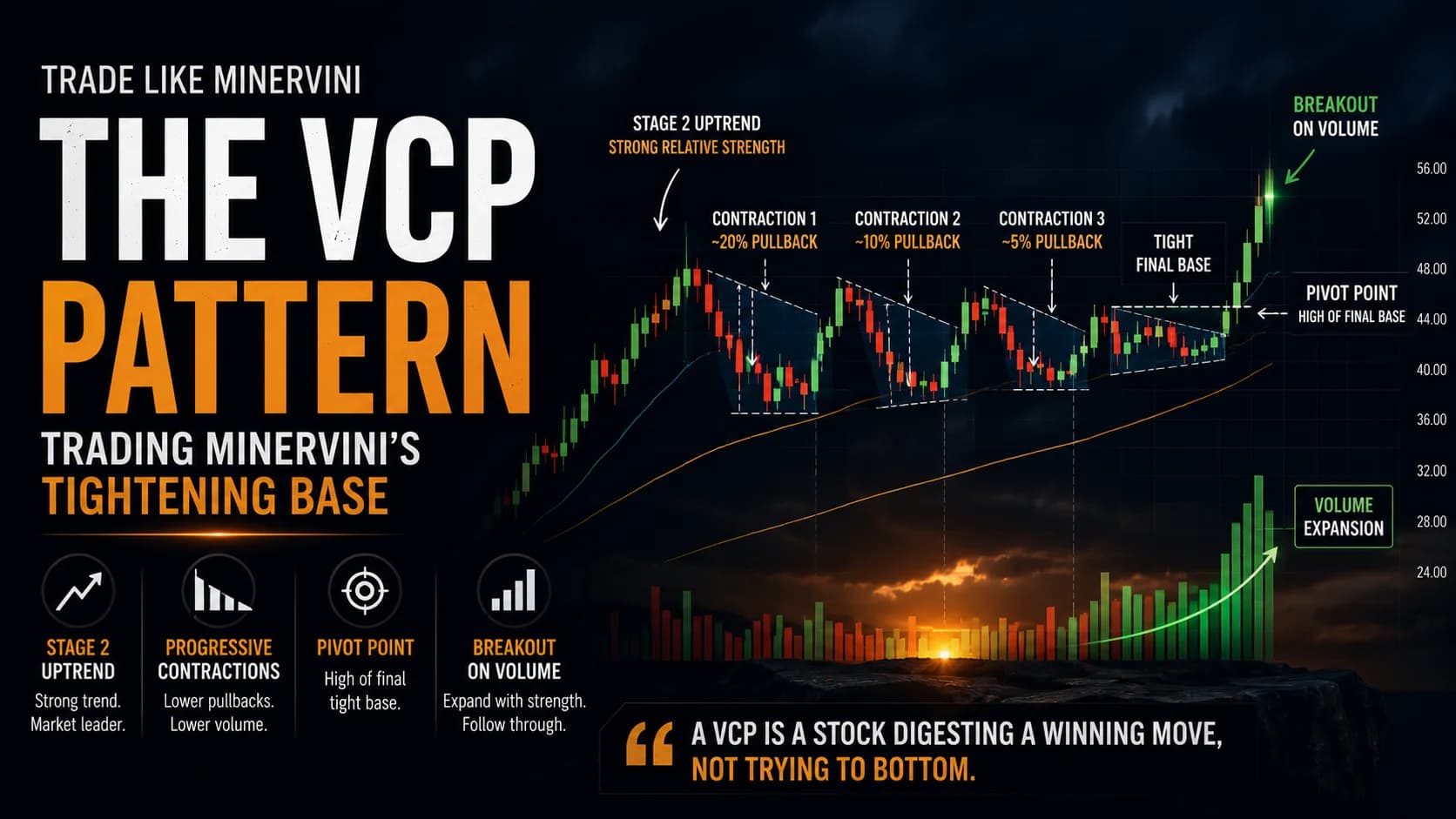
Trading Breakouts From Consolidation: The Volatility Contraction Pattern
The VCP isn't just a volatility squeeze. This guide covers the staged contraction sequence, the pivot point, and why context matters as much as the pattern.
Comments
No comments yet. Be the first to share your thoughts.