
The pattern is so predictable it's almost a script. You find a new strategy. It feels different this time — cleaner, more logical, better suited to your personality. You study it for a week, maybe two. You take a few trades. The first couple work. Then you hit a losing streak — three, maybe four trades in a row — and a familiar thought creeps in: "Maybe this isn't the right strategy for me." You start browsing YouTube. You find another trader with a different approach, a better Win RateWin rate is the percentage of your trades that result in a profit — calculated as (number of winning trades ÷ total trades) × 100 — and while commonly cited as a measure of trading success, it means very little without also knowing the averRead definition →, a smoother equity curve. And the cycle begins again.
If this feels uncomfortably familiar, you're not alone. And you're not lacking DisciplineTrading discipline is the consistent application of your predefined rules — entries, stops, targets, position sizing, maximum daily loss — regardless of what you're feeling in the moment.Read definition →, intelligence, or market knowledge. You're caught in the strategy hopping trap — one of the most common and most destructive patterns in retail trading. It disguises itself as learning. It feels like progress. But every time you switch, you reset the clock on the only thing that actually builds an edge: deep repetition with one approach until you understand it well enough to know what's your fault and what's the market's.
This cycle can consume traders for years. Not beginners who don't know any better — often intermediate traders who know too much. They've read the books, studied the setups, backtested the systems. They have more than enough strategy knowledge to be profitable. What they lack is the psychological infrastructure to survive the inevitable drawdowns that every strategy produces. And in the absence of that infrastructure, switching feels like the rational move. It isn't. Let's unpack why.
What is strategy hopping in trading? Strategy hopping — sometimes called system hopping — is the pattern of repeatedly abandoning trading strategies before accumulating enough data to accurately evaluate their performance. Traders typically switch after a short losing streak or DrawdownA drawdown is the peak-to-trough decline in account equity — it measures how far you've fallen from your high-water mark, either from a single losing trade or a series of losing trades.Read definition →, mistaking normal statistical variance for evidence of a broken strategy. The result is a perpetual restart cycle where no single approach is ever tested with sufficient depth, and the trader never develops the pattern recognition, contextual understanding, or execution refinement that only comes from deep experience with one method.
The Five Psychological Triggers Behind Strategy Hopping
Strategy hopping isn't random. It follows predictable psychological patterns, and understanding those patterns is the first step toward breaking the cycle. Each trigger exploits a specific cognitive vulnerability — and most traders are dealing with several simultaneously.
Trigger 1: Loss AversionLoss aversion is the psychological tendency to feel the pain of a loss approximately twice as intensely as the pleasure of an equivalent gain — making traders hold losers too long and cut winners too early, which is one of the most well-docRead definition → reframed as strategy doubt. Kahneman and Tversky's foundational research on prospect theory established that humans experience the pain of a loss roughly twice as intensely as the pleasure of an equivalent gain. In trading, this asymmetry creates a specific problem: after a string of losses, the emotional pain becomes so intense that the brain starts searching for an explanation — and "the strategy is broken" is the most comforting explanation available, because it implies you can fix the problem by switching to something better.
The truth is harder to accept. Normal strategies with a 55% win rate will produce strings of five or more consecutive losses with uncomfortable regularity. Over 100 trades, a 55% win-rate strategy will almost certainly produce at least one streak of five losses in a row. That's not a failing strategy — that's basic probability. But loss aversion doesn't do math. It does emotion. And the emotion says: this hurts, make it stop, find something that doesn't hurt. The "something that doesn't hurt" is always a new strategy — one you haven't experienced losses with yet.
Trigger 2: Recency bias masquerading as analysis. Recency bias — the tendency to weight recent events disproportionately when making decisions — turns a three-trade losing streak into "evidence" that the strategy has stopped working. The trader doesn't look at the last 100 trades. They look at the last five. And because those five were losers, the entire strategy feels broken.
This plays out in a specific, repeatable way. A trader runs a momentum BreakoutA breakout is when price moves decisively beyond a defined level — a resistance zone, a consolidation boundary, a chart pattern boundary, or a prior high — suggesting that the previous supply at that level has been overcome.Read definition → strategy for six weeks. Weeks one through four: the market is trending, breakouts follow through, the strategy works beautifully. Weeks five and six: the market shifts to a choppy, range-bound environment. Breakouts start failing. The trader, now focused exclusively on the recent failures, concludes the strategy "doesn't work anymore." They switch to a mean reversion approach — just in time for the market to start trending again. The whipsaw isn't bad luck. It's recency bias driving a poorly timed strategy change.
Trigger 3: The information bias — more knowledge as a solution. This is the most seductive trigger. The trader believes that the problem is insufficient knowledge — that there's a better indicator, a smarter entry rule, a more sophisticated filter that will eliminate the losing trades. So they consume more content. More YouTube videos, more courses, more books, more Discord channels. Each new piece of information feels like progress. And each new piece of information exposes them to a new strategy that seems superior to the one they're currently struggling with.
The trap is that learning and performing are different activities. Reading about a strategy is not the same as executing it under pressure for months. A trader with surface-level knowledge of ten strategies will consistently underperform a trader with deep mastery of one — because the second trader has the contextual understanding that only comes from repetition. They know what the strategy looks like when it's working. They know what it looks like when it's struggling but still valid. They know the difference between "this strategy is failing" and "this strategy is in a normal drawdown." The first trader, with ten strategies and no depth, can't distinguish between any of these states.
Trigger 4: Social comparison and highlight reels. Trading social media creates a constant stream of other people's best trades. The breakout trader scrolling Instagram sees a scalper post a $5,000 day. The scalper sees a swing trader post a 200% gain on a single position. Everyone else's strategy looks better than yours, because you're comparing your full experience — including the losses, the drawdowns, the boring waiting — against their curated highlights.
This isn't a moral failing. It's a structural problem with how trading content is shared online. Nobody posts their seven-trade losing streak. Nobody screenshots the three weeks they sat in a drawdown wondering if they should quit. The result is a systematically distorted view of what other strategies produce, which makes your current strategy — with all its warts visible — look inferior by comparison.
Trigger 5: The sunk cost problem in reverse. Classic sunk cost bias makes people stick with bad decisions because they've already invested time and money. Strategy hopping involves the opposite: an inability to tolerate the sunk cost of learning a strategy that's temporarily underperforming. The trader calculates — consciously or unconsciously — that the time spent learning a strategy that's currently losing is "wasted," and the only way to stop wasting time is to switch. The irony is that switching guarantees the time was wasted, while staying would have eventually turned that investment into mastery.
Here's what nobody calculates when they're excited about a new strategy: every switch resets at least four critical clocks.
The pattern recognition clock. After 200+ trades with one strategy, you start recognizing subtle variations — the A+ setup versus the B-grade setup, the market conditions where your strategy thrives versus the conditions where it grinds. This recognition is subconscious and can only develop through repetition. When you switch, that recognition resets to zero. You're back to not knowing what "good" and "bad" versions of your setups look like.
The execution refinement clock. Real-time execution improves with practice. Your entries get sharper. Your stops get more precise. Your position sizing becomes more intuitive. You learn the specific timing nuances — when to enter on the first pullback versus waiting for the second, when to trail your stop versus holding for the target. Every switch erases these micro-refinements and replaces them with the awkward fumbling of a beginner again.
The statistical confidence clock. You need a minimum of 50-100 trades to make even preliminary judgments about a strategy's viability, and most statisticians recommend 200+ trades for reliable performance metrics. If you switch after 20-30 trades, you've generated zero useful statistical data. You literally cannot know whether the strategy works, because your sample size is too small for the numbers to mean anything. The three-trade losing streak that triggered the switch might have been followed by a twelve-trade winning streak — but you'll never know.
The emotional calibration clock. Every strategy has a "normal drawdown" range — the depth and duration of losses that fall within expected variance. Learning what this feels like is a process. The first time you experience a drawdown with a new strategy, it feels catastrophic because you have no reference point. By the fifth drawdown, you recognize the pattern and hold steady. But if you switch before the fifth drawdown, you never develop that emotional resilience, and the next drawdown with the next strategy triggers the same panic.
How to Tell If You're Hopping or Legitimately Evolving
Not every strategy change is hopping. Strategies do fail. Markets do shift. Sometimes switching is the right call. The danger is that hoppers use this reality to rationalize every switch. "I'm not hopping — I'm adapting!" So how do you tell the difference?
Here's the diagnostic we use. Honest answers only.
Question 1: How many trades have you taken with this strategy? If fewer than 50, you don't have enough data to evaluate it. Any conclusion you draw — positive or negative — is statistically meaningless. Fewer than 50 trades is not a strategy evaluation. It's a gut reaction. If you're considering switching with fewer than 50 trades logged, the answer is almost certainly "stay."
Question 2: Did you follow the strategy's rules on every trade? This is the critical question nobody wants to answer honestly. If you modified entries, widened stops, took profits early, skipped signals, or traded setups that didn't fully qualify — you haven't been trading the strategy. You've been trading your improvised version of the strategy. And your improvised version failing doesn't tell you anything about whether the original strategy works. Before switching strategies, make sure you've actually traded the one you're evaluating. A trading journal with rule-compliance notes — not just P&L — is the only way to answer this honestly.
Question 3: Have market conditions changed, or have your emotions changed? A strategy that works in trending markets will underperform in range-bound markets. That's not a broken strategy — that's a strategy encountering conditions outside its sweet spot. If you can identify the specific market condition that changed and articulate why it affects your strategy, you have a legitimate reason to pause (not necessarily switch). If you can't articulate the condition change and just "feel" like it's not working — that's emotion talking, not analysis.
Question 4: What specifically is broken? Can you name the exact mechanic that's failing? "The breakout entries are getting stopped out because intraday volatility has compressed and my stop placement assumes wider ranges" is a specific diagnosis. "It just doesn't work" is not a diagnosis — it's a feeling. Specific diagnoses often have specific fixes that don't require a full strategy change. Vague feelings almost always lead to full strategy changes.
Question 5: Have you switched before? Check your own history. If this is your third strategy in six months, the pattern is clear. The problem isn't any specific strategy — it's the switching itself. No strategy survives the switching pattern, because the pattern abandons every strategy before it has a chance to prove itself.
The Commitment Protocol: How to Actually Stop
Understanding why you hop is necessary but not sufficient. You also need a structural solution — a protocol that makes it harder to switch impulsively and easier to stay committed through drawdowns. Here's the framework we recommend.
Step 1: Choose one strategy and write a Strategy Commitment Document. This isn't a trading plan — it's a commitment contract with yourself. It includes: the strategy you've chosen and why, the specific conditions under which the strategy has an edge, the expected drawdown range (based on backtesting or paper trading data), your minimum commitment period (we recommend 100 trades or 60 trading days, whichever comes first), and the specific, predefined conditions under which you're allowed to switch.
Step 2: Define your exit criteria in advance — before the drawdown. This is the most important step. Before you experience the drawdown that will make you want to switch, write down what would actually justify switching. Examples: "If my win rate drops below 35% after 100+ trades, reassess." Or "If maximum drawdown exceeds 15% of my account, reduce size and investigate." Or "If the strategy produces a negative expectancy across 50+ trades after accounting for commissions, pause and backtest again." Notice: these criteria are quantitative, require meaningful sample sizes, and are written during calm, rational conditions — not during a losing streak.
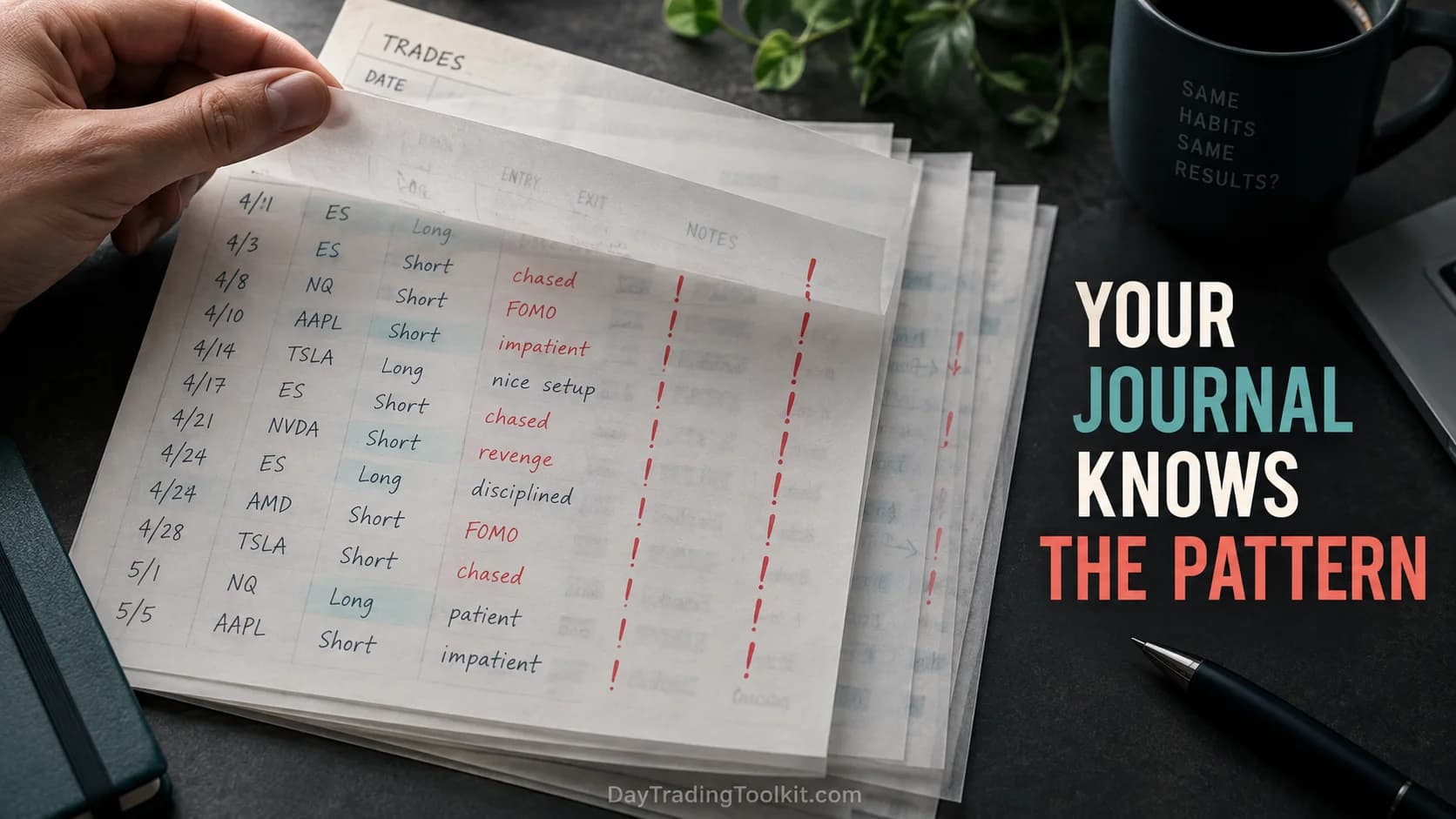
Step 3: Build a "Hopping Temptation" log. Every time you feel the urge to switch, don't switch — log it. Write down: the date, the trigger (what happened that made you want to switch), the strategy you're tempted to switch to, and your current strategy's cumulative performance. Review this log monthly. You'll notice patterns — the urge almost always follows losing streaks and almost never corresponds to genuine strategy failure. Over time, this log becomes your most powerful anti-hopping tool, because it shows you, in your own handwriting, how many times the urge to switch arose and then passed without the strategy actually being broken.
Step 4: Implement a mandatory cooling period. If, after logging the temptation, you still want to switch — wait five trading days. Do not research the new strategy. Do not paper trade it. Do not consume content about it. Just continue trading your current strategy for five more days. Most switching urges fade within 48 hours because they're emotional responses to recent losses, not rational evaluations of strategy viability. The cooling period catches the impulse before it becomes action.
Step 5: Require a post-mortem before any switch. If, after the cooling period, you still believe a switch is warranted, conduct a formal review. Pull your trade log. Calculate your win rate, average winner, average loser, expectancy, and maximum drawdown — all from actual data, not from how it feels. Compare these numbers to your Strategy Commitment Document's expected ranges. If the data genuinely shows the strategy underperforming its expected parameters over a meaningful sample, a switch may be justified. If the data shows normal variance that feels worse than it is — and it almost always does — you've just saved yourself from another restart.
The Market Regime Problem: When "Not Working" Is Actually Normal
One of the most common catalysts for strategy hopping is a shift in market conditions — and it's the one situation where the hopping urge feels most justified. Your momentum strategy killed it for three months in a trending market, and now the market has gone sideways and your results have flatlined. The strategy feels broken. It isn't — it's encountering a regime it wasn't designed for.
This is where understanding your strategy's relationship to market conditions becomes critical. Every strategy has market conditions where it thrives and conditions where it struggles. Trend-following strategies underperform in range-bound markets. Mean reversion strategies underperform in trending markets. Breakout strategies underperform in low-volatility environments. This isn't a design flaw — it's an inherent characteristic of all strategies.
The correct response to a regime mismatch is not switching strategies. It's reducing size and waiting for your conditions to return — or, if you've developed sufficient skill, having a secondary strategy specifically designed for the alternate regime. But developing a secondary strategy requires mastering the primary one first, which means surviving the regime mismatch without abandoning the strategy that works in your primary regime.
Research and trader accounts show traders abandon trend-following strategies during choppy periods, switch to mean reversion, and then watch the market resume trending — leaving them whipsawed in both directions. The strategy hopper experienced two drawdowns (one from the regime change, one from the poorly timed switch). The patient trader experienced one drawdown (from the regime change alone) and then participated in the recovery. Same market. Dramatically different outcomes.
The One-Year Commitment: Why Depth Beats Breadth
Here's a thought experiment that might reframe how you think about strategy selection. Imagine you're forced to trade one strategy — and only one — for an entire year. You can adjust position size. You can add filters. You can refine your execution. But you cannot change the core setup, the entry logic, or the exit framework. Same strategy, 250 trading days.
What would happen? First, you'd develop genuine pattern recognition for that setup. After hundreds of occurrences, you'd start seeing nuances invisible to someone who's been trading the setup for three weeks. The A+ version versus the C-grade version would become obvious. Second, you'd learn the strategy's failure modes intimately — not from reading about them, but from living through them. You'd know which market conditions cause it to struggle and you'd start noticing those conditions forming before they cost you money. Third, your execution would sharpen. Entry timing, stop placement, profit-taking — all the micro-decisions that determine whether a strategy's theoretical edge translates into real money. These refinements only emerge with volume.
This is what deep specialization produces. And it's exactly what strategy hopping prevents.
The traders who inspire the most switching — the ones posting huge gains on social media — almost always have this depth with one primary approach. They didn't get there by trying ten strategies in a year. They got there by grinding one strategy through hundreds of trades, refining it through drawdowns, and developing the contextual understanding that turns a textbook setup into a genuine edge.
Tools That Support Commitment Instead of Enabling Switching
The right trading tools can structurally support strategy commitment — or they can enable hopping. The difference is how you use them.
A trading journal becomes your accountability partner. Not a P&L tracker — a process tracker. Every trade logged with: did this meet my strategy criteria (yes/no), did I follow my entry rules (yes/no), did I follow my exit rules (yes/no), and what was my emotional state. Over 50+ trades, this journal produces the data you need to evaluate your strategy honestly, separating execution problems from strategy problems. If your win rate is low but your rule-compliance rate is also low, the strategy isn't the issue — your execution is. Switching strategies won't fix an execution problem. It just moves the same problem to a new context.
A scanner should be configured for your strategy and left alone. If you're running a breakout strategy, your scanner should be filtering for breakout candidates — not showing you momentum plays, gap fills, mean reversion setups, and everything else the market offers. Seeing alternative opportunities you're "missing" is one of the strongest hopping triggers. A scanner tuned to your specific strategy eliminates the temptation by keeping alternatives out of your line of sight.
Frequently Asked Questions
How many trades do I actually need before I can judge whether a strategy works?
Fewer than 30 trades provides essentially no useful statistical information — the sample is too small for any conclusion about win rate, expectancy, or drawdown to be reliable. At 50 trades, you can begin to identify preliminary patterns, but the confidence intervals around your metrics are still wide. At 100 trades, your performance data becomes meaningfully more reliable, and at 200+ trades, you can start making high-confidence assessments about whether the strategy has a genuine edge. Most traders who strategy hop abandon approaches after 15-30 trades — a sample so small that a 40% win-rate strategy can easily produce results that look like a 55% win-rate strategy, or vice versa.
Key Takeaway: If you haven't taken at least 50 trades with strict rule compliance, you don't have an opinion about the strategy — you have a guess, and switching based on a guess is the definition of hopping.
Is there a difference between strategy hopping and adapting to changing markets?
Adaptation looks like this: "My breakout strategy uses a 20-period consolidation filter. Volatility has compressed, so consolidation periods are shorter. I'm adjusting to a 15-period filter while maintaining the same entry logic and risk rules." Hopping looks like this: "My breakout strategy lost money three days in a row. Breakouts don't work anymore. I'm switching to scalping." The first response is specific, data-driven, and preserves the core approach. The second is emotional, vague, and abandons everything. If you can articulate exactly what changed and why your specific adjustment addresses it, you're adapting. If you just feel like things aren't working, you're hopping.
Key Takeaway: Legitimate adaptation adjusts parameters within a strategy's framework — it doesn't replace the entire framework based on a few days of poor performance.
What if I genuinely picked the wrong strategy for my personality?
A genuine mismatch between your trading style and your personality will show up consistently, not just during losing streaks. If you dread every trade regardless of whether it wins or loses, if the time commitment consistently conflicts with your life, or if the type of decision-making required exhausts you even on good days — those are personality mismatch signals. But if the strategy feels great when it's winning and unbearable when it's losing, that's not a personality mismatch. That's loss aversion. The distinction matters enormously, because switching fixes a genuine mismatch and perpetuates loss aversion.
Key Takeaway: Personality mismatch feels wrong all the time — wins and losses alike — while loss aversion only feels wrong during drawdowns, and mixing up the two is one of the most common strategy-hopping triggers.
How do I handle the urge to switch when I see another trader's strategy performing better?
Every strategy goes through winning and losing periods. The strategy you're envying is currently in a winning period — which you're seeing — while your strategy is in a losing period — which you're experiencing. Next month, the positions might be reversed. Social media creates a structurally distorted view because traders share wins at far higher rates than losses. The antidote is data: review your own strategy's full-year performance, not just recent results. If the full-year numbers show a positive expectancy, the strategy works. The losing period you're in right now is part of the distribution that produces those full-year numbers.
Key Takeaway: The urge to switch because someone else's strategy looks better is almost always recency bias compounded by social comparison — log it, wait five days, and the urge will almost always pass.
Can I work on a second strategy while committed to my primary one?
Adding a secondary strategy makes sense when your primary strategy has a demonstrated edge and you've identified specific market conditions where it underperforms. The secondary strategy fills that gap — for example, a mean reversion approach for range-bound days when your primary trend-following strategy sits idle. The danger is adding a second strategy prematurely, before the first is mastered, which just creates two underdeveloped approaches instead of one underdeveloped one. The litmus test: can you trade your primary strategy profitably for three consecutive months? If not, you're not ready for a second one.
Key Takeaway: A secondary strategy is an addition for advanced traders with proven mastery of a primary approach — not an escape hatch for traders who haven't committed to their first one.
What's the difference between a strategy drawdown and a strategy that's actually broken?
Every strategy has a "normal" drawdown range that you can estimate through backtesting — the depth and duration of losses that occur within the strategy's profitable operation. If your backtest shows a maximum drawdown of 8%, experiencing a 6% drawdown isn't evidence the strategy is broken — it's evidence the strategy is behaving normally. A strategy is genuinely broken when performance degrades beyond its backtested parameters over a meaningful trade count: win rate drops below expected minimums, expectancy turns negative, or drawdown exceeds the maximum observed in testing. These determinations require 100+ trades and honest rule compliance — not a 15-trade gut feeling.
Key Takeaway: Write down your strategy's expected drawdown range before you experience a drawdown, so you have a rational benchmark to compare against when emotions start driving the narrative.
Does strategy hopping happen more with discretionary or systematic traders?
Discretionary traders can gradually modify their approach without formally acknowledging a strategy change — entries drift, stops shift, and before they realize it, they're trading something unrecognizable from their original plan. Systematic traders with codified rules have a clearer boundary: the rules either change or they don't. However, systematic traders can also hop by constantly modifying their rule parameters — changing indicator periods, adjusting filter thresholds, adding conditions — which achieves the same destabilizing effect as a full switch. Both styles need the Commitment Protocol, but discretionary traders need the journaling component more because their strategy boundaries are inherently less defined.
Key Takeaway: If you trade discretionary or hybrid approaches, a detailed process journal isn't optional — it's the only tool that makes your actual strategy visible enough to evaluate honestly.
How long should my mandatory cooling period be before switching?
Five trading days serves two purposes. First, it interrupts the emotional momentum of a losing streak. Most switching impulses are triggered by three to five consecutive losses, and the urge typically peaks within 24-48 hours before fading. Second, five days provides enough additional trades to test whether the losing streak was a temporary cluster or the beginning of genuine underperformance. If after five days of continued trading the strategy is still underperforming and you can articulate specific, data-backed reasons why — not "it feels broken" — then proceed to the formal post-mortem review. Only if the post-mortem confirms underperformance beyond expected parameters should switching be considered.
Key Takeaway: The five-day cooling period catches the vast majority of impulse switches, because most switching urges are emotional responses that fade once the losing streak ends — and losing streaks always end.
What's the single most effective way to prevent strategy hopping?
The Commitment Document removes the strategy evaluation decision from the moment of maximum emotional stress. When you're in the middle of a drawdown, you don't have to decide whether to switch — you've already decided, weeks or months ago, under calm conditions, what circumstances would justify a switch. You just compare current data against those predefined criteria. If the criteria aren't met, you continue. No debate, no agonizing, no late-night YouTube research sessions. The Temptation Log adds a feedback loop: after a few months, you can see every time you wanted to switch and didn't, along with what the strategy did afterward. This log builds a visceral, personal evidence base that switching urges are not reliable signals.
Key Takeaway: The most powerful anti-hopping tool isn't discipline — it's structure that makes the right behavior easier than the wrong behavior, removing the decision from the moment you're least qualified to make it.
Article Sources
- Kahneman, D. & Tversky, A. (1979). "Prospect Theory: An Analysis of Decision Under Risk." Econometrica, 47(2), 263-291.
- Dietvorst, B.J., Simmons, J.P., & Massey, C. (2015). "Algorithm Aversion: People Erroneously Avoid Algorithms After Seeing Them Err." Journal of Experimental Psychology: General, 144(1), 114-126.
- Barber, B.M. & Odean, T. (2000). "Trading Is Hazardous to Your Wealth." Journal of Finance, 55(2), 773-806.
- SEC Office of Investor Education and Advocacy: "Investor Bulletin — The Importance of Diversification."
- Douglas, M. (2000). "Trading in the Zone." New York Institute of Finance / Prentice Hall Press.
- Bailey, D.H. & López de Prado, M. (2014). "The Deflated Sharpe Ratio: Correcting for Selection Bias, Backtest Overfitting, and the Disposal of Trials." Journal of Portfolio Management, 40(5).
Disclaimer
The psychological frameworks and commitment protocols discussed in this article are for educational purposes only and do not constitute financial or psychological advice. Strategy hopping is a behavioral pattern, not a clinical diagnosis, and the frameworks presented here are based on common trading patterns observed in retail traders — individual experiences may differ. No trading strategy guarantees profitability, and committing to a strategy does not eliminate the risk of loss. The majority of retail day traders lose money regardless of their strategy selection approach. Always conduct your own analysis before making trading decisions. Never risk more than you can afford to lose. For our full disclaimer, visit https://daytradingtoolkit.com/disclaimer.