



Here’s a number most “beginner guides” won’t put in their opening paragraph: 97% of day traders lose money.
That’s not a scare tactic. It’s a verified statistic from peer-reviewed academic research tracking real traders with real money. We’re leading with it because our team believes the first thing you deserve as someone exploring day trading is the truth—not a sales pitch, not a hype reel, and definitely not a screenshot of someone’s cherry-picked P&L from their best day ever.
Day trading can be a legitimate skill. Some people do it professionally and earn a living. But the gap between what day trading actually is and what the internet wants you to believe it is… that gap has ruined a lot of accounts.
So if you’re Googling “what is day trading” right now—maybe during a lunch break, maybe at 2 AM because you can’t stop thinking about it—good. You’re in the right place. This guide is the first chapter of our complete Beginner’s Guide to Day Trading, a structured 101-article curriculum that takes you from zero to your first live trade. No fluff. No shortcuts. Just the real information you need, explained like a human being wrote it.
Which we did. Our team has collectively spent years watching charts, making mistakes, and slowly getting better. We know what this journey looks like from the inside.
Let’s start with the basics.
What Is Day Trading? The Real Definition
Day trading is the practice of buying and selling a financial instrument—stocks, options, futures, currencies, or crypto—within the same trading day. You open a position (buy or sell), and you close it before the market shuts down that evening. No positions held overnight. That’s the defining characteristic.
FINRA—the Financial Industry Regulatory Authority, which oversees broker-dealers in the United States—defines a “day trade” as the purchase and sale (or sale and purchase) of the same security on the same day in a margin account. Simple enough on paper.
But here’s what that definition doesn’t capture: day trading is an entirely different activity from investing. If investing is planting an oak tree and waiting twenty years for shade, day trading is surfing. You’re riding waves that last minutes or hours, trying to catch momentum before it fades, and paddling back out to do it again. The ocean doesn’t care about your feelings, and neither does the market.
Day traders aren’t interested in whether a company will be worth more in five years. They care about whether the stock will move $0.50 in the next fifteen minutes—and whether they can be on the right side of that move.
That speed and that focus are what make day trading fundamentally different from every other approach to the markets. And it’s exactly why the skill set required is so specific.
How Does a Day Trade Actually Work?
If you’ve never placed a trade, the mechanics can feel mysterious. They’re not. Here’s a simplified walkthrough of what actually happens.
The Setup: It’s 9:15 AM Eastern Time. The market opens in fifteen minutes. A trader on our team is reviewing the morning watchlist—stocks showing unusual activity in the pre-market session (the period before the official 9:30 AM open). One stock, let’s call it XYZ Corp, just reported strong earnings and is trading 8% higher than yesterday’s close. Volume—the number of shares changing hands—is already three times its normal level. This stock has a catalyst (a reason to move) and participation (people are actually trading it).
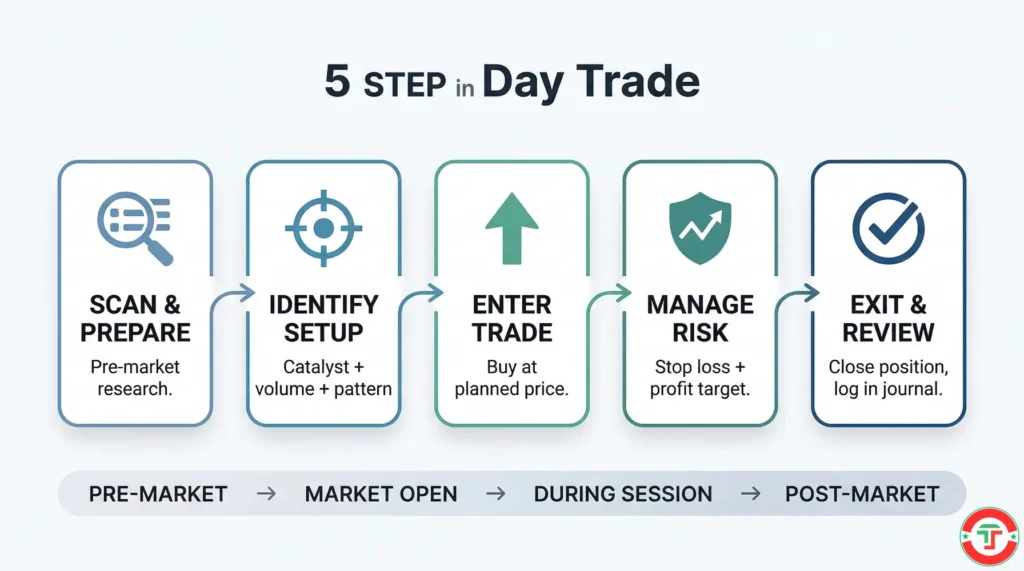
The Entry: At 9:35 AM, the stock pulls back slightly from its pre-market high and holds a key price level. The trader buys 200 shares at $52.00. Total cost: $10,400. The plan—set before entering—is to sell if the stock reaches $53.50 (the profit target) or if it drops to $51.25 (the stop loss, which is a pre-set exit point that limits the loss).
The Exit: By 10:10 AM, the stock has climbed to $53.50. The trader sells all 200 shares. The gross profit is $1.50 per share × 200 shares = $300. After commissions and fees, the net profit is roughly $295.
The Reality Check: That’s a clean example. In practice, maybe the stock gaps up and comes straight back down—the trader hits the stop loss and loses $150. Maybe the internet goes out. Maybe the trader panics and sells too early, locking in $40 instead of $295. Maybe the stock drops through the stop loss before the order fills—a phenomenon called slippage—and the loss is $200 instead of $150.
Day trading is a game of probabilities, not certainties. The best traders don’t win every trade. They win enough trades, and they keep their losses small enough that the math works over time.
Quick note—we used stocks in that example, but day trading applies to many markets. If you’re curious about which markets suit different trading styles, our Day Trading Markets guide breaks down stocks, forex, futures, and crypto in detail.
Day Trading vs. Swing Trading vs. Investing: What’s the Difference?
This is one of the most common points of confusion for beginners, so let’s clear it up fast.
Day Trading means all positions are opened and closed within the same trading session. No overnight exposure. Holding periods range from seconds to hours. Day traders primarily use technical analysis—reading charts, volume, and price patterns—to make decisions.
Swing Trading means holding positions for days to weeks, sometimes a few months. Swing traders are comfortable holding overnight and through market closes. They typically use a mix of technical and fundamental analysis (looking at the company’s financial health, earnings, industry trends).
Investing means holding positions for months to years—sometimes decades. Investors care about a company’s long-term growth potential, dividends, and competitive advantages. Warren Buffett is an investor. He buys companies he believes will compound in value over time.
The key difference comes down to time horizon and what drives your decisions. Day traders are reading a stock’s price action minute to minute. Investors are reading annual reports. Neither is “better”—they’re fundamentally different activities that require different skills, temperaments, and time commitments.
If you’re not sure which approach fits your life, our guide on Is Day Trading Right for You? will walk you through the honest pros and cons.

What Markets Can You Day Trade?
You’re not limited to stocks. Here’s a quick overview of the four main markets day traders operate in.
Stocks are the most popular choice for U.S. day traders. You’re buying and selling shares of publicly traded companies—Apple, Tesla, NVIDIA, or smaller companies with high volatility. Stocks trade on exchanges like the NYSE and NASDAQ, primarily between 9:30 AM and 4:00 PM Eastern.
Forex (Foreign Exchange) is the global currency market. You’re trading pairs—like the US Dollar against the Euro (EUR/USD). Forex runs nearly 24 hours a day, five days a week. It’s popular internationally and allows very small starting accounts because of high leverage (borrowed buying power) availability. That leverage is a double-edged sword, though—it amplifies losses just as fast as gains.
Futures are contracts that obligate you to buy or sell an asset at a predetermined price on a specific date. Popular futures for day traders include the E-mini S&P 500 (/ES) and E-mini Nasdaq (/NQ). Futures trade nearly around the clock and aren’t subject to the Pattern Day Trader rule that applies to stocks—something we’ll cover shortly. Many experienced day traders eventually gravitate to futures because of the tax advantages and extended trading hours.
Cryptocurrency markets—Bitcoin, Ethereum, and thousands of altcoins—trade 24/7, including weekends. Crypto is known for extreme volatility, which creates both opportunity and danger. Regulation in this space is still evolving, and the lack of circuit breakers (automatic trading pauses during sharp moves) means crypto can move 10-20% in a single day.
Each market has its own personality, costs, and quirks. We go deep on the differences—including the specific beginner traps in each one—in our Day Trading Markets: Stocks vs. Forex vs. Futures vs. Crypto guide.
The Brutal Truth: Day Trading Success Rates
We promised no-nonsense, and this is the section where that promise matters most.
The academic research on day trading profitability is extensive—and it’s not encouraging. But understanding these numbers honestly is one of the most important things you can do as a beginner, because it sets realistic expectations and helps you avoid the mistakes that wipe most people out.
The Taiwan Stock Exchange Study (Barber et al.) tracked over 450,000 individual day traders across fifteen years of data. The findings were stark. In any given year, only about 19% of the most active traders (those trading over $20,000 daily) earned positive returns after fees. And only about 4,000 individuals—less than 1% of the entire day trading population—were able to profit consistently year after year.
The Brazilian Futures Market Study (Chague, De-Losso, Giovannetti, 2020) examined all new day traders entering the Brazilian equity futures market from 2012 to 2017. The headline: 97% of those who persisted for more than 300 days lost money. Only 1.1% earned more than minimum wage from day trading. The researchers concluded that day trading is “almost uniformly unprofitable” for new entrants.
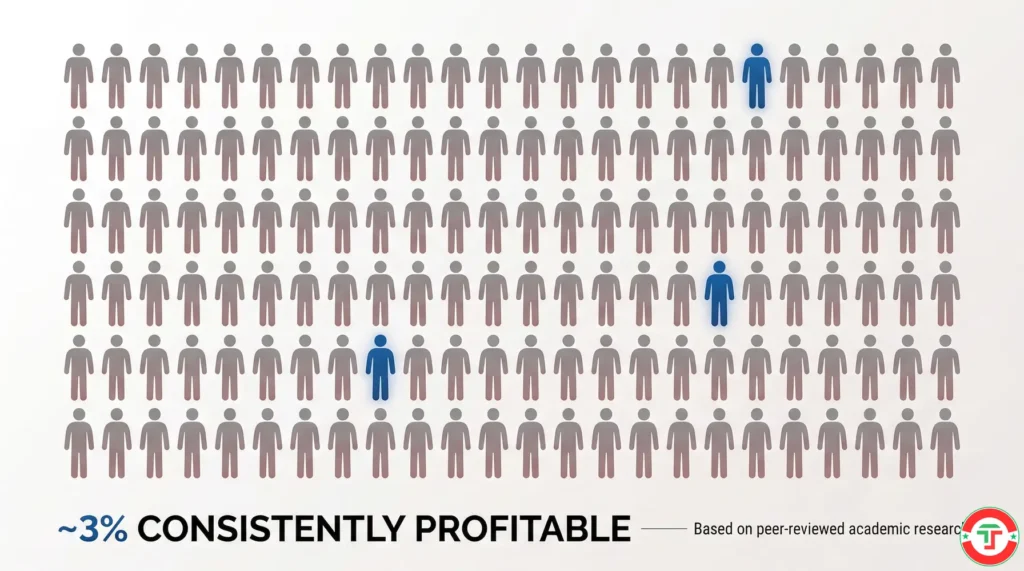
FINRA data indicates that over 72% of day traders end the year with financial losses, and more than 85% of active day traders fail within their first year—primarily due to inadequate risk management.
The SEC itself warns on its official investor education page: “Day traders typically suffer severe financial losses in their first months of trading, and many never graduate to profit-making status.”
Those are real numbers from real research. And here’s what our team wants you to take away: these statistics don’t mean day trading is impossible. They mean it’s genuinely difficult, and anyone telling you otherwise is selling something.
The small percentage of traders who do succeed share common traits: they treated it like a serious profession, they spent months in simulated trading before risking real money, they obsessed over risk management, and they were willing to lose for a long time while they learned. Nobody woke up profitable on day one.
If those statistics concern you—good. They should. Concern isn’t weakness; it’s intelligence. A healthy respect for the difficulty is what separates the traders who eventually make it from the ones who blow up their accounts in the first three months.
What You Need to Start Day Trading (The Essentials Checklist)
Before you look at a single chart, you need the right foundation. Here’s what it takes.
Capital. In the U.S., the minimum to day trade stocks in a margin account recently dropped from $25,000 to approximately $2,000 after the SEC eliminated the Pattern Day Trader (PDT) rule in April 2026. We’ll cover this in the next section. But the regulatory minimum and the functional minimum are two very different numbers — you need enough capital to manage risk properly and survive the learning curve. We break down the real numbers, including what you actually need by market, in our How Much Money to Start Day Trading guide.
A Brokerage Account. You need a broker—a company that executes your trades. Not all brokers are created equal. Factors like commission costs, execution speed, platform quality, and customer support matter enormously. Our Choosing Your First Broker checklist walks you through what to look for.
A Trading Platform with Real-Time Data. Day traders need live price data—not the 15-minute delayed quotes you see on most free websites. You need a charting platform that lets you analyze price movements, set alerts, and execute orders quickly. TradingView is a solid starting point for charting, and many brokers offer their own platforms with built-in tools.
A Stock Scanner. The stock market has thousands of stocks. You can’t watch all of them. A scanner filters the market in real time, surfacing stocks that meet your specific criteria—like unusual volume, price gaps, or momentum. Trade Ideas is the industry standard for serious scanners, though we’d recommend mastering the basics before investing in premium tools. Our Stock Scanners for Beginners guide covers how they work.
A Trading Plan. This isn’t a suggestion—it’s a requirement. Before risking any money, you need a written plan that defines what you’ll trade, how you’ll enter and exit, how much you’ll risk per trade, and when you’ll stop trading for the day. Flying blind is the fastest route to a blown-up account.
Education and Practice Time. Day trading is a skill that takes months of dedicated learning and practice. Paper trading—simulated trading with fake money—is where every beginner should start. No exceptions. We cover why this step is non-negotiable in our Why Paper Trading is Essential guide.
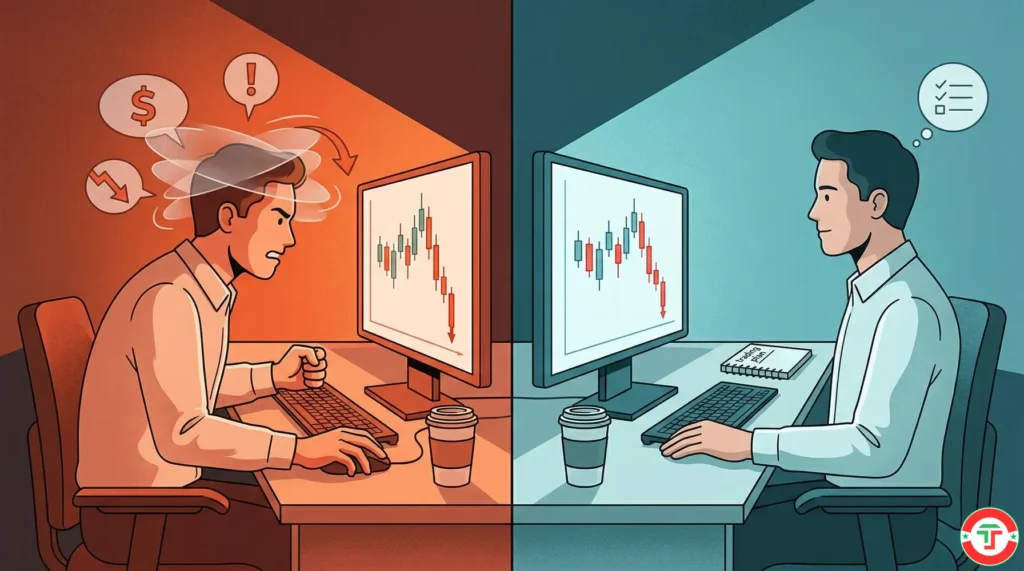
Emotional Readiness. This one doesn’t fit neatly into a checklist, but it’s real. Day trading will test your patience, your discipline, and your ego in ways you don’t expect. You will lose money. The question is whether you can handle those losses rationally or whether they’ll send you into revenge trading—taking bigger, riskier trades to “win back” what you lost. We’ll get deeper into the psychology in Module 7 of our Beginner’s Guide, but for now, just know this: the hardest part of day trading isn’t learning to read charts. It’s learning to manage yourself.
The 2026 Regulatory Landscape: The PDT Rule Is Gone
If you’ve been researching day trading, you’ve probably heard about the Pattern Day Trader (PDT) rule — a regulation that since 2001 required anyone making four or more day trades per week in a margin account to maintain $25,000 in equity.
That rule is gone.
On April 14, 2026, the SEC granted accelerated approval to eliminate the PDT framework entirely. The $25,000 minimum, the day trade counting, the PDT flag, the 90-day account freezes — all of it has been replaced by a risk-based intraday margin system where your buying power is calculated dynamically based on your actual positions. The effective date is June 4, 2026, with brokers having until October 20, 2027 to fully implement. The new minimum to day trade in a margin account drops to approximately $2,000.
What this means for beginners: The regulatory barrier that kept small-account traders out of stock day trading for 25 years is officially removed. Several major brokers — including Webull and Cobra Trading — have announced they’ll implement the new rules immediately upon the effective date.
What this doesn’t change: The difficulty. Lower barriers to entry don’t lower the skill requirements. If anything, our team is concerned that easier access without proper education could lead to more people losing money faster. The PDT rule, for all its flaws, forced some traders to slow down. Without that guardrail, discipline becomes even more important.
For the complete timeline, new margin mechanics, and a broker-by-broker implementation tracker, see The PDT Rule Is Dead: Everything That Changed. For the full history of the rule and what replaced it, read our PDT Rule Explained guide.
Is Day Trading Right for You? The Honest Litmus Test
We’ve given you the definition, the mechanics, the markets, the statistics, and the regulatory landscape. Now for the question that actually matters: should you do this?
Our team can’t answer that for you. But we can give you a few honest filters.
Day trading might be worth exploring if you have capital you can afford to lose entirely, you’re willing to spend 6-12 months learning before expecting any returns, you have a personality that handles losses without spiraling, you enjoy analytical problem-solving, and you have realistic expectations—meaning you’re not doing this because you saw someone on social media turn $500 into $50,000 in a week.
Day trading is probably not for you if you need the money you’d be trading with for rent, bills, or emergencies. If you’re looking for passive income—day trading is anything but passive. If you get emotionally attached to money (and be honest with yourself here). If you’re looking for a shortcut to financial freedom. Or if you don’t have time to commit to learning properly.
There’s no shame in deciding day trading isn’t your thing. Plenty of people build wealth through long-term investing, real estate, or building businesses. Day trading is one path. It’s not the only path, and it’s certainly not the easiest one.
For a much deeper dive into the real pros and cons—including the lifestyle factors most guides ignore, like stress, isolation, and the time commitment—read our full guide on Is Day Trading Right for You?.
What to Learn Next
If you’ve read this far and you’re still interested, that’s a good sign. Curiosity and caution are a far better starting combination than excitement and confidence.
This article is the first step in our Beginner’s Guide to Day Trading—a structured 101-article learning path that takes you from “what is day trading?” all the way to executing your first live trades. The next article in the series tackles the question everyone’s thinking but nobody wants to ask honestly: Is Day Trading Right for You? A Brutal Look at the Pros and Cons.
Take it one step at a time. There’s no rush. The market will be there tomorrow.
Frequently Asked Questions (FAQ)
Is day trading legal?
Quick Answer: Yes, day trading is completely legal in the United States and most countries around the world.
Day trading is a legitimate form of securities speculation. It’s regulated by the SEC and FINRA in the U.S., and by equivalent bodies in other countries. What is illegal are activities like insider trading (trading on non-public information), market manipulation, and certain forms of fraud. But the act of buying and selling securities within the same day? Perfectly legal. That said, just because it’s legal doesn’t mean it’s easy or safe. The SEC has published extensive warnings about the risks, and for good reason.
Key Takeaway: Day trading is legal and regulated, but the regulatory bodies themselves warn that most participants lose money. Legality and profitability are very different things.
How much money do I need to start day trading?
Quick Answer: With the PDT rule eliminated in April 2026, the regulatory minimum for U.S. stock day trading in a margin account drops to approximately $2,000. For futures or forex, you can start with similar amounts. But the functional minimum — what you actually need to trade safely — is significantly higher.
The $25,000 PDT requirement is gone, but the math of small accounts hasn’t changed. A $2,000 account with 1% risk per trade means risking $20 per trade — barely enough for meaningful positions. Futures offer a strong alternative for small accounts with Micro E-mini contracts starting around $3,000–$5,000. Forex accounts can be opened with even less. Regardless of market, “can start with” and “should start with” are very different conversations.
Key Takeaway: The regulatory barrier is gone, but capital is still the biggest factor in survival. Our How Much Money to Start Day Trading guide covers the real numbers by market and experience level.
Can you make a living day trading?
Quick Answer: Some people do, but they represent a very small minority—research suggests roughly 1-4% of day traders are consistently profitable.
Making a living from day trading requires significant capital (typically $50,000+), months or years of practice, a proven strategy with a statistical edge, and exceptional emotional discipline. It’s closer to running a small business than to a get-rich-quick scheme. Most traders who eventually become profitable describe their first year as “paying tuition”—they lost money while learning. If you’re considering this path, our guide on Realistic Day Trading Income Expectations gives you the honest math.
Key Takeaway: A living? Possible. Probable? No. Approach it as a skill to develop over years, not as an income source you can rely on next month.
What is the Pattern Day Trader rule?
Quick Answer: The PDT rule was a FINRA regulation (2001–2026) that required $25,000 in equity for anyone making four or more day trades per week in a margin account. The SEC eliminated this rule on April 14, 2026, effective June 4, 2026.
The rule was created after the dot-com crash to protect inexperienced traders from overleveraging. It applied only to stocks and options in margin accounts — never to futures, forex, cash accounts, or crypto. With its elimination, the minimum to day trade in a margin account drops to approximately $2,000, and brokers no longer count or restrict day trades. The replacement is a risk-based intraday margin system where buying power is calculated dynamically based on position risk.
Key Takeaway: The PDT rule is officially eliminated, though brokers are transitioning throughout 2026–2027. Check with your specific broker. We cover the full story in our PDT Rule Explained guide and our complete guide to the elimination.
Is day trading just gambling?
Quick Answer: It depends on how you approach it. Without a strategy and risk management, yes—it’s functionally gambling. With a tested edge and disciplined execution, it becomes calculated speculation.
This is actually one of the most important distinctions in all of trading. Gambling relies on luck and has a negative expected value (the house always wins over time). Professional day trading relies on identifying statistical patterns, managing risk precisely, and executing a repeatable process. The key word is “edge”—a small, consistent advantage that, applied over hundreds or thousands of trades, generates positive returns. Most beginners are gambling, because they haven’t yet developed an edge. The goal of proper education is to move from gambling to informed, systematic decision-making.
Key Takeaway: Day trading without a plan is gambling. Day trading with a tested strategy, risk management, and discipline is a legitimate—but difficult—form of speculation.
How much time does day trading take?
Quick Answer: Active day trading typically requires 2-4 hours of focused screen time during market hours, plus 1-2 hours of preparation and review.
There’s a misconception that day traders stare at screens for eight hours straight. Most experienced traders focus on the first two hours after the market opens (9:30-11:30 AM Eastern), when volume and volatility are highest. Pre-market preparation—reviewing news, building a watchlist, checking economic calendars—adds another hour. And post-market review—analyzing your trades, updating your journal—adds 30-60 minutes. All told, it’s a 4-6 hour daily commitment during trading days. For a thorough breakdown, check our Day Trading Time Commitment guide.
Key Takeaway: Day trading isn’t an all-day affair, but it does require dedicated, focused blocks of time during market hours—not something you can casually do during meetings.
What are the biggest risks of day trading?
Quick Answer: The biggest risks are financial loss (the majority of day traders lose money), emotional decision-making, overleveraging, and the opportunity cost of time spent learning.
Financial loss is the obvious one, but it’s not the only risk. Leverage—using borrowed money to take larger positions—can amplify losses beyond your initial investment. Emotional trading (revenge trading after a loss, FOMO-driven entries, overconfidence after a win) destroys more accounts than bad strategies. And there’s an underappreciated opportunity cost: the months or years you spend learning day trading could have been spent on other income-producing activities or investments. Risk management—knowing how much to risk per trade and when to stop—is the single most important skill in day trading. We cover it extensively starting in Module 6 of our Beginner’s Guide.
Key Takeaway: The risk is real and multi-dimensional. Start with our Introduction to Risk Management before you even think about placing a live trade.
Do I need special software or tools to day trade?
Quick Answer: You need a brokerage account, a real-time charting platform, and ideally a stock scanner—but you don’t need thousands of dollars worth of subscriptions as a beginner.
The essentials are a reliable broker with competitive commissions, a platform that provides real-time data and decent charting, and a stable internet connection. Many brokers—like TD Ameritrade’s thinkorswim or Interactive Brokers—offer capable platforms included with your account. Free charting is available through TradingView‘s basic plan. As you advance, tools like dedicated stock scanners become more valuable. But starting out? Keep it simple. Too many indicators and subscriptions create noise, not clarity.
Key Takeaway: Start with the basics and add tools as your skills justify them. Our Essential Day Trading Setup guide covers exactly what you need—and what you don’t.
What’s the difference between a margin account and a cash account for day trading?
Quick Answer: A margin account lets you borrow money from your broker to trade, giving you up to 4:1 intraday buying power. A cash account uses only your own settled funds — no borrowing, no leverage, but you must wait for trades to settle before reusing capital.
With the elimination of the PDT rule in April 2026, the biggest historical distinction between these accounts for day traders — the $25,000 requirement — is gone. Margin accounts now require only ~$2,000 for day trading. The remaining tradeoffs are leverage (margin gives you more buying power but amplifies losses), settlement speed (margin recycles instantly; cash accounts settle T+1), and short selling (requires margin). Cash accounts still offer a valuable advantage for beginners: built-in risk protection, since you can never lose more than you’ve deposited.
Key Takeaway: With the PDT rule gone, the margin vs. cash decision is now about risk tolerance and leverage preference, not regulatory avoidance. Our Margin vs. Cash Accounts for Day Traders guide covers this in depth.
Should I learn day trading from courses or YouTube?
Quick Answer: Free resources (YouTube, articles, forums) can teach you the basics, but be extremely skeptical of paid courses—especially those that promise fast profits or “guaranteed” systems.
The best day trading education combines free foundational knowledge (like this guide and our full Beginner’s Guide series) with practice in a simulated environment. If you’re considering a paid course, apply this filter: does it spend more time talking about the difficulty and risk of trading, or about how much money you’ll make? Legitimate educators are honest about failure rates. The SEC itself warns investors to be cautious of educational materials that may not be objective—particularly when the instructor profits from selling courses rather than actual trading.
Key Takeaway: Start with free, high-quality resources and paper trading. If you invest in education later, prioritize instructors who are transparent about the risks and who teach risk management as a core skill—not as an afterthought.
Disclaimer
The information provided in this article is for educational purposes only and should not be considered financial advice. Day trading involves substantial risk and is not suitable for every investor. Past performance is not indicative of future results.
For our complete disclaimer, please visit: https://daytradingtoolkit.com/disclaimer/
Article Sources
Our team builds every article on verified research and primary sources. Here are the key references used in this guide.
- Investor.gov — Thinking of Day Trading? Know the Risks — SEC Office of Investor Education guidance on day trading risks, leverage dangers, and the importance of risk tolerance assessment.
- SEC — Day Trading: Your Dollars at Risk — The SEC’s official investor education page on day trading risks, including warnings about the high rate of financial losses among day traders.
- FINRA — Day Trading Margin Rules — FINRA’s official explanation of pattern day trader requirements, including the $25,000 minimum equity rule and margin provisions.
- Barber, Lee, Liu, Odean — “Do Day Traders Rationally Learn About Their Ability?” (Taiwan Stock Exchange Study) — Academic study of 450,000+ day traders on the Taiwan Stock Exchange, finding less than 1% achieved consistent profitability.
- Chague, De-Losso, Giovannetti — “Day Trading for a Living?” (Brazilian Futures Market Study, SSRN 2020) — Peer-reviewed study showing 97% of new day traders in Brazil’s equity futures market lost money, with only 1.1% earning above minimum wage.
- Federal Register — FINRA Proposed Rule Change to Amend Rule 4210 (January 2026) — The official SEC filing of FINRA’s proposed amendments to replace day trading margin provisions with intraday margin standards.


