



You’ve decided to learn day trading. Great. But here’s the question nobody warns you about early enough: which market are you actually going to trade?
Most beginners default to stocks because that’s what they’ve heard of. Makes sense. But stocks are just one of four major day trading markets—and depending on your capital, schedule, and personality, they might not even be the best fit. Our team has spent years trading across all four, and we can tell you this: picking the wrong market doesn’t just slow you down. It can drain your account before you develop real skill.
Each of these four day trading markets has a completely different personality. Different rules, different rhythms, different capital requirements, and different ways of punishing mistakes. The forex market doesn’t care about your sleep schedule. Crypto doesn’t care about your risk tolerance. And the stock market has a regulatory rule that locks most small accounts out of day trading entirely.
So before you open a brokerage account and start clicking buttons, you need to understand what you’re walking into. This guide breaks down all four markets honestly—the advantages, the traps, and the brutal realities—so you can make an informed decision.
If you’ve been following our Beginner’s Guide series, you already know what day trading is and whether it’s right for you. Now it’s time to choose your battlefield.
What Are the Four Main Day Trading Markets?
Before we compare anything, let’s make sure you understand what each market actually is. These are the four arenas where day traders operate, and each one trades a fundamentally different type of asset.
Stocks are shares of ownership in publicly traded companies. When you buy a share of Apple or Tesla, you own a tiny piece of that company. Day traders buy and sell these shares within the same trading day, profiting from short-term price movements driven by earnings reports, news, sector momentum, and overall market sentiment.
Forex (short for “foreign exchange”) is the global currency market. Instead of buying company shares, you’re trading one currency against another—like the US dollar against the euro (EUR/USD) or the British pound against the Japanese yen (GBP/JPY). These trades are based on macroeconomic forces: interest rate decisions, inflation data, geopolitical events, and the relative strength of national economies.
Futures are standardized contracts to buy or sell a specific asset—like the S&P 500 index, crude oil, or gold—at a predetermined price on a future date. For day traders, the appeal is that you’re trading the “raw pulse” of entire markets rather than individual companies. The most popular futures for day traders are the E-mini and Micro E-mini contracts, traded on centralized exchanges like the CME Group.
Crypto (cryptocurrency) involves trading digital assets like Bitcoin (BTC) and Ethereum (ETH). It’s the newest of the four markets, operates on decentralized blockchain technology, and is known for extreme volatility. Unlike the other three markets, crypto never closes—it trades 24 hours a day, 7 days a week, 365 days a year.
Each market has millions of participants and real opportunity. But the differences in regulation, capital requirements, trading hours, and risk profiles are massive—and those differences should drive your decision.

Day Trading Stocks: The Familiar Starting Point
Stocks are where most people start, and for good reason. You already know what companies are. You’ve heard of Apple, Amazon, and Tesla. That familiarity makes the learning curve feel less steep—and there’s real value in trading something you intuitively understand.
Why Stocks Attract Day Traders
The US stock market—primarily the NYSE and Nasdaq—is heavily regulated by the SEC and FINRA, which means strong investor protections, transparent pricing, and standardized rules. When you trade stocks, you’re operating in one of the most well-regulated financial environments in the world.
Stocks also offer incredible variety. Thousands of publicly traded companies means thousands of potential trading opportunities every day. From mega-cap tech stocks moving on earnings to small-cap momentum plays surging on news catalysts, the stock market gives day traders a massive menu. Tools like stock scanners can filter through this universe in seconds—something we cover in our Stock Scanners guide.
The PDT Rule Is Gone — But Capital Still Matters
For over two decades, stocks carried one massive regulatory catch no other market had: the Pattern Day Trader (PDT) rule, which required $25,000 in equity to make more than three day trades per week in a margin account.
That barrier was eliminated on April 14, 2026, when the SEC approved FINRA’s proposal to replace the PDT framework with a risk-based intraday margin system. The effective date is June 4, 2026. The new minimum to day trade stocks in a margin account drops to approximately $2,000. Brokers are transitioning throughout 2026, with full implementation required by October 2027. For the full timeline and broker-by-broker status, see our complete guide to the PDT elimination.
This is great news for small-account traders — but it doesn’t change the functional capital requirements. You still need enough money to manage risk properly. We cover the real numbers in our PDT Rule Explained guide.
Stock Market Trading Hours
The regular US stock market session runs from 9:30 AM to 4:00 PM Eastern Time—just 6.5 hours. Pre-market and after-hours trading exist but with significantly reduced liquidity. For some people, this fixed schedule is a feature—you know when to show up and when to walk away. For others working a 9-to-5, it’s a serious limitation. We cover the details in our Market Hours guide.
Stocks at a Glance
- Minimum Capital (Practical): ~$2,000 regulatory minimum (PDT rule eliminated April 2026); $5,000-$10,000+ recommended for responsible risk management
- Trading Hours: 9:30 AM – 4:00 PM ET (extended hours available with reduced liquidity)
- Regulation: Heavy — SEC, FINRA (US)
- Leverage: Up to 4:1 intraday buying power in a margin account
- Volatility: Moderate — individual stocks can swing wildly, but the market overall is relatively structured
- Best For: Traders with $5K-$10K+ capital who prefer a fixed schedule and enjoy researching individual companies
Day Trading Forex: The 24-Hour Currency Machine
Forex is the largest financial market on the planet, and it’s not even close. According to the Bank for International Settlements’ 2025 Triennial Survey, the global forex market averages $9.6 trillion in daily trading volume. That’s trillion—with a T. To put that in perspective, the entire US stock market’s daily volume is roughly $300-500 billion. Forex dwarfs it by a factor of 20 or more.
Why Forex Attracts Day Traders
The appeal starts with accessibility. There’s no PDT rule in forex. No $25,000 minimum. Most forex brokers let you open an account with a few hundred dollars, and some offer micro lots—positions as small as 1,000 units of currency—that let you trade with minimal risk while you learn.
Forex also operates 24 hours a day, 5 days a week, rotating through three major sessions: the Asian session (Tokyo), the European session (London), and the US session (New York). This means if you work a day job, you can trade the London session before work, or the Asian session late at night. That schedule flexibility is a game-changer for part-time traders.
The market is also extremely liquid—the EUR/USD pair alone accounts for roughly 23% of all forex volume, meaning you can enter and exit positions with minimal slippage on major pairs.
The Traps Beginners Fall Into
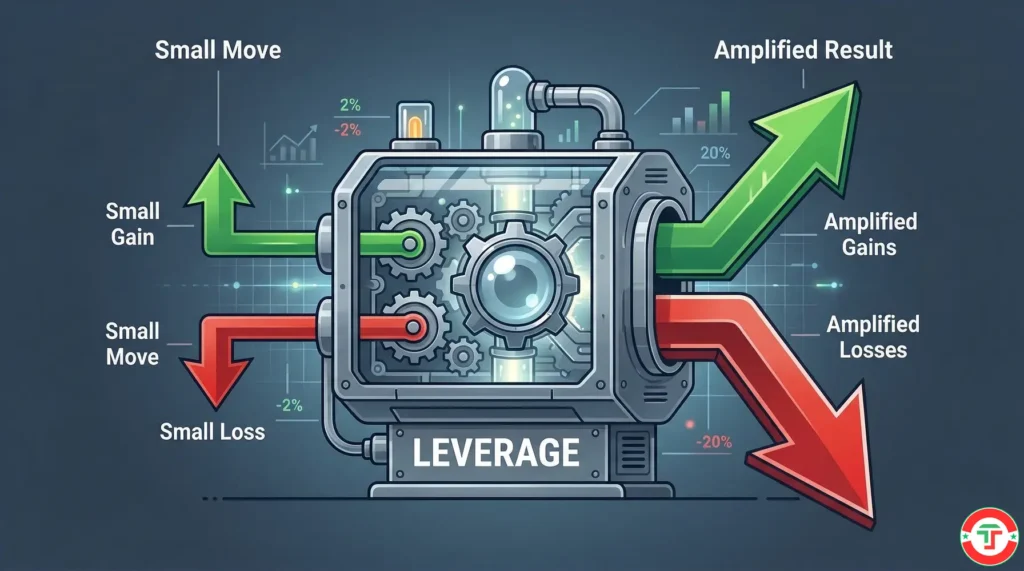
Forex has a deceptive quality. Because the price movements in currency pairs are small—often measured in “pips” (a pip is typically 0.0001 of the exchange rate)—brokers offer massive leverage to make those small moves meaningful. In the US, retail forex leverage is capped at 50:1. Offshore brokers? Some offer 500:1 or even 1000:1.
This is where beginners get destroyed. A trader sees they can control $50,000 worth of currency with just $1,000 in their account. The position “feels” small. Then the market moves half a percent against them, and their entire balance is gone. Leverage is a double-edged sword, and in forex, that sword is sharp.
Regulation is another consideration. US forex brokers are regulated by the CFTC and NFA, providing solid protection. But many brokers operate offshore with minimal oversight—choose carefully.
Forex at a Glance
- Minimum Capital (Practical): $500-$2,000 to start (no PDT rule)
- Trading Hours: 24 hours, 5 days a week (Sunday 5 PM – Friday 5 PM ET)
- Regulation: Varies wildly — CFTC/NFA (US) is strong, offshore can be sketchy
- Leverage: Up to 50:1 (US), much higher offshore
- Volatility: Low to moderate on major pairs — small absolute moves, amplified by leverage
- Best For: Part-time traders, small-account traders, and those fascinated by macroeconomics and global events
Day Trading Futures: The Professional’s Playground (Now Accessible to Everyone)
If forex is the largest market, futures are—in our team’s view—the cleanest. When you trade the E-mini S&P 500 (/ES), you’re trading the aggregate sentiment of the entire US stock market. No individual company earnings surprises. No CEO tweets crashing a single stock. Just pure supply and demand, condensed into a single instrument.
Why Futures Attract Day Traders
Futures trade on centralized, regulated exchanges like the CME Group, which means transparent pricing and standardized contracts. Every trader sees the same order book, the same bids and asks. There’s no market fragmentation like you sometimes see in stocks or the dark pool concerns that worry some traders.
Here’s what really matters for beginners: there’s no PDT rule in futures. None. You can day trade futures with any account size, as many times as you want, without hitting a regulatory wall. That alone makes futures attractive to undercapitalized traders who want to actively day trade.
Futures also offer favorable US tax treatment. Under the Section 1256 “60/40 rule,” 60% of profits are taxed at the long-term capital gains rate and 40% at the short-term rate—regardless of holding period. For active day traders, this can mean significant savings compared to stocks. We cover the details in our Section 1256 Tax Advantage guide.
The trading hours are nearly 24/5, similar to forex. Most popular contracts trade from Sunday evening through Friday afternoon with only a brief daily maintenance break. If you work a traditional job, you can trade futures outside of US stock market hours.
Micro E-Minis Changed the Game
Futures used to be expensive to enter. A single E-mini S&P 500 contract requires roughly $17,000 in exchange margin at major brokerages. Not beginner-friendly.
But in 2019, the CME Group launched Micro E-mini contracts—1/10th the size of standard E-minis. A Micro E-mini S&P 500 (MES) contract requires as little as $1,700 in exchange margin, and some brokers offer day trading margins as low as $50. Each one-point S&P 500 move is worth $5 per MES contract (versus $50 for the full E-mini). Same market, same price action, smaller position. For strategies specific to these contracts, check our Micro E-mini Strategy guide.
The Learning Curve
Futures have their own vocabulary—contango, backwardation, rollover dates, margin calls—that can feel intimidating. And even with Micro contracts, you’re controlling roughly $32,500 in market exposure with $1,700 in margin. Poor risk management can do real damage fast.
The instrument selection is also narrower than stocks. Most futures day traders focus on one or two contracts—/ES, /NQ, /CL, /GC—rather than scanning thousands of opportunities. Some traders love this focus. Others find it limiting.
Futures at a Glance
- Minimum Capital (Practical): $2,500-$5,000 for Micro contracts; $15,000+ for standard E-minis
- Trading Hours: Nearly 24/5 (Sunday 6 PM – Friday 5 PM ET with a daily break)
- Regulation: Strong — CFTC, centralized exchanges (CME Group)
- Leverage: High — built into the contract structure
- Volatility: Moderate to high — depends on the contract (/NQ is more volatile than /ES)
- Tax Treatment: Favorable 60/40 rule under Section 1256
- Best For: Focused traders who prefer one instrument, small-account traders wanting to avoid the PDT rule, and those who appreciate clean market structure
Day Trading Crypto: The Wild West That Never Closes
Crypto is the youngest of the four markets, and it behaves like it. Bitcoin was created in 2009. Ethereum launched in 2015. By 2026, the global cryptocurrency market cap fluctuates between roughly $2.5 and $4 trillion, with daily spot trading volume frequently exceeding $100 billion across exchanges.
The market has matured dramatically from its early days, but “mature” is relative. Compared to stocks or futures, crypto is still the Wild West.
Why Crypto Attracts Day Traders
The volatility is the obvious draw. Bitcoin regularly swings 3-5% in a single day. Altcoins—smaller cryptocurrencies—can move 10%, 20%, even 50%+ in a session. For day traders, volatility means opportunity. A 5% intraday move on a stock is a huge day. On Bitcoin, it’s a Tuesday.
There’s no PDT rule. No minimum capital requirement to day trade. Many exchanges let you start with as little as $10. And the market is open 24/7/365—weekends, holidays, Christmas morning. If you want to trade at 2 AM on a Saturday, crypto is the only game in town.
The Risks That Make Our Team Cautious
We’re going to be blunt: crypto has characteristics that make it particularly dangerous for beginners.
Regulation is fragmented and evolving. In the US, the regulatory landscape for crypto is still being actively built. The SEC and CFTC have overlapping jurisdictions, and the rules can change quickly. Unlike stocks or futures, where regulatory frameworks have been refined over decades, crypto regulation is a moving target. This creates uncertainty about exchange safety, asset classifications, and investor protections.
Exchange risk is real. The collapse of FTX in late 2022 wiped out billions in customer funds. While safeguards have improved, when you hold crypto on an exchange, there’s no SIPC insurance like there is for stocks.
Market manipulation is more prevalent. Lower liquidity on many altcoins makes them vulnerable to pump-and-dump schemes, whale manipulation, and wash trading—fake volume designed to make tokens appear more active than they are.
The 24/7 schedule is a trap, not a feature. A market that never closes means you can always trade—which means you’ll always be tempted to trade. We’ve seen traders destroy their accounts and their mental health by trading crypto around the clock, never disconnecting. If discipline is something you’re still developing, crypto’s constant availability will exploit that weakness.
For those specifically interested in crypto strategies, our team put together a dedicated Crypto Day Trading Strategy guide that addresses these risks head-on.
Crypto at a Glance
- Minimum Capital (Practical): $500-$2,000+ (no minimums, but undercapitalization + volatility = fast blowups)
- Trading Hours: 24/7/365 — never closes
- Regulation: Fragmented and evolving — varies dramatically by country
- Leverage: Available on many exchanges, often high (and dangerous)
- Volatility: Extreme — daily 3-10%+ swings are normal; altcoins can do much more
- Best For: Traders comfortable with high volatility, tech-savvy individuals, and those who want weekend/off-hours market access
The Market Comparison: A Side-by-Side Breakdown
Here’s the honest comparison, stripped down to the factors that actually matter for your decision:
| Factor | Stocks | Forex | Futures | Crypto |
|---|---|---|---|---|
| Minimum Capital (US) | ~$2,000 (PDT eliminated 2026) | $500+ | $2,500+ (Micros) | $500+ |
| Trading Hours | 6.5 hrs/day | 24/5 | ~24/5 | 24/7/365 |
| PDT Rule Applies? | No (eliminated April 2026) | No | No | No |
| Regulation (US) | SEC/FINRA (Strong) | CFTC/NFA (Strong) | CFTC/CME (Strong) | Fragmented (Evolving) |
| Typical Leverage | 4:1 intraday | Up to 50:1 (US) | High (built-in) | Varies widely |
| Volatility | Moderate | Low-Moderate | Moderate-High | Extreme |
| Number of Instruments | Thousands | Dozens of major pairs | Dozens of contracts | Thousands of tokens |
| Tax Treatment (US) | Short-term cap gains | Ordinary income (spot) | 60/40 rule (favorable) | Ordinary income |
| Beginner Resources | Excellent | Good | Good | Mixed quality |
| Exchange Risk | Very Low (SIPC) | Low (regulated brokers) | Very Low (centralized) | Higher (no SIPC) |
A few things jump out from this table. With the PDT rule eliminated in April 2026, stocks are now accessible to small accounts — but futures and forex still offer advantages like extended hours, lower margin requirements, and (for futures) tax benefits under Section 1256. And if capital protection and regulation matter to you — they should — crypto carries the most uncertainty.
But raw comparisons only get you so far. The right market is the one that fits you.
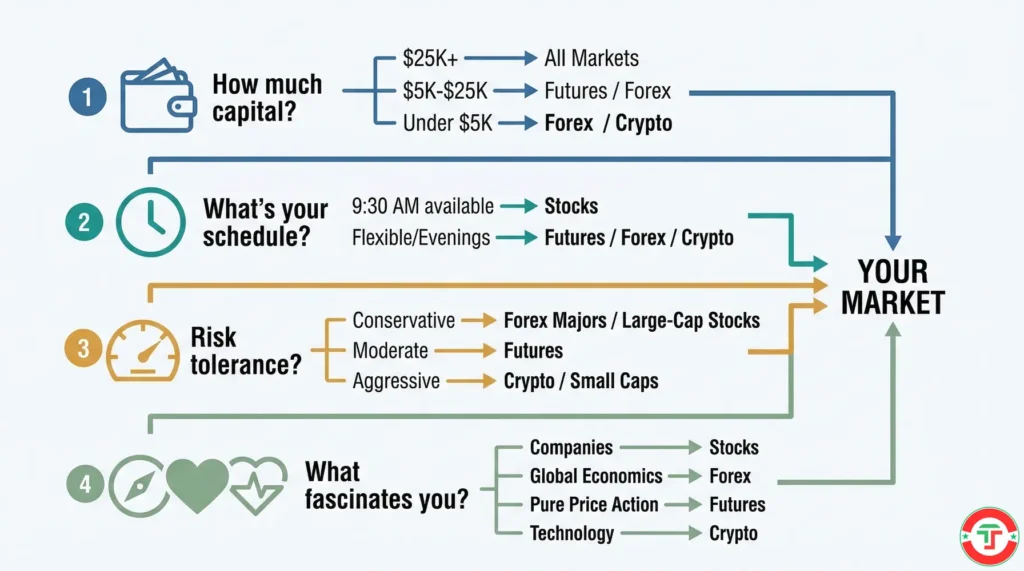
How to Choose Your Market: The 4-Question Decision Framework
After watching thousands of traders struggle with this decision, our team developed a simple 4-question framework. Answer these honestly—not based on what sounds exciting, but based on your actual life situation right now.
Question 1: How Much Capital Can You Responsibly Allocate?
This isn’t about how much you have. It’s about how much you can genuinely risk without it affecting your rent, your bills, or your sleep.
- $25,000+ → All four markets are fully accessible with comfortable risk management math.
- $5,000-$25,000 → Stocks are now accessible in margin accounts (PDT eliminated), plus futures and forex remain strong options. Consider starting with whichever market best fits your strategy.
- Under $5,000 → Forex and crypto have the lowest barriers. Micro futures are possible but require disciplined position sizing. Stocks are very limited.
Quick reality check: whatever market you choose, our team’s position is that you should never fund a trading account with money you can’t afford to lose. We cover capital planning in detail in our How Much Money to Start guide.
Question 2: What Does Your Daily Schedule Look Like?
This matters more than most beginners realize.
- Available 9:30 AM – 12:00 PM ET? Stocks are ideal. The first two hours of the US stock market session are where the majority of day trading opportunity concentrates.
- Available during European business hours (3 AM – 12 PM ET)? Forex is compelling—the London/New York session overlap (8 AM – 12 PM ET) is the most liquid and active period.
- Only available evenings or weekends? Futures trade nearly around the clock, and crypto never closes. These are your markets.
- Unpredictable schedule? Forex and futures offer the most flexibility with their extended hours.
Question 3: What’s Your Honest Risk Tolerance?
Not what you think you can handle—what can you actually stomach when real money is on the line?
- Conservative → Forex major pairs (EUR/USD, GBP/USD) have the smallest typical moves. Stocks in large caps are relatively structured.
- Moderate → Futures on major indices (/ES, /NQ) provide solid movement without the chaos of crypto.
- Aggressive → Crypto and small-cap momentum stocks offer the biggest swings—but the biggest potential for fast, painful losses.
Question 4: What Genuinely Fascinates You?
This might sound soft, but it’s possibly the most important factor for long-term success.
Learning to day trade is hard. The failure rate is brutal—research suggests that 72% of day traders experience financial losses annually, according to FINRA data. The people who survive the learning curve are almost always the ones who find the process genuinely interesting, not just profitable.
- Love digging into individual companies? Stories, earnings, products, leadership? → Stocks.
- Fascinated by global economics? Interest rates, central bank decisions, geopolitical forces? → Forex.
- Prefer pure price action on a single instrument? Clean charts, market structure, order flow? → Futures.
- Drawn to emerging technology? Blockchain, DeFi, tokenomics, the cutting edge? → Crypto.
There’s no wrong answer. But trading a market that bores you is a recipe for distraction—and distracted traders lose money.
Our team’s honest recommendation for most beginners? Start with one market. Master the basics. Then expand. You’re not married to your first choice—many successful traders eventually operate across multiple markets. But trying to learn all four simultaneously is a fast track to analysis paralysis, a real problem we discuss in our Analysis Paralysis guide.
Now that you know the four markets and have a framework for choosing yours, the next step is understanding how these markets actually work under the hood. Whichever market you pick, you need to understand the basic mechanics of price movement, supply and demand, and how exchanges operate. That’s exactly what we cover next in our How Do Stock Markets Work guide—the foundational knowledge that applies across every market you’ll ever trade.
Frequently Asked Questions
Which market is best for day trading beginners?
Quick Answer: There’s no single “best” market — it depends on your capital, schedule, and risk tolerance. For US-based beginners with limited capital, forex or Micro E-mini futures are often the most accessible starting points.
Stocks feel familiar, but the $25,000 PDT rule creates a significant barrier for most new traders. Forex lets you start with a few hundred dollars and trade around the clock. Micro E-mini futures give you access to professional-grade markets with as little as $2,500-$5,000. Crypto is accessible but the extreme volatility and evolving regulation add layers of risk that can overwhelm someone still learning the fundamentals.
Key Takeaway: Match your market to your capital and schedule first, then consider your interests. Don’t default to stocks just because they’re familiar — you might have better options.
Can you day trade with less than $25,000?
Quick Answer: Yes — in any market. With the elimination of the PDT rule in April 2026, even U.S. stock day trading in a margin account now requires only approximately $2,000.
The $25,000 barrier that previously restricted stock day trading is gone. You can now trade stocks, futures, forex, and crypto with small accounts. That said, the functional minimum for responsible trading is higher than the regulatory minimum. Micro E-mini futures still offer excellent capital efficiency for small accounts, and cash accounts remain a solid option for beginners who want built-in protection against overleveraging. For the full story on what changed and when, see our PDT elimination guide.
Key Takeaway: The regulatory playing field is now level across markets. Choose based on strategy fit, not regulatory workarounds.
Is forex safer than stocks for day trading?
Quick Answer: Not inherently. Major forex pairs like EUR/USD have smaller price movements than most stocks, but the high leverage available in forex can amplify losses just as easily as gains.
The “safety” of any market depends on your risk management, not the market itself. A trader risking 1% per trade on a leveraged forex position faces the same percentage risk as a stock trader using proper position sizing. The difference is that forex’s high leverage tempts beginners into oversized positions—a poorly managed forex trade can wipe out an account faster than a poorly managed stock trade. For risk control fundamentals, see our Introduction to Risk Management guide.
Key Takeaway: No market is “safe” for day trading — your risk management discipline is what protects you, not the market you choose.
How much money do I need to start day trading futures?
Quick Answer: With Micro E-mini contracts, you can start with $2,500-$5,000 and trade responsibly. Standard E-mini contracts require significantly more — typically $15,000+.
The Micro E-mini S&P 500 (MES) has an exchange margin requirement of roughly $1,700-$2,200 per contract, and some brokers offer day trading margins as low as $50. But just because you can trade with the minimum doesn’t mean you should. Our team recommends at least 2-3x the margin requirement to absorb normal losing streaks without getting margin-called.
Key Takeaway: Micro futures made the futures market genuinely accessible to beginners — but treat margin requirements as a floor, not a target.
Is crypto too risky for day trading beginners?
Quick Answer: For most beginners, yes — the combination of extreme volatility, evolving regulation, exchange risk, and 24/7 trading hours creates an environment that punishes inexperience harshly.
That doesn’t mean you can’t eventually trade crypto. But starting your education in a market where 10%+ daily swings are normal and the temptation to overtrade runs 24/7 stacks the odds against you. Learn the fundamentals—chart reading, risk management, trading psychology—in a more structured market first.
Key Takeaway: Crypto can be part of your trading future, but it’s a challenging place to start your trading education.
What’s the most liquid market for day trading?
Quick Answer: Forex, by a massive margin. The global forex market averages $9.6 trillion in daily volume according to the Bank for International Settlements’ 2025 Triennial Survey. No other market comes close.
High liquidity means tight spreads (lower trading costs), fast execution, and the ability to enter and exit positions without moving the market. The US stock market is the next most liquid for equity traders, followed by futures on popular contracts like /ES and /NQ. Crypto liquidity varies enormously—Bitcoin and Ethereum are liquid, but smaller tokens often are not.
Key Takeaway: If liquidity and tight spreads are your priority, forex major pairs and popular futures contracts offer the best trading conditions.
Can I day trade multiple markets at the same time?
Quick Answer: You can, but our team strongly recommends against it when you’re starting out. Focus on one market first and build competence before diversifying.
Some experienced traders operate across multiple markets—trading stocks during the US session and futures in the evening, for example. But each market has its own dynamics, terminology, and behavior. Trying to learn all four simultaneously spreads your attention too thin. Think of it like learning instruments: master guitar before picking up the drums.
Key Takeaway: Start with one market, become consistently competent, then consider adding a second market to your toolkit.
Do I need different platforms and brokers for each market?
Quick Answer: Often, yes. Most brokers specialize in one or two markets. However, some multi-asset platforms like TradingView let you chart and analyze all four markets in one place.
Stock brokers (like TD Ameritrade, Interactive Brokers) may also offer futures trading, but forex and crypto typically require separate accounts with specialized brokers. Interactive Brokers is one of the few platforms offering stocks, forex, futures, and crypto under one roof. We cover the broker selection process in our Choosing Your First Broker checklist.
Key Takeaway: You’ll likely need specialized accounts for different markets, but charting and analysis tools can often work across all of them.
What about options? Is that a fifth market?
Quick Answer: Options are technically derivatives that trade within the stock (and sometimes futures) market — they’re a different instrument, not a separate market.
Options give you the right to buy or sell shares at a specific price by a specific date. They offer leveraged exposure and defined risk, but add complexity—Greeks, time decay, implied volatility—that’s beyond what most beginners should tackle initially. We have a dedicated Day Trading Options for Beginners guide when you’re ready.
Key Takeaway: Learn to trade the underlying market (stocks or futures) before adding options to your toolkit.
Has the PDT rule been eliminated?
Quick Answer: Yes. On April 14, 2026, the SEC granted accelerated approval to eliminate the Pattern Day Trader designation and the $25,000 minimum. The effective date is June 4, 2026, with full broker implementation required by October 20, 2027.
The new framework bases your buying power on the actual risk of your positions through real-time intraday margin calculations, rather than counting trades or enforcing an arbitrary dollar threshold. The minimum to day trade in a margin account drops to approximately $2,000. Several major brokers have announced immediate implementation plans. For the full timeline, new margin mechanics, and broker tracker, see The PDT Rule Is Dead: Everything That Changed.
Key Takeaway: The rule is officially eliminated, but check with your specific broker for their implementation timeline — the transition is rolling out throughout 2026.
Disclaimer
The information provided in this article is for educational purposes only and should not be considered financial advice. Day trading involves substantial risk and is not suitable for every investor. Past performance is not indicative of future results.
For our complete disclaimer, please visit: https://daytradingtoolkit.com/disclaimer/
Article Sources
Our team builds every article on verified facts from authoritative sources. Here are the primary sources used in this guide:
- FINRA — Day Trading — Pattern Day Trader rules, margin requirements, and investor education on the risks of day trading.
- Bank for International Settlements — 2025 Triennial Central Bank Survey — The definitive source for global forex market volume data, reporting $9.6 trillion in average daily trading volume as of April 2025.
- CME Group — Micro E-mini Futures FAQ — Contract specifications, margin requirements, and trading details for Micro E-mini equity index futures.
- SEC — Investor.gov: Day Trading — SEC’s investor education resource on the risks and realities of day trading.
- SEC Order Granting Accelerated Approval — SR-FINRA-2025-017 — The SEC’s April 14, 2026 order eliminating the Pattern Day Trader framework and approving risk-based intraday margin standards (Release No. 34-105226).
- Investopedia — Day Trading: Stocks, Forex, Futures, Crypto — Educational definitions and beginner-friendly explanations of trading concepts across all four markets.


