

You’ve done the math. You’ve picked your market. You’re ready to start day trading. Then you place your fourth trade of the week — and your broker locks your account.
No warning that made sense. No countdown you could see coming. Just a notification that you’ve been “flagged as a pattern day trader” and you need $25,000 in your account to keep going.
This is one of the most frustrating moments a new trader faces, and it happens constantly. The Pattern Day Trader rule — commonly called the PDT rule — has been the single biggest barrier to entry for aspiring day traders since 2001. It has forced beginners into awkward workarounds, pushed some toward riskier overseas brokers, and confused just about everyone who’s encountered it.
Here’s the good news — and in April 2026, it became very good news. We’re going to break this rule down until it makes complete sense. You’ll understand exactly what triggered it, what happened when you were flagged, the workarounds traders used for two decades, and — the headline event — the SEC’s historic decision on April 14, 2026 to eliminate the $25,000 requirement entirely and replace the PDT framework with a modern, risk-based margin system.
If you’ve been following our Beginner’s Guide series, you already understand how much money you need to start trading and the differences between day trading, swing trading, and investing. The PDT rule is where those capital requirements get very real, very fast.
What Is the Pattern Day Trader (PDT) Rule?
The Pattern Day Trader rule is a regulation enforced by FINRA — the Financial Industry Regulatory Authority — that applies to anyone trading stocks or options in a U.S. margin account. A margin account, for those new to trading, is a brokerage account that lets you borrow money from your broker to buy securities, giving you more buying power than the cash you’ve deposited.
Here’s the core of the rule: if you execute four or more day trades within five consecutive business days in a margin account, and those day trades represent more than 6% of your total trading activity during that same period, your broker must classify you as a “pattern day trader.”
Once you carry that designation, you’re required to maintain a minimum of $25,000 in equity (cash plus the value of your securities) in your account at all times. Drop below that threshold, and you lose the ability to day trade until your balance is restored.
A “day trade,” by the way, is simple: it’s buying and selling — or selling short and buying back — the same security on the same trading day. Buy 100 shares of a stock at 9:45 AM and sell them at 11:30 AM? That’s one day trade.
The rule is codified under FINRA Rule 4210, and it applies to all U.S. broker-dealers. Every major brokerage — Schwab, Fidelity, Robinhood, Interactive Brokers, Webull — enforces it because they’re legally required to.
How Does the PDT Rule Actually Work? (The 4-Trade Trigger Explained)
The mechanics trip people up, so let’s walk through this carefully.
The Rolling 5-Day Window
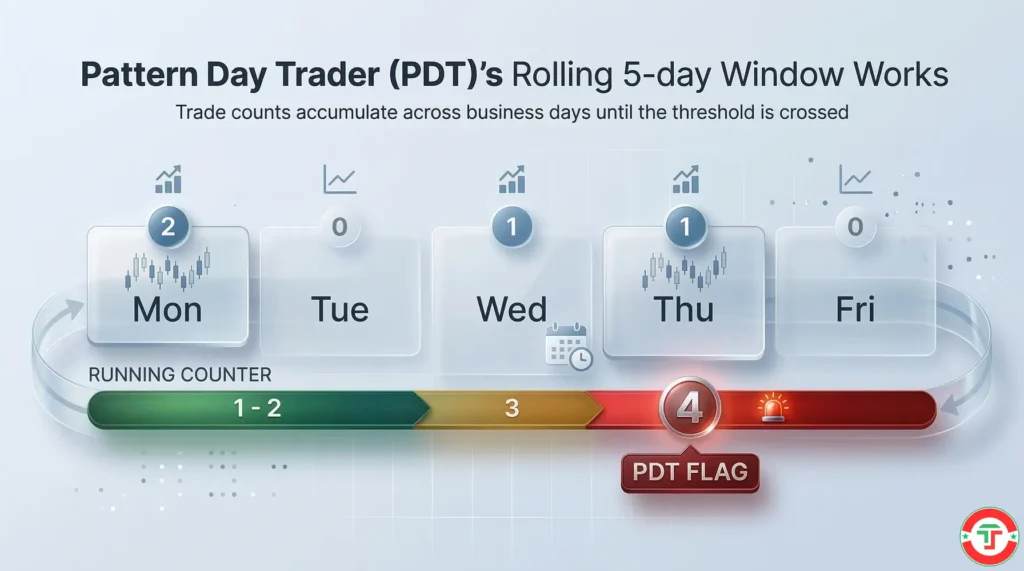
Your broker tracks your day trades over a rolling five-business-day window. Not a calendar week — rolling. That means if you made two day trades on Monday, one on Wednesday, and one on Thursday, you’ve hit four day trades within five business days. You’re flagged.
The 6% Exception Most People Miss
There’s a nuance that almost nobody talks about. You’re only flagged as a PDT if your day trades represent more than 6% of your total trades during that same five-day period. So if you placed 80 total trades in a week and only four were day trades, you technically wouldn’t trigger the rule — those four trades represent just 5% of your activity.
In practice, though, most new traders aren’t placing 67+ non-day-trades per week. If you’re a beginner making a handful of trades, any four day trades will almost certainly exceed that 6% threshold. Don’t count on this exception saving you.
What Counts as a Day Trade
This is where it gets specific:
- Buying 500 shares of AAPL at 10:00 AM and selling them at 2:00 PM = 1 day trade
- Selling short 200 shares of TSLA at 9:35 AM and buying them back at 11:00 AM = 1 day trade
- Buying options contracts in the morning and selling them in the afternoon = 1 day trade
- Buying a stock today and selling it tomorrow morning = NOT a day trade (different calendar days)
One thing that catches new traders off guard: partial fills. If you place a large order and it fills in multiple executions throughout the day, each execution can count separately toward your day trade total. Trading low-volume stocks or placing oversized orders increases this risk.
Extended Hours Count Too
Trades placed during pre-market (4:00 AM–9:30 AM ET) and after-hours (4:00 PM–8:00 PM ET) sessions can still count as day trades if you open and close the same position within the same trading day.
What Happens When You Get Flagged as a Pattern Day Trader?
Getting flagged isn’t the end of the world, but it does create real restrictions. Here’s the sequence:
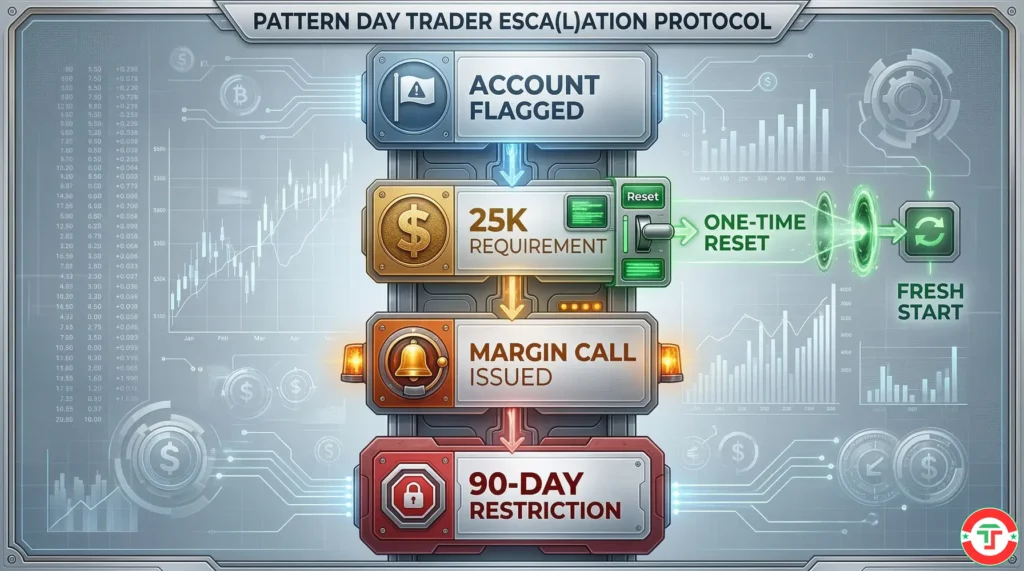
Step 1: Your Broker Flags Your Account
Once you hit four day trades in five business days (exceeding the 6% threshold), your broker designates your account as a “pattern day trader.” At most brokers, this flag is permanent — or at least very sticky. Robinhood notes that PDT flags remain on accounts indefinitely outside of extraordinary circumstances.
Step 2: The $25,000 Requirement Kicks In
You now need to maintain at least $25,000 in total equity — that’s cash plus the market value of your holdings — in your margin account. This must be in your account before you day trade, not deposited after the fact.
Step 3: If You’re Below $25,000, You’re Restricted
If your equity falls below the threshold, your broker issues a “day trading margin call.” You typically have five business days to deposit funds or securities to restore your balance. During this time — and for up to 90 calendar days if you don’t meet the call — your account may be restricted to closing transactions only. That means you can sell what you own, but you can’t open new positions.
Step 4: The One-Time Reset (Maybe)
Most brokers offer a one-time courtesy removal of the PDT flag. Contact your broker’s compliance department and ask politely. After that single reset, subsequent violations trigger the standard 90-day restriction. Don’t waste your reset on something careless — treat it like an emergency escape hatch.
Buying Power Changes
Once designated as a PDT with $25,000+ in equity, you actually get more buying power for day trades — up to 4:1 leverage (meaning $25,000 in equity gives you $100,000 in intraday buying power). Your overnight buying power remains at 2:1. This is a double-edged sword. More leverage means bigger potential profits — and much bigger potential losses. Many traders have been wrecked by the very leverage that the PDT rule gives them access to.
Why Does the PDT Rule Exist? (The Dot-Com Origin Story)
The PDT rule wasn’t created to annoy you. It was created because a lot of people got annihilated.
In the late 1990s, during the dot-com bubble, online brokerages exploded in popularity. Suddenly anyone with an internet connection and a few thousand dollars could day trade tech stocks. And they did — aggressively, with margin, often with zero understanding of risk management.
When the bubble burst in 2000–2001, the damage was severe. Inexperienced traders who’d been using margin to amplify their bets saw their accounts wiped out, sometimes owing their brokers more than they’d deposited. FINRA — then called the NASD — responded by implementing the Pattern Day Trader rules in 2001, requiring a $25,000 minimum equity buffer for anyone who traded actively enough to be classified as a pattern day trader.
The logic made sense at the time: force active traders to maintain a financial cushion so they couldn’t lose more than they had. The rule was approved by the SEC on February 27, 2001, and it’s been largely unchanged for over two decades.
But here’s the uncomfortable truth our team has observed: the rule has created its own perverse incentives. A beginner who wants to day trade with $5,000 can’t — unless they take on $25,000 in margin exposure, which is far more risk than they should handle. The rule designed to protect small traders has, in many cases, pushed them toward more dangerous levels of leverage just to participate.

The 2026 PDT Rule Overhaul: What Changed and What Replaces It
This is the most significant change to retail trading access since online brokers eliminated commissions. On April 14, 2026, the SEC granted accelerated approval of FINRA’s proposal to eliminate the Pattern Day Trader framework entirely — including the $25,000 minimum equity requirement and the PDT designation itself.
After 25 years, the rule that locked millions of traders out of active trading is officially done.
The Timeline: How We Got Here
The overhaul moved through the regulatory pipeline faster than most expected. In September 2025, FINRA’s Board of Governors voted to replace the entire day trading margin framework. On December 29, 2025, FINRA filed the proposed rule change with the SEC as SR-FINRA-2025-017. The SEC published it in the Federal Register on January 14, 2026, and accepted public comments through February 4, 2026 — receiving over 100 responses, with all but one supporting the change.
On April 2, 2026, FINRA filed Amendment No. 1 to clarify implementation timing. Twelve days later, the SEC issued its accelerated approval order, and the Federal Register published the final notice on April 17, 2026.
What’s Eliminated
The “pattern day trader” designation no longer exists. Your broker will no longer count your day trades or flag your account based on how many times you buy and sell within a rolling five-day window. The $25,000 minimum equity requirement — the rule that kept traders with $5,000 or $10,000 or $20,000 from freely day trading in a margin account — is gone.
The entire compliance apparatus that brokerages built around PDT violations — the margin calls, the 90-day freezes, the one-time courtesy resets — all of it is being retired.
What Replaces It
Instead of a flat dollar threshold, brokers now apply real-time intraday margin requirements based on the actual risk of your open positions. Think of it as a shift from a blunt instrument (one number for everyone) to a precision tool (margin calculated dynamically based on what you’re actually trading).
The new minimum to hold a margin account remains at $2,000 — the standard threshold that already existed for opening any margin account. Major brokerages like Cobra Trading have confirmed they expect $2,000 to be the new functional minimum for day trading, though individual brokers may set their own higher internal floors.
Your day trading buying power will be calculated based on standardized maintenance margin requirements — typically 25% of position value — rather than a fixed 4:1 multiplier tied to the old PDT framework. In practice, this means your buying power will flex based on the volatility and concentration of your positions, not just your account balance.
When It Takes Effect
FINRA will issue a Regulatory Notice announcing the effective date, which will be 45 days after publication of that notice. Based on the April 14 approval, the likely effective date falls in late May or early June 2026. Brokers that need additional time are permitted to phase in implementation over 18 months.
Some brokers are moving fast. Webull announced on April 15, 2026 — one day after the SEC approval — that it will support the removal of PDT rules as soon as the new regulations take effect, enabling unlimited day trades under the new margin framework. Their stock surged over 11% on the news. Cobra Trading has similarly stated it plans to roll out the new system immediately upon the rule taking effect.
The Critical “Right Now” Caveat
Until your specific broker officially transitions to the new system, the old PDT rules still apply to your account. The SEC approved the elimination. FINRA is working on the regulatory notice. But the change isn’t live at your brokerage until they flip the switch — and some brokers may take months to implement.
What this means for you today: Check with your broker directly. Ask when they plan to implement the new intraday margin rules. Until they confirm the transition is complete, continue operating under the assumption that the $25,000 minimum and three-day-trade limit are in effect.
What You Should Be Doing Right Now
The traders who benefit most from this change aren’t the ones who rush in with $2,000 and start firing off trades the moment restrictions lift. They’re the ones who’ve been building skills, developing a strategy, and practicing discipline while the regulatory process played out.
More access means more participants. More participants means more competition. And the market doesn’t care that you’re newly eligible to trade freely — it will take your money just as efficiently whether the PDT rule exists or not. The skills that matter — risk management, emotional control, trade selection — haven’t changed at all.
Our advice: if you’ve been waiting on the PDT rule to start day trading, use the remaining transition period to paper trade, study the concepts in this Beginner’s Guide series, and build a trading plan you can execute with confidence. The door is opening. Make sure you’re ready to walk through it prepared.
How to Work Around the PDT Rule (6 Legitimate Options)
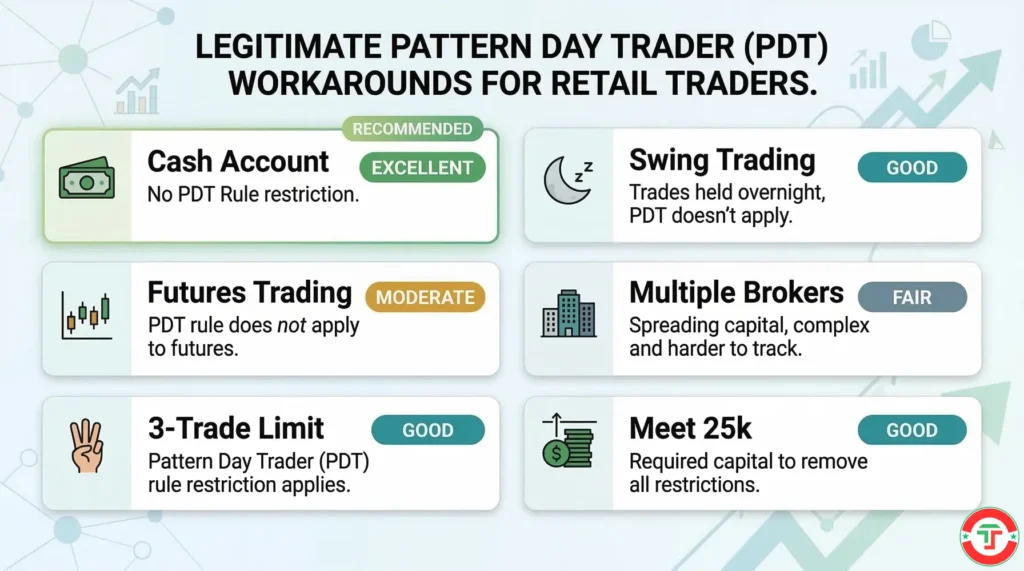
While the rule remains in effect, here are six legal ways to trade actively without the $25,000 minimum. We’ve ranked them by practicality for beginners.
Option 1: Use a Cash Account (Best for Most Beginners)
The PDT rule only applies to margin accounts. Switch to a cash account and you can day trade as often as you want — with one catch: you can only trade with settled funds.
Under the current T+1 settlement system (updated from T+2 in 2024), when you sell a stock, your cash settles by the next business day. So if you sell $1,000 of stock on Monday, that cash is available to trade again on Tuesday.
The practical impact: if you have $3,000 in a cash account, you could realistically make one or two day trades per day and rotate your capital as it settles. You won’t be scalping 20 times a day, but for a beginner learning the ropes, this is actually a feature — it forces you to be selective.
The risk to watch: If you buy and sell using unsettled funds, you trigger a “Good Faith Violation.” Accumulate enough of these and your broker restricts your account to settled-cash-only for 90 days. Track your settled cash carefully.
Beginner suitability: Excellent. This is the cleanest, safest workaround and it teaches you to be patient and selective.
Option 2: Trade Futures Instead of Stocks
Futures contracts — like E-mini S&P 500 (/ES), Micro E-mini Nasdaq (/MNQ), or gold futures (/GC) — are regulated by the CFTC, not FINRA. The PDT rule simply doesn’t apply.
You can day trade futures unlimited times per day with accounts as small as $1,000–$2,000, depending on your broker. Micro contracts have made this accessible even for beginners.
The risk to watch: Futures involve significant leverage. A Micro E-mini S&P 500 contract controls roughly $25,000 worth of the index, even though you only put up about $1,300 in margin. Losses can exceed your deposit. Futures are a different beast from stocks — the market structure, hours, and risk profiles are all different. We break down these market differences in our guide to day trading markets.
Beginner suitability: Moderate. Great for bypassing PDT, but start with Micro contracts and paper trade first.
Option 3: Limit Yourself to 3 Day Trades per 5 Days
The simplest math-based approach: if you never make more than three day trades in any rolling five-business-day window, you’ll never trigger PDT. Most brokers have built-in PDT protection tools that warn you before your fourth trade.
This forces discipline. Instead of jumping at every opportunity, you pick your three best setups each week.
The risk to watch: You might hesitate to exit a losing position because you don’t want to “waste” a day trade. Never let the PDT rule override risk management — if you need to get out, get out.
Beginner suitability: Good. Forces selectivity, which is actually a valuable habit for beginners.
Option 4: Hold Positions Overnight (Swing Trading)
If you buy a stock today and sell it tomorrow, it’s not a day trade. Swing trading — holding positions for days to weeks — completely avoids the PDT rule while still being active, short-term trading.
The risk to watch: Overnight risk. A stock can gap down significantly before the market opens due to after-hours news, earnings releases, or macroeconomic events. You also need to adjust your position sizing to account for this added uncertainty. For a deeper comparison, check out our day trading vs. swing trading guide.
Beginner suitability: Good, especially as a bridge while building capital toward $25,000.
Option 5: Open Accounts at Multiple Brokers
If you have accounts at two or three different brokerages, you get three day trades per five days at each broker. Three brokers = nine day trades per week. Each broker tracks PDT independently.
The risk to watch: This adds complexity. You’re managing positions across multiple platforms, splitting your capital (meaning less buying power per account), and tracking settled funds in each account separately. Commission-free brokers make this viable from a cost perspective, but operational mistakes increase.
Beginner suitability: Fair. Works, but adds unnecessary complexity. Better suited for intermediate traders.
Option 6: Meet the $25,000 Requirement
The most straightforward option: fund your margin account to $25,000 or above. Once you’re above the threshold, you can day trade freely with 4:1 intraday leverage.
The risk to watch: Having $25,000 doesn’t mean you should use $25,000. That level of capital with 4:1 leverage gives you $100,000 in intraday buying power — which can destroy an undisciplined account in hours. If you go this route, start by risking a small percentage of your capital per trade. Our risk management guide covers the rules that keep accounts alive.
Beginner suitability: Good if you have the capital, but only after significant paper trading and education. The $25,000 should be money you can afford to lose entirely.
Which PDT Workaround Is Right for You?
For most beginners reading this series, we recommend starting with a cash account (Option 1). It removes the PDT headache entirely, and the settlement-based trading limits actually help build good habits. You’ll learn to wait for your best setups instead of overtrading — which is a skill most traders take years to develop.
If you’re interested in broader markets, futures with Micro contracts (Option 2) is a solid second choice, but paper trade extensively first. For identifying the best stocks to trade — whether in a cash or margin account — a real-time scanner makes a massive difference. Our team has used Trade Ideas for years; their AI-powered scanner surfaces high-probability setups so you can be selective with your limited day trades. Check our Trade Ideas coupon page for the latest savings before committing.
Whatever path you choose, the right combination of tools accelerates your learning curve. We break down the best scanners, charting platforms, education, and journals in our Day Trading Toolkit.
What’s Next in Your Day Trading Journey
Now that you understand the PDT rule — what triggers it, what happens when you’re flagged, and how to work around it — you’ve cleared one of the biggest knowledge gaps that blindsides new traders. The next piece of the puzzle is understanding when to trade. Markets don’t behave the same way at 9:30 AM as they do at 1:00 PM, and the pre-market session is a completely different animal than regular hours.
→ Next Article: Understanding Market Hours: Pre-Market, Regular Session & After-Hours
Frequently Asked Questions
What is a pattern day trader?
Quick Answer: A pattern day trader is anyone who executes four or more day trades in a margin account within five consecutive business days, where those day trades represent more than 6% of their total trades during that period.
The designation is defined under FINRA Rule 4210 and applies to all U.S. broker-dealers. Once flagged, you must maintain at least $25,000 in equity in your margin account. Your broker may also proactively classify you as a PDT if they have a reasonable basis to believe you’ll day trade — for example, if you indicated day trading as your goal when opening the account.
Key Takeaway: The PDT flag is triggered automatically by trade frequency in margin accounts, and it’s sticky — once flagged, most brokers keep the designation indefinitely.
Does the PDT rule apply to cash accounts?
Quick Answer: No. The Pattern Day Trader rule applies only to margin accounts. Cash accounts are exempt.
In a cash account, you can day trade as often as you want, provided you use settled funds. The trade-off is settlement time — under T+1, your cash from a sale settles the next business day. If you trade with unsettled funds, you risk a Good Faith Violation, which can lead to account restrictions after multiple offenses.
Key Takeaway: Switching to a cash account is the simplest PDT workaround, but you must track settled funds carefully. Learn more in our margin vs. cash accounts guide.
What happens if I violate the PDT rule?
Quick Answer: Your broker issues a day trading margin call, and your account may be restricted to closing-only transactions for up to 90 days unless you deposit enough to bring your equity above $25,000.
The restriction means you can sell existing positions but can’t open new ones. Most brokers offer a one-time courtesy removal of the PDT flag — after that, subsequent violations result in the full 90-day restriction. Some brokers now use real-time margin monitoring and may block your ability to open new day trades the moment your equity dips below $25,000 during the session.
Key Takeaway: A PDT violation isn’t permanent, but it can sideline you for months. Use your one-time reset wisely and consider switching to a cash account if you’re consistently under $25,000.
Has the PDT rule been eliminated?
Quick Answer: Yes. On April 14, 2026, the SEC granted accelerated approval of FINRA’s proposal to eliminate the Pattern Day Trader designation and the $25,000 minimum equity requirement. The change replaces the old framework with a risk-based intraday margin system.
FINRA’s Board approved the amendments in September 2025, the proposal was filed with the SEC in December 2025, and the SEC published it for public comment in January 2026. After receiving over 100 comments — nearly all supportive — the SEC issued accelerated approval on April 14, 2026. FINRA will issue a Regulatory Notice with an effective date 45 days from publication, putting the likely go-live date in late May or early June 2026. Brokers have up to 18 months to fully implement the new system, though several major platforms have announced they’ll transition immediately.
Key Takeaway: The rule is officially eliminated, but the transition is still rolling out. Check with your specific broker for their implementation timeline — until they’ve switched to the new system, the old PDT restrictions may still apply to your account.
How many day trades can I make without getting flagged?
Quick Answer: You can make up to three day trades within any rolling five-business-day period in a margin account without triggering the PDT flag.
The fourth day trade within that window is what crosses the threshold (assuming it exceeds 6% of your total trades). Many brokers offer built-in PDT protection alerts that warn you before you place a trade that would trigger the designation. Enable these features in your account settings.
Key Takeaway: Three day trades per five business days is the safe limit in a margin account. If you need more, switch to a cash account or use one of the other workarounds described in this article.
Does the PDT rule apply to futures, forex, or crypto?
Quick Answer: No. The PDT rule is a FINRA regulation that applies only to securities (stocks, ETFs, and options) traded in U.S. margin accounts. Futures, forex, and crypto are regulated separately.
Futures are regulated by the CFTC, not FINRA, so there’s no day trade count or $25,000 minimum. Forex markets are similarly exempt. Cryptocurrency regulations vary, but most crypto platforms don’t enforce PDT rules. However, each of these markets has its own risk profile, leverage rules, and capital requirements. We cover the differences in our day trading markets guide.
Key Takeaway: Futures and forex are popular PDT workarounds, but they come with their own learning curves and risks — especially around leverage.
How many pattern day traders are there in the U.S.?
Quick Answer: FINRA estimates approximately 1.3 million customers across major U.S. brokerages are currently designated as pattern day traders, representing about 2.4% of all margin account holders.
This data comes from FINRA’s own 2025 analysis of ten major member firms that account for an estimated 85% of all PDT accounts. Using additional data from the Consolidated Audit Trail (CAT), FINRA identified roughly 1.1 million accounts meeting PDT criteria in a three-month sample. About 75% of those PDT accounts had six or more day trades in a five-day window — well above the minimum threshold.
Key Takeaway: PDT affects millions of traders, which is why the regulatory overhaul has such broad industry support — from major firms like Morgan Stanley and Schwab to retail platforms like Robinhood.
Can I use offshore brokers to avoid the PDT rule?
Quick Answer: Technically yes, but we strongly advise against it. Offshore brokers operate outside FINRA’s jurisdiction, but they also lack the investor protections that U.S. regulation provides.
When you use an overseas broker, your deposits may not be protected by SIPC insurance. Withdrawal issues, platform instability, and outright fraud are more common with unregulated firms. The SEC has explicitly warned about the risks of using offshore brokers. The PDT rule is frustrating, but losing your entire deposit to an unregulated broker is worse.
Key Takeaway: Stick with legitimate U.S.-regulated workarounds. The risk of offshore brokers far outweighs the inconvenience of the PDT rule.
What is the minimum account balance for day trading?
Quick Answer: With the elimination of the PDT rule, the minimum to day trade in a U.S. margin account drops to approximately $2,000 — the standard minimum for opening any margin account. In a cash account, there’s no minimum specific to day trading.
The $25,000 requirement was tied to the pattern day trader designation, which no longer exists under the new framework approved by the SEC in April 2026. However, individual brokers may set their own internal minimums above the $2,000 regulatory floor. Some may also apply higher margin requirements for accounts trading volatile or concentrated positions under the new risk-based system. Check with your broker for their specific policies. Our guide to starting capital breaks down realistic numbers for different account types.
Key Takeaway: The regulatory minimum is now ~$2,000 for margin accounts, but having more capital always provides better risk management flexibility. Never trade with money you can’t afford to lose — regardless of the minimum.
Why do most day traders fail despite having $25,000+?
Quick Answer: Having $25,000 doesn’t make you a good trader. Research shows that 70–90% of day traders lose money, and only about 1–4% achieve consistent long-term profitability — regardless of account size.
The PDT rule solves a capital problem, not a skill problem. A landmark study of Brazilian day traders found that only 3% were profitable, with just 1.1% earning above minimum wage. FINRA’s own data shows 72% of day traders end the year with losses. The traders who survive share common traits: disciplined risk management, a tested strategy, emotional control, and realistic expectations. Capital is just the entry ticket — education and discipline are what keep you in the game.
Key Takeaway: Don’t rush to fund a $25,000 account just to bypass PDT. Build skills through paper trading and education first. Check out our day trader mindset guide for the traits that separate survivors from statistics.
Disclaimer
The information provided in this article is for educational purposes only and should not be considered financial advice. Day trading involves substantial risk and is not suitable for every investor. Past performance is not indicative of future results.
For our complete disclaimer, please visit: https://daytradingtoolkit.com/disclaimer/
Article Sources
Our team relies on primary regulatory sources and established financial education platforms to ensure accuracy on complex compliance topics like the PDT rule. The FINRA overhaul details referenced in this article come directly from the filed rule change (SR-FINRA-2025-017) and associated Federal Register publications. All current-rule mechanics are verified against FINRA’s official Rule 4210 and SEC investor education materials.
- SEC Investor Education — Pattern Day Trader — Official U.S. government definition of pattern day trading and the $25,000 requirement.
- FINRA Rule Filing SR-FINRA-2025-017 — The proposed rule change to replace day trading margin provisions with intraday margin standards, filed December 2025.
- Federal Register: Notice of Filing (Release No. 34-104572) — The SEC’s official publication of FINRA’s proposed amendment, including PDT account data (1.3 million accounts, 2.4% of margin holders).
- SEC Notice of Designation for Longer Review (Release No. 34-104732) — The SEC’s January 28, 2026 notice designating additional time for Commission action on the PDT rule change.
- Charles Schwab — Pattern Day Trader Rules — Clear explanation of PDT mechanics, margin calls, and account equity requirements from a major U.S. brokerage.
- Barber, Lee, Liu & Odean — “Do Day Traders Rationally Learn About Their Ability?” — Foundational academic research on day trader profitability rates, via UC Berkeley’s Haas School of Business.
- SEC Order Granting Accelerated Approval — SR-FINRA-2025-017 (Release No. 34-105226) — The SEC’s April 14, 2026 order approving FINRA’s elimination of the pattern day trader framework and adoption of risk-based intraday margin standards.
- Federal Register: Notice of Accelerated Approval (April 17, 2026) — Official Federal Register publication of the SEC’s accelerated approval order with full implementation details.