


On February 3, 2026, CNN’s Fear & Greed Index dropped from “greed” to “fear” in a single session as stocks tumbled and Bitcoin crashed to its lowest level since late 2024. The VIX spiked 25% intraday. Traders who were tracking sentiment data saw the shift happening in real time—across social media, news headlines, and options flow—before many price charts fully reflected the damage.
That’s sentiment analysis in action. And increasingly, artificial intelligence is the engine behind it.
But here’s the thing our team keeps wrestling with: just because AI can read market mood faster than a human doesn’t mean it can predict what happens next. There’s a massive gap between classifying a headline as “bearish” and knowing whether the S&P will close red tomorrow. Most articles about AI sentiment analysis blur that line—either hyping it as a crystal ball or dismissing it entirely.
We’re going to take a different approach. In this guide, we’ll show you exactly what AI sentiment analysis can and can’t do for a day trader, backed by real academic research and our team’s framework for separating useful signal from expensive noise.

What Is AI Sentiment Analysis? (The Plain-English Version)
Sentiment analysis is the process of using technology to determine whether a piece of text—a news headline, a tweet, an earnings call transcript—expresses a positive, negative, or neutral opinion. In trading, the goal is to gauge the collective mood of market participants and use that information as an input for trading decisions.
The “AI” part is where things get interesting—and where most of the confusion lives.
Traditional sentiment analysis relied on dictionaries. You’d have a list of positive words (“growth,” “beat,” “upgrade”) and negative words (“decline,” “miss,” “downgrade”), and the software would count them up. Simple, fast, and often wrong. The sentence “Analysts expected a decline, but the company beat estimates” would confuse a dictionary-based system because it sees both “decline” and “beat” without understanding the relationship between them.
Modern AI sentiment analysis uses natural language processing—NLP—to understand context, not just keywords. Think of the difference between a calculator and someone who actually understands math. Today’s models, particularly transformer-based architectures like BERT and large language models like GPT-4, can parse the nuance in financial language with remarkable accuracy.
A 2023 study published in Machine Learning with Applications found that ChatGPT outperformed FinBERT—a widely respected finance-specific NLP model—by approximately 35% in sentiment classification of forex news headlines and showed a 36% higher correlation with actual market returns. That’s a significant leap. But before you rush to build a trading strategy around it, keep reading—because accuracy in classification and accuracy in prediction are very different things.
The 3-Tier Sentiment Framework Every Trader Should Know
Here’s the framework our team uses to make sense of the entire sentiment analysis landscape. Not all “sentiment tools” are created equal, and understanding these tiers will save you from spending money—or worse, making trades—based on the wrong level of sophistication.
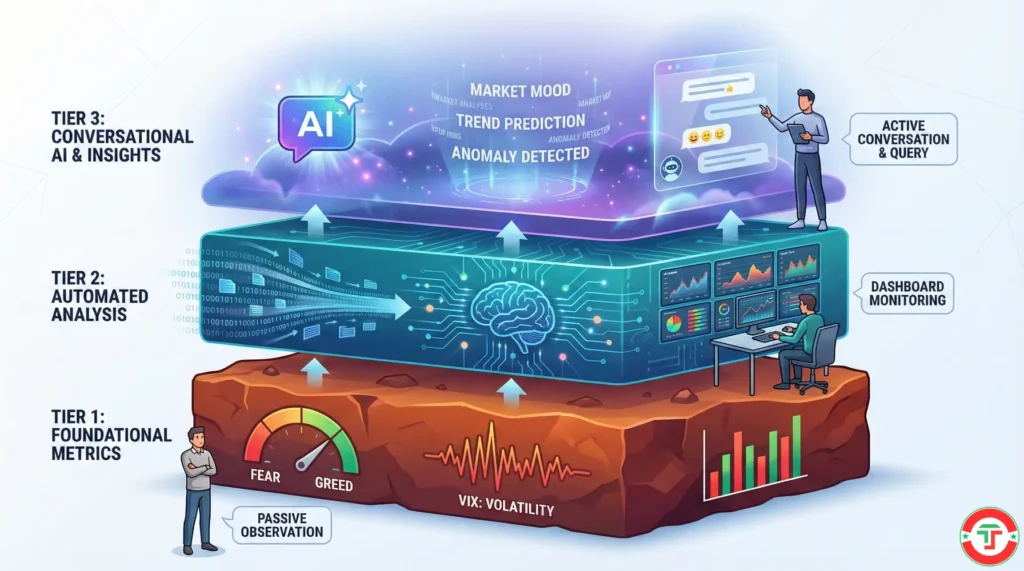
Tier 1: Traditional Sentiment Indicators (The Foundation)
These aren’t AI at all—they’re market-derived indicators that measure sentiment through actual trading behavior. And honestly? They’ve been around for decades because they work.
The CNN Fear & Greed Index is probably the most recognizable example. It combines seven market-based indicators—stock price momentum, put/call ratios, market volatility (VIX), safe haven demand, junk bond spreads, stock price breadth, and stock price strength—into a single score from 0 (extreme fear) to 100 (extreme greed). As of mid-February 2026, the index sits in the “fear” zone around 38, reflecting ongoing market uncertainty driven by AI-disruption fears and geopolitical tensions.
Other Tier 1 tools include the VIX itself (often called the “fear gauge”), the AAII Investor Sentiment Survey, and the put/call ratio on the CBOE.
The key advantage of Tier 1: These are based on real money flows, not opinions. When the put/call ratio spikes, that’s actual capital being deployed into protective positions. When junk bond spreads widen, institutions are actually demanding more compensation for risk.
The limitation: They tell you what the crowd is feeling, but they update relatively slowly and can’t parse the why behind a sentiment shift. That’s where AI enters the picture.
Tier 2: AI-Enhanced Sentiment Platforms (The Middle Ground)
Tier 2 tools use machine learning and NLP to process text data—news, social media, filings—and output sentiment scores in real time. These are purpose-built platforms that do the heavy lifting for you.
FinBERT is the backbone of many institutional sentiment systems. Developed by researchers at Prosus AI and fine-tuned on financial text, FinBERT classifies financial sentences as positive, negative, or neutral with high accuracy. It understands that “the company missed earnings expectations” is negative even though “company” and “expectations” are neutral words on their own. A 2025 study published in Frontiers in Artificial Intelligence confirmed that FinBERT-based sentiment analysis of business news content significantly improved stock market predictions in the energy sector—and that analyzing full article content produced better results than headlines alone.
StockGeist offers a free tier that tracks AI-processed sentiment across 2,200+ publicly traded companies using social media data. It visualizes sentiment shifts in real time and separates “informational” posts from “emotional” ones—a surprisingly useful distinction. Not every social media post moves markets, and filtering out the noise matters.
Trade Ideas integrates sentiment-aware scanning into its Holly AI system. Holly doesn’t just analyze sentiment in isolation—it combines sentiment signals with technical and statistical factors across its nightly backtesting process. Our team has covered Holly extensively in our Trade Ideas review, and its approach of treating sentiment as one input among many is something we think retail traders should emulate.
TrendSpider offers AI-powered pattern recognition and automated analysis features that can complement your sentiment workflow, particularly when you want to overlay sentiment data with technical chart analysis. We break it down in our TrendSpider review.
The key advantage of Tier 2: Speed and scale. These platforms can process thousands of headlines, tweets, and filings simultaneously and deliver actionable scores. A human can’t read 500 news articles in 30 seconds—FinBERT can.
The limitation: Most retail-accessible Tier 2 tools operate on some time delay. By the time a sentiment signal reaches your dashboard, high-frequency trading firms may have already acted on it.

Tier 3: LLM-Powered Analysis (The DIY Approach)
This is where things have shifted dramatically since 2024. Large language models—ChatGPT, Claude, Gemini—give individual traders access to sophisticated sentiment analysis that would have required a quant team and six figures in infrastructure just a few years ago.
The landmark study by Alejandro Lopez-Lira and Yuehua Tang at the University of Florida—updated through late 2025—found that GPT-4 could predict initial stock market reactions to news headlines with approximately 90% accuracy on a portfolio-day basis. Trading strategies built on GPT-4’s sentiment scores outperformed baseline strategies and traditional sentiment methods. The researchers also found that this predictive ability increased with model complexity—simpler models like GPT-2 and basic BERT couldn’t replicate the results. Financial reasoning, it turns out, is an emergent capability of more sophisticated AI systems.
But—and this is critical—the study also showed that the predictive power was strongest for the initial market reaction (which happens too fast for most retail traders to capture) and for subsequent drift, particularly in smaller stocks following negative news. This is not a “buy/sell signal” machine. It’s a research accelerator.
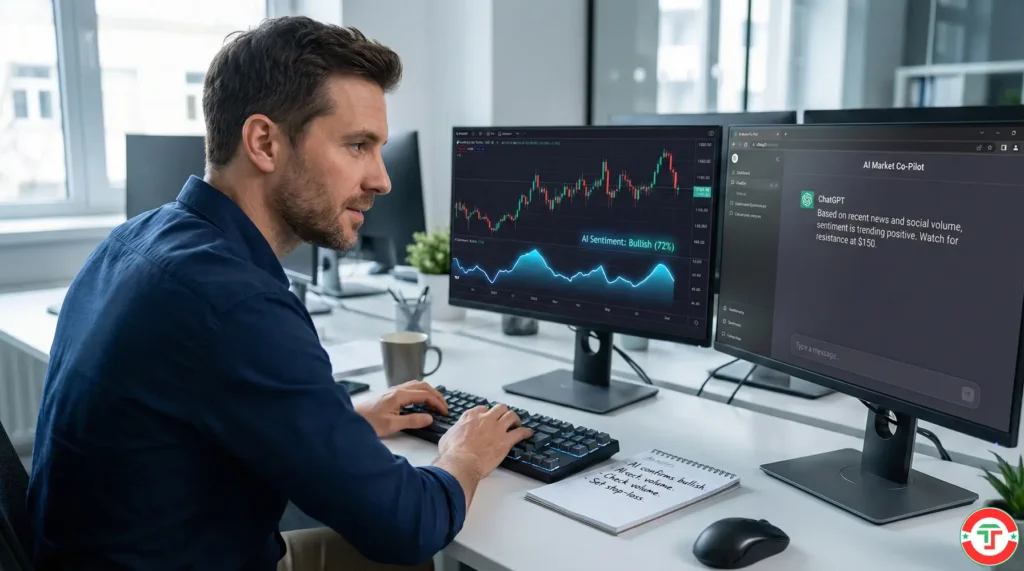
For practical day trading use, our team recommends using LLMs for three specific sentiment tasks: parsing earnings reports and Fed communications for tone, gauging social media sentiment around specific tickers before market open, and stress-testing your own thesis against counter-arguments. We walk through specific workflows in our ChatGPT day trading guide.
The key advantage of Tier 3: Flexibility and accessibility. You can ask ChatGPT to analyze a specific set of headlines in your own words, focusing on whatever nuance matters to your strategy.
The limitation: LLMs don’t have real-time market data. They can’t tell you what the market is doing right now. They’re analytical tools, not trading terminals. And they hallucinate—confidently generating plausible-sounding analysis that’s based on nothing real. We detail seven specific risks in our AI trading risks guide.
What the Research Actually Says (The Evidence, Honestly)
Our team dug deep into the academic literature because most articles about AI sentiment analysis cherry-pick the impressive numbers while burying the caveats. Here’s what the balance of evidence actually shows as of early 2026.

The Case FOR AI Sentiment Analysis
LLMs outperform traditional methods for classification. The Fatouros et al. (2023) study in Machine Learning with Applications found that ChatGPT beat FinBERT by roughly 35% in classifying financial news sentiment. A follow-up study using ChatGPT-4o for Bitcoin sentiment analysis, published in China Finance Review International in late 2025, confirmed that LLM-based sentiment indicators significantly predicted Bitcoin returns even after controlling for other established sentiment indicators. The research community is converging on a clear conclusion: modern LLMs understand financial language better than anything that came before.
Sentiment adds value when combined with other signals. A 2025 study by Gómez-Martínez and colleagues, published in SAGE Open, tested whether adding the CNN Fear & Greed Index and crypto sentiment data to an algorithmic trading system on Nasdaq Mini futures would improve results. The sentiment-augmented strategy achieved a Sharpe ratio of 1.13 compared to 0.79 for the AI-only baseline—a meaningful improvement in risk-adjusted returns. However, net profit was slightly lower, underscoring that sentiment’s primary value is in risk management, not profit maximization.
Data volume matters enormously. Research compiled by AIMultiple found that AI sentiment accuracy on Twitter data for 20 U.S. stocks jumped from about 60% with 3,200 tweets to approximately 85% with 20,000 tweets. More data makes the models dramatically more reliable—which is good news for major stocks with heavy social media coverage and bad news for thinly traded names.
The Case AGAINST Relying on AI Sentiment
Speed is the fundamental problem. For day traders specifically, the latency issue is brutal. By the time AI processes a headline, classifies it, and delivers a sentiment score, the market’s fastest participants—high-frequency trading firms—have already moved the price. The Lopez-Lira & Tang study acknowledged this: the 90% hit rate was for the non-tradable initial reaction. The subsequent drift, which retail traders might capture, was weaker and less consistent.
Predictive power varies wildly by context. The same study found stronger effects for small-cap stocks and negative news. For large-cap names with massive analyst coverage—the stocks most day traders actually trade—the signal was weaker because the market is already efficient at processing information about Apple, Tesla, and Microsoft.
The IMF has flagged systemic risks. The IMF’s October 2024 Global Financial Stability Report devoted an entire chapter to AI in capital markets, warning that widespread adoption of AI trading strategies could increase market speed and volatility under stress—particularly if multiple AI models respond to shocks in similar ways simultaneously. The October 2025 report reinforced these concerns, noting that financial stability risks “remain elevated” and that stretched valuations leave markets vulnerable to sentiment-driven corrections.
Overfitting is a silent killer. A 2026 Springer publication on AI-enhanced investing found that while sentiment-driven strategies showed improved risk-return profiles in backtests, their real-world effectiveness was “closely tied to data quality, model interpretability, and the integration of human oversight.” In other words, a backtest showing 80% accuracy means nothing if the model was overfit to historical patterns that won’t repeat.
Our Team’s Bottom Line
The evidence supports using AI sentiment analysis as a confirmation tool and risk filter, not as a primary entry signal. The research consistently shows that sentiment adds the most value when combined with technical and fundamental analysis—not when used in isolation. That finding has held across multiple studies, markets, and time periods.
How to Use Sentiment Data Without Getting Burned (The Confirmation Framework)
So how does a practical day trader actually use this stuff? Here’s the framework our team recommends—built from the research and refined through experience.

Step 1: Check the Macro Sentiment Backdrop (30 Seconds)
Before each trading session, glance at your Tier 1 indicators. The CNN Fear & Greed Index, the VIX level, and the AAII survey give you a quick read on the overall market mood. This isn’t about generating trades—it’s about calibrating your expectations and risk appetite for the day.
If the Fear & Greed Index is below 25 (extreme fear), that’s a signal to reduce position sizes and tighten stops regardless of what your charts say. If it’s above 75 (extreme greed), be cautious about chasing breakouts. These extreme readings have historically coincided with market turning points—not because the index is magic, but because crowded trades tend to unwind.
Step 2: Scan for Sentiment Divergences (Pre-Market)
The real edge in sentiment data isn’t when it confirms what the chart says—it’s when it disagrees. If a stock gaps up on earnings but AI sentiment scores on the actual earnings call transcript are negative (management hedging, lowered guidance buried in optimistic language), that’s a divergence worth paying attention to.
Use Tier 2 tools (StockGeist, or the free tier on TradingView community scripts) to screen for mismatches between price action and sentiment scores on your watchlist.
Step 3: Use Sentiment as a Trade Filter, Not a Trigger
This is the most important principle. Sentiment data should veto bad trades, not initiate new ones. Here’s how:
- You see a bullish setup on the chart → Check: Is sentiment confirming? Is social media buzz positive, or are insiders quietly selling? If sentiment is strongly negative, pass on the trade.
- You see a bearish setup on the chart → Check: Is the Fear & Greed Index already in extreme fear? Shorting into maximum fear is a contrarian trap. If sentiment is already deeply negative, the move may be exhausted.
- You have a strong conviction trade → Check: Feed the key headlines to ChatGPT or Claude and ask for a devil’s advocate analysis. “Here are three bullish headlines about NVDA. What could go wrong that these headlines aren’t capturing?” This is Tier 3 at its best—not prediction, but perspective.
Step 4: Journal and Review
Track which trades were sentiment-confirmed and which weren’t. After 50-100 trades, you’ll have personal data on whether sentiment integration is actually improving your results. Journaling is where real edge compounds—our trading journal psychology guide covers how to structure this process.
The Limitations Nobody Talks About
We’d be violating our own standards if we didn’t give the limitations their own section. Our team has identified six problems that most AI sentiment articles conveniently skip.
1. The Latency Problem Is Real and Unsolvable for Retail Traders. Institutional firms process sentiment data in milliseconds. Retail platforms deliver it in seconds to minutes. In day trading, where moves are measured in pennies, that delay matters. AI sentiment analysis is more suited to swing-trade-timeframe decisions than scalping.
2. Sarcasm, Irony, and Context Defeat AI Regularly. “Great, another Fed rate hold. Just what we needed.” Is that positive or negative? Humans get the sarcasm instantly. AI models—even the best ones—struggle with it. Financial social media is loaded with sarcasm, and misclassifications corrupt the data.
3. Garbage In, Garbage Out—Amplified. AI doesn’t evaluate source quality. A tweet from a teenager speculating about Tesla carries the same weight as analysis from a veteran fund manager unless the system is specifically designed to filter by credibility. Most free tools don’t do this filtering.
4. Sentiment Can Be Manufactured. Coordinated social media campaigns, bot armies, and paid promoters can artificially inflate sentiment scores for individual stocks. If you’re trading small-cap or penny stocks, AI sentiment scores are especially vulnerable to manipulation. Our pump and dump playbook covers the mechanics.

5. Model Drift Is Invisible. The financial language evolves. “Tariff” was a niche policy term five years ago—now it moves markets. AI models trained on pre-2025 data may misinterpret or underweight terminology that’s become critically important. Models need retraining, and most retail tools don’t tell you when they were last updated.
6. Confirmation Bias on Steroids. Here’s the psychological trap: if you’re bullish on a stock and you ask ChatGPT to analyze recent headlines, you’ll naturally gravitate toward the analysis that confirms your view. AI doesn’t cure your biases—it can amplify them if you’re not disciplined about seeking disconfirming evidence. We cover the psychology of these biases in our cognitive biases guide.
Frequently Asked Questions
Can AI sentiment analysis actually predict stock prices?
Quick Answer: Not reliably enough to use as a standalone signal, but it can meaningfully improve existing strategies when used as a confirmation filter.
Research from the University of Florida shows that GPT-4 can classify the directional impact of news headlines with strong accuracy, but converting that classification into profitable trades is much harder due to latency, transaction costs, and the speed at which markets digest information. The academic consensus as of early 2026 is that sentiment analysis adds the most value when layered on top of technical and fundamental analysis—not used in isolation.
Key Takeaway: Think of AI sentiment as a weather forecast, not a crystal ball. It tells you the conditions, but you still decide whether to go outside.
What’s the best free AI sentiment tool for day trading?
Quick Answer: ChatGPT’s free tier combined with StockGeist’s free dashboard gives you a surprisingly capable sentiment toolkit at zero cost.
ChatGPT can analyze headlines, earnings call transcripts, and Fed communications for tone and nuance. StockGeist provides real-time social media sentiment tracking for over 2,200 stocks. Add CNN’s Fear & Greed Index for the macro backdrop, and you have a three-layer sentiment system without spending a dime.
Key Takeaway: Start free, upgrade only when you’ve proven sentiment integration improves your personal results. For premium AI scanning, Trade Ideas offers institutional-grade sentiment-aware tools.
How is AI sentiment analysis different from the Fear & Greed Index?
Quick Answer: The Fear & Greed Index measures sentiment through market-based data (prices, volumes, options), while AI sentiment analysis processes text—news, social media, filings—to classify mood.
They complement each other. The Fear & Greed Index tells you what the crowd is doing with their money. AI sentiment analysis tells you what the crowd is saying and feeling. Divergences between the two—where one is bullish and the other bearish—can be especially informative.
Key Takeaway: Use both together. Market-based sentiment shows revealed preferences; text-based AI sentiment shows expressed opinions. The most actionable signals occur when they disagree.
What is FinBERT and why do traders care about it?
Quick Answer: FinBERT is a finance-specific AI model built on Google’s BERT architecture that classifies financial text as positive, negative, or neutral with high accuracy.
Unlike general-purpose language models, FinBERT was fine-tuned on financial text, so it understands domain-specific language. It’s open-source, available on Hugging Face, and powers many institutional sentiment systems. For retail traders, you won’t use FinBERT directly—but knowing it exists helps you evaluate the tools built on top of it.
Key Takeaway: FinBERT is the engine under the hood of many Tier 2 platforms. Understanding it helps you judge which tools are using real AI versus marketing buzzwords.
Can ChatGPT replace a paid sentiment analysis platform?
Quick Answer: For basic research and one-off analysis, yes. For real-time, continuous market monitoring during trading hours, no.
ChatGPT excels at deep analysis of specific texts—parsing an earnings call, analyzing Fed language, or evaluating a batch of headlines you paste in. But it can’t continuously scan the entire market in real time the way platforms like StockGeist or Trade Ideas can. The best approach combines ChatGPT for depth with a dedicated platform for breadth.
Key Takeaway: Use ChatGPT for targeted, deep sentiment analysis before and after market hours. Use dedicated tools for real-time monitoring during the session.
Does AI sentiment analysis work better for certain types of stocks?
Quick Answer: Yes—it works best for stocks with high social media and news coverage, and the academic evidence suggests stronger signals for small-cap stocks and negative news events.
The Lopez-Lira & Tang study specifically found that ChatGPT’s predictive power was most pronounced for smaller stocks, where information is less efficiently priced. For mega-caps like AAPL or MSFT, the market processes news so quickly that sentiment-based signals often arrive after the move has happened.
Key Takeaway: AI sentiment can provide an edge where traditional coverage is thinnest. For heavily covered large-caps, focus on sentiment divergences rather than directional signals.
What are the biggest risks of using AI for sentiment trading?
Quick Answer: Overconfidence, latency, hallucinations, and the false sense of precision that AI-generated scores can create.
The biggest danger isn’t that the AI is wrong—it’s that it sounds right even when it isn’t. A sentiment score of 0.87 feels precise and scientific, but it might be based on misclassified sarcasm, bot-generated posts, or manufactured hype. We cover all seven key risks in our AI trading risks guide.
Key Takeaway: Never trade on a sentiment score alone. Always cross-reference with price action, volume, and your own analysis.
Is the “AI” in most trading tools actually AI?
Quick Answer: Often, no. Many tools marketed as “AI-powered” are using simple rules-based logic or basic statistical models dressed up with AI branding.
Our team introduced a 4-Level AI Framework specifically to help traders evaluate these claims. Genuine AI sentiment analysis uses machine learning or transformer-based NLP models. If a tool can’t explain how it processes text, be skeptical. And if it promises guaranteed returns based on sentiment—run.
Key Takeaway: Ask any “AI” tool provider what model they use and how it’s trained. Legitimate platforms are transparent about their methodology.
How should a beginner start using AI sentiment analysis?
Quick Answer: Start with free Tier 1 tools (Fear & Greed Index, VIX), add a free Tier 3 tool (ChatGPT for manual analysis), and only upgrade when you have data showing it helps.
The worst thing a beginner can do is spend $200/month on a sentiment platform before mastering basic risk management and developing a trading plan. Sentiment analysis is a refinement tool—it makes a good trader slightly better, but it won’t rescue a fundamentally flawed approach.
Key Takeaway: Build your trading foundation first. Add sentiment analysis as a layer after you’re consistently following your plan and managing risk.
Can AI sentiment analysis detect market manipulation?
Quick Answer: Sometimes, but not reliably. Sudden spikes in social media volume with suspiciously uniform language can flag potential pump-and-dump schemes, but sophisticated manipulation is designed to evade exactly this kind of detection.
Some Tier 2 platforms attempt to filter bot activity and identify coordinated campaigns. StockGeist, for example, separates “informational” from “emotional” posts, which helps somewhat. But if you’re relying on AI sentiment for micro-cap or penny stock trades, proceed with extreme caution.
Key Takeaway: AI sentiment can be a red-flag detector for obvious manipulation, but it’s not a substitute for due diligence. If a stock’s sentiment scores look too good to be true, they probably are.
Disclaimer
The information provided in this article is for educational purposes only and should not be considered financial advice. Day trading involves substantial risk and is not suitable for every investor. Past performance is not indicative of future results.
For our complete disclaimer, please visit: https://daytradingtoolkit.com/disclaimer/
Article Sources
Our team relies on authoritative academic research, regulatory reports, and established financial institutions to ensure every claim in this article is verifiable. Below are the key sources referenced throughout this guide.
- Lopez-Lira, A. & Tang, Y. (2023, updated 2025). “Can ChatGPT Forecast Stock Price Movements? Return Predictability and Large Language Models.” University of Florida / SSRN. — The foundational study on LLM sentiment analysis and stock return prediction.
- Fatouros, G. et al. (2023). “Transforming Sentiment Analysis in the Financial Domain with ChatGPT.” Machine Learning with Applications, Volume 14. — Key study showing ChatGPT outperforming FinBERT by 35% in financial sentiment classification.
- Gómez-Martínez, R. et al. (2025). “How Sentiment Indicators Improve Algorithmic Trading Performance.” SAGE Open. — Empirical evidence that sentiment-augmented trading strategies improve Sharpe ratios.
- IMF Global Financial Stability Report, October 2024, Chapter 3: “Advances in Artificial Intelligence: Implications for Capital Market Activities.” — The IMF’s comprehensive assessment of AI risks and opportunities in financial markets.
- Frontiers in Artificial Intelligence (2025). “Does Business News Sentiment Matter in the Energy Stock Market?” — Research confirming FinBERT-based sentiment analysis improves stock prediction when using full article content.
- CNN Business — Fear & Greed Index Methodology. — The methodology and real-time data behind the most widely recognized market sentiment indicator.


