Day Trading Checklist: Templates and Pre-Market Routines That Actually Work

In this article11 sections
You know what separates consistent day traders from those who blow up their accounts in six months? It's not some secret indicator or expensive scanner. It's something far simpler—and far less sexy.
It's a checklist.
Look, we get it. You didn't start day trading to follow a boring set of rules like some corporate drone. You wanted freedom, excitement, fast profits. But here's the kicker: the most successful traders we've worked with—the ones pulling consistent monthly gains—are the most systematic. They use checklists for everything. Pre-market prep. Trade entry. Risk management. Post-market review.
This guide is going to walk you through the complete day trading checklist system that this guide uses every single day. We're talking actual copyable templates, pre-market routines with specific time blocks, trade validation criteria that keep you out of trash setups, and post-market review processes that turn mistakes into lessons. If you've been winging it and wondering why your results are inconsistent, this is your answer.
Why Every Day Trader Needs a Checklist (And What Happens Without One)
The market doesn't care about your intuition. It doesn't care that you "had a feeling" about that trade. What it does care about—what it ruthlessly exploits—is emotional decision-making and inconsistency.
The Psychology Behind Trading Checklists
Here's what most traders don't understand: by the time the market opens at 9:30 AM, you've already made hundreds of decisions that morning. What to wear, what to eat, whether to check email, which route to take if you went to get coffee. Adults make approximately 35,000 decisions per day, and each one depletes your mental resources.
This phenomenon—called decision fatigue—is a well-documented cognitive constraint that causes the quality of your decisions to deteriorate after extended decision-making sessions. Research published in academic journals shows that traders demonstrate significantly stronger disposition effects (holding losers too long, cutting winners too early) as the number of trades and hours increase throughout the day. Your brain gets tired. And when it's tired, it defaults to emotional shortcuts.
Think of a day trading checklist as a safety harness on your trading account. When your brain is fried at 2:00 PM and you're tempted to revenge trade after two losses, the checklist steps in. It says, "Did you check your daily loss limit? No? Then you're done for the day."
The checklist removes the cognitive load. You're not making decisions from scratch every time—you're following a predetermined system that you built when your head was clear. That's the difference between trading discipline and trading chaos.
Common Mistakes Traders Make Without a Systematic Process
This plays out repeatedly. A trader opens their platform, sees something moving, and—bam—they're in. No plan. No validation. Just pure FOMO wrapped in a market order.
Without a systematic day trading checklist, here's what happens:
Overtrading and impulsive decisions. You take trades that don't match your strategy because the price action "looks good" in the moment. You end up with eight positions when your plan says three maximum.
Poor risk management. You forget to place your stop-loss, or you move it further away because you don't want to take the loss. You risk 5% on a trade when your rule is 1%. These aren't small mistakes—they're account killers.
Deviation from your trading plan. You built a plan for a reason, but when things get choppy, you abandon it. You start taking trades that don't fit your criteria. The result? Inconsistent performance that makes it impossible to know what's working and what isn't.
Missing key market events. The Fed announces rate decisions at 2:00 PM, but you're in a position because you didn't check the economic calendar. Suddenly your "safe" trade is in free fall, and you're stuck trying to manage the chaos.
Real talk—trading without a checklist is like trying to fly a plane by feel. Sure, maybe you get lucky a few times. But eventually, you're going to crash. The professionals? They go through their pre-flight checklist every single time, no matter how many times they've flown before.
Understanding the Four-Document Trading System
Before we dive into the actual checklists, let's clear up some confusion. A lot of traders think a "trading plan" and a "day trading checklist" are the same thing. They're not. Understanding this distinction will change how you approach your entire trading process.
How Checklists Fit Into Your Trading Framework
This guide uses a four-document system that works together like a well-oiled machine. Each document serves a specific purpose, and missing even one creates gaps in your process.
Here's the breakdown:
The Trading Plan is your constitution—the big-picture "why" and "what" of your trading. It defines your market focus, your core strategy, your risk tolerance, and your long-term goals. This document answers questions like: What markets do I trade? What setups am I looking for? What's my risk per trade? What are my profit targets? This is the master document that everything else flows from. If you don't have one yet, check out our guide on building your first trading plan.
The Daily Routine is your consistency framework—the habits and time blocks that structure your trading day. It's the "when" and "how often." This routine includes things like: I wake up at 6:00 AM, I review news from 6:30-7:00 AM, I create my watchlist from 7:30-8:30 AM, I stop trading at 11:00 AM unless I see an A+ setup. The routine is about building sustainable habits.
The Pre-Trade Routine is your mental preparation protocol—the ritual that gets you into the right psychological state before you start making trading decisions. This might include: five minutes of clearing negative thoughts, reviewing your key trading rules, checking your emotional state, visualizing how you'll handle both wins and losses. This is the warm-up for your trading performance.
The Pre-Trade Checklist (what this article is focused on) is your validation tool—the specific items you verify before entering every single trade. This is where you ask: Does this trade match my strategy? Is the risk/reward acceptable? Have I calculated my position size correctly? Is there any conflicting news coming out? The checklist is your last line of defense against bad trades.
Think of it this way: your Trading Plan tells you what to do, your Daily Routine tells you when to do it, your Pre-Trade Routine gets your head right to do it well, and your Pre-Trade Checklist makes sure you actually do it correctly.
The Difference Between Routines and Checklists
Let's hammer this home because it's crucial. A routine is something you do to prepare. A checklist is something you verify before you act.
Your pre-market routine might include making coffee, doing some breathing exercises, and scanning the news. Those are habits—things you do whether you take a trade or not. They create the conditions for good trading.
Your pre-trade checklist, on the other hand, is the gate you have to pass through before you enter a position. It's a series of yes/no questions: Is my stop-loss in place? Yes. Does this match my strategy? Yes. Is my risk under 1%? Yes. Only when all the boxes are checked do you pull the trigger.
Routines are about consistency and preparation. Checklists are about validation and quality control. You need both, and they serve completely different purposes in your trading process.
The Complete Pre-Market Routine for Day Traders
Alright, here's where we get into the actual minute-by-minute breakdown of what a professional day trading pre-market routine looks like. This is what DayTradingToolkit does every single day—no exceptions. You can customize this for your schedule, but the principles remain the same.
Pre-Market Routine Timeline (6:00 AM - 9:30 AM EST)
First things first—if you're serious about day trading U.S. markets, you need to be awake and alert well before the opening bell. The pre-market session (4:00 AM - 9:30 AM EST) is where the real preparation happens. You're gathering intelligence, building your watchlist, and getting mentally ready for battle.
Here's our standard timeline. Some days it's compressed, some days we spend more time on specific areas, but this is the framework:
6:00-7:00 AM: Review Market Conditions 7:00-7:30 AM: Economic Calendar and News Review 7:30-8:30 AM: Create Your Daily Watchlist 8:30-9:00 AM: Set Up Your Trading Environment 9:00-9:30 AM: Mental Preparation
Let's break down each block with specific action items.
Step 1: Review Market Conditions (6:00-7:00 AM)
You need to understand what happened overnight and what the broader market is telling you before the U.S. session opens. The market doesn't exist in a vacuum—global events move prices 24/7.
Check major index futures. We're talking S&P 500 futures (ES), Nasdaq futures (NQ), and Dow futures (YM). Are they green or red? How much? Futures give you a preview of where the market is likely to open and set the tone for the day. If futures are down 1.5%, you know it's going to be a risk-off day—probably not the time to go long on speculative tech stocks.
Review overnight news and global market action. What happened in European markets? How did Asian markets close? Were there any major geopolitical events, central bank announcements, or unexpected news? Sometimes a single headline from overseas can dictate the entire U.S. session.
Assess market sentiment indicators. Check the VIX (volatility index)—is fear elevated or muted? Look at sector rotation—are defensive sectors (utilities, consumer staples) leading, or are growth sectors (tech, consumer discretionary) showing strength? This gives you clues about risk appetite.
The goal of this hour is to walk away with a clear picture: Is the market trending or choppy? Is there strong conviction one way or the other, or is it uncertain? This context is everything.
Step 2: Economic Calendar and News Review (7:00-7:30 AM)
Here's where you identify the land mines for the day. You don't want to be in a position when the Fed drops an unexpected statement or a key economic report comes out worse than expected.
Check the economic calendar for scheduled releases. We use resources like Trading Economics or Forex Factory. Look for high-impact events: Fed announcements, Non-Farm Payrolls, CPI data, GDP reports. Even if you're trading stocks, these macro events move everything. Write down the exact times—if there's a big release at 10:00 AM, maybe you're flat by 9:50 AM.
Review earnings announcements. Which companies are reporting today? Pre-market earnings can create huge gap-ups or gap-downs. If a stock you're watching is reporting earnings, that changes the game entirely. You might avoid it, or you might specifically target it if you trade earnings plays.
Scan for major corporate or geopolitical news. Did a CEO resign? Is there a new trade deal? Did a major company announce a merger? What about geopolitical tensions—any overnight escalations that could impact energy or defense sectors? You're building a mental map of what could move the market today.
Identify potential market-moving catalysts. Sometimes the biggest moves come from things that aren't on the official calendar. Keep an eye on financial news outlets, Twitter feeds from reliable market analysts, and pre-market movers. What's the narrative today? Is everyone talking about AI stocks, or is it all about Fed policy?
This 30-minute block is insurance. You're making sure you don't get blindsided by something you should have known about.
Step 3: Create Your Daily Watchlist (7:30-8:30 AM)
This is the heart of your pre-market preparation. Your watchlist is the menu you're ordering from today—these are the stocks that meet your criteria and deserve your attention.
Use stock scanners to identify candidates. If you're looking for momentum plays, you want stocks gapping up or down with strong volume. That's where Trade Ideas comes in—it's our go-to scanner for pre-market movers. You can set custom criteria like: stocks up 5%+ pre-market with volume above 500K shares. The scanner does the heavy lifting, and you focus on the best setups. For more on how to effectively use scanners, check out our introduction to stock scanners.
Review gappers and pre-market movers. Look at the top 10-15 stocks that are moving in pre-market. What's driving the move? Is it earnings, news, sector rotation, or just random volatility? If there's a clear catalyst, the move is more likely to continue. If there's no news, it might be a pump that fades at the open.
Apply your strategy criteria. Not every stock that's moving deserves to be on your watchlist. Filter ruthlessly. Does it meet your minimum liquidity requirements? Is the spread reasonable? Does the setup align with your trading strategy? If you trade breakouts, you're looking for stocks consolidating near highs. If you trade reversals, you want extended moves that are showing exhaustion.
Map support and resistance levels. For each stock on your final watchlist, identify key levels before the market opens. Where's the previous day's high and low? Where are the major swing highs and lows from the past week? Are there any obvious trendlines? Mark these on your chart. When the market opens and things get fast, you won't have time to draw lines—you need this done in advance.
By 8:30 AM, you should have a tight watchlist of 3-7 stocks (or futures contracts, or forex pairs—whatever you trade) that you'll focus on for the day. Quality over quantity, always.
Step 4: Set Up Your Trading Environment (8:30-9:00 AM)
You'd be shocked how many traders skip this step and then wonder why they miss entries or click the wrong button during a fast move. Preparation prevents problems.
Organize charts and workspace. Make sure your monitors are arranged correctly. Do you have all your key charts open? Is your Level 2 data visible? Do you have your watchlist window where you need it? Clean up anything that's distracting or unnecessary. This is your cockpit—everything should have a place and a purpose.
Verify technology and connections. Test your internet connection. Make sure your trading platform is logged in and functioning. Check that your order routing is set correctly. Sounds basic, but a slow connection or a platform glitch during a volatile open can cost you real money. Have a backup plan if your primary setup fails.
Set up alerts and notifications. If your trading platform supports price alerts, set them for key levels on your watchlist stocks. You can't watch eight charts simultaneously with full attention, but you can get alerted when something important happens. We use alerts for breakout levels, major support/resistance, and volume spikes.
Review your trading rules. Pull up your one-page trading summary—the document that lists your strategy criteria, your risk rules, your position sizing guidelines. Read it. Out loud if you're alone. This is your reminder of what you're supposed to do. On stressful days, this simple review can prevent a costly mistake.
This 30-minute window is your final technical prep. When the bell rings, you're not scrambling—you're ready.
Step 5: Mental Preparation (9:00-9:30 AM)
This is the step that separates amateurs from professionals. The market is about to open, and you need your head in the right place. Not over-eager. Not anxious. Not still thinking about the argument you had yesterday or the bill you forgot to pay.
Review your trading plan. Go back to your main trading plan document and skim your goals for the month or week. What are you trying to accomplish? This isn't about performance pressure—it's about reminding yourself why you're doing this and what success looks like.
Set daily goals and loss limits. Before you take a single trade, decide: What's my profit target for the day? What's my maximum loss limit? When do I stop trading? For many traders, setting a daily loss limit of 2-3% of account balance is a smart circuit breaker. If you hit that limit, you're done—no exceptions. Writing these numbers down before the open creates accountability.
Clear mental state assessment. Ask yourself honestly: Am I in the right headspace to trade today? Did I sleep well? Am I emotionally neutral, or am I angry, anxious, or overconfident? If you're off, it's okay to sit out. Missing a day of trading is better than making emotional mistakes that set you back a week. For more on managing emotions in trading, check out our detailed psychology guide.
Final pre-market review. Take the last 10-15 minutes before the bell to watch your watchlist stocks. How are they moving in the pre-market? Are they holding their gaps or fading? Are there any late-breaking news items you need to know about? Just observe—don't start trading yet. Let your mind get into the rhythm of the charts.
Some traders we know do a quick five-minute meditation or breathing exercise right before the open. The goal is to clear out the noise and enter a state of focused calm. You want to be alert and ready to act, but not jumpy or impulsive.
When that opening bell rings at 9:30 AM, you're not just prepared—you're in the zone.
Day Trading Checklist Templates: From Beginner to Advanced
Alright, this is what you've been waiting for. The actual checklists you can copy, customize, and use today. We're giving you three different versions: one for beginners, one for advanced traders, and one for psychological/mental validation.
Template #1: The Beginner's Daily Trading Checklist
If you're new to day trading or you're rebuilding after blowing up an account, start here. This checklist is streamlined and focuses on the absolute essentials—the stuff that will keep you alive while you learn.
PRE-MARKET PREPARATION
- Checked overnight news and market sentiment
- Reviewed economic calendar for today's events
- Created watchlist of 3-5 stocks meeting my strategy criteria
- Identified key support/resistance levels on watchlist stocks
- Set daily profit target: $______
- Set maximum daily loss limit: $______ (stop trading if hit)
- Reviewed my core trading rules
BEFORE ENTERING EACH TRADE
- Does this trade match my strategy? (Yes/No - if No, skip it)
- Is there a clear catalyst or setup? (Breakout, reversal, etc.)
- Have I identified my entry price? $______
- Have I identified my stop-loss price? $______
- Have I identified my profit target? $______
- Is my risk/reward ratio at least 2:1? (Yes/No)
- Position size calculated: ______ shares
- Does this risk <1% of my account? (Yes/No)
- Am I in a calm, focused mental state? (Yes/No)
- Is my stop-loss order ready to place immediately after entry? (Yes/No)
DURING THE TRADE
- Stop-loss order placed and active
- Trade is moving as expected or has a valid reason to deviate
- I'm not checking the position every 30 seconds (let it work)
AFTER CLOSING TRADE
- Recorded trade in journal: entry, exit, profit/loss, strategy used
- What did I do right on this trade?
- What could I improve next time?
END OF DAY
- Did I follow my trading plan today? (Yes/No)
- Did I respect my loss limit? (Yes/No)
- Total P&L for today: $______
- Best trade of the day (and why):
- Worst trade or mistake (and lesson learned):
- Am I carrying any negative emotions into tomorrow? (Address them now)
That's it. Simple, clear, and focused on risk management basics and discipline. As you gain experience, you'll add more nuance, but this foundation will serve you well.
Template #2: The Advanced Day Trader's Checklist
Once you've been trading consistently for a while and you understand your edge, you can layer in additional checks that help you refine entries and avoid marginal setups. This is the checklist this guide uses.
PRE-MARKET PREPARATION
- Reviewed futures (ES, NQ) and overnight ranges
- Checked VIX and market internals (ADD, TICK)
- Identified sector leaders and laggards
- Reviewed economic calendar and marked critical times
- Scanned for earnings reports and corporate news
- Watchlist built (5-7 candidates) with catalyst identified for each
- Support/resistance levels marked on all watchlist charts
- Multiple timeframes aligned (daily, 60min, 15min, 5min)
- Set max daily loss: $______ and max # of trades: ______
- Pre-trade mental routine completed (5 minutes)
TRADE VALIDATION (Before Entry)
- Setup Confirmation: Does this setup match my A+ criteria?
- Market Condition: Is the overall market trending or choppy today?
- Relative Strength: Is this stock stronger/weaker than its sector?
- Volume Confirmation: Is volume above average for this time of day?
- Multiple Timeframe Alignment: Do higher timeframes support this trade?
- Entry Price: Exact entry level identified: $______
- Stop-Loss: Logical stop-loss level identified: $______
- Profit Target 1: First target (50% position): $______
- Profit Target 2: Second target (remaining position): $______
- Risk/Reward: Minimum 2:1, preferably 3:1+ (Actual: __:1)
- Position Size: Shares to trade: ______ (risking ___% of account)
- Correlation Check: Am I already exposed to this sector?
- News Check: No major news event scheduled in next 2 hours?
- Spread Check: Bid-ask spread acceptable for entry/exit?
- Timing: Is this the right time of day for this setup? (Avoid 11:30-2:00 chop)
- Emotional State: Am I trading from a plan or from emotion?
DURING TRADE MANAGEMENT
- Stop-loss order is live and will be honored
- Profit target orders placed (or alert set)
- Trailing stop strategy defined if applicable
- Not checking position obsessively (set alerts instead)
- Trade thesis still valid based on current price action
POST-TRADE REVIEW
- Trade logged in journal software
- Screenshot saved with entry, stop, and target marked
- Execution grade: Did I follow my rules? (A, B, C, D, F)
- What was my emotional state during this trade?
- If I lost money, was it a good process trade? (Yes/No)
END OF DAY METRICS
- Total trades taken today: ______
- Win rate today: ____%
- Average R:R achieved: __:1
- P&L: $______
- Biggest win: $______ (Why did it work?)
- Biggest loss: $______ (What was the mistake?)
- Did I honor my max loss limit and trade limit?
- Key lesson from today:
The advanced checklist is longer, but that's because it catches more edge-case mistakes. After doing this for months, many of these items become automatic—you're not literally ticking boxes, you're running through a mental checklist in seconds.
Template #3: The Mental and Emotional Checklist
Here's the one most traders completely ignore—and it's the one that might save your account. This checklist is about your psychological readiness and emotional state, not the chart patterns or indicators.
We recommend running through this checklist before your trading session starts and again if you feel yourself getting tilted during the day.
PSYCHOLOGICAL READINESS ASSESSMENT
- Sleep Quality: Did I get at least 7 hours of quality sleep? (Yes/No)
- Physical State: Am I well-fed, hydrated, and physically comfortable? (Yes/No)
- Life Stress Check: Are there major personal issues affecting my focus today?
- Previous Day Baggage: Am I still angry or frustrated about yesterday's losses?
- Overconfidence Check: Am I feeling invincible after a big win streak?
- Revenge Trading Urge: Do I feel the need to "get back" money I lost?
- FOMO Level: Am I anxious about missing trades or being left behind?
- Patience Level: Am I willing to wait for A+ setups, or am I itching to trade?
BEHAVIORAL PATTERN REMINDERS
(Customize this section based on your personal trading weaknesses)
- Entry Discipline: I will NOT enter trades early just because I'm impatient
- Stop-Loss Discipline: I will NOT move my stop-loss further away after entry
- Size Discipline: I will NOT overtrade after a big win (stay consistent)
- Time Discipline: I will NOT trade during my "danger hours" (e.g., after 3 PM)
- Rule Discipline: If the trade doesn't meet ALL my criteria, I WILL skip it
MENTAL TRIGGERS TO AVOID
(These are specific phrases or thoughts that signal you're about to make a mistake)
- If I think "This will definitely work," I need to double-check my bias
- If I think "I need to make money today," I need to take a break
- If I think "This time is different," I'm probably rationalizing a bad trade
- If I think "I'll just risk a little more on this one," I'm breaking my rules
- If I feel rushed or anxious, I need to step away from the screen
EMERGENCY PROTOCOL
If you answer "Yes" to any of these questions, STOP TRADING immediately:
- Have I hit my daily loss limit?
- Have I taken 2 consecutive losses without following my plan?
- Am I feeling strong negative emotions (anger, frustration, desperation)?
- Am I making decisions to "get even" rather than following my strategy?
- Has something happened in my personal life that's preventing focus?
When you stop, walk away from the screen. Go for a walk, do some breathing exercises, or call a fellow trader. Don't come back until you've reset mentally. For more strategies on building this kind of resilience, read our guide on bouncing back from setbacks.
This mental checklist might feel touchy-feely, but it's the difference between a sustainable trading career and a short, expensive lesson in emotional discipline.
How to Customize Your Checklist for Your Trading Strategy
No two traders are exactly alike, and your day trading checklist should reflect your unique approach. Here's how to adapt these templates to your specific strategy.
For Momentum/Breakout Traders: Add checks for:
- Volume surge confirmation (2x average volume?)
- Is the stock breaking out of a multi-day consolidation?
- Has there been a recent catalyst within the last 24 hours?
- Is the sector showing relative strength today?
For Mean Reversion/Reversal Traders: Add checks for:
- Is the stock extended from its moving averages? (20MA, 50MA)
- Are momentum indicators showing overbought/oversold conditions?
- Is there a clear support/resistance level to target?
- What's the stop-loss if the reversal fails?
For Scalpers: Add checks for:
- Is the spread tight enough for quick entries/exits?
- Is Level 2 showing good liquidity on both sides?
- Is this the right time of day for scalping? (First hour and last hour usually best)
- Have I set my max number of scalps for the day to avoid overtrading?
For Swing Traders (holding overnight/multiday): Add checks for:
- What major news or earnings reports are coming in the next 2-5 days?
- Does the daily chart support this hold?
- What are my overnight risk parameters?
- Where will I re-evaluate the trade tomorrow?
The key is to identify what makes YOUR strategy work, and then build checks that ensure you're following those criteria every single time. Over time, you'll notice patterns—maybe you lose money when you trade stocks with tight spreads, or maybe you do better when you wait until 10:00 AM. Add checks to your list that address your specific weaknesses.
Your checklist should be a living document. Update it based on your journal reviews and lessons learned. What got you to consistent profitability won't necessarily keep you there—evolve your checklist as you evolve as a trader.
Trade Validation Criteria: Your Pre-Entry Checklist
Before you click that buy or sell button, there's one final gate you have to pass through: trade validation. This is where you verify—with absolute certainty—that the trade you're about to take meets your standards.
Think of this as airport security for your trades. No shortcuts. No exceptions. Every trade goes through the full screening.
Setup Validation
First question: Does this trade actually match your strategy criteria, or are you rationalizing something that's "close enough"?
Does this match my strategy criteria? Pull up your trading plan. What are the exact conditions that define your A+ setup? Does the current chart show those conditions, or are you seeing what you want to see? Be ruthlessly honest here. If it's a B+ setup at best, skip it. There will be other trades.
Is the pattern/setup high-quality? Compare this setup to your best historical winners. Does it have the same clean structure, the same volume profile, the same context? Or does it look a bit sloppy, a bit forced? Quality matters more than quantity. One great trade beats five mediocre ones.
Have I seen this work before? If this is a pattern you've never traded successfully, why are you taking it with real money now? Either you're expanding your strategy (which should be done carefully, perhaps with smaller size), or you're trading outside your edge. Stick to what you know works for you until you've proven something new works.
Market Condition Check
Your trade doesn't exist in isolation—it's operating within a larger market context. Ignoring that context is how you get chopped up.
Overall market trend alignment. If you're going long on a small-cap tech stock while the Nasdaq is down 2% and selling off, you're fighting the current. It doesn't mean the trade will lose, but you're adding unnecessary difficulty. Is the broad market supporting your directional bias, or are you swimming upstream?
Sector strength/weakness. Is the sector your stock is in leading or lagging today? If you're trading a biotech stock and the entire biotech sector is weak, your individual stock analysis might be perfect, but the sector headwind can kill the trade. Use sector ETFs as a quick proxy for strength.
Market breadth indicators. Look at NYSE TICK (short-term sentiment) and ADD (advancing vs. declining stocks). If the market internals are strongly negative, even good long setups might struggle. If you have access to these indicators, they're invaluable for gauging whether the market has legs or is just chopping around.
VIX and volatility assessment. When the VIX spikes above 25-30, you're in a different market environment. Moves are bigger, faster, and less predictable. Your stop-losses might need to be wider, and your position sizes should probably be smaller. Know what kind of market you're trading in.
Technical Confirmation
This is where the rubber meets the road—the actual chart analysis that validates your entry.
Support and resistance levels identified. Where's your stop? Where's your target? These should be based on actual levels the market respects—previous swing highs and lows, psychological round numbers, major moving averages. If you can't clearly identify these levels, you don't have a trade setup—you have a guess.
Volume confirmation. Is volume expanding as the price makes the move you want to trade? Volume is the fuel that drives price movement. A breakout on light volume usually fails. A reversal on heavy volume usually sticks. Check the volume profile before you enter—it's one of the most reliable confirmation tools you have.
Indicator alignment. Do your chosen technical indicators support the trade? If you use RSI, MACD, or moving averages, do they confirm the setup, or are they sending mixed signals? Be careful not to cherry-pick indicators that tell you what you want to hear—if there's divergence, pay attention to it.
Multiple timeframe agreement. This is huge. Check the daily chart, the 60-minute chart, and the 5-minute chart. Are they all pointing in the same direction, or is your 5-minute long setup happening during a daily downtrend? The more timeframes that align, the higher your probability of success.
Risk Management Verification
Even a perfect setup can be ruined by poor risk management. These checks ensure you're not overexposing yourself.
Position size calculated correctly. You should know exactly how many shares you're trading before you enter. Use this formula: (Account Size × Risk %) ÷ (Entry Price - Stop Loss Price) = Number of Shares. For detailed guidance on this critical skill, check out our position sizing guide.
Stop-loss placement determined. Your stop-loss should be at a price level where, if hit, it invalidates your trade thesis. It's not random—it's based on support levels, volatility, or pattern structure. And you need to know this number before you enter, not after you're already losing money.
Risk/reward ratio meets minimum threshold. Most successful day traders won't take a trade unless the potential reward is at least 2x the risk. If you're risking $100 to make $150, that's a 1.5:1 R:R—it might work occasionally, but over time, it's a losing game. Aim for 2:1 minimum, ideally 3:1 or better.
Total portfolio exposure acceptable. Are you already in three positions from the same sector? Are you approaching your maximum daily risk allocation? Even if this new trade looks great, adding it might put too much capital at risk simultaneously. Diversify your exposure to avoid correlated losses.
Timing and Execution Check
The right trade at the wrong time is still the wrong trade. These final checks ensure timing and logistics are in your favor.
No conflicting news events scheduled. Check the economic calendar one more time. Is there a Fed statement in 15 minutes? Is this stock's company presenting at a conference today? Even if your technical setup is perfect, unexpected news can blow it up. Avoid taking positions right before high-impact events unless that's specifically part of your strategy.
Liquidity sufficient for position size. Can you get in and out of this stock quickly? If you're trading 1,000 shares, but the average volume is only 50,000 shares per day with a wide spread, you might struggle to exit at your target. Check the bid-ask spread and average daily volume—make sure there's enough liquidity to support your position.
Spread acceptable for entry. If the bid is $10.00 and the ask is $10.10, that's a $0.10 spread—or 1% of the stock price. You're starting $0.10 in the hole before the stock even moves. For day traders, especially scalpers, tight spreads are critical. If the spread is too wide, either skip the trade or use limit orders.
Mental and emotional state optimal. Last question: How do you feel right now? Are you calm and focused, or anxious and desperate? If you're emotionally compromised—maybe you just took a big loss, or you're trying to force a trade out of boredom—don't take it. Step away. The market will be there tomorrow.
If you can check all these boxes with confidence, you've got a validated trade. If even one of them is questionable, that's a signal to pause and reconsider. The discipline to skip marginal setups is what separates profitable traders from those who just keep giving money back to the market.
Risk Management Rules: The 1% Rule and Beyond
We've said it before, and we'll say it again: risk management is the foundation of every successful trading career. You can have the best strategy in the world, but without proper risk controls, one bad week will wipe you out.
Let's talk about the specific rules that keep you alive.
The 1% Risk Rule Explained
Here's the golden rule: never risk more than 1% of your account on a single trade.
Let's break down what this actually means. If you have a $50,000 trading account, 1% is $500. That's your maximum loss on any single trade. Not your position size—your actual risk from entry to stop-loss.
Here's the math in action:
Let's say you want to buy a stock at $50, and your stop-loss is at $49. That's a $1 risk per share. How many shares can you buy while staying under your $500 maximum risk? $500 ÷ $1 = 500 shares.
If your stop-loss is at $48 instead (a $2 risk per share), then you can only buy 250 shares: $500 ÷ $2 = 250 shares.
The wider your stop, the smaller your position size. This is how you scale your risk to keep it consistent across all your trades.
Why 1%? Because it allows you to be wrong a lot and still survive. Even if you lose 10 trades in a row (which, let's be honest, happens to everyone at some point), you're only down 10% of your account. That's recoverable. If you were risking 5% per trade, 10 losses in a row would cut your account in half. Game over.
Professional traders understand that preservation of capital is rule number one. Making money is rule number two. You can't do number two if you violate number one.
The 5-3-1 Rule for Day Trading Discipline
Here's a framework that helps newer traders stay disciplined when they're still learning their edge: the 5-3-1 rule.
5% maximum risk on any single trade. Wait—didn't we just say 1%? Yes. This is an upper bound that you should never, ever exceed. For most traders, 1-2% is the sweet spot. The 5% cap is there to prevent the catastrophic mistake of going "all in" on one trade. Some aggressive traders might push to 3% on their highest-conviction setups, but 5% should be the absolute red line.
3 trades per day maximum. If you're taking 15 trades a day, you're overtrading. You're forcing trades that don't meet your criteria, and you're fatiguing your decision-making ability. Three quality trades, executed with discipline, will outperform 15 marginal trades every single time. Set a max trade limit to prevent the emotional urge to "do something" when you should be sitting on your hands.
1 trading strategy focus. This is critical, especially for beginners. If you're trying to trade breakouts, reversals, momentum, and mean reversion all in the same day, you're not a trader—you're gambling. Pick one strategy, master it, and stick to it. Once you're consistently profitable with that one approach, then—maybe—you can add a second strategy. But one at a time.
This rule structure creates natural boundaries that keep you from self-destructing.
The 3-5-7 Risk Management Framework
If you want to take it up a notch, the 3-5-7 framework adds weekly review and tighter daily constraints.
3% risk per trade maximum. This is tighter than the 5-3-1 rule's 5% cap. For intermediate traders, 3% should be the absolute maximum risk on even your best setups, with most trades in the 1-2% range. This gives you more cushion for error.
5 trades per day limit. A bit more flexibility than 3 trades, but still enough to prevent overtrading. Five trades is reasonable for active day traders who might see multiple A+ setups on high-volatility days. But once you hit five, you're done—no exceptions.
7-day weekly performance review. Every Sunday (or Monday morning before the market opens), sit down and analyze the past week. What was your win rate? What was your average R:R? Which trades followed your plan, and which were impulsive? What patterns do you notice in your mistakes? This weekly review is where you identify bad habits before they become expensive patterns. For a deep dive on how to journal effectively, read our guide on trading journals as psychological tools.
The 3-5-7 framework keeps you tight on risk, prevents overtrading, and forces regular self-assessment. It's a complete system for disciplined risk management.
Daily and Weekly Loss Limits
Here's a rule that will save your account: set a maximum daily loss limit, and when you hit it, stop trading.
Setting your maximum daily loss. A common approach is to set your daily loss limit at 2-3% of your account. If you have a $50,000 account, that's a $1,000-$1,500 loss. Once you hit that number, you close your platform, walk away, and come back tomorrow. No revenge trading. No "just one more trade to get even." You're done.
Why? Because losing days happen. But when you're down significantly, your emotional state is compromised. You're more likely to take bad trades, increase your size, and break your rules—all in a desperate attempt to recover. That's how a bad day becomes a catastrophic day.
When to stop trading for the day. You should also set rules for stopping even if you haven't hit your loss limit. For example:
- After two consecutive losses
- After breaking a major trading rule (moving your stop, sizing up out of frustration)
- If you feel emotionally compromised (angry, anxious, desperate)
- If you hit your profit target for the day and don't want to give it back
Some traders actually stop after hitting their daily profit goal. If you're up $1,000 and that was your target, consider calling it a day. Greed can turn a winning day into a breakeven day faster than you think.
Weekly loss limit implementation. Just like you have a daily cap, set a weekly loss limit. If you're down 5-6% for the week, take a break. Review your journal, figure out what went wrong, and reset mentally. Trying to dig yourself out of a weekly hole often just digs the hole deeper.
Loss limits aren't about giving up—they're about protecting your capital so you can trade another day. The market will always be there. Your account might not be if you don't set boundaries.
One more thing: enforcing these limits requires brutal honesty. Don't convince yourself that "this next trade will get me back to breakeven." That's the first step toward a blown account. Use tools, alerts, or even an accountability partner to help you stick to your limits. For more on developing this kind of unshakeable discipline, read our guide on trading discipline.
During the Trading Day: Real-Time Checklist Items
You've done your pre-market prep. You validated your trade. You're in the position. Now what? This is where a lot of traders drop the ball—they nail the entry but fumble the management.
Here's what you should be checking while you're in an active trade.
Active Trade Management Checklist
Stop-loss in place and functioning. First thing, every time: the second you enter a trade, your stop-loss order should be live in the market. Not a mental stop. Not "I'll place it in a minute." It goes in immediately. This is non-negotiable. Unexpected flash crashes, news bombs, and fat-finger errors happen. Your stop-loss is your insurance policy.
Profit target levels identified. You should know where you're taking profits before the trade even starts. Many traders use a two-step approach: take 50% of the position off at a conservative target (maybe 2:1 R:R), and then let the remaining 50% run to a more aggressive target (3:1 or 4:1 R:R). This approach locks in some profit while still allowing for larger wins. Have these levels marked on your chart before you enter.
Trailing stop criteria. If the trade is working in your favor, when do you move your stop to breakeven? When do you start trailing it higher (or lower for shorts)? Some traders move to breakeven as soon as they're up 1R (one times their initial risk). Others wait until they're up 2R. Define your rule in advance so you're not making it up on the fly.
When to scale out of positions. Scaling out—taking partial profits as the trade moves—can reduce stress and lock in gains. But it can also cut your winners short if you exit too early. The key is consistency. If you're going to scale out, do it the same way every time according to your plan, not based on how you're feeling in the moment.
Monitoring and Adjustment Criteria
When to adjust your stop-loss. The only acceptable reason to move your stop is to lock in profit or move to breakeven once the trade is working. Never—and we mean never—move your stop-loss further away to "give the trade more room." That's how small losses become big losses. If the trade hits your original stop, you were wrong. Take the loss and move on.
How to identify changing market conditions. Sometimes the market environment shifts mid-day. The morning might be trending strongly, but by 11:30 AM it's turned into a choppy, low-volume grind. If that happens and your strategy is built for trending markets, you might need to tighten your targets or exit positions early. Stay aware of the broader market context—don't just stare at your individual stock.
Red flags that signal exit. Some signs tell you to get out even if your stop hasn't been hit:
- Volume dries up and the move stalls
- The stock starts making lower highs (for longs) or higher lows (for shorts)
- News breaks that changes the thesis of the trade
- The overall market reverses sharply
Trust your instincts if something feels off, but make sure you're reacting to objective price action, not just fear.
Avoiding Common Intraday Mistakes
Overtrading prevention checks. After you close a trade, ask yourself: "Do I need to take another trade right now, or am I just trading because I'm bored?" If it's boredom, step away from the screen. Walk around. Get some water. Come back when there's an actual setup worth taking. Many traders find that their best days are when they take the fewest trades.
Revenge trading circuit breakers. If you just took a loss and you immediately feel the urge to get back in and "win the money back," that's revenge trading. Stop. Close your platform if you need to. The urge to revenge trade is one of the most dangerous emotions in trading because it leads to oversized risk and impulsive decisions. Have a rule: after any loss, wait at least 15-30 minutes before considering another trade. For more strategies to combat this, read our guide on stopping revenge trading.
FOMO and emotional impulse management. FOMO—fear of missing out—makes you chase trades that have already moved. You see a stock ripping higher, and you jump in at the top, only to watch it reverse immediately. The antidote to FOMO is simple: remind yourself that there will always be another trade. Miss this one, and a new opportunity will come tomorrow, or later today, or next week. Chasing is expensive.
The best traders we know spend most of their time watching and waiting. When the right setup appears, they act decisively. The rest of the time, they sit on their hands. That patience is what separates consistent winners from traders who are always fighting to get back to breakeven.
Post-Market Review Process: Learning From Every Trading Day
Here's where most traders fail. They close their platform at 4:00 PM, maybe glance at their P&L for the day, and then move on with their lives. They're not learning, they're not improving—they're just repeating the same patterns day after day.
The post-market review is where you level up. This is where amateurs become professionals.
The Daily Trading Journal Template
If you're not journaling your trades, you're flying blind. You need a record—not just of what you traded, but of why you traded it, how you felt, and what you learned.
Here's what should be in your journal for every single trade:
Trade Details:
- Date and time
- Ticker symbol
- Long or short
- Entry price
- Exit price
- Stop-loss level
- Profit target(s)
- Position size (number of shares)
- Profit/Loss (in dollars and in R—multiples of your risk)
Setup and Reasoning:
- What was the setup? (Breakout, reversal, pullback, etc.)
- What was your thesis for taking this trade?
- What indicators or signals confirmed the entry?
- Was this an A+ setup, or was it marginal?
Execution:
- Did you follow your rules?
- Did you enter at your planned price, or did you chase?
- Did you exit according to plan, or did you panic/get greedy?
- Were there any execution errors?
Emotional State:
- How did you feel before entering the trade?
- How did you feel during the trade?
- How did you feel after closing the trade?
- Did emotions influence any of your decisions?
Lesson Learned:
- What did you do well on this trade?
- What could you improve next time?
- If you lost money, was it a good trade with bad luck, or a bad trade you shouldn't have taken?
You can use a spreadsheet, a notebook, or dedicated journal software like TraderSync—it doesn't matter. What matters is that you actually do it. Consistently.
Daily Performance Review Checklist
At the end of every day, take 15-30 minutes to review not just your individual trades, but your overall performance.
Win rate calculation. What was your win rate today? If you took five trades and won three, that's a 60% win rate. Track this over time. A high win rate (70%+) might feel good, but if your average win is small and your average loss is large, you're still losing money. Conversely, a 40% win rate can be profitable if your wins are much larger than your losses.
Average risk/reward achieved. Did you actually get the 2:1 or 3:1 R:R you were targeting, or did you cut winners early and let losers run? If you're consistently achieving less than 2:1, you need to either improve your exits or be more selective about which trades you take.
Strategy adherence score. This is a binary assessment: did you follow your trading plan, or did you break your rules? Give yourself a simple score out of 10. A score of 8 or higher means you had strong discipline. Below 5 means you went rogue. Be honest. The goal is to get your strategy adherence score to 9-10 consistently—even on losing days.
Emotional discipline assessment. How was your emotional control today? Did you stay calm after losses? Did you avoid revenge trading? Did you resist the urge to overtrade? This is as important as your financial P&L. You can lose money on a day but still win on discipline—and that sets you up for long-term success.
Weekly and Monthly Review Protocol
Daily reviews are tactical. Weekly and monthly reviews are strategic—they help you see the big picture and spot trends you'd miss day-to-day.
Pattern identification in your trading. Look back at your last 20 or 30 trades. Are there patterns? Do you consistently lose on trades taken after 2:00 PM? Do you do better with breakouts than reversals? Do you tend to cut winners too early on Fridays? Identifying these patterns is gold—they tell you exactly what to fix.
Strategy effectiveness analysis. Is your strategy actually working, or are you breaking even by luck? Calculate your expectancy: (Average Win × Win Rate) - (Average Loss × Loss Rate). If the number is positive, your strategy has a mathematical edge. If it's negative, you're trading a losing system and need to make changes.
Areas for improvement identification. Pick one or two specific areas to focus on for the next week. Maybe it's "wait for volume confirmation before entering," or "move to breakeven after 1.5R profit," or "stop trading after 11:00 AM on low-volume days." Don't try to fix ten things at once. Improve incrementally.
Goal progress tracking. How are you tracking toward your monthly profit goal? Are you taking the right number of trades? Are you staying within your risk parameters? If you're off track, what adjustments do you need to make?
This weekly and monthly discipline of reviewing your performance is what compounds your improvement. It's the difference between a trader who stays stuck at the same level for years and one who steadily gets better every quarter.
What to Do When You Break Your Rules
Let's be real—everyone breaks their rules sometimes. You're human. The question is: what do you do about it?
The emergency stop protocol. If you catch yourself in the middle of breaking a major rule—say, you just moved your stop-loss further away, or you're about to double down on a losing position—stop immediately. Close the platform. Walk away from the screen. Don't try to fix it with another trade. Just stop.
Taking a forced break. After a major rule violation, especially one that costs you money, take a mandatory break. Some traders have a rule: "If I break a major rule, I don't trade for the rest of the day." Others extend it to 24-48 hours. The break isn't punishment—it's a reset. It gives you time to cool off emotionally and think clearly about what went wrong.
Checklist revision process. If you're repeatedly breaking the same rule, there are two possibilities: (1) the rule is unrealistic or poorly defined, or (2) you haven't built a strong enough habit around it. Review the rule. Is it clear? Is it actionable? If the rule is sound but you keep breaking it, add a specific check to your pre-trade routine or mental checklist that addresses that exact behavior.
For example, if you keep moving your stop-loss, add this to your mental checklist: "Before considering moving my stop, I will close the chart, take three deep breaths, and ask myself if I would take this trade right now with the new stop level." That small pause can prevent the mistake.
Rule breaks are learning opportunities, not failures—but only if you actually learn from them. Otherwise, they're just expensive mistakes you keep repeating.
Tools and Technology to Support Your Checklist System
Alright, let's talk about the practical tools that make your day trading checklist system actually work in real-time. You don't need every gadget on the market, but a few key tools can make the difference between struggling to keep up and executing flawlessly.
Stock Scanners for Watchlist Creation
If you're manually sifting through thousands of stocks every morning to build your watchlist, you're wasting time and mental energy. Stock scanners do the heavy lifting for you, filtering the market based on your exact criteria.
Using Trade Ideas for pre-market scanning. Trade Ideas is hands-down our favorite scanner, and it's the one we recommend most to traders who are serious about finding high-probability setups. Here's why it's worth the investment:
Trade Ideas uses AI-driven algorithms to identify stocks that are moving based on criteria like gap percentage, volume surge, price action patterns, and news catalysts. You can set up custom scans that match your strategy—whether you're looking for momentum breakouts, gap-and-go plays, or stocks pulling back to support.
The real power is in its real-time alerts. You set your criteria, and Trade Ideas continuously scans the market, notifying you the moment a stock meets your parameters. This means you're not staring at charts hoping to catch something—you're alerted to opportunities as they develop.
Setting up custom scan criteria. Whatever scanner you use, your scans should reflect your strategy. For example:
- Momentum traders might scan for: stocks up 10%+ with volume >500K shares
- Breakout traders might scan for: stocks consolidating in a tight range with increasing volume
- Gap traders might scan for: pre-market gaps >5% with a clear news catalyst
The tighter your scan criteria, the better quality your watchlist. And a better watchlist means fewer wasted trades on marginal setups.
Integrating scanner results into your checklist. Once your scanner spits out a list of candidates, don't just blindly trade them. Run each one through your pre-trade checklist. Does it meet all your validation criteria? Is the risk/reward acceptable? Is the setup actually high-quality? The scanner finds opportunities—your checklist ensures you only take the best ones.
Trading Journal Software
Spreadsheets work, but dedicated journal software is a game-changer. It automates data entry, visualizes your performance, and helps you spot patterns you'd never catch manually.
Benefits of TraderSync for checklist tracking. TraderSync is one of the top journal platforms, and it integrates directly with most brokers to automatically import your trades. No more manual data entry. It calculates your win rate, average R:R, and expectancy automatically. It even lets you tag trades by setup type (breakout, reversal, etc.) so you can see which strategies are actually working.
Automated performance metrics. The software tracks everything: daily P&L, cumulative P&L, win rate by day of the week, performance by time of day, best and worst trades, and much more. This kind of detailed analytics makes it easy to spot trends—like the fact that you lose money every Tuesday afternoon, or that your breakout trades have a 70% win rate but your reversals are only 40%.
Pattern recognition features. Good journal software will show you visual patterns in your trading. You'll see heatmaps of your most profitable hours, charts showing your equity curve over time, and breakdowns of performance by asset or strategy. This is invaluable for improving because it turns subjective feelings ("I think I'm doing okay") into objective data ("I'm down 8% on trades taken after 2 PM").
If you're serious about day trading, investing in quality journal software is one of the smartest moves you can make. It's not expensive compared to the cost of a single bad trade, and it pays for itself quickly by helping you eliminate mistakes.
Digital vs. Physical Checklists
Here's a debate that comes up a lot: should you use a digital checklist on your screen, or a physical paper checklist on your desk?
Pros of digital tools: They're fast, easily editable, and can integrate with other software. You can have a checklist template saved and just click through it for each trade. Some traders use task management apps or even build custom checklists in their trading platform. Digital is efficient.
Pros of physical checklists: There's something powerful about physically checking a box with a pen. It's tangible. It forces you to slow down. And most importantly, it takes you away from your screen for a moment—which can prevent impulsive clicks. A physical checklist sitting next to your monitor is a constant visual reminder of what you're supposed to be doing.
When to use digital tools: If you're taking multiple trades per day and need speed, digital makes sense. You can quickly verify your checklist items without taking your hands off the keyboard.
The power of handwritten checklists: If you struggle with discipline or impulsive trading, use a physical checklist. The act of picking up a pen and consciously marking each item creates a mental pause—a moment where you're forced to think rather than react. Some of the best traders we know keep a laminated checklist card on their desk that they reference every single trade.
Bottom line: use whatever works for you, but do use something. The worst option is no checklist at all.
Alerts and Automation
Modern trading platforms offer powerful alert and automation features that can take some of the cognitive load off your shoulders.
Setting up price alerts. You can't watch ten charts at once. But you can set price alerts that notify you when a stock hits a key level. For example, if you're waiting for a breakout above $50, set an alert at $50.10. When it triggers, you can review the setup and decide if it's worth taking. This way, you're not glued to your screen—you're waiting for the market to come to you.
Economic calendar notifications. Most trading platforms and financial news apps allow you to set notifications for economic events. Get an alert 15 minutes before major reports (FOMC, NFP, CPI) so you can close positions or avoid entering new trades around volatile events.
Automated reminders for checklist items. You can even set up recurring reminders on your phone or computer: "9:00 AM: Complete pre-market checklist," "11:00 AM: Check daily P&L and loss limit," "4:00 PM: Log trades and review performance." These automated nudges help you build the habit of following your routine, especially in the early stages when it's not yet automatic.
The key with automation is to use it strategically. Automate the repetitive tasks and reminders so your brain can focus on the high-value work: analyzing setups, managing risk, and executing trades with discipline.
How to Evolve Your Checklist Over Time
Your day trading checklist isn't set in stone. It's a living document that should grow and change as you grow and change as a trader.
When to Update Your Checklist
After identifying recurring mistakes. If you notice through your journal reviews that you keep making the same error—say, entering trades too early—add a specific check to your pre-trade list: "Has the pattern fully formed, or am I anticipating it?" The checklist should address your actual weak points, not theoretical ones.
When your strategy changes. As you evolve as a trader, your strategy might shift. Maybe you started trading breakouts and now you're adding mean reversion setups. Your checklist needs to reflect those new criteria. Update it to include the specific validation checks for the new strategy.
After performance reviews. Your weekly and monthly reviews will reveal patterns in your trading. If you realize that you do better with trades taken in the first two hours of the session, add a checklist item: "Is it before 11:30 AM? If no, is this an exceptional A+ setup?" Build the checklist around your data, not your assumptions.
As you gain experience. Some items that were critical when you started will become second nature after six months or a year. Once something is truly automatic—like always placing your stop-loss immediately—you might not need it on your written checklist anymore. At the same time, you'll discover new nuances that do need to be on the checklist. Let it evolve.
Common Signs Your Checklist Needs Revision
Skipping checklist items regularly. If you find yourself skipping certain items because they feel unnecessary or slow you down, that's a sign. Either remove them (if they're truly not adding value), or double down on them (if they're important but inconvenient). Don't let your checklist become something you ignore—that defeats the entire purpose.
Checklist too long or complex. If your pre-trade checklist has 40 items, you're not going to use it consistently. It needs to be concise—focused on the items that actually matter for your edge. Trim the fat. Keep only the checks that prevent costly mistakes or improve your win rate.
Not addressing your actual weaknesses. Your checklist should be personalized to your specific trading challenges. If you struggle with overtrading, there should be checks that force you to ask, "Is this really an A+ setup, or am I just bored?" If you cut winners too early, there should be a check: "Have I hit my first profit target, or am I exiting out of fear?" Generic checklists are better than nothing, but custom checklists are exponentially more effective.
Items have become automatic. This is a good problem to have. If you've been placing your stop-loss immediately after every trade for six months and it's now automatic, congratulations—you've built a habit. You can remove that item from your active checklist and add something new that you're working on. The checklist should always be focused on the next layer of improvement.
From Beginner to Expert: How Your Checklist Changes
When you're a beginner, your checklist is focused on survival. You're checking basics: Did I calculate position size correctly? Is my stop in place? Am I risking more than 1%? These are foundational.
As you become intermediate, your checklist shifts to refinement. You're checking for higher-quality setups: Is volume confirming this move? Do multiple timeframes align? Is this trade in the top 20% of setups I've seen recently?
When you're advanced, your checklist becomes minimalist—but incredibly specific. You're not checking basic risk management anymore because that's automatic. Instead, you're checking edge-case nuances: Is the market microstructure supporting this move? Is the order flow on Level 2 showing institutional interest? Is this the optimal entry within my 5-minute window?
The evolution looks something like this:
- Beginner: 15-20 items, mostly about not screwing up
- Intermediate: 10-15 items, focused on quality and consistency
- Advanced: 5-10 items, laser-focused on your specific edge and psychological triggers
The goal isn't to have the longest checklist. The goal is to have the most effective one for where you are right now in your trading journey.
FAQ: Day Trading Checklists and Pre-Market Routines
What should be on a day trading checklist?
Every effective day trading checklist covers four critical phases of trading. During pre-market preparation, you need to review overnight market action, check futures, scan for news and economic events, and build your watchlist using scanners or manual analysis. Before entering any trade, your checklist should verify that the setup matches your strategy, that risk/reward meets your minimum threshold (typically 2:1), that position size is correctly calculated to risk no more than 1% of your account, and that your stop-loss level is clearly defined. While in a trade, you should confirm your stop-loss order is active, profit targets are identified, and you're not making emotional decisions. Finally, after the market closes, your checklist should include trade journaling, calculating your win rate and average R:R, and identifying lessons learned from the day.
Key Takeaway: A comprehensive day trading checklist acts as your quality control system, ensuring you follow your plan consistently rather than trading on emotion or impulse—which is the difference between sustainable profits and giving your money back to the market.
How do you create a pre-market routine for day trading?
An effective pre-market routine is structured around consistency and completeness. Start early—professional day traders are typically analyzing the market 2-3 hours before the opening bell. Your first task is understanding the broader market context by checking major index futures, reviewing overnight global market action, and assessing market sentiment indicators like the VIX. Next, identify potential market-moving events by thoroughly reviewing the economic calendar for high-impact data releases and scanning for corporate earnings announcements or major news that could create volatility. The core of your routine is watchlist creation—use stock scanners to filter for stocks meeting your criteria, then manually review each candidate to identify support/resistance levels and assess setup quality. Before the open, prepare your trading environment by organizing charts, testing your technology, and setting price alerts. Finally, complete a mental preparation phase where you review your trading rules, set your daily profit and loss limits, and assess your emotional readiness to trade.
Key Takeaway: A structured pre-market routine eliminates decision fatigue during trading hours and ensures you enter the market session with a clear plan, validated opportunities, and the right mental state—the foundation of consistent trading performance.
What is a good pre-market routine for day traders?
The best pre-market routines balance comprehensive market analysis with time efficiency. You don't need to spend four hours preparing, but you do need to cover the essential bases. Start by getting the big picture—where are major indices heading based on futures, what's the sentiment in global markets, and are there any overnight news items that could impact your trading? Then drill down to specifics by identifying exactly which stocks or instruments you'll focus on today. Quality pre-market routines use technology efficiently—scanners like Trade Ideas do the heavy lifting of filtering thousands of stocks based on your criteria, allowing you to focus on the best opportunities rather than manual screening. Once you have your watchlist, the critical step is preparation: mark your levels in advance, because when the market opens and things move fast, you won't have time to draw trendlines or calculate support zones. Finally—and this is what many traders skip—take a few minutes before the open to get your head right. Review your trading rules, remind yourself of your loss limits, and consciously enter a calm, focused mental state.
Key Takeaway: The best pre-market routines are both systematic and adaptable—you follow the same structure every day for consistency, but you adjust based on market conditions, focusing more time on analysis during volatile periods and less during quiet markets.
How long should a pre-market routine take?
The length of your pre-market routine depends on your experience level, trading style, and the market environment. Newer traders should allocate more time—potentially starting at 6:00 AM EST to review overnight markets, check futures and international sessions, scan news and economic calendars, build watchlists, mark key levels, and complete mental preparation before the 9:30 AM open. As you gain experience, you'll become more efficient at scanning markets and identifying opportunities, potentially reducing your routine to 90-120 minutes while maintaining quality. Your routine length should also flex based on market conditions: during high-volatility periods with major economic events or earnings season, you might need extra time to properly analyze opportunities and assess risks; during quiet summer trading days with light volume, a shorter routine might suffice. Part-time traders with other commitments can develop abbreviated routines focusing on the most critical elements—at minimum, check market direction via futures, review the economic calendar for scheduled events, and spend 20-30 minutes building a focused watchlist of 2-3 high-quality setups.
Key Takeaway: Don't rush your pre-market routine to save time—the 2-3 hours you invest in preparation often determines whether you have a profitable day or lose money through avoidable mistakes, making it the highest-ROI time you'll spend as a day trader.
What should I check before placing a day trade?
Pre-trade verification is your last line of defense against costly mistakes. Start with setup validation—does this trade genuinely meet your strategy criteria, or are you rationalizing a marginal opportunity because you want action? Be ruthlessly honest here because taking B-grade setups consistently erodes profitability. Next, verify your risk management with mathematical precision: if your account has $50,000 and you're risking 1% ($500 maximum loss), and your entry is $50 with a stop at $49 (risking $1 per share), you can trade exactly 500 shares—not 600, not "around 500," but exactly 500. Confirm that your stop-loss level is based on technical structure (support/resistance, pattern invalidation) rather than an arbitrary distance, and make certain your profit target is realistic given the stock's average true range and the distance to the next major resistance. Check that you're not already overexposed to this sector or correlated positions that could compound losses. Finally—and this is critical—do a psychological check: if you're feeling desperate to make money, anxious about yesterday's losses, or overconfident from a winning streak, those emotional states compromise decision-making and that's your signal to step back.
Key Takeaway: Pre-trade verification takes 60-90 seconds but prevents the majority of preventable trading mistakes—think of it as the final quality control gate that separates professional execution from emotional gambling.
How do professional day traders prepare for the market?
Professional traders understand that preparation is what separates consistent profitability from random results. Their preparation begins hours before the market opens—many are at their desks by 6:00 AM EST reviewing what happened in European and Asian markets overnight, checking how major index futures are trading, and assessing whether the market sentiment is risk-on or risk-off. They systematically work through the economic calendar, noting not just the scheduled events but the exact times they occur so they can avoid being in positions during high-volatility releases. Professionals use technology efficiently—they rely on quality scanners to filter the market based on their proven criteria rather than randomly looking for trades, and they prepare their workspace meticulously, ensuring their charts are organized, alerts are set, and technology is functioning properly before volatility begins. What separates professionals most significantly from amateurs is their mental preparation: they have routines to clear emotional baggage, review their trading rules, set objective profit and loss limits for the day, and consciously enter a state of focused calm rather than anxious excitement. Many professional traders we work with also review their recent performance in the morning, reminding themselves of what's working and what mistakes to avoid based on recent data.
Key Takeaway: Professional traders don't wing it—they treat preparation as seriously as execution because they know that the quality of their pre-market routine directly determines the quality of their trading decisions when the market opens and volatility spikes.
What is trade validation criteria in day trading?
Trade validation acts as your quality filter—it's the difference between taking every trade that looks interesting and only taking trades that genuinely have edge. Setup validation means comparing the current opportunity against your best historical winners: does it have the same clean structure, clear catalyst, and technical alignment? Market condition validation considers context: are you trying to go long on a small-cap while the Nasdaq is down 2%? That's fighting the tide and reduces your probability of success. Technical confirmation involves checking that volume is expanding (not contracting) as the price makes the move you want to trade, that your indicators (if you use them) are aligned rather than divergent, and that multiple timeframes tell the same story—your 5-minute chart might show a bullish setup, but if the daily chart is in a strong downtrend, you're picking up pennies in front of a steamroller. Risk management validation ensures your position size is mathematically correct based on the distance to your stop-loss (not based on how confident you feel), that your stop is at a logical level where the trade thesis is invalidated (not just a percentage away), and that your risk/reward ratio meets your minimum threshold of 2:1 or better. Finally, timing validation checks for scheduled news or economic events that could create unexpected volatility—taking a position 10 minutes before a Fed announcement is usually a recipe for disaster.
Key Takeaway: Trade validation criteria create consistency in your trading by ensuring every position meets the same objective standards—this systematic approach eliminates emotional decision-making and dramatically improves your trading edge over time.
How do you do a post-market review as a day trader?
An effective post-market review is where learning happens. Immediately after the market closes, while trades are fresh in your mind, log each trade in your journal—not just the numbers but the qualitative details: what was your thesis, how did you feel entering the trade, did you follow your rules, what could you improve? Calculate objective performance metrics so you're not relying on feeling: what was your win rate today (number of winning trades divided by total trades), what was your average risk/reward achieved (did you actually get 2:1 or did you cut winners early and let losers run), and how does today's P&L fit into your weekly and monthly targets? Critically assess your discipline using a simple rating: did you follow your trading plan today, or did you break rules? Be brutally honest because this self-assessment drives improvement. Review each individual trade and categorize it: was this a good trade that lost money (acceptable), a bad trade that made money (dangerous because it reinforces bad habits), a good trade that won (ideal), or a bad trade that lost (learn and move on)? Look for patterns—are you consistently profitable in the first hour but losing money after 2 PM? Do breakout trades work better for you than reversals? This pattern recognition is gold. Finally, write down one specific thing you'll focus on improving tomorrow—maybe it's "wait for volume confirmation" or "don't trade after two consecutive losses." Small, incremental improvements compound over months into dramatic skill development.
Key Takeaway: Post-market review transforms trading from random speculation into a deliberate practice where you systematically learn from every decision—professionals spend 15-30 minutes on this daily discipline because they know it's what creates long-term edge.
Why is a day trading checklist important?
The importance of a checklist stems from how the human brain works—or more accurately, how it fails under pressure. Research on decision fatigue shows that after making numerous decisions throughout the day, decision quality deteriorates, leading to impulsive choices and increased errors. Day traders make hundreds of decisions each session (what to watch, when to enter, how to manage positions, when to exit), which rapidly depletes mental resources and increases the likelihood of costly mistakes. A checklist offloads this cognitive burden by providing a predetermined framework: instead of making fresh decisions from scratch when you're mentally fatigued, you're simply verifying items on a list created when your mind was clear. Checklists enforce consistency, which is critical because trading profitability comes from having a statistical edge that plays out over dozens or hundreds of trades—if you're constantly changing your approach based on emotion, you never give your edge time to work. During volatile market conditions when fear and greed are highest, checklists act as a circuit breaker, forcing you to pause and verify that a trade meets objective criteria before acting on impulse. Perhaps most importantly, checklists remove cognitive biases: confirmation bias (seeing what you want to see), recency bias (overweighting recent events), overconfidence bias (thinking you're smarter than the market)—a systematic checklist forces you to evaluate trades based on predefined criteria rather than feelings or hunches.
Key Takeaway: The traders who consistently make money aren't necessarily smarter or faster—they're more systematic, and the checklist is the tool that transforms raw intelligence into repeatable, profitable trading execution.
What time should day traders start their pre-market routine?
The ideal start time for your pre-market routine depends on what markets you trade and your personal trading style, but for U.S. equity day traders, starting between 6:00-7:00 AM EST is optimal. This timing allows you to check overnight price action from European markets (which opened hours earlier), review any significant news or geopolitical events that occurred while you were sleeping, and assess major index futures to understand the likely direction of the U.S. market open. Starting this early also gives you adequate time to methodically work through your routine without rushing—you can spend 30-60 minutes building and refining your watchlist, 20-30 minutes marking key technical levels on charts, and 15-30 minutes organizing your workspace and completing mental preparation. If you're trading futures or forex, which have different session times, your routine timing shifts accordingly—many futures traders are preparing by 5:00 AM EST to catch the overnight session transitions. Part-time traders with work commitments might need to condense their routine into a very focused 45-60 minutes starting at 8:30 AM, covering only the absolute essentials: check futures, scan the economic calendar, identify 2-3 high-probability setups, and get mentally ready. The key principle is allowing enough time to feel prepared but not so much time that you burn out before the market even opens—find your optimal balance through experimentation, but never walk into the opening bell unprepared because you started too late.
Key Takeaway: Starting your pre-market routine early enough to complete it without stress sets the psychological tone for your entire trading day—feeling rushed and unprepared leads to reactive, emotional trading, while feeling organized and prepared enables calm, disciplined execution.
Do I need different checklists for different trading strategies?
Each trading strategy has unique characteristics that determine its success rate, and your checklist should reflect those specifics. A momentum trader's pre-trade checklist needs to verify volume expansion (is volume at least 2x average?), catalyst presence (is there recent news driving the move?), relative strength versus the sector (is this stock leading or lagging?), and breakout level validity (is this breaking out of a multi-day consolidation with clear resistance?). In contrast, a mean reversion trader's checklist focuses on different factors: extension from key moving averages (how far has the stock deviated from its 20-day or 50-day MA?), momentum indicator readings (are RSI or stochastics showing overbought/oversold extremes?), clear support or resistance targets (where's the likely reversal point?), and risk management if the reversal fails (where's the stop if the stock keeps trending?). Scalpers need checklists that verify tight spreads (is the bid-ask spread narrow enough for quick entries and exits?), sufficient liquidity on Level 2 (are there buyers and sellers at multiple price levels?), optimal timing (is it the first hour or last hour when volatility is highest?), and strict position limits (have I hit my maximum number of scalps today to prevent overtrading?). Despite these differences, all checklists must include universal risk management checks: position size verification, stop-loss identification, risk/reward calculation, and emotional state assessment—these fundamentals apply regardless of strategy.
Key Takeaway: Strategy-specific checklists ensure you're validating the right criteria for each approach—using a generic checklist for all strategies is like using the same pre-flight checklist for a Cessna and a Boeing 747; the fundamentals overlap, but the specifics matter enormously.
How do you build consistency with a trading routine?
Consistency in trading routines is built through deliberate habit formation, not motivation or willpower. Start by defining your routine with precision—not "I'll do some pre-market research," but "Every trading day, I will begin my routine at 6:30 AM EST by checking index futures, then review the economic calendar by 6:45 AM, then build my watchlist by 7:30 AM." Specificity removes ambiguity and makes the routine easier to follow. Schedule these blocks on your calendar just like you would schedule meetings, and protect that time ruthlessly—if you treat your routine as optional, you'll skip it whenever you don't feel like doing it, and inconsistency kills edge. Track your adherence by adding a simple question to your daily journal: "Did I complete my full pre-market routine today? Yes/No." This creates awareness and accountability; when you see you've skipped your routine three days this week, that's a red flag. Start simple if you're building the habit for the first time—maybe just 30 minutes covering the essentials—and gradually expand as the habit solidifies; trying to implement a 3-hour routine from day one usually leads to burnout and abandonment. Use external accountability: set phone alarms for each phase of your routine, keep physical checklists visible on your desk, or find a trading partner who you check in with each morning to confirm you've both completed your preparation. Over time—usually 4-8 weeks of consistent execution—the routine becomes automatic, requiring less willpower and feeling more like just "what you do" before trading.
Key Takeaway: Consistency in routines creates consistency in results because trading performance is determined not by what you do on your best days when you're motivated, but by what you do on average days when discipline is required—and discipline is the direct result of ingrained routine.
Ready to take your day trading to the next level? Start by implementing just one of these checklists today. Pick the template that matches your experience level, customize it based on your strategy, and commit to using it for the next 30 trading days. Track how it affects your performance, adjust based on what you learn, and watch as systematic preparation transforms your trading results.
The market rewards preparation, discipline, and consistency—not hope, guessing, or winging it. Your checklist is how you translate those principles into daily action.
Article Sources
- Wikipedia - Decision Fatigue (https://en.wikipedia.org/wiki/Decision_fatigue) - Comprehensive overview of decision fatigue as a psychological phenomenon, its effects on decision-making quality, and research on cognitive depletion.
- SSRN Academic Paper - "Trading During the Day or Night? Decision Fatigue and Disposition Effect" (https://papers.ssrn.com/sol3/papers.cfm?abstract_id=4840844) - Peer-reviewed research demonstrating how decision fatigue affects individual investors' trading decisions, showing stronger disposition effects as transaction numbers increase throughout the trading session.
- Investopedia - "What Is A Trading System?" (https://www.investopedia.com.cach3.com/university/tradingsystems/tradingsytems1.asp.html) - Authoritative explanation of trading systems, systematic approaches to trading, and the benefits of removing cognitive biases through structured methodologies.
- Investopedia - "Using Automated Trading Systems" (https://www.investopedia.com.cach3.com/university/beginner-trading-fundamentals/beginner-trading-fundamentals-strategy-automation.asp.html) - Detailed analysis of how systematic trading preserves discipline, minimizes emotions, and achieves consistency in trading outcomes.
- The Decision Lab - Decision Fatigue (https://thedecisionlab.com/biases/decision-fatigue) - Research-backed exploration of decision fatigue as a cognitive shortcut, its causes, and its impact on decision quality across various domains including trading and investing.
- FOREX.com - Risk Management in Trading (https://www.forex.com/en-us/trading-academy/courses/managing-risk/risk-management/) - Professional guidance on comprehensive risk management strategies, including position sizing, stop-loss orders, and the importance of structured risk plans for trading success.
Was this helpful?
Be the first to weigh in

Written by
Kazi Mezanur RahmanFounder, independent researcher, and editor of DayTradingToolkit. A one-person publication focused on risk-first trading education and documented tool research. He trades his own capital as a retail trader and combines personal market experience with systematic primary-source research.
Keep Reading
Tools & Tutorials
How to Build a Trading Bot: The 7-Step Blueprint for Beginners
Our complete, step-by-step trading bot tutorial for beginners. Learn how to create a trading algorithm, choose your tools, backtest, and deploy your first bot safely.
Tools & Tutorials
Building a Custom Trading Dashboard with Free Tools
Learn to build a professional trading dashboard using Google Sheets, TradingView, and free APIs. Complete guide with step-by-step setup for real-time tracking.
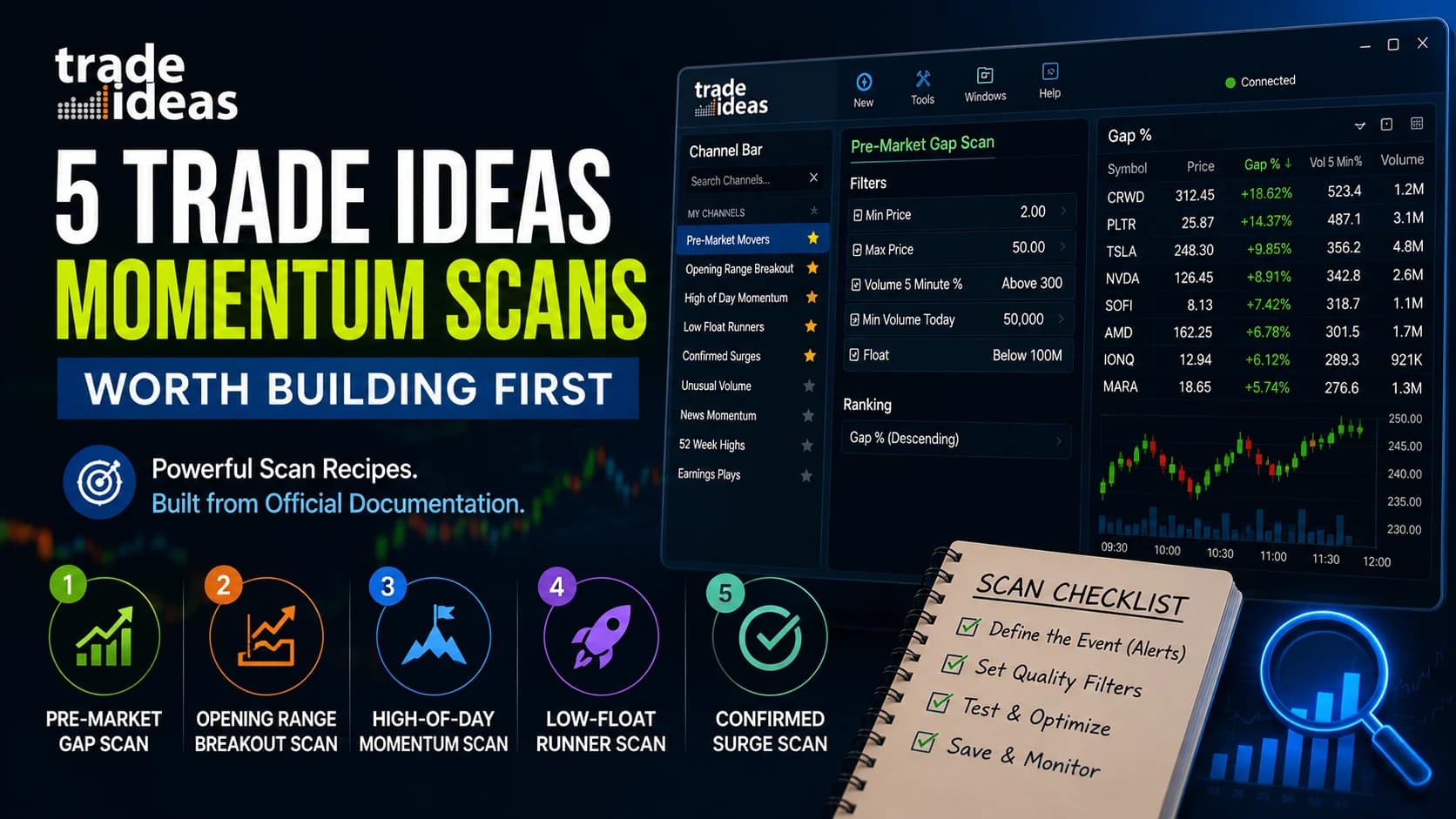
Tools & Tutorials
Best Trade Ideas Scans for Momentum Traders: 5 Recipes Worth Building First
Five complete momentum scan recipes for Trade Ideas — exact alerts, filters, and starting values built from the official documentation, plus the OR/AND logic that breaks most beginner scans, the Multi-Strategy consolidation setup, and how to validate any scan before trading it.
Tools & Tutorials
The Best ChatGPT Prompts for Day Trading (Structured for Trading Research)
Get 25 copy-paste ChatGPT prompts tested by pro traders. Organized by use case with customization tips. Free prompts for research, analysis & journaling.
Comments
No comments yet. Be the first to share your thoughts.