You’re living a double life, and it’s exhausting.
By 6:30 AM, you’re already scanning charts and building your watchlist. At 9:30, the market opens—but so does your first meeting. You’re nodding along while your boss discusses quarterly targets, but your mind is on that breakout setup you spotted at 6:45. Your phone buzzes. It’s your stop-loss alert. You excuse yourself to the bathroom, pull up your trading app, and close the position at a loss. Back at your desk, you’ve got a choice: stay focused on your actual job, or spend the rest of the day trying to make back that loss.
Sound familiar?
Day trading while working full time is one of the most challenging paths you can take—not because the strategies are harder, but because you’re fighting a war on two fronts. You’re managing the stress of the market while juggling the demands of a 9-to-5 job, and the psychological toll can be brutal. Our team has worked with hundreds of traders attempting this balancing act, and we’ve seen both spectacular failures and hard-won successes.
This guide cuts through the lifestyle marketing nonsense and gives you the real framework: practical time management strategies, research-backed stress management techniques, realistic expectations, and the honest truth about whether part-time trading is even right for you. Let’s dig in.

The Reality Check: Why Part-Time Trading Is Harder Than It Looks
Here’s the uncomfortable truth our team learned the hard way: trading part-time isn’t “day trading lite.” It’s actually harder than full-time trading in many ways, and most people underestimate the challenge.
The Attention Conflict (You Can’t Serve Two Masters)
When you’re trading, your edge often lives in those micro-decisions—adjusting your stop when market conditions shift, recognizing when your thesis has invalidated, seeing the trap before you walk into it. But when you’re in a meeting? When your boss needs that report? When a client calls? You’re torn between two competing demands, and both suffer.
We’ve talked to traders who missed critical exits because they were presenting in a conference room. Others who entered trades they shouldn’t have because they were distracted by work stress. The constant mental switching between “trader mode” and “employee mode” creates a cognitive load that most people don’t anticipate until they’re already underwater.

The Psychological Burden of the “Double Life”
This is the part nobody talks about—the emotional weight of serving two masters. Research from the National Institute for Occupational Safety and Health confirms what our team has observed: healthcare expenditures are nearly 50% greater for workers who report high levels of stress. Now add trading stress on top of work stress. It compounds.
When you have a bad trading morning and lose money, you don’t get to go for a run or decompress. You’ve got four to six more hours of your workday ahead of you. You’re sitting in meetings, pretending everything is fine, while your mind is replaying that blown trade. Your coworkers notice you’re off. Your performance slips. And here’s the kicker—at most companies, when they need to cut costs and reduce headcount, the underperformer goes first.
One study on workplace stress found that roughly 36 workable days per year could be impacted if you’re having just three bad trading days per month. Think about that. That’s almost two full months of the year where you’re showing up to your day job mentally and emotionally compromised.
Career Risk: When Your Day Job Performance Suffers
Let’s be brutally honest about the ethical dimension here: your employer is paying you for eight hours of work. If you’re spending significant mental bandwidth on trading—monitoring positions, adjusting orders, checking the tape—you’re not delivering what you’re being paid for. Beyond the ethics, there’s a practical concern: declining job performance in service of a side hustle is a fast track to unemployment.
Look, we get it. You’re not trying to screw anyone over. You’re trying to build something. But the reality is that trading during work hours creates a productivity conflict that your employer will eventually notice. And in today’s economy, job security matters more than ever.

Should You Even Try? A Decision Framework
Before we go any further, you need to answer these questions honestly:
Can you commit to doing the work outside market hours? Ninety percent of successful day trading happens when the market is closed—research, planning, journaling, analysis. If you’re not willing to put in two to three hours per night plus weekend work, part-time trading isn’t for you.
Do you have financial stability? If you need trading profits to pay rent, you’re already in a dangerous psychological position. Trading without financial pressure from your day job is a massive advantage—you can cut losses small because you’re not emotionally attached to the money.
Can you accept slow progress? You’re not going to replace your income quickly. You’re building habits, gaining screen time, and learning to trade—not making rent money. If you can’t accept that timeline, you’ll force trades that aren’t there.
Are you willing to risk your career? Because that’s what you’re doing if you trade during work hours. Be honest about this trade-off.
If you answered yes to all four, keep reading. If not, you might want to reconsider whether this path makes sense right now.
Time Management Strategies: Finding Your Trading Window
Alright, so you’ve decided you’re going to try this. Smart move: figure out when you can actually trade effectively.
Identifying Your Optimal Trading Hours
Your trading window depends entirely on your work schedule and time zone. Here’s the framework our team uses:
If you’re on the West Coast and start work at 9 AM local (noon EST): You’ve got the entire morning session. This is the golden scenario—wake up at 5 AM local (8 AM EST), prep from 5:00-6:15, trade from 6:30-8:00 AM local (first 90 minutes of the market). You can catch the opening volatility and be done before you start work.
If you’re on the East Coast and start work at 9 AM: Your options are tighter. You can try the pre-market (5:00-9:30 AM), but volume and volatility are limited. Alternatively, focus on the last hour (power hour, 3:00-4:00 PM) if you can carve out time late in your workday.
If your schedule is completely locked during regular hours: Consider futures trading on the Globex session—markets are open nearly 24 hours. The Asian session (9:30 PM EST) and London open (3:00 AM EST) offer opportunities, though moves tend to be slower and you’ll need to adjust your strategy.
The key is to match your available time with market activity. Don’t try to trade during low-volume periods just because you’re available—that’s how you lose money.
The Morning Open Strategy (6:30-8:00 AM)
The first 30 to 60 minutes of the market open provides the highest volatility for quick trades. If you can access this window, here’s the framework:
Setup the night before: Your watchlist should be built, key levels marked, alerts set. You’re not doing analysis at 6:15 AM—that’s execution time.
Focus on pre-market gappers: Stocks that gap up or down with volume and a catalyst. These provide immediate movement. Whether you’re trading long or short, the opening window is where you make quick trades and get out.
Set hard stops on everything: Because you need to be done and mentally shifted to your day job by 8:00 AM. No exceptions.
Don’t chase if you miss the entry: This is critical. If the setup isn’t there in your window, you don’t trade. The temptation to force trades because “this is your only time” will destroy your account.
Lunch Break Trading: Opportunities and Traps
Here’s where most part-time traders screw up. Lunch break trading sounds great in theory—check the market, place a quick trade, maybe scalp a winner. In practice, it’s a minefield.
The opportunity: The power hour (3:00-4:00 PM) often overlaps with West Coast lunch breaks. If you’re looking for swing positions—stocks closing strong and holding key levels—this can work.
The trap: Putting on a speculative intraday position that takes longer than 30 minutes to play out. What happens when your lunch break ends and you’re holding a position you can’t monitor? You either take a worse exit than you wanted, or you hold it and spend the rest of your afternoon distracted.
Our rule: Lunch break is for monitoring and closing positions you entered in the morning, OR for identifying swing setups you’ll enter later with bracket orders. Don’t initiate speculative day trades during lunch unless you have a concrete plan and tight stops.
Power Hour Trading (3:00-4:00 PM)
The last hour of trading can be useful for part-time traders, but not for day trading. Our team rarely day trades power hour—instead, we use it to scan for swing setups. Stocks closing strong, holding daily levels, showing relative strength—these are candidates for overnight positions.
If you’re going to swing trade (holding overnight or multiple days), power hour is your friend. You get to see how the stock behaved all day, where it’s closing relative to its range, and whether institutional money is accumulating. Then you enter after hours or the next morning.
Extended Hours and Futures for Night Owls
Can’t trade during regular hours? Futures markets offer nearly 24-hour access through the Globex session. Here’s what you need to know:
Pre-market futures (5:00-9:30 AM EST): Solid opportunities exist, but markets don’t move quickly or consistently every day. You’ll need to adjust expectations and potentially use wider stops with smaller position sizes to let trades develop over hours instead of minutes.
Evening session (6:00 PM-9:30 PM EST): Generally slower, but major news or overseas market movements can create volatility. Better suited for those who work late shifts or have evening availability.
The trade-off: lower volatility means you’re not getting the explosive moves of the morning open, but you also have more time to think and less pressure to make split-second decisions.
The Weekend Work: When Real Trading Happens
Here’s the secret: your weekend is when you actually become a trader. While everyone else is watching Netflix, you’re doing weekly chart analysis, reviewing your trades from the week, journaling your thought process, and planning for Monday.
Sunday routine:
- Review major markets and indices
- Identify key support/resistance levels for the week
- Scan for stocks with upcoming catalysts or technical setups
- Create your preliminary watchlist
- Review your trading journal from last week
This isn’t glamorous work. It’s not exciting. But this is where you build your edge. When Monday morning rolls around, you’re not scrambling to figure out what to trade—you already know.
Building Your Pre-Market Preparation Routine
Most traders fail at part-time trading because they try to do everything in the morning. That’s backwards. Your morning should be execution only—the real work happens the night before.

The Night-Before Analysis Session
After dinner, after the kids are in bed, after you’ve decompressed from work—that’s when you do your trading homework. Budget two hours minimum.
Step 1: Review the day’s top movers (20 minutes). Which stocks gapped and ran? Which failed? What patterns are working in the current market? You’re not analyzing every stock—you’re looking for themes and setups that match your strategy.
Step 2: Scan for tomorrow’s candidates (40 minutes). Use your scanner to find stocks that meet your criteria: volume, volatility, price range, technical setup. For our team, we use Finviz for free scanning and Trade Ideas when we need more sophisticated AI-powered scanning. Build a shortlist of 5-10 stocks maximum.
Step 3: Chart your levels (30 minutes). For each stock on your shortlist, mark your key support/resistance, note the catalyst if there is one, identify your entry, stop, and target. This is all pre-planned. You’re not making these decisions at 6:45 AM when you’re groggy and the market is moving.
Step 4: Set your alerts (15 minutes). Price alerts, volume alerts, whatever triggers your attention. The goal is to be notified when your setup activates—you’re not watching 10 stocks all morning.
Step 5: Journal your plan (15 minutes). Write down your thesis for each trade. What’s your bias? What would invalidate it? What’s your target? This forces clarity and gives you something to review later.
When you go to bed, your work is done. Your morning is just execution.
Creating Your Watchlist Efficiently
Your watchlist shouldn’t be a random collection of stocks you heard about on Twitter. It should be a curated list based on objective criteria that fit your strategy. Here’s our framework:
Volume minimum: For day trading, you need at least 1-2 million shares in average daily volume. Ideally more. You want stocks where you can enter and exit without slippage.
Price range: Most part-time traders do best in the $5-$50 range. High enough to avoid penny stock nonsense, low enough to be accessible with smaller account sizes.
Catalyst or technical setup: Either the stock has news, earnings, or an event driving it, OR it has a clean technical pattern (breakout, pullback to support, reversal setup). Preferably both.
Limit your list: Five to ten stocks maximum. You don’t have time to monitor 30 names. Focus is your edge.
For more on building effective watchlists and using scanners, check out our guide on finding stocks to trade.
Using Scanners for Time-Strapped Traders
We’re going to be direct: if you’re trading part-time and you’re not using a scanner, you’re wasting time you don’t have. Scanners do in 30 seconds what would take you an hour manually.
Free options: Finviz and ThinkorSwim’s built-in scanners work well for basic criteria. Filter by pre-market gappers, volume leaders, and percent change.
Paid options: Trade Ideas is our top recommendation for serious traders. The AI-powered pattern recognition and real-time scanning are worth the cost if you’re committed. You’re paying for time—and when you have a full-time job, time is your scarcest resource.
Scanner strategy: Run your scan at night (for the next day’s gappers based on after-hours movement), then run it again in the morning around 8:00 AM to catch pre-market developments. Don’t scan during trading hours—your focus should be on execution, not research.
The Morning Setup Ritual (15-20 Minutes)
When you wake up, you’ve got a tight window before either the market opens or you need to start work. Here’s the routine:
6:00-6:10 AM: Coffee. Wake up. Quick scan of major market news—did anything happen overnight that changes your plan? Check futures. If the market is gapping down hard and you had long setups, you might need to adjust or skip trading entirely.
6:10-6:20 AM: Pull up your watchlist from last night. Are the stocks still setting up? Did they gap out of your entry range? Any new pre-market volume or price action that changes your thesis? Make quick yes/no decisions: trade or remove from list.
6:20-6:30 AM: Platform setup. Open your trading software, make sure your orders are ready to go (bracket orders with pre-set stops and targets), confirm your hotkeys work, check your risk calculator. You’re doing a pre-flight check.
6:30 AM onward: Execution mode. You’re not researching, not second-guessing. You’re executing the plan you made last night. If your setup triggers, you trade it. If it doesn’t, you don’t.
That’s it. Fifteen to twenty minutes. If you need more time than that in the morning, you didn’t do enough work the night before.
Platform Configuration for Quick Execution
When you have limited time, every second counts. Here’s how to set up your platform for speed:
Hotkeys are mandatory: Buy, sell, cancel, flatten position—all on hotkeys. You can’t be clicking through menus when you have 90 seconds to make a decision.
Bracket orders ready to go: Have your order templates pre-configured with your typical stop distance and target. You’re modifying, not building from scratch.
Alerts configured: Sound alerts, pop-up alerts, push notifications to your phone. You need to know immediately when your setup activates.
Declutter your screen: Only the information you need—price, volume, Level 2 if you use it, your chart. Remove everything else. Focus is critical when you have limited time.
Most brokers (ThinkorSwim, TradeStation, Interactive Brokers) allow extensive customization. Spend an hour on a weekend getting your setup perfect. It’s an investment that pays off every single trading day.
Automation and Technology: Your Force Multipliers
If you’re trying to day trade part-time without automation, you’re making it exponentially harder than it needs to be. Technology is your edge—use it.
Bracket Orders and OCO (One-Cancels-Other) Orders
This is non-negotiable. If you can’t watch your trades all day, you need automated risk management.
How bracket orders work: You place a buy order with a stop-loss and take-profit attached. When your buy executes, both the stop and target are activated automatically. When one triggers, the other cancels. You’ve defined your risk and reward before you even enter.
Example: You’re buying XYZ at $50. You set a stop-loss at $49.50 (risking $0.50) and a take-profit at $51.50 (targeting $1.50). Your order executes at 6:45 AM. At 8:00 AM you close your platform and go to work. During the day, the stock hits $51.50—your take-profit triggers, you’re out with a gain. Or it drops to $49.50—your stop triggers, you’re out with a small controlled loss. Either way, you’re not staring at your phone during meetings.
Platforms that support bracket orders: ThinkorSwim, Interactive Brokers, TradeZero, TradeStation, Webull. Most professional platforms have this feature—if yours doesn’t, switch.

For more detail on position sizing and risk management, see our guide on position sizing for beginners.
Alert Systems That Actually Work
You can’t watch ten stocks all morning. Alerts let you focus on your work until your setup is ready.
Price alerts: Set above resistance or below support. When the stock breaks the level, you get notified.
Volume alerts: If a stock suddenly sees a volume spike, that’s worth checking. Could be news, a breakout, or an institution entering.
Technical pattern alerts: Some advanced platforms (like Trade Ideas or TrendSpider) can alert you when specific patterns form—flag patterns, bull flags, VWAP touches, etc.
The key: Don’t set so many alerts that you’re constantly interrupted. Five to ten alerts maximum. You’re looking for high-probability setups, not every possible trade.
Stop-Loss Automation (Non-Negotiable)
We’re going to say this bluntly: if you’re trading without automated stop-losses while you’re at work, you’re going to blow up your account. It’s not a question of if, it’s when.
Why manual stops don’t work for part-time traders: Because you’re not watching. That stock can drop 10% while you’re in a meeting, and by the time you check your phone, your $500 risk is now a $2,000 loss.
How to set stops properly:
- Mental stops don’t count. Your stop must be an actual order in the system.
- Place it immediately when you enter the trade—not “I’ll add it later.”
- Use stop-market orders (not stop-limit) for small accounts to ensure execution
- Base your stop on technical levels (support/resistance) and your risk tolerance (1-2% of account)
A note on stop-loss orders: Yes, they can get triggered on a spike and then the stock reverses. Yes, you might feel like you “got stopped out for nothing.” But the alternative—holding a position that gaps against you while you’re unavailable—is far worse. Stops are the price you pay for the luxury of not watching the screen all day.
For a deeper dive into stop-losses, read what is a stop-loss order and why you must use it.
Mobile Trading: When to Use It (and When Not To)
Your phone is not your primary trading device. Let’s get that straight right now.
When mobile trading is appropriate:
- Closing positions you entered earlier (profit-taking or stop adjustment)
- Monitoring positions with pre-set orders already in place
- Checking alerts to see if your setup triggered
- Emergency exits (though your stop-loss should handle this)
When mobile trading is NOT appropriate:
- Entering new speculative positions during work hours
- Doing analysis or making complex decisions
- Trading during meetings or while you’re supposed to be working
- Revenge trading after a loss
The screen is too small, the execution is too slow, and your attention is divided. If you’re using your phone as your main trading interface, you’re setting yourself up for mistakes. Do your trading on a real computer with a real setup, or don’t trade at all.
Platform Comparison for Part-Time Traders
Not all platforms are created equal for part-time trading. Here’s what matters:
ThinkorSwim (TD Ameritrade): Great free platform, excellent charting, supports bracket orders. Execution can be slightly slower than direct-access platforms. Good for beginners and part-time traders focused on stocks.
Interactive Brokers (IBKR): Professional-grade platform, excellent for futures and international markets, very customizable. Steeper learning curve. Better for experienced traders.
TradeZero: Direct market access, good for shorting, supports bracket orders. Requires higher capital commitment. Good for more active part-time traders.
Webull: Commission-free, decent mobile app, supports extended hours. Less sophisticated than ThinkorSwim. Good for very casual part-time trading.
The best platform is the one you know inside and out. Spend a weekend learning your platform’s features—hotkeys, order types, alerts—so that when you’re trading in a limited time window, you’re not fumbling with basic functions.
Managing the Psychological Stress of Dual Responsibilities
Let’s talk about the elephant in the room: the mental and emotional toll of this lifestyle. This is where most part-time traders break—not because their strategy fails, but because the stress becomes unsustainable.

Understanding Work-Related Stress Research
Research from the National Institute for Occupational Safety and Health (NIOSH) found that one-fourth of employees view their jobs as the number one stressor in their lives. Three-fourths believe workers have more stress than a generation ago. Now add trading on top of that—an activity where you can lose significant money in minutes—and you’re compounding stress exponentially.
Studies confirm that healthcare expenditures are nearly 50% greater for workers reporting high levels of stress. The physical manifestations—headaches, digestive issues, sleep disturbances, muscle tension—aren’t just uncomfortable. They’re costly and they impact your ability to perform at both your job and your trading.
Here’s what the research tells us: combination approaches work best. Stress management interventions that use multiple techniques (cognitive-behavioral strategies plus relaxation plus physical exercise) show more consistent results than single-method approaches. For traders, that means you need a toolkit, not a single solution.
Cognitive-Behavioral Techniques for Traders
Cognitive-behavioral therapy (CBT) has the strongest research backing for workplace stress management. A 2021 review of randomized controlled trials found that CBT was effective for anxiety, depression, and stress-related conditions in the short term, with effect sizes around 0.65-0.78 depending on the outcome measured.
For traders, CBT techniques focus on identifying and challenging irrational thoughts:
Catastrophic thinking: “I lost $500 today, I’m going to blow up my account and lose everything.” Reality check: one loss doesn’t determine your future. What does your trading plan say? Have you stuck to your risk rules?
All-or-nothing thinking: “I either make money every day or I’m a failure.” Reality: even the best traders have losing days. Success is measured over months, not days.
Personalization: “That loss happened because I’m not good enough.” Reality: the market doesn’t care about you. The setup failed because of market conditions, not because you’re deficient as a person.
Practical application: When you notice stress or negative thoughts, write them down. Challenge them. Reframe them. This sounds simple—and it is—but it works. The act of externalizing and examining your thoughts breaks the rumination cycle.
For more on managing trading psychology, see our guide on managing fear and greed in trading.
The Meditation and Mindfulness Approach
Meditation produced the most consistent stress-reduction results across outcome measures in workplace stress research, though it was used in only a small fraction of studies. For traders, a simple daily practice can make a huge difference.
The 5-minute pre-trade routine: Before you open your platform, spend five minutes getting into a neutral mental state. You don’t want to be over-eager, anxious, or over-confident. You want alert and focused, but not stressed.
Breathing exercises: When you feel your heart racing during a trade, when you’re tempted to revenge trade after a loss, when you’re checking your phone during a meeting—stop. Three deep breaths. Inhale slowly through your nose for four counts, hold for four, exhale through your mouth for six. This triggers your parasympathetic nervous system and reduces the fight-or-flight response.
Mindfulness during the workday: When you catch yourself obsessing about your trading positions during work hours, acknowledge the thought, then redirect your focus. “I’m thinking about my trades. That’s normal. But right now I need to focus on this report. I’ll check my positions at lunch.” Sounds basic, but practice builds the skill.
Physical Exercise as a Stress Buffer
Research consistently shows that regular exercise is one of the most effective stress management techniques. It’s not sexy or complicated, but it works.
Why exercise matters for traders: Trading—especially when combined with a desk job—is sedentary. You’re sitting for hours, staring at screens, muscles tense. Exercise releases that physical tension and triggers endorphin production. Just as importantly, it gives your mind a break from market obsession.
What works: Any consistent exercise is better than none. Thirty minutes of moderate activity most days of the week shows measurable stress reduction. Running, weightlifting, swimming, cycling—pick what you’ll actually do, not what sounds optimal.
Timing matters: Exercise after your trading session (if you trade mornings) or after work. This helps you transition mentally from one activity to another and prevents you from ruminating on losses or obsessing about missed opportunities.
The traders on our team who exercise regularly report better emotional control, better sleep, and better decision-making. The ones who don’t? They burn out faster.
Setting Boundaries Between Trading and Work
This is where most part-time traders fail. They don’t set boundaries, so trading bleeds into work, work bleeds into trading, and eventually both suffer.
Physical boundaries: When you’re done trading for the day, close the platform. Don’t check it “just once more” at 10 AM, noon, 2 PM. If you’ve set your stops and targets, there’s nothing productive to check. You’re either scratching an itch or revenge-trading—neither helps.
Time boundaries: Trading hours are trading hours. Work hours are work hours. If you trade 6:30-8:00 AM and work starts at 9:00, the hour in between is transition time—shower, breakfast, mental reset. Don’t blur the lines.
Mental boundaries: When you’re at work, you need to be present. If you find yourself constantly thinking about your trades, ask yourself: “Can I do anything productive about this right now?” If the answer is no—because you’re in a meeting, because your stops are set, because the position is managed—then let it go. Check at lunch if you must, but don’t let trading colonize your entire workday.
Digital boundaries: Turn off trading alerts during critical work hours (meetings, presentations, focused work). Set designated check-in times—maybe lunch and end of day—and stick to them.
For strategies on maintaining long-term sustainability, see our guide on preventing trader burnout.
Handling Bad Trading Days at Your Day Job
Here’s a scenario: you lose $800 before 8 AM. Your stop got triggered on a gap-down you didn’t anticipate. You’re frustrated, you’re angry, and you have seven hours of work ahead of you. What do you do?
First, close your trading platform. Immediately. The temptation to “make it back” during your work day will destroy both your trading account and your career. You’re done trading for the day.
Second, acknowledge the emotion without acting on it. “I’m frustrated. That loss hurts. But I followed my plan, the market moved against me, and that’s part of trading. This doesn’t define my results.” Sounds cheesy? Maybe. But externalizing the thought helps you process it.
Third, give yourself a hard reset. Take a walk. Call a friend (not about trading—about anything else). Do something physical. Get out of your head for 10-15 minutes.
Fourth, refocus on your job. You’re being paid to do work. Do it. The trading loss is a sunk cost. Making it worse by also losing your job solves nothing.
Finally, journal it tonight. After work, write about the trade. What happened? What was the setup? Did you follow your rules? What would you do differently? The goal is to extract the lesson without ruminating on the loss.
For more on handling losses like a professional, read our guide on dealing with trading losses and drawdowns.
Risk Management for Limited-Attention Trading
Risk management is always important. When you can’t watch your positions all day, it becomes absolutely critical.
Why Position Sizing Matters Even More
When you’re trading full-time, you can adjust on the fly—scale out of a winner, move your stop to breakeven when the setup changes, exit early if the market conditions shift. When you’re part-time? You don’t have that luxury.
The problem: You need to size your positions assuming you won’t be able to actively manage them. That means your risk per trade needs to account for potentially worse fills, unexpected volatility, and the inability to scale out gradually.
The solution: Size smaller than you would if you were watching full-time. If your normal risk is 1% of your account per trade, consider risking 0.5-0.75% when you know you’ll be unavailable. Yes, your potential gains are smaller. But your potential for catastrophic loss is also smaller.
The calculation: Use your stop distance to determine share size, not your gut feeling. If you have a $10,000 account and you’re risking 0.5% ($50), and your stop is $0.50 away, you can buy 100 shares. That’s it. Not 200 because “it feels like a good setup.” Math, not emotion.

For a complete breakdown of position sizing, check out our guide on position sizing for beginners.
The 1% Rule When You Can’t Watch the Screen
The 1% rule is simple: never risk more than 1% of your account on a single trade. When you’re trading part-time and can’t actively monitor positions, we’d argue for an even more conservative 0.5-1% max.
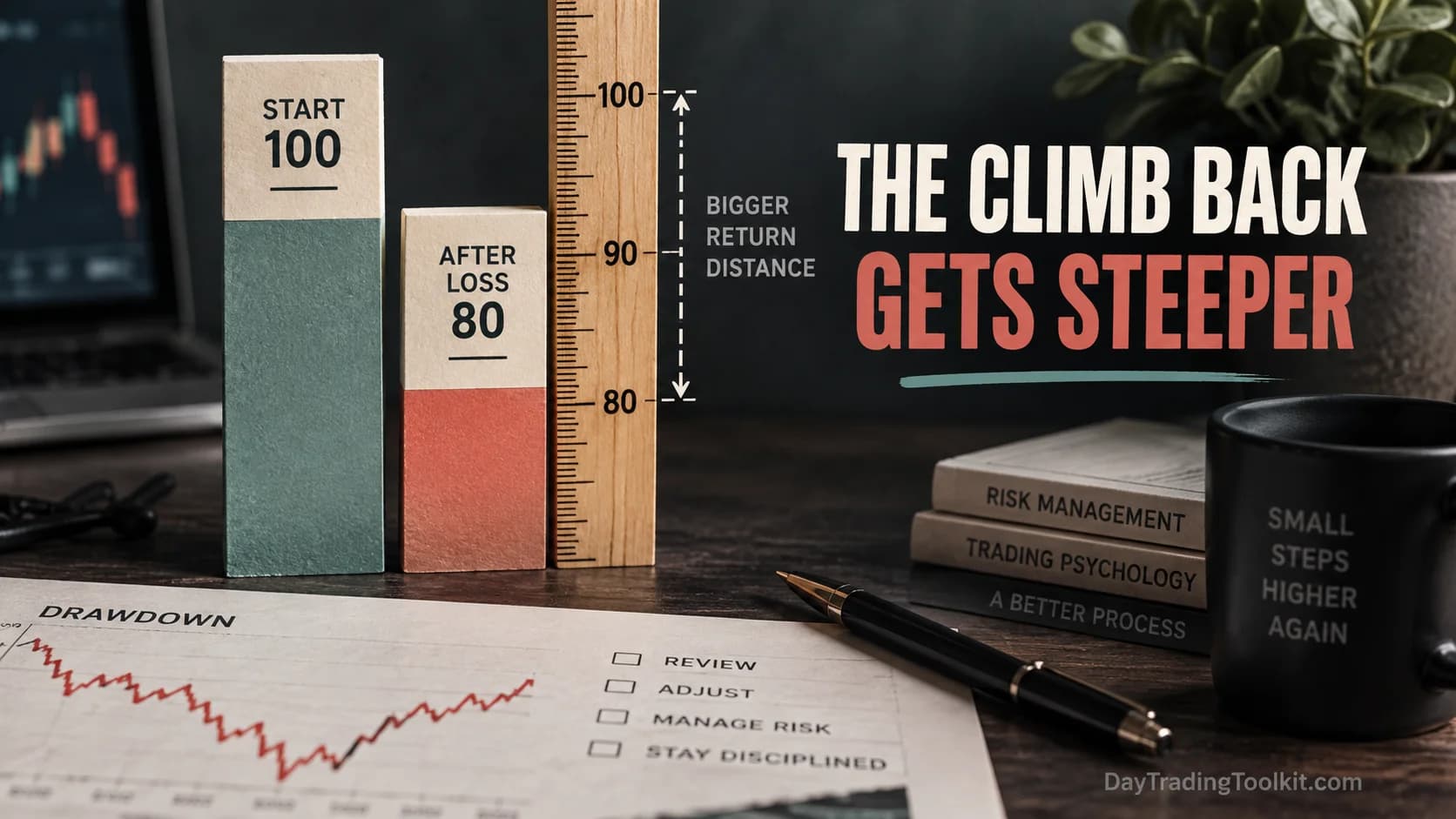
Why this matters: Let’s say you have a $10,000 account. If you risk 5% per trade ($500), just two bad trades puts you down 10%. Three puts you down 15%. At that point, you need a 20%+ gain just to get back to breakeven. The math gets ugly fast.
Compare to 1% risk: Two losses = 2% drawdown. You need a 2% gain to recover. Psychologically and mathematically, you’re in a much better position.
The part-time trader modification: Because you can’t babysit trades, risk 0.5-0.75% until you’re consistently profitable. Once you’ve proven your edge over at least 50 trades, you can increase to the full 1% if you want.
This is conservative. Some will tell you it’s too conservative. But our team has watched countless part-time traders blow up because they sized too aggressively relative to their attention capacity. Don’t be that person.
Avoiding Overtrading with Time Constraints
Overtrading is one of the most common mistakes part-time traders make. You have a limited window, you feel pressure to “make it count,” so you force trades that aren’t really there.
The problem: Just because you woke up at 6 AM and did your homework doesn’t mean the market owes you a trade. Some days, there’s nothing that meets your criteria. But you’re up early, you’re caffeinated, the market is open—it’s hard to just sit on your hands.
The discipline: Track this metric: your win rate on “A+ setups” versus “B/C setups.” An A+ setup is one where all your criteria align—volume, catalyst, clean technical pattern, good risk/reward. A B or C setup is missing one or more elements, but you talked yourself into it because “I need to trade today.”
Our bet: your win rate on A+ setups is at least 20 percentage points higher than B/C setups. And yet most part-time traders take more B/C setups because they feel pressure to be active.
The solution: If there’s no A+ setup in your window, don’t trade. Go to work. Use the extra time to exercise, to journal, to do literally anything else. Not every day is a trading day, and forcing trades will cost you more than sitting out.
For strategies on developing the patience to wait for quality setups, see our guide on finding patience and staying objective.
The Danger of “Just One More Trade” at Work
This is the trap that kills careers and accounts simultaneously: you’re at work, the market is open, you see what looks like a setup, and you think “just one quick trade.”
Don’t.
Why this fails:
- You don’t have your full setup—you’re on your phone, not your trading computer
- You’re distracted by work responsibilities—can’t give the trade proper attention
- You’re likely frustrated from earlier losses or excited from earlier wins—emotional trading
- You can’t manage the position properly if it goes against you
- You’re risking your job to take a mediocre setup
The rule: If you’re at work, you’re not trading. Period. The only exception is closing positions you entered during your designated trading time with pre-set orders. No new entries. No exceptions.
Set this boundary now, before you violate it and regret it. Your future self will thank you.
Realistic Expectations: What You Can Actually Achieve
Let’s have the conversation nobody wants to have but everyone needs to hear: you’re probably not going to quit your job and trade full-time in six months.
The “Build Habits, Not Income” Mindset
When you’re trading part-time alongside a full-time job, your goal cannot be income replacement—at least not immediately. You don’t have the screen time, the attention capacity, or the capital to realistically replace a full-time salary in your first year. Maybe not your second year either.
What you should focus on:
- Building consistent execution habits (following your plan, not your emotions)
- Gaining screen time and pattern recognition (learning what setups work in which market conditions)
- Refining your edge (testing, journaling, improving)
- Growing your capital slowly (through both saving from your job and modest trading gains)
What you should not focus on:
- Making $X per month to “prove” trading works
- Quitting your job by an arbitrary deadline
- Comparing your results to full-time traders with different time commitments
You’re playing a different game. Your advantage is that you have financial stability from your job, which means you can trade without the psychological pressure of needing to make money. Use that advantage.
PDT Rule Considerations (and the Coming Changes)
If you’re in the United States and trading stocks, you need to understand the Pattern Day Trading (PDT) rule—and the significant changes coming soon.
Current rule (as of late 2024/early 2025): If you make four or more day trades within five business days in a margin account, you’re flagged as a pattern day trader. Once flagged, you must maintain at least $25,000 in account equity to continue day trading. Fall below that, and you’re restricted for 90 days.
Coming changes: In September 2025, FINRA’s Board of Governors approved amendments to replace the fixed $25,000 minimum with an intraday maintenance margin requirement. This change is pending SEC approval and is expected to take effect in late 2025 or early 2026. Under the new framework, buying power would be determined by real-time risk rather than a fixed dollar threshold, potentially opening day trading to traders with smaller accounts.
What this means for part-time traders:
- If you have under $25,000 right now, you’re limited to three day trades per rolling five-day period in a margin account
- Cash accounts aren’t subject to PDT rules, but you need to wait for settlement (T+2 for stocks)
- Once the rule changes, smaller accounts may have more flexibility—but the specifics are still being finalized
- Don’t make career or financial decisions based on proposed rules that aren’t yet in effect
For now, if you’re under $25,000, consider using a cash account and treating it as forced discipline—you can’t overtrade because you’re limited by settled funds. It’s not ideal, but it forces you to be selective.
For more on capital requirements, see our guide on how much money you need to start day trading.
Why Keeping Your Day Job Is Actually an Advantage
Here’s the truth that lifestyle marketers won’t tell you: keeping your job is a massive psychological advantage.
Reason 1: No performance pressure. When your rent doesn’t depend on your trading profits, you can cut losses small. You’re not holding losers hoping they come back because you “need” this trade to work. You can be objective.
Reason 2: Consistent capital growth. Your job provides steady income to save and add to your trading account. Full-time traders who aren’t consistently profitable have to withdraw from their accounts to live—which makes growing capital nearly impossible.
Reason 3: Better decision-making. Research on decision-making under pressure shows that financial stress impairs cognitive function. When you’re not stressed about money, you make better trading decisions.
Reason 4: Time to develop properly. You’re not forced to trade before you’re ready. You can spend a year in a demo account if needed. Full-time traders often can’t afford that luxury—they need to make money now, which leads to rushed learning and bad habits.
The goal isn’t to quit your job as fast as possible. The goal is to become a consistently profitable trader. Keep your job until trading profits consistently exceed your job income for at least 12 months. Maybe longer. There’s no shame in that—it’s actually the smart play.
When to Consider Going Full-Time (If Ever)
Let’s say you’ve been trading part-time for two years. You’re consistently profitable. Your account has grown. You’re thinking about taking the leap to full-time trading. Should you?
Our criteria for going full-time:
- At least 12 months of consistent profitability (every month profitable, or at worst one small losing month)
- Your trading income exceeds your job income for at least six consecutive months
- You have at least 12 months of living expenses saved (separate from your trading capital)
- You have a detailed business plan for full-time trading, including worst-case scenarios
- You’ve tested full-time trading on vacation (take a week off work, trade full-time, see how it feels)
- You’re emotionally ready for the isolation, pressure, and lack of steady paycheck
If you meet all six criteria, full-time trading might be worth considering. If you’re missing even one, you’re not ready. That’s not a judgment—it’s reality.
And here’s a secret: some of the best traders we know never go full-time. They keep their careers, trade part-time, and enjoy the best of both worlds—steady income, trading profits, and no existential pressure to perform every day. That’s a legitimate end goal.
Creating Your Weekly Trading Routine
Success in part-time trading comes down to routine. Not motivation, not excitement—routine. Here’s a framework that works.
Sunday: Weekly Market Analysis
Time commitment: 2-3 hours
Tasks:
- Review the major indices (S&P 500, Nasdaq, Dow) for the past week and identify the overall market trend
- Check the economic calendar for the coming week—FOMC announcements, earnings season, major reports
- Scan for stocks with upcoming catalysts (earnings, FDA decisions, conferences)
- Review your own trading results from last week—win rate, average winner vs. loser, mistakes made
- Create a preliminary watchlist of 5-10 stocks that have clean setups for the coming week
- Set your intentions: what’s your goal for this week? (Not a profit target—a process goal, like “take only A+ setups” or “improve my exit discipline”)
This Sunday session is your strategic planning. When Monday morning rolls around, you’re not starting from scratch—you already have direction.
Monday-Friday: Evening Review and Journaling
Time commitment: 1.5-2 hours per night (can skip nights you didn’t trade)
Tasks:
- Review the day’s price action in the stocks you watched or traded
- Journal your trades: what was your thesis, what happened, did you follow your plan, what did you learn?
- Scan for tomorrow’s candidates using your screening criteria
- Mark levels on your shortlist for the next day
- Set alerts for the morning
- Review any mistakes and write down one specific thing you’ll improve tomorrow
A note on journaling: This is not optional. Every successful trader we know journals religiously. You’re not just tracking P&L—you’re tracking your decision-making process, your emotional state, your pattern recognition. Over time, your journal becomes your most valuable learning tool.
For more on getting maximum value from your journal, see our guide on your trading journal as more than just numbers.
The Importance of Rest Days
You need at least one full day per week where you do no trading work. No analysis, no scanning, no chart review. Nothing.
Why rest matters:
- Trading requires intense focus and decision-making—your brain needs recovery time
- Constant market exposure leads to overtrading and FOMO
- You need perspective to see your patterns objectively
- Burnout is real, and the part-time grind accelerates it
Our recommendation: Make Saturday your full rest day. Sunday is light work (the weekly planning session), but Saturday is completely off. Spend time with family, pursue hobbies, exercise, do literally anything that isn’t trading-related.
The traders who burn out fastest are the ones who never give themselves permission to stop. Don’t be that person.
Balancing Trading, Work, and Life
Here’s the blunt reality: trading part-time while working full-time requires sacrifice. You’re giving up two to three hours per evening and a few hours on weekends. That’s time you could be watching Netflix, socializing, playing video games, or sleeping.
What gets sacrificed (usually):
- Some social time with friends and coworkers (goodbye lunch-hour gym sessions)
- Some leisure and entertainment time
- Some sleep (if you’re waking up at 5 AM to trade)
What should never be sacrificed:
- Your relationship with your partner or family
- Your physical and mental health
- Your job performance and career progression
- Your core values and identity outside of trading
If trading is destroying your relationships, wrecking your health, or tanking your career, you need to reevaluate. It’s not worth it. Trading should enhance your life, not consume it.
For more on sustainable trading practices, check out our guide on preventing trader burnout and maintaining sustainability.
Common Mistakes Part-Time Traders Make
Let’s run through the mistakes our team sees constantly—and how to avoid them.
Trading During Work Meetings (Don’t)
We’ve said it before, but it bears repeating: do not trade during work meetings. Not “just to close a position.” Not “just to check.” Not ever.
Why this is career suicide:
- Someone will notice you’re distracted
- You’ll miss critical information from your boss or client
- You’re demonstrating that you don’t value the meeting or the people in it
- When layoffs come, the guy who’s always on his phone gets cut first
The exception: If you’re in a bathroom break or genuinely stepping out for a legitimate reason, checking your positions quickly (with pre-set orders) is fine. But placing new trades or making active decisions? No.
Revenge Trading After a Bad Morning
You lost money before 8 AM. You’re frustrated. The market is still open. You’re thinking about “just one more trade” to make it back.
Stop. Close the platform. Walk away.
Why revenge trading destroys accounts:
- You’re trading from emotion, not analysis
- Your risk management goes out the window (you’re sizing too big to “make it back faster”)
- You’re likely forcing a setup that isn’t really there
- Even if you win, you’ve reinforced a terrible habit that will eventually blow up
The rule: After two consecutive losses in a session, you’re done trading for the day. No exceptions. Walk away, journal the trades, and come back tomorrow with a clear head.
For more on building resilience after losses, see our guide on bouncing back and building mental toughness.
Neglecting the Day Job
This should be obvious, but we’ve seen too many traders lose their jobs because they couldn’t keep their focus where it needed to be.
Signs you’re neglecting your job:
- Missing deadlines because you were focused on trading
- Showing up late because you were “just finishing a trade”
- Poor performance reviews or feedback from your boss
- Coworkers commenting on your distraction or mood swings
- Constantly checking your phone during work hours
If any of these apply to you, you need to either scale back your trading or quit entirely. Your day job is your financial foundation—don’t destroy it chasing trading profits you’re not ready to capture.
Overcomplicating the Strategy
Part-time traders often think they need a complex, sophisticated strategy to succeed with limited time. The opposite is true.
The trap: You’re learning supply and demand zones, order flow, market internals, options spreads, and five different indicators. You’re trying to monitor 30 stocks. You’re switching strategies every week because nothing seems to work.
The reality: The best part-time trading strategies are simple, repeatable, and require minimal real-time decision-making. You need a clear setup, a clear entry, a clear stop, and a clear target. That’s it.
Our recommendation: Pick one strategy—maybe it’s trading pre-market gap-ups, maybe it’s breakouts from consolidation, maybe it’s pullbacks to moving averages. Master that one setup. Trade it for at least 50 times before you even think about adding another strategy.
Simplicity scales. Complexity doesn’t.
For an overview of different strategy approaches, see our guide on day trading strategies overview.
Skipping the Journal
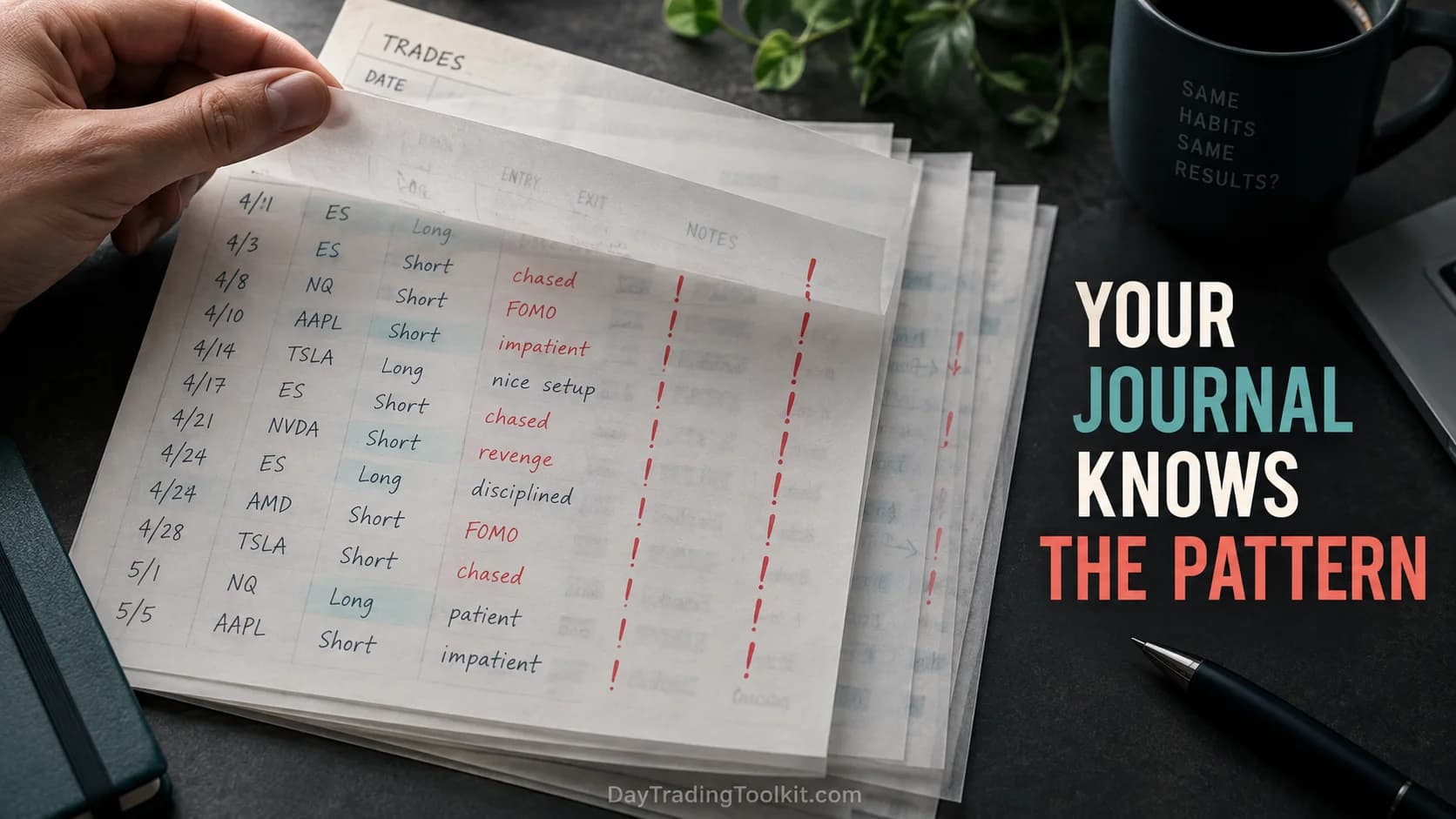
We’re going to be harsh here: if you’re not journaling your trades, you’re not serious about improving. You’re just gambling with better technology.
What happens when you don’t journal:
- You repeat the same mistakes over and over (because you never analyzed them)
- You can’t identify your edge (because you’re not tracking what actually works)
- You blame “the market” for losses instead of owning your decisions
- You lack data to make informed adjustments to your approach
What to journal:
- The setup (chart screenshot, thesis, catalyst)
- Your entry, stop, and target
- Your emotional state before, during, and after the trade
- What you did right
- What you’d do differently
- Key takeaway (one sentence)
Five minutes per trade. That’s all it takes. And over time, your journal becomes your greatest teacher.
FAQs: Day Trading While Working Full Time
Can I realistically make money day trading while working a 9-5 job?
Quick Answer: Yes, but your timeline and expectations need to be realistic.
You can absolutely make supplemental income as a part-time trader, but you’re not going to replace your full-time salary quickly. Most successful part-time traders spend at least a year building skills and consistency before they see meaningful profits. Your edge as a part-time trader is that you have financial stability from your job, which lets you trade without the pressure of needing to make money immediately. Focus on building good habits, gaining screen time, and refining your strategy. Profitability follows skill development, not the other way around.
Key Takeaway: Part-time trading is about building a skill and supplemental income over time, not getting rich quick. Treat it as a business you’re developing while maintaining your primary income source.
How much time do I actually need to dedicate to part-time trading?
Quick Answer: Plan for 10-15 hours per week minimum.
Here’s the realistic breakdown: 1-2 hours in the morning for active trading (if you trade the open), 1.5-2 hours each evening for research, analysis, and watchlist building, and 2-3 hours on weekends for weekly review and planning. That’s roughly 10-15 hours per week. Less than that, and you’re probably not doing enough preparation to trade successfully. More than that, and you risk burnout or neglecting your day job. The key is that 90% of this time should be outside market hours—you’re doing homework at night and executing the plan in the morning.
Key Takeaway: Success requires consistent time investment, mostly outside trading hours. If you can’t commit 10-15 hours per week, part-time trading probably isn’t realistic right now.
Will the Pattern Day Trading rule affect me if I have a small account?
Quick Answer: Currently yes, but significant changes are coming.
Right now, if you have less than $25,000 in a margin account, you’re limited to three day trades per rolling five-business-day period. Make a fourth day trade and you’re flagged as a pattern day trader, which either requires you to maintain the $25,000 minimum or face a 90-day restriction. However, FINRA approved amendments in September 2025 to replace this fixed minimum with an intraday maintenance margin requirement (pending SEC approval, expected late 2025 or early 2026). Until those changes take effect, traders with smaller accounts should either use cash accounts (which aren’t subject to PDT rules but require waiting for settlement) or be extremely selective with their day trades.
Key Takeaway: For now, small accounts need to work within PDT restrictions. Use it as discipline—trade only your best setups. The rules are changing soon, but don’t make decisions based on proposed changes that aren’t yet in effect.
What are the best trading hours for someone who works full-time?
Quick Answer: The first 30-90 minutes after market open (9:30-11:00 AM EST) or extended hours, depending on your schedule.
If you’re on the West Coast and start work later, you can catch the morning volatility before your workday begins. If you’re on the East Coast with early morning obligations, consider the power hour (3:00-4:00 PM) for swing setups, or look at futures trading on extended hours (Globex session). The critical factor isn’t which hours are “best” universally—it’s which hours align with your schedule while offering sufficient volatility and volume. Don’t try to trade low-volume periods just because you’re available. Match your availability to market activity.
Key Takeaway: The morning open provides the best volatility for quick trades, but extended hours and futures markets offer alternatives if your schedule doesn’t allow morning trading.
Should I trade during my lunch break at work?
Quick Answer: Only for closing positions or identifying swing setups—never for speculative intraday entries.
The lunch break trading trap has destroyed many part-time traders. It sounds logical: the market is open, you have 30-60 minutes, why not trade? The problem is that putting on a speculative position that requires active management when you only have a limited time window is a recipe for poor exits, distracted work performance, and bad habits. If you’re going to use your lunch break for trading, limit it to closing positions you entered during your morning trading session, or scanning for swing setups (overnight or multi-day holds) that you’ll enter later with bracket orders.
Key Takeaway: Lunch break is for monitoring and planning, not speculative trading. Don’t initiate day trades you can’t fully manage.
How do I handle the stress of managing both a job and trading?
Quick Answer: Use a combination of cognitive-behavioral techniques, physical exercise, and strict boundaries.
Research shows that stress management works best when you use multiple approaches together. For traders, that means: (1) cognitive techniques to reframe irrational thoughts (“one loss doesn’t define my results”), (2) physical exercise to release tension and boost mood, (3) meditation or breathing exercises for acute stress moments, and (4) strict boundaries between trading time and work time. Close your trading platform after your session ends. Set specific check-in times rather than constantly monitoring. Give yourself at least one full day off per week from all trading activity. The part-time trading grind is real—if you don’t actively manage stress, burnout is inevitable.
Key Takeaway: Stress management isn’t optional—it’s essential for sustainability. Build a toolkit of techniques and use them consistently.
What type of orders should I use if I can’t watch my trades all day?
Quick Answer: Bracket orders with automated stops and profit targets are non-negotiable.
If you can’t actively monitor your positions, you must use automated risk management. Bracket orders (also called OCO or “one-cancels-other” orders) allow you to set your stop-loss and take-profit levels when you enter the trade. When one triggers, the other automatically cancels. This means your risk is defined and automated—the trade will exit at your stop or target without requiring your attention. Most professional platforms (ThinkorSwim, Interactive Brokers, TradeZero) support these order types. If your platform doesn’t, switch platforms. Trading without automated stops while you’re unavailable is asking to blow up your account.
Key Takeaway: Automated bracket orders are essential for part-time traders. They define your risk and allow the trade to manage itself when you’re unavailable.
Is it better to trade stocks, futures, or forex with a full-time job?
Quick Answer: It depends on your schedule, but stocks during the morning open or futures on extended hours are most common.
Stocks offer the most volatility and opportunity during the first 60-90 minutes after market open, making them ideal if you can trade before work or if you’re on the West Coast. Futures markets are open nearly 24 hours (through Globex), which gives you flexibility if your work schedule conflicts with regular market hours—you can trade pre-market, evening sessions, or even the Asian/London opens. Forex is also 24-hour, but tends to have more gradual moves and requires different strategies. Most part-time traders start with stocks because the patterns are clearer and educational resources are more abundant, then potentially explore futures if their schedule requires extended hours access.
Key Takeaway: Stocks are the most common starting point, but futures offer flexibility for traders with schedule conflicts. Choose based on when you can actually trade effectively.
How do I know when I’m ready to quit my job and trade full-time?
Quick Answer: When your trading profits consistently exceed your job income for 12+ months and you have significant savings.
Don’t quit your job based on a few good months. You’re ready to consider full-time trading when: (1) you’ve been consistently profitable for at least 12 consecutive months, (2) your trading income exceeds your job income for at least six months, (3) you have 12+ months of living expenses saved separately from your trading capital, (4) you have a detailed business plan including worst-case scenarios, and (5) you’ve tested full-time trading by taking time off work to see how it feels. If you’re missing even one of these criteria, you’re not ready. Many successful traders never go full-time—they keep their careers and enjoy the best of both worlds.
Key Takeaway: The threshold for going full-time should be extremely high. Keep your job until trading profits are consistent, substantial, and sustainable for at least a year.
What are the biggest mistakes part-time traders make?
Quick Answer: Trading during work hours, revenge trading after losses, and skipping preparation work.
The three most common mistakes we see: (1) trading during work meetings or hours, which risks both trading capital and career, (2) revenge trading after morning losses—trying to “make it back” during the workday when emotions are high and judgment is impaired, and (3) skipping the critical evening preparation work because they’re tired, then trying to wing it in the morning. Part-time trading success comes from discipline and routine, not talent or luck. The traders who survive are the ones who respect the boundaries between work and trading, who close their platforms after losses rather than chasing, and who do their homework every single night no matter how they feel.
Key Takeaway: Discipline beats talent in part-time trading. Stick to your boundaries, manage your emotions, and do the work even when you don’t feel like it.
Final Thoughts: The Long Game
Let’s bring it home.
If you’re still reading this, you’re either already trading part-time or seriously considering it. Either way, you need to hear this: the path you’re on is harder than most people realize, and that’s exactly why most people fail at it.
Part-time trading while working full-time isn’t a lifestyle hack. It’s not passive income. It’s not a quick path to financial freedom. It’s a grind that requires discipline, sacrifice, emotional resilience, and a willingness to put in work when you’re tired, when you’re stressed, when you’d rather be doing literally anything else.
But here’s what our team has observed over years of working with part-time traders: the ones who make it are the ones who treat it as a long-term skill development process, not a get-rich-quick scheme. They keep their jobs. They manage their stress. They show up and do the work—homework at night, execution in the morning, review and improvement on weekends—even when progress feels slow.
They don’t quit after a bad month. They don’t blow up their accounts revenge trading. They don’t sacrifice their careers or their families chasing trading profits they’re not ready to capture. They play the long game.
And eventually—maybe after a year, maybe after two or three—they develop a real edge. They start seeing consistent profits. They build a trading business that actually works alongside their career. Some eventually transition to full-time trading. Many don’t, and they’re perfectly happy with that—they enjoy the security of their job plus the supplemental income and intellectual challenge of trading.
That’s success. Not the Instagram version with Lambos and watches. The real version: sustainable income from a skill you’ve built over time while maintaining the rest of your life.
If you’re willing to commit to that version—the unsexy, disciplined, long-game version—you have a real shot at making this work.
Just remember: manage the stress, respect your boundaries, do the work, and keep your day job until the profits prove you don’t need to. That’s the path.
Now get to work.

Article Sources
This article was built on research from the following high-authority sources:
- National Institute for Occupational Safety and Health (NIOSH) – “STRESS…At Work” (CDC Publication 99-101)
https://www.cdc.gov/niosh/docs/99-101/default.html - Murphy, L.R. (1996) – “Stress management in work settings: A critical review of the health effects” – PubMed
https://pubmed.ncbi.nlm.nih.gov/10163598/ - Nakao, M., et al. (2021) – “Cognitive–behavioral therapy for management of mental health and stress-related disorders: Recent advances in techniques and technologies” – BioPsychoSocial Medicine
https://bpsmedicine.biomedcentral.com/articles/10.1186/s13030-021-00219-w - Aminoff, V., et al. (2022) – “Internet-delivered cognitive behavioral interventions to reduce elevated stress” – ScienceDirect
Journal of Contextual Behavioral Science, Volume 25 - Financial Industry Regulatory Authority (FINRA) – Pattern Day Trading Rules and Amendments
Multiple sources including official FINRA announcements (September 2025) - Robinhood Financial LLC – “Pattern day trading”
https://robinhood.com/us/en/support/articles/pattern-day-trading/ - U.S. Securities and Exchange Commission (SEC) – Pattern Day Trader regulations
Via FINRA Rule 4210 - Wikipedia – “Pattern day trader” (for historical context)
https://en.wikipedia.org/wiki/Pattern_day_trader - NerdWallet – “The $25,000 Day Trading Rule May Soon Go Away” (October 2025)
https://www.nerdwallet.com/article/investing/pattern-day-trading-rule-change - PMC (PubMed Central) – “Perceptions of work stress causes and effective interventions in employees”
https://www.ncbi.nlm.nih.gov/pmc/articles/PMC5353523/