


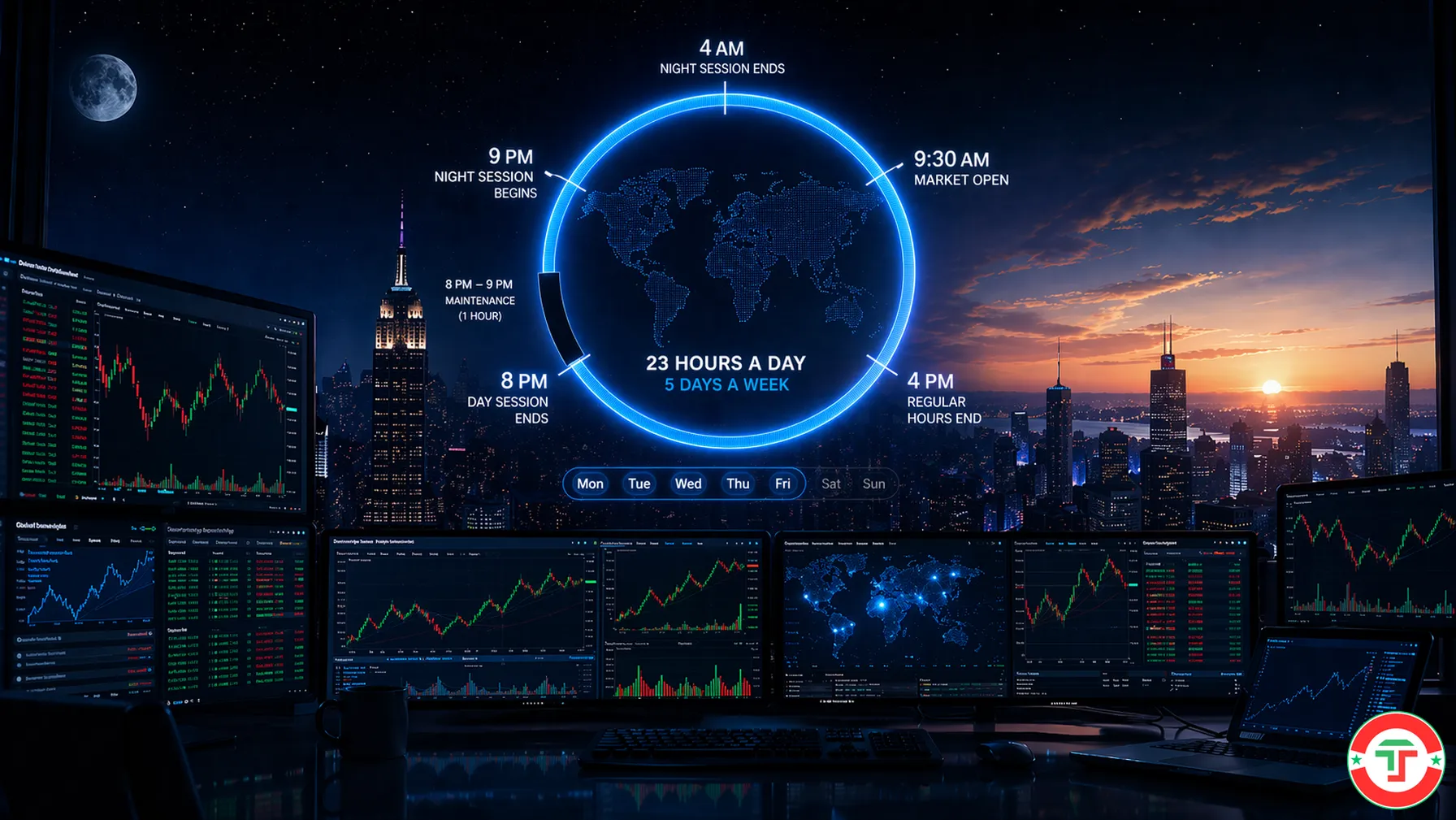
Your alarm goes off at 4 AM. You roll over, grab your phone, and check pre-market levels before your feet hit the floor. It’s been the routine for years—wake early, scan for gaps, plan your trades before the 9:30 bell.
That routine is about to change. Permanently.
In April 2026, the SEC approved Nasdaq’s proposal to trade stocks and ETFs 23 hours a day, five days a week. The NYSE already has approval for 22-hour trading on its Arca exchange. A brand new exchange called 24X has been greenlit for 23-hour sessions. And Cboe is pushing to extend equity options trading beyond regular hours for the first time ever.
The U.S. stock market—which has operated on roughly the same schedule since the 1980s—is about to become a near-round-the-clock operation. And for day traders, this isn’t just a scheduling curiosity. It fundamentally reshapes how we think about gaps, pre-market analysis, session-based strategies, and even what “day trading” means.
Our team has spent the past two weeks digging through SEC filings, exchange proposals, clearing infrastructure updates, and overnight volume data. This article is the result—a complete, trader-focused breakdown of everything happening, when it’s happening, and what you should actually do about it.
What’s Actually Happening: The Complete Regulatory Timeline
Multiple exchanges are moving toward extended hours simultaneously, and each is on a slightly different timeline. Here’s the full picture.
Nasdaq — 23 Hours a Day, 5 Days a Week
On April 10, 2026, the SEC granted accelerated approval for Nasdaq to extend trading from its current 16-hour window to 23 hours per day. The new structure splits trading into two sessions: a Day Session running from 4:00 AM to 8:00 PM ET (combining the existing pre-market, regular, and post-market into one continuous session), and a new Night Session from 9:00 PM to 4:00 AM ET. Between 8:00 PM and 9:00 PM, Nasdaq pauses for system maintenance, corporate action processing, and trade date advancement.
On April 23, Nasdaq announced it will roll out new data and market products to support the extended hours. The target launch date is December 6, 2026, pending final infrastructure readiness from the Securities Information Processors (SIPs) and DTCC clearing systems.
All outstanding orders on the Nasdaq book at 4:00 AM—when the Night Session ends and the Day Session begins—will be canceled. Traders will need to re-enter orders for the new session, similar to how the current pre-market works.
NYSE Arca — 22 Hours a Day, 5 Days a Week
NYSE Arca was actually the first established exchange to receive SEC approval for extended hours, back in February 2025. Under the approved plan, NYSE Arca will operate from 1:30 AM to 11:30 PM ET on Monday through Thursday, and 1:30 AM to 8:00 PM ET on Fridays. The exchange is targeting a launch in late 2026, pending the same SIP and DTCC dependencies as Nasdaq.
All U.S.-listed stocks, ETFs, and closed-end funds will be available for trading during the extended sessions. NYSE’s support desk will operate from 9:00 PM Sunday through Friday close.
24X National Exchange — 23 Hours a Day
A new exchange called 24X received SEC approval in 2024 to operate as a national securities exchange with 23-hour trading capability. Originally, 24X filed for full 24/7 operations, but amended its application to 23 hours per day, five days a week—the same framework Nasdaq adopted. 24X is expected to launch in stages, with overnight trading capabilities coming online in the second half of 2026.
Cboe — Extended Equity Options Hours (Pending)
Here’s one that most traders have missed entirely. On April 2, 2026, Cboe filed an amendment to its proposal for extended trading hours on multi-listed equity options. The SEC published the filing in the Federal Register on April 9 for public comment. If approved, Cboe would become the first options exchange to offer equity options trading outside regular hours—a massive development for options day traders who currently can only trade SPX and VIX index options during the overnight “Global Trading Hours” session.
The proposal takes a conservative approach: Cboe plans to start with a limited number of highly liquid equity option classes before expanding. The exchange acknowledges the disparity between options hours and the underlying equities—stocks already trade for 16+ hours, but options on those stocks are limited to the regular 9:30–4:00 window.
How We Got Here: From 6.5 Hours to 23
The trading day hasn’t always looked like this. Understanding the evolution helps put the current shift in context.
For decades, the U.S. stock market operated from 10:00 AM to 4:00 PM ET—just six hours. In 1985, the opening bell moved to 9:30 AM, adding 30 minutes. Pre-market and after-hours trading emerged gradually through ECNs (Electronic Communication Networks) in the late 1990s, eventually giving active traders access from 4:00 AM to 8:00 PM ET at most brokerages. But those extended sessions were always secondary—lower volume, wider spreads, and limited participation.
The real catalyst for overnight trading came from an unexpected direction: Asia.
In 2021, a fintech company called Blue Ocean Technologies launched the Blue Ocean ATS—an SEC-regulated alternative trading system that matched orders in U.S. stocks from 8:00 PM to 4:00 AM ET, precisely when Asian markets are open. The idea was simple: global investors—particularly retail traders in South Korea, Japan, and Hong Kong—wanted to trade U.S. stocks during their business hours, not at 2 AM local time.
The growth was explosive. Blue Ocean went from less than one million shares per night in 2022 to averaging 30–50 million shares per night by late 2024. On U.S. election night in November 2024, the platform processed $3.27 billion in notional overnight volume in a single session. By the end of 2025, Blue Ocean had handled $375 billion in cumulative notional value, averaging $1.2 billion per night across 307 sessions. Competitors emerged too—Moon ATS and Bruce ATS launched after Blue Ocean suffered a major outage in August 2024 that rattled South Korean brokers.
That volume got the attention of the major exchanges. When NYSE announced its 22-hour plan in October 2024, NYSE President Lynn Martin cited DTCC’s extended clearing hours as the enabling factor. The race was on.
Off-hours volume data tells the story clearly. By Q2 2025, extended-hours trading (all sessions combined) had reached record levels—over 2 billion shares and $62 billion traded daily outside regular hours, accounting for 11.5% of all U.S. equity activity. That’s more than double the 5% share that off-hours trading represented in early 2019.
The Infrastructure Behind the Scenes
You can’t trade stocks at 2 AM if there’s nobody to clear, settle, and report those trades. The extended hours push depends on three critical infrastructure pieces, and all three are actively being rebuilt.
DTCC and the National Securities Clearing Corporation (NSCC)
DTCC’s NSCC is the engine that clears and guarantees virtually all U.S. equity trades. Historically, NSCC’s systems operated during daytime hours. In April 2026, NSCC filed a proposed rule change (SR-NSCC-2026-006) with the SEC to formally describe how it will support extended trading hours—including extending its Universal Trade Capture (UTC) system to process overnight trades in near-real-time rather than batching them until morning.
NSCC’s extended clearing is targeted for production by mid-2026, with a comment period on the rule change ending May 7, 2026.
Here’s why this matters to you as a trader: when NSCC isn’t clearing, trades executed on exchanges carry undefined counterparty risk. This is why NYSE specifically chose 22 hours instead of 24—to ensure every exchange-matched trade clears through NSCC. Alternative trading systems like Blue Ocean have historically batched their overnight trades and submitted them to NSCC when it opened at 3:50 AM (later moved to 1:30 AM). The new infrastructure eliminates that gap.
Securities Information Processors (SIPs)
SIPs are the systems that consolidate and disseminate real-time quotes and trade data from all U.S. exchanges—the “consolidated tape” that feeds your Level 1 data. The SIP operating committees have proposed extending their hours from 8:00 PM ET Sunday through 8:00 PM ET Friday with a one-hour nightly maintenance pause. The SEC has up to 300 days to act on the amendment. A target launch of December 2026 has been set, pending approval.
Without SIP coverage, there’s no National Best Bid and Offer (NBBO) during overnight hours—which means no benchmark for best execution, no Limit Up-Limit Down (LULD) circuit breakers, and significantly degraded market data. This is the biggest remaining dependency. Both NYSE Arca and Nasdaq have committed to launching extended hours only when SIP data feeds are available.
FINRA Trade Reporting Facilities (TRFs)
FINRA has already filed to open Trade Reporting Facilities at 4:00 AM ET (previously 8:00 AM), and the TRFs will eventually align with SIP hours. This matters because TRFs are where off-exchange trades (including ATS trades) get reported to the consolidated tape.
The bottom line: the infrastructure is converging toward readiness by late 2026. The exchanges have approval. The clearing systems are expanding. The remaining bottleneck is SIP approval—and that’s expected by year-end.
What Overnight Trading Actually Looks Like Right Now
Before the exchanges launch their extended sessions, several brokerages already offer overnight trading through alternative trading systems. If you want to understand what 23-hour trading will feel like, look at what’s already happening between 8:00 PM and 4:00 AM.
The Current Overnight Landscape
Three ATSs currently operate during U.S. overnight hours: Blue Ocean ATS (the pioneer, still commanding roughly 83% of overnight session volume as of late 2025), Moon ATS (launched by OTC Markets Group), and Bruce ATS. These platforms match orders in U.S. NMS stocks during the 8:00 PM–4:00 AM window that exchanges currently don’t cover.
The session is overwhelmingly retail-driven. Blue Ocean’s CEO has stated that approximately 90% of volume comes from retail traders, with about 10 market makers providing two-sided quotes. According to Blue Ocean’s hourly breakdown from late 2025, 56% of overnight notional trades between 8:00 PM and midnight ET—aligning with Asian business hours. There’s a secondary volume peak around 3:00 AM ET, coinciding with several Asian markets’ closing hours.
Liquidity and Spread Reality
Here’s the honest assessment our team would give any trader asking about overnight sessions: liquidity is thin, and the data proves it.
The hour with the highest overnight volume—9:00 PM ET—averages about 2.94 million shares per day. Compare that to the last hour of regular extended hours trading, which averages 43.22 million shares, or the first hour of pre-market, which averages 113.30 million shares. The overnight session is roughly 1/15th as liquid as even the pre-market.
For the most actively traded names—NVDA, TSLA, SPY, QQQ—overnight notional across all of 2025 on the SIP consolidated tape was approximately $36.8 billion. That sounds big until you compare it to $3.48 trillion in after-hours (4–8 PM) and $1.07 trillion in pre-market (3 AM–9:30 AM) for those same tickers. The overnight session represents less than 1% of extended-hours notional and about 11 basis points of total all-session notional.
Wider spreads follow naturally from thinner liquidity. If you’re used to penny-wide spreads on large-caps during regular hours, expect that to widen significantly overnight—sometimes to nickel or dime spreads even on the most liquid names. On less liquid securities, you may not find a counterparty at all.
Risk Controls
Blue Ocean ATS uses a 20% price band based on the closing price near 7:30 PM ET—any order priced more than 20% away from that reference gets rejected. This is their version of circuit breakers, but it’s far looser than the LULD bands used during regular hours. When exchanges launch their overnight sessions, they’ll implement their own volatility controls, but these are still being finalized.
Which Brokers Support Extended Hours: A Day Trader’s Comparison
Not every brokerage is built the same for overnight trading. Here’s how the major players stack up as of April 2026.
Interactive Brokers offers the broadest overnight access among major brokerages—over 10,000 U.S. stocks and ETFs, plus U.S. equity index options during Cboe’s Global Trading Hours. IBKR routes through both its own IBEOS ATS and Blue Ocean ATS. Trading hours run nearly 24/6 (8:00 PM Sunday through 8:00 PM Friday with a 10-minute break at 3:50–4:00 AM). Clients need to request overnight trading permission, which is typically granted quickly. For active day traders who want the most complete overnight access, IBKR is currently the strongest option.
Robinhood launched its 24-hour market in mid-2023, routing overnight orders through Blue Ocean ATS. Over 900 stocks and ETFs are available. The platform only accepts limit orders during overnight hours—a sensible protection given spread conditions. Robinhood’s interface makes overnight trading feel seamless, but the available security list is significantly narrower than IBKR’s.
Charles Schwab entered overnight trading through its thinkorswim platform, initially with a pilot program of just 23 highly liquid ETFs and stocks. In February 2025, Schwab expanded 24-hour trading access to all clients. The selection is growing but remains more limited than IBKR or Robinhood.
Webull offers full extended hours from 4:00 AM to 8:00 PM ET and has announced support for the new regulatory framework. During the PDT rule elimination announcement, Webull was notably the fastest broker to confirm support for the new intraday margin rules. Overnight access through Blue Ocean ATS is available for select securities.
For day traders specifically, the critical question isn’t just “which broker offers overnight hours” but “which broker gives me the tools to trade effectively during those hours.” Scanners, real-time data, Level 2 access, and alert systems during overnight sessions are still limited compared to regular hours. Platforms like Trade Ideas with real-time scanning and Holly AI signals currently focus on regular market hours—but as extended sessions mature and volume grows, expect scanner and alert coverage to expand.
For a full breakdown of what to look for in a day trading brokerage, see our Choosing Your First Day Trading Broker checklist.
How Extended Hours Change Day Trading
This is the section most coverage of 23-hour trading completely skips—and it’s the part that actually matters to you. How does a 23-hour market change the mechanics of strategies you use every day?
The Death (and Rebirth) of the Gap
Gaps have been a staple of day trading strategy for decades. A stock closes at $100, news breaks overnight, and it opens at $108. That gap—created by eight hours of information accumulation during market closure—is the raw material for gap-and-go, gap-fill, and Opening Range Breakout strategies.
With 23-hour trading, the window for gaps narrows dramatically. Instead of an 8-hour closure (8 PM to 4 AM) where information accumulates, you’ll have a 1-hour maintenance pause (8 PM to 9 PM). Most news and earnings reactions will play out in real-time during the night session rather than building into a morning gap.
Does this kill gap trading? Not entirely. But it changes the game. Gaps will still exist—corporate actions processed during the maintenance window, pre-market reactions to overnight geopolitical developments, and the opening auction dynamics at 9:30 AM will still create dislocations. However, the magnitude of gaps should decrease over time as more price discovery happens overnight.
What gap traders should watch for: the transition period. As exchanges roll out their overnight sessions through late 2026 and into 2027, volume will build gradually. During this ramp-up period, overnight moves may be exaggerated by thin liquidity, potentially creating even more volatile gaps than we see today—followed by a gradual normalization as participation increases.
Pre-Market Analysis Gets Longer
If you currently wake up at 6 or 7 AM to prepare for the trading day, a 23-hour market might require adjustments. Price action from the overnight session will need to be incorporated into your pre-market analysis. Key levels established during the Night Session—overnight highs and lows, volume-weighted prices, areas of consolidation—will become part of your morning preparation.
Think of it like this: futures traders have always dealt with overnight sessions on the CME (E-mini S&P futures trade nearly 23 hours on CME Globex). Equity day traders are now entering that same world. The techniques futures traders use—identifying overnight range, noting whether the equity market opens inside or outside that range, watching for tests of overnight levels—will become increasingly relevant for stock traders. Our pre-market trading strategy playbook covers many of these concepts, and they’ll become even more critical as extended hours expand.
The “Session Within a Session” Dynamic
The regular trading session—9:30 AM to 4:00 PM—isn’t going away, and it will almost certainly remain the highest-volume, most liquid period for the foreseeable future. The opening auction, the VWAP anchoring at 9:30, the power hour into the close—these mechanics don’t change just because the market stays open longer.
What changes is the context around those hours. Day traders who focus exclusively on the 9:30–4:00 window will still have plenty of opportunity—probably the same quality of opportunity. But they’ll be operating with less information edge if they’re ignoring what happened during the Night Session.
The analogy here is time zones and the forex market. Forex trades 24/5, but specific sessions (London, New York, Tokyo) have distinct characteristics. The overlap between London and New York is the highest-volume period. Day traders who specialize in that overlap don’t need to trade all 24 hours—but the best forex traders are aware of what happened in the Asian session before they enter their positions.
Expect the equity market to develop similar session-based personality traits. The overnight session will likely be thinner, more spread-driven, and dominated by Asian-time-zone participants. The pre-market (4–9:30 AM) will continue to be the catalyst-reaction zone. Regular hours will remain the primary arena. And the post-market/early evening will capture earnings reactions and late-day institutional flow.
Impact on the Opening Range Breakout (ORB)
The Opening Range Breakout—one of the most popular day trading setups—depends on the first 15 or 30 minutes of the regular session to establish a range. The logic is straightforward: the open consolidates overnight information into a range, and a breakout from that range signals directional conviction. We walk through this setup in detail in our market open trading playbook.
In a 23-hour market, the opening range may carry slightly less significance if the overnight session has already priced in the major catalysts. However, the 9:30 AM open will still bring a wave of retail participation, institutional order flow, and auction dynamics that create genuine range formation. The ORB isn’t dead—but the range itself may shift, and the magnitude of ORB breakouts could narrow as pre-open price discovery improves.
The Real Risks Every Trader Must Understand
Extended hours aren’t all upside. Our team sees several risks that aren’t getting enough attention in the conversation around 23-hour markets.
Liquidity Risk Is the Big One
We’ve covered the numbers: overnight volume is currently 1/15th of even pre-market levels. When Nasdaq and NYSE Arca launch their Night Sessions, volume will increase—but it won’t match regular hours anytime soon. Lower liquidity means wider spreads, more slippage on market orders, and the possibility that you simply can’t exit a position at a reasonable price.
For day traders who rely on tight execution and quick entries/exits, the overnight session is a fundamentally different environment. A strategy that works beautifully during the first 30 minutes of the regular session—when millions of shares are trading per minute in large-cap names—can get destroyed in a session where the same stock trades a few thousand shares per hour.
No Established Circuit Breakers (Yet)
During regular hours, the Limit Up-Limit Down (LULD) mechanism pauses trading when a stock’s price moves too far, too fast. This prevents flash crashes and gives the market time to stabilize. During overnight sessions, these exchange-level circuit breakers haven’t been fully defined yet. Blue Ocean uses a 20% price band, and exchanges are developing their own overnight volatility controls—but they’ll likely be wider than regular-hours bands.
Until these mechanisms are tested under stress, overnight trading carries a heightened tail risk. A major geopolitical event at 11 PM could cause violent moves without the safety net you’re used to.
Corporate Action Gaps
Here’s something that gets almost zero attention: corporate actions—dividends, stock splits, mergers, rights offerings—are currently processed overnight between 8 PM and 4 AM. The NYSE alone processed tens of thousands of corporate actions in 2024. These adjustments affect trading prices, and exchanges currently use the closed-market window to apply them.
In a 23-hour market, corporate actions get processed during the 1-hour maintenance pause (8–9 PM). Both NYSE and Nasdaq have built mechanisms to halt specific securities during the Night Session when pending corporate actions would affect their price. But this creates a quirky situation: a stock might be available for overnight trading most nights but suddenly halted for a session due to a dividend ex-date or stock split. Traders need to be aware of which securities are subject to overnight halts on any given night.
The Fatigue Factor
This one sounds soft, but it’s real. Trading is mentally exhausting—and that’s in a 6.5-hour regular session. A 23-hour market creates the temptation to trade more, monitor longer, and rest less. We’ve written extensively about the psychology of trading and the dangers of overtrading. Extended hours amplify every one of those dangers.
The traders who will thrive in a 23-hour market aren’t the ones who try to trade all 23 hours. They’re the ones who define their session, stick to their plan, and treat the overnight data as preparation—not as an invitation to trade more.
Should Day Traders Actually Trade the Overnight Session?
The honest answer: probably not for most traders, and definitely not yet.
There are specific scenarios where overnight access creates genuine value. If you’re already awake during Asian hours (you’re based outside the U.S., or you work a night shift), the overnight session gives you legitimate access to U.S. equities during your available hours. If a major news event breaks overnight—a surprise earnings release, a geopolitical shock, a Fed emergency action—the ability to react immediately rather than waiting until 4 AM pre-market is valuable. And if you’re a swing trader who wants to manage an existing position based on overnight developments, having the ability to exit during the Night Session can be a genuine risk management tool.
But for most U.S.-based day traders running intraday strategies during regular hours, the overnight session is not where your edge lives. The volume isn’t there. The spreads aren’t tight enough. The price discovery is too thin for most momentum and breakout strategies to work reliably.
Our team’s recommendation is straightforward: use the overnight session for awareness, not for active trading. Check what happened overnight the same way you’d check futures overnight. Note the key levels. Understand the context. Then execute during the sessions where your strategy has a statistical edge—which, for most day traders, remains the regular trading hours.
This calculus will evolve as volume grows. If overnight equity sessions eventually reach 5–10% of regular-session volume (which some industry projections suggest is plausible within a few years), certain strategies—particularly those around overnight catalyst reactions and Asian-market-correlated moves—could become viable. But we’re not there yet, and jumping in prematurely is a fast way to bleed capital on execution costs.
Extended Hours + PDT Elimination: The Combined Impact
Two of the most significant market structure changes in decades are happening within weeks of each other. The PDT rule officially ceases to exist on June 4, 2026 (for details, see our comprehensive PDT elimination guide), and extended exchange hours begin rolling out in the second half of 2026.
Together, these changes lower both the capital barrier and the time barrier to active trading. A trader with a $3,000 margin account will soon be able to execute unlimited day trades across a near-24-hour trading window. That’s a world that simply didn’t exist six months ago.
The optimistic view: more access means more participation, more liquidity, and more efficient price discovery. Schwab’s record Q1 2026 results—9.9 million daily average trades, up 34% year-over-year, with 1.3 million new brokerage accounts opened—suggest retail engagement is already surging before either change fully takes effect.
The cautionary view—and the one our team leans toward: lower barriers don’t make trading easier. They make it more accessible, which is not the same thing. A $3,000 account with 24-hour access and no PDT restrictions is still a $3,000 account. The market will still be competitive, spreads will still eat into small-account returns, and the statistical reality that most day traders lose money doesn’t change because the market stays open longer.
The traders who benefit most from both changes will be those who combine the freedom with discipline. More hours to trade means more hours to make mistakes—unless you approach the expanded market with a clear plan, defined session focus, and ironclad risk management. Our risk management fundamentals and the complete Day Trading Toolkit are the right starting points for building that framework.
What’s Coming Next: The 2026-2027 Roadmap
Here are the key dates and milestones every day trader should have on their calendar:
April 28-29, 2026 — FOMC meeting. The next Fed rate decision lands right in the middle of the extended hours rollout discussions. The current rate sits at 3.50-3.75%.
May 7, 2026 — Comment period closes for NSCC’s extended clearing hours proposal (SR-NSCC-2026-006). If approved without modification, this clears one of the final infrastructure hurdles.
June 4, 2026 — PDT rule officially eliminated. The first of the two major structural changes takes effect.
June 2026 (target) — DTCC UTC production cut for extended trade capture (Tag 715). This is the clearing infrastructure going live for overnight exchange trading.
Late 2026 (target) — NYSE Arca aims to launch 22-hour trading on its exchange, subject to SIP readiness.
December 6, 2026 (target) — Nasdaq’s target launch date for 23-hour trading, pending regulatory confirmation and SIP data feed availability.
December 2026 (target) — SIP extended operating hours targeted for launch, pending SEC approval of the plan amendment.
Through October 20, 2027 — Broker-dealers have an 18-month window from FINRA’s April 20, 2026 Regulatory Notice to fully implement both the new PDT/intraday margin framework and any extended-hours trading support.
The transition won’t happen overnight (pun intended). Expect a staggered rollout where some exchanges launch their extended sessions while others are still preparing, some brokers offer overnight access while others wait, and infrastructure components come online in stages. The full picture—every major exchange running 22-23 hours with complete SIP coverage, NSCC clearing, and broad broker support—is more of a 2027 reality than a 2026 one.
But the direction is clear and irreversible. The U.S. stock market is becoming a near-round-the-clock operation. The question isn’t if—it’s how quickly the volume and infrastructure mature to make overnight trading a genuinely viable arena for active day traders.
Frequently Asked Questions
When does 23-hour stock market trading officially start?
Quick Answer: Nasdaq is targeting December 6, 2026 for its 23-hour launch. NYSE Arca is targeting late 2026 for its 22-hour launch. Both depend on SIP and DTCC infrastructure readiness.
The SEC has already approved both proposals—Nasdaq on April 10, 2026 and NYSE Arca in February 2025. The approvals are conditional on supporting infrastructure being in place, particularly the Securities Information Processors extending their data feed hours and DTCC/NSCC providing clearing coverage during overnight sessions. DTCC is targeting mid-2026 for extended clearing production, and the SIPs are targeting December 2026 for extended hours. If everything aligns on schedule, active overnight exchange trading could begin as early as December 2026, with full maturity through 2027.
Key Takeaway: Regulatory approval is done. Infrastructure readiness is the remaining bottleneck, with a late 2026 to early 2027 timeline for launch.
Can I day trade stocks at 2 AM?
Quick Answer: Technically yes—several brokers already offer overnight trading through alternative trading systems. But liquidity is extremely thin, spreads are wide, and most day trading strategies don’t work well in these conditions.
Interactive Brokers, Robinhood, and Charles Schwab all offer overnight trading through connections to Blue Ocean ATS and other off-exchange platforms. You can buy and sell stocks during the 8:00 PM to 4:00 AM window right now. However, overnight volume averages roughly 2-3 million shares per hour during peak times—a fraction of the hundreds of millions of shares per hour during regular trading hours. This thin liquidity creates meaningfully wider bid-ask spreads and makes execution unreliable for strategies that depend on tight fills and fast exits.
Key Takeaway: You can trade at 2 AM today, and access will improve when exchanges launch their Night Sessions. But for most day traders, the regular session remains where the edge lives.
Which brokers offer overnight stock trading in 2026?
Quick Answer: Interactive Brokers (10,000+ securities), Robinhood (900+), Charles Schwab (expanding list via thinkorswim), and Webull all offer some form of overnight access.
Interactive Brokers has the broadest overnight access, offering over 10,000 U.S. stocks and ETFs through its own IBEOS ATS and Blue Ocean ATS connections. Trading runs nearly 24 hours from Sunday evening through Friday. Robinhood routes overnight orders through Blue Ocean ATS for approximately 900 securities. Schwab offers overnight access through thinkorswim with a growing but still limited list of securities. All platforms require limit orders during overnight hours—market orders are not accepted due to the liquidity conditions. For a deeper comparison of broker features, see our Day Trading Broker Checklist.
Key Takeaway: IBKR offers the broadest overnight access today. Expect all major brokers to expand their offerings as exchange-based overnight sessions launch.
Are spreads really wider during overnight and extended hours?
Quick Answer: Yes, significantly. Overnight spreads can be 5-10x wider than regular-hours spreads, even on highly liquid large-cap stocks.
During regular trading hours, a stock like AAPL might trade with a $0.01 bid-ask spread. During pre-market (4–9:30 AM), that spread might widen to $0.02-0.05. During overnight hours (8 PM–4 AM), spreads routinely reach $0.05-0.15 on large-caps and can exceed $0.25 on less liquid names. This directly impacts your trading costs—a $0.10 spread on a 1,000-share trade costs you $100 in immediate slippage versus $10 during regular hours. With only about 10 market makers providing two-sided quotes during overnight sessions, the order book is simply thinner and less competitive.
Key Takeaway: Wider spreads during extended hours are a real cost. Factor them into any decision to trade outside regular hours, especially for strategies that depend on tight execution.
Do circuit breakers work during overnight trading?
Quick Answer: Not the same way. The standard Limit Up-Limit Down (LULD) mechanism that pauses trading during regular hours is not yet fully defined for overnight exchange sessions.
Blue Ocean ATS currently uses a 20% price band based on the previous session’s closing price—much wider than the 5-10% LULD bands that trigger during regular hours. Nasdaq and NYSE Arca are developing their own overnight volatility controls, but the specific mechanisms haven’t been finalized. Nasdaq’s proposal includes additional customer risk disclosures specifically addressing the potential for heightened volatility during the Night Session. Until these controls are stress-tested under real market conditions, overnight trading carries a meaningful tail risk that doesn’t exist during regular hours.
Key Takeaway: Overnight circuit breakers are weaker than regular-hours protections. This is a genuine risk factor that every trader should understand before participating in overnight sessions.
Will options trade during extended hours?
Quick Answer: Cboe has proposed extended hours for multi-listed equity options, but it’s still pending SEC approval. Index options (SPX, VIX) already trade during some extended hours via Cboe’s Global Trading Hours session.
This is a major pending development. Currently, equity options (options on individual stocks and ETFs) only trade during regular hours (9:30 AM to 4:00 PM). Cboe’s April 2026 proposal would expand trading hours for a select group of highly liquid equity option classes to include Global Trading Hours and a new “Curb” session. If approved, this would be the first time traders could trade equity options outside regular hours on a national exchange—a significant shift for options day traders. The SEC published the proposal for comment in April 2026, but no approval timeline has been announced.
Key Takeaway: Equity options extended hours are coming but aren’t here yet. Monitor the Cboe filing for updates—this could meaningfully change options day trading when approved.
How does overnight trading affect gap strategies?
Quick Answer: Gaps should narrow over time as more price discovery happens during overnight sessions, but they won’t disappear entirely.
Gaps exist because information accumulates during market closure. With a 23-hour market, the closure window shrinks from 8 hours to just 1 hour (the maintenance pause). Most news—earnings reactions, geopolitical developments, economic data from overseas—will get priced in during the Night Session rather than building into a morning gap. However, gaps will still form from corporate actions processed during the maintenance window, the opening auction dynamics at 9:30 AM, and any events during the 1-hour pause. During the transition period (2026-2027), overnight gaps could actually be more volatile than normal as thin liquidity amplifies price swings.
Key Takeaway: Gap traders should prepare for gradually narrower gaps as extended hours mature. The transition period may actually create more volatile gap behavior before gaps eventually compress. For current gap trading techniques, see our market open playbook.
Is overnight trading risky for beginners?
Quick Answer: Yes—more risky than regular-hours trading. Beginners should focus on the regular session (9:30 AM–4:00 PM) and treat overnight data as context for their morning preparation.
Overnight sessions combine every risk factor that challenges inexperienced traders: wider spreads increase execution costs, lower volume makes price action less reliable for technical analysis, fewer circuit breakers mean less protection from flash moves, and the psychological temptation to trade more hours leads to overtrading and fatigue. The overnight session is also dominated by a different participant mix—primarily Asian retail traders and a small number of market makers—which creates price dynamics that may not match patterns you’ve studied during regular hours.
Key Takeaway: If you’re still building consistency during regular trading hours, adding overnight sessions will likely hurt more than help. Master one session before attempting to trade another.
What happens to corporate actions during 23-hour trading?
Quick Answer: Corporate actions (dividends, splits, mergers) are processed during the 1-hour maintenance pause between 8:00 PM and 9:00 PM ET. Securities with pending corporate actions may be halted during the Night Session.
Both Nasdaq and NYSE Arca have built mechanisms to handle the tens of thousands of corporate actions that U.S. exchanges process annually. During the maintenance window, exchanges apply adjusted closing prices, process ex-dividend dates, stock splits, and other corporate events. If a pending corporate action for a specific security hasn’t been processed before the Night Session opens at 9:00 PM, that security gets halted until the adjustment is applied. Traders participating in overnight sessions need to be aware of upcoming corporate action dates for any securities they’re trading or holding overnight.
Key Takeaway: Corporate actions create one of the more complex operational challenges for 23-hour trading. Check corporate action calendars before entering overnight positions.
How does T+1 settlement work with overnight trading?
Quick Answer: Trades executed between 8:00 PM and midnight carry a trade date of the following business day. Settlement follows standard T+1 from that trade date.
This is one of the trickiest operational details. When you trade at 10:00 PM on a Tuesday, that trade carries a Wednesday trade date—meaning it settles Thursday. The trade date rollover happens at midnight, not at the start of the Night Session. Exchanges process this through their clearing systems, and DTCC’s NSCC will handle the settlement mechanics. For day traders, the key consideration is buying power calculation: trades made late at night may affect your available margin differently than you expect because of the trade date assignment. The PDT rule elimination and the new intraday margin framework at your broker will interact with these overnight settlement mechanics in ways that are still being defined by individual broker-dealers.
Key Takeaway: Understand how your broker assigns trade dates for overnight trades and how this affects your margin and buying power calculations.
Disclaimer
The information provided in this article is for educational purposes only and should not be considered financial advice. Day trading involves substantial risk and is not suitable for every investor. Past performance is not indicative of future results. Extended-hours trading involves additional risks including lower liquidity, wider spreads, and potentially greater volatility compared to regular trading hours.
For our complete disclaimer, please visit: https://daytradingtoolkit.com/disclaimer/
Article Sources
This article draws on primary regulatory filings, exchange announcements, and industry research to provide accurate, up-to-date information about extended trading hours developments.
- SEC Order Approving Nasdaq 23-Hour Trading Proposal — Federal Register, Release No. 34-105199, April 15, 2026.
- NYSE Arca Extended Hours Trading — Official NYSE page covering SEC approval, implementation timeline, and operational details for 22-hour trading.
- NSCC Proposed Rule Change for Extended Clearing Hours — Federal Register, SR-NSCC-2026-006, April 16, 2026.
- SEC Approves Nasdaq Proposal to Expand Trading Hours — Arnold & Porter advisory, April 10, 2026.
- Cboe Extended Trading of Multi-Listed Equity Options Filing — Federal Register, April 9, 2026.
- Nasdaq to Launch New Products Ahead of Extended Trading Hours Plan — Reuters via Options Trading Report, April 23, 2026.
- NYSE: Expanding Market Hours — Key Considerations — ICE/NYSE Insights, February 2025. Detailed rationale for 22-hour (not 24-hour) approach and clearing dependencies.
- Blue Ocean: Overnight Trading Could Reach 10% of Total Volumes — Global Trading, January 2026. Comprehensive data on overnight ATS volume, participant mix, and growth trajectory.
