

Here’s a question that should make every trader uncomfortable: if most day traders lose money without AI, what makes you think adding AI will change the outcome?
We’re not asking to be cynical. Our team uses AI tools every single day. But after years of testing ChatGPT for trade research, running Holly AI signals, and watching hundreds of traders in our community adopt these tools—we’ve noticed a pattern that nobody wants to talk about.
The traders who were already disciplined? AI made them faster, sharper, more efficient. The traders who were already struggling with impulsive decisions, blown stop-losses, and revenge trading? AI made all of that worse. Faster. More confidently wrong.
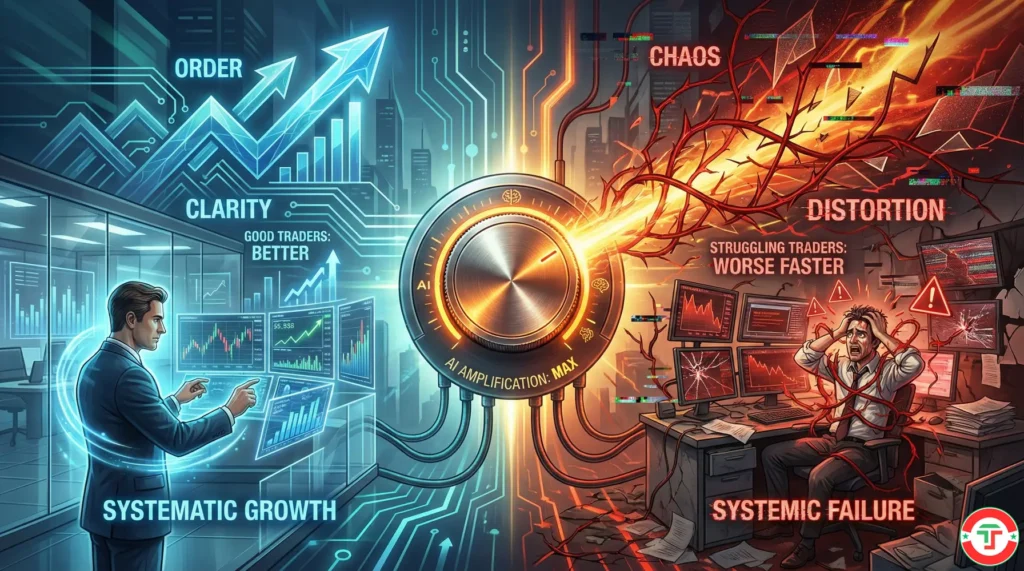
AI doesn’t create edge. It amplifies whatever you already have.
And the research backs this up in a way that should give every trader pause. A landmark 2026 study from Aalto University found that when people use AI, they consistently overestimate their own performance—and the most AI-literate users were actually the worst at judging their results accurately. Think about what that means for a trader risking real money.
This article isn’t about bashing AI. It’s about AI trading psychology—understanding the prerequisite skills you need before AI tools become a genuine advantage instead of an expensive way to lose money faster.
The Amplification Effect: Why AI Makes Bad Habits Worse
There’s a concept we keep coming back to when explaining AI’s impact on trading: the amplifier effect.
Think of AI like a megaphone. Hand it to a skilled public speaker, and their message reaches a wider audience with more impact. Hand it to someone who doesn’t know what they’re talking about, and they just broadcast nonsense—louder.
Trading works the same way. AI tools accelerate everything you do. If you have a well-defined trading plan, solid risk management, and emotional discipline, AI will help you execute that plan more consistently. It’ll find setups faster. Parse earnings reports in seconds. Flag patterns across hundreds of tickers that your eyes would miss.
But if you don’t have those foundations? AI becomes a turbocharged mistake machine.
Here’s what we’ve seen happen repeatedly. A trader without a clear strategy starts using ChatGPT to “generate trade ideas.” The AI produces something that sounds incredibly sophisticated—complete with entry levels, stop-losses, and profit targets. The trader follows it without the experience to evaluate whether the setup makes sense in the current market context. The trade fails. The trader asks ChatGPT again. And again. Each time, the AI delivers another confident-sounding answer built on the same fundamental problem: the trader has outsourced their thinking to a machine that doesn’t actually know their risk tolerance, account size, or psychological weaknesses.
This isn’t a failure of AI. It’s a failure of foundation.
The traders who thrive with AI tools share something in common—they were already competent before they added AI to their workflow. The AI didn’t teach them to trade. It made their existing skills more efficient. There’s a critical difference, and it’s one the marketing behind most AI trading tools conveniently ignores.
A 2024 study published in the Journal of Financial Economics by Cao, Jiang, Wang, and Yang made this explicit. Their research found that a “Man + Machine” approach—where human analysts used AI as a supplement, not a replacement—outperformed both humans alone and AI alone. The hybrid model outperformed 57.8% of human-only forecasts and beat the AI-only model in most years. The key ingredient wasn’t the AI. It was the human expertise that gave the AI’s output context and judgment.
Without that human foundation, the AI is just a faster way to be wrong.

The Overconfidence Trap: What the Research Actually Shows
If the amplification effect is the theory, the overconfidence trap is the hard data behind it.
In early 2026, researchers from Aalto University in Finland published a study in Computers in Human Behavior that should be required reading for every trader using AI tools. The study, led by Fernandes, Villa, Nicholls, and Welsch, examined what happens to people’s ability to judge their own performance when they use large language models like ChatGPT.
The findings were startling. Participants who used AI to complete logical reasoning tasks saw their actual performance improve—but they overestimated their scores by an average of four points. Their confidence went up even more than their competence did. The gap between what they thought they accomplished and what they actually accomplished widened.
But here’s the part that hit us hardest: the classic Dunning-Kruger effect—where low performers overestimate and high performers underestimate—completely vanished when AI was involved. Overconfidence became universal. Everyone, regardless of skill level, thought they were doing better than they actually were.

And in a twist that defies intuition, the participants with the highest AI literacy—the ones who knew the most about how these tools work—showed the lowest accuracy in self-assessment. Being “good with AI” didn’t protect against overconfidence. It made it worse.
Professor Robin Welsch, the study’s senior author, put it plainly: when it comes to AI, higher literacy brings more overconfidence, not less.
Now translate that into trading. A trader uses ChatGPT to analyze a setup, gets a polished, articulate response confirming their thesis, and walks away feeling more confident about a trade that might be fundamentally flawed. The AI didn’t challenge their assumptions—it reinforced them. And because the response sounded authoritative, the trader didn’t feel the need to do the deeper analysis they would have done without AI.
This is what psychologists call “cognitive offloading”—the tendency to let AI do the thinking and accept the result without critical evaluation. The Aalto researchers found that most participants simply copied their question into the AI, accepted the first answer, and moved on. No verification. No second-guessing. No metacognition.
For a trader, that’s dangerous. Markets punish overconfidence ruthlessly. And AI tools—with their articulate, confident-sounding outputs—are uniquely designed to feed that overconfidence, whether the underlying analysis is sound or not.
This doesn’t mean you should avoid AI. It means you need to build the internal skills to evaluate what AI tells you. And that’s a very different thing from just learning how to write a good prompt.
The 5 Foundation Skills AI Can’t Build for You
So what does that foundation actually look like? Based on our team’s experience—and the research we’ve cited—here are the five non-negotiable skills you need before AI tools start helping more than they hurt.

Skill #1: A Written, Tested Trading Plan
This one seems obvious. It’s also the one most traders skip.
Your trading plan is the lens through which every AI output gets filtered. Without it, you have no framework for evaluating whether an AI-generated trade idea is actually relevant to your style, your risk parameters, or your market conditions. You’re essentially asking a machine to make decisions you haven’t defined the criteria for.
A written plan doesn’t need to be complicated. It needs to answer: What setups do you trade? What timeframe? What’s your maximum risk per trade? What are your entry and exit rules? When do you stop trading for the day?
AI can help you refine a plan that already exists. It can stress-test your rules, identify edge cases, suggest modifications based on historical patterns. But it cannot create a plan that reflects your personal risk tolerance, your psychological tendencies, and your life circumstances. That requires self-knowledge that no algorithm possesses.
If you don’t have a trading plan yet, our guide to building your first trading plan walks through the entire process step by step.
Skill #2: Functional Risk Management
Of the traders we’ve watched blow up their accounts, we can’t recall a single one whose primary problem was “not enough AI tools.” The problem was always risk management. Too much size. No stop-loss. Adding to losers. Ignoring daily loss limits.
AI can calculate optimal position sizes. It can suggest stop-loss levels based on ATR or support zones. But here’s what it cannot do: it cannot force you to follow the plan when you’re down $500 and your finger is hovering over the “add to position” button.
Risk management isn’t just a calculation—it’s a behavior. And behavioral change doesn’t come from a chatbot. It comes from experience, journaling, and hard-won discipline. The calculation is the easy part. The execution is where traders fail.
You need to internalize the fundamentals: the 1-2% rule, proper position sizing, max daily loss limits, and the emotional control to honor your stops. For a deep dive into these mechanics, see our introduction to risk management in day trading. But the mechanics are only half the story—the psychological side of risk management is where most traders collapse, which we cover in advanced risk management techniques.
Skill #3: Trading Discipline Under Pressure
Discipline is the bridge between knowing what to do and actually doing it when money is on the line.
AI doesn’t experience fear. It doesn’t feel the sting of a losing streak. It doesn’t get greedy when a position is running. That’s often presented as AI’s advantage—it’s emotionless. But that’s also its limitation. You’re still the one executing the trade. You’re still the one deciding whether to follow the AI’s suggestion or override it because “this time feels different.”
The traders who benefit most from AI are the ones who have already built the muscle of discipline through repetition—who have sat through losing streaks without revenge trading, who have taken profits at their predetermined target instead of hoping for more, who have shut down their platform when they hit their daily loss limit.
These aren’t skills you can download. They’re forged through experience, and there are no shortcuts.
We’ve devoted an entire article to mastering trading discipline because we believe it’s the single biggest differentiator between profitable and unprofitable traders—with or without AI.
Skill #4: The Habit of Journaling and Self-Review
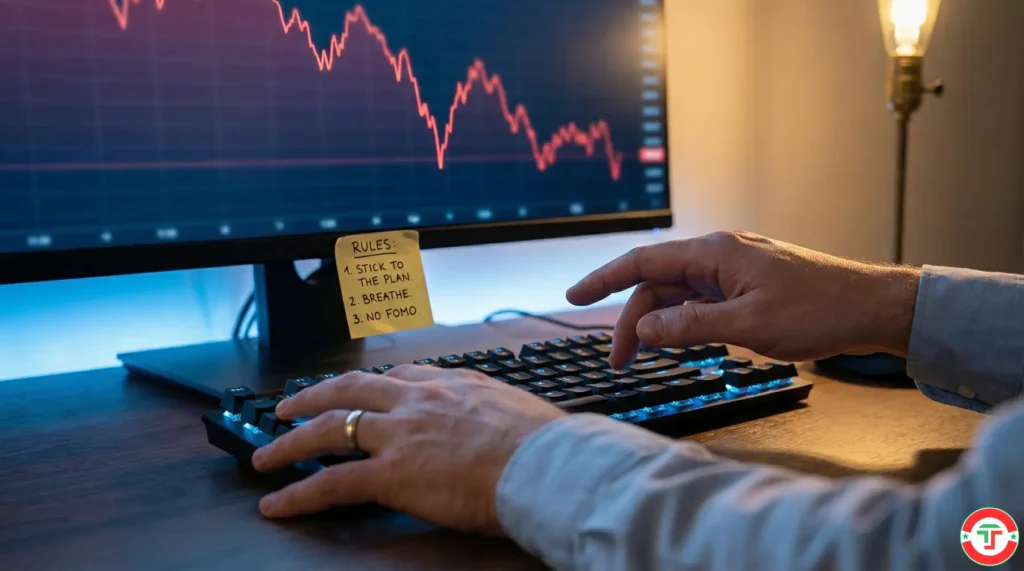
The Aalto University study identified a core problem: AI users lose the ability to accurately assess their own performance. The antidote to that? A systematic journaling practice.
A trading journal forces you to confront reality. Not the AI-polished version of reality. The raw, uncomfortable truth about what you did, why you did it, and what happened. Did you follow your plan? Did your emotions override your rules? Were you trading your setup, or were you trading because you were bored?
AI can actually be incredibly useful for analyzing journal data once you have it—spotting patterns in your behavior, identifying your most profitable setups, flagging emotional triggers. But the habit of journaling—the daily practice of honest self-reflection—must exist first. Without data, there’s nothing for AI to analyze. And without honesty in that data, the analysis is garbage in, garbage out.
Our trading journal psychology guide digs into how to structure your journal for maximum insight. And if you’re looking for tools that streamline the process, platforms like TraderSync integrate well with AI-assisted analysis workflows.
Skill #5: Emotional Regulation (Not Elimination)
The goal isn’t to become emotionless—that’s what bots are for. The goal is to recognize your emotions, understand how they influence your decisions, and manage them effectively enough that they don’t override your plan.
Fear and greed are part of trading. They always will be. The question is whether you’ve developed the self-awareness to recognize when fear is making you exit early, when greed is making you hold too long, or when frustration is pushing you toward a revenge trade.
AI can’t do this internal work for you. A chatbot can tell you the textbook-correct position size. It cannot tell you that you’re angry about your last loss and that anger is about to make you triple your size on the next trade.
This kind of emotional intelligence develops through practice—mindfulness, journaling, and sometimes just stepping away from the screen. We explore the mechanics of this in our guide to managing fear and greed in trading.
When AI Actually Starts Helping (The Tipping Point)
So when does the switch flip? When does AI go from a crutch to a genuine competitive advantage?
It happens when you can honestly say: “I already know what I’m looking for—I just want help finding it faster.”
That’s the tipping point. When you have a defined strategy, proven through backtesting and live trading. When your risk management is automatic—not something you have to think about, but something you do instinctively. When you journal consistently and review your trades weekly. When you’ve survived a significant losing streak without blowing up your account.

At that point, AI tools become transformational. Not because they replace your judgment, but because they extend your capabilities in specific, measurable ways:
Research speed. A ChatGPT or Claude session can parse an earnings report in 60 seconds that would take you 30 minutes to digest manually. Not to decide the trade for you—but to give you the relevant data points faster so you can make a better-informed decision. Our ChatGPT day trading guide covers the practical workflows.
Pattern recognition at scale. Tools like Trade Ideas’ Holly AI scan thousands of stocks every night using machine learning to identify setups that match specific criteria—60%+ historical win rate, 2:1 risk-reward minimum. That’s not a shortcut. It’s a time multiplier for a trader who already knows how to evaluate and filter those signals. We break down exactly how that system works in our Holly AI deep-dive.
Journal analysis. Once you have 50+ trades logged with detailed notes—entries, exits, emotional state, market conditions—feeding that data into an LLM reveals behavioral patterns you’d never see on your own. Our guide to using AI to analyze your trading journal walks through this process.
Bias detection. AI is exceptionally good at spotting patterns in your behavior that cognitive biases make invisible. Confirmation bias, recency bias, loss aversion—they’re hard to catch in yourself but obvious in your data. AI doesn’t have the same blind spots you do.
Notice the pattern? In every case, AI is enhancing a process that already exists. It’s not creating something from nothing. It’s accelerating something that’s already working.
Building the Human-AI Partnership That Works
The research is clear: the optimal approach isn’t “human only” or “AI only.” It’s the collaboration. But building that collaboration requires intentionality—not just downloading an app and expecting miracles.
Here’s the framework our team uses:
Start with your edge, not the tool. Ask yourself: What is my specific advantage as a trader? Speed? Pattern recognition? Emotional control during volatility? Sector expertise? Then ask: Where in my current workflow am I slowest, most error-prone, or most inconsistent? That’s where AI should enter—not everywhere at once, but at your specific bottleneck.
Verify before you trust. Remember the Aalto study—everyone overestimates their performance with AI. Build a verification habit. When ChatGPT suggests a trade thesis, check it against your own analysis. When an AI scanner flags a setup, confirm it meets your plan’s criteria before you act. The value of AI drops to zero if you stop thinking critically about its output.
Keep score honestly. Track your performance before and after adding AI to your workflow. Not anecdotally—quantitatively. What’s your win rate with AI-assisted trades vs. your baseline? What about risk-adjusted returns? If the numbers don’t improve after 30-50 trades, the tool isn’t adding value to your specific process. It might be a great tool—just not for your current skill level.
Know when to ignore it. This might be the most important discipline of all. There will be times when the AI’s analysis contradicts your gut, your experience, and what you’re seeing on the chart. Sometimes the AI is right. Sometimes it’s hallucinating, or working from outdated data, or missing context that only a human watching the tape in real time would catch. Developing the judgment to know which scenario you’re in—that’s not an AI skill. That’s a trading skill.
Treat AI as a teammate, not an oracle. The best analogy our team has found: think of AI the way a pilot thinks of autopilot. Autopilot handles the routine—altitude, heading, speed. The pilot handles the judgment calls—when to deviate from the flight plan, when conditions require a manual approach, when something feels wrong that the instruments don’t show. A pilot who relies entirely on autopilot is dangerous. A pilot who refuses to use it is inefficient. The partnership between the two is what keeps everyone safe.

We expand on this co-pilot philosophy in our AI day trading complete guide, which covers the full framework for integrating AI into a retail trading workflow.
A Quick Reality Check on AI Adoption
The numbers tell an interesting story. According to eToro’s Q3 2025 Retail Investor Beat—a survey of 11,000 retail investors across 13 countries—19% of investors now use AI tools to pick or alter investments, up 46% from the prior year. In the U.S. specifically, 30% of retail investors reported using AI tools, a 75% year-over-year surge.
AI adoption is accelerating. That’s not a debate.
But here’s what those numbers don’t tell you: how many of those adopters are actually improving their returns. Adoption isn’t the same as profitability. According to FINRA data, 72% of day traders still ended the year with financial losses. A Brazilian study tracking day traders over 300+ trading days found that 97% lost money. Less than 1% of traders on the Taiwan Stock Exchange were consistently profitable over a 15-year study period.
These failure rates haven’t meaningfully changed since AI tools became widely available. That’s not because AI is useless—it’s because the root causes of trader failure are psychological and behavioral, not informational. Traders don’t lose because they lack data. They lose because they can’t manage risk, can’t maintain discipline, and can’t control their emotions.
AI doesn’t fix those problems. In some cases—as the overconfidence research suggests—it might make them worse.
The CFTC said it plainly in their customer advisory: “AI technology can’t predict the future or sudden market changes.” And yet, traders keep treating AI outputs as if they’re prophecy. The gap between what AI can do and what traders expect it to do is where most of the damage happens.

Frequently Asked Questions
Will AI eventually replace the need for trading skills?
Quick Answer: No—and the research increasingly suggests the opposite. AI performs best when paired with human expertise, not when substituting for it.
The Cao et al. study in the Journal of Financial Economics found the “Man + Machine” model outperformed both standalone AI and standalone human analysis. AI processes data faster, but traders provide context, judgment, and the ability to adapt to unprecedented market conditions—qualities that AI still fundamentally lacks. Markets are driven by human psychology, and understanding that psychology requires human experience.
Key Takeaway: AI will likely make trading skills more valuable, not less—because the traders who combine AI with genuine expertise will have the biggest advantage.
I’m a complete beginner—should I avoid AI tools entirely?
Quick Answer: Not entirely, but start with AI as a learning tool, not a trading tool.
ChatGPT and Claude are fantastic for explaining trading concepts, defining terminology, and helping you understand chart patterns. That’s a legitimate, low-risk use case. What you should avoid is using AI to generate specific trade ideas before you’ve developed the skills to evaluate them. Using AI for education is smart. Using AI for execution before you’re ready is where the trouble starts. Our ChatGPT day trading guide shows you exactly which use cases are appropriate for different experience levels.
Key Takeaway: Use AI to learn faster—but do the learning. Don’t skip the fundamentals.
How do I know if I’m relying too much on AI?
Quick Answer: If you can’t explain why you’re taking a trade without referencing what the AI told you, you’re over-relying.
A healthy relationship with AI means you can still articulate your own thesis, identify your own setups, and manage your own risk without AI assistance. AI should make you faster—not replace your ability to think independently. A useful test: try trading for a full week without any AI tools. If your process completely falls apart, that’s a red flag. If it just takes longer, you’re in a healthy spot.
Key Takeaway: You should always be able to trade without AI. AI makes it easier—it shouldn’t make it possible.
What’s the biggest psychological risk of using AI for trading?
Quick Answer: Overconfidence—specifically, the illusion that AI-backed decisions are inherently more reliable than they actually are.
The Aalto University research found this effect is universal—it affects beginners and AI experts alike. When AI gives you a confident, well-structured response, it feels more trustworthy. But confidence in delivery isn’t the same as accuracy in content. In trading, overconfidence leads to oversizing, ignoring stop-losses, and abandoning risk management. Those are the behaviors that destroy accounts. For a comprehensive look at psychological risks, read our 7 risks every AI trader must know.
Key Takeaway: Build the habit of verifying AI outputs before acting on them, no matter how authoritative they sound.
Can AI help me with trading discipline?
Quick Answer: Indirectly, yes—but it can’t create discipline where none exists.
AI can analyze your journal to show you exactly when and how you break your rules. It can quantify the cost of your indiscipline in hard numbers. That feedback loop is genuinely powerful. But the actual behavior change—choosing to follow your plan when every emotion is screaming at you to deviate—that’s a human challenge that requires human solutions: practice, journaling, accountability, and sometimes just experience. AI shows you the problem. You still have to fix it.
Key Takeaway: AI is an excellent mirror for your trading behavior, but looking in the mirror doesn’t change what you see—action does.
Is there a minimum experience level before AI tools become useful?
Quick Answer: We’d suggest at least 3-6 months of consistent practice with a defined strategy—either paper trading or live with small size—before integrating AI into your decision-making process.
That’s enough time to have experienced winning streaks, losing streaks, emotional trading, boredom-driven trades, and the slow realization that this is harder than it looks. Once you’ve built that baseline of experience, you have the context needed to evaluate whether AI is genuinely improving your process or just adding noise.
Key Takeaway: Build the reps first. AI makes experienced traders better—it doesn’t make inexperienced traders experienced.
How does the “Man + Machine” model work in practice?
Quick Answer: You handle the judgment, context, and execution decisions. AI handles the data processing, pattern scanning, and research acceleration.
A practical example: You define your sector rotation thesis and setups for the week (human judgment). AI scans 5,000 stocks to find candidates matching your specific criteria (data processing). You evaluate the short list against current market context, news catalysts, and your risk parameters (human judgment). AI parses the latest earnings data for your final picks (research speed). You size and execute the trade based on your plan (human execution). The human stays in control of what to trade and how much to risk. The AI accelerates finding and researching the opportunities.
Key Takeaway: AI replaces the legwork, not the thinking.
What are the best AI tools to start with once I’m ready?
Quick Answer: Start free—ChatGPT or Claude for research and journal analysis—then upgrade to specialized tools as your needs become clearer.
The free tiers of major LLMs are genuinely useful for trade research, concept learning, code debugging, and journal analysis. Once you have a proven process and understand where your specific bottlenecks are, tools like Trade Ideas (for AI-powered scanning) and TrendSpider (for AI-assisted chart analysis) become worthwhile investments. For our full breakdown, see our best AI tools for day traders guide.
Key Takeaway: Match the tool to your specific bottleneck—don’t buy solutions before you’ve identified the problem.
Disclaimer
The information provided in this article is for educational purposes only and should not be considered financial advice. Day trading involves substantial risk and is not suitable for every investor. Past performance is not indicative of future results.
For our complete disclaimer, please visit: https://daytradingtoolkit.com/disclaimer/
Article Sources
The research and data cited in this article come from academic institutions, regulatory bodies, and professional research organizations. We relied on the following primary sources to ensure factual accuracy:
- Fernandes, D., Villa, S., Nicholls, S., et al. (2026). “AI Makes You Smarter, But None The Wiser: The Disconnect Between Performance and Metacognition.” Computers in Human Behavior, 175, 108779. Aalto University research on AI overconfidence and the Dunning-Kruger effect.
- Cao, S., Jiang, W., Wang, J., & Yang, B. “From Man vs. Machine to Man + Machine: The Art and AI of Stock Analysis.” Journal of Financial Economics. Research demonstrating hybrid human-AI models outperform both human-only and AI-only forecasting.
- eToro Retail Investor Beat, Q3 2025. Survey of 11,000 retail investors across 13 countries documenting AI tool adoption trends. Available at etoro.com.
- CFTC Customer Advisory. “AI Won’t Turn Trading Bots into Money Machines.” Official consumer warning from the U.S. Commodity Futures Trading Commission. Available at cftc.gov.
- Barber, B.M. & Odean, T. (2000). “Trading Is Hazardous to Your Wealth: The Common Stock Investment Performance of Individual Investors.” The Journal of Finance, 55(2). Landmark study on retail trader performance and overconfidence.
- Gallegos-Erazo, F.A. (2024). “The Myth of Profitable Day Trading: What Separates the Winners from the Losers.” SSRN Working Paper. Analysis finding less than 1% of day traders are consistently profitable, with success depending on discipline, emotional control, and risk management.


