

A tool that sounds like a Wall Street analyst, never sleeps, and costs less than your morning coffee. What could possibly go wrong?
Quite a lot, actually.
Our team watches the AI trading space as closely as anyone, and here’s what concerns us: the gap between what traders believe AI can do and what it actually does is widening every quarter. According to eToro’s Q3 2025 Retail Investor Beat, 19% of retail investors worldwide now use AI tools to pick or alter investments—up 46% in just one year. In the U.S., that figure jumps to 30%.
That’s millions of traders making real decisions with real money based on outputs from systems that regularly invent stock prices, fabricate earnings data, and deliver wrong answers with the confidence of a tenured professor.
We’re not anti-AI. Far from it. Our team uses AI tools daily, and we’ve covered how to use ChatGPT effectively for day trading and explored the real truth about AI trading bots. We genuinely believe AI can give traders an edge—when used correctly.
But “correctly” requires understanding the risks. And that’s what this article is about. Not the theoretical, abstract, hand-wavy kind of risks that get mentioned in passing. The real, specific, account-threatening risks that we’ve identified from academic research, regulatory reports, and our own experience testing these tools.
Here are the seven that keep us up at night.
Risk #1: Overconfidence in AI Predictions — The Dunning-Kruger Amplifier
This one is subtle, which makes it dangerous.
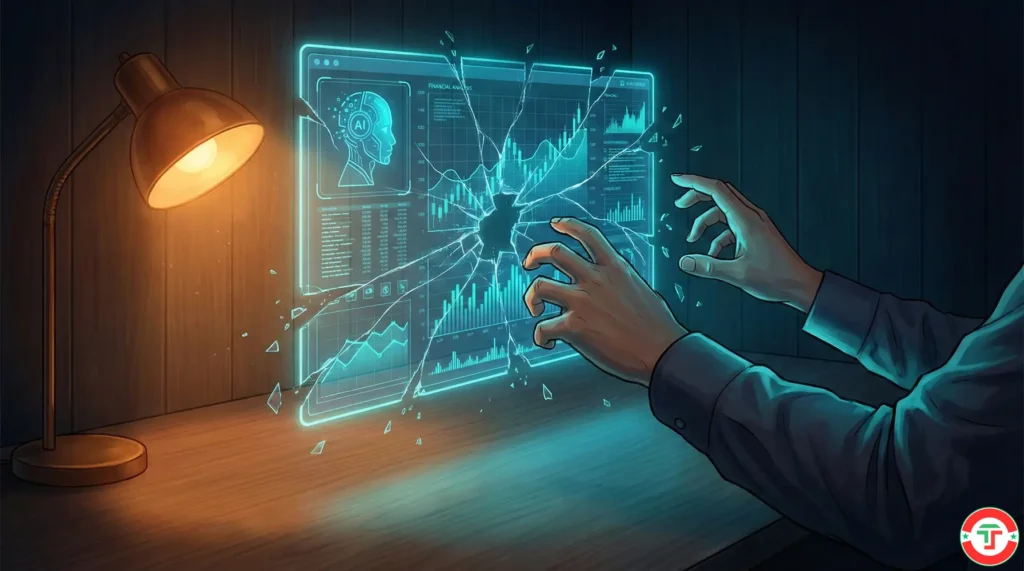
When you read a trading recommendation from a friend, you naturally apply some skepticism. You know your friend’s track record, their biases, and whether they actually know what they’re talking about. But when a sophisticated AI model delivers the same recommendation in crisp, well-structured prose with bullet points and financial terminology? Something shifts in your brain. It feels more authoritative.
Dan Moczulski, UK managing director at eToro, put it well: AI models can be brilliant, but the risk emerges when people treat generic models like ChatGPT or Gemini as crystal balls. He specifically noted that general AI models tend to misquote figures and dates, lean too hard on pre-established narratives, and overly rely on past price action to predict the future.
Here’s the mechanism that concerns us most: AI doesn’t say “I’m guessing.” It doesn’t hedge the way a human analyst might when they’re unsure. A study published in the journal Financial Innovation (2025) described this as the “confirmation bias” problem—ChatGPT can use correct domain knowledge to rationalize incorrect observations, leading less experienced traders to accept wrong information as fact.
Think about what that means for a day trader. You ask ChatGPT to analyze a breakout setup on NVDA. It delivers a polished, convincing analysis with technical levels, volume commentary, and a recommendation. Except the price levels are from last week. Or the volume data is hallucinated entirely. And because the reasoning sounds correct, you don’t notice.
What this looks like in practice: You gradually stop doing your own analysis because the AI’s output “sounds right.” Your verification process disappears. You’re now flying without instruments—but it feels like you have more instruments than ever.
The mitigation: Treat every AI output like a trading thesis from an anonymous source on a message board. Interesting starting point? Sure. Basis for risking capital? Never—not without independent verification against live market data.

Risk #2: AI Hallucinations — When Your “Analyst” Invents Data
If Risk #1 is the setup, this is the knockout punch.
AI hallucinations aren’t occasional glitches. They’re a fundamental feature of how large language models work. These models predict what words should come next based on patterns—they don’t “know” facts, and they don’t check their answers against reality.
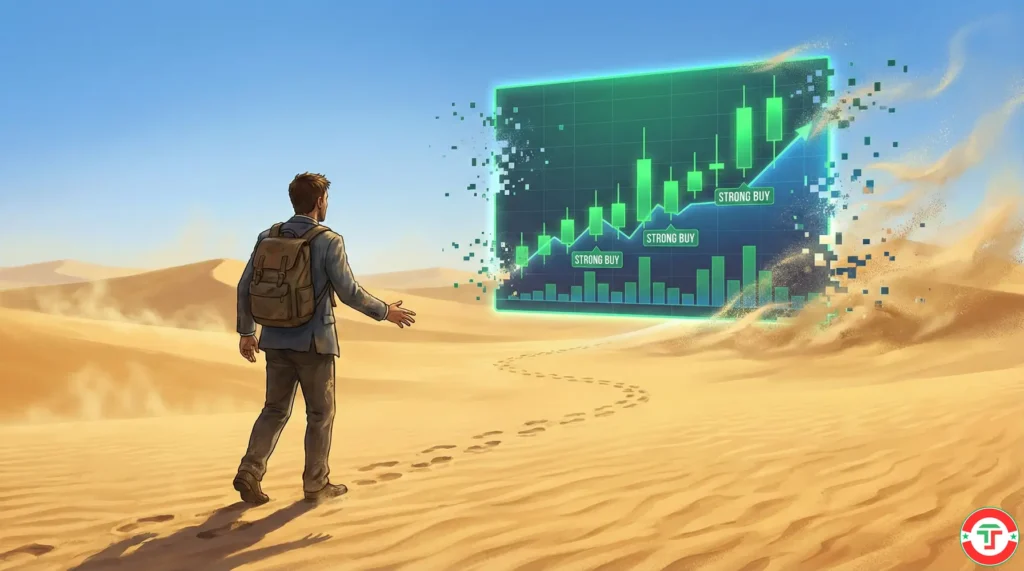
In August 2025, DayTrading.com published a landmark study that tested six popular AI tools—ChatGPT, Claude, Perplexity, Gemini, Groq, and Meta AI—across more than 180 trading-related queries. The results were sobering. Meta AI scored a danger rating of 8.8 out of 10, frequently fabricating live stock prices and issuing strong “Buy” calls on incomplete data. Even ChatGPT, the safest performer, scored 5.2 out of 10—meaning roughly half its outputs carried meaningful risk for traders.
The study’s most alarming finding? The most dangerous way to use AI is asking it for live market data. Tools without direct market feeds didn’t admit they couldn’t provide real-time prices. Instead, they simply invented numbers.
Here’s a non-exhaustive list of what LLMs have been documented inventing in financial contexts:
- Stock prices that never existed
- Earnings figures for companies that were completely fabricated
- Analyst price targets and ratings that no analyst ever issued
- Merger and acquisition events that never happened
- SEC filing details that were entirely made up
Research by Amos Levy found that when he changed the least significant digit in a company’s accounting results—say, $7.334 billion to $7.335 billion—GPT-4’s accuracy in predicting earnings changes dropped from 60% to no better than random chance. The model wasn’t analyzing financial data. It was matching memorized patterns from training data.
What this looks like in practice: You ask ChatGPT to summarize the latest earnings call for a mid-cap stock. It delivers a detailed summary—complete with specific revenue figures, guidance numbers, and management quotes. Except the earnings call happened after the model’s training cutoff, and every number is fabricated. You trade on this “analysis” and get blindsided by reality.
The mitigation: Never act on AI-provided data without cross-referencing against primary sources. Use AI for structure (organizing your analysis process) and brainstorming (generating ideas to test), not as a data source. When you need actual market data, use actual market tools—your broker platform, TradingView, or a professional scanner like Trade Ideas.
Risk #3: Overfitting — The Backtest That Lies to Your Face
If you’ve explored AI trading bots—or even used ChatGPT to help code a strategy—you’ve probably encountered the seductive pull of a beautiful backtest. The equity curve goes up and to the right. The win rate is 72%. The Sharpe ratio looks institutional.
Then you go live, and it falls apart within a week.
This is overfitting, and it’s arguably the most expensive risk in the AI trading space because it costs you money and time. Overfitting occurs when an AI model is so finely tuned to historical data that it essentially memorizes the past instead of learning transferable patterns. It’s like a student who memorizes every answer on last year’s exam but can’t solve a single new problem.
The risk is amplified by AI because machine learning models can find patterns in noise that a human never would. A model might “discover” that stocks with tickers starting with the letter “M” tend to rally on Tuesdays after a full moon. This sounds absurd, but when you have an algorithm sifting through millions of data points, these kinds of spurious correlations are inevitable—and they look convincing in a backtest.
Our team has covered this extensively in our guide on the hidden costs of automated trading, where we break down how slippage, latency, and data quality destroy the gap between backtested and live performance. But the AI-specific angle is worth emphasizing: the more powerful the AI, the better it is at finding patterns—including patterns that don’t actually exist.
What this looks like in practice: You use an AI platform to “optimize” a trading strategy. It tweaks 15 parameters to produce a stunning backtest. In live trading, it hemorrhages money because those 15 parameters were curve-fitted to the exact market conditions of the past 6 months—conditions that no longer exist.
The mitigation: If someone shows you an AI strategy with an incredible backtest, your first question should be: “How does it perform on out-of-sample data?” Walk-forward testing—where the model is tested on data it’s never seen—is the only honest test. For a thorough introduction to proper methodology, see our backtesting guide.

Risk #4: The Black Box Problem — You Can’t Fix What You Can’t See
Imagine you hired a trader to manage your money. They’re profitable—for a while. But when you ask why they made a specific trade, they can’t explain it. They just say, “Trust me, the algorithm knows.”
Would you keep giving them your capital?
This is the black box problem with AI trading. Many AI systems—especially those using deep learning or neural networks—produce outputs that are fundamentally unexplainable. Even the engineers who built them can’t always articulate why the model made a specific prediction.
The IMF flagged this directly in Chapter 3 of their October 2024 Global Financial Stability Report, noting that AI-driven trading strategies create increased opacity and monitoring challenges. The Bank of England’s April 2025 report on AI in the financial system echoed this concern, noting that most market participants view human oversight as an essential part of any AI-based strategy for regulatory, risk management, liability, and ethical reasons.
For retail day traders, the black box problem is personal: if you don’t understand why your AI tool told you to buy, you won’t know when to override it. And in fast markets, that inability to exercise judgment is the difference between a manageable loss and a catastrophic one.
This is one area where the better AI trading tools genuinely differentiate themselves. Trade Ideas, for instance, publishes Holly AI’s methodology—it runs nightly backtests across dozens of strategies and selects the ones that statistically performed best in similar market conditions. You can see the logic. You can evaluate it. Compare that to a random “AI trading bot” on Telegram that just says “BUY AAPL NOW” with zero explanation.
What this looks like in practice: Your AI bot takes a large short position in a stock that’s gapping up on earnings. You don’t understand why. The stock continues higher. You don’t know whether to cut the loss or trust the bot. You freeze. The loss doubles.
The mitigation: Never trade a strategy—AI or otherwise—that you can’t explain in plain English. If you can’t articulate the logic, you can’t manage the risk. Period. Our team discusses the psychological dimensions of this in our trading cognitive biases guide.

Risk #5: Garbage In, Garbage Out — The Data Quality Trap
AI is only as good as the data it’s trained on. This sounds obvious, but the implications for day traders are anything but.
Maximilian Goehmann, a PhD candidate at the London School of Economics and contributor to the UK government’s AI and financial services inquiry, has focused his research specifically on how small data errors in automated trading systems lead to outsized consequences. His research highlights a critical point: the 2010 Flash Crash—which wiped nearly $1 trillion in market value within minutes—wasn’t caused by a major system failure. It was caused by small data errors entering the system.
For retail traders using AI tools, data quality problems come in several flavors:
Stale data. LLMs like ChatGPT have knowledge cutoff dates. Even with web search capabilities, the data they access may be delayed, incomplete, or from unreliable sources. You’re making fast decisions in a real-time market based on analysis that might be hours, days, or months old.
Training data bias. If an AI model was trained primarily on bull market data (2009–2024 was overwhelmingly bullish), its pattern recognition is biased toward buying setups. It may systematically underperform in bear markets or choppy conditions because those market regimes are underrepresented in its training data.
Free data problems. Many retail traders feed AI models with free data sources that contain errors, gaps, and inconsistencies. This is especially problematic with intraday data, where missing bars, incorrect timestamps, or bad prints can lead an AI to “learn” patterns that are actually just data artifacts.
What this looks like in practice: You feed ChatGPT a CSV of your recent trades for analysis, but the data exported from your broker has several errors in fill prices. ChatGPT confidently analyzes the faulty data and recommends you stop trading a strategy that was actually profitable—because the bad data made it look like a loser.
The mitigation: Audit your data sources. Use professional-grade data for anything that touches real capital. When using LLMs for analysis, always provide your own verified data rather than asking the AI to look up market information.
Risk #6: Flash Crashes and Herding Risk — When Everyone’s AI Thinks Alike
Here’s a thought experiment: What happens when thousands of traders, all using similar AI models trained on similar data, get the same sell signal at the same time?
You get a flash crash.
The IMF’s October 2024 Global Financial Stability Report identified herding and market concentration as the top risk cited by industry stakeholders when asked about dangers from the wider adoption of generative AI in capital markets. The Bank of England’s April 2025 report expanded on this, warning that the widespread use of a small number of AI models or datasets could lead market participants to take increasingly correlated positions.
This isn’t theoretical. On May 6, 2010, the Dow Jones Industrial Average dropped roughly 1,000 points in minutes—nearly $1 trillion in market value evaporated before the market corrected itself. And the 2012 Knight Capital incident demonstrated how a single algorithmic malfunction could generate over 4 million erroneous trades in 45 minutes, resulting in a $460 million loss that bankrupted one of the largest trading firms on Wall Street.
Now imagine those same dynamics with AI models that are orders of magnitude more sophisticated—and widely available to retail traders.
The Congressional Research Service flagged this directly in its analysis of AI and derivatives markets, noting that “herding risk” from AI could amplify systemic risk, particularly during periods of price volatility. One comment in the CFTC’s January 2024 Request for Comment on AI specifically warned that AI using predictive analytics and social media sentiment analysis could amplify, affect, or distort commodity prices.
What this looks like in practice: You’re using an AI scanner that identifies a breakout pattern. But so are 10,000 other traders using similar AI tools. Everyone piles in. The stock spikes on no real volume, then collapses when there are no new buyers. You’re left holding the bag.
The mitigation: Remember that AI tools don’t give you a secret edge when everyone has the same tools. Your real edge comes from how you use them—which is why developing your own trading strategy and understanding market structure matters more than ever.

Risk #7: Death by a Thousand Subscriptions — The Hidden Cost Spiral
Let’s do some math that most AI trading articles conveniently skip.
A typical “AI-enhanced” trading stack might look like this:
- ChatGPT Plus: ~$20/month
- AI stock scanner: ~$100-200/month
- AI charting platform: ~$50-100/month
- AI journal analyzer: ~$30-50/month
- Real-time data feeds: ~$50-100/month
- API access for custom models: Variable
Suddenly you’re spending $250-$470/month—$3,000 to $5,600 per year—before you’ve made a single trade. For a trader with a $25,000 account, that’s 12-22% of your capital going to tools, not trades. You need to generate 12-22% returns annually just to break even on your technology costs.
And here’s the kicker: the February 2026 NBER study surveying almost 6,000 executives across the U.S., UK, Germany, and Australia found that over 80% of firms reported no measurable impact on productivity from AI, despite widespread adoption. If large firms with dedicated teams and massive budgets are struggling to see ROI from AI, what does that tell you about a retail trader subscribing to three different “AI” platforms?
The cost spiral is particularly dangerous because it creates psychological pressure. When you’re paying $400/month for tools, you feel compelled to trade more to justify the expense. More trades mean more commissions, more slippage, and more opportunities to make emotional mistakes. It becomes a vicious cycle.
What this looks like in practice: You subscribe to an AI scanner, an AI journal tool, and an AI-powered charting platform. Your monthly costs jump by $350. You start overtrading to “get your money’s worth.” Three months later, your account is smaller than when you started—not because of bad trades, but because fees and overtrading ate your capital alive.
The mitigation: Start free. ChatGPT’s free tier, Claude’s free tier, and TradingView’s free plan can teach you 80% of what AI can do for your trading. Only upgrade when you’ve identified a specific bottleneck that a paid tool solves. We cover this extensively in our free AI tools guide. And when you do upgrade, Trade Ideas is the one premium tool our team recommends starting with—because its AI scanner (Holly) actually replaces hours of manual scanning work rather than just adding another monthly charge.

Your AI Risk Management Checklist
After laying out seven risks, we’re not going to leave you hanging without a game plan. Here’s the framework our team uses when evaluating any AI tool or output for trading:
Before trusting AI output, ask:
- Can I verify this independently? If the AI gives you a data point, check it against a primary source. If you can’t verify it, don’t trade on it.
- Can I explain this in plain English? If you can’t articulate why the AI told you to take a trade, you can’t manage that trade. Walk away.
- What’s the worst case if this is wrong? Size your position as if the AI is wrong. Because sometimes, it will be.
- Is this AI augmenting my process, or replacing it? AI should make your existing analysis faster and more thorough—not replace the analysis entirely.
- Am I paying for genuine value, or for the word “AI” on the label? Most “AI” trading tools are just rules-based systems with a marketing makeover. Our AI Trading Bots: Truth vs. Hype article helps you tell the difference.
The traders who will thrive in the AI era aren’t the ones with the most subscriptions. They’re the ones who understand these risks, build verification into their process, and treat AI as what it actually is: a powerful assistant that occasionally lies to your face with absolute confidence.
Use it wisely, and it’s genuinely valuable. Trust it blindly, and it’s the most expensive mistake you’ll make.
Frequently Asked Questions
Can AI predict the stock market?
Quick Answer: No. No AI system—including ChatGPT, machine learning models, or neural networks—can reliably predict short-term stock market movements.
Academic research has shown that while AI sentiment analysis can demonstrate statistical predictive power when aggregated across thousands of stocks over time, individual stock predictions are barely better than random chance. University of Florida researcher Alejandro Lopez-Lira found that for any single headline, ChatGPT’s accuracy is essentially marginally better than a coin flip. Markets are driven by an unpredictable mix of human psychology, institutional flows, geopolitical events, and information that no AI model has access to in real time.
Key Takeaway: Treat any AI “prediction” as a hypothesis to investigate, never as a signal to trade. For the practical ways AI can help your trading, see our ChatGPT day trading guide.
Is ChatGPT safe to use for trading decisions?
Quick Answer: ChatGPT is safe for research, learning, and brainstorming—but dangerous when used as a direct source of market data or trade signals.
The DayTrading.com AI error study (August 2025) found that even ChatGPT—the safest tool tested—still carried meaningful risk when used for live market queries. The key problems are hallucinated data (it invents financial figures), no real-time market access, and knowledge cutoff limitations. A CPA quoted by GOBankingRates noted that any plan that relies on fresh numbers from ChatGPT is working with placeholders, not real data. However, ChatGPT excels at explaining concepts, helping debug code, brainstorming strategy ideas, and organizing your thinking.
Key Takeaway: Use ChatGPT as a thinking partner, not a data terminal. Always verify any numbers or facts against primary sources before making trading decisions.
What is overfitting in AI trading and why is it dangerous?
Quick Answer: Overfitting happens when an AI model is tuned so precisely to historical data that it memorizes past patterns instead of learning generalizable rules—causing it to fail in live trading.
Think of it like this: if you trained an AI to pass a driving test by memorizing every turn on a specific route, it would ace that route. But put it on a new road and it would crash. In trading, overfitting looks like a strategy with a stunning backtest—72% win rate, beautiful equity curve—that bleeds money the moment you trade it live. The more parameters an AI model can adjust, the easier it is to overfit. This is why some “AI-optimized” strategies show incredible historical performance but deliver catastrophic real-world results.
Key Takeaway: Always demand out-of-sample testing results and walk-forward analysis. A great backtest means nothing without forward validation. Our backtesting guide covers the full methodology.
What is the biggest risk of using AI for day trading?
Quick Answer: Overconfidence—the tendency to trust AI outputs without verification—is the single biggest risk, because it amplifies every other risk on this list.
When traders develop excessive trust in AI, they stop doing their own homework. They skip verification steps. They size positions larger because “the AI said so.” This is particularly dangerous because AI outputs sound authoritative—they’re well-structured, use proper financial terminology, and present conclusions with certainty. A veteran trader knows to question every signal. A trader who trusts AI blindly has essentially outsourced their risk management to a system that can’t manage risk at all.
Key Takeaway: Your verification process is your most important trading tool. Never let AI replace it. Our trading discipline guide provides frameworks for building these habits.
Can AI trading bots lose all my money?
Quick Answer: Yes. Any automated trading system—AI-powered or otherwise—can lose your entire account if it lacks proper risk controls.
The Knight Capital incident of August 2012 remains the most dramatic example: a software error in their automated system generated over 4 million erroneous trades in just 45 minutes, resulting in a $460 million loss that effectively destroyed the company. While retail AI bots operate at a smaller scale, the same principle applies. A bot without proper stop-losses, position size limits, or kill switches can compound losses faster than any human could react. The problem is amplified when traders can’t see inside the “black box” to understand why the bot is making specific decisions.
Key Takeaway: Never run an AI bot on a live account without hardcoded risk limits that you set—including maximum position sizes, daily loss limits, and automatic shutoffs. Start with paper trading. Always.
What does the IMF say about AI trading risks?
Quick Answer: The IMF has identified herding behavior, increased market speed and volatility, operational risks from third-party AI providers, and enhanced cyber/manipulation risks as the primary concerns.
The IMF’s October 2024 Global Financial Stability Report dedicated an entire chapter to AI in capital markets. Their outreach with industry participants found that herding and market concentration was the number one risk cited. The concern is that widespread adoption of similar AI models could lead to correlated trading positions, amplifying market dislocations during periods of stress. IMF Financial Counsellor Tobias Adrian acknowledged that while AI can improve risk management and market liquidity, regulators must remain vigilant about how AI could exacerbate traditional financial stability channels like interconnectedness, liquidity, and leverage.
Key Takeaway: Institutional regulators are worried about AI’s systemic effects—which means retail traders should be, too. Diversify your tools and approaches rather than relying on a single AI system.
Are free AI tools good enough for trading?
Quick Answer: Free AI tools are excellent for learning, research, and developing your trading process—but they have meaningful limitations for real-time trading decisions.
ChatGPT’s free tier, Claude’s free tier, and TradingView’s free plan collectively give you access to powerful analysis capabilities without spending a dime. The trade-off is rate limits, lack of real-time data, and less powerful model versions. For most traders—especially those still building their skills—free tools provide 80% of the value at 0% of the cost. The mistake is upgrading to paid AI tools before you’ve exhausted what free options offer.
Key Takeaway: Master free AI tools first. When you hit a specific, identifiable bottleneck, then consider upgrading. Our free AI tools guide walks you through the optimal free stack.
How do I tell if an AI trading product is a scam?
Quick Answer: Any AI product that promises guaranteed returns, shows only winning trades, or uses phrases like “set and forget” is almost certainly a scam or wildly misleading.
The red flags are consistent: guaranteed profit claims (no legitimate trading tool can guarantee returns), anonymous founders, no regulatory registration, pressure to deposit quickly, and dashboards showing only fake “profits.” The London Academy of Trading documented several high-profile examples, including platforms that used deepfake videos of financial celebrities to lure investors. A helpful framework is our 4-Level AI classification from our AI bots truth article—most scam “AI bots” are Level 1 (simple rules-based systems) hiding behind the word “artificial intelligence.”
Key Takeaway: If it sounds too good to be true, it is. Legitimate AI tools like Trade Ideas are transparent about their methodology, openly publish performance data with drawdowns included, and never promise guaranteed returns.
Disclaimer
The information provided in this article is for educational purposes only and should not be considered financial advice. Day trading involves substantial risk and is not suitable for every investor. Past performance is not indicative of future results.
For our complete disclaimer, please visit: https://daytradingtoolkit.com/disclaimer/
Article Sources
Our team relies on authoritative, primary sources for all claims in this article. The following research, regulatory reports, and industry studies informed our analysis:
- International Monetary Fund (IMF) — Global Financial Stability Report, October 2024, Chapter 3: Artificial Intelligence and Capital Markets. Comprehensive assessment of AI’s implications for market structure, stability risks, and regulatory preparedness. https://www.imf.org/en/publications/gfsr/issues/2024/10/22/global-financial-stability-report-october-2024
- Bank of England — Financial Stability in Focus: Artificial Intelligence in the Financial System, April 2025. Detailed analysis of herding risk, correlated AI positions, and market resilience under widespread AI adoption. https://www.bankofengland.co.uk/financial-stability-in-focus/2025/april-2025
- U.S. Securities and Exchange Commission (SEC) — SEC Charges Knight Capital With Violations of Market Access Rule (Release 2013-222). Enforcement action detailing the August 2012 algorithmic trading failure that resulted in over $460 million in losses. https://www.sec.gov/newsroom/press-releases/2013-222
- National Bureau of Economic Research (NBER) — Yotzov et al., “Firm Data on AI,” Working Paper 34836, February 2026. First representative international survey of firm-level AI adoption and impact, finding 80%+ of firms report no measurable productivity impact from AI. https://www.nber.org/papers/w34836
- DayTrading.com — AI Trading Error Rates: Accuracy, Risks, and Reliability Study, August 2025. Comprehensive testing of six AI tools across 180+ trading-related queries, measuring error rates, hallucination frequency, and danger scores. https://www.daytrading.com/ai/test
- eToro — Retail Investor Beat Q3 2025 & US Retail Investors Flock to AI Tools Report, October 2025. Survey of 11,000 retail investors across 13 countries documenting AI tool adoption rates and trends. https://www.etoro.com/news-and-analysis/etoro-updates/retail-investors-flock-to-ai-tools-with-usage-up-46-in-one-year/
- London School of Economics (LSE) — “The Impact of AI on Stock Market Trading,” Research by Maximilian Goehmann, 2025. Analysis of how small data errors in automated trading systems create systemic fragility, with specific reference to the 2010 Flash Crash. https://www.lse.ac.uk/research/research-for-the-world/ai-and-tech/ai-and-stock-market
- Congressional Research Service — “Artificial Intelligence and Derivatives Markets: Policy Issues” (IF13072). Overview of AI-related herding risk, third-party operational risk, and CFTC regulatory considerations for AI in financial markets. https://www.congress.gov/crs-product/IF13072


