


Earnings season is a minefield and a gold rush—sometimes in the same morning.
Every quarter, thousands of publicly traded companies dump mountains of financial data into the market. We’re talking 10-K filings that stretch past 100 pages, conference calls packed with corporate doublespeak, and guidance numbers buried under layers of accounting jargon. A single missed detail—a subtle change in revenue recognition, a quietly revised margin forecast—can mean the difference between catching a 10% gap-up and getting steamrolled by one.
Here’s the problem most day traders face: you physically cannot process all of it. Not even close. The biggest earnings weeks see 1,500+ companies reporting. Even if you only care about 20 stocks on your watchlist, reading every 10-Q and listening to every earnings call would eat your entire week.
This is where ChatGPT genuinely shines—and where it can also get you into serious trouble if you use it carelessly.
Our team has spent months building and refining a ChatGPT earnings analysis workflow specifically for day traders. Not long-term investors analyzing annual reports over coffee. Day traders who need to extract actionable intelligence from an earnings release before the opening bell. In this guide, we’ll walk you through the exact process, the tested prompts, and—critically—the verification steps that keep you from trading on hallucinated data.
If you’re new to using AI for trading, our complete ChatGPT day trading guide covers the broader picture. This article goes deep on one specific, high-value use case: turning earnings data into a pre-market edge.

Why Day Traders Should Care About ChatGPT Earnings Analysis
Before we get into the how, let’s be clear about the why—because this isn’t about replacing fundamental analysis. It’s about speed and pattern recognition.
When a company reports earnings after the close or before the open, day traders have a narrow window to make decisions. The stock gaps up 8% pre-market on an earnings beat. Or it drops 12% on disappointing guidance. In both cases, the money is made (or lost) in the first 30–60 minutes of the session. If you haven’t done your homework, you’re gambling—not trading.
Traditionally, preparing for an earnings play meant manually reading the press release, scanning the income statement, maybe skimming the conference call transcript if one was available. That works when you’re watching two or three names. It falls apart during a busy earnings week.
ChatGPT compresses this research cycle dramatically. What might take 45 minutes of manual reading can be processed in under 10 minutes. But—and this is the part most “AI for trading” articles conveniently skip—the output still requires verification. A University of Chicago study by researchers Kim, Muhn, and Nikolaev found that GPT-4 achieved 60.4% accuracy in predicting earnings direction from financial statements alone, outperforming the median human analyst. That’s impressive. It also means the model was wrong nearly 40% of the time.
So the goal isn’t blind trust. The goal is informed speed.
Our workflow uses ChatGPT as a first-pass analyst—someone who reads everything quickly and flags what matters—while you remain the decision-maker who verifies, interprets, and trades.
For context on how we actually trade around earnings events, our Trader’s Playbook for Earnings Reports covers the specific setups—gap-and-go, gap-fill, the works. This guide focuses purely on the analysis side: extracting intelligence from the data before you ever place a trade.
Where to Find Earnings Data to Feed ChatGPT
ChatGPT doesn’t have access to real-time financial data or current SEC filings on its own. This is the single biggest misconception traders have about using AI for earnings analysis. You need to bring the data to ChatGPT—it won’t go fetch it for you.
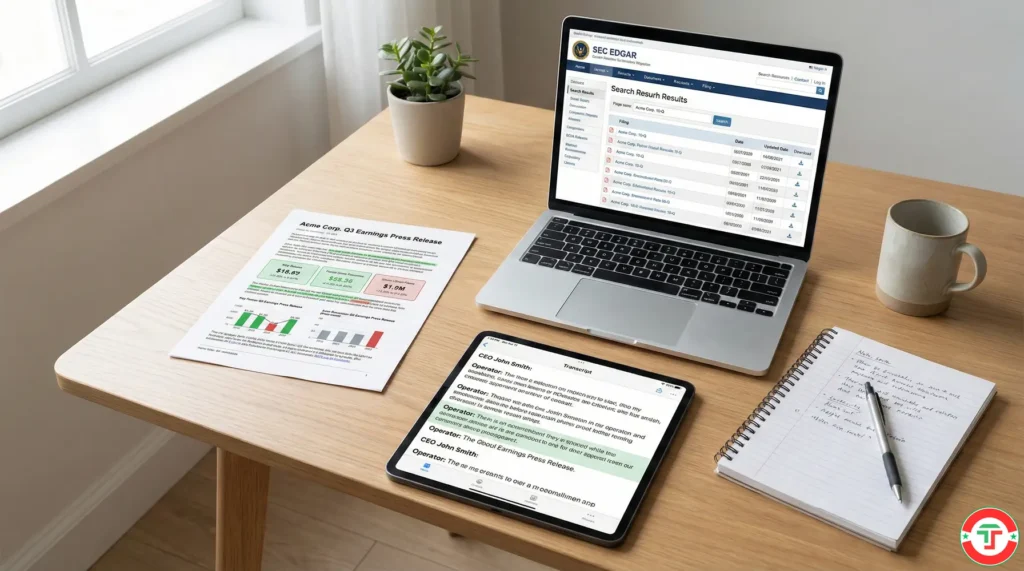
Here’s where to get what you need, all free:
SEC EDGAR (Primary Source for Financial Statements)
The SEC’s EDGAR database is the gold standard. Every 10-K (annual report), 10-Q (quarterly report), and 8-K (current events report) filed by a U.S. public company lives here. Go to sec.gov/cgi-bin/browse-edgar, type in the ticker, and download the filing. You can copy-paste the text directly into ChatGPT or upload the PDF to ChatGPT’s file analysis feature.
Earnings Call Transcripts (Free Sources)
Earnings call transcripts are arguably more valuable than the numbers themselves for day traders, because they contain forward guidance, management tone, and analyst Q&A—the stuff that really moves stocks. Free transcript sources include:
- The Motley Fool — Publishes transcripts for most major companies, usually within hours
- Seeking Alpha — Extensive transcript library (some behind paywall, but many are free)
- Company Investor Relations Pages — Most large-cap companies post their own transcripts or provide webcast replays
Earnings Press Releases
These are the condensed versions—the headline numbers. Find them on the company’s investor relations page, through major financial news sites, or via EDGAR (filed as 8-K). Press releases are perfect for a quick ChatGPT summary when you don’t have time for the full 10-Q.
A quick note on data freshness: ChatGPT’s training data has a cutoff, which means it cannot verify whether the numbers you’re feeding it are accurate. That’s your job. Always pull data from the primary source—never ask ChatGPT to “look up” a company’s latest earnings. It might generate numbers that sound right but are completely fabricated. We cover this in detail in our section on verification below.
The 5-Phase ChatGPT Earnings Analysis Workflow
This is the core of our approach. We’ve tested and refined this workflow across multiple earnings seasons. Each phase builds on the last, moving from raw numbers to actionable trading intelligence.
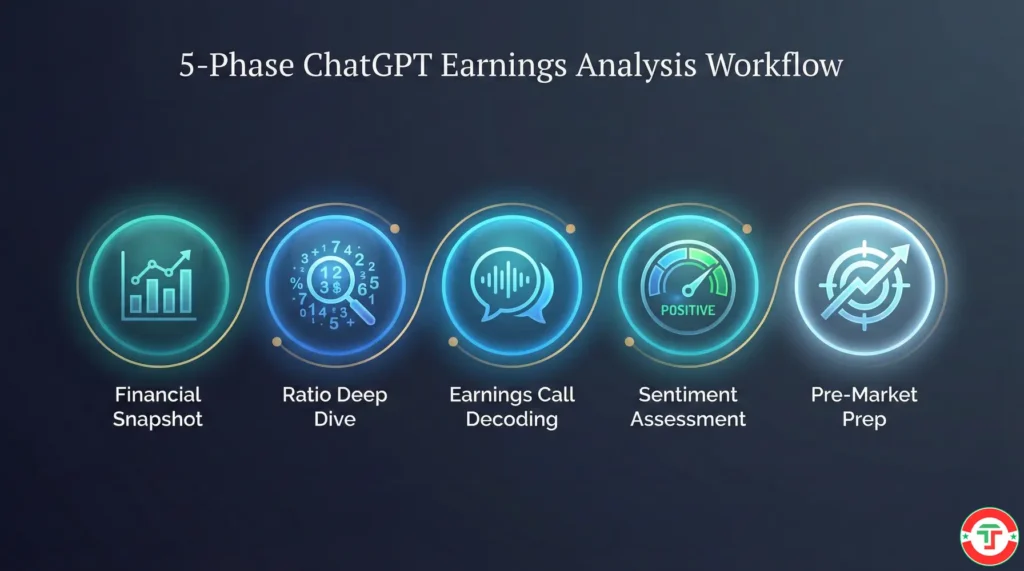
Phase 1: The Financial Snapshot (Numbers First)
Start with the earnings press release or 10-Q income statement. Copy-paste the key financial tables into ChatGPT. The goal here is a rapid summary—not deep analysis.
Tested Prompt:
“I’m going to paste the quarterly earnings data for [COMPANY, TICKER]. Please provide a concise financial snapshot covering: (1) Revenue vs. prior quarter and year-over-year, (2) EPS reported vs. consensus estimate if I provide it, (3) Net income trend, (4) Any line items that changed more than 15% year-over-year, and (5) Operating margin direction. Keep it brief and flag anything unusual. Here’s the data: [PASTE DATA]”
Why this works: The prompt gives ChatGPT a specific structure to follow, prevents it from rambling, and—crucially—sets a 15% threshold for flagging changes. Without that threshold, you’ll get commentary on every minor fluctuation, which isn’t useful when you’re prepping at 7 AM. For more on crafting effective trading prompts and the principles behind them, our best ChatGPT prompts for day trading guide covers the broader methodology.
What to look for in the output: Revenue surprises, margin compression or expansion, and any line item with a dramatic year-over-year shift. These are the numbers that drive opening gaps.
Phase 2: Ratio Deep Dive (Finding What’s Under the Hood)
Once you’ve got the snapshot, go deeper. This is where ChatGPT’s ability to process numbers quickly really pays off. Feed it the balance sheet and cash flow statement alongside the income statement.
Tested Prompt:
“Using the financial data I’ve provided for [COMPANY], calculate and interpret these key ratios: (1) Current ratio and quick ratio (liquidity health), (2) Debt-to-equity ratio (leverage risk), (3) Operating margin and net margin trends over the last 3 quarters if data available, (4) Free cash flow vs. reported earnings (quality of earnings check), and (5) Revenue growth rate vs. earnings growth rate (are margins expanding or contracting?). For each ratio, tell me if the trend is improving, deteriorating, or stable compared to prior periods. Be specific with the numbers.”
This is where the University of Chicago research becomes relevant. Kim, Muhn, and Nikolaev found that GPT-4’s strength lies in exactly this kind of analysis—identifying trends and computing ratios from standardized financial data. The model excelled particularly in scenarios where human analysts tended to struggle, such as smaller firms with less analyst coverage.
Critical verification step: Spot-check at least two of the ratios ChatGPT calculates. Pull up the same filing on EDGAR and manually verify one number. We’ve caught ChatGPT making arithmetic errors on financial ratios—rare, but it happens. One wrong ratio could completely flip your read on a company’s health.
Phase 3: Earnings Call Decoding (Reading Between the Lines)
This phase is, in our experience, the single highest-value use of ChatGPT in the entire workflow.
Earnings call transcripts contain two distinct sections: the prepared remarks (scripted, polished, rehearsed) and the Q&A session (where the real information leaks). Management teams spend weeks crafting their prepared remarks to sound optimistic. But during Q&A, analysts press on weak spots, and executives sometimes reveal more than they intended through hesitation, deflection, or overly vague answers.
A 2024 study by Beckmann et al. demonstrated that ChatGPT could effectively classify earnings call Q&A sessions as “usual” or “unusual,” identifying evasive management communication with notable accuracy. The researchers found that companies flagged for unusual communication patterns experienced worse stock performance around the call—something that matters enormously for day traders positioning around these events.
Tested Prompt for Prepared Remarks:
“I’m pasting the prepared remarks section of [COMPANY]’s Q[X] earnings call transcript. Please analyze for: (1) Forward guidance—any specific numbers or changes from prior guidance, (2) Key phrases that signal confidence or concern (e.g., ‘headwinds,’ ‘cautiously optimistic,’ ‘acceleration’), (3) New strategic initiatives or product mentions, (4) Any mentions of cost-cutting, restructuring, or headcount changes, and (5) Tone assessment—does management sound more or less confident than typical corporate language? Here’s the transcript: [PASTE]”
Tested Prompt for the Q&A Section:
“Now I’m pasting the analyst Q&A section from the same earnings call. Please identify: (1) Which topics did analysts press on most (asked about more than once), (2) Any questions where management gave vague or evasive non-answers, (3) Specific numbers or commitments made during Q&A that weren’t in prepared remarks, (4) Any analyst who expressed clear skepticism and why, and (5) The single most important new piece of information from this Q&A. Here’s the Q&A transcript: [PASTE]”
The Q&A prompt is particularly powerful because it catches the kind of information that moves stocks after the initial gap. The headline numbers drive the first reaction. The Q&A nuance drives the follow-through—or the reversal.

Phase 4: Sentiment and Comparative Assessment
Now you’ve got the numbers and the narrative. Phase 4 puts them in context.
Tested Prompt:
“Based on all the earnings data and transcript analysis we’ve done for [COMPANY], provide: (1) Overall sentiment grade (Strongly Positive / Positive / Neutral / Negative / Strongly Negative) with a one-sentence justification, (2) The single biggest positive surprise from this report, (3) The single biggest risk or concern, (4) How does this quarter’s performance compare to the trend of the previous 2-3 quarters (is the company accelerating, decelerating, or flat?), and (5) What one metric should traders watch most closely in the next quarter? Keep the response under 250 words.”
This is where you’re leveraging ChatGPT’s ability to synthesize everything you’ve fed it across the conversation. The word limit in the prompt is intentional—it forces the model to prioritize, which produces more useful output than a sprawling analysis.
For a deeper exploration of how AI sentiment analysis works in trading—including its limitations—check out our AI Sentiment Analysis for Day Trading guide.
Phase 5: Pre-Market Trading Prep (Turning Analysis into Action)
The final phase bridges the gap between analysis and execution. This is where the workflow becomes specifically useful for day traders—not just investors.

Tested Prompt:
“I’m a day trader preparing for the market open after [COMPANY]’s earnings report. Based on our analysis, help me build a quick pre-market game plan: (1) Is the post-earnings move (gap up/down) justified by the fundamentals, or could it be an overreaction? (2) What are the key price levels I should watch (prior earnings high/low, recent support/resistance)? Note: I’ll verify these on my chart—just flag what matters conceptually. (3) What’s the bull case for continuation? (4) What’s the bear case for a reversal/fade? (5) What risk factors could cause a sharp intraday reversal? Keep this actionable and under 200 words.”
Fair warning: ChatGPT does not have access to real-time price data. It cannot tell you actual support and resistance levels. What it can do is reason about whether a 7% gap is proportional to a 2% revenue beat—and that kind of sanity check is invaluable at 8:30 AM when your emotions are telling you to chase.
For the actual price levels and technical setup, you’ll want a real charting platform. TradingView is our go-to for mapping earnings gaps against key technical zones. And for finding which stocks are gapping on earnings in the first place, a real-time scanner like Trade Ideas is far more effective than asking ChatGPT to guess.
The Critical Limitation: Why You Must Verify Everything
We need to be direct about something: ChatGPT will occasionally fabricate financial data with complete confidence.
This isn’t a minor footnote. It’s the single most dangerous aspect of using any LLM for financial analysis. The model can generate plausible-sounding revenue figures, earnings per share numbers, analyst ratings, and even fake news events—all of which look perfectly real but have no basis in fact.
Academic research specifically documents this problem. Studies published in Sage Journals have noted how ChatGPT fabricates non-existent citations in economics and finance contexts. In our own testing, we’ve seen ChatGPT confidently cite analyst price targets that don’t exist and reference earnings results from quarters that haven’t happened yet.
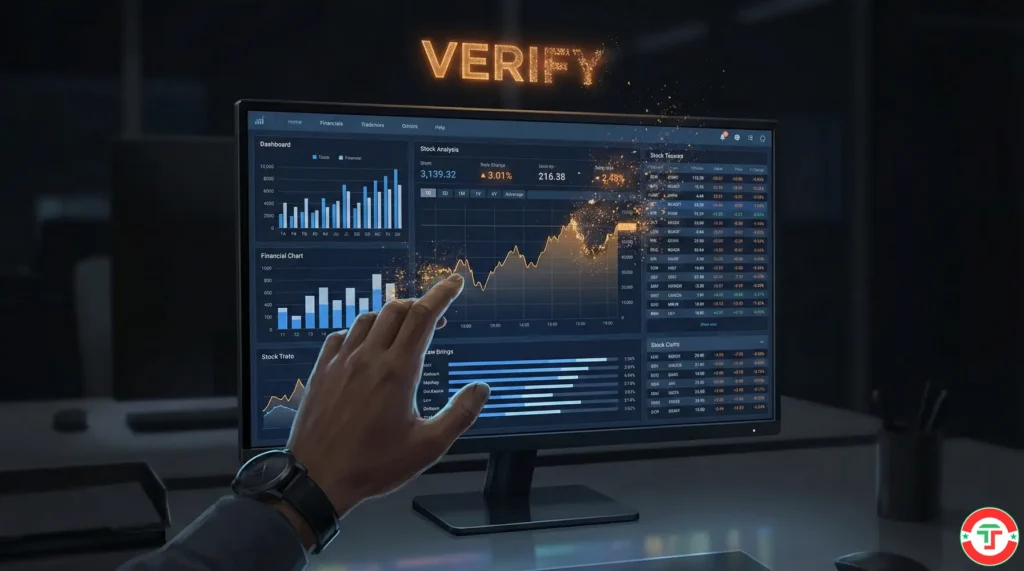
Our Verification Protocol (Non-Negotiable):
Rule 1: Never ask ChatGPT to retrieve financial data. Always provide the data yourself from a primary source (SEC EDGAR, company IR page, or a trusted financial data provider). The moment you ask ChatGPT “What was Apple’s revenue last quarter?”—you’re playing Russian roulette with hallucinated numbers.
Rule 2: Spot-check every critical number. After ChatGPT generates its analysis, manually verify at least the headline figures (revenue, EPS, guidance ranges) against the actual filing or press release. This takes 60 seconds and could save you from trading on fiction.
Rule 3: Be skeptical of specific claims you didn’t feed it. If ChatGPT mentions a specific analyst downgrade, a recent news event, or a competitive development that you didn’t include in your prompt, verify it independently before acting on it. These are the highest-risk hallucination zones.
Rule 4: Cross-reference sentiment with price action. If ChatGPT’s sentiment assessment says “Strongly Positive” but the stock is gapping down in pre-market, the market is telling you something ChatGPT can’t see. Real money always outranks AI analysis.
Rule 5: Use ChatGPT’s analysis as a starting framework, not a final answer. The best use of this workflow is to rapidly organize your thinking—not to replace it. Think of ChatGPT as the intern who reads everything and gives you a brief. You’re still the portfolio manager who makes the call.
For a comprehensive look at the risks of relying on AI for trading decisions—including overfitting, black-box decision making, and systemic risks—our Dark Side of AI Trading article covers the full landscape.

Combining ChatGPT Earnings Analysis with Real Trading Tools
ChatGPT’s strengths are in text processing and synthesis. Its weaknesses are real-time data and execution. The most effective earnings analysis setup combines both.
The Workflow in Practice:
Night Before / Early Morning:
- Identify which stocks on your watchlist reported earnings (most brokers and financial news sites have earnings calendars)
- Pull the earnings press release and transcript from free sources
- Run the 5-Phase ChatGPT Workflow above
- Note your key levels, bull/bear case, and sentiment grade
Pre-Market (7:00–9:30 AM ET):
- Check actual pre-market price action against your ChatGPT analysis—is the gap direction consistent with the fundamentals?
- Use a real-time scanner to see how the stock is trading relative to other earnings movers. A platform like Trade Ideas can surface which post-earnings stocks have the most momentum, volume, and institutional interest before the bell
- Map key levels on your charting platform—prior day’s high/low, earnings gap levels, VWAP
- Make your go/no-go decision based on the combination of fundamental analysis (ChatGPT) and technical setup (your charts and scanner)
During the Session:
ChatGPT’s job is done. This is where execution, risk management, and your trading plan take over. The AI helped you prepare—it can’t trade for you.
This combined approach acknowledges what AI does well (processing lots of text quickly) and what it doesn’t do at all (real-time market data, execution, or risk management). If you want to explore the broader universe of AI tools that can complement this workflow, our complete AI day trading guide maps out the full landscape.
Frequently Asked Questions
Can ChatGPT accurately predict stock price movement after earnings?
Quick Answer: No—and anyone telling you otherwise is selling something. ChatGPT can help you analyze earnings data, but it cannot predict price movement with reliability.
Research from the University of Florida by Lopez-Lira and Tang showed that ChatGPT-derived sentiment scores from news headlines had a statistically significant correlation with next-day stock returns. However, the researchers also noted declining performance over time as the strategy became more widely known, with the annualized Sharpe ratio dropping from 6.54 in late 2021 to 1.22 by early 2024. The real-world trading conditions—transaction costs, slippage, timing—further erode theoretical returns.
Key Takeaway: Use ChatGPT for analysis speed, not price prediction. For how we actually trade earnings volatility, see our Earnings Report Trading Playbook.
Do I need ChatGPT Plus (paid) or can I use the free version?
Quick Answer: The free tier works for basic earnings analysis, but the paid version is significantly better for handling long documents like 10-K filings and earnings transcripts.
The free version of ChatGPT has shorter context windows and less capable reasoning. When you paste a 30-page transcript, the free tier may truncate or miss important details from later sections. The paid version handles longer inputs more reliably and produces more nuanced financial analysis. That said, if you’re working with earnings press releases (typically 2-5 pages), the free version is perfectly adequate for the Phase 1 Financial Snapshot.
Key Takeaway: Start free. Upgrade if you find yourself regularly analyzing full transcripts and 10-Q filings. The ~$20/month cost pays for itself quickly if it saves you even one bad trade per earnings season.
What about using Claude or Gemini instead of ChatGPT?
Quick Answer: Both are viable alternatives with different strengths. Claude handles longer documents particularly well, and Gemini has tighter integration with Google’s ecosystem.
The core workflow we’ve outlined here works with any major LLM—the prompts translate directly. The key differences are in context window size (how much text you can paste at once), reasoning quality on financial data, and integration features. We cover the detailed comparison in our ChatGPT vs. Gemini vs. Claude for Traders article.
Key Takeaway: The prompts and methodology matter more than which specific LLM you use. Pick the one you’re most comfortable with and run the same 5-phase workflow.
How far in advance should I run this analysis before the market opens?
Quick Answer: Ideally, the night before for after-hours reports, or by 7:00 AM ET for pre-market reports. Rushing this workflow in the final 15 minutes before the bell defeats its purpose.
The entire 5-Phase workflow takes roughly 15–25 minutes once you’ve practiced it a few times. For after-hours earnings (reported at 4:00 PM ET), our team typically runs the analysis that evening and lets the key findings marinate overnight. For before-market reports (released at ~7:00 AM ET), the timeline is tighter—but you still have a solid 2.5-hour window before the open.
Key Takeaway: Speed matters, but accuracy matters more. A methodical 20-minute analysis beats a frantic 5-minute skim every time.
Can ChatGPT analyze earnings for companies outside the U.S.?
Quick Answer: Yes, but with additional caveats. Accounting standards differ globally (IFRS vs. GAAP), and ChatGPT’s training data skews heavily toward U.S. companies.
International companies file under different frameworks, use different reporting cadences, and follow different disclosure rules. ChatGPT can still process the numbers and transcripts, but you should explicitly tell it which accounting standard the company uses. Add to your Phase 1 prompt: “This company reports under IFRS standards” or “This company is listed on [exchange] and follows [country] GAAP.”
Key Takeaway: The workflow applies globally, but always specify the accounting standard and be extra vigilant about verification for non-U.S. companies where ChatGPT has less training data.
What’s the biggest mistake traders make using ChatGPT for earnings?
Quick Answer: Asking ChatGPT to look up or generate financial data instead of providing verified data themselves.
This is the hallucination trap. A trader asks, “What were NVIDIA’s Q3 earnings?” and ChatGPT generates a confident, detailed answer that might be from an old quarter, a fabricated quarter, or a blended guess. The trader doesn’t verify, builds a thesis on bad data, and takes a position. This is not a theoretical risk—it happens constantly. Our Rule 1 exists for this exact reason: always bring verified data to ChatGPT. Never ask it to bring data to you.
Key Takeaway: Treat ChatGPT as a powerful text processor, not a financial database. Provide the data; let the AI process it.
How does this compare to professional AI earnings tools like AlphaSense or FactSet?
Quick Answer: Professional platforms are purpose-built for financial analysis and far more reliable for data accuracy, but they cost hundreds to thousands of dollars monthly. ChatGPT is a remarkably capable free alternative if you handle verification yourself.
Tools like AlphaSense, Aiera, and FactSet’s AI summarization features are built on verified financial databases, include real-time data, and have safeguards against hallucinations. FactSet has shared how they implemented “back-check” procedures where ChatGPT flags quality issues in its own output—a sophisticated approach that individual traders using vanilla ChatGPT don’t have access to. The tradeoff is straightforward: professional tools give you verified speed; ChatGPT gives you raw speed that requires manual verification.
Key Takeaway: For retail day traders, ChatGPT with our verification protocol is a practical and cost-effective approach. If you’re managing serious capital, the professional tools may justify their cost.
Is it legal to use ChatGPT to analyze earnings reports for trading?
Quick Answer: Yes—analyzing publicly available financial data with AI tools is completely legal. You’re simply using a tool to read and interpret information that’s freely accessible to everyone.
Using ChatGPT to process SEC filings, press releases, and public earnings call transcripts is no different legally than reading them yourself or using a calculator to compute financial ratios. The SEC’s EDGAR database exists specifically to give the public free access to these documents. What would be problematic is using AI to process material non-public information (insider information)—but that’s illegal regardless of whether you use AI or a pencil and paper.
Key Takeaway: Analyzing public data with any tool is perfectly fine. The same insider trading laws apply whether you use AI, spreadsheets, or your own brain.
Disclaimer
The information provided in this article is for educational purposes only and should not be considered financial advice. Day trading involves substantial risk and is not suitable for every investor. Past performance is not indicative of future results.
For our complete disclaimer, please visit: https://daytradingtoolkit.com/disclaimer/
Article Sources
Our team uses only high-authority, primary sources to support the claims and frameworks presented in our content. Here are the key sources referenced in this article:
- Kim, A.G., Muhn, M., & Nikolaev, V.V. (2024). “Financial Statement Analysis with Large Language Models.” University of Chicago Booth School of Business Working Paper. Available via SSRN and arXiv. This study demonstrated GPT-4 achieving 60.4% accuracy in predicting earnings direction, outperforming the median financial analyst.
- Lopez-Lira, A. & Tang, Y. (2024). “Can ChatGPT Forecast Stock Price Movements? Return Predictability and Large Language Models.” University of Florida, Warrington College of Business. Published via SSRN and arXiv. Documented ChatGPT sentiment scores’ correlation with next-day stock returns across 67,000+ headlines.
- Beckmann, K.S. et al. (2024). Research on using ChatGPT to identify unusual earnings call communication patterns, demonstrating AI’s ability to flag evasive management behavior linked to subsequent underperformance.
- SEC EDGAR (U.S. Securities and Exchange Commission). Free public database for accessing 10-K, 10-Q, 8-K, and other required corporate filings. Accessible at sec.gov/edgar/searchedgar/companysearch.
- Investor.gov (SEC Office of Investor Education and Advocacy). “Form 10-K” explainer for understanding annual report filings. Accessible at investor.gov.
- FactSet (2023). “How We Use AI to Summarize Earnings Call Q&A Discussions.” Detailed methodology for professional-grade LLM earnings call analysis, including back-check verification procedures. Published at insight.factset.com.


