



Most “AI trading tool” articles fall into one of two camps: breathless hype or vague hand-waving. You’ve probably read a dozen already. They’ll tell you Holly AI is “revolutionary” and show you a screenshot of a 300% winner—then conveniently forget to mention the losers, the learning curve, or the $2,136 annual price tag.
We’re not doing that here.
Our team has spent thousands of hours inside the Trade Ideas platform. We’ve watched Holly fire signals in real-time, tracked her wins and her losses, and dug into the actual mechanics of how this system operates under the hood. What we found is genuinely impressive—but also comes with caveats that every trader deserves to know before swiping their credit card.
This is the owner’s manual that Trade Ideas’ marketing page won’t give you. By the time you’re done reading, you’ll understand exactly how Holly works, what she can realistically do for your trading, and—just as importantly—what she can’t.

What Is Holly AI? (The 60-Second Answer)
Holly AI is Trade Ideas’ proprietary artificial intelligence system that generates real-time stock trade signals throughout the trading day. She’s not a chatbot. She’s not a generative AI tool like ChatGPT. Holly is a machine learning engine that runs millions of backtests every single night, tests over 70 different trading strategies against 8,000+ U.S. stocks, and then deploys only the strategies that meet strict performance criteria the following morning.
Think of it this way: if most stock scanners are like a flashlight—you point them where you want to look—Holly is more like a self-adjusting spotlight that decides on its own where the best opportunities are, based on what actually worked in recent market conditions.
Here’s the critical distinction that separates Holly from the flood of “AI-powered” tools cluttering the market right now. Holly uses genuine machine learning. She’s not a set of static if/then rules dressed up with an “AI” label. Her strategies adapt nightly based on fresh market data. The parameters shift. The filters tighten or loosen. Strategies that stopped working get benched. Ones that are clicking get promoted.
That adaptability is what makes Holly genuinely different—and it’s why our team considers Trade Ideas the gold standard for AI-powered stock scanning.
But let’s peel back the curtain and see how the sausage actually gets made.
The Engine Room: How Holly’s Nightly Backtesting Cycle Works
This is the part that most articles gloss over with a single sentence like “Holly runs millions of backtests.” True—but what does that actually mean? Understanding the nightly cycle is key to understanding why Holly’s signals carry more statistical weight than a random alert from a basic scanner.

Here’s the process, broken down into the steps that happen while you sleep:
Step 1: Market Close Data Ingestion. After each trading day ends at 4:00 PM ET, Holly ingests the complete market data from that session—every trade, every price movement, every volume spike across all U.S.-listed equities.
Step 2: Strategy Simulation. Holly takes her library of 70+ predefined trading strategies and tests each one against the full universe of 8,000+ stocks. That’s 70 strategies multiplied by 8,000+ symbols—we’re talking about millions of individual backtested scenarios. Each simulation evaluates how that strategy would have performed under the current market regime using recent historical data.
Step 3: Performance Filtering. Here’s where it gets selective—and this is the part that matters most. Holly doesn’t just pick the strategies that made money. She applies two hard filters:
- Win rate must exceed 60%. If a strategy doesn’t win more than six out of ten times in recent backtesting, it’s out.
- Risk-to-reward ratio must be at least 2:1. Even a high win rate isn’t enough if the average winner is smaller than the average loser. Holly requires that the expected reward be at least double the expected risk.
Only strategies that clear both bars make the cut for the next trading day. Everything else sits on the bench.
Step 4: Strategy Deployment. The surviving strategies go live when the market opens the following morning. Holly begins scanning in real-time, watching for stocks that match the criteria of her active strategies. When conditions align—the right price action, volume, technical levels, and market context—she fires a signal.
This cycle repeats every single night. Monday’s Holly might deploy different strategies than Friday’s Holly, because the market data shifted. That self-optimizing loop is what Trade Ideas means when they call Holly “adaptive AI”—and it’s not marketing fluff. The strategies genuinely evolve based on what the market is doing right now, not what it did six months ago.
As StockBrokers.com noted in their 2026 Trade Ideas review, these AI-powered modules “refresh daily using machine learning and updated backtesting to adapt to changing market trends.”
Fair warning, though: adaptive doesn’t mean infallible. More on that later.
Three Hollys, Three Risk Profiles
Here’s something that catches most new users off guard: there isn’t just one Holly. Trade Ideas actually runs three distinct AI systems, each with a different risk appetite and trading style. Understanding the differences is crucial, because picking the wrong one for your personality is a recipe for frustration.
Holly (Original) — The Balanced Approach
The original Holly is the workhorse. She runs the full library of 70+ strategies across all risk categories—conservative, moderate, and aggressive—and fires signals for the ones that pass the nightly filter. Holly typically generates 5 to 25 trade signals per day, all designed to be closed before the market closes. She’s built for the bread-and-butter intraday trader who wants a mix of long and short setups across different market conditions.
Most of her strategies focus on stocks priced between $1 and $100, with specific volume and float requirements baked into each algorithm. The strategies themselves have names that hint at their logic: “Breakout Long,” “Bullish Pullback,” “Bon Shorty,” “Bear Trap,” “Balloon Under Water”—each targeting a specific, repeatable market pattern.
Holly 2.0 — The Aggressive Variant
Holly 2.0 is the same engine, but with the risk dial cranked up. She focuses on more aggressive day trading scenarios—wider targets, potentially bigger moves, and the kind of setups that carry more heat before they work. If original Holly is the experienced trader who waits for textbook setups, Holly 2.0 is the one willing to take a shot on a slightly messier chart because the reward potential is worth it.
This isn’t for everyone. If you’re newer to trading or have a smaller account, Holly 2.0’s signals can feel uncomfortably volatile. Our team’s recommendation: start with the original Holly, get comfortable with the signal flow, and only graduate to 2.0 once you understand the rhythm.
Holly NEO — The Pattern Hunter
Holly NEO is the newest member of the family, and she works a bit differently. While the original Holly and Holly 2.0 rely primarily on the nightly backtesting cycle, NEO is focused on identifying real-time chart patterns as they form during the trading day. She uses a mix of pattern recognition and machine learning to spot setups that are developing right now, not just setups based on overnight optimization.
Think of NEO as the scout. She’s looking for formations—consolidation breakouts, support bounces, momentum shifts—and flagging them as they happen. This makes her signals more reactive to intraday conditions, which can be an advantage in fast-moving markets but also means the statistical backtesting window is different from her siblings.
The practical takeaway? Most traders use original Holly as their primary signal source and treat Holly 2.0 and NEO as supplementary—additional eyes watching for opportunities they might otherwise miss. You don’t have to trade every signal from all three. In fact, you absolutely shouldn’t.

Inside a Holly Signal: What You Actually See
Alright, let’s get concrete. When Holly fires a signal, what actually shows up on your screen?
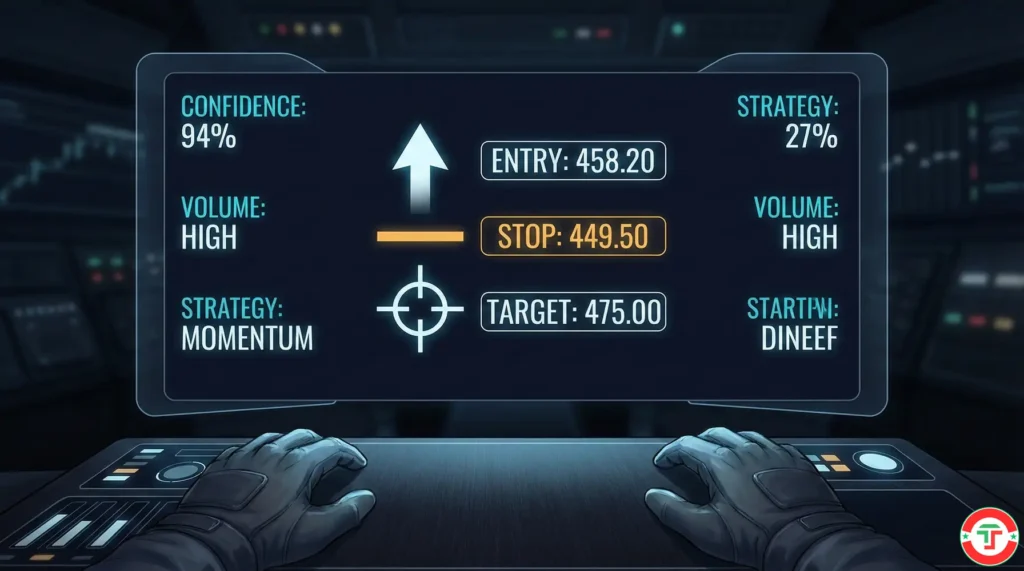
Each trade alert appears in the AI Strategy Trades Window and includes several key data points. Every signal tells you the ticker symbol, the strategy name that triggered it, the suggested entry price, a defined stop-loss level, and a profit target. You’ll also see the expected hold time for that particular strategy—some are designed for quick scalps lasting minutes, others for trades that might run for hours.
Here’s a simplified example of what a Holly signal looks like in practice:
| Signal Element | What You See |
|---|---|
| Ticker | ABCD |
| Strategy | Breakout Long |
| Direction | Buy |
| Entry | $14.52 |
| Stop Loss | $14.10 |
| Target | $15.35 |
| Hold Time | ~45 minutes |
The signals also appear directly on Trade Ideas’ charts, so you can visually see where the entry, stop, and target sit relative to the current price action. This visual overlay is genuinely useful—it lets you quickly assess whether the setup makes sense to you based on the broader chart context.
One thing our team appreciates: Holly shows her work. You can see which strategy triggered the signal, review the backtested performance metrics for that specific strategy, and even check the “Signals in the Money” and “Signals out of the Money” windows to track how previous signals performed. That transparency is rare in AI trading tools, and it’s a legitimate trust-builder.
But here’s the reality check—and this is something competitors almost never mention. Not every signal is a winner. Holly’s backtested win rate threshold is 60%, which means that by design, roughly 4 out of every 10 signals are expected to lose money. That’s not a flaw. That’s probability. The system is designed so that the winners are larger than the losers (the 2:1 risk-to-reward requirement), producing positive expectancy over a meaningful sample size.
The traders who struggle with Holly are typically the ones who cherry-pick signals, bail early on winners, or override the stop-loss on losers—which, ironically, destroys the very statistical edge the system is designed to provide.
Four Ways to Trade with Holly
One of Holly’s underappreciated strengths is flexibility. You’re not locked into a single execution method. Trade Ideas gives you four distinct ways to act on Holly’s signals, ranging from fully manual to fully automated.
Method 1: Manual Execution (Holly Hands-On)
This is the simplest approach and where most traders start. You watch Holly’s signals in the AI Strategy Trades Window, evaluate the setup on the chart, and then manually place the order in your own brokerage account. Holly tells you what to trade. You decide whether to trade it.
Trade Ideas even has an External Linking feature that lets you click a signal and have it auto-populate the ticker in your broker’s order entry window—saving you a few precious seconds during fast-moving markets.
This method keeps you firmly in the driver’s seat. You maintain full control and can apply your own judgment as a filter on top of Holly’s signals. As Trade Ideas puts it in their own guide: “The combination of human and machine is much more powerful than each on their own.”
Method 2: One-Click Trading
If you’ve connected Trade Ideas to a participating broker through their Brokerage Plus module—currently supporting Interactive Brokers and E*TRADE—you can execute Holly’s signals with a single click directly from the chart or the AI Strategy Trades Window. Your position size, stop-loss, and target are pre-configured based on risk parameters you’ve set ahead of time.
This is the sweet spot for traders who want speed without giving up the final decision. You still approve every trade, but the execution is nearly instant.
Method 3: Simulated Trading
Trade Ideas offers a built-in paper trading simulator that works hand-in-hand with Holly. You can let Holly’s signals execute automatically in the simulator, tracking performance in real-time without risking a single dollar.
Our team strongly recommends this as step one for any new Holly user. Spend at least two to four weeks in simulation mode. Watch how the signals behave. Track the win rate. Get a feel for the rhythm of entries and exits. This isn’t optional—it’s essential due diligence. For more on why simulated practice matters, check our paper trading guide.
Method 4: Automated Execution (Brokerage Plus)
For traders ready to take the leap, the Brokerage Plus module can execute Holly’s signals automatically in a live brokerage account. Once configured, the system handles entries, stop-loss placement, and profit targets without manual intervention.
This is powerful—and dangerous in equal measure. Automated execution removes emotional interference, which is a genuine benefit. But it also means you’re trusting the system completely, and things like slippage, fast markets, and unusual conditions can create outcomes that look nothing like the backtested results. If you’re interested in understanding the broader landscape of automated execution, our semi-automated trading guide provides important context about keeping the right balance between human oversight and machine speed.
The bottom line: start with Method 1 or Method 3. Graduate to faster execution only after you’ve built real confidence in how Holly’s signals behave in live market conditions.

The Money Machine: Trade Ideas’ Second-Generation AI
While Holly remains the flagship, Trade Ideas has been developing what they call “the biggest innovation in retail trading history”—the Money Machine. This is their second-generation AI system, and it represents a fundamentally different approach to automated trading.
Where Holly generates individual trade signals from a library of strategies, the Money Machine is designed as an end-to-end automated trading engine focused on momentum. You select your preferred direction—upside momentum, downside momentum, or both—and the system continuously monitors and ranks the entire market to keep your portfolio positioned in the three stocks with the strongest momentum at any given time.
The Money Machine handles everything: signal identification, order execution, position sizing, stop-loss management, and exit timing. It automatically rotates positions as momentum shifts, replacing a fading stock with a fresher one. It’s like having a co-pilot who’s constantly scanning the radar and adjusting your flight path in real-time.
As of early 2026, the Money Machine is in a limited live-trading rollout phase. Wave 1 proved the demand—spots were capped at 100 users initially—and Wave 2 is expected to expand access. For now, most traders interact with it through Simulation Mode, which provides full trade logs, equity curves, and performance metrics for strategy refinement.
We’ve covered the Money Machine in much more detail in our dedicated Money Machine review, including our team’s hands-on experience with the simulation environment. If automated momentum trading interests you, that’s your next read.
For this article, the key takeaway is understanding how the Money Machine relates to Holly: they’re complementary systems. Holly gives you targeted, strategy-specific signals where you maintain control. The Money Machine is a fully autonomous momentum engine. Different tools for different traders—and different levels of comfort with automation.
The Honest Truth: What Holly Can’t Do

Here’s where we earn our keep. This is the section that competitors either skip entirely or bury in a footnote. Holly is genuinely impressive technology—but she has real limitations that will absolutely affect your trading if you’re not prepared for them.
Holly doesn’t guarantee profits. This sounds obvious, but it needs to be said plainly because the marketing leans hard into winner showcases. Holly’s nightly optimization targets a 60%+ win rate with 2:1 risk-to-reward. That’s a positive expectancy over a large sample of trades. On any single day, or even over a bad week, you can absolutely lose money. Multiple losing signals in a row is normal, expected, and part of the math. If a four-trade losing streak would shake your confidence or your account, you need to rethink your position sizing before touching Holly—or any trading system. Our position sizing guide covers the fundamentals.
Everyone sees the same signals. This is the elephant in the room. Every Premium subscriber receives Holly’s alerts simultaneously. When Holly fires a buy signal on a small-cap stock with limited liquidity, hundreds or potentially thousands of traders are seeing that same signal at the same time. That crowding effect can cause slippage on entry—you might not get filled at Holly’s suggested entry price because the demand spike moved the stock—and it can make exits crowded too. StockBrokers.com flagged this exact issue in their 2026 review, noting that “AI signals are shared across the entire community, so crowded trades can limit potential.”

The practical fix? Be selective. You don’t have to trade every Holly signal. Use your own judgment to filter for signals with sufficient volume and liquidity to absorb the crowd.
The learning curve is steep. Trade Ideas isn’t plug-and-play. The desktop platform—where all of Holly’s advanced features live—is complex, configurable, and frankly overwhelming for new users. Expect to spend serious time learning how to navigate the AI Strategy Windows, configure channels, interpret signal parameters, and set up your preferred execution method. This isn’t a criticism—it’s the nature of professional-grade software. But if you’re expecting a “buy this stock now” button, you’ll be disappointed.
Holly is a black box. While Holly shows you which strategy triggered and the resulting entry/stop/target, she doesn’t fully explain why her machine learning chose those specific parameters on that specific night. This is the classic explainability problem with ML systems that FINRA’s 2026 Regulatory Oversight Report specifically highlights as a risk factor for AI tools in the securities industry. You’re trusting the statistical output without being able to audit every decision in the model.
Backtested performance ≠ live performance. Holly’s signals are optimized on historical data. By definition, they perform best on the data they were trained on. Live markets introduce variables—slippage, execution speed, liquidity gaps, news events, and the crowding effect mentioned above—that don’t exist in a backtest. Our team has covered this broader issue in our hidden costs of automated trading article, and it applies directly to Holly.
U.S. equities only. Holly scans U.S.-listed stocks and ETFs exclusively. If you trade forex, futures, crypto, or international markets, Holly has nothing for you.
None of these limitations make Holly a bad tool. They make her a specific tool—one that works best when you understand what you’re actually getting and pair it with realistic expectations, proper risk management, and your own trading judgment. For a deeper dive into the broader risks of relying on AI for trading decisions, our AI trading risks article covers the full landscape.
Who Should (and Shouldn’t) Use Holly AI
Let’s cut through the marketing and be direct about who actually benefits from Holly and who is wasting their money.
Holly makes sense for you if:
You’re an active day trader focused on U.S. stocks who already has a working understanding of market mechanics—support and resistance, volume confirmation, basic chart reading. You’re making enough trades that the cost of the Premium plan ($254/month, or $178/month billed annually at $2,136/year) is justifiable relative to your trading profits. You want an AI-powered idea generation engine to expand the number of quality setups hitting your screen, and you’re disciplined enough to use it as one input in your decision-making process—not your entire strategy.
Holly probably isn’t for you if:
You’re a complete beginner who hasn’t yet built a solid trading plan or learned fundamental risk management. Holly amplifies what you already have. If what you already have is undisciplined execution and poor risk habits, Holly will amplify those too—faster and more expensively. As we’ve written before: 5 signs you’re NOT ready for Trade Ideas.
You’re trading with a small account under $25,000. Between the Pattern Day Trader rule restrictions and the subscription cost, the math gets tough. The Premium subscription alone would consume a significant percentage of a small account’s potential annual returns.
You expect Holly to do the thinking for you. Holly finds setups. You still need to evaluate them, manage the trade, control your position size, and maintain discipline. Anyone promising a “set it and forget it” AI trading experience is selling you a fantasy. If you want to understand how to evaluate any AI trading tool’s claims honestly, we’ve written a detailed truth vs. hype guide for AI trading bots that applies directly here.
The in-between option: If you’re curious but not ready for the Premium commitment, Trade Ideas offers a free plan with delayed data and basic platform access—enough to get familiar with the interface. Their Test Drive option lets you experience Premium features for a limited time at low cost. And the free live trading room hosted by Barrie Einarson lets you watch Holly signals discussed in real-time without spending a dime.
For current pricing and the best available discount, check Trade Ideas’ pricing page.

Frequently Asked Questions
Is Holly AI a trading bot?
Quick Answer: Not exactly. Holly is an AI-powered signal generator, not an autonomous trading bot—though it can be connected to automated execution.
Holly’s core function is generating trade ideas with specific entry, stop, and target levels based on machine learning optimization. You can choose to act on those signals manually, semi-automatically with one-click execution, or fully automatically through the Brokerage Plus module. But out of the box, Holly is an idea engine, not a bot. The Money Machine, Trade Ideas’ second-generation system, comes closer to a true autonomous trading bot with its end-to-end automation.
Key Takeaway: Holly generates signals; you decide how (and whether) to execute them. For a comparison of different bot types, see our trading bot types guide.
How much does Holly AI cost?
Quick Answer: Holly AI requires the Trade Ideas Premium (Eagle Elite) plan, which costs $254/month or $178/month on an annual subscription ($2,136/year).
Holly is not available on the free or Basic plans. The Premium tier unlocks access to all three Holly systems (Holly, Holly 2.0, and Holly NEO), the Money Machine, backtesting capabilities, and the Brokerage Plus module for automated execution. The Basic plan at $127/month gives you real-time scanning and charting but no AI signals.
Key Takeaway: Budget at minimum $178/month with the annual commitment to access Holly. Check our Trade Ideas discount guide for ways to reduce the cost.
Does Holly AI actually work?
Quick Answer: Holly generates statistically vetted signals with a positive expected value—but “works” depends entirely on how you use it and your expectations.
Holly’s nightly optimization process is legitimate machine learning, not marketing window dressing. The system filters for strategies with 60%+ backtested win rates and 2:1 risk-to-reward ratios. Over a meaningful sample of trades, that math produces positive expectancy. However, individual results depend on your execution quality, position sizing, which signals you choose to trade, and market conditions. No AI system—Holly included—can guarantee profits. Some independent reviewers have also noted that Trade Ideas tends to showcase winning signals more prominently than losing ones, making it difficult to independently verify long-term performance metrics.
Key Takeaway: Holly provides a genuine statistical edge in signal generation, but your trading skill and discipline determine whether that edge translates to profit.
What brokers work with Holly AI?
Quick Answer: Trade Ideas’ Brokerage Plus module currently integrates with Interactive Brokers and E*TRADE for direct execution.
These integrations allow one-click trading and automated execution directly from the Trade Ideas platform. If your broker isn’t supported, you can still use Holly by monitoring signals and placing orders manually in your broker’s platform—Trade Ideas’ External Linking feature helps streamline this process. Simulated trading is also available directly within the Trade Ideas platform for practice.
Key Takeaway: Interactive Brokers and E*TRADE are the supported brokers; everyone else can trade Holly signals manually.
How many trades does Holly make per day?
Quick Answer: Holly typically generates between 5 and 25 trade signals per day, depending on market conditions.
On volatile, trending days with clear directional movement, Holly tends to generate more signals because more stocks meet her strategy criteria. On quiet, range-bound days, the signal count drops. All Holly trades are designed to be intraday—positions are closed before the market closes at 4:00 PM ET. You’re not expected to trade every signal. Most experienced Holly users develop their own selection criteria to filter down to the setups that best fit their style and risk tolerance.
Key Takeaway: Expect 5-25 signals daily, but trade selectively based on your own judgment and risk rules.
Can I customize Holly’s strategies?
Quick Answer: No—Holly’s strategies are preconfigured and optimized by the AI. You can’t modify them directly.
This is by design. The nightly backtesting cycle determines which strategies to deploy and with what parameters. Allowing user customization would defeat the purpose of the machine learning optimization. However, you can customize your experience by choosing which Holly system to follow (Holly, Holly 2.0, or Holly NEO), filtering signals by price range or volume, and applying your own discretionary judgment. If you want to build and backtest your own strategies, Trade Ideas offers the OddsMaker backtesting tool separately, and our backtesting guide covers the fundamentals.
Key Takeaway: You can’t tweak Holly’s algorithms, but you control which signals you act on and how you manage the trades.
What’s the difference between Holly and the Money Machine?
Quick Answer: Holly generates individual trade signals from 70+ strategies; the Money Machine is a fully automated momentum engine that manages a concentrated portfolio.
Holly is a signal generator—she tells you what to buy or short, with defined risk parameters, and you decide how to execute. The Money Machine is a complete trading system that selects, enters, manages, and exits the top three momentum stocks automatically. Holly requires some level of human involvement (even if just clicking “execute”); the Money Machine aims for full autonomy. They serve different needs and can be used together or independently.
Key Takeaway: Holly = AI signals with human execution. Money Machine = fully automated momentum management. Read our Money Machine review for the full breakdown.
Is Holly AI suitable for swing trading or just day trading?
Quick Answer: Holly is primarily built for intraday trading, but Trade Ideas does offer a “Long-Term Holly AI” window that tracks how signals perform beyond the initial day.
The core Holly system is designed to enter and exit trades within the same trading session. However, Trade Ideas recognized that some of Holly’s signals catch the beginning of multi-day moves, so they created a dedicated window for tracking signals that continue to perform after the initial day trade. This isn’t the same as a swing trading signal service—it’s more of a “what happened next” tracker. If dedicated swing or position trading is your focus, Holly probably isn’t the right tool.
Key Takeaway: Holly is optimized for day trading. Multi-day tracking is available but supplementary, not the system’s core strength.
Does Holly work in bear markets or only bull markets?
Quick Answer: Holly deploys both long and short strategies, so she’s designed to find opportunities regardless of market direction.
This is one of Holly’s genuine advantages. Because the nightly backtesting evaluates both bullish and bearish strategies, Holly adapts to the prevailing market regime. In a bear market or a strong selloff, you’ll see more short-biased signals getting deployed—strategies like “Bon Shorty,” “Downward Momentum,” and “Slippery Slope” that profit from declining stocks. In a raging bull market, long strategies dominate. The system’s adaptability is directly tied to the nightly cycle—she doesn’t hold onto strategies that aren’t working in the current environment.
Key Takeaway: Holly’s nightly optimization means she adjusts to both bull and bear conditions, deploying the strategies that match the current market regime.
Disclaimer
The information provided in this article is for educational purposes only and should not be considered financial advice. Day trading involves substantial risk and is not suitable for every investor. Past performance—including any backtested results from Holly AI or any other system—is not indicative of future results. AI tools can help with analysis and signal generation but cannot guarantee profits. Never trade with money you can’t afford to lose.
For our complete disclaimer, please visit: https://daytradingtoolkit.com/disclaimer/
Article Sources
Our team relies on primary sources, regulatory guidance, and verified third-party analysis to ensure factual accuracy in every article we publish. Here are the key sources referenced in this piece:
- Trade Ideas Official Holly AI User Guide — trade-ideas.com/hollyguide — Primary documentation on Holly’s strategies, nightly backtesting process, and execution methods, maintained by Trade Ideas LLC (Encinitas, CA, founded 2002).
- StockBrokers.com: Trade Ideas Review 2026 — stockbrokers.com/review/tools/trade-ideas — Independent review by Steven Hatzakis covering Holly AI’s machine learning approach, pricing tiers, and platform capabilities. Published December 2025.
- FINRA: Artificial Intelligence (AI) in the Securities Industry — finra.org/rules-guidance/key-topics/fintech/report/artificial-intelligence-in-the-securities-industry — FINRA’s comprehensive report on AI applications, risks, and regulatory considerations for broker-dealers and retail investors.
- FINRA: 2026 Annual Regulatory Oversight Report – GenAI Section — finra.org/rules-guidance/guidance/reports/2026-finra-annual-regulatory-oversight-report/gen-ai — Latest regulatory guidance on AI tools in the securities industry, including explainability concerns and supervision requirements.
- Pragmatic Coders: Top AI Trading Tools 2026 — pragmaticcoders.com/blog/top-ai-tools-for-traders — Independent third-party benchmark comparing Trade Ideas’ Holly and Money Machine against competing AI trading platforms.
- Investopedia: Machine Learning in Trading — investopedia.com — Definitions and context for machine learning, backtesting methodology, and algorithmic trading concepts referenced throughout this article.


