


You’re staring at 8,000 stocks. The opening bell is in 45 minutes. Your traditional scanner has surfaced 37 results based on the gap-up and volume filters you set last night—same filters you always use.
Meanwhile, the trader sitting next to you in the chat room just mentioned a setup you completely missed. A stock that didn’t meet your static criteria at 8:00 AM but started building a pattern by 8:30 that their AI scanner flagged automatically.
That sting? Our team knows it well. And it raises the question every active day trader eventually asks: Is an AI stock scanner actually worth the upgrade, or is it just expensive marketing dressed up in machine learning buzzwords?
Here’s the thing—the answer depends entirely on where you are as a trader, what you’re trading, and whether the technology behind that “AI” label is genuine or glorified rules with a shiny sticker. This guide breaks down the real technology differences between AI-powered and traditional stock scanners, gives you a framework for deciding whether the upgrade makes sense for your situation, and—fair warning—might save you a couple thousand dollars by telling you when not to upgrade.
If you’re exploring AI tools for the first time, our AI Day Trading Complete Guide provides the broader context. This article zooms in specifically on the scanning decision.
Quick Clarification — Scanner vs. Screener (And Why It Matters)
Before we compare AI-powered versus traditional tools, we need to clear up a terminology mix-up that trips up a surprising number of traders.
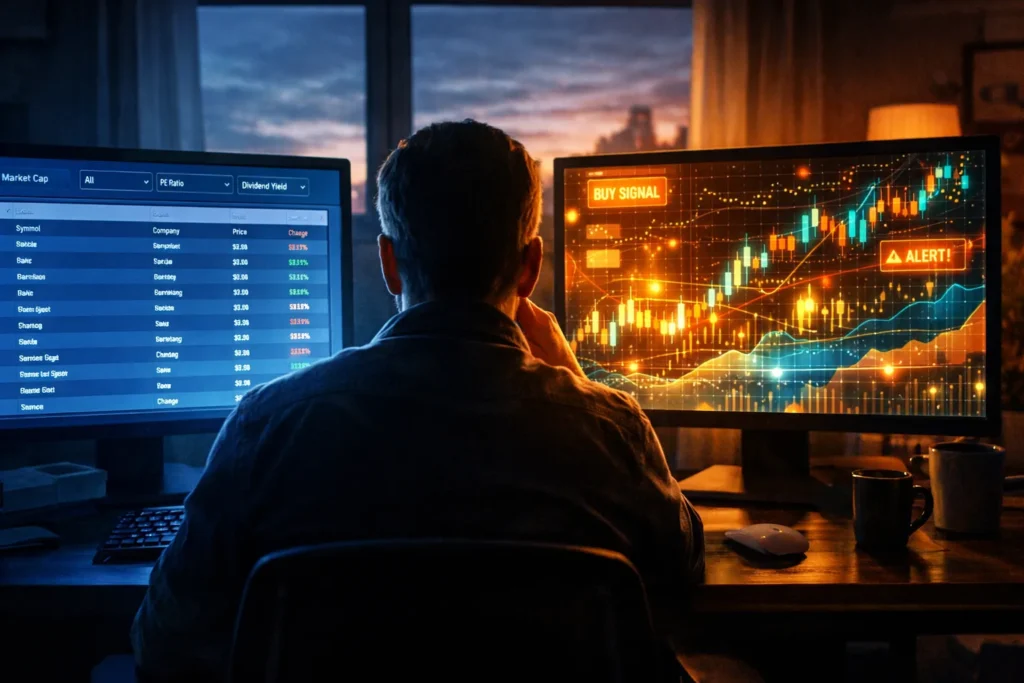
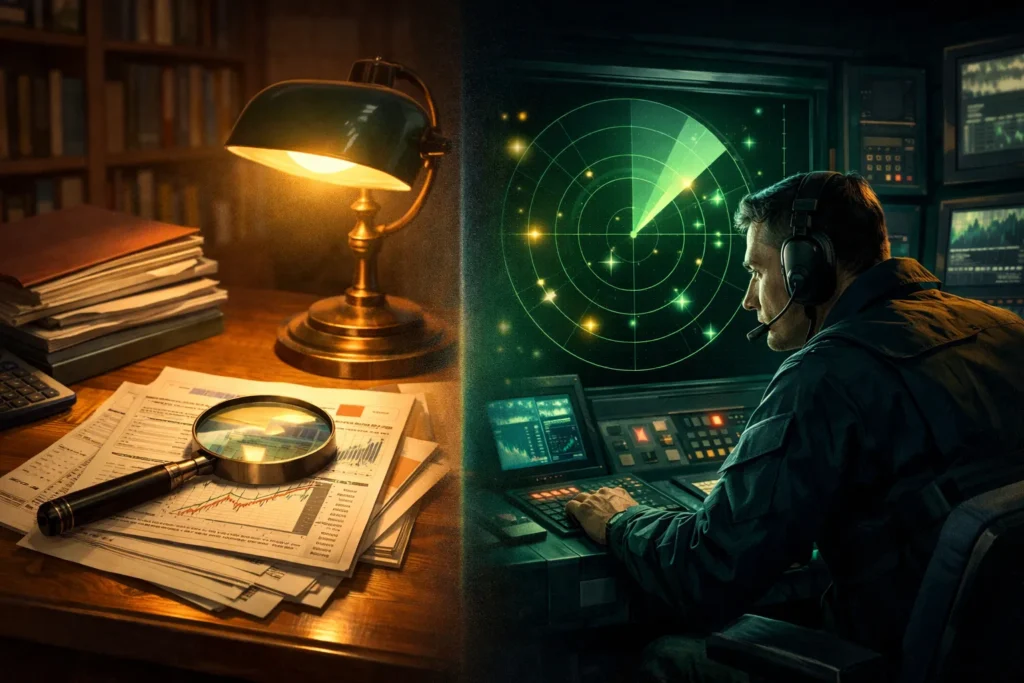
A stock screener is a static filtering tool. You set criteria—market cap over $500M, P/E under 20, average volume above 1 million—and it returns a list. You initiate the search. It waits for you. Think of it as a research librarian: incredibly useful, but you have to walk up and ask the question.
A stock scanner works in real time. You set your criteria once, and the scanner continuously monitors the entire market, pushing alerts to you the instant a stock meets your conditions. It doesn’t wait for you to ask—it taps you on the shoulder. Think of it as a radar system: always on, always watching.
Why does this distinction matter here? Because when people say “AI stock scanner,” they sometimes mean an AI-enhanced screener (like Finviz with pattern overlays) and sometimes mean a genuine real-time AI scanner (like Trade Ideas with Holly). The technology, the cost, and the practical value are very different between those two categories.
For a deeper breakdown of scanner fundamentals—including how to set criteria and avoid common beginner mistakes—check out our Stock Scanners for Day Trading: Beginner’s Guide. This article assumes you understand the basics and focuses on the AI upgrade question.
We’re comparing real-time scanning tools here. AI-powered vs. traditional rules-based. Same arena, different engines.
What Makes a Scanner “AI-Powered”? (Cutting Through the Marketing)
Here’s where the industry gets messy. Roughly 80% of platforms marketing themselves as “AI-powered” are using the same basic technology that’s been around for two decades—pre-programmed rules that filter stocks by price, volume, and indicator thresholds. They’ve just slapped a trendy label on it.
Our team introduced a 4-Level AI Framework in our AI Trading Bots article to help you evaluate any “AI” claim. Here’s a condensed version as it applies to scanners:
Level 1 — Rules-Based Filtering: Pre-programmed if/then logic. “Show me stocks gapping up 5% with volume 3x average.” Most so-called “AI scanners” live here. The criteria never adapt. You change them, or they stay the same forever.
Level 2 — Automated Pattern Recognition: The scanner identifies chart patterns (double bottoms, head and shoulders, trendline breaks) and candlestick formations without you having to define each one manually. TrendSpider’s engine recognizes 220+ chart patterns and 150+ candlestick patterns automatically. That’s genuinely useful—but it’s pattern matching, not learning.
Level 3 — Machine Learning: This is where it gets real. The scanner analyzes historical data, identifies which strategies are working in current market conditions, and adapts its parameters accordingly. Trade Ideas Holly AI runs 60+ strategies through nightly backtesting simulations, essentially re-optimizing for tomorrow’s environment based on what worked recently. The criteria change without you touching them.
Level 4 — NLP/Generative AI Interface: Natural language queries (“Show me small-cap tech stocks building a base near their 20-day moving average with increasing institutional volume”) parsed by a large language model. TrendSpider’s Sidekick AI moves in this direction, letting you type what you want in plain English.
The gap between Level 1 and Level 3 is enormous. And that gap is exactly what the “AI washing” problem exploits.
The “AI Washing” Problem Is Real—And Regulators Are Paying Attention
FINRA—the Financial Industry Regulatory Authority—has specifically called out “AI washing” as a deceptive practice. In their 2025 investor alert on auto-trading risks, FINRA defined AI washing as companies that falsely claim AI capabilities or overstate what their technology actually does to create a perception of cutting-edge sophistication.
The SEC, FINRA, and NASAA issued a joint alert warning that fraudsters frequently leverage the hype around emerging technologies like AI to draw investors into schemes. These warnings aren’t limited to outright scams—they extend to legitimate products that oversell their capabilities.
This matters for scanner buyers. When a basic screener with RSI and MACD filters calls itself “AI-powered,” that’s marketing—not machine learning. Our advice? If a platform can’t explain specifically how its technology learns, adapts, or processes data differently from traditional filtering, be skeptical. FINRA’s guidance is clear: any service using AI should be able to explain with specificity how its technology actually works.

Traditional Scanners — What They Do Well (And Where They Hit a Ceiling)
Let’s give traditional scanning tools their due. They’ve made a lot of traders a lot of money, and they do several things extremely well.
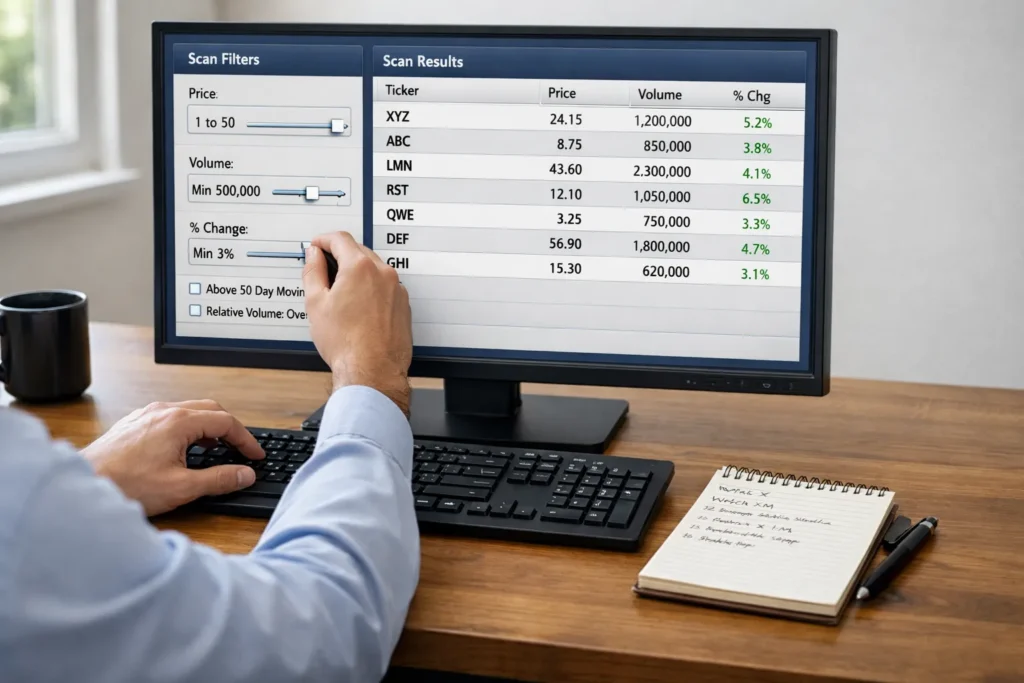
Transparency. You know exactly what criteria the scanner is using because you set them. There’s no black box. If a stock appears in your results, you can trace exactly why. For traders who value full control over their process—and many successful traders do—this transparency is non-negotiable.
Speed and simplicity. A well-configured traditional scanner surfaces results in milliseconds. There’s no AI processing overhead, no latency from machine learning calculations. Platforms like Finviz Elite ($39.50/mo) and TradingView (free to $59.95/mo for Premium) provide powerful filtering at a fraction of what AI scanners cost. For a thorough breakdown of Finviz’s capabilities, see our Finviz Review.
Cost-effectiveness. Finviz’s free tier is genuinely useful for pre-market screening. TradingView’s free plan includes community-built scripts, many of which incorporate technical analysis logic that rivals paid platforms. You can build a functional scanning workflow for zero dollars.
Reliability. Rules-based logic doesn’t have off days. It doesn’t hallucinate patterns that aren’t there. It doesn’t overfit to a dataset that no longer reflects current conditions.
But here’s where traditional scanners hit a ceiling.
Static criteria can’t adapt to changing market regimes. The volume and gap filters that work beautifully in a trending market might generate nothing but noise in a choppy, range-bound environment. You have to manually recognize the shift and adjust your filters—which takes experience, time, and a willingness to constantly tinker.
They only find what you ask for. A traditional scanner can only surface stocks matching the exact criteria you’ve defined. If a high-probability setup develops through a pattern you didn’t program—or a combination of factors you hadn’t considered—you’ll miss it entirely. You can only catch what your net is built to catch.
Volume of missed opportunities scales with market complexity. When you’re monitoring large-cap stocks with a few simple filters, traditional scanning works fine. But as you expand into multiple strategies, timeframes, and sectors simultaneously, the limitations compound. You simply can’t program enough filters to cover every angle—not without creating so many windows that your screen looks like a cockpit and your brain starts melting.
AI Scanners — What’s Actually Different Under the Hood
So what does a genuine AI scanner do that traditional tools can’t?
Adaptive strategy optimization. Trade Ideas Holly AI doesn’t just run the same scan every day. Each night, Holly runs 60+ distinct strategies through simulated backtesting against recent market data, essentially asking: “Which of my strategies would have performed best in the current market environment?” By morning, the strategies have been re-weighted based on what’s actually working now. That’s fundamentally different from a static filter that treats January’s choppy market the same as April’s momentum-driven rally.
For a deeper look at exactly how this nightly backtesting works—including the OddsMaker feature that lets you customize risk parameters—check out our Trade Ideas Holly AI Deep Dive.
Scale of pattern recognition. TrendSpider’s AI engine automatically detects 220+ chart patterns and 150+ candlestick formations across every stock on your watchlist—simultaneously, in real time. A human trader might recognize 15-20 patterns reliably. The gap between “I know what a cup and handle looks like” and “the system is scanning for 220 patterns across 500 stocks at once” is where AI scanning creates practical, measurable value.
Natural language accessibility. TrendSpider’s Sidekick AI lets you type queries in plain English: “Find me tech stocks near their 50-day moving average with above-average volume and an RSI below 35.” Instead of building a filter chain across five dropdown menus, you describe what you want. The AI translates that into the appropriate technical criteria. That’s not just convenience—it reduces the barrier to building complex, multi-factor scans.
Real-time adaptation during the session. Some AI scanners adjust their alert sensitivity based on market conditions throughout the day. High-volatility environments might tighten criteria to reduce noise; low-volatility periods might widen the net to surface fewer but higher-conviction setups.
None of this means AI scanners are perfect. They’re not. We cover the limitations and genuine risks of over-relying on AI tools in our 7 Risks Every Day Trader Must Know article—and we’d recommend reading it before upgrading to anything.
The Morning Workflow Showdown — Traditional vs. AI-Assisted
Theory is nice. But what does this actually look like at 7:30 AM when you’re building your watchlist?
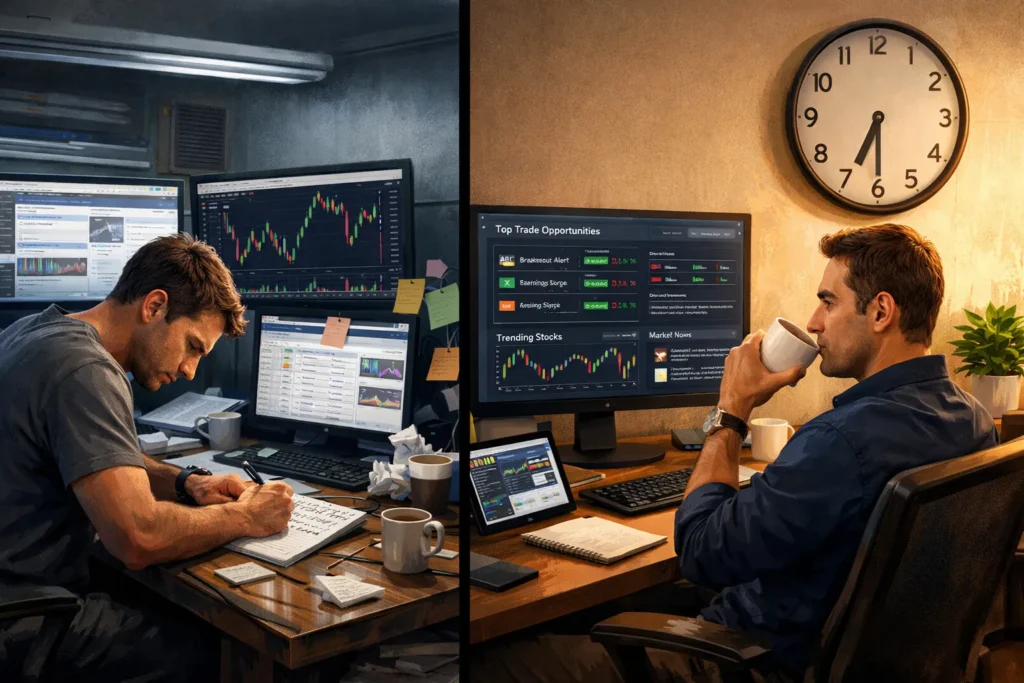
The Traditional Scanner Workflow
7:30 AM — Open Finviz or TradingView. Run pre-market gap screener (stocks up 3%+ on volume 2x average). Get 25-40 results.
7:45 AM — Manually review each result. Open charts. Check for news catalysts. Look for support/resistance levels. Discard 70% of results as noise.
8:00 AM — Narrow to a 5-8 stock watchlist. Set manual alerts on key levels in your charting platform.
8:15 AM — Run a second scan for momentum plays. More filtering. More chart review. Feel the clock ticking.
9:30 AM — Bell rings. You’re watching 5 stocks. Hoping the best setups made your list.
Total active prep time: ~90 minutes. Stocks covered: ~200. Filters used: 3-4 static criteria.
The AI-Assisted Scanner Workflow
7:30 AM — Open Trade Ideas. Holly AI has already run nightly analysis. A curated list of high-probability setups is waiting, ranked by estimated risk/reward and aligned to current market conditions.
7:40 AM — Review Holly’s top picks. Cross-reference with TrendSpider’s pattern detection for confirmation. Check for news catalysts.
7:55 AM — Finalize a 6-10 stock watchlist from AI-generated candidates plus your own manual additions.
8:00 AM — AI scanner runs throughout the session, adapting alerts to intraday conditions. A setup you didn’t see at 7:30 gets flagged at 10:15 because the pattern just completed.
9:30 AM — Bell rings. Your scanner is still working, watching thousands of stocks for criteria that adapt as the day unfolds.
Total active prep time: ~45 minutes. Stocks effectively covered: 6,000+. Filters: Dynamic and adaptive.
The difference isn’t subtle. But it comes at a cost—and whether that cost is justified depends on you.
The AI Upgrade Decision Matrix — 5 Questions to Ask Before You Pay
This is where most articles fail you. They list features and let you figure it out. We’ve built a framework instead—five honest questions that will tell you whether upgrading to an AI stock scanner makes financial sense for your specific situation.

Question 1: How Many Trades Are You Executing Per Week?
If you’re placing fewer than 5 trades per week, a traditional scanner almost certainly handles your needs. You have time to manually review charts, check catalysts, and build your watchlist thoughtfully. The AI premium is buying speed you don’t need.
Between 5 and 15 trades per week, AI scanning starts adding measurable value—not just in finding setups, but in the breadth of opportunities you can evaluate in limited time.
Above 15 trades per week, and you’re operating at a pace where manual scanning creates real bottlenecks. AI scanning likely pays for itself in time savings alone, independent of whether it finds better setups.
Question 2: What’s Your Current Monthly Profitability?
If you’re not yet profitable, stop. Seriously. An AI scanner won’t fix a broken process. It’ll just help you lose money more efficiently on setups you would’ve missed anyway. Invest in education, practice in a paper trading account, and build a strategy first.
If you’re marginally profitable—pulling $500-$1,500/month—consider a mid-tier tool like TrendSpider (starting at $54/mo) that provides automated pattern recognition without the full machine learning price tag.
If you’re consistently profitable at $3,000+ per month, the cost of a full AI suite like Trade Ideas Premium ($178/mo annually) represents less than 6% of your monthly income. At that level, even a small improvement in setup quality or time efficiency generates a positive return.
Question 3: Are You Missing Setups You Recognize in Hindsight?
This is the diagnostic question. Pull up your charts from last week. Look at the stocks that made big moves. How many of them would you have traded if you’d seen them in time?
If the answer is “not many—my scanner caught the ones I would’ve wanted,” your current tools are working. If the answer is “at least 2-3 per week that I only noticed after the move,” AI scanning directly addresses this gap. Its ability to monitor thousands of stocks against hundreds of criteria simultaneously is precisely what catches those opportunities your static filters miss.
Question 4: What’s Your Strategy Complexity?
Running a single strategy on one timeframe—say, gap-and-go on the 5-minute chart—doesn’t require AI scanning. Your criteria are simple, well-defined, and unlikely to change day to day. A traditional scanner handles this beautifully.
But if you trade multiple strategies depending on market conditions—trend following on strong days, range plays on choppy days, reversals on exhaustion patterns—AI’s ability to monitor hundreds of conditions simultaneously across multiple timeframes becomes genuinely valuable. You can’t manually run six different scanners at once. An AI engine can.
Question 5: How Much Is Your Time Worth?
Here’s a calculation most traders skip. If your AI scanner saves you 45 minutes of manual scanning per day, and you value your time at $50/hour, that’s $37.50 in time saved daily—or roughly $9,375 across 250 trading days.
Trade Ideas Premium costs about $2,136 annually. Even at a conservative $30/hour time valuation, the math works if the time savings are real. The key word is if—and that requires you to actually use the time savings for productive trading, not just extra scrolling.
The Cost-Per-Trade Reality Check
Let’s put hard numbers on this, because vague “it might be worth it” answers help nobody.
Trade Ideas Premium (with Holly AI): ~$2,136/year ($178/mo annually). Divided by approximately 250 trading days, that’s roughly $8.54 per trading day.
TrendSpider Standard (AI pattern recognition): ~$648/year ($54/mo). That works out to about $2.59 per trading day.
Finviz Elite (traditional screener): ~$299.50/year. That’s approximately $1.20 per trading day.
TradingView Pro (traditional charting + scanning): ~$179.40/year ($14.95/mo). About $0.72 per trading day.
The upgrade from Finviz Elite to Trade Ideas Premium costs roughly $7.34 per trading day more. For a trader averaging 10+ trades daily, finding even one additional quality setup that generates $15-$20 in profit means the tool has more than paid for itself that day. For a trader placing 2-3 trades per day, that single extra setup needs to be substantially more profitable to justify the premium.
This isn’t an argument for or against upgrading. It’s a framework for running the numbers against your own trading reality. Nobody can do that math for you.
The Hybrid Approach — Why the Smartest Traders Use Both
Here’s what our team has found after years of testing these tools: the most effective scanning workflow isn’t “AI or traditional.” It’s both—strategically deployed at different stages of your trading day.
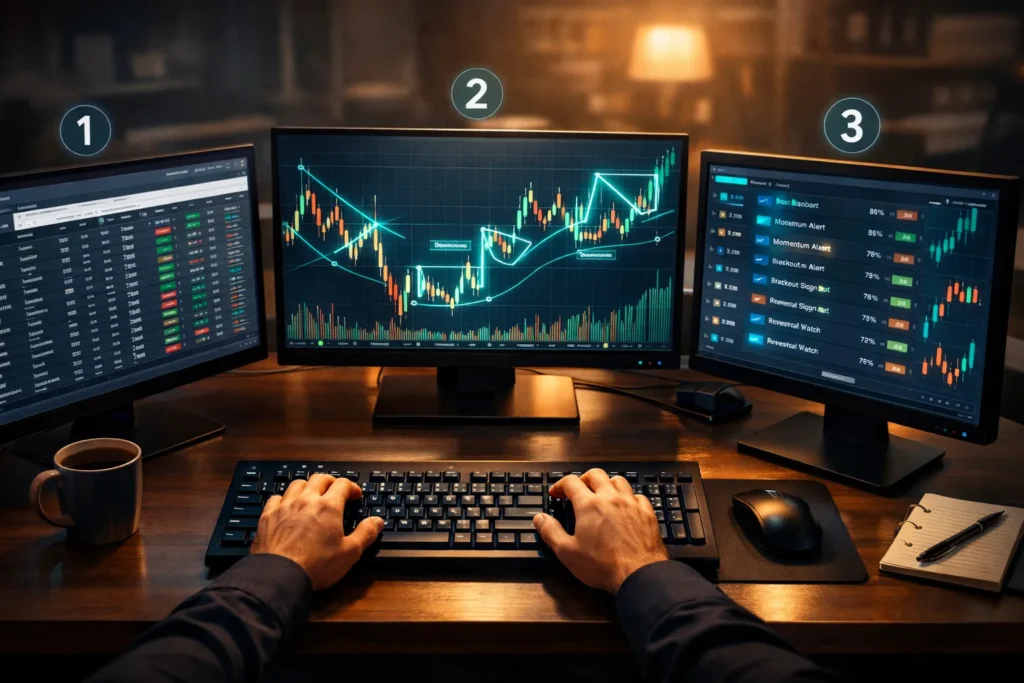
Phase 1 — Pre-Market Discovery (Traditional): Use Finviz’s free screener or TradingView to cast a wide net. Gap screeners, unusual volume filters, sector heat maps. You’re building awareness of the market landscape. Traditional tools do this cheaply and effectively.
Phase 2 — Watchlist Refinement (AI-Assisted): Feed your preliminary watchlist into an AI tool. Let TrendSpider’s pattern recognition identify which of your gap stocks are also forming technical setups. Or let Holly AI provide an entirely separate list of algorithmically-curated opportunities to cross-reference against yours.
Phase 3 — Live Session Monitoring (AI): During active trading hours, this is where AI scanning earns its keep. While you’re managing open positions, the AI scanner is watching thousands of stocks for developing setups, pattern completions, and unusual activity that traditional scanners—which only update when you manually refresh—simply cannot catch.
This layered approach means you’re never entirely dependent on either technology. You maintain the transparency and control of traditional tools while gaining the breadth and adaptability of AI scanning where it matters most—in real-time execution.
The Honest Bottom Line — Who Should (and Shouldn’t) Upgrade
We’ve covered the technology, the costs, and the workflows. Here’s where we give you the straight answer.
Upgrade to a full AI scanner (Trade Ideas Premium tier) if you’re consistently profitable, trading actively (10+ trades/week), and finding yourself regularly missing setups that show up in hindsight reviews. At this level, the cost is a business expense that the tool’s capabilities should more than offset. Check out our Trade Ideas Review for a complete assessment before committing.
Consider a mid-tier AI option (TrendSpider Standard or Premium) if you’re developing consistency, want automated pattern recognition to supplement your manual analysis, and don’t need full machine learning optimization. It’s a meaningful upgrade from traditional scanning at roughly half the cost of the premium tier.
Stay with traditional scanners if you’re still building your foundational trading skills, placing fewer than 5 trades per week, or haven’t achieved consistent profitability yet. No tool—AI or otherwise—fixes a strategy problem. Our team has watched traders burn through expensive subscriptions they weren’t ready to leverage. Don’t be that trader.
And remember our cluster’s core philosophy: AI tools amplify what you already have. If your habits, discipline, and strategy are solid, AI scanning makes them more efficient. If they’re not? The AI just helps you find more ways to make the same mistakes—faster.
Day trading involves substantial risk. AI scanners can help with analysis, but they cannot guarantee profits. Never trade with money you can’t afford to lose.
Frequently Asked Questions About AI Stock Scanners
What is an AI stock scanner?
Quick Answer: An AI stock scanner is a real-time market monitoring tool that uses machine learning, pattern recognition, or natural language processing to identify trading opportunities—going beyond the static, rules-based filters of traditional scanners.
The key distinction is adaptability. A traditional scanner applies the same fixed criteria every day until you manually change them. A genuine AI scanner—like Trade Ideas Holly AI—learns from recent market data and adjusts its parameters automatically. Some AI scanners, like TrendSpider, focus on automated pattern recognition across hundreds of chart formations simultaneously. The technology varies widely, which is why understanding the difference between marketing “AI” and genuine machine learning matters.
Key Takeaway: Not all “AI scanners” use real AI. Look for platforms that can explain specifically how their technology adapts, learns, or processes data beyond basic filtering. Our AI Trading Bots: Truth vs. Hype article provides a framework for evaluating these claims.
What’s the difference between a stock scanner and a stock screener?
Quick Answer: A scanner monitors the market in real time and pushes alerts to you; a screener filters stocks based on static criteria when you initiate a search.
Think of it as proactive vs. reactive. A screener is a research tool—you ask it a question, and it provides an answer based on current or end-of-day data. Useful for building watchlists and longer-term analysis. A scanner is an execution tool—it watches thousands of stocks continuously and notifies you the moment something meets your conditions. Essential for day traders who need to react to setups as they develop. Most modern platforms blur the line by offering both functions, but the underlying technology and use cases remain distinct.
Key Takeaway: Day traders need scanners (real-time); investors and swing traders benefit more from screeners (static). For scanner fundamentals, see our Beginner’s Guide to Stock Scanners.
Are AI stock scanners worth the money for day traders?
Quick Answer: For consistently profitable traders executing 10+ trades per week, yes—the time savings and broader opportunity detection typically justify the cost. For beginners or infrequent traders, probably not yet.
The math is straightforward. Trade Ideas Premium costs roughly $8.54 per trading day. If the AI scanner helps you find even one additional quality setup daily that you would have otherwise missed, and that setup generates $15+ in profit, the tool pays for itself. The problem is that beginners often lack the strategy and risk management skills to capitalize on the setups AI surfaces. An expensive scanner without the skills to use it is like buying a race car before you’ve learned to drive.
Key Takeaway: Use the 5-question Decision Matrix in this article to determine whether upgrading makes sense for your specific trading situation.
What is the best AI stock scanner for day trading in 2026?
Quick Answer: Trade Ideas (with Holly AI) is the most advanced AI scanner for active day traders. TrendSpider is the strongest option for traders who want AI-enhanced charting and pattern recognition at a lower price point.
Trade Ideas Holly AI sits at Level 3 (machine learning) on our framework—it runs nightly backtesting across 60+ strategies and adapts to current conditions. It’s purpose-built for real-time day trading. TrendSpider focuses on automated pattern recognition (Level 2) with an NLP interface (Level 4) and is better suited for traders who want AI to enhance their chart analysis rather than generate independent trade ideas. Both are legitimate AI tools; they just solve different problems.
Key Takeaway: The “best” scanner depends on whether you want AI to find setups for you (Trade Ideas) or confirm setups you’ve identified (TrendSpider). Read our Trade Ideas Review for a complete assessment.
Can AI scanners predict which stocks will go up?
Quick Answer: No. AI scanners identify statistically favorable patterns based on historical data. They assess probability, not certainty—and there’s a critical difference.
Machine learning models like Holly AI analyze historical price patterns and identify setups with favorable risk/reward characteristics. But “this pattern has historically produced a positive outcome 62% of the time” is very different from “this stock will go up.” Markets are inherently uncertain, influenced by news events, institutional flows, and human behavior that no algorithm can fully predict. Any platform claiming its AI can predict stock movements with certainty is making a claim that should raise immediate red flags.
Key Takeaway: AI improves probability assessment—it doesn’t eliminate risk. Always pair AI scanner output with your own analysis and risk management.
How much do AI stock scanners cost?
Quick Answer: Genuine AI scanners range from ~$54/month (TrendSpider Standard) to ~$254/month (Trade Ideas Premium), while traditional scanners range from free (Finviz, TradingView) to ~$39.50/month (Finviz Elite).
The pricing spectrum is wide because the technology is wide. A rules-based screener with good data costs far less to build and maintain than a machine learning engine running nightly backtesting across thousands of stocks. Annual billing typically saves 20-30% over monthly. TrendSpider occasionally offers promotional discounts on first invoices, and Trade Ideas offers an annual plan that drops the Premium tier from $254 to $178/month.
Key Takeaway: Compare costs against your trading frequency using the cost-per-trade analysis above. The right price depends on what the tool is worth to your trading, not on the sticker price alone.
Can beginners use AI stock scanners effectively?
Quick Answer: Beginners can use AI scanner output as a learning tool, but they shouldn’t use AI signals as their primary decision-making process until they’ve developed foundational trading skills.
There’s real danger in giving a beginner trader an AI scanner that surfaces 15 “high-probability” setups per day. Without understanding why those setups are interesting—the chart patterns, the volume dynamics, the risk/reward profile—the trader is essentially following signals they can’t evaluate. That’s a fast path to losses. Our recommendation: start with a free traditional scanner, learn to build your own criteria, understand why certain stocks make good setups, and only then layer in AI tools to expand your reach.
Key Takeaway: Build skills first, then upgrade tools. Free traditional scanners are the right starting place. Our AI Day Trading Complete Guide maps out a realistic progression.
What is “AI washing” in trading tools?
Quick Answer: AI washing is the practice of falsely claiming or overstating AI capabilities in a product’s marketing to attract customers. FINRA has specifically warned investors about this practice.
The term mirrors “greenwashing” in environmental marketing. A scanner that uses basic RSI and MACD filters might be marketed as “AI-powered” simply because those filters run automatically. That’s automation, not artificial intelligence. FINRA’s guidance advises investors to be skeptical of vague technology claims and to require platforms to explain specifically how their technology works. If a platform can’t articulate what makes its AI different from static rules—how it learns, adapts, or improves—treat the “AI” label with caution.
Key Takeaway: Ask any “AI” scanner to explain its technology specifically. If the answer is buzzwords without substance, it’s likely AI washing. Our 7 Risks of AI Trading article explores this issue further.
Are free stock scanners good enough for day trading?
Quick Answer: Yes—for many traders, especially those in their first 1-2 years. Finviz free and TradingView free provide genuinely useful scanning capabilities that can support a profitable trading practice.
The myth that you need expensive tools to succeed is exactly that—a myth. Plenty of consistently profitable day traders use free or low-cost tools combined with strong chart-reading skills and disciplined risk management. Where free tools fall short is in real-time speed (Finviz free has delayed data), breadth of simultaneous monitoring, and adaptive criteria. If your trading strategy is simple, well-defined, and doesn’t require scanning thousands of stocks in real time, free tools handle the job.
Key Takeaway: Free scanners are enough to start and even to sustain profitability for simpler strategies. Upgrade when—and only when—your trading outgrows what free tools can provide.
Should I use Trade Ideas or a free scanner like Finviz?
Quick Answer: They serve different roles and the best answer for many active traders is “both.” Use Finviz for broad pre-market screening and Trade Ideas for real-time AI-assisted scanning during the session.
Finviz excels at pre-market research: heat maps for sector analysis, earnings calendars, screening across fundamental and technical criteria. It’s a discovery tool. Trade Ideas excels at real-time opportunity identification: Holly AI’s adaptive alerts, streaming scanner windows, and simulated trading via its built-in paper trading. It’s an execution tool. Many traders on our team use Finviz to get a sense of the market landscape before the open, then rely on Trade Ideas to surface real-time opportunities during the session.
Key Takeaway: Don’t think of it as either/or. The hybrid approach—traditional for research, AI for execution—often provides the best overall workflow.
Disclaimer
The information provided in this article is for educational purposes only and should not be considered financial advice. Day trading involves substantial risk and is not suitable for every investor. Past performance is not indicative of future results.
For our complete disclaimer, please visit: https://daytradingtoolkit.com/disclaimer/
Article Sources
This article’s analysis was built on research from authoritative financial regulatory and educational sources. Below are the primary references used:
- FINRA — Artificial Intelligence (AI) and Investment Fraud (Joint Alert with SEC & NASAA): Joint SEC/FINRA/NASAA investor alert on AI-related fraud, including the definition of “AI washing” and red flags for evaluating AI investment claims.
- FINRA — Know the Risks of Auto-Trading Services Offered by Unregistered Entities: FINRA’s guidance on auto-trading risks, including specific language defining AI washing and recommendations for investors evaluating AI-powered services.
- SEC/Investor.gov — Artificial Intelligence (AI) and Investment Fraud Alert: The SEC’s investor education alert on AI investment fraud, including red flags and due diligence recommendations.
- FINRA — Regulatory Notice 24-09: FINRA Reminds Firms of Their Obligations Related to the Use of AI: FINRA’s technology-neutral regulatory guidance on AI tool usage, emphasizing that existing obligations apply regardless of the technology employed.
- FINRA — 2026 Annual Regulatory Oversight Report (GenAI Section): FINRA’s latest annual report identifying generative AI as an emerging risk area, with guidance on supervision and vendor diligence for AI tools.
- Investing.com — What Is a Stock Screener?: Educational reference for stock screener and scanner definitions, functionality comparisons, and use-case guidance.


