
Look—trading doesn’t have to be a solo act played out in a dark room at 3 AM.
We’ve been in this game long enough to know the uncomfortable truth: most traders who go it alone don’t make it. Not because they lack intelligence or drive, but because they’re trying to reinvent the wheel while the market punishes every mistake with real money. Meanwhile, traders who build strong networks—who find the right mentors, connect with solid communities, and create accountability partnerships—accelerate their learning curve and avoid the costly errors that blow up accounts.
Here’s what we’re covering in this guide: the proven strategies for building a trading network that actually moves the needle, how to identify legitimate mentors versus the Instagram scammers, where to find valuable trading communities (both free and paid), and the framework for evaluating opportunities before you commit time or money. We’ll also show you the red flags that scream “scam” and the green flags that signal you’ve found something real.
The goal isn’t just to connect you with other traders—it’s to help you build a support system that makes you sharper, keeps you disciplined, and gives you the collective wisdom of people who’ve already navigated the path you’re on.

Why Every Trader Needs a Network (The Science Behind Community)
The Proven Benefits of Trading Communities
Trading communities aren’t just nice-to-have social clubs. Research on mentorship and peer learning shows they provide tangible benefits that directly impact your bottom line.
Knowledge sharing and diverse perspectives. When you’re part of a real trading community, you get exposed to different strategies, market views, and problem-solving approaches. Our team has seen this firsthand—watching the same chart setup, but hearing how an options specialist, a scalper, and a swing trader each see different opportunities. That diversity of thought keeps you from getting tunnel vision on one approach.
Emotional support during drawdowns. Let’s be real—trading is psychologically brutal. Research demonstrates that mentorship and community support help traders manage psychological hurdles including fear of missing out, revenge trading after losses, analysis paralysis, and overconfidence following winning streaks. When you’re in a 20% drawdown and questioning everything, having traders who’ve been there (and survived) makes the difference between staying disciplined and blowing up your account.
Accountability and discipline reinforcement. Here’s the kicker: you’re way more likely to follow your trading discipline when you know someone’s watching. Accountability partners keep you honest about following your plan, sticking to your risk limits, and maintaining your trading journal.
Access to opportunities and resources. Connected traders get first access to information—new tools, platform features, market inefficiencies, even job opportunities at prop firms. Professional networks open doors that solo traders never even see.
What Research Says About Mentorship in Trading
The academic research on mentorship is clear, and it applies directly to trading. Studies from the National Academies of Sciences show that mentorship provides both career support functions—including career guidance, skill development, and sponsorship—and psychosocial support functions like psychological and emotional support and role modeling.
A comprehensive meta-analysis comparing mentored and non-mentored individuals found that mentoring is associated with favorable behavioral, attitudinal, and career outcomes, though researchers note that effect sizes are generally small to moderate. Translation? Mentorship helps, but it’s not magic. You still have to do the work.
The quality of perceived mentorship strongly shapes mentees’ beliefs in their own skills and predicts self-efficacy, which in turn predicts long-term success. In trading terms: if you believe your mentor is helping you actually improve (not just feeding you hot stock tips), that confidence translates into better execution and risk management.
The research also reveals something interesting—multiple mentors through developmental networks are often more effective than relying on a single mentor. You need different people for different aspects of your development. One mentor for technical analysis. Another for risk psychology. Maybe a peer group for accountability.
The Four Types of Trading Relationships You Need
Most traders think in binary terms: mentor or no mentor. That’s too simplistic. Here’s what a complete trading network actually looks like.

1. Mentors (The Experienced Guide)
A mentor is someone who’s been in the trenches, survived the learning curve, and can show you the ropes. They provide real-time feedback on your trades, help you develop personalized strategies, and—most importantly—challenge your thinking when you’re about to do something stupid.
What mentors provide:
- Pattern recognition from years of screen time you don’t have yet
- Frameworks for risk management and position sizing
- Emotional coaching during losses and wins
- Industry connections and opportunities
When you need one vs. when you don’t: If you’re brand new and overwhelmed, you need structure before mentorship. Get through paper trading, build your first trading plan, then seek a mentor. If you’re stuck at breakeven after 6-12 months of serious effort, that’s when a mentor can diagnose your specific problems.
2. Trading Partners (The Accountability Buddy)
This is someone roughly at your skill level—or slightly above—who serves as your second set of eyes. Trading partners look at charts with fresh perspective and honestly share their viewpoint, which could be quite different from yours, to challenge your thinking and keep you accountable to yourself.
Think of it like a workout partner. They’re not your coach, but they keep you showing up and call out your BS when you’re cutting corners. The best trading partners are those who will challenge your analysis. Someone too agreeable does you a disservice—you need constructive friction.
You might review each other’s trade journals weekly, discuss setups before the market opens, or just check in on whether you’re both following your rules. The relationship should feel like a partnership, not a competition.
3. Trading Communities (The Supportive Network)
These are your broader connections—chatrooms, Discord servers, forums, or local meetup groups where traders gather to share ideas and experiences. Communities come in all shapes: from free Reddit groups with thousands of members to paid chatrooms with a dozen serious traders.
Online vs. in-person communities: Online communities offer scale and convenience. You can learn from traders worldwide, across different markets and strategies. In-person communities—local trading meetups or conferences—create deeper relationships. There’s something about meeting someone face-to-face that builds trust you can’t replicate in a Discord channel.
Active vs. passive participation: Passive lurking in communities teaches you almost nothing. The real value comes from active participation—asking questions, sharing your own analysis (even when it’s wrong), and contributing to discussions. Communities reward contributors and ignore spectators.
4. Professional Networks (The Career Accelerator)
This is the elite level—connections with professional traders, prop firm owners, industry insiders, and experienced market participants who can open doors. These aren’t people who will teach you how to read a candlestick chart. They’re the ones who might offer you a funded account, introduce you to other professionals, or give you insights into institutional trading.
Elite networks and how to access them: Some trading clubs are genuinely exclusive—requiring verified track records, minimum account sizes, or referrals from existing members. You don’t typically start here. You build your way up by demonstrating competence, contributing value to lower-tier communities, and networking strategically at trading conferences.
Mentors with extensive networks can provide introductions to professional connections if you’ve proven yourself. Your trading performance becomes your credential.
Where to Find Legitimate Trading Mentors and Communities
Building a trading network starts with knowing where to look. Here are the proven channels where serious traders actually connect.
Online Trading Communities and Platforms
Discord servers and Slack groups have become the modern trading floor. These real-time chat platforms let you watch experienced traders think through setups, ask questions immediately, and participate in live market discussions. The best servers have separate channels for different strategies, markets, and experience levels.
Warning: Discord is also flooded with scammers. Any server that immediately pushes you toward paid signals or “guaranteed profit” systems should trigger your alarm bells. Legitimate communities focus on education and discussion, not selling you the next hot stock.
Reddit trading communities like r/Daytrading, r/stocks, and r/options offer massive scale with quality that varies wildly. You’ll find both genuinely helpful analysis and complete nonsense within the same thread. The key is learning to filter signal from noise—and never making trading decisions based solely on Reddit sentiment. Use it for ideas and perspectives, then verify everything independently.
StockTwits and social platforms give you real-time access to what other traders are watching, but be cautious. Social sentiment can be a useful contrarian indicator (when everyone’s screaming about a stock, it’s often too late), but following the herd blindly is how accounts die. These platforms work best for finding potential setups to research, not for copying trades.
Investors Underground: A proven community model. When we’re asked about legitimate paid communities, Investors Underground consistently comes up. Founded by traders who share their actual trades in real-time, the community focuses on momentum trading strategies with transparent P&L. The chatroom provides live commentary during market hours, educational resources, and a network of serious traders. It’s not cheap, but the accountability and real-time learning environment justify the cost for traders who are committed. The platform combines mentorship from verified profitable traders with a community that holds you accountable to your rules.
Trading Education Platforms with Built-In Communities
Some of the best networks form around trading tools and education platforms. You’re learning the tools while connecting with others who use the same systems.
Trade Ideas: Scanner technology + community chat rooms. Trade Ideas is primarily known for its AI-powered stock scanning software, but the real secret weapon is the community aspect. Their platform includes chat rooms where traders discuss the setups the scanners are highlighting in real-time. You learn to use the scanning tools while simultaneously seeing how experienced traders interpret and filter those signals. It’s like having a mentor looking over your shoulder, explaining why they’re taking one scanner alert and ignoring another. The integration of tool education and community feedback creates a powerful learning environment. For more on finding the right stocks to trade, check out our guide on stock scanners.
TradingView: Social network for traders. TradingView has quietly become the largest social network for traders and investors globally. Beyond its industry-leading charting platform, TradingView lets you follow other traders, see their published chart analyses, discuss setups in the comments, and even copy their chart layouts. The platform’s “Ideas” section showcases analyses from traders worldwide, letting you see how others approach technical analysis across different markets. The community aspect is completely free—you can participate in discussions, publish your own analysis, and follow top-rated contributors without paying a dime. The transparency is refreshing: you see exactly how each trader’s past predictions played out.
Other legitimate platforms: Other communities worth exploring include Warrior Trading (primarily for small-cap momentum), Bear Bull Traders (founded by Andrew Aziz, focused on small account growth), and Timothy Sykes’ community (penny stock focus, though controversial and expensive). Each has different trading styles and price points. The key is finding one that matches your strategy and personality.
Trading Events and Conferences
Virtual webinars and workshops have exploded since 2020. Many brokers and platforms offer free educational webinars featuring professional traders. While these are often sales-focused, you can still extract value—and sometimes connect with other attendees in the chat or breakout sessions. Paid workshops typically provide more depth and better networking opportunities.
In-person trading conferences like the Traders Expo, MoneyShow, and various regional trading summits offer concentrated networking. You meet people face-to-face, attend presentations from industry professionals, and build relationships that extend beyond the conference. These events attract serious traders, platform developers, educators, and industry insiders. Yes, you’ll also encounter vendors and promoters, but the networking value can be substantial if you’re strategic about who you approach.
Local trading meetups might exist in your city—check Meetup.com or local financial groups. These smaller gatherings lack the polish of major conferences but often create tighter-knit communities. You might find a group of five traders who meet monthly at a coffee shop to discuss their trades. Sometimes that small, consistent group provides more value than a thousand-person conference.
LinkedIn and Professional Networks
LinkedIn isn’t just for corporate job seekers. The platform has become surprisingly useful for building trading networks. Join trading-focused groups, engage with content from traders you respect, and share your own insights (without the hard-sell approach that plagues other platforms).
Building your trading profile: Your LinkedIn should reflect your actual trading journey. Be honest about where you are. If you’re learning, say so—and document what you’re learning. If you’re profitable, share insights without bragging. The goal is to appear professional and thoughtful, not to flex unrealistic returns.
Joining relevant groups and reaching out strategically: Don’t spam connection requests. When reaching out to potential mentors or trading contacts, personalize your message. Reference something specific they’ve shared, explain why you want to connect, and make it easy for them to say yes. Think about what you can offer, not just what you want to take.
How to Evaluate a Trading Mentor (Red Flags vs. Green Flags)
This is where most traders get burned. The trading education industry is infested with frauds—people who make more money selling courses than trading. Here’s your framework for separating legitimate mentors from the scammers.
The Critical Questions to Ask Before Committing
Track record verification: Ask to see actual brokerage statements—not screenshots that can be faked, but real account statements. Any legitimate mentor willing to charge you for their expertise should be willing to prove they can actually trade. Look for consistency over time, not just one lucky year.
Red flag: “I can’t share my statements because of my broker’s rules.” That’s nonsense. You can share statements with identifiers redacted. If they won’t show proof, walk away.
Teaching methodology: How do they actually teach? Is it live trading where you watch their process, or pre-recorded videos of cherry-picked winning trades? The best mentors show their entire thought process—including the trades they don’t take and the losses they manage properly. Ask about their curriculum, the time commitment required, and how they measure your progress.
Time commitment and availability: Will you get one-on-one time, or is this just access to a chatroom? How many students do they actively mentor? Some “mentorship programs” are really just group chats with 500 people where the guru pops in once a week. That’s not mentorship—that’s content consumption.
Pricing transparency: Legitimate mentors have clear, upfront pricing. Be extremely cautious of:
- Programs that require you to “apply” just to learn the price
- High-pressure sales tactics (“this price expires tonight”)
- Tiered systems designed to upsell you repeatedly
- Costs that seem disconnected from the value provided
8 Red Flags That Scream “SCAM”

The SEC and FINRA have documented the most common fraud tactics. Here’s what to watch for:
1. Guaranteed returns promises. No one can guarantee returns in trading. Period. Anyone who promises specific profit percentages is either lying or doesn’t understand how markets work. The promise of high returns with little or no risk is the classic hallmark of investment fraud, according to FINRA research.
2. Pressure tactics and urgency. Scammers create false urgency by claiming limited spots available or time-sensitive pricing. Real educators and mentors don’t need to manufacture scarcity. They’re confident enough in their value to let you take time to decide.
3. No verifiable track record. If they claim to be profitable but can’t (or won’t) prove it, assume they’re not. It’s that simple. Scammers often misrepresent their backgrounds or create entirely fictional trading careers.
4. Secretive about methodology. “I’ve discovered a proprietary system that beats the market” is code for “I’m making this up.” Legitimate strategies are built on sound principles you can understand and verify. If they can’t explain the “why” behind their approach, it’s probably because there is no “why.”
5. Focus on lifestyle, not education. Watch out for the Instagram trader flexing rental cars and Photoshopped account balances. If their marketing is all about money, watches, and “the laptop lifestyle,” they’re selling you a dream—not an education. Real traders talk about process, risk management, and the grind. Scammers sell fantasy.
6. Testimonials that seem fake. Look for reviews outside their controlled ecosystem. Check forums, Reddit, and review sites. Be skeptical of testimonials on their own site that are all glowing with no specific details. Real reviews include both positives and constructive criticisms.
7. Unusually high costs with vague deliverables. If you’re paying $5,000+ but can’t get clear answers about exactly what you’re getting, that’s a problem. Legitimate programs spell out the curriculum, the time commitment, what resources you receive, and what support you can expect.
8. Resistance to questions. Any mentor who gets defensive or evasive when you ask basic due diligence questions is hiding something. Legitimate educators welcome questions—they know informed students make better clients and get better results.
6 Green Flags of Legitimate Mentors
Now let’s flip it. Here’s what legitimate mentorship looks like:
1. Transparent track record. They openly share verified trading results—including losses. They explain their drawdowns and how they managed them. Real traders have bad trades and bad months; they don’t pretend otherwise.
2. Educational focus over profit promises. They emphasize learning process over making money fast. They talk about the time it takes to develop competence, the importance of risk management, and the psychological challenges you’ll face. Their marketing reflects reality, not fantasy.
3. Clear curriculum and expectations. You know exactly what you’re getting: X hours of instruction, Y amount of personal feedback, Z resources included. They set realistic timelines for your development and are honest about the work required.
4. Reasonable pricing structure. Costs are proportional to what’s provided and transparent from the start. They might offer payment plans, but they’re not playing psychological pricing games or creating artificial scarcity.
5. Active, engaged community. The mentor actually participates in their community. You can see them answering questions, sharing current analysis, and demonstrating their ongoing involvement. The community members discuss real trading—not just cheerleading the guru.
6. Emphasis on risk management. This is the biggest tell. Legitimate mentors talk constantly about protecting capital, position sizing, and managing losses. They understand that managing fear and greed is as important as finding good setups. Scammers barely mention risk because they’re not actually trading.
Evaluating Trading Communities Before You Join
Not all communities are created equal. Some are gold mines of information; others are toxic wastelands that will corrupt your thinking. Here’s how to tell the difference.
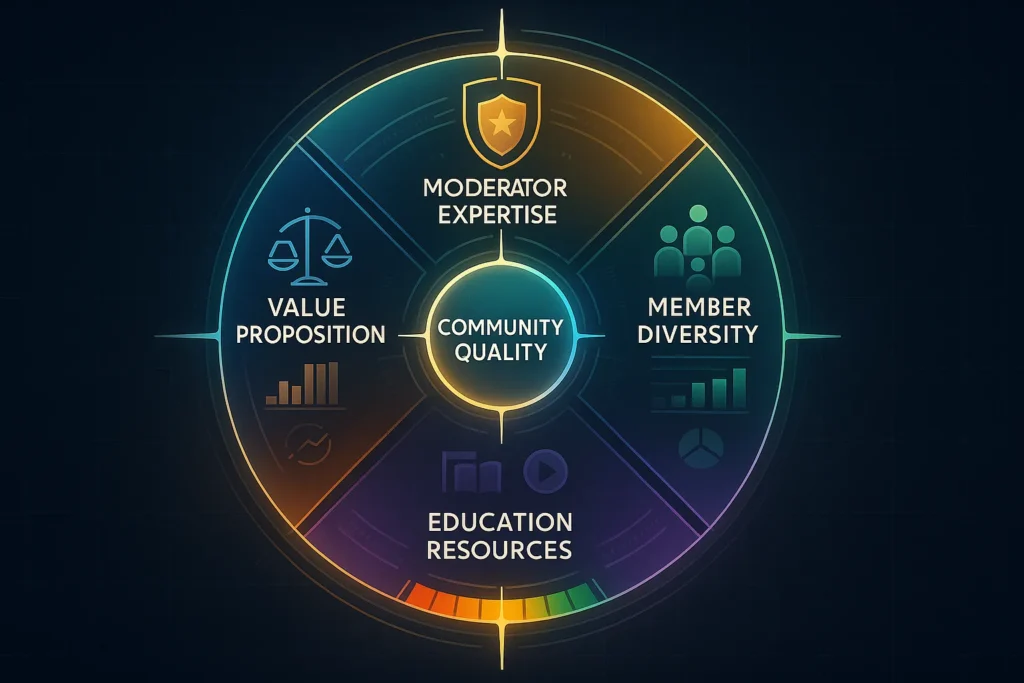
The 5-Point Community Assessment Framework
Quality of discussions (signal vs. noise). Spend a week lurking before you commit any money. What’s the signal-to-noise ratio? Are people sharing thoughtful analysis, or is it just an echo chamber of confirmation bias and cheerleading? High-quality communities have substantive discussions about strategy, risk, and market structure. Low-quality communities are dominated by “rocket ship” emojis and “to the moon” hype.
Moderator involvement and expertise. Who’s running this community, and are they actually trading? The best communities have active moderators who are verified traders, not just community managers. They set the tone, enforce quality standards, and provide educational content. If moderators are absent or just policing spam without adding value, that’s a red flag.
Member skill diversity. A healthy community has traders at different levels—beginners asking questions, intermediate traders sharing analysis, and advanced traders offering perspective. If everyone claims to be an expert, you’re probably in a room full of frauds. If everyone’s a beginner with no experienced voices, you’re in an echo chamber where the blind lead the blind.
Educational resources available. Does the community provide real value beyond the chat? Look for educational libraries, recorded webinars, trading resources, or organized learning paths. Communities that invest in education typically attract serious traders. Those that just provide a chatroom are often low-effort cash grabs.
Cost vs. value proposition. Free communities can be excellent if well-moderated. Paid communities should clearly justify their cost with tangible benefits—verified expert access, exclusive education, advanced tools, or networking opportunities you can’t get elsewhere. If you’re paying $200/month just for access to a chatroom with no additional structure, question whether that’s worth it.
Free vs. Paid Communities: What You Actually Get
Reddit/Discord pros and cons. Free platforms democratize access to trading knowledge, which is fantastic. You can learn an enormous amount on r/Daytrading or in free Discord servers. The downside? No quality control. You’ll wade through mountains of terrible advice, scams, and ego-driven nonsense to find the valuable insights. You need strong filters and the ability to verify information independently.
Free communities also lack accountability. People can (and do) lie about their results without consequences. They can share reckless strategies that would blow up real accounts. Use free communities as one input among many, not as your primary education source.
When paid communities are worth it. Paid communities earn their cost when they provide verified expertise, structured learning, and genuine accountability. If you’re getting access to proven traders who share real-time analysis, review your trades, and maintain quality standards, that’s potentially worth hundreds per month. The key word is “proven”—you need to verify their credentials before paying.
Paid communities also filter out the purely casual traders. When people pay to be there, they tend to take it more seriously. The discussions generally have higher quality because everyone has skin in the game.
Trial periods and money-back guarantees. Never commit to a paid community long-term upfront. Legitimate programs offer trial periods (7-14 days) or money-back guarantees (30 days). This lets you verify the value before fully committing. If a community won’t let you try before you buy, that tells you something about their confidence in their product.
A Self-Assessment Framework: What Do You Actually Need?
Before you start building your network, get honest about where you are and what you need. Most traders skip this step and end up in communities or mentorships that don’t match their development stage.
Evaluating Your Current Trading Skills
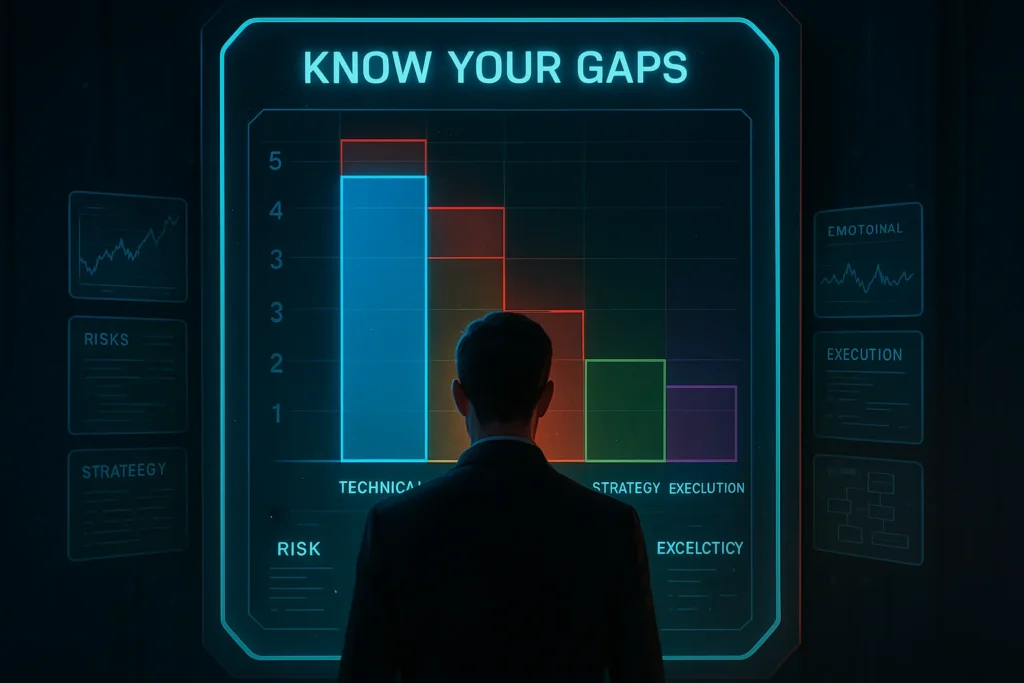
Rate yourself honestly in these key areas on a scale of 1 to 5 (1 = beginner, 5 = expert):
| Trading Area | Your Rating (1-5) | Focus Areas |
|---|---|---|
| Technical Analysis | ___ | Chart reading, indicator usage, pattern recognition, complex indicators, multiple timeframe analysis |
| Risk Management | ___ | Position sizing, stop-loss strategy, portfolio balance, risk-reward ratios |
| Market Psychology | ___ | Emotional control, decision-making under pressure, stress handling, FOMO management |
| Strategy Development | ___ | Trading plan creation, backtesting, strategy execution, market adaptation |
| Execution | ___ | Order types, entry/exit timing, managing live positions, using trading platforms |
This assessment reveals your gaps. If you rated yourself 1-2 in most areas, you need structured education before mentorship. Focus on courses, books, and paper trading to build foundational skills.
If you’re 3-4 across the board but stuck at breakeven, that’s where mentorship and community feedback become crucial. You know the mechanics, but you need help refining execution and psychology.
If you’re 4-5 in most areas and consistently profitable, you need peer networks and professional connections—not basic mentorship.
Setting SMART Goals for Your Trading Network
Don’t just vaguely want “a mentor.” Get specific about what you’re trying to achieve. Use the SMART framework:
Specific: “I want to find a mentor who trades small-cap momentum stocks using technical analysis, can review my trades weekly, and has at least 3 years of verified profitability.”
Measurable: “I’ll connect with at least 3 potential mentors, participate in 2 trading communities for 30 days each, and attend 1 trading conference in the next 6 months.”
Achievable: Don’t set goals like “find the perfect mentor in 2 weeks.” Finding the right fit takes time. Be realistic about what you can accomplish given your time and budget constraints.
Relevant: Your networking goals should directly support your trading development. If you trade long-term positions, joining a scalping community isn’t relevant—no matter how active it is.
Time-bound: “Within 3 months, I will identify and join one paid community that focuses on momentum trading and has verified profitable members.”
Clear goals prevent you from bouncing around aimlessly or falling for the first charismatic guru you encounter.
How to Build Strong Trading Relationships (The Right Way)
You’ve found potential mentors and communities. Now you need to actually build relationships that matter. Here’s how to do it without being that annoying person everyone ignores.

Making the First Contact with Potential Mentors
Crafting compelling introductions. Your outreach message is your first impression—make it count. A good introduction includes:
- Who you are and your current trading experience (be honest)
- Why you’re reaching out to them specifically (reference something they’ve shared or taught)
- What you’re looking for (be clear about what you need)
- What you can offer (yes, even as a newer trader, you can contribute value)
Bad example: “Hey, I want to learn to trade. Can you teach me?”
Good example: “Hi [Name], I’ve been following your breakdown of momentum strategies and particularly appreciated your analysis of volume patterns in your recent post. I’ve been trading for 18 months, primarily focused on small-cap breakouts, but I’m struggling with risk management on fast-moving stocks. I’m looking for mentorship focused specifically on position sizing and stop placement for volatile stocks. I’m committed to the work and happy to compensate you appropriately for your time. Would you be open to a brief conversation about potential mentorship?”
What to include (and skip). Include specifics about your situation, your commitment level, and any relevant experience. Skip the sob stories, the promises to be the best student ever, and any sense of entitlement. Also skip anything that suggests you’re looking for a shortcut to riches.
Following up professionally. If you don’t hear back in a week, one polite follow-up is appropriate. If you still don’t hear back, move on. Successful traders are busy. Don’t take silence personally—and definitely don’t spam them with repeated messages.
Setting Clear Expectations from Day One
Once you establish a mentorship relationship, nail down the logistics immediately:
Communication frequency. How often will you meet or communicate? Weekly video calls? Daily message access? Monthly reviews? Get specific. Mismatched expectations on availability kill more mentorships than anything else.
Progress tracking methods. How will you measure improvement? Is it reviewing your trade journal every week? Analyzing your P&L monthly? Demonstrating specific skills? Having clear milestones keeps both parties accountable and prevents the relationship from becoming directionless.
Boundaries and confidentiality. What’s appropriate to share publicly, and what stays private? Can you reference your mentor by name in trading communities? Can they use your trades as teaching examples? Address this upfront to avoid awkwardness later.
Payment terms (if applicable). If this is a paid mentorship, get the terms in writing. How much, when, what’s included, cancellation policy. Professional relationships require professional structure.
Being a Valuable Community Member
Want to get the most from a trading community? Stop taking and start contributing.
Contributing before asking. New members often join a community and immediately start asking questions that have been answered a hundred times. That’s exhausting for everyone else. Spend your first week (at least) observing, reading the archives, and understanding the culture. When you do contribute, share your own analysis, post helpful resources, or answer questions from other newbies.
Sharing your own insights. Even as a newer trader, you have value to add. Maybe you found a great article on trading psychology. Maybe you discovered a helpful way to organize your watchlist. Maybe you failed spectacularly and can explain what you learned. Vulnerability and transparency make you relatable and trustworthy.
Asking quality questions. The difference between a good question and a bad question is specificity.
Bad question: “What do you think about AAPL?”
Good question: “I’m watching AAPL for a potential breakout above $185 on the daily chart, with volume confirming. However, I’m concerned about the broader market weakness. How do you weigh individual stock setups against overall market conditions when deciding position size?”
Good questions show you’ve done your homework and are looking for specific guidance, not a hot tip.
Respecting others’ time. Don’t expect instant responses. Don’t send unsolicited direct messages to community leaders asking them to review your trades when that’s not what they signed up for. Don’t dominate discussions or argue endlessly when you don’t like an answer. Respect is the currency of every successful community.
Common Mistakes When Building a Trading Network
Even with good intentions, traders sabotage their own networking efforts. Here are the traps to avoid.
The Comparison Trap: Keeping Your Own Pace
You join a community and immediately see people posting their big wins. Five-figure days. Ten-bagger options plays. Accounts doubling in a month. And suddenly your slow, steady progress feels pathetic.
Stop.
Every trader has their own timeline. Comparing your chapter 2 to someone else’s chapter 20 is a recipe for reckless decisions. Those big wins you’re seeing? You’re not seeing the years of losses that came before, or the context of their account size, or the losses they’re not posting.
Focus on your own measurable improvement. Are you making fewer emotional mistakes this month than last? Are you following your plan more consistently? Is your risk management tighter? That’s what matters—not whether someone else made $10K on a single trade.
The irony is that the traders posting the most about their wins are often the least successful long-term. Consistently profitable traders tend to be quieter about specific results and more focused on process.
Over-Reliance: Why You Still Need Independent Thinking
Trading communities and mentors should enhance your decision-making—not replace it. We’ve seen traders become so dependent on their chatroom that they can’t take a trade without group consensus. That’s not trading; that’s following.
The goal of mentorship and community is to develop your independent judgment, not to create dependency. Use mentors to learn frameworks and develop skills. Use communities to test your thinking and get feedback. But ultimately, you need to trust your own analysis and make your own decisions.
If you find yourself unable to trade without checking the chatroom first, you’re over-reliant. Step back, return to basics, and rebuild your confidence in your own process.
Following Blindly: Verifying Information Always
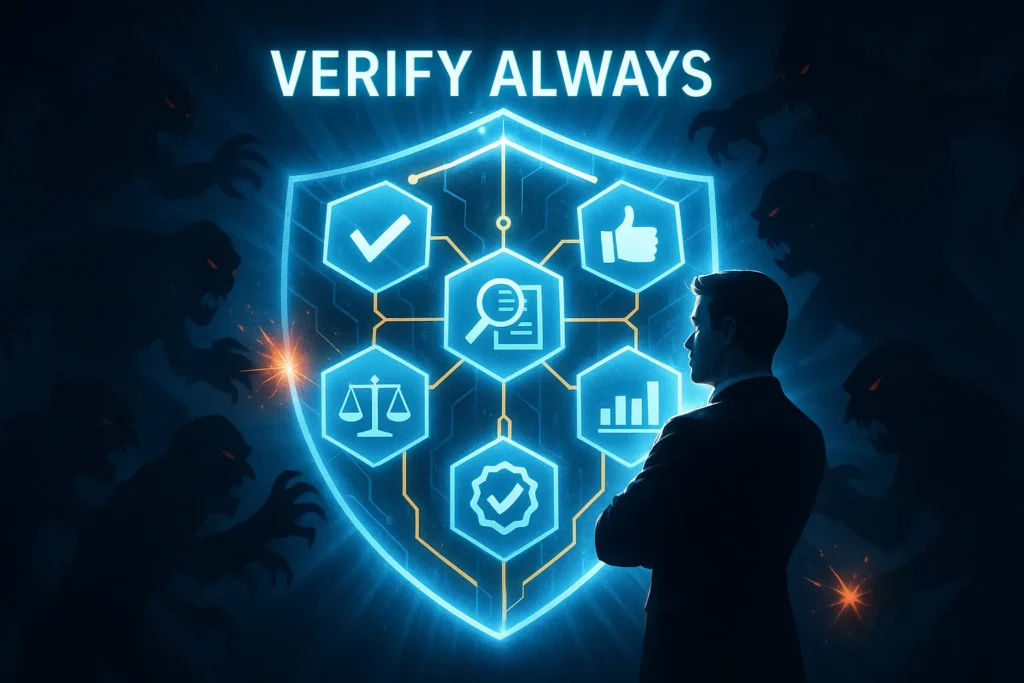
Here’s a rule that will save you money and heartache: verify everything. Even information from people you trust and respect.
Someone shares a “stat” about a trading pattern? Look it up. A mentor explains a concept? Cross-reference it with other sources. The group consensus is strongly bullish on a stock? Do your own analysis before committing capital.
Cognitive biases are powerful in trading—particularly confirmation bias and herd behavior. Research on financial decision-making shows that traders often exhibit loss aversion, overconfidence, and availability bias, even when they’re aware of these tendencies. The only defense is rigorous, independent verification of information before acting on it.
Community groupthink is real. Just because twenty smart people agree doesn’t make them right. Markets punish consensus thinking regularly. Your job is to think independently while considering others’ perspectives—not to blindly follow the crowd.
Neglecting the Relationship: Maintaining Connections
Building a network is just the start. Maintaining it requires consistent effort. The biggest mistake traders make is treating relationships transactionally—they engage when they need something, then disappear when things are going well.
Check in periodically with your trading partners and mentors even when you don’t need anything specific. Share articles you found helpful. Congratulate them on achievements. Offer help when you can. Relationships are investments that compound over time—but only if you consistently add to them.
The traders with the strongest networks are the ones who give more than they take and maintain connections even when it’s not immediately beneficial to them.
Real-World Success: How Communities Amplify Trading Performance
Theory is great. Let’s talk reality. Trading communities and networks have demonstrated real, measurable impact on trader performance—when done right.

The GameStop Case Study: Community Power in Action
In January 2021, a Reddit community demonstrated the immense power of collective action in markets. The r/WallStreetBets forum rallied around GameStop stock, with members sharing analysis, encouraging each other to hold positions, and creating a massive short squeeze that cost hedge funds billions.
Now, we’re not recommending you chase meme stocks or try to recreate that moment. But the episode illustrated several truths about trading communities: collective information sharing can identify opportunities traditional analysis misses, community support helps traders maintain conviction during volatility, and organized groups can move markets in ways individual traders cannot.
The takeaway isn’t about finding the next GameStop—it’s about understanding that connected traders have advantages that isolated traders lack. When thousands of people are collaborating, sharing research, and acting together, they become a force in the market.
Examples of Traders Who Credit Communities
Many professional traders openly credit their networks with their success. While we can’t name specific community members (privacy matters), we’ve seen consistent patterns: traders who engage seriously with quality communities tend to survive the early years when most fail. They avoid the common beginner mistakes because someone warns them off. They develop strategies faster because they can test ideas against experienced traders’ feedback.
The compound effect of shared knowledge is real. When ten traders each research a different aspect of market structure and share their findings, everyone in the group benefits from work they didn’t have to do themselves. That’s leverage—the good kind.
One consistent finding: traders with strong accountability relationships—particularly trading partners they check in with daily or weekly—maintain discipline better during both winning and losing streaks. Having someone ask “did you follow your plan today?” matters more than most traders expect.
Frequently Asked Questions
How do I find a legitimate trading mentor?
Quick Answer: Start by verifying track records through brokerage statements, checking references independently, and ensuring they emphasize education over profit promises.
Finding a legitimate trading mentor requires thorough due diligence. First, demand proof of consistent profitability—real brokerage statements, not screenshots. Ask to speak with current or former students about their experience. Examine the mentor’s teaching methodology to ensure it includes both theory and practical application. Legitimate mentors focus on skill development, risk management, and psychology—not on getting rich quick. Research their background through FINRA BrokerCheck if they’re registered, or do extensive online research for their trading history and reputation. Be extremely cautious of anyone who resists transparency or pressures you to commit quickly. Finally, start with small commitments—trial periods or short-term programs—before investing in long-term mentorship.
Key Takeaway: Legitimate mentors are transparent about their track records, patient with your questions, and focused on your long-term development rather than quick profits.
What are the red flags of a trading scam?
Quick Answer: Watch for guaranteed return promises, pressure tactics, unverifiable track records, focus on lifestyle over education, and resistance to questions.
Trading scams follow predictable patterns. The biggest red flag is any guarantee of specific returns or claims of “no risk” trading strategies—these are impossible in real markets. Pressure to “act now” or artificial scarcity (“only 5 spots left”) indicates manipulation rather than legitimate education. Scammers typically can’t or won’t verify their trading results with real brokerage statements. Their marketing emphasizes luxury lifestyle imagery—cars, watches, yachts—rather than actual trading education. They’re secretive about their methodology, calling it “proprietary” when they really can’t explain it. Testimonials appear fake or overly positive with no specific details. Costs are extremely high relative to what’s delivered, or they’re hidden behind “application” requirements. Finally, legitimate educators welcome your questions; scammers get defensive when you ask for proof or clarification. Trust your instincts—if something feels off, it probably is.
Key Takeaway: If an opportunity promises easy money, uses high-pressure tactics, or won’t provide transparent proof of results, it’s a scam.
Is it worth paying for a trading mentor?
Quick Answer: It can be worth it if the mentor is verified profitable, offers personalized guidance, and charges reasonable fees—but free resources should be exhausted first.
Paid mentorship is worth the investment when several conditions are met. The mentor must have a verified, consistent track record of profitability—not just one good year, but sustained success across market conditions. They should offer personalized feedback on your specific trades and challenges, not just generic group education. The cost should be proportional to the value provided and transparent upfront. Most importantly, you should already have exhausted quality free resources—books, YouTube channels, paper trading, free communities—and still have specific gaps that mentorship can address. Mentorship works best for traders who are stuck at a plateau after serious self-directed effort, not for complete beginners who haven’t done their homework. The mentor should teach you a sustainable process, not just give you trade alerts to follow. If these conditions are met, paid mentorship can dramatically accelerate your development and help you avoid costly mistakes that would exceed the mentorship cost.
Key Takeaway: Paid mentorship is valuable for committed traders who’ve mastered basics but need personalized guidance to break through specific barriers—not for beginners seeking shortcuts.
What questions should I ask a potential trading mentor?
Quick Answer: Ask about their track record, teaching methodology, time commitment, pricing structure, and how they measure your progress.
Come prepared with specific questions that reveal whether this mentor is legitimate and right for you. Start with track record: “Can you share verified brokerage statements showing consistent profitability over at least 2-3 years?” Ask about their teaching approach: “What’s your curriculum, and how do you adapt it to individual students’ needs?” Understand the time commitment: “How often will we meet, and will I have access to you between sessions?” Clarify pricing completely: “What’s the total cost, what’s included, and what’s your refund policy?” Ask about measuring progress: “How will we track my development, and what milestones should I expect?” Inquire about their current students: “Can I speak with 2-3 current students about their experience?” Finally, ask about their own continuing education: “How do you continue to develop your own trading skills?” A legitimate mentor will welcome these questions and provide detailed, thoughtful answers. Evasiveness or defensiveness is your signal to walk away.
Key Takeaway: Don’t be afraid to ask tough questions—legitimate mentors respect thorough due diligence and welcome the opportunity to demonstrate their credibility.
How do I evaluate a trading community before joining?
Quick Answer: Assess the quality of discussions, moderator expertise, member diversity, educational resources, and whether the cost justifies the value.
Evaluating a trading community requires observation before commitment. Spend at least a week lurking to assess discussion quality—are conversations substantive and educational, or just hype and cheerleading? Research the moderators and founders: are they verified traders with real expertise, or just community managers? Look for skill diversity among members; healthy communities have traders at various levels, not just beginners or claimed experts. Examine what educational resources they provide beyond the chatroom—video libraries, documented strategies, organized learning paths. For paid communities, calculate whether the cost is justified by the access and resources provided; don’t pay hundreds per month for just a chatroom. Check for trial periods or money-back guarantees that let you test before fully committing. Search for independent reviews outside the community’s controlled channels—Reddit, forums, social media. Finally, assess the culture: is it supportive and educational, or toxic and competitive? Trust your gut on whether this feels like a place where you’ll learn and grow.
Key Takeaway: Take your time evaluating communities—the best ones welcome scrutiny and prove their value during trial periods.
What’s the difference between a mentor and a trading course?
Quick Answer: A mentor provides personalized, ongoing guidance adapted to your specific needs; a course delivers standardized education to everyone.
Trading courses and mentorship serve different purposes in your development. A course offers structured, standardized education—everyone gets the same curriculum, videos, and materials. Courses are excellent for learning foundational concepts, strategies, and techniques efficiently. They’re typically one-time purchases with lifetime access to materials. However, courses can’t adapt to your specific challenges, review your individual trades, or answer your unique questions in real-time. Mentorship, by contrast, is personalized and dynamic. A mentor reviews your actual trades, identifies your specific blind spots, adapts their teaching to your learning style, and provides ongoing accountability. Mentorship evolves as you develop, addressing new challenges as they arise. The downside is higher cost and time commitment. The ideal approach for most traders is using courses to build foundational knowledge, then seeking mentorship to refine execution and break through plateaus. Courses teach you what to do; mentors help you actually do it consistently and correctly given your personality and circumstances.
Key Takeaway: Use courses for efficient foundational learning; use mentorship for personalized guidance on your specific challenges and ongoing accountability.
Are trading Discord servers worth joining?
Quick Answer: Free Discord servers can provide value if well-moderated and you actively participate, but quality varies dramatically—verify before committing.
Discord servers for trading range from exceptionally valuable to complete garbage, so approach them skeptically. The best free Discord communities have clear rules, active moderation that maintains quality standards, and verified traders who genuinely contribute. They work well for real-time market discussion, finding potential trade ideas, and connecting with other traders. The collaborative environment can accelerate learning if the community culture is educational rather than promotional. However, many Discord servers are poorly moderated chaos—pump-and-dump schemes, scammers promoting their courses, or just noise from inexperienced traders amplifying each other’s mistakes. Before committing serious time to any Discord server, lurk for at least a week. Assess whether discussions are thoughtful or just hype. Check if moderators are actively involved and adding value. Verify any claims made by “expert” members independently. Never follow trades blindly from Discord—use the server as one input among many for your own analysis. Treat free Discord servers as networking and idea generation, not as your primary education source.
Key Takeaway: Discord servers can provide valuable real-time networking and market discussion, but require active participation and critical evaluation—never follow advice blindly.
How much should a trading mentor cost?
Quick Answer: Legitimate mentorship typically costs $200-$500 per month for group programs, or $500-$2,000+ monthly for one-on-one coaching, depending on the mentor’s expertise and time commitment.
Trading mentorship costs vary widely based on structure and intensity. Group mentorship programs with limited one-on-one access typically run $200-$500 monthly. These include access to educational materials, group calls, chatrooms, and occasional personal feedback. One-on-one mentorship with regular scheduled sessions usually costs $500-$2,000+ per month, depending on the mentor’s track record and time commitment. Some mentors charge per session ($200-$500 per hour) rather than monthly retainers. Be extremely cautious of programs charging $5,000-$10,000+ upfront with vague deliverables—these are often overpriced relative to value. Consider what you’re actually getting: How much personalized attention? What resources and materials? What’s the expected duration before you’ve extracted the value? Compare costs to your trading capital and potential benefit—spending $1,000/month on mentorship when you have a $5,000 account doesn’t make mathematical sense. Many legitimate mentors offer trial periods or starter packages that let you test fit before major commitment. Remember: price isn’t always an indicator of quality. Some expensive mentorships are scams, while some reasonably priced ones provide excellent value.
Key Takeaway: Expect to pay $200-$2,000 monthly depending on structure and intensity, but always ensure costs are transparent, proportional to value, and justified by the mentor’s verified expertise.
What makes a good trading mentor?
Quick Answer: A good mentor combines verified trading success, strong teaching ability, personalized attention to your development, and emphasis on risk management and psychology.
Exceptional trading mentors share several key characteristics. First, they have a proven, verifiable track record of sustained profitability—not just hot streaks, but consistent success across different market conditions. They’re skilled educators who can break down complex concepts into understandable frameworks and adapt their teaching to different learning styles. They provide personalized feedback on your specific trades and challenges rather than just delivering generic advice to everyone. They emphasize risk management and trading psychology as much as strategy, understanding that most failures come from poor discipline rather than bad systems. Good mentors are patient and supportive during your learning process, celebrating progress while constructively addressing mistakes. They’re transparent about their own failures and losses, using them as teaching moments. They set clear expectations about the time and effort required for success—no promises of easy money. They encourage your independence and critical thinking rather than creating dependency on their guidance. Finally, they have strong networks themselves and can introduce you to other quality traders as you develop. A great mentor doesn’t just teach you to trade—they teach you to think like a successful trader.
Key Takeaway: The best mentors combine proven trading success with genuine teaching ability, focusing on your long-term development rather than creating dependency or making unrealistic promises.
How do I network with other traders?
Quick Answer: Start by actively participating in online communities, attending trading events, contributing value before asking for help, and being genuine in your connections.
Effective trader networking requires strategy and consistency. Begin with online engagement—join quality Discord servers, Reddit communities, or platforms like TradingView where traders actively share ideas. Don’t just lurk; contribute thoughtfully by sharing your own analysis, asking specific questions, and helping others when you can. Your value to the network determines the value you extract from it. Attend trading conferences, webinars, and local meetups where you can make face-to-face connections that go deeper than online interactions. When reaching out to individual traders, personalize your approach—reference specific content they’ve shared, explain clearly why you want to connect, and be honest about your experience level. Focus on building genuine relationships rather than transactional “what can you do for me” connections. Follow up consistently with people you meet; relationships require maintenance. Use LinkedIn strategically to connect with professional traders and stay visible in trading circles. Share your own journey authentically—both struggles and progress—as vulnerability builds trust and relatability. Join paid communities strategically when they align with your trading style and offer verified expertise. Most importantly, think long-term about relationships; the traders you connect with early in your journey may become valuable peers and partners as you both develop.
Key Takeaway: Successful networking requires giving value before asking for it, being authentic about your journey, and consistently maintaining relationships over time.
Article Sources
This article draws on research and authoritative sources to provide accurate, evidence-based guidance on building trading networks and identifying legitimate mentorship:
National Academies of Sciences, Engineering, and Medicine (2019). The Science of Effective Mentorship in STEMM. This comprehensive report provides research-backed frameworks for understanding mentorship effectiveness, including the importance of psychosocial support, career guidance, and developmental networks. The research demonstrates how quality mentorship shapes self-efficacy beliefs and predicts long-term success outcomes. https://www.ncbi.nlm.nih.gov/books/NBK552775/
Eby, L.T., Allen, T.D., Evans, S.C., Ng, T., & DuBois, D. (2008). “Does Mentoring Matter? A Multidisciplinary Meta-Analysis Comparing Mentored and Non-Mentored Individuals.” Journal of Vocational Behavior. This meta-analysis examined mentorship across multiple disciplines and found consistent associations between mentoring and favorable outcomes, providing quantitative evidence for the benefits of mentoring relationships. https://pmc.ncbi.nlm.nih.gov/articles/PMC2352144/
Financial Industry Regulatory Authority (FINRA). “Avoid Fraud” and “Red Flags of Investment Fraud.” FINRA’s investor protection resources document common scam tactics including social consensus manipulation, reciprocity tactics, and scarcity pressure. These authoritative sources provide the foundation for identifying fraudulent mentorship and education schemes in trading. https://www.finra.org/investors/protect-your-money/avoid-fraud
U.S. Securities and Exchange Commission (SEC). “Investor Alert: 10 Red Flags That an Unregistered Offering May Be a Scam” and “What You Can Do to Avoid Investment Fraud.” The SEC’s investor education materials outline warning signs of investment scams, verification procedures for investment professionals, and protective measures investors should take when evaluating opportunities. https://www.investor.gov/
Finet, A., Laznicka, J., & Kristoforidis, K. (2025). “Cognitive Bias Dynamics in Simulated Trading: Evidence from a Qualitative Experiment.” SSRN. This recent research examines how cognitive biases including loss aversion, overconfidence, availability bias, and herd behavior impact trading decisions, demonstrating that these biases persist even with virtual money and affect trader decision-making processes. https://papers.ssrn.com/sol3/papers.cfm?abstract_id=5320120
Mistry, V. (2025). “Cognitive Biases in Financial Decision-Making.” International Journal of Social Impact. This paper synthesizes research on how cognitive and emotional biases affect investment decisions, emphasizing that awareness and behavioral training are necessary to mitigate these effects through structured interventions and decision-making frameworks. The research underscores that conventional financial literacy training alone is insufficient to eliminate cognitive biases.
These sources provide the scientific foundation and regulatory guidance that inform our recommendations for building trading networks, evaluating mentorship opportunities, and protecting yourself from fraud.