


If you’re an active day trader, the single most important tax concept you need to understand is Trader Tax Status (TTS).
Here’s the problem: by default, the IRS doesn’t see you as a business owner. It sees you as an “investor.” And the tax rules for investors are downright punitive for active traders. They include the dreaded wash sale rule, a tiny $3,000 limit on loss deductions, and zero write-offs for your expensive software, data feeds, and equipment.
TTS is the official IRS classification that changes everything. It’s the key that unlocks the door to being treated as a business, and it’s the first step toward a professional trader tax strategy.
But here’s the kicker: you don’t just “check a box” to get it. You have to qualify for it based on your actions. In this guide, our team will break down the vague IRS rules, what tax courts actually look for, and the real-world benefits of TTS qualification.

Trader Tax Status vs. “Investor” Status: Why the Difference Is Critical
To understand why TTS matters, you first need to understand the default you’re stuck in.
The Default: How the IRS Sees You as an “Investor”
By default, every person who buys and sells stocks is an “investor” in the eyes of the IRS. An investor’s goal is to profit from long-term capital appreciation, dividends, and interest.
As an investor, you are subject to:
- Capital Gains & Losses: Your profits are capital gains, and your losses are capital losses.
- The $3,000 Loss Limit: If your losses exceed your gains, you can only deduct a net $3,000 against your ordinary income (like a salary) per year.
- The Wash Sale Rule: You cannot claim a loss on a stock if you buy it back within 30 days. For a day trader, this rule is a financial disaster.
- No Business Deductions: Your $3,000 trading computer? Your $200/month software subscription? Your home office? None of it is deductible.
This is a terrible setup for a day trader.
The Upgrade: What It Means to Be a “Trader in Securities”
A “trader in securities” is someone the IRS recognizes as being in the business of trading. A trader’s goal is to profit from daily market movements and short-term price swings, not long-term holds.
Qualifying for TTS is the only way to bridge this gap. It tells the IRS that your trading is a business, not a hobby.
The Official IRS 3-Part Test for Trader Tax Status
To qualify for TTS, the IRS says you must meet three specific conditions. The problem? They are famously vague.
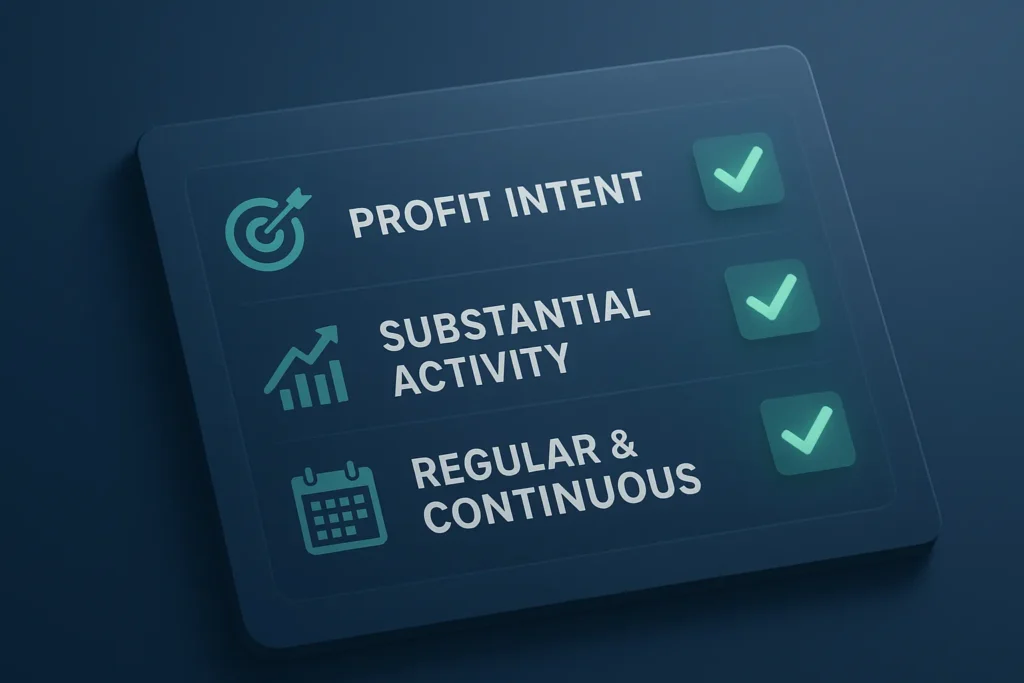
1. Profit Intent (The “Why”)
You must “seek to profit from daily market movements in the prices of securities and not from dividends, interest, or capital appreciation”. For most day traders, this is the easiest test to pass. Your goal is to get in and out, profiting from short-term volatility.
2. Substantial Activity (The “How Much”)
Your trading activity must be “substantial”. This is the fuzziest and most-litigated requirement. What does “substantial” mean? The IRS doesn’t say. A few trades a week won’t cut it. You have to be trading frequently, and in significant volume.
3. Regular and Continuous Activity (The “How Often”)
You must carry on the trading activity with “continuity and regularity”. This means trading can’t be a sporadic hobby. You must be trading (or actively researching and managing trades) on a near-daily basis throughout the year.
The “Vague Reality”: How Tax Courts Define the IRS Rules
So, if the IRS rules are vague, how do you actually know if you qualify?
We look to the people who really define the rules: the U.S. Tax Court. Over the years, court cases have given us a set of real-world guidelines. While not “law,” these are the numbers the IRS and CPAs use to determine if a claim for TTS is legitimate.

What We Learned from Poppe v. Commissioner
A key 2015 case, Poppe v. Commissioner, provides some of the clearest benchmarks we have. The court found the taxpayer did qualify for TTS, and here’s what his activity looked like:
- He devoted four to five hours per day to his trading business.
- He executed 60 trades per month.
- His trades were largely in stocks and options held for less than one month.
This case and others have established the “rules of thumb” that tax professionals rely on.
Volume Guideline: ~720+ Trades Per Year
The Poppe case sets a baseline of 720 trades per year (60/month). Other court cases have been more specific. Courts have ruled against traders with as few as 372 trades in a year, but for traders with over 1,100 trades.
- Our Team’s Take: We believe 720 trades (counting both buy and sell transactions) is the absolute minimum to be considered.
Frequency Guideline: Trading ~75% of Market Days
“Regular and continuous” means you can’t just trade when the market is hot. You need to be at your desk consistently. The general CPA guideline is that you should be executing trades on at least 75% of available market days.
Holding Period Guideline: Average Hold of 31 Days or Less
This goes back to the “profit intent” test. Your goal must be short-term profits. If your average holding period is 60 or 90 days, you look like an investor, not a trader. A guideline of 31 days or less is the common standard.
Time Guideline: 4+ Hours Per Day (Time Logs Are Key)
You have to prove this is a “business,” not something you do during your lunch break. Based on Poppe, spending at least 4 hours per day on your trading—which includes researching, backtesting, and managing positions, not just executing trades—is a strong indicator.
The Core Benefits of Qualifying for TTS
Let’s say you meet the guidelines. What do you actually get? The benefits are simple but powerful.
Benefit 1: Deducting Business Expenses (Schedule C)
This is the single biggest benefit of TTS. As a “business,” you can now deduct all your “ordinary and necessary” trading expenses. You do this by filing a Schedule C (Form 1040), “Profit or Loss from Business,” with your tax return.
These deductions lower your Adjusted Gross Income (AGI) and include:
- Software subscriptions (TradingView, Trade Ideas)
- Data fees (Level 2, news feeds)
- Computers, monitors, and equipment
- A home office deduction (if it’s your principal place of business)
- Trading books and education
- CPA and professional fees
See the full list in our Day Trading Tax Deductions Guide.
Benefit 2: Unlocking the Mark-to-Market (MTM) Election
This is the advanced move. TTS by itself does not solve your wash sale or $3,000 loss limit problems.
However, once you have TTS, you become eligible to make the powerful Section 475(f) Mark-to-Market (MTM) election. This election is what truly separates you from an investor by eliminating the wash sale rule and the capital loss limit.
What Disqualifies You? 4 Activities That DON’T Count
Here’s some real talk. In an audit, the IRS will look not just at what you did, but how you did it. Certain activities will almost certainly disqualify your claim for TTS.
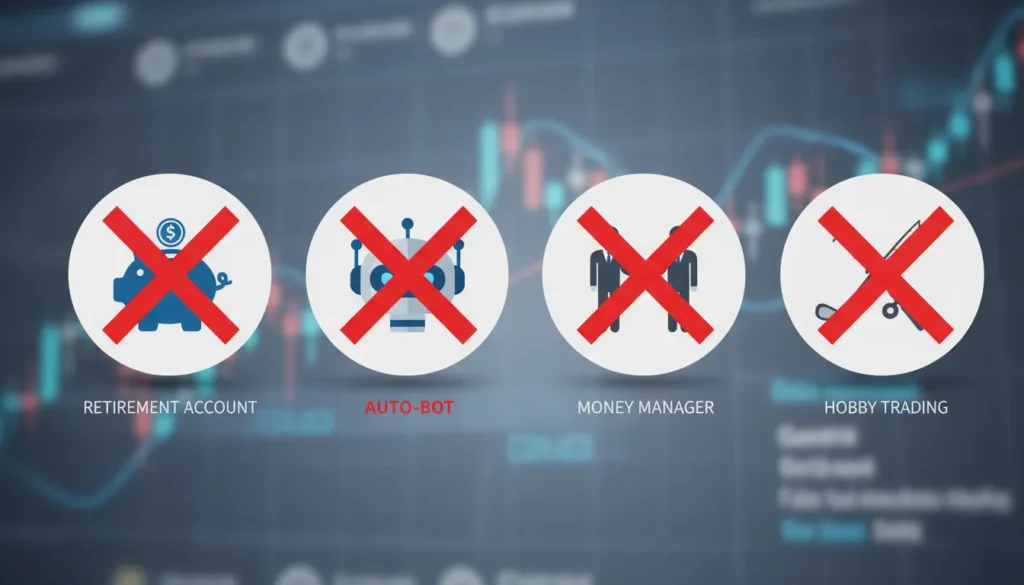
- Trading in a Retirement Account (IRA, 401k): Activity in a non-taxable retirement account does not count toward TTS qualification. TTS is a status for your taxable business, period.
- Using Automated “Black Box” Systems: If you simply buy an automated “bot” and let it run with “little trader involvement,” that’s not your business activity. You look like a passive investor in a fund.
- Hiring a Money Manager or Copy-Trading Service: The same logic applies. If you hire a money manager or just copy another trader’s signals, you are not engaged in the substantial, regular activity.
- Sporadic or Hobby Trading: This is the most common. Trading heavily in January, taking three months off, and then trading again in May is not “continuous and regular”. It’s a hobby.
Can You Qualify for TTS With a Full-Time Job?
This is one of the most common questions we get. The answer is: yes, but it is very difficult and you will face higher scrutiny.
The IRS will be skeptical. You must be able to prove—with meticulous records—that your trading activity alone independently meets all the tests. This means:
- You are still spending 4+ hours per day on trading.
- You are still executing 720+ trades per year.
- You are trading on 75%+ of market days.
If you have a demanding 9-to-5, proving this is nearly impossible. You can’t just trade for an hour after work. You must demonstrate a substantial business operation, which is why your time commitment is so critical.
How to Claim TTS (And Prepare for an Audit)
You don’t file a “Form for Trader Tax Status.” It’s not an election. You claim it by filing your taxes as a business.
This means you file a Schedule C to deduct your trading expenses. This action is your declaration to the IRS that you have met the qualification tests.
Because this is an “action” and not an “application,” it also means your claim could be challenged in an audit. Your only defense is your records.
- Trade Logs: You need a complete log of every trade, including date, time, shares, and holding period.
- Time Logs: This is your silver bullet. Keep a daily calendar or log of the hours you spend researching, trading, and managing your business.
- Expense Receipts: Keep a record of every single business expense you deduct.
Our Team’s Verdict: Is TTS Worth the Hassle?
After guiding many traders through this, our team’s view is pretty clear.

When TTS Doesn’t Make Sense
If you are a new trader, a part-time trader, or have a small account, don’t even think about TTS. The record-keeping burden is immense, and the benefits (deducting a few hundred in software) are not worth the audit risk. Focus on becoming profitable first. This is a foundational concept we cover in our beginner’s tax awareness guide.
When TTS is Non-Negotiable
If you are a full-time, professional trader, TTS is not optional. It is the bedrock of your business. It is the only way to professionally manage your tax liability, deduct your legitimate expenses, and unlock the advanced strategies—like the Mark-to-Market election—that the tax code provides for. It’s the first step you take before you even consider forming a trading LLC or S-Corp.
For the full picture of how TTS fits into a complete tax strategy, see our Ultimate Guide to Day Trading Taxes.
Frequently Asked Questions (FAQ) About Trader Tax Status
How many trades per day do you need for trader tax status?
Quick Answer: There is no official “per day” rule, but tax court guidelines suggest a minimum of ~720 trades per year, which averages to 3-4 trades per market day.
The IRS looks for “substantial” activity. Tax court cases, like Poppe v. Commissioner, have established guidelines. A trader who made 60 trades per month (about 720 per year) was approved. Conversely, courts have ruled against traders with as few as 372 trades in a year.
Key Takeaway: Focusing on a consistent annual volume of 720+ trades is a safer benchmark than a specific daily number.
Can I claim trader tax status and have a full-time job?
Quick Answer: Yes, but it’s very difficult and invites high IRS scrutiny.
You must be able to prove that your trading activity, separate from your job, meets the “substantial, regular, and continuous” tests. This means you must still be spending 4+ hours per day on trading, trading on 75%+ of market days, and executing a high volume of trades. This is extremely challenging to do while holding a full-time job.
Key Takeaway: You will need meticulous time logs and trade logs to defend your claim in an audit.
What is the difference between TTS and MTM?
Quick Answer: Trader Tax Status (TTS) is a status you qualify for, while Mark-to-Market (MTM) is a tax election you make.
TTS is the first step. You must qualify for TTS to be treated as a “business.” The main benefit of TTS alone is deducting expenses on a Schedule C. TTS does not fix your wash sale or $3,000 loss limit problems.
MTM (Section 475(f)) is an accounting method you can elect only after you have TTS. MTM is what solves the wash sale and capital loss limit issues.
Key Takeaway: TTS is the prerequisite; MTM is the optional (but powerful) upgrade.
Does an LLC give me trader tax status?
Quick Answer: No. Forming an LLC or S-Corp is a legal action and has no bearing on your tax status.
Trader Tax Status is determined only by your trading activity (volume, frequency, holding period), not by your legal structure. You can be a sole proprietor with TTS, and you can be an LLC that is still an “investor.”
Key Takeaway: You must qualify for TTS based on your trading first. Only then should you consider forming an LLC for liability protection or S-Corp for tax optimization.
How do I claim trader tax status on my tax return?
Quick Answer: You claim TTS by filing a Schedule C (Form 1040), “Profit or Loss from Business,” to report your trading-related business expenses.
There is no form to “apply” for TTS. You and your CPA determine if you meet the qualification guidelines. If you do, you then file your taxes as a business by attaching a Schedule C. This form is where you will list and deduct your software, home office, data feeds, and other expenses.
Key Takeaway: Filing a Schedule C is the act of claiming TTS, which is why it’s critical to have the records to back it up.
Can part-time traders qualify for TTS?
Quick Answer: It is very unlikely. The IRS tests for “substantial, regular, and continuous” activity, which implies a full-time endeavor.
A part-time trader who, for example, trades for an hour a day and has a low volume of trades will almost certainly fail the IRS tests. The guidelines from court cases (4+ hours/day, 720+ trades/year) point to a level of activity that is far beyond “part-time”.
Key Takeaway: TTS is designed for individuals whose primary business is trading, not for those who trade as a side activity.
Do I have to trade every day to qualify for TTS?
Quick Answer: Not literally every day, but you must be “regular and continuous.” The common CPA guideline is to trade on at least 75% of available market days.
The IRS test is “continuity and regularity”. Taking a two-week vacation is not a problem. However, trading heavily for one month and then taking two months off would be “sporadic” and would likely disqualify you.
Key Takeaway: The IRS wants to see that you are running a consistent business, not just trading opportunistically.
What records do I need to keep to prove trader tax status?
Quick Answer: You need meticulous records of your trades, your time, and your expenses.
In an audit, the burden of proof is on you. You will need:
Trade Logs: Detailed spreadsheets of every trade (buy/sell, date, shares, holding period) to prove volume and holding period.
Time Logs: A daily calendar or log detailing the hours spent on all trading activities (research, execution, review) to prove substantial and continuous time commitment.
Expense Records: Receipts and bank statements for every single deduction you claim on your Schedule C.
Key Takeaway: If you don’t have these records, you cannot defend your TTS claim in an audit.
Article Sources
- IRS.gov – Topic No. 429, Traders in Securities
- Bradford Tax Institute – William F. Poppe v. Commissioner (T.C. Memo. 2015-205)
- FustCharles – Learn How To Qualify for Tax-Favored Securities Trader Status
- Green Trader Tax – Trader Tax Status: How To Qualify
- IRS.gov – Instructions for Schedule C (Form 1040)
- IRS.gov – Topic No. 509, Business Use of Home
The DayTradingToolkit.com team, comprised of professional traders and fintech researchers, is committed to providing content built on a foundation of verifiable, high-authority sources. We rely on primary data from government agencies (like the SEC and BLS), academic research, financial white papers, and data from reputable financial institutions. All content is created to be objective, educational, and is fact-checked against these sources to ensure accuracy.


